REVIEW 3 major objections 4 minor 1 cited by
Learning Mamba as a Continual Learner: Meta-learning Selective State Space Models for Efficient Continual Learning
T0 review · 3 major / 4 minor · reviewed 2026-08-12 · deepseek-v4-flash
Pith's one-line read Mamba, a selective state space model with a fixed-size hidden state, can be meta-learned as a continual learner that matches or beats Transformers at lower memory and compute.
desk verdict A credible empirical case that Mamba works for MCL, held back by an under-specified regularizer and missing code. read the letter →
The pith
A machine-rendered reading of the paper's core claim, the machinery that carries it, and where it could break.
The reading
What carries the argument
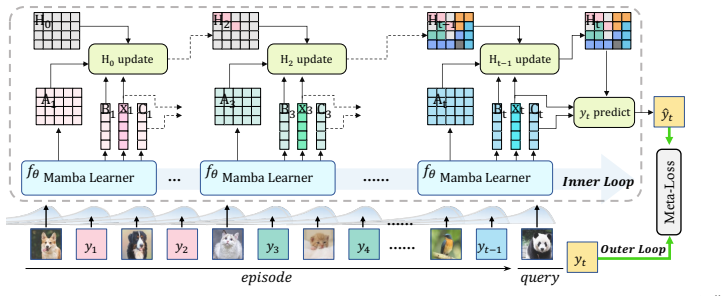
The central object is the associative indicator q^Mamba_{2t+1} = [C_{2t+1} B_j^T]_{j=1}^{2t}, built from Mamba's input-dependent output and input projection parameters C and B. It is used exactly like Transformer attention weights: a ground-truth indicator vector marks which past samples share the query's class, and a KL divergence steers Mamba's selectivity pattern toward it. This works because, under the duality identified between Mamba and linear attention, C_t plays the role of the query and B_j the role of a key, so C_t B_j^T encodes how much past token j should be retrieved when predicting at step t. The A_t recurrence that also shapes the hidden state is set aside in this proxy, and the fixed-size hidden state H_t itself is what gives Mamba its constant memory.
What would settle it
Compare the learned association maps of a model trained with the paper's regularizer against a version trained with a full-path regularizer that accumulates each past token's influence through the actual recurrence by summing over all paths the product of intervening A matrices times C_t B_j^T (computed by auto-differentiation or by ablating individual B_j). If the two maps disagree sharply, or if the proxy-regularized model cannot predict which individual past token most changes the output (test by zeroing each B_j in turn and measuring the output change), the proxy assumption fails.
Extended reading notes
Core claim
The central claim is that selective state space models can serve as effective meta-continual learners once they are properly formulated and regularized. Concretely, the paper treats each class-incremental episode as a token sequence (x1, y1, ..., xt, yt, xtest) -> ytest, meta-learns a Mamba model over many such episodes, and introduces a selectivity regularization loss that forces the model's input-dependent SSM parameters to associate each query with the samples of the same class. The regularizer works by identifying the cross-products C_t B_j^T of Mamba's selective parameters with the query-key products of linear attention, which in turn approximate softmax attention; the KL divergence between this association pattern and the ground-truth same-class indicator stabilizes meta-training, which otherwise fails to converge for Mamba. Across general, fine-grained, and domain-shifted image classification plus regression tasks, the meta-learned Mamba matches or beats a vanilla Transformer on meta-test accuracy while using a fixed-size hidden state, and degrades far less than Transformers when meta-test episodes are longer, noisier, or from a held-out domain.
Load-bearing premise
The load-bearing assumption is that the cross-products C_t B_j^T of Mamba's input-dependent SSM parameters faithfully represent how much Mamba actually retrieves each past token, even though the recurrent A_t matrices that multiply earlier B_j values are dropped from the regularization; if that proxy is unfaithful, the selectivity regularizer may teach the wrong association pattern and the reported gains may not transfer to other MCL definitions or architectures.
Editorial extensions
If this is right
- MambaCL matches or exceeds Transformer meta-test accuracy on general, fine-grained, and domain-shift benchmarks while keeping a fixed-size state, removing the memory growth that conflicts with continual learning's goal of not storing all seen samples.
- It generalizes to meta-test episodes with ten times as many shots as training (50 versus 5) with only about a 10% accuracy drop, while Transformer and Linear Transformer degrade sharply at untrained episode lengths.
- Under Gaussian input noise up to σ = 10, Mamba's accuracy remains far more stable than Transformer's, and on the DomainNet held-out-domain test it reaches 55.6% on quickdraw versus 50.2% for Transformer.
- The selectivity regularizer is necessary for Mamba to converge at all: without it the meta-training loss oscillates and stops decreasing, while varying the regularization weight λ across 0.1 to 2.0 leaves results stable.
- The efficiency claim is concrete: MambaCL uses 5.4M parameters and runs 858 episodes per second versus the Transformer's 9.2M parameters and 325 episodes per second, at comparable or better accuracy.
Reading between the lines
- If the C_t B_j^T proxy is faithful, the same KL-regularizer recipe should extend to any recurrent or linear-attention model whose state update can be written as an outer-product accumulation; testing it on other recurrent architectures with fixed-size states would show whether Mamba's advantage is specific to selective SSMs or a general property of recurrent compression.
- The strong length generalization suggests that a meta-learned recurrent learner may be inherently less prone to positional overfitting than attention models, because it must represent content in a capacity-limited state; this predicts that MambaCL should also transfer to streaming settings with unpredictable task boundaries, which the paper does not test.
- The random-token vocabulary trick, where class identities are arbitrary symbols within each episode, means the learner is effectively trained to handle any label permutation; a natural extension the paper does not explore is using MambaCL as a task-agnostic few-shot classifier on streams where the label set changes by example rather than by task.
- The paper's stated limitations leave offline CL and larger-scale datasets unexplored; one concrete implication of the results is that Mamba's fixed-state compression could bring replay-free offline CL within reach if the selectivity regularizer transfers to multi-epoch streams.
Signed reviews
Editorial analysis
A structured set of objections, weighed in public.
Referee Report
Summary. The paper proposes MambaCL, a meta-continual-learning method that trains a selective state-space model (Mamba) as a sequence-prediction continual learner with a fixed-size hidden state. To stabilize meta-training, the authors introduce a selectivity regularizer that encourages Mamba's C_t B_j^T scores to match ground-truth same-class association patterns, drawing an analogy between Mamba and linear/softmax attention. Extensive experiments on general image classification, fine-grained recognition, domain shift, regression, and length/noise generalization settings compare Mamba with Transformers, Linear Transformers, Performer, and OML, reporting that Mamba matches or exceeds Transformer performance at lower parameter count and higher inference speed. The paper also includes ablations on regularization strength, state size, architecture variants, and learning rate.
Significance. If the empirical claims hold, the paper is a useful demonstration that attention-free SSMs with fixed-size hidden states can be competitive with Transformers in meta-continual learning, and the length/domain/noise generalization studies are valuable for the MCL community. The paper's strengths include extensive tables with means and standard deviations, several ablation families, and the explicit convergence comparison with and without the regularizer in Fig. 6. However, the load-bearing selectivity regularizer is under-specified as a loss, and its Mamba association proxy ignores the A_t recurrence; these issues make the method description and the mechanistic interpretation currently unsupported, so the significance is conditional on resolving them.
major comments (3)
- [§3.2.2 and Appendix C.1 (Fig. 6)] The selectivity regularizer is not a well-defined loss as written. The paper defines ℓ_slct((x,y)) = KL(p_idx, q*_idx), where p is an unnormalized indicator vector in {0,1}^{2t} and q is, for Transformers, an unnormalized softmax score vector (the text explicitly says normalization is omitted) and, for Mamba, the raw real-valued inner-product vector [C_{2t+1}B_j^T]. KL divergence is undefined for such inputs, so the reader cannot tell what objective is actually minimized. This is not a cosmetic issue because Fig. 6 shows that Mamba does not converge without ℓ_slct, making the regularizer load-bearing. Please specify the exact computation: the normalization/softmax procedure over which positions, the handling of zero entries in p, which Mamba layer(s) provide C and B, and whether the same convention is used for the Transformer, Linear Transformer, and Performer baselines.
- [§3.2.2 and Eq. (3)] The association proxy qMamba = [C_{2t+1}B_j^T] omits the A_t factors in the state recurrence. Unrolling Eq. (3), the contribution of token z_j to the output at step 2t+1 is C_{2t+1}(A_{2t+1}A_{2t}...A_{j+1})B_j z_j, so C_{2t+1}B_j^T equals the true retrieval weight only if all A_l are identities, which contradicts the selectivity/gating role of A in Mamba and the paper's own description in §3.1. Since Appendix C.1 makes the regularizer necessary for convergence, the method may be training Mamba to align a surrogate association pattern that its hidden state does not actually implement; the visualizations in Appendix D inherit this issue. I request a validation of the proxy (for example, comparing C_tB_j^T with the A-inclusive influence or with the actual gradient contribution on a trained model, or ablating against an A-aware weighting). Without such validation, the mechanistic interpretation and the generalization claims tied to Mamba's selectivity are not established.
- [§4.3, Table 6, and Tables 1–5] The main results are not clearly tied to a specific Mamba architecture version. In Table 6, the row labeled Mamba-1 reports 59.7±0.5 on Cifar-100 and 90.1±0.3 on ImageNet-1K, while the row labeled Mamba-2 reports 67.1±0.4 and 93.6±0.2; the 'Mamba' entries in Table 2 (67.1±0.4 on Cifar-100 and 93.6±0.2 on ImageNet-1K) match the Mamba-2 row exactly. The body text, however, describes a Mamba block with 1-D convolution and Table 8 lists a convolution kernel size of 4, which reads like Mamba-1, and the version used for the main tables is never stated explicitly. Please state which architecture all reported results correspond to and adjust the method description and configuration table accordingly.
minor comments (4)
- [§3.2.2] The indexing in the definition of p_{2t+1} is inconsistent: the token at step 2t+1 is x_{t+1}, so its label is y_{t+1}, not y_{2t+1}; please fix the notation.
- [Appendix D] The captions of Figs. 10–15 describe the plots as showing Mamba's 'associations,' but the quantities plotted are the C_tB_j^T surrogate whose validity is questioned in Major Comment 2; the captions should acknowledge this.
- [Table 8] The row label 'Delta Convolution 4' is unclear; if this denotes the convolution kernel size or dilation used in the Mamba block, please state the terminology precisely.
- [§4.1 and Tables 1–5] The tables indicate that best and second-best results are highlighted in red and blue, but the text-only rendering does not show these colors; please ensure the final formatted version is unambiguous.
Circularity Check
One minor self-referential element: the paper visualizes the exact association score that the selectivity regularizer is trained to align, but the central empirical comparisons against external benchmarks are independent.
-
other
[Sec. 3.2.2 (selectivity regularization) and Appendix D.1 (visualization of attention and selectivity)]
"Relying on the linear attention as the bridge, we can obtain the associative indicators of Mamba as qMamba_{2t+1}=[C_{2t+1}B^⊤_j]^{2t}_{j=1}. To regularize the models' selection behavior in meta-training, for a query sample (x,y) in a sequence, we apply a selectivity regularization: ℓslct((x,y)) = KL(pidx((x,y)), q∗_{idx((x,y))}). ... Note that Mamba does not have explicit attention weights, we compute the scores relying on the connection between Mamba and Transformers described in 3.2.2 ... Specifically, we computed the parameters C_test and B (C_testB^⊤) within its SSMs."
The selectivity regularizer directly trains q = C_tB_j^T to match the ground-truth same-class indicator p via a KL loss. The same score C_testB^⊤ is then reported in Appendix D as evidence that Mamba effectively associates with relevant shots and exhibits selective behavior. The visualized association pattern is therefore not an emergent, independently measured property of the meta-learned model; it is the quantity that the training objective explicitly encouraged. This makes the mechanistic interpretation partially self-referential. However, the accuracy results in Tables 1-5 are external benchmark evaluations, and the visualization is not required to compute them, so the central empirical claims remain independent.
full rationale
The paper's main contribution is an empirical study of Mamba as a meta-continual learner, evaluated with held-out accuracy on standard benchmarks such as Cifar-100, ImageNet-1K, fine-grained datasets, DomainNet, and regression tasks. These results are not derived from the paper's own assumptions; they are comparisons against external baselines and held-out test sets. The selectivity regularizer is an auxiliary training loss, and removing it changes convergence as shown in Appendix C.1, but the final performance numbers still measure generalization to unseen episodes rather than the regularizer's target. The only self-referential element that can be pinned to specific text is the use of the regularized association score C_tB_j^T as evidence of Mamba's associative selectivity in the visualization analyses in Appendix D. Since this score is exactly what ℓslct is trained to align with same-class indicators, observing that it aligns is partly by construction; nevertheless, the visualizations are on meta-testing episodes with unseen classes and longer lengths, so they retain some generalization content. I do not find load-bearing self-citation, uniqueness arguments imported from the authors, or renamed known results. The concern that the proxy C_tB_j^T omits the recurrent A_t factors is an assumption-validity issue about the regularizer's fidelity, not circularity. Overall, a minor self-referential analysis accompanies an otherwise independent empirical derivation, so the circularity score is 2.
Assumptions & free parameters
free parameters (4)
- selectivity regularization weight λ =
0.5
- SSM state size =
128
- initial learning rate =
1e-4
- target vocabulary size =
200
assumptions (3)
- domain assumption The linear-attention duality between selective SSMs and linear attention (Dao and Gu, 2024) is valid for Mamba's trained parameters in MCL.
- ad hoc to paper C_t B_j^T, without the A_t decay factors, is a sufficient association proxy for selective SSM behavior.
- domain assumption Pre-trained frozen CLIP-ViT-B16 features are an adequate representation for evaluating continual learning behavior.
Cite this review
Pith. "Pith review of Learning Mamba as a Continual Learner: Meta-learning Selective State Space Models for Efficient Continual Learning." pith.science (2026). https://pith.science/paper/UY4KWLYE
@misc{pith2026241200776,
  author       = {Pith},
  title        = {Pith review of: Learning Mamba as a Continual Learner: Meta-learning Selective State Space Models for Efficient Continual Learning},
  year         = {2026},
  howpublished = {\url{https://pith.science/paper/UY4KWLYE}},
  note         = {Machine review of arXiv:2412.00776}
}
read the original abstract
Continual learning (CL) aims to efficiently learn from a non-stationary data stream, without storing or recomputing all seen samples. CL enables prediction on new tasks by incorporating sequential training samples. Building on this connection between CL and sequential modeling, meta-continual learning (MCL) aims to meta-learn an efficient continual learner as a sequence prediction model, with advanced sequence models like Transformers being natural choices. However, despite decent performance, Transformers rely on a linearly growing cache to store all past representations, conflicting with CL's objective of not storing all seen samples and limiting efficiency. In this paper, we focus on meta-learning sequence-prediction-based continual learners without retaining all past representations. While attention-free models with fixed-size hidden states (e.g., Linear Transformers) align with CL's essential goal and efficiency needs, they have shown limited effectiveness in MCL in previous literature. Given Mamba's strong sequence modeling performance and attention-free nature, we explore a key question: Can attention-free models like Mamba perform well on MCL? By formulating Mamba and the SSM for MCL tasks, we propose MambaCL, a meta-learned continual learner. To enhance MambaCL's training, we introduce selectivity regularization, leveraging the connection between Mamba and Transformers to guide its behavior over sequences. Furthermore, we study how Mamba and other models perform across various MCL scenarios through extensive and well-designed experiments. Our results highlight the promising performance and strong generalization of Mamba and attention-free models in MCL, demonstrating its potential for efficient continual learning and adaptation.
Figures


Figures from the paper (11 more)


Forward citations
Cited by 1 Pith paper
-
Little by Little: Continual Learning via Incremental Mixture of Rank-1 Associative Memory Experts
MoRAM learns continually by adding small rank-1 adapters that act as associative memory items, using input-key similarity to retrieve and mix only the relevant adapters at test time.
Reference graph
Works this paper leans on
-
[1]
Memory aware synapses: Learning what (not) to forget
Rahaf Aljundi, Francesca Babiloni, Mohamed Elhoseiny, Marcus Rohrbach, and Tinne Tuyte- laars. Memory aware synapses: Learning what (not) to forget. In Proceedings of the European conference on computer vision (ECCV), pages 139–154, 2018
work page 2018
-
[2]
Shawn Beaulieu, Lapo Frati, Thomas Miconi, Joel Lehman, Kenneth O Stanley, Jeff Clune, and Nick Cheney. Learning to continually learn. arXiv preprint arXiv:2002.09571, 2020
arXiv 2002
-
[3]
Transformers for supervised online continual learning
Jorg Bornschein, Yazhe Li, and Amal Rannen-Triki. Transformers for supervised online continual learning. arXiv preprint arXiv:2403.01554, 2024
arXiv 2024
-
[4]
Class-incremental continual learning into the extended der-verse
Matteo Boschini, Lorenzo Bonicelli, Pietro Buzzega, Angelo Porrello, and Simone Calderara. Class-incremental continual learning into the extended der-verse. IEEE transactions on pattern analysis and machine intelligence, 45(5):5497–5512, 2022
work page 2022
-
[5]
Language models are few-shot learners
Tom Brown, Benjamin Mann, Nick Ryder, Melanie Subbiah, Jared D Kaplan, Prafulla Dhariwal, Arvind Neelakantan, Pranav Shyam, Girish Sastry, Amanda Askell, et al. Language models are few-shot learners. Advances in neural information processing systems, 33:1877–1901, 2020
1901
-
[6]
Dark experience for general continual learning: a strong, simple baseline
Pietro Buzzega, Matteo Boschini, Angelo Porrello, Davide Abati, and Simone Calderara. Dark experience for general continual learning: a strong, simple baseline. Advances in neural information processing systems, 33:15920–15930, 2020
2020
-
[7]
On tiny episodic memories in continual learning
Arslan Chaudhry, Marcus Rohrbach, Mohamed Elhoseiny, Thalaiyasingam Ajanthan, Puneet K Dokania, Philip HS Torr, and Marc’Aurelio Ranzato. On tiny episodic memories in continual learning. arXiv preprint arXiv:1902.10486, 2019
arXiv 1902
-
[8]
Rethinking attention with performers
Krzysztof Choromanski, Valerii Likhosherstov, David Dohan, Xingyou Song, Andreea Gane, Tamas Sarlos, Peter Hawkins, Jared Davis, Afroz Mohiuddin, Lukasz Kaiser, et al. Rethinking attention with performers. arXiv preprint arXiv:2009.14794, 2020
arXiv 2009
Show all 74 references
-
[9]
Transformers are ssms: Generalized models and efficient algorithms through structured state space duality
Tri Dao and Albert Gu. Transformers are ssms: Generalized models and efficient algorithms through structured state space duality. arXiv preprint arXiv:2405.21060, 2024
2024 arXiv
-
[10]
Novel datasets for fine-grained image categorization
E Dataset. Novel datasets for fine-grained image categorization. First Workshop on Fine Grained Visual Categorization, CVPR. Citeseer. Citeseer. Citeseer, 5(1):2, 2011
2011
-
[11]
A continual learning survey: Defying forgetting in classification tasks
Matthias De Lange, Rahaf Aljundi, Marc Masana, Sarah Parisot, Xu Jia, Aleš Leonardis, Gregory Slabaugh, and Tinne Tuytelaars. A continual learning survey: Defying forgetting in classification tasks. IEEE transactions on pattern analysis and machine intelligence , 44(7): 3366–3...
2021
-
[12]
Bert: Pre-training of deep bidirectional transformers for language understanding
Jacob Devlin, Ming-Wei Chang, Kenton Lee, and Kristina Toutanova. Bert: Pre-training of deep bidirectional transformers for language understanding. arXiv preprint arXiv:1810.04805, 2019
2019 arXiv
-
[13]
Switch transformers: Scaling to trillion parameter models with simple and efficient sparsity
William Fedus, Barret Zoph, and Noam Shazeer. Switch transformers: Scaling to trillion parameter models with simple and efficient sparsity. Journal of Machine Learning Research, 23 (120):1–39, 2022
2022
-
[14]
Model-agnostic meta-learning for fast adap- tation of deep networks
Chelsea Finn, Pieter Abbeel, and Sergey Levine. Model-agnostic meta-learning for fast adap- tation of deep networks. In International conference on machine learning, pages 1126–1135. PMLR, 2017
2017
-
[15]
The pile: An 800gb dataset of diverse text for language modeling
Leo Gao, Stella Biderman, Sid Black, Laurence Golding, Travis Hoppe, Charles Foster, Jason Phang, Horace He, Anish Thite, Noa Nabeshima, et al. The pile: An 800gb dataset of diverse text for language modeling. arXiv preprint arXiv:2101.00027, 2020
2020 arXiv
-
[16]
Mamba: Linear-time sequence modeling with selective state spaces
Albert Gu and Tri Dao. Mamba: Linear-time sequence modeling with selective state spaces. arXiv preprint arXiv:2312.00752, 2023
2023 arXiv
-
[17]
Efficiently modeling long sequences with structured state spaces
Albert Gu, Karan Goel, and Christopher Ré. Efficiently modeling long sequences with structured state spaces. arXiv preprint arXiv:2111.00396, 2021. 10
2021 arXiv
-
[18]
Combining recurrent, convolutional, and continuous-time models with linear state space layers
Albert Gu, Isys Johnson, Karan Goel, Khaled Saab, Tri Dao, Atri Rudra, and Christopher Ré. Combining recurrent, convolutional, and continuous-time models with linear state space layers. Advances in neural information processing systems, 34:572–585, 2021
2021
-
[19]
Ms-celeb-1m: A dataset and benchmark for large-scale face recognition
Yandong Guo, Lei Zhang, Yuxiao Hu, Xiaodong He, and Jianfeng Gao. Ms-celeb-1m: A dataset and benchmark for large-scale face recognition. In Computer Vision–ECCV 2016: 14th European Conference, Amsterdam, The Netherlands, October 11-14, 2016, Proceedings, Part III 14, pages 87–...
2016
-
[20]
Dealing with cross-task class discrimination in online continual learning
Yiduo Guo, Bing Liu, and Dongyan Zhao. Dealing with cross-task class discrimination in online continual learning. In Proceedings of the IEEE/CVF conference on computer vision and pattern recognition, pages 11878–11887, 2023
2023
-
[21]
Look-ahead meta learning for continual learning
Gunshi Gupta, Karmesh Yadav, and Liam Paull. Look-ahead meta learning for continual learning. Advances in Neural Information Processing Systems, 33:11588–11598, 2020
2020
-
[22]
Demystify mamba in vision: A linear attention perspective
Dongchen Han, Ziyi Wang, Zhuofan Xia, Yizeng Han, Yifan Pu, Chunjiang Ge, Jun Song, Shiji Song, Bo Zheng, and Gao Huang. Demystify mamba in vision: A linear attention perspective. arXiv preprint arXiv:2405.16605, 2024
2024 arXiv
-
[23]
Remind your neural network to prevent catastrophic forgetting
Tyler L Hayes, Kushal Kafle, Robik Shrestha, Manoj Acharya, and Christopher Kanan. Remind your neural network to prevent catastrophic forgetting. In European conference on computer vision, pages 466–483. Springer, 2020
2020
-
[24]
Openclip, 2021
Gabriel Ilharco, Mitchell Wortsman, Ross Wightman, Cade Gordon, Nicholas Carlini, Rohan Taori, Achal Dave, Vaishaal Shankar, Hongseok Namkoong, John Miller, Hannaneh Hajishirzi, Ali Farhadi, and Ludwig Schmidt. Openclip, 2021
2021
-
[25]
Meta-learning representations for continual learning
Khurram Javed and Martha White. Meta-learning representations for continual learning. Ad- vances in neural information processing systems, 32, 2019
2019
-
[26]
A new approach to linear filtering and prediction problems
Rudolph Emil Kalman. A new approach to linear filtering and prediction problems. Journal of Basic Engineering, 1960
1960
-
[27]
Transformers are rnns: Fast autoregressive transformers with linear attention
Angelos Katharopoulos, Apoorv Vyas, Nikolaos Pappas, and François Fleuret. Transformers are rnns: Fast autoregressive transformers with linear attention. In International conference on machine learning, pages 5156–5165. PMLR, 2020
2020
-
[28]
Overcoming catastrophic forgetting in neural networks
James Kirkpatrick, Razvan Pascanu, Neil Rabinowitz, Joel Veness, Guillaume Desjardins, Andrei A Rusu, Kieran Milan, John Quan, Tiago Ramalho, Agnieszka Grabska-Barwinska, et al. Overcoming catastrophic forgetting in neural networks. Proceedings of the national academy of scien...
2017
-
[29]
3d object representations for fine- grained categorization
Jonathan Krause, Michael Stark, Jia Deng, and Li Fei-Fei. 3d object representations for fine- grained categorization. In Proceedings of the IEEE international conference on computer vision workshops, pages 554–561, 2013
2013
-
[30]
Learning multiple layers of features from tiny images
Alex Krizhevsky and Geoffrey Hinton. Learning multiple layers of features from tiny images. Technical report, University of Toronto, 2009
2009
-
[31]
Human-level concept learning through probabilistic program induction
Brenden M Lake, Ruslan Salakhutdinov, and Joshua B Tenenbaum. Human-level concept learning through probabilistic program induction. Science, 350(6266):1332–1338, 2015
2015
-
[32]
Recasting continual learning as sequence mod- eling
Soochan Lee, Jaehyeon Son, and Gunhee Kim. Recasting continual learning as sequence mod- eling. In Proceedings of the 37th International Conference on Neural Information Processing Systems, pages 70433–70452, 2023
2023
-
[33]
Learn to grow: A continual structure learning framework for overcoming catastrophic forgetting
Xilai Li, Yingbo Zhou, Tianfu Wu, Richard Socher, and Caiming Xiong. Learn to grow: A continual structure learning framework for overcoming catastrophic forgetting. In International conference on machine learning, pages 3925–3934. PMLR, 2019
2019
-
[34]
Learning without forgetting
Zhizhong Li and Derek Hoiem. Learning without forgetting. IEEE transactions on pattern analysis and machine intelligence, 40(12):2935–2947, 2017. 11
2017
-
[35]
Jamba: A hybrid transformer-mamba language model
Opher Lieber, Barak Lenz, Hofit Bata, Gal Cohen, Jhonathan Osin, Itay Dalmedigos, Erez Safahi, Shaked Meirom, Yonatan Belinkov, Shai Shalev-Shwartz, et al. Jamba: A hybrid transformer-mamba language model. arXiv preprint arXiv:2403.19887, 2024
2024 arXiv
-
[36]
Casia online and offline chinese handwriting databases
Cheng-Lin Liu, Fei Yin, Da-Han Wang, and Qiu-Feng Wang. Casia online and offline chinese handwriting databases. In Proceedings of the 2011 International Conference on Document Analysis and Recognition, pages 37–41, 2011
2011
-
[37]
Gradient episodic memory for continual learning
David Lopez-Paz and Marc’Aurelio Ranzato. Gradient episodic memory for continual learning. Advances in neural information processing systems, 30, 2017
2017
-
[38]
Adaptive rank, reduced forgetting: Knowledge retention in continual learning vision-language models with dynamic rank-selective lora
Haodong Lu, Chongyang Zhao, Jason Xue, Lina Yao, Kristen Moore, and Dong Gong. Adaptive rank, reduced forgetting: Knowledge retention in continual learning vision-language models with dynamic rank-selective lora. arXiv preprint arXiv:2412.01004, 2024
2024 arXiv
-
[39]
Supervised contrastive replay: Revisiting the nearest class mean classifier in online class-incremental continual learning
Zheda Mai, Ruiwen Li, Hyunwoo Kim, and Scott Sanner. Supervised contrastive replay: Revisiting the nearest class mean classifier in online class-incremental continual learning. In Proceedings of the IEEE/CVF conference on computer vision and pattern recognition, pages 3589–3599, 2021
2021
-
[40]
Fine- grained visual classification of aircraft
Subhransu Maji, Esa Rahtu, Juho Kannala, Matthew Blaschko, and Andrea Vedaldi. Fine- grained visual classification of aircraft. arXiv preprint arXiv:1306.5151, 2013
2013 arXiv
-
[41]
Metaicl: Learning to learn in context
Sewon Min, Mike Lewis, Luke Zettlemoyer, and Hannaneh Hajishirzi. Metaicl: Learning to learn in context. arXiv preprint arXiv:2110.15943, 2021
2021 arXiv
-
[42]
Continual learning using a kernel-based method over foundation models
Saleh Momeni, Sahisnu Mazumder, and Bing Liu. Continual learning using a kernel-based method over foundation models. In Proceedings of the AAAI Conference on Artificial Intelli- gence, pages 19528–19536, 2025
2025
-
[43]
Variational continual learning
Cuong V Nguyen, Yingzhen Li, Thang D Bui, and Richard E Turner. Variational continual learning. arXiv preprint arXiv:1710.10628, 2017
2017 arXiv
-
[44]
Continual learning via local module composition
Oleksiy Ostapenko, Pau Rodriguez, Massimo Caccia, and Laurent Charlin. Continual learning via local module composition. Advances in Neural Information Processing Systems, 34:30298– 30312, 2021
2021
-
[45]
Can mamba learn how to learn? a comparative study on in-context learning tasks
Jongho Park, Jaeseung Park, Zheyang Xiong, Nayoung Lee, Jaewoong Cho, Samet Oymak, Kangwook Lee, and Dimitris Papailiopoulos. Can mamba learn how to learn? a comparative study on in-context learning tasks. arXiv preprint arXiv:2402.04248, 2024
2024 arXiv
-
[46]
Moment matching for multi-source domain adaptation
Xingchao Peng, Qinxun Bai, Xide Xia, Zijun Huang, Kate Saenko, and Bo Wang. Moment matching for multi-source domain adaptation. In Proceedings of the IEEE/CVF international conference on computer vision, pages 1406–1415, 2019
2019
-
[47]
Moe-mamba: Efficient selective state space models with mixture of experts
Maciej Pioro, Kamil Ciebiera, Krystian Krol, Jan Ludziejewski, and Sebastian Jaszczur. Moe-mamba: Efficient selective state space models with mixture of experts. arXiv preprint arXiv:2401.04081, 2024
2024 arXiv
-
[48]
Learning transferable visual models from natural language supervision
Alec Radford, Jong Wook Kim, Chris Hallacy, Aditya Ramesh, Gabriel Goh, Sandhini Agarwal, Girish Sastry, Amanda Askell, Pamela Mishkin, Jack Clark, et al. Learning transferable visual models from natural language supervision. In International conference on machine learning, pa...
2021
-
[49]
icarl: Incremental classifier and representation learning
Sylvestre-Alvise Rebuffi, Alexander Kolesnikov, Georg Sperl, and Christoph H Lampert. icarl: Incremental classifier and representation learning. In Proceedings of the IEEE conference on Computer Vision and Pattern Recognition, pages 2001–2010, 2017
2001
-
[50]
Learning to learn without forgetting by maximizing transfer and minimizing interference
Matthew Riemer, Ignacio Cases, Robert Ajemian, Miao Liu, Irina Rish, Yuhai Tu, and Ger- ald Tesauro. Learning to learn without forgetting by maximizing transfer and minimizing interference. arXiv preprint arXiv:1810.11910, 2018
-
[51]
Scalable rec- ollections for continual lifelong learning
Matthew Riemer, Tim Klinger, Djallel Bouneffouf, and Michele Franceschini. Scalable rec- ollections for continual lifelong learning. Proceedings of the AAAI conference on artificial intelligence, 33(01):1352–1359, 2019. 12
2019
-
[52]
Complementary learning for overcoming catastrophic forgetting using experience replay
Mohammad Rostami, Soheil Kolouri, and Praveen K Pilly. Complementary learning for overcoming catastrophic forgetting using experience replay. arXiv preprint arXiv:1903.04566, 2019
1903 arXiv
-
[53]
Imagenet large scale visual recognition challenge
Olga Russakovsky, Jia Deng, Hao Su, Jonathan Krause, Sanjeev Satheesh, Sean Ma, Zhiheng Huang, Andrej Karpathy, Aditya Khosla, Michael Bernstein, et al. Imagenet large scale visual recognition challenge. International journal of computer vision, 115:211–252, 2015
2015
-
[54]
Neural machine translation of rare words with subword units
Rico Sennrich. Neural machine translation of rare words with subword units. arXiv preprint arXiv:1508.07909, 2015
2015 arXiv
-
[55]
Learning equi-angular representations for online continual learning
Minhyuk Seo, Hyunseo Koh, Wonje Jeung, Minjae Lee, San Kim, Hankook Lee, Sungjun Cho, Sungik Choi, Hyunwoo Kim, and Jonghyun Choi. Learning equi-angular representations for online continual learning. In Proceedings of the IEEE/CVF Conference on Computer Vision and Pattern Reco...
2024
-
[56]
Overcoming catastrophic forgetting with hard attention to the task
Joan Serra, Didac Suris, Marius Miron, and Alexandros Karatzoglou. Overcoming catastrophic forgetting with hard attention to the task. In International conference on machine learning, pages 4548–4557. PMLR, 2018
2018
-
[57]
Continual learning with deep generative replay
Hanul Shin, Jung Kwon Lee, Jaehong Kim, and Jiwon Kim. Continual learning with deep generative replay. Advances in neural information processing systems, 30, 2017
2017
-
[58]
When meta-learning meets online and continual learning: A survey
Jaehyeon Son, Soochan Lee, and Gunhee Kim. When meta-learning meets online and continual learning: A survey. IEEE Transactions on Pattern Analysis and Machine Intelligence, 2024
2024
-
[59]
Efficient transformers: A survey
Yi Tay, Mostafa Dehghani, Dara Bahri, and Donald Metzler. Efficient transformers: A survey. arXiv preprint cs.LG/2009.06732, 2020
2009 arXiv
-
[60]
Efficient transformers: A survey
Yi Tay, Mostafa Dehghani, Dara Bahri, and Donald Metzler. Efficient transformers: A survey. ACM Computing Surveys, 55(6):1–28, 2022
2022
-
[61]
Llama: Open and efficient foundation language models
Hugo Touvron, Thibaut Lavril, Gautier Izacard, Xavier Martinet, Marie-Anne Lachaux, Timo- thée Lacroix, Baptiste Rozière, Naman Goyal, Eric Hambro, Faisal Azhar, et al. Llama: Open and efficient foundation language models. arXiv preprint arXiv:2302.13971, 2023
2023 arXiv
-
[62]
The caltech-ucsd birds-200-2011 dataset
Catherine Wah, Steve Branson, Peter Welinder, Pietro Perona, and Serge Belongie. The caltech-ucsd birds-200-2011 dataset. Technical report, California Institute of Technology, 2011
2011
-
[63]
Self-expansion of pre-trained models with mixture of adapters for continual learning
Huiyi Wang, Haodong Lu, Lina Yao, and Dong Gong. Self-expansion of pre-trained models with mixture of adapters for continual learning. arXiv preprint arXiv:2403.18886, 2024
2024 arXiv
-
[64]
A comprehensive survey of continual learning: theory, method and application
Liyuan Wang, Xingxing Zhang, Hang Su, and Jun Zhu. A comprehensive survey of continual learning: theory, method and application. IEEE Transactions on Pattern Analysis and Machine Intelligence, 2024
2024
-
[65]
Attention is all you need
A Waswani, N Shazeer, N Parmar, J Uszkoreit, L Jones, A Gomez, L Kaiser, and I Polosukhin. Attention is all you need. Advances in Neural Information Processing Systems, 2017
2017
-
[66]
Meta continual learning revisited: Implicitly enhancing online hessian approximation via variance reduction
Yichen Wu, Long-Kai Huang, Renzhen Wang, Deyu Meng, and Ying Wei. Meta continual learning revisited: Implicitly enhancing online hessian approximation via variance reduction. In The Twelfth International Conference on Learning Representations, 2024
2024
-
[67]
Der: Dynamically expandable representation for class incremental learning
Shipeng Yan, Jiangwei Xie, and Xuming He. Der: Dynamically expandable representation for class incremental learning. In Proceedings of the IEEE/CVF conference on computer vision and pattern recognition, pages 3014–3023, 2021
2021
-
[68]
Self-evolved dynamic expansion model for task-free continual learning
Fei Ye and Adrian G Bors. Self-evolved dynamic expansion model for task-free continual learning. In Proceedings of the IEEE/CVF International Conference on Computer Vision, pages 22102–22112, 2023
2023
-
[69]
Lifelong learning with dynamically expandable networks
Jaehong Yoon, Eunho Yang, Jeongtae Lee, and Sung Ju Hwang. Lifelong learning with dynamically expandable networks. arXiv preprint arXiv:1708.01547, 2017. 13
2017 arXiv
-
[70]
Continual learning through synaptic intelligence
Friedemann Zenke, Ben Poole, and Surya Ganguli. Continual learning through synaptic intelligence. In International conference on machine learning, pages 3987–3995. PMLR, 2017
2017
-
[71]
Class-incremental learning via deep model consolidation
Junting Zhang, Jie Zhang, Shalini Ghosh, Dawei Li, Serafettin Tasci, Larry Heck, Heming Zhang, and C-C Jay Kuo. Class-incremental learning via deep model consolidation. In Proceedings of the IEEE/CVF winter conference on applications of computer vision , pages 1131–1140, 2020
2020
-
[72]
Motion mamba: Efficient and long sequence motion generation with hierarchical and bidirectional selective ssm
Zeyu Zhang, Akide Liu, Ian Reid, Richard Hartley, Bohan Zhuang, and Hao Tang. Motion mamba: Efficient and long sequence motion generation with hierarchical and bidirectional selective ssm. arXiv preprint arXiv:2403.07487, 2024
2024 arXiv
-
[73]
Deep class-incremental learning: A survey
Da-Wei Zhou, Qi-Wei Wang, Zhi-Hong Qi, Han-Jia Ye, De-Chuan Zhan, and Ziwei Liu. Deep class-incremental learning: A survey. arXiv preprint arXiv:2302.03648, 2023
2023 arXiv
-
[74]
Vision mamba: Efficient visual representation learning with bidirectional state space model
Lianghui Zhu, Bencheng Liao, Qian Zhang, Xinlong Wang, Wenyu Liu, and Xinggang Wang. Vision mamba: Efficient visual representation learning with bidirectional state space model. arXiv preprint arXiv:2401.09417, 2024. 14 A Datasets A.1 General Image Classification Tasks Cifar-1...
2024 arXiv
Reviewed August 12, 2026 · model on record in the stance chip above.
Discussion (0). Continue with ORCID to comment.