REVIEW 2 major objections 5 minor 37 references
Exponential and algebraic double-soliton solutions of the massive Thirring model
T0 review · 2 major / 5 minor · reviewed 2026-08-12 · deepseek-v4-flash
Pith's one-line read The algebraic double-soliton solutions of the massive Thirring model carry a double embedded eigenvalue at $\zeta=i$, confirming that multiple embedded eigenvalues occur in the model's Lax spectrum.
desk verdict Solid RH-construction paper whose headline spectral claim is slightly ahead of what is proved: the Jordan chain is there, but the 'exactly one eigenvector' part rests on an external lemma the paper does not reproduce. read the letter →
The pith
A machine-rendered reading of the paper's core claim, the machinery that carries it, and where it could break.
The reading
What carries the argument
The Riemann–Hilbert problem for the squared spectral parameter $\lambda=\zeta^2$ with reflectionless potential and a double pole at $\lambda_0=e^{i\gamma}\in\mathbb{C}^+$ is the central object. Residue and double-pole coefficients of the sectionally meromorphic matrix are computed from the scattering data and the symmetry $\lambda_0\to\bar\lambda_0$, producing a closed linear system whose Cramer's-rule solution gives explicit formulas for $u$ and $v$. The singular limit $\gamma\to\pi$ with rescaled translation parameters $\tilde x_0\to\tilde x_0\epsilon^2$ is the mechanism that converts the double isolated eigenvalue into the double embedded eigenvalue at $\zeta=i$, and the eigenvector and generalized eigenvector are obtained as suitably rescaled limits of $\psi^{(+)}_1(\zeta_0)$ and its derivative.
What would settle it
Compute the dimension of the $H^1$ solution space of $(\partial_x-L(u_{\rm alg},v_{\rm alg},i))\psi=0$ and the length of the Jordan chain at $\zeta=i$. If the kernel contains a second independent $H^1$ eigenvector, or if the generalized eigenvector equation has no $H^1$ solution with $\psi_0=O(|x|^{-2})$, then the double embedded eigenvalue claim fails; this can be checked by direct substitution of (2.20)–(2.21) into (2.18)–(2.19) or by numerically evaluating the Evans function on the imaginary axis.
Extended reading notes
Core claim
The central discovery is the explicit algebraic double-soliton solution (2.20)–(2.21) and the proof that its Lax spectrum has a double embedded eigenvalue at $\zeta=i$: one eigenvector $\psi_0\in H^1(\mathbb{R},\mathbb{C}^2)$ and one generalized eigenvector $\psi_1\in H^1(\mathbb{R},\mathbb{C}^2)$ satisfying (2.18)–(2.19) with $\zeta_0=i$. The paper obtains this by first constructing exponential double-solitons from a reflectionless Riemann–Hilbert problem with a quadruplet of double poles at $\lambda_0=e^{i\gamma}$ and $\bar\lambda_0$, then taking $\gamma\to\pi$ with a rescaling of the translation parameters so that the two double isolated eigenvalues coalesce into a symmetric pair of double embedded poles on the imaginary axis. The resulting rational functions are shown to reduce to the algebraic double-solitons found previously by the bilinear method, and the decay rates $\psi_0=O(|x|^{-2})$, $\psi_1=O(|x|^{-1})$ verify the criterion for embedded eigenvalues of higher algebraic multiplicity.
Load-bearing premise
The paper's conclusion that $\zeta=i$ is exactly a double embedded eigenvalue with only one eigenvector stands on a previously proved criterion about how fast the generalized eigenvectors decay at infinity; the paper verifies those decay rates, but does not re-derive the full criterion or exclude other independent $H^1$ eigenvectors at the same spectral point.
Editorial extensions
If this is right
- The algebraic double-soliton gives the first concrete rational solution of MTM on the zero background that realizes a double embedded eigenvalue in the Lax spectrum.
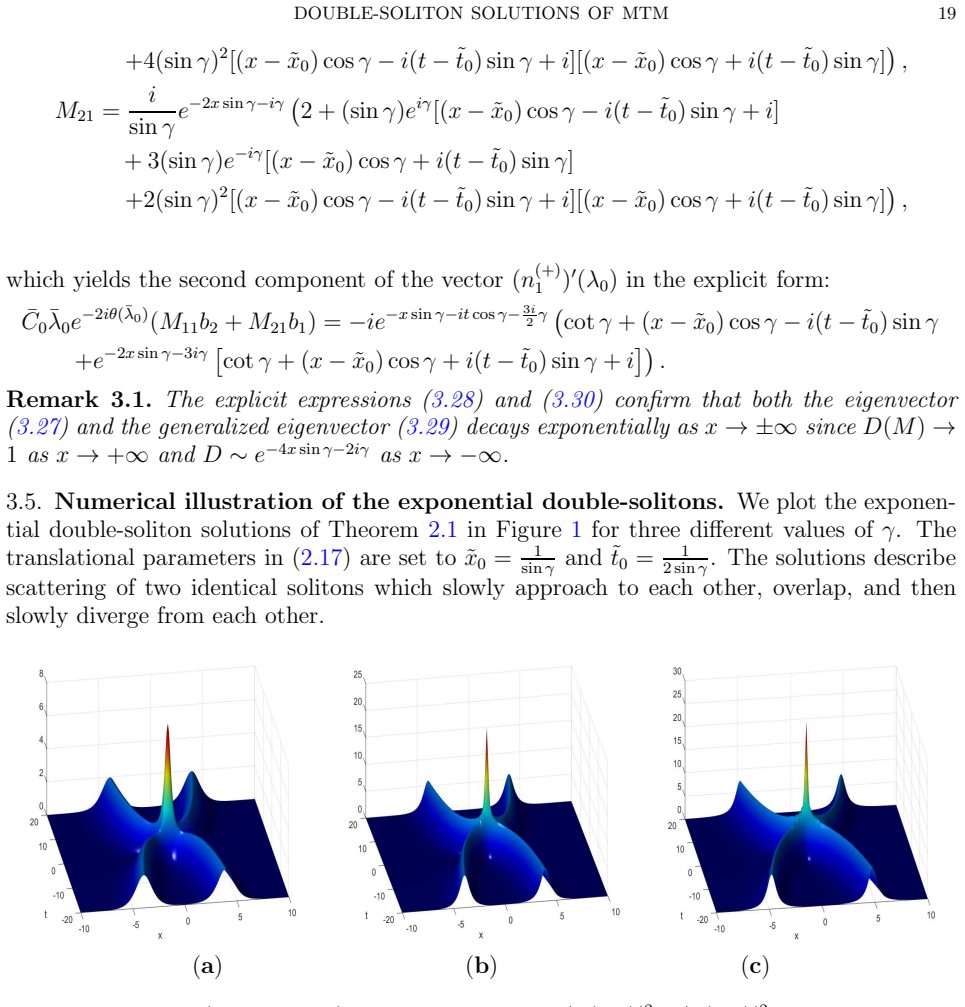
- The exponential double-soliton describes two identical solitons whose separation grows as $\log|t|/\sin\gamma$, the slow logarithmic dynamics associated with double eigenvalues.
- The same Riemann–Hilbert construction, with $\lambda_0=e^{i\gamma}$ and the $\gamma\to\pi$ limit, produces algebraic double-solitons without needing a direct RH formulation at an embedded eigenvalue.
- Because the eigenvector and generalized eigenvector both lie in $H^1$, the algebraic double-soliton satisfies the decay criterion for higher-multiplicity embedded eigenvalues, so perturbative and stability analysis of embedded eigenvalues can now be tested on an exact solution.
Reading between the lines
- A natural extension is that double poles of higher order in the same limit should produce algebraic multi-solitons with longer Jordan chains at $\zeta=i$, although this paper only constructs chains of length two.
- One can test whether the double embedded eigenvalue at $\zeta=i$ is structurally unstable under a generic perturbation, in analogy with the known instability of a pair of simple embedded eigenvalues that opens into a quadruplet of isolated eigenvalues.
- Since the derivative NLS equation and the MTM share the same spectral problem in characteristic coordinates, the same singular-limit construction suggests that double embedded eigenvalues and algebraic double-solitons should also exist for derivative NLS on the zero background.
Editorial analysis
A structured set of objections, weighed in public.
Referee Report
Summary. This paper constructs exponential and algebraic double-soliton solutions of the massive Thirring model in laboratory coordinates using the inverse scattering transform. For a double pole of the Riemann–Hilbert problem at λ0=e^{iγ}, the authors derive explicit exponential double-soliton formulas and show that the associated Lax pair has a Jordan chain of length two at ζ0=e^{iγ/2}. Taking a singular limit γ→π after a rescaling of the translation parameters, they obtain rational algebraic double-soliton solutions and exhibit an eigenvector and generalized eigenvector at the embedded value ζ=i. The paper interprets this as resolving the conjecture that multiple embedded eigenvalues can occur in the MTM spectral problem, and it also verifies consistency with earlier bilinear Hirota results.
Significance. If the spectral characterization is fully established, this is a substantial contribution: it provides the first explicit construction, via the Riemann–Hilbert method, of algebraic double-solitons of the massive Thirring model and connects them to a double embedded eigenvalue on the continuous spectrum. The derivation is systematic, with explicit residue-coefficient computations, closed-form potentials, and direct verification of the Jordan-chain equations (2.18)–(2.19). The consistency check with the bilinear results of [8] and the careful treatment of the singular limit are additional strengths. The paper is written with enough detail that the main algebraic steps can be reproduced, and the explicit formulas are a useful resource for further study of embedded eigenvalues in integrable systems.
major comments (2)
- [Theorem 2.3 and Remark 2.4] The theorem states that ζ=i is a double embedded eigenvalue with only one eigenvector ψ0∈H^1 and one generalized eigenvector ψ1∈H^1. The proof in Section 4.2 constructs ψ0 and ψ1 satisfying (2.18)–(2.19), i.e., a Jordan chain of length two. This establishes algebraic multiplicity at least two and geometric multiplicity at least one, but it does not by itself exclude additional linearly independent H^1 eigenfunctions at ζ=i or a longer Jordan chain. The only support for the 'only one' and 'double' parts is Remark 2.4, which cites [15, Lemma 6.4] but verifies only the decay rates ψ0=O(|x|^{-2}) and ψ1=O(|x|^{-1}); the lemma's remaining hypotheses are not reproduced. Please either quote the lemma and verify all of its hypotheses for the explicit solution (2.20)–(2.21), or replace the 'double embedded eigenvalue with only one eigenvector' statement by the weaker (but sufficient for the conjecture) statement that the algebraic solution admits a Jordan chain of length two at ζ=i.
- [Section 4] The passage from exponential to algebraic double-solitons is made by Taylor expanding D(M), N_u, and N_v in ε=π−γ and taking the limit after rescaling x̃0. This is a formal asymptotic argument; no uniform-convergence estimate or direct substitution into (1.1) is provided. Since (2.20)–(2.21) are claimed as exact solutions, either a direct verification of (1.1) or an explicit statement that they coincide with the bilinear solutions of [8] (under the transformation in Remark 2.5) should be part of the proof of Theorem 2.3. Remark 2.5 currently makes the connection only as a note after the theorem.
minor comments (5)
- [Eq. (3.31)] The displayed identity |u|^2+|v|^2 = (|N_u|^2+|N_v|^2)/|D(M)|^2 = 2i ∂_x log D(M)/D(M) is miswritten; the rightmost expression should presumably be 2i ∂_x log(D(M)/\overline{D(M)}) or an equivalent bilinear identity. Please correct the formatting.
- [Section 3.1, proof of Proposition 3.1] There is a typo 'folows' for 'follows', and the notation for the scattering coefficient is inconsistent: the residue term for λ0 is written with \tilde α(λ) while the double-pole term uses α(λ), and similarly \check α appears for λ̄0. Please unify the notation.
- [Remark 2.2] The statement that the double-soliton solutions 'only have two non-trivial parameters' is confusing because Theorem 2.1 also contains the parameters c, x0, and t0 arising from the Lorentz and translation symmetries. Please clarify that these are gauge parameters and that γ and x̃0 are the shape parameters.
- [Theorem 2.3, definitions of n0 and n1] The factors exp(± i/4 ∫_x^∞ (|u|^2+|v|^2)dy) in (2.22)–(2.23) are evaluated at (u,v)=(ualg,valg), which decay only as O(|x|^{-1}); a sentence confirming that the integrals converge and that the resulting ψ0 and ψ1 belong to H^1(R,C^2) would be helpful.
- [Appendix B] The matching between the bilinear expressions (B.2)–(B.4) and the RH solution in Theorem 2.1 is stated after the substitutions, but the intermediate definitions of ξ and η in (B.2)–(B.4) are not given in the text of Appendix B; please add them for readability.
Circularity Check
Derivation chain is self-contained and non-circular; the only overlap is a minor self-citation — the exact 'only one eigenvector' statement of Theorem 2.3 is outsourced to the authors' prior criterion [15, Lemma 6.4], whose full hypotheses are not reproduced.
-
uniqueness imported from authors
[Remark 2.4 and Theorem 2.3, Section 2]
"Theorem 2.3: 'the corresponding Lax spectrum includes the double embedded eigenvalue ζ0 = i of the linear system (1.2) with only one eigenvector ψ0 ∈ H1(R, C2) and one generalized eigenvector ψ1 ∈ H1(R, C2) satisfying (2.18) and (2.19) for ζ0 = i.' Remark 2.4: 'The eigenvector ψ0 and generalized eigenvector ψ1 in (2.22) and (2.23) for the double embedded eigenvalue ζ = i satisfy the criterion for the spatial decay in [15, Lemma 6.4], namely ψ0 = O(|x|−2) and ψ1 = O(|x|−1) as |x| → ∞.'"
Exactness of the spectral claim (geometric multiplicity exactly one, hence 'double' rather than higher) is not derived in-paper; it is attributed to [15, Lemma 6.4], prior work sharing an author (Pelinovsky). Only the two displayed decay rates — readable from explicit n0, n1 — are verified; the lemma's full hypotheses are not reproduced, and no argument rules out further H1 eigenfunctions or longer Jordan chains at ζ=i. The exhibited (2.22)-(2.23) satisfying (2.18)-(2.19) is genuine in-paper content, already showing an embedded Jordan chain of length two, so the conjecture resolution stands; only the 'only one eigenvector' sharpening is outsourced to a self-citation.
full rationale
The derivation chain is self-contained. The paper solves the reflectionless RH problem with a double pole at λ0 (an ansatz, not the target claim), computes the residue coefficients from the double-zero structure of a(ζ) with A0 and B0 as arbitrary normalization constants (Proposition 3.1), closes the linear algebraic system, and obtains the exponential double-solitons (Proposition 3.2, Theorem 2.1). The algebraic double-solitons (2.20)-(2.21) are obtained by a genuine singular limit γ→π with ε-expansions and the parameter rescaling x̃0→x̃0ε² (Section 4.1); the formula is not assumed from earlier work, and its agreement with the bilinear result of [8] is checked afterward (Remark 2.5, Appendix B). The spectral claim is verified explicitly: ψ0 and ψ1 in (2.22)-(2.23) are limits of the exponential-case eigenvector and generalized eigenvector (3.27), (3.29), so equations (2.18)-(2.19) are inherited by continuity, and their decay follows by inspection of the explicit rational expressions. No fitted parameter is renamed as a prediction, and no target result is used as an input. The only circularity-adjacent element is Remark 2.4, where the 'only one eigenvector' uniqueness part of Theorem 2.3 is carried by the authors' own prior criterion [15, Lemma 6.4] without reproducing its hypotheses; because the Jordan-chain existence is proven in-paper and the cited lemma is an independent published theorem, this is a minor self-citation (score 2), not load-bearing circularity.
Assumptions & free parameters
free parameters (2)
- A0, double-pole residue coefficient =
-4 (sin gamma)^2 e^(3 i gamma / 2)
- B0, double-pole phase coefficient =
-i e^(-i gamma) [x_tilde_0 cos gamma + i t_tilde_0 sin gamma]
assumptions (4)
- domain assumption The Jost function and scattering coefficient properties in Lemmas 2.1 and 2.2 are taken from [23] without reproof.
- domain assumption The reflectionless double-pole Riemann-Hilbert problem is uniquely solved by the residue-subtraction ansatz (3.1), with no additional spectral singularities or jump contributions.
- domain assumption The decay criterion of [15, Lemma 6.4], invoked in Remark 2.4, is sufficient to conclude that zeta equals i is exactly a double embedded eigenvalue with one eigenvector and one generalized eigenvector.
- domain assumption The pointwise singular limit gamma to pi of the exact solution family, with the parameter rescaling (4.1), is again a solution of the massive Thirring model.
Cite this review
Pith. "Pith review of Exponential and algebraic double-soliton solutions of the massive Thirring model." pith.science (2026). https://pith.science/paper/A4PN65MR
@misc{pith2026241200838,
  author       = {Pith},
  title        = {Pith review of: Exponential and algebraic double-soliton solutions of the massive Thirring model},
  year         = {2026},
  howpublished = {\url{https://pith.science/paper/A4PN65MR}},
  note         = {Machine review of arXiv:2412.00838}
}
read the original abstract
The newly discovered exponential and algebraic double-soliton solutions of the massive Thirring model in laboratory coordinates are placed in the context of the inverse scattering transform. We show that the exponential double-solitons correspond to double isolated eigenvalues in the Lax spectrum, whereas the algebraic double-solitons correspond to double embedded eigenvalues on the imaginary axis, where the continuous spectrum resides. This resolves the long-standing conjecture that multiple embedded eigenvalues may exist in the spectral problem associated with the massive Thirring model. To obtain the exponential double-solitons, we solve the Riemann--Hilbert problem with the reflectionless potential in the case of a quadruplet of double poles in each quadrant of the complex plane. To obtain the algebraic double-solitons, we consider the singular limit where the quadruplet of double poles degenerates into a symmetric pair of double embedded poles on the imaginary axis.
Figures

Reference graph
Works this paper leans on
-
[8]
J. Han, C. He, And D. E. Pelinovsky, Algebraic solitons in the massiv e Thirring model, Phys. Rev. E 110 (2024) 034202 (11 pages)
work page 2024
-
[1]
D. Bilman and P. D. Miller, A robust inverse scattering transform f or the focusing nonlinear Schr¨ odinger equation, Commun Pure Appl Math 72 (2019), 1722–1805
work page 2019
- [2]
-
[3]
G. Biondini, G. Kovaˇ ciˇ c, Inverse scattering transform for t he focusing nonlinear Schr¨ odinger equation with nonzero boundary conditions, J. Math. Phys. 55 (2014), 031506
work page 2014
-
[4]
J. Chen and B.-F. Feng, Tau-function formulation for bright, da rk soliton and breather solutions to the massive Thirring model, Stud. Appl. Math. 150 (2023), 35-68
work page 2023
-
[5]
J. Chen, B. Yang, and B.-F. Feng, Rogue waves in the massive Thir ring model, Stud Appl Math. 151 (2023), 1020–1052
work page 2023
-
[6]
P. A. Clarkson and E. Dowie, Rational solutions of the Boussinesq equation and applications to rogue waves, Trans. Math. Appl. 1 (2017) 1–26
work page 2017
-
[7]
P. A. Clarkson and C. Dunning, Rational solutions of the fifth Pain lev´ e equation. Generalized Laguerre polynomials, Stud. Appl. Math. 152 (2024) 453–507
work page 2024
Show all 37 references
-
[9]
C. He, J. Liu, and C.Z. Qu, Massive Thirring Model: Inverse Scatte ring and Soliton Resolution, ArXiv:2307.15323v1
-
[10]
Galkin, D.E
V.M. Galkin, D.E. Pelinovsky, and Yu.A. Stepanyants, The Struct ure of the Rational Solutions to the Boussinesq equation, Physica D 80 (1995) 246–255
1995
-
[11]
B. Guo, L. Ling, and Q. P. Liu, High-order solutions and generaliz ed Darboux transformations of deriv- ative nonlinear Schr¨ odinger Equations, Stud. Appl. Math. 130 (2013), 317-344
2013
-
[12]
L. Guo, L. Wang, Y. Cheng, and J. He, High-order rogue wave s olutions of the classical massive Thirring model equations, Commun. Nonlinear Sci. Numer. Simulat. 52 (2017), 11–23
2017
-
[13]
Kaup and A.C
D.J. Kaup and A.C. Newell, An exact solution for a derivative nonline ar Schr¨ odinger equation, J. Math. Phys. 19 (1978), 798-801
1978
-
[14]
Kaup and A.C
D.J. Kaup and A.C. Newell, On the Coleman correspondence and th e solution of the Massive Thirring model, Lett. Nuovo Cimento, 20 (1977), 325-331
1977
-
[15]
Klaus, D.E
M. Klaus, D.E. Pelinovsky, and V.M. Rothos, Evans function for L ax operators with algebraically decaying potentials, J. Nonlin. Science 16 (2006) 1-44
2006
-
[16]
Kuznetsov and A.V
E.A. Kuznetsov and A.V. Mikhailov, On the complete integrability of the two-dimensional classical Thirring model, Theor. Math. Phys. 30 (1977), 193-200
1977
-
[17]
J. H. Lee, Solvability of the derivative nonlinear Schr¨ odinger eq uation and the massive Thirring model, Theor. Math. Phys. 99 (1994), 617–621
1994
-
[18]
Y. Li, M. Li, T. Xu, Y.H. Huang, and C.X. Xu, Inverse scattering t ransform and N -soliton solutions for the massive Thirring model with zero boundary conditions, preprint (2024)
2024
-
[19]
Martel and T
Y. Martel and T. V. Nguyen, Construction of 2-solitons with log arithmic distance for the one-dimensional cubic Schr¨ odinger system, Discrete Contin. Dyn. Syst. 40 (2020), 1595–1620
2020
-
[20]
Mikhailov, Integrability of the two-dimensional Thirring mode l, JETP Lett
A.V. Mikhailov, Integrability of the two-dimensional Thirring mode l, JETP Lett. 23 (1976), 320-323
1976
-
[21]
S. J. Orfanidis, Soliton solutions of the massive Thirring model an d the inverse scattering transform, Phys. Rev. D 14 (1976), 472-478
1976
-
[22]
Pelinovsky, Rational solutions of the KP hierarchy and the dy namics of their poles
D. Pelinovsky, Rational solutions of the KP hierarchy and the dy namics of their poles. II. Construction of the degenerate polynomial solutions, J. Math. Phys. 39 (1998) 5377–5395
1998
-
[23]
D. E. Pelinovsky and A. Saalmann, Inverse scattering for the m assive Thirring model in Nonlinear Dis- persive Partial Differential Equations and Inverse Scattering (Ed itors: P. Miller, P. Perry, J.C. Saut, and C. Sulem), Fields Institute Communications 83 (Springer, New York,...
2019
-
[24]
Pichler and G
M. Pichler and G. Biondini, On the focusing non-linear Schr¨ odinge r equation with non-zero boundary conditions and double poles, IMA J. Appl. Math. 82 (2017), 131-151
2017
-
[25]
Thirring, A soluble relativistic field theory, Annals of Physics, 3 (1958), 91-112
W. Thirring, A soluble relativistic field theory, Annals of Physics, 3 (1958), 91-112
1958
-
[26]
Villarroel, The DBAR problem and the Thirring model, Stud
J. Villarroel, The DBAR problem and the Thirring model, Stud. Appl. Math. 84 (1991), 207–220
1991
-
[27]
Wang and J
C. Wang and J. Zhan, Double-pole solutions in the modified nonlinea r Schr¨ odinger equation, Wave Motion 118 (2023) 103102
2023
-
[28]
S. Xu, J. He, and L. Wang, The Darboux transformation of the derivative nonlinear Schr¨ odinger equation, J. Phys. A: Math. Theor. 44 (2011), 305203 (22 pages)
2011
-
[29]
Yang and J
B. Yang and J. Yang, Rogue wave patterns in the nonlinear Schr ¨ odinger equation, Physica D419 (2021) 132850
2021
-
[30]
Yang and J
B. Yang and J. Yang, Universal rogue wave patterns associat ed with the Yablonskii-Vorob’ev polynomial hierarchy, Physica D 425 (2021) 132958
2021
-
[31]
Yang and J
B. Yang and J. Yang, Rogue wave patterns associated with Oka moto polynomial hierarchies, Stud. Appl. Math. 151 (2023) 60–115
2023
-
[32]
Y. Ye, L. Bu, C. Pan, S. Chen, D. Mihalache, and F. Baronio, Sup er rogue wave states in the classical massive Thirring model system, Rom. Rep. Phys. 73 (2021), 117
2021
-
[33]
Zhang, L
Y. Zhang, L. Guo, S. Xu, Z. Wu, and J. He, The hierarchy of high er order solutions of the derivative nonlinear Schr¨ odinger equation, Commun. Nonlinear Sci. Numer. Sim ulat, 19 (2014), 1706–1722
2014
-
[34]
Zakharov and A.B
V.E. Zakharov and A.B. Shabat, Exact theory of two-dimension al self-focusing and one-dimensional self- modulation of waves in nonlinear media, Sov. Phys. JETP 34 (1972), 62–69
1972
-
[35]
Zhang and Z
G. Zhang and Z. Yan, The derivative nonlinear Schr¨ odinger equ ation with zero/nonzero boundary con- ditions: inverse scattering transforms and N -double-pole solutions, J. Nonlin. Sci. 30 (2020), 3089-3127
2020
-
[36]
Zhang, J
Y. Zhang, J. Rao, Y. Cheng, and J. He, Riemann-Hilbert method for the Wadati-Konno-Ichikawa equa- tion: N simple poles and one higher-order pole, Physica D 399 (2019), 173-1 85
2019
-
[37]
Zhang, H
Y. Zhang, H. Wu, and D. Qiu, Revised Riemann-Hilbert problem for the derivative nonlinear Schr¨ odinger equation: Vanishing boundary condition, Theor. Math. Phys. 217 ( 2023), 1595-1608. Zhi-Qiang Li, School of Mathematics, China University of Mining and Techn ology, Xuzhou 22...
2023
Reviewed August 12, 2026 · model on record in the stance chip above.
Discussion (0). Continue with ORCID to comment.