REVIEW 3 major objections 5 minor 1 cited by
DynSUP: Dynamic Gaussian Splatting from An Unposed Image Pair
T0 review · 3 major / 5 minor · reviewed 2026-08-12 · deepseek-v4-flash
Pith's one-line read A method that fits dynamic 3D scenes as Gaussians from just two unposed images, jointly recovering camera pose and object motion.
desk verdict Novel and coherent pipeline for dynamic GS from two unposed images, but the test image is used at inference to tune pose and per-object SE(3) ratios, inflating Table 1. read the letter →
The pith
A machine-rendered reading of the paper's core claim, the machinery that carries it, and where it could break.
The reading
What carries the argument
The load-bearing mechanism is a two-stage pipeline: first, an object-level two-view bundle adjustment that uses optical flow, monocular depth, and motion segmentation masks to divide the scene into static background and rigid objects, then jointly optimizes camera pose, per-object SE(3) transformations, and depths; second, an SE(3) field-driven Gaussian splatting stage in which each 3D Gaussian carries its own learnable SE(3) transformation, initialized from the object-level motion, with a Huber-based regularization that keeps motions smooth within each object and a 6D rotation representation for stable optimization. This bridges geometry (reprojection, depth consistency) and photometry (rendering loss), and the same pipeline with per-object interpolation ratios is reused at test time to align the temporal position of objects.
What would settle it
Take two frames of a dynamic scene that contains no static background, run DynSUP, and check whether camera pose and object motions are still recovered and whether novel-view rendering remains sharp; if the pipeline fails or the camera pose is grossly wrong, the static-background anchor is required.
Extended reading notes
Core claim
The paper's central claim is that a dynamic scene can be fitted with 3D Gaussian Splatting from a single, unposed pair of images. An object-level dense bundle adjustment decomposes the scene into static background and piecewise-rigid objects, jointly estimating the camera motion and each object's SE(3) motion while regularizing depth. These motions seed an SE(3) field in which every Gaussian has its own learnable rotation and translation, refined jointly with the Gaussian parameters and camera pose under photometric loss. The resulting representation supports rendering a novel view at an intermediate timestamp, including a test-time alignment that optimizes per-object SE(3) interpolation ratios. The paper argues this is the first demonstration of dynamic Gaussian fitting from two unposed views, with experiments showing consistent improvement over methods that assume static scenes, multiple images, or known poses.
Load-bearing premise
The method assumes a detectable static background region whose apparent motion between the two frames is purely camera motion, because the camera pose is taken directly from the static region's motion. If no static region can be found, camera and object motion cannot be separated.
Editorial extensions
If this is right
- Dynamic novel-view synthesis becomes possible from a two-frame capture with no pose metadata, which matters for casual photography and autonomous driving logs where pose estimation is unreliable.
- The explicit SE(3) field gives an interpretable per-object motion model that can be interpolated in time, enabling temporal alignment of test frames rather than just spatial rendering.
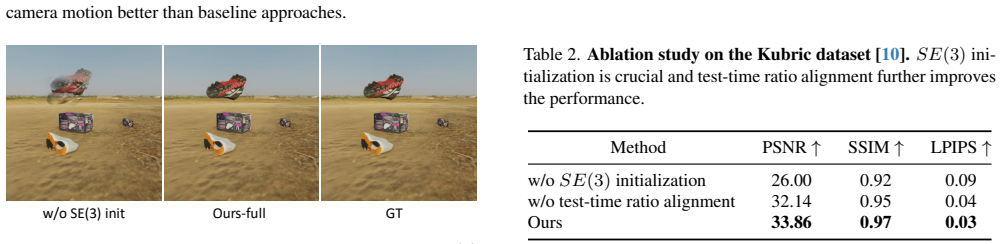
- The object-level bundle adjustment provides the initialization that makes the otherwise ambiguous two-view dynamic problem converge; the ablation study shows that removing it degrades rendering sharply in large-motion regions.
- Because the representation is explicit 3D Gaussians with rigid motions, it can be rendered in real time with existing rasterizers, unlike deformation-field methods that need dense temporal observations.
Reading between the lines
- The method's dependence on a detectable static background suggests a natural stress test: scenes where all visible content moves, such as a train interior or a flock of birds filling the frame, should break the camera-object decomposition unless the ambiguity is resolved by other cues.
- A natural extension is to chain the two-view bundle adjustment across additional frames, which would give richer observations for the SE(3) field and might relax the static-background requirement.
- The per-object interpolation-ratio alignment at test time is effectively a temporal pose estimate, so the same mechanism could estimate the time offset between two unposed frames, turning the method into a synchronization tool for uncalibrated cameras.
- Because the pipeline leans on learned depth and flow priors, its reliability on out-of-distribution motion is bounded by those priors; a controlled test with fast motion and heavy occlusion would clarify how much geometric constraint the two-view objective alone provides.
Editorial analysis
A structured set of objections, weighed in public.
Referee Report
Summary. The paper proposes DynSUP, a two-stage method for fitting dynamic 3D Gaussian Splatting (3DGS) from two unposed images with known intrinsics. In the first stage, an object-level dense bundle adjustment decomposes the scene into a static background and piecewise rigid dynamic objects, jointly estimating camera pose and per-object SE(3) motions using optical flow and monocular depth. In the second stage, each Gaussian is initialized with its object's SE(3) motion and a dense per-Gaussian SE(3) field is optimized jointly with Gaussian parameters and camera pose. At test time, the method additionally optimizes the camera pose and per-object SE(3) interpolation ratios against the actual test image (Sec. 4.3, Eq. 6). Experiments are reported on KITTI and Kubric, with comparisons against 4DGS, SC-GS, and InstantSplat, plus ablations of the SE(3) initialization and the test-time ratio alignment.
Significance. If the evaluation protocol is corrected, this would be a meaningful step: it is the first 3DGS formulation that explicitly combines object-level two-view bundle adjustment with a per-Gaussian SE(3) motion field for dynamic scenes from sparse, pose-free input. The ablation study does provide evidence that the SE(3) initialization matters (Kubric PSNR 26.00 without initialization vs 33.86 with it), and the piecewise-rigid decomposition is a sensible way to constrain an under-determined problem. The paper also honestly lists non-rigid motion and segmentation quality as limitations. However, the current test-time procedure uses the target image to optimize both camera pose and per-object temporal interpolation ratios, so the reported numbers partly measure fitting to the target rather than prediction from the two training images. The central claim of 'use only two images' is therefore not yet supported as stated.
major comments (3)
- [Sec. 4.3, Eq. (6); Table 1; Table 2] The evaluation protocol leaks the target image into inference. The text states that at test time the method fixes the trained Gaussians and minimizes the photometric loss against the actual test image Itest, jointly optimizing the camera pose Tcam and, in particular, each object's SE(3) interpolation ratio robj. This means the intermediate frame is rendered after aligning the camera and placing each object at its target temporal position using the answer image. The per-object ratio is not a camera pose, so this is not an ordinary pose-free NVS concession. The ablation in Table 2 quantifies the effect: fixing robj=0.5 reduces Kubric PSNR from 33.86 to 32.14, so about 1.7 dB of the headline result comes directly from target-based ratio optimization. Baselines are not given an equivalent target-adaptive per-object temporal parameter, so the comparison is not apples-to-apples. Please re-evaluate with robj fixed at 0.5 (or otherwise determined from the two training frames alone), and report both settings so the reader can see the predictive performance of the two-view model without the test-time alignment.
- [Sec. 4.1, object transformation formula] The formula T_obj^(i) = Tcam (T^(i))^{-1} appears inconsistent with the stated definitions. Since T^(i) maps a 3D point from the I0 camera coordinate system to the I1 camera coordinate system, and T^(0)=Tcam for the static region, for a dynamic region the combined transformation should satisfy T^(i) = Tcam * T_obj^(i) (assuming the world frame coincides with the I0 camera frame). Then T_obj^(i) = Tcam^{-1} T^(i), not Tcam (T^(i))^{-1}. As printed, the initialization of the SE(3) field would be the inverse/conjugation of the intended object motion. Given that the ablation shows SE(3) initialization is crucial for the method's performance, please clarify the transformation convention or correct the formula, and verify that the implemented initialization matches the corrected expression.
- [Sec. 4.1, static background assumption] The method relies on a detectable static background region P^(0) whose apparent motion between the two frames is purely camera motion, because the camera pose Tcam is taken directly from T^(0). If a scene has no reliable static region, or the static region is too small, camera motion cannot be separated from object motion, and the SE(3) initialization and the subsequent rendering pipeline lose their anchor. Both datasets used in the paper (KITTI driving scenes, Kubric with static floor and walls) contain prominent static backgrounds, so this assumption is never stress-tested. The conclusion lists non-rigid motion and segmentation quality as limitations but does not mention the static-background requirement. Please add a discussion of this requirement and, if possible, an experiment or qualitative example on a sequence without a dominant static background.
minor comments (5)
- [Table 2] The column header 'LPIPS ↑' should be 'LPIPS ↓', since lower LPIPS is better.
- [References] The related-work text cites 'MASt3R [25]' and 'Splatt3R [13]', but reference [25] is the Splatt3R paper and reference [13] is Pf3plat; the labels and the reference list need to be corrected to match the intended works.
- [Eq. (3)] The notation in Eq. (3) is confusing: Lreproj and Ld already include sums over pixels, so writing Lba = sum_{p in P(i)} (lambda1 Lreproj + lambda2 Ld) reads as a sum of sums. Please rewrite using per-region losses, e.g., Lba = sum_i (lambda1 Lreproj^(i) + lambda2 Ld^(i)).
- [Abstract and Fig. 1 caption] The statements 'use only two images' and 'two images captured at distinct moments with unknown poses' should also mention that known camera intrinsics are required, since K appears in all projection equations.
- [Sec. 4.2, regularization] The SE(3) regularization Lreg is applied only to dynamic regions (i>0). It would be helpful to state explicitly whether background Gaussians are allowed to drift during optimization and, if so, how background rigidity is enforced.
Circularity Check
Test-time SE(3) ratio optimization against the target image (Eq. 6) means Table 1 measures fitting, not held-out two-view prediction.
-
fitted input called prediction
[Section 4.3, Eq. (6)]
"During optimization, these per-object interpolation factors are refined to their optimal values, effectively aligning the dynamic object motions with the test views. ... The optimization objective minimizes the photometric discrepancy between the rendered image ˆItest and the actual test image Itest using the loss following [17], jointly refining the camera poses and dynamic object motions to achieve accurate rendering."
The target of evaluation (the intermediate image Itest) is an optimization input at inference: robj and Tcam are solved by minimizing photometric loss against Itest (Eq. 6). The rendered novel view is thus a fit to the measured image, not a prediction from I0 and I1 alone. The Table 2 ablation quantifies the leak: freezing robj=0.5 drops Kubric PSNR 33.86→32.14, so ~1.7 dB of the headline result comes from target-based ratio optimization. Baselines are not given an equivalent target-adaptive per-object temporal parameter, so the comparison is asymmetric. The two-view fitting of Gaussians itself is independent; the circularity is in the evaluation supporting the 'only two images' claim.
full rationale
The core reconstruction chain is not circular: object-level dense bundle adjustment uses only I0 and I1 (Eqs. 1-3), and the SE(3) field-driven Gaussian training uses only those two frames' photometric losses (Eq. 4). No load-bearing self-citation or ansatz-smuggling is present. The circular step is the evaluation protocol in Sec. 4.3: when rendering the intermediate test frame, the paper fixes the Gaussians trained on the two unposed frames but then optimizes the test camera pose and, crucially, each object's SE(3) interpolation ratio robj against the actual test image Itest (Eq. 6). The per-object ratio is a temporal motion parameter, not a camera pose, so it places dynamic objects using the answer image in hand. The paper is transparent about this optimization and notes it follows prior pose-free practice (InstantSplat, NeRFmm), but the per-object temporal ratio is an additional target-adaptive degree of freedom that baselines are not given. Table 2 confirms the contribution of this step: removing test-time ratio alignment lowers Kubric PSNR from 33.86 to 32.14, so roughly 1.7 dB of the headline result is attributable to fitting the target. Consequently, the claim 'can use only two images' is not fully supported by the current metrics; the intermediate view is generated with the aid of the third image. This is a fixable evaluation flaw, not a fatal derivation flaw, but it is a genuine partial circularity in the paper's central quantitative claim. Score 6 reflects that one or more 'predictions' reduce by construction while the main two-view fitting remains independent.
Assumptions & free parameters
free parameters (3)
- per-image depth affine parameters theta0, gamma0, theta1, gamma1 =
optimized during BA; initial values not reported
- per-object SE(3) interpolation ratio r_obj =
initialized to 0.5, then optimized per object on the test image
- loss weights lambda1, lambda2, lambdat, lambdar =
lambda1=1.0, lambda2=0.1, lambdat=1, lambdar=1
assumptions (6)
- domain assumption The scene can be decomposed into piece-wise rigid components, with each dynamic object undergoing a single SE(3) motion between the two frames.
- domain assumption A reliable static background region P(0) exists in both frames, and its apparent motion T(0) equals the camera motion.
- domain assumption Monocular depth maps D0 and D1 from Depth Anything V2 are accurate up to a per-image affine transform.
- domain assumption Optical flow (GMFlow) provides correspondences accurate enough that forward-backward consistency (W_fwd) identifies reliable matches.
- standard math Known camera intrinsics K are available for both views.
- domain assumption The intermediate test frame's object states can be modeled by interpolating each object's SE(3) transformation between the two training frames.
Cite this review
Pith. "Pith review of DynSUP: Dynamic Gaussian Splatting from An Unposed Image Pair." pith.science (2026). https://pith.science/paper/OC7NCPW3
@misc{pith2026241200851,
  author       = {Pith},
  title        = {Pith review of: DynSUP: Dynamic Gaussian Splatting from An Unposed Image Pair},
  year         = {2026},
  howpublished = {\url{https://pith.science/paper/OC7NCPW3}},
  note         = {Machine review of arXiv:2412.00851}
}
read the original abstract
Recent advances in 3D Gaussian Splatting have shown promising results. Existing methods typically assume static scenes and/or multiple images with prior poses. Dynamics, sparse views, and unknown poses significantly increase the problem complexity due to insufficient geometric constraints. To overcome this challenge, we propose a method that can use only two images without prior poses to fit Gaussians in dynamic environments. To achieve this, we introduce two technical contributions. First, we propose an object-level two-view bundle adjustment. This strategy decomposes dynamic scenes into piece-wise rigid components, and jointly estimates the camera pose and motions of dynamic objects. Second, we design an SE(3) field-driven Gaussian training method. It enables fine-grained motion modeling through learnable per-Gaussian transformations. Our method leads to high-fidelity novel view synthesis of dynamic scenes while accurately preserving temporal consistency and object motion. Experiments on both synthetic and real-world datasets demonstrate that our method significantly outperforms state-of-the-art approaches designed for the cases of static environments, multiple images, and/or known poses. Our project page is available at https://colin-de.github.io/DynSUP/.
Figures


Figures from the paper (2 more)

Forward citations
Cited by 1 Pith paper
-
EndoFlow-SLAM: Real-Time Endoscopic SLAM with Flow-Constrained Gaussian Splatting
EndoFlow-SLAM couples 3D Gaussian Splatting with optical-flow and depth-gradient supervision, and reports improved pose and rendering accuracy on static and dynamic endoscopic datasets.
Reference graph
Works this paper leans on
-
[1]
Nope-nerf: Optimising neu- ral radiance field with no pose prior
Wenjing Bian, Zirui Wang, Kejie Li, Jia-Wang Bian, and Victor Adrian Prisacariu. Nope-nerf: Optimising neu- ral radiance field with no pose prior. In Proceedings of the IEEE/CVF Conference on Computer Vision and Pattern Recognition, pages 4160–4169, 2023. 2
work page 2023
-
[2]
pixelsplat: 3d gaussian splats from image pairs for scalable generalizable 3d reconstruction
David Charatan, Sizhe Li, Andrea Tagliasacchi, and Vincent Sitzmann. pixelsplat: 3d gaussian splats from image pairs for scalable generalizable 3d reconstruction. In arXiv, 2023. 1, 2
work page 2023
-
[3]
Dbarf: Deep bundle-adjusting generalizable neural radiance fields
Yu Chen and Gim Hee Lee. Dbarf: Deep bundle-adjusting generalizable neural radiance fields. In Proceedings of the IEEE/CVF Conference on Computer Vision and Pattern Recognition, pages 24–34, 2023. 2
2023
-
[4]
Mvsplat: Efficient 3d gaussian splatting from sparse multi-view images
Yuedong Chen, Haofei Xu, Chuanxia Zheng, Bohan Zhuang, Marc Pollefeys, Andreas Geiger, Tat-Jen Cham, and Jianfei Cai. Mvsplat: Efficient 3d gaussian splatting from sparse multi-view images. arXiv preprint arXiv:2403.14627, 2024. 1, 2
arXiv 2024
-
[5]
Depth-regularized optimization for 3d gaussian splatting in few-shot images
Jaeyoung Chung, Jeongtaek Oh, and Kyoung Mu Lee. Depth-regularized optimization for 3d gaussian splatting in few-shot images. In Proceedings of the IEEE/CVF Con- ference on Computer Vision and Pattern Recognition, pages 811–820, 2024. 2
2024
-
[6]
Instantsplat: Un- bounded sparse-view pose-free gaussian splatting in 40 sec- onds
Zhiwen Fan, Wenyan Cong, Kairun Wen, Kevin Wang, Jian Zhang, Xinghao Ding, Danfei Xu, Boris Ivanovic, Marco Pavone, Georgios Pavlakos, et al. Instantsplat: Un- bounded sparse-view pose-free gaussian splatting in 40 sec- onds. arXiv preprint arXiv:2403.20309, 2024. 1, 2, 5, 6
arXiv 2024
-
[7]
Random sample consensus: a paradigm for model fitting with applications to image analysis and automated cartography.Communications of the ACM, 24(6):381–395, 1981
Martin A Fischler and Robert C Bolles. Random sample consensus: a paradigm for model fitting with applications to image analysis and automated cartography.Communications of the ACM, 24(6):381–395, 1981. 4
1981
-
[8]
Efros, and Xiaolong Wang
Yang Fu, Sifei Liu, Amey Kulkarni, Jan Kautz, Alexei A. Efros, and Xiaolong Wang. Colmap-free 3d gaussian splat- ting. In Proceedings of the IEEE/CVF Conference on Com- puter Vision and Pattern Recognition (CVPR), pages 20796– 20805, 2024. 2
2024
Show all 45 references
-
[9]
Are we ready for autonomous driving? the kitti vision benchmark suite
Andreas Geiger, Philip Lenz, and Raquel Urtasun. Are we ready for autonomous driving? the kitti vision benchmark suite. In Conference on Computer Vision and Pattern Recog- nition (CVPR), 2012. 6, 8
2012
-
[10]
Klaus Greff, Francois Belletti, Lucas Beyer, Carl Doersch, Yilun Du, Daniel Duckworth, David J Fleet, Dan Gnanapra- gasam, Florian Golemo, Charles Herrmann, Thomas Kipf, Abhijit Kundu, Dmitry Lagun, Issam Laradji, Hsueh- Ti (Derek) Liu, Henning Meyer, Yishu Miao, Derek Nowrouz...
2022
-
[11]
Multiple view ge- ometry in computer vision
Richard Hartley and Andrew Zisserman. Multiple view ge- ometry in computer vision . Cambridge university press,
-
[12]
Unifying corre- spondence, pose and nerf for pose-free novel view synthesis from stereo pairs
Sunghwan Hong, Jaewoo Jung, Heeseong Shin, Jiaolong Yang, Seungryong Kim, and Chong Luo. Unifying corre- spondence, pose and nerf for pose-free novel view synthesis from stereo pairs. arXiv preprint arXiv:2312.07246, 2023. 2
2023 arXiv
-
[13]
Pf3plat: Pose-free feed-forward 3d gaussian splatting
Sunghwan Hong, Jaewoo Jung, Heeseong Shin, Jisang Han, Jiaolong Yang, Chong Luo, and Seungryong Kim. Pf3plat: Pose-free feed-forward 3d gaussian splatting. arXiv preprint arXiv:2410.22128, 2024. 2
2024 arXiv
-
[14]
Lrm: Large reconstruction model for single image to 3d
Yicong Hong, Kai Zhang, Jiuxiang Gu, Sai Bi, Yang Zhou, Difan Liu, Feng Liu, Kalyan Sunkavalli, Trung Bui, and Hao Tan. Lrm: Large reconstruction model for single image to 3d. arXiv preprint arXiv:2311.04400, 2023. 2
2023 arXiv
-
[15]
s3 gaussian: Self-supervised street gaussians for autonomous driving
Nan Huang, Xiaobao Wei, Wenzhao Zheng, Pengju An, Ming Lu, Wei Zhan, Masayoshi Tomizuka, Kurt Keutzer, and Shanghang Zhang. s3 gaussian: Self-supervised street gaussians for autonomous driving. arXiv preprint arXiv:2405.20323, 2024. 2
2024 arXiv
-
[16]
Sc-gs: Sparse-controlled gaussian splatting for editable dynamic scenes
Yi-Hua Huang, Yang-Tian Sun, Ziyi Yang, Xiaoyang Lyu, Yan-Pei Cao, and Xiaojuan Qi. Sc-gs: Sparse-controlled gaussian splatting for editable dynamic scenes. arXiv preprint arXiv:2312.14937, 2023. 5, 6, 7
2023 arXiv
-
[17]
3d gaussian splatting for real-time radiance field rendering
Bernhard Kerbl, Georgios Kopanas, Thomas Leimk ¨uhler, and George Drettakis. 3d gaussian splatting for real-time radiance field rendering. ACM Trans. Graph., 42(4):139–1,
-
[18]
Ep n p: An accurate o (n) solution to the p n p problem
Vincent Lepetit, Francesc Moreno-Noguer, and Pascal Fua. Ep n p: An accurate o (n) solution to the p n p problem. International journal of computer vision, 81:155–166, 2009. 4
2009
-
[19]
Ggrt: Towards generalizable 3d gaussians without pose priors in real-time
Hao Li, Yuanyuan Gao, Dingwen Zhang, Chenming Wu, Yalun Dai, Chen Zhao, Haocheng Feng, Errui Ding, Jing- dong Wang, and Junwei Han. Ggrt: Towards generalizable 3d gaussians without pose priors in real-time. arXiv preprint arXiv:2403.10147, 2024. 2
2024 arXiv
-
[20]
Barf: Bundle-adjusting neural radiance fields
Chen-Hsuan Lin, Wei-Chiu Ma, Antonio Torralba, and Si- mon Lucey. Barf: Bundle-adjusting neural radiance fields. In Proceedings of the IEEE/CVF international conference on computer vision, pages 5741–5751, 2021. 2
2021
-
[21]
Unflow: Un- supervised learning of optical flow with a bidirectional cen- sus loss
Simon Meister, Junhwa Hur, and Stefan Roth. Unflow: Un- supervised learning of optical flow with a bidirectional cen- sus loss. In Proceedings of the AAAI conference on artificial intelligence, 2018. 4
2018
-
[22]
Srinivasan, Matthew Tancik, Jonathan T
Ben Mildenhall, Pratul P. Srinivasan, Matthew Tancik, Jonathan T. Barron, Ravi Ramamoorthi, and Ren Ng. Nerf: Representing scenes as neural radiance fields for view syn- thesis. In ECCV, 2020. 1, 5
2020
-
[23]
Sam 2: Segment anything in images and videos
Nikhila Ravi, Valentin Gabeur, Yuan-Ting Hu, Ronghang Hu, Chaitanya Ryali, Tengyu Ma, Haitham Khedr, Roman R¨adle, Chloe Rolland, Laura Gustafson, Eric Mintun, Junt- ing Pan, Kalyan Vasudev Alwala, Nicolas Carion, Chao- Yuan Wu, Ross Girshick, Piotr Doll´ar, and Christoph Feic...
2024 arXiv
-
[24]
Structure- from-motion revisited
Johannes L Schonberger and Jan-Michael Frahm. Structure- from-motion revisited. In Proceedings of the IEEE con- 9 ference on computer vision and pattern recognition , pages 4104–4113, 2016. 2, 3, 6
2016
-
[25]
Splatt3r: Zero-shot gaussian splat- ting from uncalibarated image pairs
Brandon Smart, Chuanxia Zheng, Iro Laina, and Vic- tor Adrian Prisacariu. Splatt3r: Zero-shot gaussian splat- ting from uncalibarated image pairs. arXiv preprint arXiv:2408.13912, 2024. 2
2024 arXiv
-
[26]
Flowcam: training generalizable 3d radiance fields without camera poses via pixel-aligned scene flow
Cameron Smith, Yilun Du, Ayush Tewari, and Vincent Sitz- mann. Flowcam: training generalizable 3d radiance fields without camera poses via pixel-aligned scene flow. arXiv preprint arXiv:2306.00180, 2023. 2
2023 arXiv
-
[27]
Dn-splatter: Depth and normal priors for gaussian splatting and meshing
Matias Turkulainen, Xuqian Ren, Iaroslav Melekhov, Otto Seiskari, Esa Rahtu, and Juho Kannala. Dn-splatter: Depth and normal priors for gaussian splatting and meshing. arXiv preprint arXiv:2403.17822, 2024. 2
2024 arXiv
-
[28]
PyPose: A library for robot learning with physics-based optimization
Chen Wang, Dasong Gao, Kuan Xu, Junyi Geng, Yaoyu Hu, Yuheng Qiu, Bowen Li, Fan Yang, Brady Moon, Abhinav Pandey, Aryan, Jiahe Xu, Tianhao Wu, Haonan He, Daning Huang, Zhongqiang Ren, Shibo Zhao, Taimeng Fu, Pranay Reddy, Xiao Lin, Wenshan Wang, Jingnan Shi, Rajat Talak, Kun C...
2023
-
[29]
Pf-lrm: Pose-free large reconstruction model for joint pose and shape prediction
Peng Wang, Hao Tan, Sai Bi, Yinghao Xu, Fujun Luan, Kalyan Sunkavalli, Wenping Wang, Zexiang Xu, and Kai Zhang. Pf-lrm: Pose-free large reconstruction model for joint pose and shape prediction. arXiv preprint arXiv:2311.12024, 2023. 2
2023 arXiv
-
[30]
Dust3r: Geometric 3d vi- sion made easy
Shuzhe Wang, Vincent Leroy, Yohann Cabon, Boris Chidlovskii, and Jerome Revaud. Dust3r: Geometric 3d vi- sion made easy. InProceedings of the IEEE/CVF Conference on Computer Vision and Pattern Recognition, pages 20697– 20709, 2024. 1, 2, 6
2024
-
[31]
Image quality assessment: from error visibility to structural similarity
Zhou Wang, Alan C Bovik, Hamid R Sheikh, and Eero P Si- moncelli. Image quality assessment: from error visibility to structural similarity. IEEE transactions on image processing, 13(4):600–612, 2004. 6
2004
-
[32]
Nerf–: Neural radiance fields without known camera parameters
Zirui Wang, Shangzhe Wu, Weidi Xie, Min Chen, and Victor Adrian Prisacariu. Nerf–: Neural radiance fields without known camera parameters. arXiv preprint arXiv:2102.07064, 2021. 2, 5
2021 arXiv
-
[33]
4d gaussian splatting for real-time dynamic scene render- ing
Guanjun Wu, Taoran Yi, Jiemin Fang, Lingxi Xie, Xiaopeng Zhang, Wei Wei, Wenyu Liu, Qi Tian, and Xinggang Wang. 4d gaussian splatting for real-time dynamic scene render- ing. In Proceedings of the IEEE/CVF Conference on Com- puter Vision and Pattern Recognition (CVPR), pages 2...
2024
-
[34]
Gmflow: Learning optical flow via global matching
Haofei Xu, Jing Zhang, Jianfei Cai, Hamid Rezatofighi, and Dacheng Tao. Gmflow: Learning optical flow via global matching. In Proceedings of the IEEE/CVF Conference on Computer Vision and Pattern Recognition , pages 8121– 8130, 2022. 4
2022
-
[35]
Unifying flow, stereo and depth estimation
Haofei Xu, Jing Zhang, Jianfei Cai, Hamid Rezatofighi, Fisher Yu, Dacheng Tao, and Andreas Geiger. Unifying flow, stereo and depth estimation. IEEE Transactions on Pattern Analysis and Machine Intelligence, 2023. 4, 6
2023
-
[36]
Grm: Large gaussian reconstruction model for ef- ficient 3d reconstruction and generation
Yinghao Xu, Zifan Shi, Wang Yifan, Hansheng Chen, Ceyuan Yang, Sida Peng, Yujun Shen, and Gordon Wet- zstein. Grm: Large gaussian reconstruction model for ef- ficient 3d reconstruction and generation. arXiv preprint arXiv:2403.14621, 2024. 2
2024 arXiv
-
[37]
Street gaussians for modeling dynamic ur- ban scenes
Yunzhi Yan, Haotong Lin, Chenxu Zhou, Weijie Wang, Haiyang Sun, Kun Zhan, Xianpeng Lang, Xiaowei Zhou, and Sida Peng. Street gaussians for modeling dynamic ur- ban scenes. arXiv preprint arXiv:2401.01339, 2024. 2
2024 arXiv
-
[38]
Learning to seg- ment rigid motions from two frames
Gengshan Yang and Deva Ramanan. Learning to seg- ment rigid motions from two frames. In Proceedings of the IEEE/CVF conference on computer vision and pattern recognition, pages 1266–1275, 2021. 4, 6
2021
-
[39]
Depth any- thing v2
Lihe Yang, Bingyi Kang, Zilong Huang, Zhen Zhao, Xiao- gang Xu, Jiashi Feng, and Hengshuang Zhao. Depth any- thing v2. arXiv:2406.09414, 2024. 4, 6
2024 arXiv
-
[40]
Monst3r: A simple approach for estimat- ing geometry in the presence of motion
Junyi Zhang, Charles Herrmann, Junhwa Hur, Varun Jam- pani, Trevor Darrell, Forrester Cole, Deqing Sun, and Ming- Hsuan Yang. Monst3r: A simple approach for estimat- ing geometry in the presence of motion. arXiv preprint arxiv:2410.03825, 2024. 2
-
[41]
Gs-lrm: Large recon- struction model for 3d gaussian splatting
Kai Zhang, Sai Bi, Hao Tan, Yuanbo Xiangli, Nanxuan Zhao, Kalyan Sunkavalli, and Zexiang Xu. Gs-lrm: Large recon- struction model for 3d gaussian splatting. In European Con- ference on Computer Vision, pages 1–19. Springer, 2025. 2
2025
-
[42]
The unreasonable effectiveness of deep features as a perceptual metric
Richard Zhang, Phillip Isola, Alexei A Efros, Eli Shecht- man, and Oliver Wang. The unreasonable effectiveness of deep features as a perceptual metric. In Proceedings of the IEEE conference on computer vision and pattern recogni- tion, pages 586–595, 2018. 6
2018
-
[43]
Drivinggaussian: Composite gaussian splatting for surrounding dynamic au- tonomous driving scenes
Xiaoyu Zhou, Zhiwei Lin, Xiaojun Shan, Yongtao Wang, Deqing Sun, and Ming-Hsuan Yang. Drivinggaussian: Composite gaussian splatting for surrounding dynamic au- tonomous driving scenes. In Proceedings of the IEEE/CVF Conference on Computer Vision and Pattern Recognition , pages...
2024
-
[44]
On the continuity of rotation representations in neural networks
Yi Zhou, Connelly Barnes, Jingwan Lu, Jimei Yang, and Hao Li. On the continuity of rotation representations in neural networks. In Proceedings of the IEEE/CVF conference on computer vision and pattern recognition, pages 5745–5753,
-
[45]
Fsgs: Real-time few-shot view synthesis using gaussian splatting
Zehao Zhu, Zhiwen Fan, Yifan Jiang, and Zhangyang Wang. Fsgs: Real-time few-shot view synthesis using gaussian splatting. In European Conference on Computer Vision , pages 145–163. Springer, 2025. 2 10
2025
Reviewed August 12, 2026 · model on record in the stance chip above.
Discussion (0). Continue with ORCID to comment.