REVIEW 4 major objections 5 minor 52 references
WAFFLE: Multimodal Floorplan Understanding in the Wild
T0 review · 4 major / 5 minor · reviewed 2026-08-12 · deepseek-v4-flash
Pith's one-line read WAFFLE is a nearly 20K-image floorplan dataset from Wikimedia Commons with LLM-extracted metadata, and the paper argues it enables building-type retrieval, open-vocabulary segmentation, and type-conditioned floorplan generation that prior…
desk verdict A genuinely new diverse floorplan dataset, but the retrieval evaluation likely overstates layout understanding by not masking text in the images. read the letter →
The pith
A machine-rendered reading of the paper's core claim, the machinery that carries it, and where it could break.
The reading
What carries the argument
The machine behind the dataset is a fully automatic curation-and-labeling pipeline. A transformer object detector (DETR) fine-tuned on 200 annotated images locates layout components (floorplan, legend, compass, scale); the contrastive image-text model CLIP filters scraped images to floorplans; OCR is run on each image; and prompts to the large language model Llama-2 turn the noisy metadata and OCR text into structured pseudo-ground truth, including building name, type, country, and architectural features. Grounding is achieved by matching legend keys and feature names to OCR detections inside the detected floorplan and legend regions, giving the textual labels spatial coordinates. This pipeline is what converts unlabeled schematic images into paired image-text data usable for retrieval, segmentation, and generation.
What would settle it
Take a random sample of WAFFLE test images, have independent annotators label building type and grounded features without seeing the machine-generated labels, then evaluate the fine-tuned retrieval and segmentation models against those human labels; if performance collapses toward chance while the models still match the machine labels, the reported understanding is an artifact of label bias rather than building semantics.
Extended reading notes
Core claim
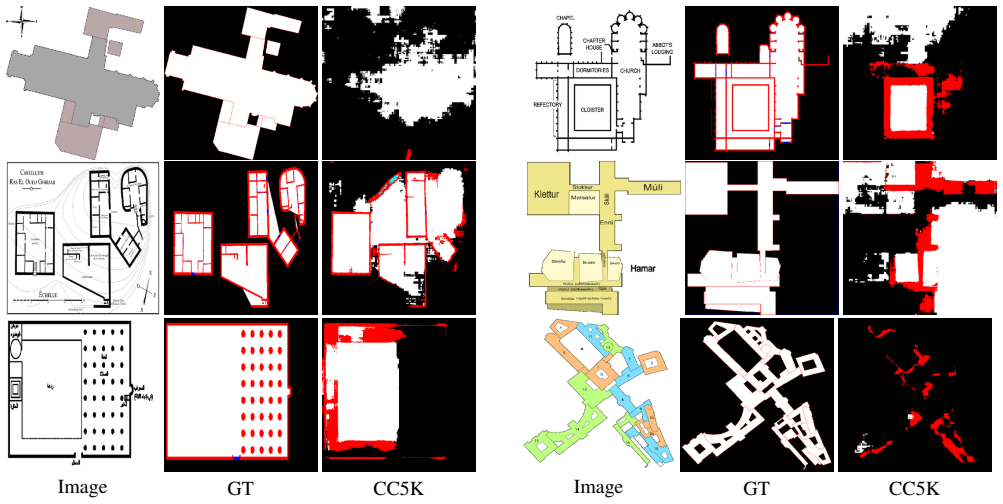
WAFFLE contains nearly 20K floorplan images spanning more than 100 countries, over 1K building types, and over 11K distinct grounded architectural features, with a train/test split of 18,259 and 297 images made by country to prevent building leakage. The paper's claim is that these data enable new discriminative and generative tasks: fine-tuning CLIP on paired images and building-type labels raises retrieval Recall@1 from 1.5% to 11.8%; fine-tuning CLIPSeg on grounded features raises open-vocabulary segmentation Average Precision from 0.157 to 0.226; and fine-tuning Stable Diffusion with prompts like "a floor plan of a <building type>" improves generation realism (FID from 194.8 to 145.3) and prompt alignment, with users preferring the fine-tuned generations 70.42% of the time. The same images also serve as a challenging benchmark: a supervised residential-floorplan segmentation model trained on CubiCasa5K attains only 0.488 IoU on walls in WAFFLE, suggesting that prior narrow datasets do not transfer to diverse real-world floorplans. The paper reports manual inspection of 100 random samples with 85-96% accuracy for the language-model-extracted labels.
Load-bearing premise
The load-bearing premise is that the building type, country, and architectural-feature labels produced by Llama-2 are accurate enough to serve both as training signal and as test ground truth; they are validated only by manual inspection of 100 random samples (85-96% accuracy), and the test-set labels themselves are not re-verified.
Editorial extensions
If this is right
- A model fine-tuned on WAFFLE can identify the building type of a never-seen floorplan, including non-residential types such as castles, temples, and hospitals.
- Open-vocabulary segmentation trained on WAFFLE can localize architectural terms such as nave, choir, and court inside floorplans, including terms absent from fixed residential label sets.
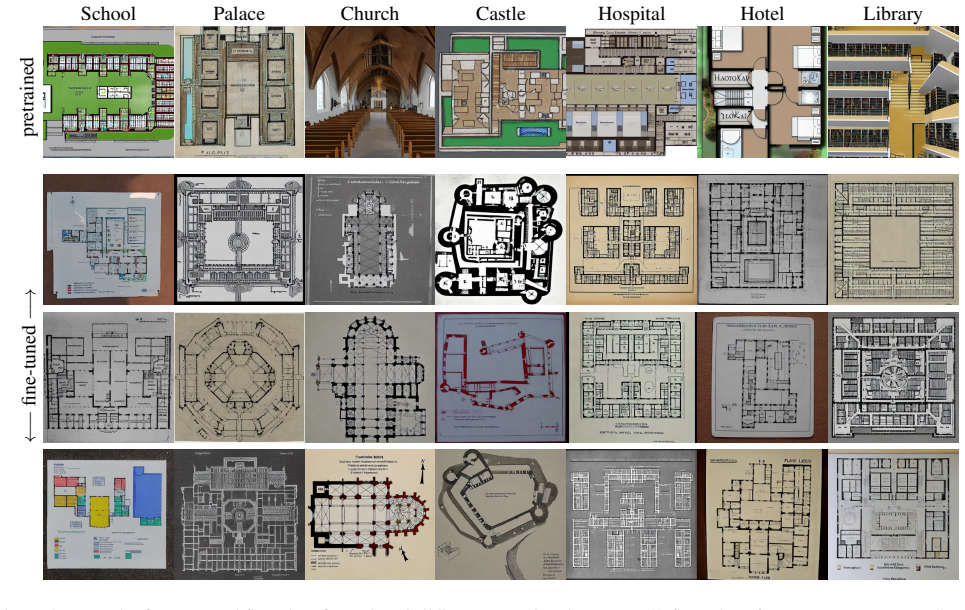
- Text-conditioned generation on WAFFLE produces floorplan images whose structure reflects the prompt type, such as towers for castles and many small rooms for hospitals.
- WAFFLE exposes the limited transfer of existing supervised residential models: their segmentation performance drops sharply on diverse, in-the-wild floorplans.
- Structure-conditioned generation works for diverse building types even when the structural constraint is unusual for that type, because the text condition and layout condition are fused from separate sources.
Reading between the lines
- Inference: because the test split is chosen by country, part of the retrieval and generation gains could come from country-specific visual style rather than building semantics; an audit that swaps or mixes countries would separate these factors.
- Inference: the same LLM-curation pipeline could plausibly transfer to other schematic document families such as maps, engineering drawings, or historic blueprints, though the paper does not test this.
- Inference: the reported label accuracy rests on 100 manual samples; verifying a larger random sample and the full test set would strengthen the case that the pseudo-labels, not metadata bias, drive the results.
- Inference: the dataset's acknowledged skew toward historic and religious buildings implies that models trained on it may underperform on modern commercial and industrial building types.
Signed reviews
Editorial analysis
A structured set of objections, weighed in public.
Referee Report
Summary. The paper introduces WAFFLE, a dataset of 18,556 floorplan images scraped from Wikimedia Commons, with LLM-extracted pseudo-labels (building name, type, country, grounded architectural features) and OCR/detection metadata. The authors evaluate the dataset as a benchmark and as training data for four tasks: fine-tuned CLIP retrieval of building type (Section 4.1), open-vocabulary segmentation with CLIPSeg (Section 4.2), a semantic segmentation benchmark for existing models (Section 4.3), and text- and structure-conditioned floorplan generation with Stable Diffusion and ControlNet (Sections 4.4 and 4.5), including a user study. The central claim is that WAFFLE makes feasible new discriminative and generative building-understanding tasks and that fine-tuning on it improves performance relative to strong baselines.
Significance. If the central claims hold, WAFFLE would be a valuable community resource: it is substantially larger and more diverse in building type and country than existing floorplan datasets, it is built by an automatic pipeline, and it is intended for public release with code and models. The paper also takes useful precautions in the weakly supervised segmentation setup, notably deriving labels from Wikipedia text rather than from image pixels and inpainting OCR regions before training. The overall significance therefore hinges on whether the reported gains reflect visual understanding of floorplan layout rather than text leakage or unverified pseudo-labels; the experiments as reported do not yet establish that.
major comments (4)
- [Section 4.1] Table 2's building-type retrieval experiment feeds raw floorplan images to CLIP without masking or inpainting OCR text, even though Section 4.2 explicitly inpaints OCR regions "to prevent leakage from the written text in the images." In-the-wild floorplans frequently contain titles, labels, and legends, and the dataset pipeline collects OCR detections precisely because this text is informative. The improvement from R@1=1.5% to 11.8% could therefore be driven by reading words such as "cathedral" or "castle" rather than by understanding floorplan layout, leaving the central claim of visual building-type understanding unsupported. The authors should repeat the evaluation on OCR-inpainted or masked images, or on a text-free subset such as the bottom images in Figure 1, to control for this confound.
- [Section 3.3] The pseudo-label validation is limited to 100 random samples from the whole dataset, with reported accuracies of 89% for building names, 85% for building types, and 96% for countries. The manual inspection of the test set only removes images that do not contain a valid floorplan and does not verify the building-type labels that are used as ground truth in the retrieval and generation evaluations (Tables 2, 5, 6). Since building-type pseudo-labels are both the training target and the evaluation target, systematic errors or biases in those labels could inflate the apparent improvements of CLIP_FT and SD_FT. The authors should report pseudo-label accuracy on the test set, with a per-type breakdown, or re-verify the test-set labels before drawing conclusions.
- [Tables 2, 3, 5] The reported comparisons lack confidence intervals, significance tests, or multiple-seed variance, which is necessary to support the paper's "significantly outperforms" language. This is especially important for Table 3, which uses a 95-image manually selected evaluation set and an empirically chosen mIoU threshold of 0.25, and for Table 5, where the CLIP similarity differences (e.g., 24.9 vs 25.6) are small and FID is known to be unstable on small datasets. The user study in Section 4.4 reports a 70.42% preference without a confidence interval or participant-level variance. Adding standard errors, paired tests, or seed-level results would substantially strengthen the central claims.
- [Table 3] The comparison against CC5K in the open-vocabulary segmentation experiment is not apples-to-apples: the footnote states that CC5K was evaluated only over a subset of residential buildings, while CLIPSeg and the fine-tuned model are evaluated on the full manually annotated 95-image set. The claim in Section 4.2 that the method "outperform[s] the strongly-supervised CC5K" is therefore not directly supported by the table as presented. The authors should evaluate all methods on the same image set or clearly report subset sizes and separate results for the common subset.
minor comments (5)
- [Section 4.5] The phrase "we leverage our data in an unsupervised manner" is imprecise for the structure-conditioned experiment, because the ControlNet for internal structure is trained on CubiCasa5K annotations; only the boundary-conditioned variant uses automatically extracted edges from WAFFLE. The caption of Figure 7 also states that the condition is from CubiCasa5K. The text should clarify what is trained on WAFFLE versus external data.
- [Table 6] Fine-tuning actually hurts the Theatre category on FID (238.4 vs 189.5) and KMMD (0.17 vs 0.08) relative to the pretrained model; the claim that fine-tuning improves "the vast majority of building types" should be replaced with a precise statement of the number and identities of categories that improve.
- [Appendix C.2] The semantic-similarity thresholds (0.7 positive, 0.4 negative) and the mIoU binarization threshold (0.25) are set empirically; reporting a short sensitivity analysis would help establish that the segmentation improvement does not depend on these choices.
- [Section 4.4] The kernel used for KMMD is not specified; reproducible reporting of kernel maximum mean discrepancy requires the kernel choice and bandwidth.
- [General] Minor typographical issues: "W AF FLE" and "W AFFLE" appear in the abstract, and "manualy inpect" appears in Appendix B.3.2.
Circularity Check
No significant circularity: WAFFLE is a dataset-and-benchmark paper; its tasks are evaluated against external or manually validated annotations.
full rationale
This paper's central claim is that the WAFFLE dataset enables new building-understanding tasks, not that a particular quantity is derived from first principles. I examined every load-bearing step for reduction to its own inputs. (1) Building-type retrieval (Sec. 4.1) trains CLIP on pseudo-labels extracted from Wikipedia text and evaluates retrieval on held-out test images with a country-based split; the labels are not fitted from image pixels, so this is not a fitted input called a prediction. (2) Open-vocabulary segmentation (Sec. 4.2) uses OCR bounding boxes as weak supervision with OCR regions inpainted during training and is evaluated on 95 manually annotated images; this is standard weakly supervised learning, not self-definitional. (3) The semantic-segmentation benchmark (Sec. 4.3) uses manually annotated ground truth. (4) Generation experiments compare pretrained versus fine-tuned Stable Diffusion using FID, KMMD, CLIP similarity, and a user study; none of these metrics are constructed from the training labels. Self-citations appear only as related-work or metric references and are not load-bearing. The validity risks (pseudo-label noise, text leakage in retrieval) are measurement concerns, not circularity. No circular step can be identified.
Assumptions & free parameters
free parameters (6)
- CLIP positive-score sum threshold =
0.5
- CLIP top-5 floor-plan prompt test =
all top five prompts contain 'floor plan'
- ViT classifier filter threshold =
filter out 10% of data
- Semantic similarity thresholds for segmentation targets =
positive > 0.7, negative < 0.4
- mIoU binarization threshold =
0.25
- ControlNet condition scale and CFG scale =
condition 0.5, CFG 15.0
assumptions (5)
- domain assumption LLM-extracted pseudo-labels (building type, country, grounded architectural features) are accurate enough to serve as training and evaluation ground truth.
- domain assumption OCR detections inside detected floorplan and legend boxes correspond to semantically meaningful architectural features.
- domain assumption Wikipedia and Wikimedia Commons metadata and text are a reliable source of building semantics.
- domain assumption Inpainting OCR text with Stable Diffusion removes leakage while preserving floorplan structure.
- domain assumption The test/train country split prevents building-level leakage.
Cite this review
Pith. "Pith review of WAFFLE: Multimodal Floorplan Understanding in the Wild." pith.science (2026). https://pith.science/paper/6W3ZRDUH
@misc{pith2026241200955,
  author       = {Pith},
  title        = {Pith review of: WAFFLE: Multimodal Floorplan Understanding in the Wild},
  year         = {2026},
  howpublished = {\url{https://pith.science/paper/6W3ZRDUH}},
  note         = {Machine review of arXiv:2412.00955}
}
read the original abstract
Buildings are a central feature of human culture and are increasingly being analyzed with computational methods. However, recent works on computational building understanding have largely focused on natural imagery of buildings, neglecting the fundamental element defining a building's structure -- its floorplan. Conversely, existing works on floorplan understanding are extremely limited in scope, often focusing on floorplans of a single semantic category and region (e.g. floorplans of apartments from a single country). In this work, we introduce WAFFLE, a novel multimodal floorplan understanding dataset of nearly 20K floorplan images and metadata curated from Internet data spanning diverse building types, locations, and data formats. By using a large language model and multimodal foundation models, we curate and extract semantic information from these images and their accompanying noisy metadata. We show that WAFFLE enables progress on new building understanding tasks, both discriminative and generative, which were not feasible using prior datasets. We will publicly release WAFFLE along with our code and trained models, providing the research community with a new foundation for learning the semantics of buildings.
Figures


Figures from the paper (24 more)





Reference graph
Works this paper leans on
-
[1]
LinkTransformer: A Unified Package for Record Linkage with Transformer Language Models
Abhishek Arora and Melissa Dell. Linktransformer: A uni- fied package for record linkage with transformer language models. arXiv preprint arXiv:2309.00789, 2023. 4
work page Pith review arXiv 2023
-
[2]
Piecewise planar and compact floorplan reconstruction from images
Ricardo Cabral and Yasutaka Furukawa. Piecewise planar and compact floorplan reconstruction from images. In 2014 IEEE Conference on Computer Vision and Pattern Recogni- tion, pages 628–635. IEEE, 2014. 2
work page 2014
-
[3]
End-to- end object detection with transformers
Nicolas Carion, Francisco Massa, Gabriel Synnaeve, Nicolas Usunier, Alexander Kirillov, and Sergey Zagoruyko. End-to- end object detection with transformers. In European confer- ence on computer vision, pages 213–229. Springer, 2020. 3, 1
work page 2020
-
[4]
What’s in a decade? transforming faces through time
Eric Ming Chen, Jin Sun, Apoorv Khandelwal, Dani Lischin- ski, Noah Snavely, and Hadar Averbuch-Elor. What’s in a decade? transforming faces through time. In Computer Graphics Forum, volume 42, pages 281–291. Wiley Online Library, 2023. 6
work page 2023
-
[5]
Effectively unbiased fid and inception score and where to find them, 2020
Min Jin Chong and David Forsyth. Effectively unbiased fid and inception score and where to find them, 2020. 6
work page 2020
-
[6]
You are here: Mimicking the human thinking process in reading floor- plans
Hang Chu, Dong Ki Kim, and Tsuhan Chen. You are here: Mimicking the human thinking process in reading floor- plans. In Proceedings of the IEEE International Conference on Computer Vision, pages 2210–2218, 2015. 2
work page 2015
-
[7]
Zillow indoor dataset: Annotated floor plans with 360deg panoramas and 3d room layouts
Steve Cruz, Will Hutchcroft, Yuguang Li, Naji Khosravan, Ivaylo Boyadzhiev, and Sing Bing Kang. Zillow indoor dataset: Annotated floor plans with 360deg panoramas and 3d room layouts. In Proceedings of the IEEE/CVF con- ference on computer vision and pattern recognition , pages 2133–2143, 2021. 3
work page 2021
-
[8]
Mathieu Delalandre, Ernest Valveny, Tony Pridmore, and Dimosthenis Karatzas. Generation of synthetic documents for performance evaluation of symbol recognition & spot- ting systems. International Journal on Document Analysis and Recognition (IJDAR), 13(3):187–207, 2010. 3
work page 2010
Show all 52 references
-
[9]
Parsing floor plan images
Samuel Dodge, Jiu Xu, and Bj ¨orn Stenger. Parsing floor plan images. In 2017 Fifteenth IAPR international conference on machine vision applications (MVA) , pages 358–361. IEEE,
2017
-
[10]
An image is worth 16x16 words: Trans- formers for image recognition at scale
Alexey Dosovitskiy, Lucas Beyer, Alexander Kolesnikov, Dirk Weissenborn, Xiaohua Zhai, Thomas Unterthiner, Mostafa Dehghani, Matthias Minderer, Georg Heigold, Syl- vain Gelly, et al. An image is worth 16x16 words: Trans- formers for image recognition at scale. arXiv preprint a...
2010 arXiv
-
[11]
Floorplancad: A large-scale cad drawing dataset for panoptic symbol
Zhiwen Fan, Lingjie Zhu, Honghua Li, Siyu Zhu, and Ping Tan. Floorplancad: A large-scale cad drawing dataset for panoptic symbol. In Proceedings of the IEEE/CVF Inter- national Conference on Computer Vision (ICCV) , October
-
[12]
Floor plan reconstruction from sparse views: Combining graph neural network with constrained diffusion
Arnaud Gueze, Matthieu Ospici, Damien Rohmer, and Marie-Paule Cani. Floor plan reconstruction from sparse views: Combining graph neural network with constrained diffusion. In Proceedings of the IEEE/CVF International Conference on Computer Vision, pages 1583–1592, 2023. 2
2023
-
[13]
Deep residual learning for image recognition
Kaiming He, Xiangyu Zhang, Shaoqing Ren, and Jian Sun. Deep residual learning for image recognition. In Proceed- ings of the IEEE conference on computer vision and pattern recognition, pages 770–778, 2016. 6
2016
-
[14]
Gans trained by a two time-scale update rule converge to a local nash equilib- rium, 2018
Martin Heusel, Hubert Ramsauer, Thomas Unterthiner, Bernhard Nessler, and Sepp Hochreiter. Gans trained by a two time-scale update rule converge to a local nash equilib- rium, 2018. 6
2018
-
[15]
Puzzlefusion: Unleash- ing the power of diffusion models for spatial puzzle solv- ing
Sepidehsadat Hosseini, Mohammad Amin Shabani, Saghar Irandoust, and Yasutaka Furukawa. Puzzlefusion: Unleash- ing the power of diffusion models for spatial puzzle solv- ing. In Thirty-seventh Conference on Neural Information Processing Systems, 2023. 2
2023
-
[16]
Graph2plan: Learning floor- plan generation from layout graphs
Ruizhen Hu, Zeyu Huang, Yuhan Tang, Oliver Van Kaick, Hao Zhang, and Hui Huang. Graph2plan: Learning floor- plan generation from layout graphs. ACM Transactions on Graphics (TOG), 39(4):118–1, 2020. 2, 8
2020
-
[17]
Irregular architectural layout synthesis with graph- ical inputs
Hao Hua. Irregular architectural layout synthesis with graph- ical inputs. Automation in construction, 72:388–396, 2016. 2, 8
2016
-
[18]
Cubicasa5k: A dataset and an im- proved multi-task model for floorplan image analysis
Ahti Kalervo, Juha Ylioinas, Markus H ¨aiki¨o, Antti Karhu, and Juho Kannala. Cubicasa5k: A dataset and an im- proved multi-task model for floorplan image analysis. In Image Analysis: 21st Scandinavian Conference, SCIA 2019, Norrk¨oping, Sweden, June 11–13, 2019, Proceedings 2...
2019
-
[19]
Alignment of 3d point clouds to overhead images
Ryan S Kaminsky, Noah Snavely, Steven M Seitz, and Richard Szeliski. Alignment of 3d point clouds to overhead images. In 2009 IEEE computer society conference on com- puter vision and pattern recognition workshops , pages 63–
2009
-
[20]
Adam: A method for stochastic optimization
Diederik P Kingma and Jimmy Ba. Adam: A method for stochastic optimization. arXiv preprint arXiv:1412.6980 ,
-
[21]
Floornet: A unified framework for floorplan reconstruction from 3d scans
Chen Liu, Jiaye Wu, and Yasutaka Furukawa. Floornet: A unified framework for floorplan reconstruction from 3d scans. In Proceedings of the European conference on com- puter vision (ECCV), pages 201–217, 2018. 2
2018
-
[22]
Raster-to-vector: Revisiting floorplan transforma- tion
Chen Liu, Jiajun Wu, Pushmeet Kohli, and Yasutaka Fu- rukawa. Raster-to-vector: Revisiting floorplan transforma- tion. In Proceedings of the IEEE International Conference on Computer Vision, pages 2195–2203, 2017. 2, 3, 6
2017
-
[23]
Image segmenta- tion using text and image prompts
Timo L ¨uddecke and Alexander Ecker. Image segmenta- tion using text and image prompts. In Proceedings of the IEEE/CVF Conference on Computer Vision and Pattern Recognition, pages 7086–7096, 2022. 5, 3, 9
2022
-
[24]
Residential floor plan recognition and reconstruction
Xiaolei Lv, Shengchu Zhao, Xinyang Yu, and Binqiang Zhao. Residential floor plan recognition and reconstruction. In Proceedings of the IEEE/CVF Conference on Computer Vision and Pattern Recognition, pages 16717–16726, 2021. 2
2021
-
[25]
The 3d jigsaw puzzle: Mapping large in- door spaces
Ricardo Martin-Brualla, Yanling He, Bryan C Russell, and Steven M Seitz. The 3d jigsaw puzzle: Mapping large in- door spaces. In Computer Vision–ECCV 2014: 13th Eu- ropean Conference, Zurich, Switzerland, September 6-12, 2014, Proceedings, Part III 13, pages 1–16. Springer, 2014. 2
2014
-
[26]
Computer- generated residential building layouts
Paul Merrell, Eric Schkufza, and Vladlen Koltun. Computer- generated residential building layouts. In ACM SIGGRAPH Asia 2010 papers, pages 1–12. 2010. 2, 8
2010
-
[27]
Seeing the un-scene: Learning amodal semantic maps for room navigation
Medhini Narasimhan, Erik Wijmans, Xinlei Chen, Trevor Darrell, Dhruv Batra, Devi Parikh, and Amanpreet Singh. Seeing the un-scene: Learning amodal semantic maps for room navigation. In Computer Vision–ECCV 2020: 16th European Conference, Glasgow, UK, August 23–28, 2020, Procee...
2020
-
[28]
Image generation from small datasets via batch statistics adaptation, 2019
Atsuhiro Noguchi and Tatsuya Harada. Image generation from small datasets via batch statistics adaptation, 2019. 6
2019
-
[29]
Large-scale image retrieval with attentive deep local features
Hyeonwoo Noh, Andre Araujo, Jack Sim, Tobias Weyand, and Bohyung Han. Large-scale image retrieval with attentive deep local features. In Proceedings of the IEEE international conference on computer vision, pages 3456–3465, 2017. 3
2017
-
[30]
Read: Recursive autoencoders for document layout generation
Akshay Gadi Patil, Omri Ben-Eliezer, Or Perel, and Hadar Averbuch-Elor. Read: Recursive autoencoders for document layout generation. In Proceedings of the IEEE/CVF Con- ference on Computer Vision and Pattern Recognition Work- shops, pages 544–545, 2020. 2
2020
-
[31]
Learning transferable visual models from natural language supervi- sion
Alec Radford, Jong Wook Kim, Chris Hallacy, Aditya Ramesh, Gabriel Goh, Sandhini Agarwal, Girish Sastry, Amanda Askell, Pamela Mishkin, Jack Clark, et al. Learning transferable visual models from natural language supervi- sion. In International conference on machine learning, ...
2021
-
[32]
High-resolution image syn- thesis with latent diffusion models, 2022
Robin Rombach, Andreas Blattmann, Dominik Lorenz, Patrick Esser, and Bj¨orn Ommer. High-resolution image syn- thesis with latent diffusion models, 2022. 5, 6, 4
2022
-
[33]
Ex- treme structure from motion for indoor panoramas without visual overlaps
Mohammad Amin Shabani, Weilian Song, Makoto Odamaki, Hirochika Fujiki, and Yasutaka Furukawa. Ex- treme structure from motion for indoor panoramas without visual overlaps. In Proceedings of the IEEE/CVF Interna- tional Conference on Computer Vision , pages 5703–5711,
-
[34]
Matthias Standfest, Michael Franzen, Yvonne Schr ¨oder, Luis Gonzales Medina, Yarilo Villanueva Hernandez, Jan Hendrik Buck, Yen-Ling Tan, Milena Niedzwiecka, and Rachele Colmegna. Swiss dwellings: a large dataset of apart- ment models including aggregated geolocation-based si...
2022
-
[35]
Rethinking the inception archi- tecture for computer vision
Christian Szegedy, Vincent Vanhoucke, Sergey Ioffe, Jon Shlens, and Zbigniew Wojna. Rethinking the inception archi- tecture for computer vision. In Proceedings of the IEEE con- ference on computer vision and pattern recognition , pages 2818–2826, 2016. 6
2016
-
[36]
Llama 2: Open foundation and fine-tuned chat models.arXiv preprint arXiv:2307.09288, 2023
Hugo Touvron, Louis Martin, Kevin Stone, Peter Albert, Amjad Almahairi, Yasmine Babaei, Nikolay Bashlykov, Soumya Batra, Prajjwal Bhargava, Shruti Bhosale, et al. Llama 2: Open foundation and fine-tuned chat models.arXiv preprint arXiv:2307.09288, 2023. 4, 1
2023 arXiv
-
[37]
Mod- ified swiss dwellings: a machine learning-ready dataset for floor plan auto-completion at scale, 2023
Casper van Engelenburg, Seyran Khademi, Fatemeh Mostafavi, Matthias Standfest, and Michael Franzen. Mod- ified swiss dwellings: a machine learning-ready dataset for floor plan auto-completion at scale, 2023. 3
2023
-
[38]
Plan2scene: Convert- ing floorplans to 3d scenes
Madhawa Vidanapathirana, Qirui Wu, Yasutaka Furukawa, Angel X Chang, and Manolis Savva. Plan2scene: Convert- ing floorplans to 3d scenes. In Proceedings of the IEEE/CVF Conference on Computer Vision and Pattern Recognition , pages 10733–10742, 2021. 3
2021
-
[39]
Lost shopping! monocular localization in large indoor spaces
Shenlong Wang, Sanja Fidler, and Raquel Urtasun. Lost shopping! monocular localization in large indoor spaces. In Proceedings of the IEEE International Conference on Com- puter Vision, pages 2695–2703, 2015. 2
2015
-
[40]
Minegan: effective knowledge transfer from gans to target domains with few images
Yaxing Wang, Abel Gonzalez-Garcia, David Berga, Luis Herranz, Fahad Shahbaz Khan, and Joost van de Weijer. Minegan: effective knowledge transfer from gans to target domains with few images. In Proceedings of the IEEE/CVF Conference on Computer Vision and Pattern Recognition , ...
2020
-
[41]
Automated floorplan generation in architectural design: A review of methods and applications
Ramon Elias Weber, Caitlin Mueller, and Christoph Rein- hart. Automated floorplan generation in architectural design: A review of methods and applications. Automation in Con- struction, 140:104385, 2022. 2
2022
-
[42]
Google landmarks dataset v2-a large-scale benchmark for instance-level recognition and retrieval
Tobias Weyand, Andre Araujo, Bingyi Cao, and Jack Sim. Google landmarks dataset v2-a large-scale benchmark for instance-level recognition and retrieval. In Proceedings of the IEEE/CVF conference on computer vision and pattern recognition, pages 2575–2584, 2020. 3
2020
-
[43]
Data-driven interior plan genera- tion for residential buildings
Wenming Wu, Xiao-Ming Fu, Rui Tang, Yuhan Wang, Yu- Hao Qi, and Ligang Liu. Data-driven interior plan genera- tion for residential buildings. ACM Transactions on Graph- ics (TOG), 38(6):1–12, 2019. 2, 3, 6, 8
2019
-
[44]
Towers of babel: Combining images, language, and 3d geometry for learning multimodal vision
Xiaoshi Wu, Hadar Averbuch-Elor, Jin Sun, and Noah Snavely. Towers of babel: Combining images, language, and 3d geometry for learning multimodal vision. In Proceedings of the IEEE/CVF International Conference on Computer Vi- sion, pages 428–437, 2021. 3
2021
-
[45]
Vec- torfloorseg: Two-stream graph attention network for vector- ized roughcast floorplan segmentation
Bingchen Yang, Haiyong Jiang, Hao Pan, and Jun Xiao. Vec- torfloorseg: Two-stream graph attention network for vector- ized roughcast floorplan segmentation. In Proceedings of the IEEE/CVF Conference on Computer Vision and Pattern Recognition, pages 1358–1367, 2023. 2
2023
-
[46]
Dula-net: A dual-projection network for estimating room layouts from a single rgb panorama
Shang-Ta Yang, Fu-En Wang, Chi-Han Peng, Peter Wonka, Min Sun, and Hung-Kuo Chu. Dula-net: A dual-projection network for estimating room layouts from a single rgb panorama. In Proceedings of the IEEE/CVF Conference on Computer Vision and Pattern Recognition , pages 3363– 3372, 2019. 2
2019
-
[47]
Connecting the dots: Floorplan reconstruction using two-level queries
Yuanwen Yue, Theodora Kontogianni, Konrad Schindler, and Francis Engelmann. Connecting the dots: Floorplan reconstruction using two-level queries. In Proceedings of the IEEE/CVF Conference on Computer Vision and Pattern Recognition, pages 845–854, 2023. 2
2023
-
[48]
Deep floor plan recognition using a multi-task network with room-boundary-guided attention
Zhiliang Zeng, Xianzhi Li, Ying Kin Yu, and Chi-Wing Fu. Deep floor plan recognition using a multi-task network with room-boundary-guided attention. In Proceedings of the IEEE/CVF International Conference on Computer Vision , pages 9096–9104, 2019. 2
2019
-
[49]
Adding conditional control to text-to-image diffusion models, 2023
Lvmin Zhang, Anyi Rao, and Maneesh Agrawala. Adding conditional control to text-to-image diffusion models, 2023. 8, 4, 5
2023
-
[50]
Content-aware generative modeling of graphic design layouts
Xinru Zheng, Xiaotian Qiao, Ying Cao, and Rynson WH Lau. Content-aware generative modeling of graphic design layouts. ACM Transactions on Graphics (TOG), 38(4):1–15,
-
[52]
an illustration of
for image-related tasks. For most text related tasks we use the meta-llama/Llama-2-13b-chat-hf model, and for legend extraction we use the meta-llama/Llama-2-70b-chat-hf model. In both cases, we use the default sampling settings de- fined by the Hugging Face API. For CLIP, we ...
-
[2019]
Interactive Visualization Tool Please see the attached HTML file ( waffle.html) for an interactive visualization of data from the WAFFLE dataset
2 Appendix A. Interactive Visualization Tool Please see the attached HTML file ( waffle.html) for an interactive visualization of data from the WAFFLE dataset. B. Additional Dataset Details We proceed to describe the creation of our WAFFLE dataset in the sections below, includ...
Reviewed August 12, 2026 · model on record in the stance chip above.
Discussion (0). Continue with ORCID to comment.