REVIEW 4 major objections 5 minor 42 references
Data Uncertainty-Aware Learning for Multimodal Aspect-based Sentiment Analysis
T0 review · 4 major / 5 minor · reviewed 2026-08-12 · deepseek-v4-flash
Pith's one-line read Reweighting each training sample by image quality and cross-modal relevance improves multimodal aspect sentiment classification, giving the best macro-F1 among compared models on Twitter-2015.
desk verdict A coherent quality-weighted loss for MABSA that gets modest gains on one benchmark, but the attribution to the quality scores is under-tested: no error bars, no permutation control, and threshold tuning that may leak test information. read the letter →
The pith
A machine-rendered reading of the paper's core claim, the machinery that carries it, and where it could break.
The reading
What carries the argument
The load-bearing identity is the uncertainty-aware loss $L' = \mathrm{avg}(W^{\mathrm{Image}}_i + W^{\mathrm{IT}}_i + W^{\mathrm{AI}}_i) \cdot L$, where $L$ is the standard cross-entropy loss for aspect sentiment classification. Each of the three weights lies roughly in a comparable range: $W^{\mathrm{Image}}_i$ comes from OpenCV quality heuristics and an OCR text-length penalty, while $W^{\mathrm{IT}}_i$ and $W^{\mathrm{AI}}_i$ come from CLIP cosine similarities computed with in-batch negative sampling. Averaging the three and multiplying the loss re-weights the training objective so that a sample that is visually clear, well matched to its text, and specifically matched to the target aspect gets a larger share of gradient update, and a noisy or weakly coupled sample gets a smaller share.
What would settle it
Run the same UA-MABSA training on Twitter-2015 with the quality weights randomly permuted across training samples while keeping the same weight distribution; if accuracy and macro-F1 stay at the reported level, the improvement is not attributable to the quality scores themselves.
Extended reading notes
Core claim
The central discovery is that a per-sample training weight built from three quality signals improves aspect-level sentiment classification and can be grafted onto existing backbones. The image quality score $W^{\mathrm{Image}}_i$ averages OpenCV-derived measures of brightness, contrast, sharpness, color, and resolution plus a penalty for the length of OCR-detected text inside the image. The coarse relevance score $W^{\mathrm{IT}}_i$ is the CLIP cosine similarity between the image and the tweet text, and the fine relevance score $W^{\mathrm{AI}}_i$ is the CLIP cosine similarity between the aspect phrase and the image. The final loss is $L' = \mathrm{avg}(W^{\mathrm{Image}}_i + W^{\mathrm{IT}}_i + W^{\mathrm{AI}}_i) \cdot L$, which makes the model spend less effort on low-quality, weakly aligned samples while keeping full loss on clear and challenging ones.
Load-bearing premise
The weights rest on the premise that OpenCV image metrics and CLIP cosine similarities rank sample quality correctly; if they mislabel informative samples as low quality, reweighting would suppress useful learning and the gains would not transfer.
Editorial extensions
If this is right
- On Twitter-2015, UA-MABSA reports 78.88 accuracy and 74.49 macro-F1, the best macro-F1 among the compared BERT-based models, and it stays competitive on Twitter-2017.
- Slotting the same quality weights into TomBERT (UA-TomBERT) improves that baseline by 1.34 accuracy and 2.15 macro-F1 on Twitter-2015, so the reweighting transfers across backbone designs.
- Ablation shows that each of the three scores contributes; removing the aspect-image relevance score hurts most on Twitter-2015, while removing the image quality score hurts most on Twitter-2017.
- Because the method only changes the loss function, it can be combined with prior MABSA systems by reweighting their losses instead of redesigning their encoders.
Reading between the lines
- A direct extension is to use the same three quality scores in other weakly supervised multimodal tasks, such as multimodal named entity recognition or visual question answering, since the weighting does not depend on sentiment labels.
- The paper's threshold tuning (e.g., choosing 200 for resolution and OCR length) is manual; a learned calibrator that maps quality scores to weights without hand-set thresholds would test whether the gains persist.
- Because CLIP supplies both relevance scores, an alternative experiment would use a quality estimator trained independently of the backbone, isolating whether the improvement comes from the quality signal or from CLIP's own textual priors leaking into the weighting.
- The authors note that Twitter-2017, which they believe has a higher share of low-quality data, benefits less; artificially corrupting or restoring image quality in a controlled way would directly test whether reweighting helps most when low-quality samples are the minority.
Editorial analysis
A structured set of objections, weighed in public.
Referee Report
Summary. The paper proposes UA-MABSA, a training-time sample-reweighting method for multimodal aspect-based sentiment analysis (MABSA). For each sample, the method computes a data-quality weight from three sources: an OpenCV-based image-quality score (brightness, contrast, sharpness, color constancy, resolution, plus an OCR-derived in-image text-length term), a CLIP-based coarse-grained image-text relevance score, and a CLIP-based fine-grained aspect-image relevance score; the three terms are averaged in Eq. (9) and multiply the standard cross-entropy loss, so that low-quality samples contribute less to training. The backbone is a BERT-based caption-fusion model in the style of CapBERT and FITE. Experiments on Twitter-2015 and Twitter-2017 report the best accuracy and macro-F1 among the compared BERT-based systems on Twitter-2015 (78.88 and 74.49), smaller gains on Twitter-2017, and a loss to VLP-MABSA on Twitter-2017; the authors also show that the reweighting transfers to a second backbone (UA-TomBERT) and provide ablations of each score component. The announced contribution is a first treatment of data uncertainty in fine-grained multimodal sentiment analysis, implemented as a quality-aware loss reweighting.
Significance. If the empirical claims hold, this is a useful and simple plug-in contribution: it introduces a quality/uncertainty dimension that prior MABSA work does not explicitly model, and the two-backbone evaluation (UA-MABSA and UA-TomBERT) together with component ablations gives reasonable evidence that each of the three score terms carries some signal. The authors also deserve credit for excluding BERTweet-based baselines to keep the comparison fair, for including a case study that shows what the weights capture, and for an explicit Limitations paragraph acknowledging the manual thresholds and the reliance on CLIP supervision. That said, the significance is currently capped by three unaddressed points: the reported margins over the best baselines are comparable in size to run-to-run variation and no variances or significance tests are reported; the threshold-selection protocol is under-specified and appears to be test-based; and there is no control showing that the specific quality assignment, rather than generic per-sample loss reweighting, is what produces the gains.
major comments (4)
- [Section 4.1 / Table 2] The paper reports 'average results of 5 independent training runs' but gives no standard deviations, per-run results, or significance tests. The headline margins over the strongest baselines on Twitter-2015 are Acc +0.20 over KEF and +0.39 over FITE, and Macro-F1 +0.74 over FITE and VLP-MABSA; these gaps are of the same order as typical run-to-run variation when fine-tuning BERT-sized models, so the SOTA claim is not yet supported. Please report per-run variances and run a paired significance test (e.g., bootstrap or approximate randomization over the five runs) for the comparisons that back the SOTA claim, and report the test for both metrics.
- [Section 4.4 / Figure 4] The threshold-selection protocol is not specified. It is not stated whether the thresholds for resolution score and OCR text length, and the 'remaining thresholds' deferred to an appendix that this version does not contain, were chosen on the validation split, and the performance curves in Figure 4 appear to be computed on test data; if so, the final test numbers are optimistically selected. The Limitations section itself concedes that 'the assessment of sample quality still requires manual threshold judgment.' Please specify the selection protocol, provide the full threshold table, and report test results for thresholds chosen on validation only.
- [Section 3.4 / Eqs. (5), (8), (9)] The quality weights are computed using learnable projections W_v, W_s, W'_a, W'_v 'during the training process', but the paper never states whether these projections receive gradients through the reweighted loss L' in Eq. (9). If they do, the weighting is an adaptive training signal rather than a fixed quality estimate, which changes the interpretation of the method; if they are detached, the phrase 'learnable weights' is misleading and should be clarified. In addition, the image-text and aspect-image terms are temperature-scaled cosine similarities that can be negative, so the averaged weight in Eq. (9) can be negative for some samples, which would invert the sign of that sample's loss contribution; no normalization, lower bound, or clipping of the weights is described. The paper should state the effective range of the final weight and the clipping procedure, if any.
- [Section 3.5 / Table 3] The ablations compare the full weighting only against removing one score component or removing all weighting; they do not test whether the specific assignment of weights to samples matters. A control that randomly permutes the computed weights across training samples, preserving the weight distribution and the loss scale, would determine whether the gains come from the quality signal or from the regularizing effect of per-sample loss reweighting per se. Since the central claim is that the quality scores identify which samples should be down-weighted, this control is required to rule out the alternative explanation that any sample-dependent reweighting improves robustness on this skewed dataset.
minor comments (5)
- [Section 3.1 / Eqs. (4), (7)] The symbol N is used both for the number of words in the text (Section 3.1) and for the in-batch sample size (Eqs. (4) and (7)); please rename one of them.
- [Eqs. (5) and (8)] The expression '* et' is presumably intended to denote multiplication by an exponential temperature e^t; please use unambiguous notation and state the temperature value used in the experiments.
- [Table 3] For the 'w/o Image Quality' ablation rows it is unclear whether the OCR text-length factor is part of the image-quality score that is removed; please specify the exact composition of each ablated term in Eq. (9).
- [Figure 4] The axes and curves in Figure 4 are not fully labeled; it is unclear which metric (Acc or Macro-F1) is plotted, whether both curves share the x-axis, and which threshold values were scanned. Please add axis labels and legends and state the scan ranges.
- [Section 4.3 vs. Section 4.4 / Figure 5] Section 4.3 conjectures that Twitter-2017 has a high proportion of low-quality data, but Section 4.4 states that the quality-weight distributions of the two datasets are similar; please reconcile these statements or remove the unsupported conjecture.
Circularity Check
No significant circularity: the sample weights come from external OpenCV and CLIP scores and are not fit to the target labels or predicted outputs, so the reported SOTA results are an independent empirical claim.
full rationale
The paper's derivation chain is a reweighted-loss heuristic, not a self-referential argument. The image-quality score in Eqs. 1-2 is computed from OpenCV heuristics (resolution, OCR text length, etc.), the coarse-grained correlation in Eq. 5 and fine-grained correlation in Eq. 8 are cosine similarities from CLIP encoders, and Eq. 9 combines these as a scalar multiplier on the standard cross-entropy loss L. None of these quantities is defined in terms of the model's predicted sentiment labels, and no fitted parameter is renamed as a prediction: the reported accuracy and Macro-F1 are test-set results of a model trained with that fixed reweighting, while the weights are computed before training and are not tuned to maximize the reported metrics. The ablation study (Table 3) is an empirical comparison, not a construction that forces the conclusion. The paper cites FITE (Yang et al. 2022a), which shares authors, but only as a related baseline and as backbone inspiration; the central uncertainty-weighting claim does not rest on a self-citation or an imported uniqueness theorem. The Limitations section explicitly acknowledges that the quality assessment needs manual thresholds and relies on CLIP for supervision, which is a reproducibility and robustness concern rather than circularity. The statement in Section 4.4 that 'The remaining thresholds can refer to the appendix' is an unresolved missing reference in this version and the threshold-selection protocol is underspecified, but this affects overfitting risk and reproducibility, not the logical circularity of the method. Overall, the empirical claim is self-contained with respect to external benchmarks and does not reduce by definition to its inputs.
Assumptions & free parameters
free parameters (3)
- Resolution threshold t_r =
200
- OCR text length threshold t_text =
200
- Thresholds for brightness, contrast, sharpness, color constancy =
Not reported (appendix missing)
assumptions (3)
- domain assumption OpenCV and CLIP scores are reliable measures of sample quality for MABSA
- domain assumption In-batch negative sampling yields stable image-text and aspect-image correlation estimates
- ad hoc to paper Weighting the cross-entropy loss by the average quality score improves generalization
Cite this review
Pith. "Pith review of Data Uncertainty-Aware Learning for Multimodal Aspect-based Sentiment Analysis." pith.science (2026). https://pith.science/paper/YJKK4PLB
@misc{pith2026241201249,
  author       = {Pith},
  title        = {Pith review of: Data Uncertainty-Aware Learning for Multimodal Aspect-based Sentiment Analysis},
  year         = {2026},
  howpublished = {\url{https://pith.science/paper/YJKK4PLB}},
  note         = {Machine review of arXiv:2412.01249}
}
read the original abstract
As a fine-grained task, multimodal aspect-based sentiment analysis (MABSA) mainly focuses on identifying aspect-level sentiment information in the text-image pair. However, we observe that it is difficult to recognize the sentiment of aspects in low-quality samples, such as those with low-resolution images that tend to contain noise. And in the real world, the quality of data usually varies for different samples, such noise is called data uncertainty. But previous works for the MABSA task treat different quality samples with the same importance and ignored the influence of data uncertainty. In this paper, we propose a novel data uncertainty-aware multimodal aspect-based sentiment analysis approach, UA-MABSA, which weighted the loss of different samples by the data quality and difficulty. UA-MABSA adopts a novel quality assessment strategy that takes into account both the image quality and the aspect-based cross-modal relevance, thus enabling the model to pay more attention to high-quality and challenging samples. Extensive experiments show that our method achieves state-of-the-art (SOTA) performance on the Twitter-2015 dataset. Further analysis demonstrates the effectiveness of the quality assessment strategy.
Figures
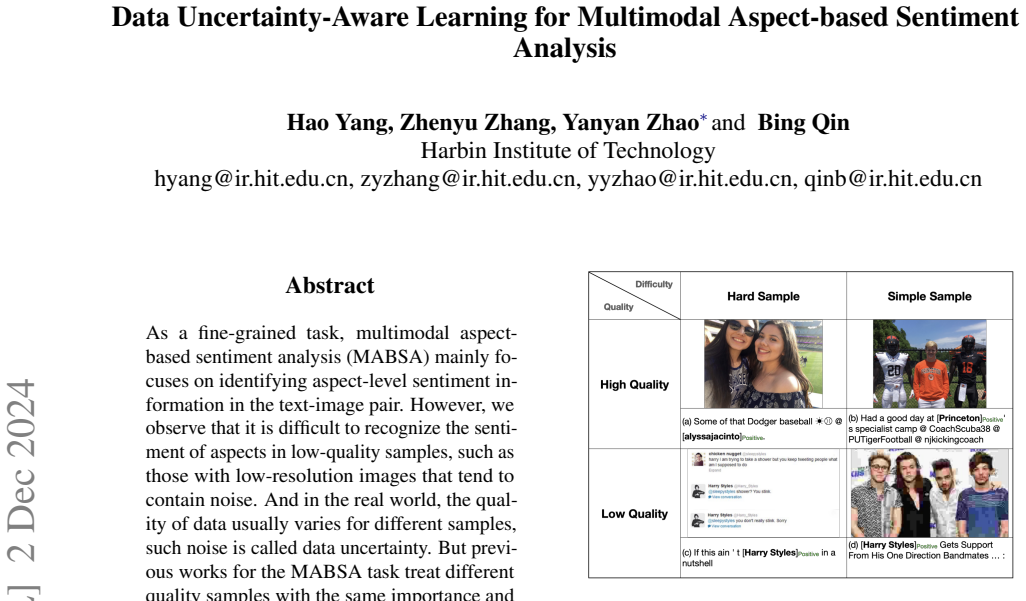


Figures from the paper (3 more)


Reference graph
Works this paper leans on
-
[1]
Moloud Abdar, Farhad Pourpanah, Sadiq Hussain, Dana Rezazadegan, Li Liu, Mohammad Ghavamzadeh, Paul Fieguth, Xiaochun Cao, Abbas Khosravi, U Rajendra Acharya, et al. 2021. A review of uncertainty quantification in deep learning: Techniques, applications and challenges. Information Fusion, 76:243--297
work page 2021
-
[2]
Charles Blundell, Julien Cornebise, Koray Kavukcuoglu, and Daan Wierstra. 2015. Weight uncertainty in neural network. In International conference on machine learning, pages 1613--1622. PMLR
work page 2015
-
[3]
Jie Chang, Zhonghao Lan, Changmao Cheng, and Yichen Wei. 2020. Data uncertainty learning in face recognition. In Proceedings of the IEEE/CVF conference on computer vision and pattern recognition, pages 5710--5719
work page 2020
-
[4]
Xiang Chen, Ningyu Zhang, Lei Li, Yunzhi Yao, Shumin Deng, Chuanqi Tan, Fei Huang, Luo Si, and Huajun Chen. 2022. Good visual guidance make a better extractor: Hierarchical visual prefix for multimodal entity and relation extraction. In Findings of the Association for Computational Linguistics: NAACL 2022, pages 1607--1618
work page 2022
-
[5]
Jiwoong Choi, Dayoung Chun, Hyun Kim, and Hyuk-Jae Lee. 2019. Gaussian yolov3: An accurate and fast object detector using localization uncertainty for autonomous driving. In Proceedings of the IEEE/CVF International Conference on Computer Vision, pages 502--511
work page 2019
-
[6]
Jacob Devlin, Ming-Wei Chang, Kenton Lee, and Kristina Toutanova. 2019. https://doi.org/10.18653/v1/N19-1423 BERT : Pre-training of deep bidirectional transformers for language understanding . In Proceedings of the 2019 Conference of the North A merican Chapter of the Association for Computational Linguistics: Human Language Technologies, Volume 1 (Long a...
-
[7]
Feifan Fan, Yansong Feng, and Dongyan Zhao. 2018. Multi-grained attention network for aspect-level sentiment classification. In Proceedings of the 2018 conference on empirical methods in natural language processing, pages 3433--3442
work page 2018
-
[8]
Yarin Gal and Zoubin Ghahramani. 2016. Dropout as a bayesian approximation: Representing model uncertainty in deep learning. In international conference on machine learning, pages 1050--1059. PMLR
2016
Show all 42 references
-
[9]
Yu Geng, Zongbo Han, Changqing Zhang, and Qinghua Hu. 2021. Uncertainty-aware multi-view representation learning. In Proceedings of the AAAI Conference on Artificial Intelligence, volume 35, pages 7545--7553
2021
-
[10]
Mahesh Gour and Sweta Jain. 2022. Uncertainty-aware convolutional neural network for covid-19 x-ray images classification. Computers in biology and medicine, 140:105047
2022
-
[11]
Kaiming He, Xiangyu Zhang, Shaoqing Ren, and Jian Sun. 2016. Deep residual learning for image recognition. In Proceedings of the IEEE conference on computer vision and pattern recognition, pages 770--778
2016
-
[12]
Yatai Ji, Junjie Wang, Yuan Gong, Lin Zhang, Yanru Zhu, Hongfa Wang, Jiaxing Zhang, Tetsuya Sakai, and Yujiu Yang. 2023. Map: Multimodal uncertainty-aware vision-language pre-training model. In Proceedings of the IEEE/CVF Conference on Computer Vision and Pattern Recognition, ...
2023
-
[13]
Xincheng Ju, Dong Zhang, Rong Xiao, Junhui Li, Shoushan Li, Min Zhang, and Guodong Zhou. 2021. Joint multi-modal aspect-sentiment analysis with auxiliary cross-modal relation detection. In Proceedings of the 2021 Conference on Empirical Methods in Natural Language Processing, ...
2021
-
[14]
Alex Kendall and Yarin Gal. 2017. What uncertainties do we need in bayesian deep learning for computer vision? Advances in neural information processing systems, 30
2017
-
[15]
Alex Kendall, Yarin Gal, and Roberto Cipolla. 2018. Multi-task learning using uncertainty to weigh losses for scene geometry and semantics. In Proceedings of the IEEE conference on computer vision and pattern recognition, pages 7482--7491
2018
-
[16]
Zaid Khan and Yun Fu. 2021. Exploiting bert for multimodal target sentiment classification through input space translation. In Proceedings of the 29th ACM International Conference on Multimedia, pages 3034--3042
2021
-
[17]
Minchul Kim, Anil K Jain, and Xiaoming Liu. 2022. Adaface: Quality adaptive margin for face recognition. In Proceedings of the IEEE/CVF Conference on Computer Vision and Pattern Recognition, pages 18750--18759
2022
-
[18]
Florian Kraus and Klaus Dietmayer. 2019. Uncertainty estimation in one-stage object detection. In 2019 ieee intelligent transportation systems conference (itsc), pages 53--60. IEEE
2019
-
[19]
Zhen Li, Bing Xu, Conghui Zhu, and Tiejun Zhao. 2022. Clmlf: A contrastive learning and multi-layer fusion method for multimodal sentiment detection. In Findings of the Association for Computational Linguistics: NAACL 2022, pages 2282--2294
2022
-
[20]
Yan Ling, Jianfei Yu, and Rui Xia. 2022. https://aclanthology.org/2022.acl-long.152 Vision-language pre-training for multimodal aspect-based sentiment analysis . In Proceedings of the 60th Annual Meeting of the Association for Computational Linguistics (Volume 1: Long Papers),...
2022
-
[21]
Tyler J Loftus, Benjamin Shickel, Matthew M Ruppert, Jeremy A Balch, Tezcan Ozrazgat-Baslanti, Patrick J Tighe, Philip A Efron, William R Hogan, Parisa Rashidi, Gilbert R Upchurch Jr, et al. 2022. Uncertainty-aware deep learning in healthcare: a scoping review. PLOS digital he...
2022
-
[22]
Jiasen Lu, Dhruv Batra, Devi Parikh, and Stefan Lee. 2019. Vilbert: Pretraining task-agnostic visiolinguistic representations for vision-and-language tasks. Advances in neural information processing systems, 32
2019
-
[23]
Qiang Meng, Shichao Zhao, Zhida Huang, and Feng Zhou. 2021. Magface: A universal representation for face recognition and quality assessment. In Proceedings of the IEEE/CVF Conference on Computer Vision and Pattern Recognition, pages 14225--14234
2021
-
[24]
Dat Quoc Nguyen, Thanh Vu, and Anh Tuan Nguyen. 2020 a . BERTweet: A pre-trained language model for English Tweets . In Proceedings of the 2020 Conference on Empirical Methods in Natural Language Processing: System Demonstrations, pages 9--14
2020
-
[25]
Dat Quoc Nguyen, Thanh Vu, and Anh Tuan Nguyen. 2020 b . Bertweet: A pre-trained language model for english tweets. EMNLP 2020, page 9
2020
-
[26]
Alec Radford, Jong Wook Kim, Chris Hallacy, Aditya Ramesh, Gabriel Goh, Sandhini Agarwal, Girish Sastry, Amanda Askell, Pamela Mishkin, Jack Clark, et al. 2021. Learning transferable visual models from natural language supervision. In International Conference on Machine Learni...
2021
-
[27]
Hamid R Sheikh and Alan C Bovik. 2006. Image information and visual quality. IEEE Transactions on image processing, 15(2):430--444
2006
-
[28]
Yichun Shi and Anil K Jain. 2019. Probabilistic face embeddings. In Proceedings of the IEEE/CVF International Conference on Computer Vision, pages 6902--6911
2019
-
[29]
Lin Sun, Jiquan Wang, Yindu Su, Fangsheng Weng, Yuxuan Sun, Zengwei Zheng, and Yuanyi Chen. 2020. Riva: a pre-trained tweet multimodal model based on text-image relation for multimodal ner. In Proceedings of the 28th International Conference on Computational Linguistics, pages...
2020
-
[30]
Zhiwei Wu, Changmeng Zheng, Yi Cai, Junying Chen, Ho-fung Leung, and Qing Li. 2020. Multimodal representation with embedded visual guiding objects for named entity recognition in social media posts. In Proceedings of the 28th ACM International Conference on Multimedia, pages 1...
2020
-
[31]
Nan Xu, Wenji Mao, and Guandan Chen. 2019. Multi-interactive memory network for aspect based multimodal sentiment analysis. In Proceedings of the AAAI Conference on Artificial Intelligence, volume 33, pages 371--378
2019
-
[32]
Hao Yang, Yanyan Zhao, and Bing Qin. 2022 a . https://aclanthology.org/2022.emnlp-main.219 Face-sensitive image-to-emotional-text cross-modal translation for multimodal aspect-based sentiment analysis . In Proceedings of the 2022 Conference on Empirical Methods in Natural Lang...
2022
-
[33]
Li Yang, Jin-Cheon Na, and Jianfei Yu. 2022 b . Cross-modal multitask transformer for end-to-end multimodal aspect-based sentiment analysis. Information Processing & Management, 59(5):103038
2022
-
[34]
Xiaocui Yang, Shi Feng, Daling Wang, Sun Qi, Wenfang Wu, Yifei Zhang, Pengfei Hong, and Soujanya Poria. 2023. Few-shot joint multimodal aspect-sentiment analysis based on generative multimodal prompt. arXiv preprint arXiv:2305.10169
2023 arXiv
-
[35]
Xiaocui Yang, Shi Feng, Yifei Zhang, and Daling Wang. 2021. Multimodal sentiment detection based on multi-channel graph neural networks. In Proceedings of the 59th Annual Meeting of the Association for Computational Linguistics and the 11th International Joint Conference on Na...
2021
-
[36]
Jianfei Yu and Jing Jiang. 2019. Adapting bert for target-oriented multimodal sentiment classification. In Proceedings of the Twenty-Eighth International Joint Conference on Artificial Intelligence, IJCAI-19 , pages 5408--5414. International Joint Conferences on Artificial Int...
2019
-
[37]
Jianfei Yu, Jing Jiang, and Rui Xia. 2019. Entity-sensitive attention and fusion network for entity-level multimodal sentiment classification. IEEE/ACM Transactions on Audio, Speech, and Language Processing, 28:429--439
2019
-
[38]
Jianfei Yu, Jing Jiang, Li Yang, and Rui Xia. 2020. Improving multimodal named entity recognition via entity span detection with unified multimodal transformer. Association for Computational Linguistics
2020
-
[39]
Dong Zhang, Suzhong Wei, Shoushan Li, Hanqian Wu, Qiaoming Zhu, and Guodong Zhou. 2021. Multi-modal graph fusion for named entity recognition with targeted visual guidance. In Proceedings of the AAAI conference on artificial intelligence, volume 35, pages 14347--14355
2021
-
[40]
Fei Zhao, Zhen Wu, Siyu Long, Xinyu Dai, Shujian Huang, and Jiajun Chen. 2022. https://aclanthology.org/2022.coling-1.590 Learning from adjective-noun pairs: A knowledge-enhanced framework for target-oriented multimodal sentiment classification . In Proceedings of the 29th Int...
2022
-
[41]
URL: " 'urlintro :=
ENTRY address author booktitle chapter edition editor howpublished institution journal key month note number organization pages publisher school series title type volume year eprint doi pubmed url lastchecked label extra.label sort.label short.list INTEGERS output.state before...
-
[42]
write newline
" write newline "" before.all 'output.state := FUNCTION n.dashify 't := "" t empty not t #1 #1 substring "-" = t #1 #2 substring "--" = not "--" * t #2 global.max substring 't := t #1 #1 substring "-" = "-" * t #2 global.max substring 't := while if t #1 #1 substring * t #2 gl...
Reviewed August 12, 2026 · model on record in the stance chip above.
Discussion (0). Continue with ORCID to comment.