REVIEW 3 major objections 4 minor 47 references
Ladder equation for the three-particle vertex and its approximate solution
T0 review · 3 major / 4 minor · reviewed 2026-08-12 · deepseek-v4-flash
Pith's one-line read This paper derives exact ladder equations for the three-particle vertex and tests the natural first approximation, finding that for the Anderson impurity model it is only qualitatively correct at weak coupling and misses quantitatively by…
desk verdict The exact ten-channel ladder equations are a genuine formal contribution, and the paper's honest numerical failure is a useful data point; the main soft spot is the untested 1/9 averaging conjecture that underpins the quantitative comparison. read the letter →
The pith
A machine-rendered reading of the paper's core claim, the machinery that carries it, and where it could break.
The reading
What carries the argument
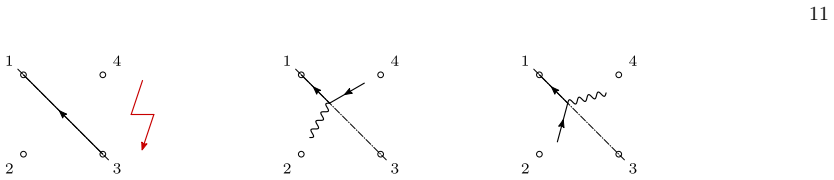
The central object is the three-particle Bethe-Salpeter-like ladder, written as $\Gamma_{1\mathrm{PI},r} = \Gamma_{(1,\vec{2},3)\mathrm{PI},r} + \Gamma_{(1,\vec{2},3)\mathrm{PI},r} \cdot \Gamma_{1\mathrm{PI},r}$, with the dot connecting three Green's function lines, and the companion equation $F_3 = \Gamma_{1\mathrm{PI},r} + (F_2 G F_2)_r$ that adds the single one-particle-reducible diagram of the pph channel. The arrow in $\Gamma_{(1,\vec{2},3)\mathrm{PI},r}$ marks a vertex that is one- and three-particle irreducible in channel $r$ and two-particle irreducible on the right, a distinction needed because three-particle diagrams can be cut in non-unique ways. In the approximation, this irreducible input is replaced by $M = M_{12} + M_{23} + M_{13}$, where each $M_{ij}$ connects two of the three lines through a two-particle irreducible vertex ($\Gamma_{\mathrm{ph}}$ or $\Gamma_{\mathrm{pp}}$ with the required $1/2$ factor), and the ladder is summed in closed form as a geometric series. Since the resulting ladder has only two of the six crossing symmetries of the full vertex, the final approximate vertex averages $L$ and the one-particle-reducible term over all nine pph channels with weight $1/9$.
What would settle it
Compute the fourth-order (two-vertex) ladder contributions in two different pph channels, for example channels 41 and 25, and check whether any diagram appears in both; the paper's Section VC conjecture says high-order ladder terms are exclusive to one channel, so finding overlap would show that the $1/9$ averaging suppresses high orders by an uncontrolled factor. A second check is to repeat the exact-diagonalization-versus-ladder comparison at $U=0.5$ with a different exact solver, such as continuous-time quantum Monte Carlo, and see whether the factor-of-two-to-ten discrepancy persists; if it disappears, the claim that the approximation is only qualitatively correct at weak coupling would be contradicted.
Extended reading notes
Core claim
The central claim is that the full three-particle vertex $F_3$ obeys an exact ladder structure: $\Gamma_{1\mathrm{PI},r} = \Gamma_{(1,\vec{2},3)\mathrm{PI},r} + \Gamma_{(1,\vec{2},3)\mathrm{PI},r} \cdot \Gamma_{1\mathrm{PI},r}$ with $F_3 = \Gamma_{1\mathrm{PI},r} + (F_2 G F_2)_r$, where $r$ labels one of ten channels and $(F_2 G F_2)_r$ is the unique one-particle-reducible diagram of that pph channel. If the vertex $\Gamma_{(1,\vec{2},3)\mathrm{PI},r}$ that is 1PI and 3PI in channel $r$ and 2PI on the right were known, iterating the first equation and adding the second term would produce the exact full three-particle vertex. The paper then implements the simplest available replacement — $\Gamma_{(1,\vec{2},3)\mathrm{PI},r}$ approximated by $M_{12} + M_{23} + M_{13}$, built from irreducible two-particle vertices — and evaluates the resulting geometric ladder for the Anderson impurity model. For the vertex contribution to the second-order spin response $\chi_{\mathrm{vertex}}^{(2)}$, the ladder is only qualitatively correct for weak coupling and quantitatively off by factors of two to ten, with sign errors in some spin components at $U = 2$ and above.
Load-bearing premise
The load-bearing premise is that the unknown irreducible three-particle vertex can be replaced by the sum of three two-particle irreducible vertices, $M_{12} + M_{23} + M_{13}$, and that averaging the resulting ladder over the nine pph channels with a $1/9$ factor restores the missing crossing symmetries without suppressing higher-order contributions in an uncontrolled way; the paper itself flags the second part as a conjecture in Section VC.
Editorial extensions
If this is right
- If the irreducible three-particle vertex in any one of the ten channels were supplied exactly, Eqs. (32) and (33) would yield the exact full three-particle vertex, including the one-particle-reducible diagrams that are absent from ppp-type ladders.
- The $1/9$ channel average makes the approximate vertex correct through second order in the two-particle vertex, but it cannot control the higher-order errors that cause the documented quantitative failures.
- For the tested Anderson impurity model at $\beta = 10$, the ladder is qualitatively reliable only up to $U \approx 1$ for the $\uparrow\uparrow\uparrow$ spin component and $U \approx 3$ for $\uparrow\uparrow\downarrow$, with quantitative errors of factors of two to ten.
- At stronger coupling the approximate vertex contribution can have the wrong sign, so extracting nonlinear response coefficients from this two-particle-vertex-only ladder would not be reliable.
- The ppp channel requires no separate numerical treatment because its ladder diagrams are particle-hole-symmetry related to pph ladders.
Reading between the lines
- A natural next step, not taken in the paper, is to feed a numerically estimated local three-particle irreducible vertex into the exact ladder equations instead of the two-particle-vertex sum; the paper's exact equations would then become a systematic route to three-particle vertices rather than a single uncontrolled approximation.
- The sign change between $U=1$ and $U=2$ in the $\uparrow\uparrow\uparrow$ component suggests that the $1/9$ averaging changes the topology of the result, not just its magnitude; tracking individual channel contributions at intermediate $U$ could show whether one channel dominates and whether the averaging hides a simpler structure.
- The paper's conjecture that high-order ladder terms are exclusive to one channel is directly testable with the same code: comparing fourth-order contributions in channels 41 and 25 would reveal whether the $1/9$ factor suppresses them by an uncontrolled amount.
- For physical second-order responses such as $\chi_{nnn}$, $\chi_{nzz}$, and $\chi_{xyz}$, which are linear combinations of the raw spin components, the factor-of-two-to-ten errors could partially cancel or accumulate; the paper deliberately avoids this masking, but practical calculations will need to test the combined quantities directly.
Editorial analysis
A structured set of objections, weighed in public.
Referee Report
Summary. The paper derives a set of three-particle ladder equations, generalizing the two-particle Bethe-Salpeter equations to ten three-particle channels. The central formal statement is that, if the three-particle vertex irreducible in one of the ten channels, Γ(1,⃗2,3)PI,r, is known, then Eqs. (32) and (33) yield the exact three-particle vertex, provided the one-particle-reducible diagram (F2GF2)r is added in the pph channels. Since Γ(1,⃗2,3)PI,r is not available, the authors approximate it by the sum of two-particle irreducible vertices M12+M23+M13, build the resulting ladder, and restore crossing symmetries approximately by averaging over all nine pph channels with a factor 1/9, Eq. (53). The approximation is then used to compute the vertex contribution to the second-order spin response function of an Anderson impurity model at DMFT self-consistency, and the results are compared with exact diagonalization for U = 0.5, 1, 2, 3, 4. The authors conclude that the approximation is only qualitatively correct for weak U and quantitatively off by factors of two to ten, with wrong signs for some components at larger U.
Significance. If the formal ladder equations are correct, they constitute a useful framework for organizing three-particle diagrammatics, and the careful treatment of one-, two-, and three-particle reducibility, including the one-particle-reducible diagram and the double-counting issues, is a genuine contribution. The paper also ships an open-source implementation and does not fit any target quantity: the input two-particle vertices are obtained independently from parquet/QMC and the comparison is against an ED solution of the same impurity model. The honest negative conclusion about the M12+M23+M13 approximation is valuable. However, the numerical benchmark—which is the main evidence for that negative conclusion—is conditional on an uncontrolled 1/9 channel average and on the use of a six-site ED reference without demonstrated convergence for three-particle quantities. The formal part is strong; the quantitative part needs substantial additional support.
major comments (3)
- [Section VC and Eq. (53)] The average over the nine pph channels with prefactor 1/9 is justified in the manuscript only for second-order diagrams. For all higher orders, the argument relies on the conjecture, stated in Section VC, that ladder terms of sufficiently high order are exclusive to a single channel. This conjecture is not tested anywhere in the manuscript. Since every data point in Figs. 21 and 22 is obtained through this averaging, the observed factor-of-two-to-ten discrepancies and the sign changes at U = 2 and U = 3 cannot be unambiguously attributed to the M12+M23+M13 replacement; they could partly be artifacts of the symmetrization procedure. I recommend a concrete check: for a fixed low-order set of ladder diagrams, explicitly enumerate the pph channels in which each topology appears and verify the 1/9 counting, or compare the averaged result with an alternative symmetrization that respects all six crossing symmetries at higher orders.
- [Section VA and Figs. 21–22] The reference solution is an exact-diagonalization calculation with six bath sites obtained by pole fitting, while the ladder is evaluated using two-particle vertices from parquet and continuous-time QMC calculations for the continuous-bath AIM under DMFT self-consistency. The manuscript does not demonstrate that the six-site bath is converged for three-particle quantities such as χ(2)_vertex. If the six-site bath is not converged, part of the discrepancy between the ladder and the ED reference could come from the reference itself. At minimum, the authors should provide a convergence check (e.g., comparing ED one- and two-particle vertices to the parquet/QMC input for the same parameters, or increasing the number of bath sites), and error bars in Figs. 21 and 22.
- [Section VB and Fig. 20] The eigenvalue analysis in Fig. 20 shows that the largest eigenvalue of M is close to unity at U = 3 and exceeds unity at U = 4, so the geometric series defining the ladder does not converge in the ordinary sense for these interaction strengths. The manuscript nevertheless uses the closed-form expression for the geometric series. For a non-convergent series, this closed form is an analytic continuation whose connection to the original ladder diagrams is not established. Consequently, the U = 4 entries in Table IV and Fig. 22 may reflect the continuation procedure rather than the quality of the ladder approximation. This should be stated explicitly, or the U = 4 data should be excluded or reinterpreted.
minor comments (4)
- [Abstract] The phrase "even than only qualitatively" should be "even then only qualitatively".
- [Section IVA] The sentence "we express the three-particle vertex as a a geometric ladder series" contains a duplicated article "a".
- [Section IVC, after Eq. (55)] The sentence "the imaginary part of χvertex,↑↑↑ and χvertex,↑↑↓ must vanish" should use the plural "imaginary parts".
- [Figs. 21 and 22] The ED and ladder panels use different color scales, which makes the factor-of-two-to-ten discrepancy difficult to judge by eye; using a common color scale or explicitly plotting the ratio would improve comparability.
Circularity Check
No significant circularity: the ladder equations are exact by construction but are not used to claim predictive power, and the approximate solution is benchmarked against an independent exact-diagonalization result.
full rationale
The derivation chain is not circular. Equations (32) and (33) are identities that define the irreducible three-particle vertex; the paper explicitly states that this building block is unknown and then replaces it with M12+M23+M13 as an approximation. The numerical comparison in Figs. 21 and 22 compares the resulting ladder to an exact-diagonalization solution of the same impurity model, so no target quantity is fitted and no fitted parameter is renamed as a prediction. The 1/9 channel average in Eq. (53) is a stated conjecture about high-order diagram channel exclusivity; being uncontrolled is a correctness and robustness concern, not circularity. Citations to Ref. [18] by overlapping authors supply frequency notations and the decomposition of the nonlinear response; these are definitions and bookkeeping, not load-bearing evidence for the ladder equations or for the numerical discrepancy. The paper's own conclusion that the approximation is only qualitatively correct for weak U is a benchmarked negative result, not a result forced by construction.
Assumptions & free parameters
assumptions (6)
- standard math Wick's theorem and the standard imaginary-time Feynman diagram expansion apply.
- domain assumption The only interaction is a local two-particle (quartic) interaction.
- domain assumption Particle number is conserved, so a three-particle vertex cannot be one-particle reducible in the ppp channel.
- ad hoc to paper The unknown three-particle irreducible vertex can be approximated by the sum M12 + M23 + M13 of two-particle irreducible vertices.
- ad hoc to paper Averaging ladders over the nine pph channels with prefactor 1/9 restores crossing symmetries without systematically corrupting higher orders.
- domain assumption ED with six bath sites obtained by pole fitting represents the exact AIM solution for the comparison.
Cite this review
Pith. "Pith review of Ladder equation for the three-particle vertex and its approximate solution." pith.science (2026). https://pith.science/paper/P4ZMOD36
@misc{pith2026241201848,
  author       = {Pith},
  title        = {Pith review of: Ladder equation for the three-particle vertex and its approximate solution},
  year         = {2026},
  howpublished = {\url{https://pith.science/paper/P4ZMOD36}},
  note         = {Machine review of arXiv:2412.01848}
}
read the original abstract
We generalize the three two-particle Bethe-Salpeter equations to ten three-particle ladders. These equations are exact and yield the exact three-particle vertex, if we knew the three-particle vertex irreducible in one of the ten channels. However, as we do not have this three-particle irreducible vertex at hand, we approximate this building block for the ladder by the sum of two-particle irreducible vertices each connecting two fermionic lines. The comparison to the exact solution shows that this approximation is only good for rather weak interactions and even than only qualitatively - at least for the non-linear response function analyzed.
Figures


Figures from the paper (14 more)




Reference graph
Works this paper leans on
-
[1]
χ(2) vertex: exact diagonalization vs approximate ladder Next, we compare the ladder approximation to the ED for three-particle vertex contributions to the second-order response functions. Similarly as in [18]: First one-, two-, and three-particle correlators are computed with the ED code [42]. Then the disconnected parts are subtracted to obtain the full...
-
[2]
A. A. Abrikosov, L. P. Gorkov, and I. E. Dzyaloshinski, Methods of Quantum Field Theory in Statistical Physics (Dover, New York, 1975)
1975
-
[3]
Metzner and D
W. Metzner and D. Vollhardt, Phys. Rev. Lett.62, 324 (1989)
1989
-
[4]
A. Georges and G. Kotliar, Phys. Rev. B45, 6479 (1992). 9 More precisely, we would also need the two-particle vertex for the 1PR diagrams
work page 1992
-
[5]
Georges, G
A. Georges, G. Kotliar, W. Krauth, and M. J. Rozenberg, Rev. Mod. Phys.68, 13 (1996)
1996
-
[6]
E. Pavarini, E. Koch, D. Vollhardt, and A. Lichtenstein, DMFT at 25: Infinite Dimensions, Reihe Modeling and Simulation 4, Vol. 4 (Forschungszentrum Jülich Zentral- bibliothek, Verlag (Jülich), Jülich, 2014)
work page 2014
- [7]
-
[8]
A. N. Rubtsov, M. I. Katsnelson, and A. I. Lichtenstein, Phys. Rev. B77, 033101 (2008). 20
work page 2008
Show all 47 references
-
[9]
Rohringer, H
G. Rohringer, H. Hafermann, A. Toschi, A. A. Katanin, A. E. Antipov, M. I. Katsnelson, A. I. Lichtenstein, A. N. Rubtsov, and K. Held, Rev. Mod. Phys.90, 025003 (2018)
2018
-
[10]
Ribic, G
T. Ribic, G. Rohringer, and K. Held, Phys. Rev. B95, 155130 (2017)
2017
-
[11]
Ribic, P
T. Ribic, P. Gunacker, S. Iskakov, M. Wallerberger, G. Rohringer, A. N. Rubtsov, E. Gull, and K. Held, Phys. Rev. B96, 235127 (2017)
2017
-
[12]
Hafermann, G
H. Hafermann, G. Li, A. N. Rubtsov, M. I. Katsnelson, A. I. Lichtenstein, and H. Monien, Phys. Rev. Lett.102, 206401 (2009)
2009
-
[13]
Metzner, M
W. Metzner, M. Salmhofer, C. Honerkamp, V. Meden, and K. Schönhammer, Rev. Mod. Phys.84, 299 (2012)
2012
-
[14]
Jorio, R
A. Jorio, R. Saito, G. Dresselhaus, and M. S. Dresselhaus, Quantum description of raman scattering, inRaman Spec- troscopy in Graphene Related Systems(Wiley-Blackwell,
-
[15]
Rostami, M
H. Rostami, M. I. Katsnelson, and M. Polini, Phys. Rev. B 95, 035416 (2017)
2017
-
[16]
Kubo, Journal of the Physical Society of Japan12, 570 (1957)
R. Kubo, Journal of the Physical Society of Japan12, 570 (1957)
1957
-
[17]
Michishita and R
Y. Michishita and R. Peters, Phys. Rev. B103, 195133 (2021)
2021
-
[18]
Rostami, M
H. Rostami, M. I. Katsnelson, G. Vignale, and M. Polini, Annals of Physics431, 168523 (2021)
2021
-
[19]
G. Riva, T. Audinet, M. Vladaj, P. Romaniello, and J. A. Berger, SciPost Phys.12, 093 (2022)
2022
-
[20]
Kappl, F
P. Kappl, F. Krien, C. Watzenböck, and K. Held, Phys. Rev. B107, 205108 (2023)
2023
-
[21]
M. A. Lampert, Phys. Rev. Lett.1, 450 (1958)
1958
-
[22]
G. Riva, P. Romaniello, and J. A. Berger, Phys. Rev. Lett. 131, 216401 (2023)
2023
-
[23]
L. D. Faddeev, Sov. Phys. JETP12, 1014 (1961)
1961
-
[24]
Combescot, O
M. Combescot, O. Betbeder-Matibet, and F. Dubin, Eur. Phys. J. B42, 63 (2004)
2004
-
[25]
Barbieri and W
C. Barbieri and W. H. Dickhoff, Phys. Rev. C63, 034313 (2001)
2001
-
[26]
Sanchis-Alepuz, R
H. Sanchis-Alepuz, R. Williams, and R. Alkofer, Phys. Rev. D87, 096015 (2013)
2013
-
[27]
Kondo, Progress of Theoretical Physics32, 37 (1964)
J. Kondo, Progress of Theoretical Physics32, 37 (1964)
1964
-
[28]
Anderson, Phys
P. Anderson, Phys. Rev.124, 41 (1961)
1961
-
[29]
Hewson,The Kondo Problem to Heavy Fermions(Cam- bridge University Press, 1993)
A. Hewson,The Kondo Problem to Heavy Fermions(Cam- bridge University Press, 1993)
1993
-
[30]
J. R. Schrieffer and P. A. Wolff, Phys. Rev.149, 491 (1966)
1966
-
[31]
N. E. Bickers and D. J. Scalapino, Ann. Phys. (N. Y.) 193, 206 (1989)
1989
-
[32]
Coleman,Introduction to Many-Body Physics(Cam- bridge University Press, 2015)
P. Coleman,Introduction to Many-Body Physics(Cam- bridge University Press, 2015)
2015
-
[33]
N. E. Bickers, Self-consistent many-body theory for condensed matter systems, inTheoretical Methods for Strongly Correlated Electrons, edited by D. Sénéchal, A.- M. Tremblay, and C. Bourbonnais (Springer New York, New York, NY, 2004) pp. 237–296
2004
-
[34]
Rohringer, A
G. Rohringer, A. Valli, and A. Toschi, Phys. Rev. B86, 125114 (2012)
2012
-
[35]
The Supplemental Material contains a more detailed dis- cussion of three-particle irreducibilities
-
[36]
E. E. Salpeter and H. A. Bethe, Phys. Rev.84, 1232 (1951)
1951
-
[37]
Wallerberger, A
M. Wallerberger, A. Hausoel, P. Gunacker, A. Kowal- ski, N. Parragh, F. Goth, K. Held, and G. Sangiovanni, Computer Physics Communications235, 388 (2019)
2019
-
[38]
Rohringer,New routes towards a theoretical treatment of nonlocal electronic correlations, Ph.D
G. Rohringer,New routes towards a theoretical treatment of nonlocal electronic correlations, Ph.D. thesis, Vienna University of Technology (2013)
2013
-
[39]
Kaufmann, P
J. Kaufmann, P. Gunacker, A. Kowalski, G. Sangiovanni, and K. Held, Phys. Rev. B100, 075119 (2019)
2019
-
[40]
Gunacker, M
P. Gunacker, M. Wallerberger, E. Gull, A. Hausoel, G. Sangiovanni, and K. Held, Phys. Rev. B92, 155102 (2015)
2015
-
[41]
Krien, A
F. Krien, A. Kauch, and K. Held, Phys. Rev. Res.3, 013149 (2021)
2021
-
[42]
Krien and A
F. Krien and A. Kauch, Eur. Phys. J. B95, 69 (2022)
2022
-
[43]
Shinaoka and Y
H. Shinaoka and Y. Nagai, Phys. Rev. B103, 045120 (2021)
2021
-
[44]
Wallerberger and K
M. Wallerberger and K. Held, Phys. Rev. Res.4, 033238 (2022)
2022
-
[45]
shared cut
S.-S. B. Lee, F. B. Kugler, and J. von Delft, Phys. Rev. X 11, 041007 (2021). 1 Supplemental Material: Ladder equation for the three-particle vertex and its approximate solution Patrick Kappl, Tin Ribic, Anna Kauch, Karsten Held Institute of Solid State Physics, TU Wien, 1040 ...
2021
-
[46]
F. B. Kugler, S.-S. B. Lee, and J. von Delft, Phys. Rev. X 11, 041006 (2021)
2021
-
[2011]
Chap. 5, pp. 103–119
Reviewed August 12, 2026 · model on record in the stance chip above.
Discussion (0). Continue with ORCID to comment.