REVIEW 4 major objections 6 minor 43 references
Global Average Feature Augmentation for Robust Semantic Segmentation with Transformers
T0 review · 4 major / 6 minor · reviewed 2026-08-11 · deepseek-v4-flash
Pith's one-line read Channel-Wise Feature Augmentation (CWFA) claims to make transformer semantic segmentation models substantially more robust to image corruptions—with a 27.7-point mIoU gain on impulse noise for SegFormer-B1 and an 84.3% retention rate for…
desk verdict A simple, cheap feature augmentation that clearly helps robustness for small segmentation transformers, but the SOTA retention claim is inflated by the retention denominator and lacks error bars. read the letter →
The pith
A machine-rendered reading of the paper's core claim, the machinery that carries it, and where it could break.
The reading
What carries the argument
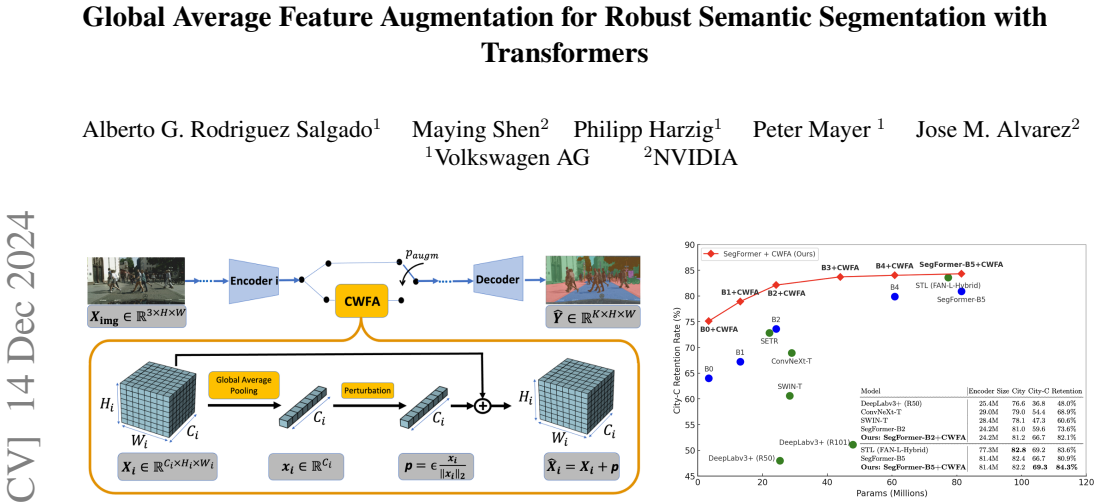
The load-bearing object is the channel-wise perturbation vector built from the global average feature. After each encoder, spatial positions are averaged to a single $C_i$-dimensional vector, normalized to unit norm, scaled by a strength $\epsilon$, and added uniformly across the spatial grid. Because the perturbation is computed from the feature map itself rather than from Gaussian noise or per-class statistics, it costs only a global average pooling operation—roughly 2% extra training time—and it encodes the assumption that a corruption shifts all features in a channel in a common direction, which the paper ties to the global receptive field of vision transformers.
What would settle it
Train SegFormer-B1 with CWFA but pick $\epsilon$ on a held-out part of the validation set (for example, tuning on 10% of validation images and reporting on the remaining 90%) and compare the Cityscapes-C retention rate to the paper's 78.9%. If the margin over the non-augmented baseline (67.2% retention) drops materially, then the reported gain is partly an artifact of validation-set tuning rather than the augmentation itself.
Extended reading notes
Core claim
The central claim is that robustness to common corruptions in transformer segmentation models can be improved by training with a perturbation that is shared across all spatial locations of a feature map, computed from the channel-wise global average of that feature map. Formally, for encoder output $X^i \in \mathbb{R}^{C_i \times H_i \times W_i}$, CWFA computes $x^i_c = \frac{1}{H_i W_i}\sum_{j,m} X^i_{c,j,m}$, then sets $p = \epsilon\, x^i / \|x^i\|_2$ and produces augmented features $\hat{X}^i_{c,j,m} = X^i_{c,j,m} + p_c$, applied stochastically during training. The paper reports that this yields up to 27.7% mIoU improvement on impulse noise for SegFormer-B1, that a CWFA-trained SegFormer-B5 achieves an 84.3% retention rate on Cityscapes-C, outperforming FAN+STL by 0.7%, and that the gains transfer to unseen corruptions and to the harder ADE20K-C benchmark while clean mIoU stays essentially unchanged.
Load-bearing premise
The load-bearing premise is that the perturbation strength (called epsilon) can be chosen per model size by testing on the same Cityscapes validation images whose corrupted versions are later used for the headline retention numbers; if that choice were made on a strictly held-out set or a different dataset, the reported gains might be smaller.
Editorial extensions
If this is right
- CWFA can be dropped into existing transformer segmentation backbones without changing the architecture or the inference pipeline, so models already deployed can be retrained with the augmentation at little extra cost.
- Small and medium models, where robustness degrades most, get the largest relative gains: SegFormer-B1 improves from 23.7 to 51.4 mIoU on impulse noise and from 52.8 to 61.7 average mIoU on Cityscapes-C.
- The robustness gains are not limited to the corruptions seen during selection of hyperparameters: retention on the disjoint Cityscapes-$\bar{\mathrm{C}}$ set improves by up to 8 points for compact models and 6.5 points for SegFormer-B5.
- Because training cost rises only about 2%, CWFA is practical for large-scale training runs where image-space augmentations like AugMix (47% overhead) or PixMix (49%) are prohibitive.
- On the largest model tested, the method sets a reported state of the art: 84.3% retention on Cityscapes-C, 0.7 points above the previous best (FAN+STL).
Reading between the lines
- Editorial inference: the mechanism suggests the global average feature acts as a 'common corruption direction' prior; one testable extension is applying the same channel-average perturbation to a CNN with global pooling or a hybrid backbone and checking whether the gain tracks global receptive field rather than the transformer architecture itself.
- Editorial inference: the paper's sensitivity analysis shows a wide range of $\epsilon$ values gives similar gains, so a single fixed strength across all model sizes may be enough in practice, removing the per-size tuning that currently anchors the evaluation.
- Editorial inference: the transferability experiments—where CWFA-trained models match or beat models trained with each specific corruption—indicate the augmentation is not memorizing seen corruptions; a direct test would be evaluating on a corruption type absent from both training and the sensitivity analysis, such as a non-Cityscapes-C corruption generated from a different rendering engine.
- Editorial inference: because the gains are smallest for Swin-T (1.2% average mIoU), the method's effectiveness may depend on global attention; predicting that hybrid local-global backbones show intermediate gains and that pure local-window models need a modified, window-wise average instead of a global one.
Signed reviews
Editorial analysis
A structured set of objections, weighed in public.
Referee Report
Summary. The paper proposes Channel-Wise Feature Augmentation (CWFA), a training-time augmentation for semantic segmentation transformers. For each encoder, CWFA computes the global spatial average of each channel of the feature map, normalizes that vector, scales it by epsilon, and adds the resulting channel-wise perturbation to the feature map, with probability paugm. The method is evaluated on Cityscapes and ADE20K using SegFormer-B0-B5, Twins-Small, and Swin-T. The reported results show consistent improvements in corrupted mIoU and retention rate relative to the unaugmented baselines, with larger gains for compact models. The headline claim is that CWFA-augmented SegFormer-B5 reaches 84.3% retention on Cityscapes-C, a 0.7% improvement over FAN+STL, while increasing training time by only 2%.
Significance. The paper's strengths are the simplicity of the method, the breadth of the empirical study (two datasets, three architectures, six model sizes), and the ablation work: removing the global average pooling eliminates the gain, and replacing the self-normalized perturbation with channel-wise Gaussian noise reduces the gain. The transferability experiment (Table 10) is a useful sanity check and is more informative than many augmentation papers. If the empirical claims hold, CWFA is a practical plug-in. However, the headline SOTA claim is currently fragile because the 0.7% retention margin over FAN+STL comes from a lower clean mIoU denominator while the corrupted-mIoU advantage is only 0.1%, and no error bars are reported. The hyperparameter epsilon is chosen using the same validation set used for reporting. These issues are fixable but need to be addressed before the claim can be accepted at face value.
major comments (4)
- [Sec. 4.1, Table 3] The claim of a new state of the art on Cityscapes-C is not firmly supported as stated. CWFA SegFormer-B5 has corrupted mIoU 69.3 versus 69.2 for FAN+STL (a +0.1 difference), while clean mIoU is 82.2 versus 82.8 (a -0.6 difference); since retention is corrupted/clean, the reported 84.3% versus 83.6% margin is largely a consequence of the lower clean denominator. With no seeds or error bars reported in any table, a 0.1 mIoU difference is within plausible run-to-run noise. Please report multiple seeds for the central comparison or soften the SOTA claim to 'comparable corrupted mIoU with a higher retention rate.'
- [Sec. 4.2 and Appendix A] Epsilon is selected using the same Cityscapes validation set on which final Cityscapes-C results are reported. The sensitivity analysis of Figure 4a is run by applying CWFA perturbations to baseline models at inference time on the Cityscapes validation set, and the chosen epsilons (9 and 15) are justified by the resulting performance drops on that set; Cityscapes-C is itself generated from that validation set. This creates a selection-on-the-test-set risk. I ask for a held-out split for hyperparameter choice, or for evidence that the gains persist for epsilons chosen without access to Cityscapes validation (e.g., a small sensitivity grid on a different dataset).
- [Abstract, Sec. 4.1, Tables 4-6] The abstract and introduction state that CWFA improves robustness 'without affecting clean data performance,' but the paper's own tables show systematic, if small, clean mIoU drops. On ADE20K every CWFA model is below its baseline (B1: 40.3 vs 41.9; B5: 49.8 vs 50.9 in Table 4); on Cityscapes, Twins-SVT drops from 80.9 to 78.9 (Table 6) and SegFormer-B1/B4/B5 drop by 0.3-0.5 (Table 1). Please revise the claim to 'with minimal clean mIoU changes' and, if possible, report a paired test across seeds.
- [Table 3 vs. Table 1] There is an inconsistency in the SegFormer-B5 baseline that directly affects the SOTA comparison. Table 1 reports the baseline B5 as clean 82.4, City-C 66.7, retention 80.9, while Table 3 lists SegFormer-B5 at 65.8/79.9 and a second entry 'SegFormer-B5_1' at 66.7/80.9. The paper does not explain which checkpoint is being cited or why two values appear. Please harmonize the tables and specify the exact source of each baseline number.
minor comments (6)
- [Sec. 3.1] The sentence 'each encoder enci computes a feature space representation Xi from the feature space Xi' is circular; the input to encoder i should be defined explicitly as the output of encoder i-1 (or the input image for i=1).
- [Algorithm 1] In Algorithm 1, the Bernoulli draw is written as p~Bernoulli(paugm), but the text says CWFA is applied with probability paugm. Please clarify whether the variable p denotes the draw or the probability, and make the apply/skip branches unambiguous.
- [Sec. 4, Table 7] The efficiency comparison reports only B0 sec/epoch (443 vs 452). Since the headline method is used with B5, please provide per-epoch or total training time for the larger models, or state explicitly that the 2% figure is measured on B0 only.
- [Appendix E, Table 11] The statement that applying CWFA from the first iteration yields 'a substantial 111.1% robustness degradation' is unclear, and the associated table needs a self-contained caption; the table also uses check marks without defining them in the caption.
- [Appendix B, Table 16] Table 16 has formatting problems (e.g., '49,2' with a comma, and columns that are not clearly aligned). Please reformat it and define all column headers.
- [References] The reference for PixMix appears twice ([7] and [13]) with slightly different titles; please consolidate.
Circularity Check
No significant circularity: CWFA's results are empirical, component-ablated, and compared against published baselines; the 84.3% retention rate is measured, not fitted or derived by construction.
full rationale
CWFA is a concrete training-time perturbation (Eqs. 1-3: p = eps * x_bar / ||x_bar||_2, added channel-wise) whose claims are empirical measurements, not derived predictions. The retention rate R = City-C/City is a standard metric applied identically to every model in Table 3; no parameter is fitted to reproduce the 84.3% value, and that number is computed directly from the reported clean and corrupted mIoU. The only hyperparameters, eps and paugm, are chosen from sensitivity measurements on the clean validation set (Appendix A) and are explicitly described as non-critical: 'we realize that its choice is not critical and do not do a hyperparameter search for it.' Figure 5 shows robustness gains are similar across a wide eps range, so the eps choice does not statistically force the corrupted-mIoU outcome. Selecting eps on the Cityscapes validation set while reporting results on Cityscapes-C (the corrupted form of the same set) is a real evaluation methodology weakness and belongs under correctness risk, not circularity: the selection criterion (clean-image mIoU drop) is not the reported target, and no equation reduces the headline number to the selection rule. The comparison baselines FAN [42] and FAN+STL [36] do have overlapping authorship with this paper (e.g., J. M. Alvarez), but the cited numbers are externally published benchmark results on Cityscapes-C, not theorems or fitted values imported to justify CWFA's design, so the self-citation is not load-bearing. Component ablations (Table 9: removing global average pooling collapses gains to baseline; channel-wise Gaussian noise yields smaller gains) independently justify the two design choices, and the paper transparently flags the zero-shot limitation in Section 4.2, addressing it with Table 10. The skeptic's concerns - the 0.7% SOTA margin rests mostly on a clean-accuracy drop (corrupted mIoU 69.3 vs 69.2; clean 82.2 vs 82.8) and no error bars are reported - concern statistical support for the headline, not circular derivation. No step reduces, by the paper's own equations or by self-citation, to its own inputs.
Assumptions & free parameters
free parameters (2)
- epsilon =
9 for SegFormer-B0 to B2, Twins, Swin-T; 15 for SegFormer-B3 to B5
- paugm =
0.3
assumptions (3)
- domain assumption Synthetic corruptions in Cityscapes-C and ADE20K-C are a good proxy for real-world natural corruptions.
- domain assumption Vision Transformer features are well-suited for global average-based perturbation because of global attention.
- domain assumption The SegFormer training recipe (optimizer, learning rate, schedule) is the appropriate basis for fair comparison.
Cite this review
Pith. "Pith review of Global Average Feature Augmentation for Robust Semantic Segmentation with Transformers." pith.science (2026). https://pith.science/paper/6WPECPMM
@misc{pith2026241201941,
  author       = {Pith},
  title        = {Pith review of: Global Average Feature Augmentation for Robust Semantic Segmentation with Transformers},
  year         = {2026},
  howpublished = {\url{https://pith.science/paper/6WPECPMM}},
  note         = {Machine review of arXiv:2412.01941}
}
read the original abstract
Robustness to out-of-distribution data is crucial for deploying modern neural networks. Recently, Vision Transformers, such as SegFormer for semantic segmentation, have shown impressive robustness to visual corruptions like blur or noise affecting the acquisition device. In this paper, we propose Channel Wise Feature Augmentation (CWFA), a simple yet efficient feature augmentation technique to improve the robustness of Vision Transformers for semantic segmentation. CWFA applies a globally estimated perturbation per encoder with minimal compute overhead during training. Extensive evaluations on Cityscapes and ADE20K, with three state-of-the-art Vision Transformer architectures : SegFormer, Swin Transformer, and Twins demonstrate that CWFA-enhanced models significantly improve robustness without affecting clean data performance. For instance, on Cityscapes, a CWFA-augmented SegFormer-B1 model yields up to 27.7% mIoU robustness gain on impulse noise compared to the non-augmented SegFormer-B1. Furthermore, CWFA-augmented SegFormer-B5 achieves a new state-of-the-art 84.3% retention rate, a 0.7% improvement over the recently published FAN+STL.
Figures


Figures from the paper (5 more)


Reference graph
Works this paper leans on
-
[1]
Towards build- ing more robust models with frequency bias
Qingwen Bu, Dong Huang, and Heming Cui. Towards build- ing more robust models with frequency bias. In Proceedings of the IEEE/CVF International Conference on Computer Vi- sion, pages 4402–4411, 2023. 2
work page 2023
-
[2]
Encoder-decoder with atrous separable convolution for semantic image segmentation
Liang-Chieh Chen, Yukun Zhu, George Papandreou, Florian Schroff, and Hartwig Adam. Encoder-decoder with atrous separable convolution for semantic image segmentation. In ECCV, 2018. 2
2018
-
[3]
Twins: Re- visiting the design of spatial attention in vision transformers
Xiangxiang Chu, Zhi Tian, Yuqing Wang, Bo Zhang, Haibing Ren, Xiaolin Wei, Huaxia Xia, and Chunhua Shen. Twins: Re- visiting the design of spatial attention in vision transformers. NeurIPS, 2021. 2
work page 2021
-
[4]
The cityscapes dataset for semantic urban scene understanding
Marius Cordts, Mohamed Omran, Sebastian Ramos, Timo Rehfeld, Markus Enzweiler, Rodrigo Benenson, Uwe Franke, Stefan Roth, and Bernt Schiele. The cityscapes dataset for semantic urban scene understanding. In CVPR, 2016. 3, 11
work page 2016
-
[5]
Improved regular- ization of convolutional neural networks with cutout
Terrance DeVries and Graham W Taylor. Improved regular- ization of convolutional neural networks with cutout. arXiv preprint arXiv:1708.04552, 2017. 2
arXiv 2017
-
[6]
N Benjamin Erichson, Soon Hoe Lim, Francisco Utrera, Win- nie Xu, Ziang Cao, and Michael W Mahoney. Noisymix: Boosting robustness by combining data augmentations, stability training, and noise injections. arXiv preprint arXiv:2202.01263, 2022. 2
arXiv 2022
-
[7]
Pixmix: Dreamlike pictures comprehensively improve safety measures
Hendrycks et al. Pixmix: Dreamlike pictures comprehensively improve safety measures. In CVPR, 2022. 6
work page 2022
-
[8]
A simple feature augmentation for domain general- ization
Li et al. A simple feature augmentation for domain general- ization. In ICCV, 2021. 6
work page 2021
Show all 43 references
-
[9]
Deep manifold traversal: Changing labels with convolutional features
Jacob R Gardner, Paul Upchurch, Matt J Kusner, Yixuan Li, Kilian Q Weinberger, Kavita Bala, and John E Hopcroft. Deep manifold traversal: Changing labels with convolutional features. arXiv preprint arXiv:1511.06421, 2015. 2
2015 arXiv
-
[10]
The many faces of robust- ness: A critical analysis of out-of-distribution generalization
Dan Hendrycks, Steven Basart, Norman Mu Mu, Saurav Ka- davath, Frank Wang, Evan Dorundo, Rahul Desi, Tyler Zhu, Samyak Parajuli, Mike Guo, et al. The many faces of robust- ness: A critical analysis of out-of-distribution generalization. In ICCV, 2021. 3
2021
-
[11]
Benchmarking neural network robustness to common corruptions and perturbations
Dan Hendrycks and Thomas Dietterich. Benchmarking neural network robustness to common corruptions and perturbations. In ICLR, 2018. 3
2018
-
[12]
Augmix: A simple data processing method to improve robustness and uncertainty
Dan Hendrycks, Norman Mu, Ekin Dogus Cubuk, Barret Zoph, Justin Gilmer, and Balaji Lakshminarayanan. Augmix: A simple data processing method to improve robustness and uncertainty. In ICLR, 2019. 1, 2, 6
2019
-
[13]
Pixmix: Dreamlike pictures comprehensively improve safety measures
Dan Hendrycks, Andy Zou, Mantas Mazeika, Leonard Tang, Bo Li, Dawn Song, and Jacob Steinhardt. Pixmix: Dreamlike pictures comprehensively improve safety measures. In Pro- ceedings of the IEEE/CVF Conference on Computer Vision and Pattern Recognition, pages 16783–16792, 2022. 1, 2
2022
-
[14]
Rethinking spatial dimensions of vision transformers
Byeongho Heo, Sangdoo Yun, Dongyoon Han, Sanghyuk Chun, Junsuk Choe, and Seong Joon Oh. Rethinking spatial dimensions of vision transformers. In ICCV, pages 11936– 11945, 2021. 5
2021
-
[15]
Benchmarking the robustness of semantic segmentation models
Christoph Kamann and Carsten Rother. Benchmarking the robustness of semantic segmentation models. In CVPR, 2020. 3, 5
2020
-
[16]
A simple feature augmentation for domain generalization
Pan Li, Da Li, Wei Li, Shaogang Gong, Yanwei Fu, and Timothy M Hospedales. A simple feature augmentation for domain generalization. In ICCV, 2021. 1
2021
-
[17]
Noisy feature mixup
Soon Hoe Lim, N Benjamin Erichson, Francisco Utrera, Win- nie Xu, and Michael W Mahoney. Noisy feature mixup. In ICLR, 2021. 2
2021
-
[18]
Swin transformer: Hierarchical vision transformer using shifted windows
Ze Liu, Yutong Lin, Yue Cao, Han Hu, Yixuan Wei, Zheng Zhang, Stephen Lin, and Baining Guo. Swin transformer: Hierarchical vision transformer using shifted windows. In CVPR, 2021. 1, 2, 5
2021
-
[19]
A convnet for the 2020s
Zhuang Liu, Hanzi Mao, Chao-Yuan Wu, Christoph Feicht- enhofer, Trevor Darrell, and Saining Xie. A convnet for the 2020s. In CVPR, 2022. 1, 5
2022
-
[20]
Fully convolutional networks for semantic segmentation
Jonathan Long, Evan Shelhamer, and Trevor Darrell. Fully convolutional networks for semantic segmentation. In CVPR,
-
[21]
Towards robust vision transformer
Xiaofeng Mao, Gege Qi, Yuefeng Chen, Xiaodan Li, Ranjie Duan, Shaokai Ye, Yuan He, and Hui Xue. Towards robust vision transformer. In CVPR, 2022. 1
2022
-
[22]
Benchmarking robustness in object detection: Autonomous driving when winter is com- ing
Claudio Michaelis, Benjamin Mitzkus, Robert Geirhos, Evge- nia Rusak, Oliver Bringmann, Alexander S Ecker, Matthias Bethge, and Wieland Brendel. Benchmarking robustness in object detection: Autonomous driving when winter is com- ing. Machine Learning for Autonomous Driving Wor...
2019
-
[23]
On in- teraction between augmentations and corruptions in natural corruption robustness
Eric Mintun, Alexander Kirillov, and Saining Xie. On in- teraction between augmentations and corruptions in natural corruption robustness. NeurIPS, 2021. 2, 3
2021
-
[24]
Prime: A few primitives can boost robustness to common corruptions
Apostolos Modas, Rahul Rade, Guillermo Ortiz-Jim ´enez, Seyed-Mohsen Moosavi-Dezfooli, and Pascal Frossard. Prime: A few primitives can boost robustness to common corruptions. In ECCV, 2022. 2
2022
-
[25]
A simple way to make neural networks robust against diverse image corruptions
Evgenia Rusak, Lukas Schott, Roland S Zimmermann, Julian Bitterwolf, Oliver Bringmann, Matthias Bethge, and Wieland Brendel. A simple way to make neural networks robust against diverse image corruptions. In ECCV, 2020. 2, 8
2020
-
[26]
A survey on image data augmentation for deep learning
Connor Shorten and Taghi M Khoshgoftaar. A survey on image data augmentation for deep learning. In J Big Data 6, 60, 2019. 2
2019
-
[27]
Deep feature interpolation for image content changes
Paul Upchurch, Jacob Gardner, Geoff Pleiss, Robert Pless, Noah Snavely, Kavita Bala, and Kilian Weinberger. Deep feature interpolation for image content changes. In Proceed- ings of the IEEE conference on computer vision and pattern recognition, pages 7064–7073, 2017. 2
2017
-
[28]
Augmax: Adversar- ial composition of random augmentations for robust training
Haotao Wang, Chaowei Xiao, Jean Kossaifi, Zhiding Yu, An- ima Anandkumar, and Zhangyang Wang. Augmax: Adversar- ial composition of random augmentations for robust training. NeurIPS, 2021. 1, 2
2021
-
[29]
Internimage: Exploring large-scale vision foundation models with deformable convolutions
Wenhai Wang, Jifeng Dai, Zhe Chen, Zhenhang Huang, Zhiqi Li, Xizhou Zhu, Xiaowei Hu, Tong Lu, Lewei Lu, Hongsheng Li, et al. Internimage: Exploring large-scale vision foundation models with deformable convolutions. In Proceedings of the IEEE/CVF Conference on Computer Vision a...
2023
-
[30]
Pyra- mid vision transformer: A versatile backbone for dense pre- diction without convolutions
Wenhai Wang, Enze Xie, Xiang Li, Deng-Ping Fan, Kaitao Song, Ding Liang, Tong Lu, Ping Luo, and Ling Shao. Pyra- mid vision transformer: A versatile backbone for dense pre- diction without convolutions. In ICCV, 2021. 2 9
2021
-
[31]
Wider or deeper: Revisiting the resnet model for visual recog- nition
Zifeng Wu, Chunhua Shen, and Anton Van Den Hengel. Wider or deeper: Revisiting the resnet model for visual recog- nition. Pattern Recognition, 90:119–133, 2019. 5
2019
-
[32]
Segformer: Simple and effi- cient design for semantic segmentation with transformers
Enze Xie, Wenhai Wang, Zhiding Yu, Anima Anandkumar, Jose M Alvarez, and Ping Luo. Segformer: Simple and effi- cient design for semantic segmentation with transformers. In NeurIPS, 2021. 1, 3, 5, 11
2021
-
[33]
Multi-scale context aggrega- tion by dilated convolutions
Fisher Yu and Vladlen Koltun. Multi-scale context aggrega- tion by dilated convolutions. ICLR, 2016. 5
2016
-
[34]
Cutmix: Regu- larization strategy to train strong classifiers with localizable features
Sangdoo Yun, Dongyoon Han, Seong Joon Oh, Sanghyuk Chun, Junsuk Choe, and Youngjoon Yoo. Cutmix: Regu- larization strategy to train strong classifiers with localizable features. In ICCV, 2019. 2
2019
-
[35]
mixup: Beyond empirical risk minimization
Hongyi Zhang, Moustapha Cisse, Yann N Dauphin, and David Lopez-Paz. mixup: Beyond empirical risk minimization. ICLR, 2018. 2
2018
-
[36]
Fully at- tentional networks with self-emerging token labeling
Bingyin Zhao, Zhiding Yu, Shiyi Lan, Yutao Cheng, Anima Anandkumar, Yingjie Lao, and Jose M Alvarez. Fully at- tentional networks with self-emerging token labeling. In Proceedings of the IEEE/CVF International Conference on Computer Vision, pages 5585–5595, 2023. 1, 2, 5
2023
-
[37]
Icnet for real-time semantic segmentation on high-resolution images
Hengshuang Zhao, Xiaojuan Qi, Xiaoyong Shen, Jianping Shi, and Jiaya Jia. Icnet for real-time semantic segmentation on high-resolution images. In ECCV, pages 405–420, 2018. 5
2018
-
[38]
Pyramid scene parsing network
Hengshuang Zhao, Jianping Shi, Xiaojuan Qi, Xiaogang Wang, and Jiaya Jia. Pyramid scene parsing network. In CVPR, pages 2881–2890, 2017. 5
2017
-
[39]
Rethinking semantic segmentation from a sequence-to-sequence perspective with transformers
Sixiao Zheng, Jiachen Lu, Hengshuang Zhao, Xiatian Zhu, Zekun Luo, Yabiao Wang, Yanwei Fu, Jianfeng Feng, Tao Xi- ang, Philip HS Torr, et al. Rethinking semantic segmentation from a sequence-to-sequence perspective with transformers. In CVPR, 2021. 2
2021
-
[40]
Improving the robustness of deep neural networks via stability training
Stephan Zheng, Yang Song, Thomas Leung, and Ian Goodfel- low. Improving the robustness of deep neural networks via stability training. In CVPR, 2016. 2
2016
-
[41]
Scene parsing through ade20k dataset
Bolei Zhou, Hang Zhao, Xavier Puig, Sanja Fidler, Adela Bar- riuso, and Antonio Torralba. Scene parsing through ade20k dataset. In CVPR, 2017. 2, 3
2017
-
[42]
Un- derstanding the robustness in vision transformers
Daquan Zhou, Zhiding Yu, Enze Xie, Chaowei Xiao, Ani- mashree Anandkumar, Jiashi Feng, and Jose M Alvarez. Un- derstanding the robustness in vision transformers. In ICLR,
-
[2022]
Choice of ϵ It is only important to select an ϵ value that incites the model to learn new representations i.e, which brings de- creases the baseline model performance
1, 2, 5 10 A. Choice of ϵ It is only important to select an ϵ value that incites the model to learn new representations i.e, which brings de- creases the baseline model performance. Otherwise, if the model is already robust against the CWFA perturbation with a certain ϵ, it wi...
Reviewed August 11, 2026 · model on record in the stance chip above.
Discussion (0). Continue with ORCID to comment.