REVIEW 4 major objections 6 minor 1 cited by
HumanRig: Learning Automatic Rigging for Humanoid Character in a Large Scale Dataset
T0 review · 4 major / 6 minor · reviewed 2026-08-11 · deepseek-v4-flash
Pith's one-line read HumanRig introduces a large-scale dataset of 11,434 AI-generated T-posed humanoid meshes and a data-driven rigging framework that predicts skeletons and skinning, outperforming prior rigging methods on both AI-generated and artist-created…
desk verdict HumanRig offers a genuinely useful dataset and coherent ablations, but the self-annotated ground truth and unavailable release make the headline performance claims provisional. read the letter →
The pith
A machine-rendered reading of the paper's core claim, the machinery that carries it, and where it could break.
The reading
What carries the argument
The load-bearing mechanism is the Prior-Guided Skeleton Estimator plus the Mesh-Skeleton Mutual Attention Network: the PGSE projects 2D skeleton priors from a front view onto the mesh surface to obtain a coarse 3D skeleton, and the MSMAN uses cross-attention in both directions so skeleton features carry body-part semantics into mesh features while mesh features refine joint positions, enabling joint optimization of skeleton and skinning. The mesh encoder is a U-shaped Point Transformer that ignores edge connectivity, chosen because AI-generated meshes have irregular face topology.
What would settle it
Have independent professional riggers re-rig a random sample of the 11,434 meshes and compare their joint positions and skinning weights to the dataset's annotations; if the inter-rater discrepancy matches or exceeds the reported improvement of HumanRig over RigNet, the core gains are annotation artifacts rather than model quality.
Extended reading notes
Core claim
The paper's central claim is that a large dataset of AI-generated humanoid meshes with a uniform skeleton topology is sufficient to train an automatic rigging system that outperforms prior rigging methods on both skeleton construction and skinning. The system's skeleton estimator uses 2D joints from a front-view rendering, back-projected onto the mesh to form a coarse skeleton; mutual attention between skeleton and mesh features refines joints and guides skinning. On the HumanRig test set the complete model reports Chamfer-distance errors of 0.0027 (CD-J2J) and skinning precision 0.9271, and it also improves upon the RigNet-v1 baseline when evaluated on artist-created T-posed meshes.
Load-bearing premise
The ground-truth skeletons and skinning weights used for both training and evaluation are produced by the authors' own Mixamo-plus-manual-refinement pipeline, with no independent validation of their accuracy or consistency.
Editorial extensions
If this is right
- Rigging of AI-generated characters can be automated end-to-end, letting generated 3D assets be dropped into standard animation pipelines without manual joint placement.
- Training on a diverse set of head-to-body ratios improves generalization; a model trained only on five-heads characters degrades when ratios deviate, while a balanced set gives stable performance across two- to nine-heads characters.
- A point-based mesh encoder that ignores edges transfers better to irregular meshes than GNN encoders such as GraphSAGE, GraphTransformer, or GMEdgeNet in the reported comparisons.
- The uniform Mixamo skeleton topology makes predicted rigs directly compatible with motion-capture data and game engines, enabling plug-and-play animation.
- Joint skeleton-and-skinning optimization through mutual attention improves both outputs, since the coarse skeleton alone leaves skinning and joint refinement worse than the complete model.
Reading between the lines
- If the dataset is released and the annotation pipeline held to independent scrutiny, the same framework could be extended to hands and fingers by enriching the template skeleton and generating higher-resolution meshes, which the authors list as a limitation.
- The 2D-prior idea suggests a testable extension: replacing the front-view render with multi-view renders could make the skeleton estimator robust to non-frontal poses or occluded characters beyond the T-pose setting.
- Because the method outputs a fixed 22-joint skeleton, it implicitly defines a canonical correspondence between characters, which could support cross-character motion retargeting and shape interpolation without additional learning.
- The dataset generation pipeline, which uses language prompts plus pose-conditioned image synthesis and image-to-3D conversion, is a reusable template for building rigged datasets for four-legged characters or generic objects, the extension the authors mention.
Signed reviews
Editorial analysis
A structured set of objections, weighed in public.
Referee Report
Summary. The paper introduces HumanRig, a dataset of 11,434 AI-generated T-posed humanoid meshes with a uniform 22-joint Mixamo skeleton topology, and proposes an automatic rigging framework combining a Prior-Guided Skeleton Estimator (PGSE), a U-shaped Point Transformer mesh encoder, and a Mesh-Skeleton Mutual Attention Network (MSMAN). The method is evaluated on skeleton construction, skinning prediction, and deformation quality, with ablations supporting the contributions of PGSE, MSMAN, and the point transformer encoder. The authors claim the first large-scale rigging dataset and state that the proposed method surpasses prior GNN-based approaches on both artist-created and AI-generated meshes.
Significance. If the dataset and annotations are trustworthy, HumanRig addresses a real bottleneck in automatic rigging research by providing a large-scale, topologically consistent corpus specifically targeting AI-generated humanoid meshes, a category ill-served by existing datasets such as RigNetv1 and SMPL. The proposed architecture is sensible, and the ablation study (Tables 3 and 4) provides credible internal evidence that the coarse-to-fine skeleton prior, the mutual attention module, and the edge-free point transformer encoder each contribute positively. The potential practical impact on animation pipelines is substantial. The main risk lies in the unvalidated annotation pipeline underlying both the dataset and the headline comparisons; the contribution is exactly as strong as the quality of the Mixamo-plus-manual-refinement labels, which are not independently assessed.
major comments (4)
- [Section 3.2] The ground-truth skeletons and skinning weights are all produced by the authors' own Mixamo semi-automated rigging plus manual refinement pipeline, and the paper provides no independent validation of this annotation process. There is no inter-annotator agreement study, no error analysis, no comparison against an alternative rigging tool (e.g., Pinocchio, Auto-Rig, or a second commercial system), and no discussion of which types of characters were most difficult to annotate. Because every reported number in Tables 2–5 depends on these labels, any systematic bias in the pipeline (e.g., misplaced joints on unusual head-to-body ratios, artifacts in manual corrections, or inaccuracies in skinning for intricate accessories) is inherited by all claims. The paper should either supply an external validation study or explicitly frame the contribution as a method trained on this particular label distribution, with the caveat that its quality is unknown.
- [Section 5.1, Table 2] The cross-dataset comparison is potentially confounded by the fact that the RigNetv1-human test set is re-rigged with the same Mixamo-plus-manual-refinement pipeline used to generate the HumanRig labels. The conclusion that a model trained on HumanRig generalizes to artist-created meshes is weakened because both the RigNetv1-human labels and the HumanRig labels share the same annotation noise; a model that fits this label distribution may outperform a model trained on the original RigNetv1 labels for reasons unrelated to mesh style or dataset size. In addition, HumanRig-small and RigNetv1-human are matched only by sample count (1,729) and not by vertex count, topological complexity, or annotation difficulty, so the comparison is not a clean isolation of dataset scale or quality. The authors should provide a side-by-side comparison where RigNetv1-human is also evaluated with its original skeleton labels (where possible) and report vertex-count distributions for both datasets.
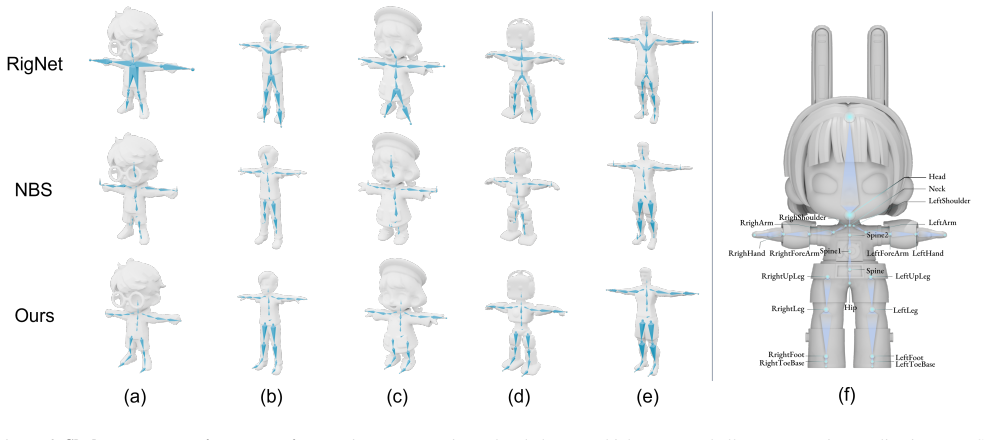
- [Section 5.3, Table 5] The quantitative comparison against prior methods is limited to deformation error on ten random poses. No quantitative skeleton-construction or skinning metrics are reported for RigNet or NBS, and the skeleton comparison in Figure 6 is purely qualitative. Since the paper's central claim is that the method 'surpasses previous methods in quality and versatility,' the evidence would be substantially stronger if the authors reported shared-metric comparisons (e.g., CD-J2J, skinning precision, L1) against RigNet and NBS on the same test sets, or clearly stated that such a comparison is impossible because those methods use different skeleton formats and therefore can only be compared through deformation quality.
- [Section 4.1] The PGSE module back-projects 2D joints into 3D by intersecting rays with the mesh surface and taking midpoints of first and last intersections. The robustness of this operation is not analyzed. For AI-generated meshes with open boundaries, self-intersections, or missing geometry (e.g., thin clothing accessories), ray-mesh intersection can produce spurious or degenerate points, and the paper does not describe how such failures are handled or filtered. Since PGSE is a load-bearing component (Table 3 shows a large drop without it), the paper should include a failure analysis of the ray-mesh step and clarify whether degenerate intersections are discarded, clamped, or otherwise processed.
minor comments (6)
- [Abstract / Section 5.3] The paper does not provide a URL or release plan for the dataset or code, despite the dataset being a major contribution. A supplementary link or a statement of public availability should be added.
- [Equation (4)] The KL divergence notation in Eq. (4) uses 'Gskini,j' with a comma; for consistency with other subscripts it should be 'Gskin_{i,j}' or the summation indices should be formatted uniformly.
- [Section 5, Evaluation metrics] The metrics CD-J2J, CD-J2B, and CD-B2B are cited from [25], but the paper does not define them or explain how the two-sided Chamfer distance is computed for sets of skeleton joints. Since Table 2 reports very small values (e.g., 0.0027), the reader cannot assess whether these are normalized per-model or absolute distances. A brief definition would make the results interpretable.
- [Section 5, Evaluation metrics] The deformation error study uses '10 random poses with joint rotations within a range of ±10 degrees,' but no random seed or standard deviation is reported, so the run-to-run variability of the reported means is unknown.
- [Section 5.2, Mesh Encoder Design] The comparison in Table 4 replaces the mesh encoder with GraphSAGE, GraphTransformer, and GMEdgeNet, but the paper does not state whether these baselines are trained with the same skeleton-aware vertex features, the same training schedule, and the same loss weights. Without that detail, the reported differences could be due to training setup rather than architectural choice.
- [Figure 2] The data acquisition pipeline figure is referenced in Section 3 but not described in the caption; adding a short caption explaining each stage would improve readability.
Circularity Check
No significant circularity: the shared annotation pipeline is a validation concern, not a reduction-by-construction.
full rationale
HumanRig is an empirical supervised-learning paper; there is no chain of equations whose conclusion equals an input by construction. The skeleton and skinning heads are trained with explicit losses (Eqs. 3-5) against ground-truth labels produced by a Mixamo-plus-manual pipeline (Sec 3.2). The 2D pose prior used by PGSE is indeed derived from those labels by projection (Sec 3.3), but the final skeleton is a network-refined estimate, and the ablations in Table 3 show the coarse prior alone is measurably worse than the full model (CD-J2J 0.0080 vs 0.0027), so the output is not the prior renamed as a prediction. The RigNetv1-human re-annotation in Sec 5.1 shares the same label-generation pipeline; that creates a possible distributional confound and a need for independent label validation, but it is not a case where the paper fits a parameter to a subset and 'predicts' the same quantity by construction. There is no invoked uniqueness theorem, and the only self-citation, [27], appears in a list of five references supporting a general statement about 3D generation progress and is not load-bearing. Consequently no circular step meets the standard of quoting an explicit reduction.
Assumptions & free parameters
free parameters (2)
- Mixamo 22-joint skeleton template =
22 joints
- Loss weights for skeleton and skinning =
1 and 1
assumptions (4)
- domain assumption Ground-truth rigging produced by Mixamo semi-automated rigging plus manual artist refinement is accurate enough to train and evaluate automatic rigging.
- domain assumption A single 22-joint Mixamo skeleton can parameterize all humanoid characters in the dataset, including cartoon characters and humanoid animals.
- domain assumption For every mesh, the front-view render and ray-mesh intersection produce a correct initial coarse skeleton.
- domain assumption The 2D pose estimator (RTMPose) generalizes from its training images to held-out HumanRig front views and to RigNetv1 meshes.
Cite this review
Pith. "Pith review of HumanRig: Learning Automatic Rigging for Humanoid Character in a Large Scale Dataset." pith.science (2026). https://pith.science/paper/RXXCK3MS
@misc{pith2026241202317,
  author       = {Pith},
  title        = {Pith review of: HumanRig: Learning Automatic Rigging for Humanoid Character in a Large Scale Dataset},
  year         = {2026},
  howpublished = {\url{https://pith.science/paper/RXXCK3MS}},
  note         = {Machine review of arXiv:2412.02317}
}
read the original abstract
With the rapid evolution of 3D generation algorithms, the cost of producing 3D humanoid character models has plummeted, yet the field is impeded by the lack of a comprehensive dataset for automatic rigging, which is a pivotal step in character animation. Addressing this gap, we present HumanRig, the first large-scale dataset specifically designed for 3D humanoid character rigging, encompassing 11,434 meticulously curated T-posed meshes adhered to a uniform skeleton topology. Capitalizing on this dataset, we introduce an innovative, data-driven automatic rigging framework, which overcomes the limitations of GNN-based methods in handling complex AI-generated meshes. Our approach integrates a Prior-Guided Skeleton Estimator (PGSE) module, which uses 2D skeleton joints to provide a preliminary 3D skeleton, and a Mesh-Skeleton Mutual Attention Network (MSMAN) that fuses skeleton features with 3D mesh features extracted by a U-shaped point transformer. This enables a coarse-to-fine 3D skeleton joint regression and a robust skinning estimation, surpassing previous methods in quality and versatility. This work not only remedies the dataset deficiency in rigging research but also propels the animation industry towards more efficient and automated character rigging pipelines.
Figures


Figures from the paper (4 more)



Forward citations
Cited by 1 Pith paper
-
One Model to Rig Them All: Diverse Skeleton Rigging with UniRig
UniRig generates topologically valid skeleton trees and skinning weights for diverse 3D meshes with an autoregressive transformer, a tree tokenization scheme, and a bone-point cross attention, trained on the new Rig-X...
Reference graph
Works this paper leans on
-
[1]
Automatic rigging and anima- tion of 3d characters
Ilya Baran and Jovan Popovi´c. Automatic rigging and anima- tion of 3d characters. ACM Transactions on graphics (TOG), 26(3):72–es, 2007. 2, 7
work page 2007
-
[2]
Multi-garment net: Learning to dress 3d people from images
Bharat Lal Bhatnagar, Garvita Tiwari, Christian Theobalt, and Gerard Pons-Moll. Multi-garment net: Learning to dress 3d people from images. InIEEE International Conference on Computer Vision (ICCV). IEEE, 2019. 2
work page 2019
-
[3]
Sue Blackman and Sue Blackman. Rigging with mixamo. Unity for Absolute Beginners, pages 565–573, 2014. 3
work page 2014
-
[4]
Openmmlab pose estimation tool- box and benchmark
MMPose Contributors. Openmmlab pose estimation tool- box and benchmark. https://github.com/open- mmlab/mmpose, 2020. 5
2020
-
[5]
Geodesic binding for degenerate character geometry using sparse voxelization
Olivier Dionne and Martin De Lasa. Geodesic binding for degenerate character geometry using sparse voxelization. IEEE transactions on visualization and computer graphics , 20(10):1367–1378, 2014. 7
work page 2014
-
[6]
Inductive representation learning on large graphs
Will Hamilton, Zhitao Ying, and Jure Leskovec. Inductive representation learning on large graphs. Advances in neural information processing systems, 30, 2017. 6, 7
work page 2017
-
[7]
Meshcnn: a network with an edge
Rana Hanocka, Amir Hertz, Noa Fish, Raja Giryes, Shachar Fleishman, and Daniel Cohen-Or. Meshcnn: a network with an edge. ACM Transactions on Graphics (ToG), 38(4):1–12,
-
[8]
Bounded biharmonic weights for real-time deformation
Alec Jacobson, Ilya Baran, Jovan Popovic, and Olga Sorkine. Bounded biharmonic weights for real-time deformation. ACM Trans. Graph., 30(4):78, 2011. 2
work page 2011
Show all 30 references
-
[9]
Rtmpose: Real- time multi-person pose estimation based on mmpose
Tao Jiang, Peng Lu, Li Zhang, Ningsheng Ma, Rui Han, Chengqi Lyu, Yining Li, and Kai Chen. Rtmpose: Real- time multi-person pose estimation based on mmpose. arXiv preprint arXiv:2303.07399, 2023. 4, 5
2023 arXiv
-
[10]
Elasticity-inspired de- formers for character articulation
Ladislav Kavan and Olga Sorkine. Elasticity-inspired de- formers for character articulation. ACM Transactions on Graphics (TOG), 31(6):1–8, 2012. 2
2012
-
[11]
Learning skeletal ar- ticulations with neural blend shapes
Peizhuo Li, Kfir Aberman, Rana Hanocka, Libin Liu, Olga Sorkine-Hornung, and Baoquan Chen. Learning skeletal ar- ticulations with neural blend shapes. ACM Transactions on Graphics (TOG), 40(4):1–15, 2021. 2, 7
2021
-
[12]
Neuroskinning: Automatic skin binding for production characters with deep graph networks
Lijuan Liu, Youyi Zheng, Di Tang, Yi Yuan, Changjie Fan, and Kun Zhou. Neuroskinning: Automatic skin binding for production characters with deep graph networks. ACM Transactions on Graphics (ToG), 38(4):1–12, 2019. 2, 5, 7
2019
-
[13]
Smpl: A skinned multi- person linear model
Matthew Loper, Naureen Mahmood, Javier Romero, Gerard Pons-Moll, and Michael J Black. Smpl: A skinned multi- person linear model. Acm Transactions on Graphics , 34 (Article 248), 2015. 2, 3, 7
2015
-
[14]
Decoupled weight decay regularization
I Loshchilov. Decoupled weight decay regularization. arXiv preprint arXiv:1711.05101, 2017. 5
2017 arXiv
-
[15]
Tarig: Adaptive template- aware neural rigging for humanoid characters
Jing Ma and Dongliang Zhang. Tarig: Adaptive template- aware neural rigging for humanoid characters. Computers & Graphics, 114:158–167, 2023. 2, 7
2023
-
[16]
Skin- ningnet: Two-stream graph convolutional neural network for skinning prediction of synthetic characters
Albert Mosella-Montoro and Javier Ruiz-Hidalgo. Skin- ningnet: Two-stream graph convolutional neural network for skinning prediction of synthetic characters. In Proceedings of the IEEE/CVF Conference on Computer Vision and Pat- tern Recognition, pages 18593–18602, 2022. 5
2022
-
[17]
Heterskinnet: A heterogeneous network for skin weights pre- diction
Xiaoyu Pan, Jiancong Huang, Jiaming Mai, He Wang, Honglin Li, Tongkui Su, Wenjun Wang, and Xiaogang Jin. Heterskinnet: A heterogeneous network for skin weights pre- diction. In Proceedings of the ACM on Computer Graphics and Interactive Techniques. Association for Computing Ma...
2021
-
[18]
High-resolution image synthesis with latent diffusion models
Robin Rombach, Andreas Blattmann, Dominik Lorenz, Patrick Esser, and Bj ¨orn Ommer. High-resolution image synthesis with latent diffusion models. In Proceedings of the IEEE/CVF conference on computer vision and pattern recognition, pages 10684–10695, 2022. 3
2022
-
[19]
Masked label prediction: Uni- fied message passing model for semi-supervised classifica- tion
Yunsheng Shi, Zhengjie Huang, Shikun Feng, Hui Zhong, Wenjin Wang, and Yu Sun. Masked label prediction: Uni- fied message passing model for semi-supervised classifica- tion. arXiv preprint arXiv:2009.03509, 2020. 6, 7
2009 arXiv
-
[20]
Triposr: Fast 3d object reconstruction from a single image
Dmitry Tochilkin, David Pankratz, Zexiang Liu, Zixuan Huang, Adam Letts, Yangguang Li, Ding Liang, Christian Laforte, Varun Jampani, and Yan-Pei Cao. Triposr: Fast 3d object reconstruction from a single image. arXiv preprint arXiv:2403.02151, 2024. 1, 3
2024 arXiv
-
[21]
Dynamic graph cnn for learning on point clouds
Yue Wang, Yongbin Sun, Ziwei Liu, Sanjay E Sarma, Michael M Bronstein, and Justin M Solomon. Dynamic graph cnn for learning on point clouds. ACM Transactions on Graphics (tog), 38(5):1–12, 2019. 2, 7
2019
-
[22]
Bone glow: An improved method for the assignment of weights for mesh deforma- tion
Rich Wareham and Joan Lasenby. Bone glow: An improved method for the assignment of weights for mesh deforma- tion. In Articulated Motion and Deformable Objects: 5th In- ternational Conference, AMDO 2008, Port d’Andratx, Mal- lorca, Spain, July 9-11, 2008. Proceedings 5 , pages...
2008
-
[23]
Unique3d: High-quality and efficient 3d mesh generation from a single image
Kailu Wu, Fangfu Liu, Zhihan Cai, Runjie Yan, Hanyang Wang, Yating Hu, Yueqi Duan, and Kaisheng Ma. Unique3d: High-quality and efficient 3d mesh generation from a single image. arXiv preprint arXiv:2405.20343, 2024. 1, 3
2024 arXiv
-
[24]
Instantmesh: Efficient 3d mesh generation from a single image with sparse-view large reconstruction models
Jiale Xu, Weihao Cheng, Yiming Gao, Xintao Wang, Shenghua Gao, and Ying Shan. Instantmesh: Efficient 3d mesh generation from a single image with sparse-view large reconstruction models. arXiv preprint arXiv:2404.07191 ,
-
[25]
Rignet: neural rigging for articu- lated characters
Zhan Xu, Yang Zhou, Evangelos Kalogerakis, Chris Lan- dreth, and Karan Singh. Rignet: neural rigging for articu- lated characters. ACM Transactions on Graphics (TOG), 39 (4):58–1, 2020. 1, 2, 3, 5, 6, 7
2020
-
[26]
Effec- tive whole-body pose estimation with two-stages distillation
Zhendong Yang, Ailing Zeng, Chun Yuan, and Yu Li. Effec- tive whole-body pose estimation with two-stages distillation. In Proceedings of the IEEE/CVF International Conference on Computer Vision, pages 4210–4220, 2023. 3
2023
-
[27]
G3PT: unleash the power of autoregressive modeling in 3d generation via cross- scale querying transformer
Jinzhi Zhang, Feng Xiong, and Mu Xu. G3PT: unleash the power of autoregressive modeling in 3d generation via cross- scale querying transformer. CoRR, abs/2409.06322, 2024. 1
2024 arXiv
-
[28]
Adding conditional control to text-to-image diffusion models
Lvmin Zhang, Anyi Rao, and Maneesh Agrawala. Adding conditional control to text-to-image diffusion models. In Proceedings of the IEEE/CVF International Conference on Computer Vision, pages 3836–3847, 2023. 3
2023
-
[29]
Clay: A controllable large-scale generative model for creat- 9 ing high-quality 3d assets
Longwen Zhang, Ziyu Wang, Qixuan Zhang, Qiwei Qiu, Anqi Pang, Haoran Jiang, Wei Yang, Lan Xu, and Jingyi Yu. Clay: A controllable large-scale generative model for creat- 9 ing high-quality 3d assets. ACM Transactions on Graphics (TOG), 43(4):1–20, 2024. 1, 3
2024
-
[30]
Point transformer
Hengshuang Zhao, Li Jiang, Jiaya Jia, Philip HS Torr, and Vladlen Koltun. Point transformer. In Proceedings of the IEEE/CVF international conference on computer vision, pages 16259–16268, 2021. 2, 5 10
2021
Reviewed August 11, 2026 · model on record in the stance chip above.
Discussion (0). Continue with ORCID to comment.