REVIEW 3 major objections 4 minor 77 references
Tidally induced multipole moments of a charged material body
T0 review · 3 major / 4 minor · reviewed 2026-08-11 · deepseek-v4-flash
Pith's one-line read This paper shows that the tidal Love numbers of a charged polytropic body in a static binary with balanced gravitational and electrostatic forces are negative, scaling like $k_\ell = -(\text{constant}) M/R$ at low compactness, so a…
desk verdict A careful, important calculation that refutes the small-charge continuity conjecture, with the main caveat being an unproved particular solution that enters the Love numbers. read the letter →
The pith
A machine-rendered reading of the paper's core claim, the machinery that carries it, and where it could break.
The reading
What carries the argument
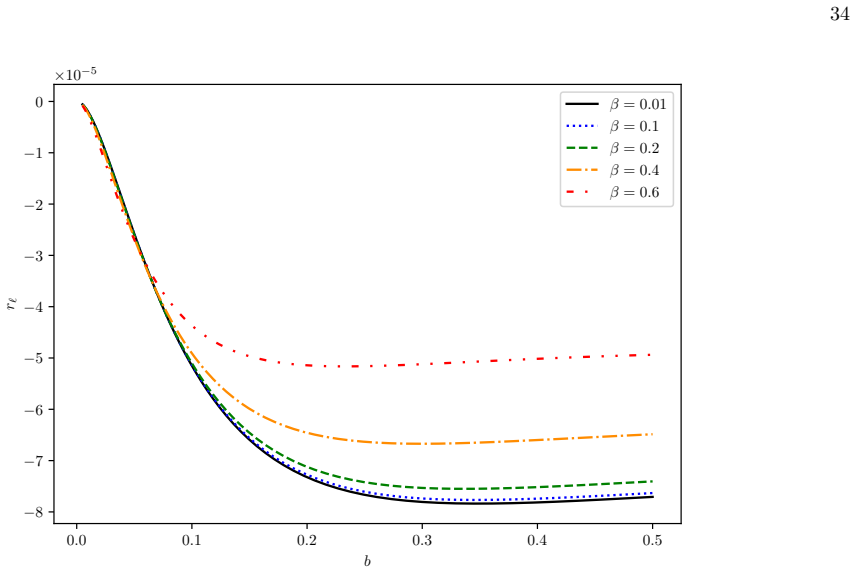
A Love number is a dimensionless coefficient relating a body's induced multipole moment to the applied tidal field. The calculation is carried out in full Einstein-Maxwell theory as a linearized perturbation of a charged polytropic star, with the exterior perturbation solved in closed form using associated Legendre functions $P^{m=1}_\ell$, $Q^{m=1}_\ell$, and $Q^{m=2}_\ell$, and the interior integrated numerically. The Love number is assembled as $k_\ell = p_\ell + q_\ell + r_\ell + t_\ell (L/R)^{2\ell+1}$ (Eq. 11.17), where $p_\ell$ and $q_\ell$ are tidal constants from the Regge-Wheeler-gauge metric and vector potential, $r_\ell$ arises from the transformation to harmonic gauge, and $t_\ell$ from converting areal radius to harmonic radius; only the sum is the physical Love number, not the individual tidal constants. Matching interior and exterior solutions, together with the force-balance condition $m(M - Q^2/r_0) = qQ\sqrt{f_0}$, delivers the numerical Love numbers.
What would settle it
Substitute the conjectured $G^1_\ell$ and $H^1_\ell$ directly into Eq. (9.17) for a multipole not sampled, say $\ell = 8$, and check that the residual is identically zero; alternatively, compute $k_8$ by full numerical integration of the interior harmonic-gauge equations without invoking the conjecture and compare with Eq. (11.17).
Extended reading notes
Core claim
The paper's central claim is that a charged material body—modeled as a perfect fluid with uniform charge-to-mass density ratio and a polytropic equation of state—tidally deformed by a smaller charged particle in a static, force-balanced configuration has negative tidal Love numbers $k_\ell$ for every multipole $\ell$ tested. This is the opposite of uncharged stellar bodies, whose Love numbers are positive. The negativity persists in the formal limit $\beta := \rho_e/\rho_m \to 0$, so the result is not an artifact of large charge; even a very small charge-to-mass ratio changes the sign of the tidal deformability as long as the gravitational and electrostatic forces on the companion are balanced. At small compactness the Love numbers scale as $k_\ell = -(\text{constant}) M/R$, vanishing in the Newtonian limit rather than approaching the nonzero constant typical of uncharged polytropes. The paper therefore concludes that tidally induced multipole moments of an electrically charged body are radically different from those of an uncharged body, and that the earlier conjecture that a small charge would leave the uncharged behavior essentially unchanged is not verified.
Load-bearing premise
The closed-form expressions for the harmonic-gauge particular solutions $G^1_\ell$ and $H^1_\ell$ in Eqs. (9.23)-(9.26) are conjectured and verified only numerically for sample multipoles; if they fail for some $\ell$, the constants $r_\ell$ and $s_\ell$, and hence the Love numbers, would change.
Editorial extensions
If this is right
- For force-balanced charged binaries, the sign of the tidal phase shift in a gravitational-wave signal would be reversed relative to uncharged neutron-star binaries, because $k_\ell < 0$.
- In the $\beta \to 0$ limit, the Love numbers remain negative, so a perturbatively small charge does not recover the uncharged result; the balanced-force limit is singular in this sense.
- The low-compactness scaling $k_\ell = -(\text{constant}) M/R$ means charged stars become undeformable in the Newtonian limit, unlike uncharged polytropes, whose Love numbers approach nonzero constants.
- The decomposition (11.17) shows that gauge choices and radial-coordinate conventions contribute to the Love number, so comparing values across formalisms requires the full sum, not just the tidal constants.
Reading between the lines
- Inference: If a neutron star in a binary carried even a tiny net charge and were subjected to a tuned external electric field, its tidal response could flip sign; the paper's static balance is fine-tuned, so the dynamical, unbalanced case is the natural next test.
- Inference: The negative sign may be reproducible in laboratory analogues, such as charged colloids or dusty plasmas in gravity-electrostatic balance, offering an experimental check of the mechanism.
- Inference: The matching method could be extended to magnetic-type Love numbers or to charged rotating bodies, where similar sign reversals might occur.
- Inference: Because the conjecture that small charge is irrelevant fails here, one should revisit other 'charge as a regulator' arguments in black-hole perturbation theory, though the vanishing of black-hole Love numbers is separately robust.
Signed reviews
Editorial analysis
A structured set of objections, weighed in public.
Referee Report
Summary. The paper defines and computes the mass multipole moments and Love numbers k_l of a static, spherically symmetric, charged polytropic body in general relativity, tidally deformed by a charged particle at rest in a static binary with gravitational and electrostatic forces balanced. The calculation is performed as a linearized perturbation of the Reissner-Nordström exterior and a charged-fluid interior, with junction conditions at the stellar surface, followed by a transformation to harmonic coordinates and a post-Newtonian expansion of W = sqrt(-g) g^tt. The main result is that the Love numbers are negative for all considered compactnesses and polytropic indices, behave as k_l approximately proportional to -(constant) M/R for small compactness, and remain negative in the formal beta -> 0 limit, in contrast to uncharged bodies.
Significance. If correct, the result is a striking counterexample to the expectation that a small charge on a material body should reproduce the uncharged tidal response: in the balanced-force electrostatic configuration, the tidally induced multipole moments have the opposite sign to the applied tidal field. The paper is significant because it provides an explicit relativistic framework, following Poisson's post-Newtonian operational definition, in which Love numbers are unambiguously defined and computed for charged matter. Strengths include the largely analytic exterior perturbation calculation, the explicit harmonic-coordinate transformation, and the augmented Newtonian model in Appendix A, which gives a simple physical explanation for the sign and scaling. The main weakness is that a key particular solution of the gauge equations is conjectured rather than proved, and the numerical integrations are not independently reproducible from the text alone.
major comments (3)
- [Sec. IX D, Eqs. (9.23)-(9.26)] The particular solutions G^1_l and H^1_l to the gauge equations are presented as a conjecture; the text states 'We were not able to devise a formal proof' and only reports numerical tests for 'a large sample of values for ℓ'. These solutions enter H_l in Eq. (9.28b) and thus the exterior harmonic-gauge metric used in the junction conditions (10.6)-(10.7) that determine r_l and s_l. Since k_l = p_l + q_l + r_l + t_l(L/R)^{2l+1} (Eq. 11.17), any error in this conjecture changes every computed Love number. The numerical tests cover the plotted ℓ = 2,...,5, but the paper's central claim is not so restricted. I request a proof of Eqs. (9.24)-(9.26), or at least an independent symbolic verification for arbitrary ℓ, together with a statement of the range of ℓ for which the results are claimed.
- [Sec. X C and Sec. XI E] The Love numbers in Figs. 12-15 are obtained by numerical integration of the interior perturbation and gauge equations (8.7), (10.8)-(10.11) followed by numerical solution of the junction conditions. The paper provides no code, no data tables, and no numerical tolerances, so none of the quantitative claims (negative values, scaling with M/R, beta -> 0 limit) can be independently checked. I ask that the numerical data underlying the figures, or a reproducible script, be made available as supplementary material.
- [Sec. XI D, Eqs. (11.15)-(11.18)] The derivation of Eq. (11.16) is too condensed. H_l in Eq. (9.28b) contains, in addition to the r_l Q_{l-1} term, a term proportional to -(l+1)Q_l(ξ) + C N_l(ξ). With Q_l(ξ) ~ ξ^{-(l+1)} and N_l(ξ) ~ ξ^{-(l+4)} (Eq. 9.27), the Q_l part is in principle of the same order in z as the mass-moment term being extracted. The statement that the R_l,S_l contribution to W_l-mass is 'entirely from H_l' and equals only 2 r_l z^{-(l+1)} therefore requires an explicit demonstration that the Q_l contribution cancels or becomes subdominant in the combination entering Eq. (11.8). Please provide the intermediate algebra, or identify the cancellation responsible.
minor comments (4)
- [Sec. IX D] The text refers to 'equations with T_l = S0_l' where T0_l appears to be intended; the notation should be corrected.
- [Secs. VII and VIII] The symbol p_l is used both for a tidal constant (Sec. VII) and for the pressure perturbation (Sec. VIII); this is confusing and should be disambiguated.
- [Secs. I D and II] The units convention is stated twice with different content: Sec. II sets G=1 and c=1, while Sec. I D sets G=1 and 4πϵ0=1; the electromagnetic units should be stated once and consistently.
- [Sec. I D and Sec. XI E] The claim that k_l = -(constant) M/R for small compactness is supported only by visual inspection of the figures; a short table of fitted constants or an analytic expansion would make this quantitative claim verifiable.
Circularity Check
No significant circularity: Love numbers are computed from perturbation equations and junction conditions; the unproved Sec. IX D conjecture is a correctness risk, not a circular step.
full rationale
The derivation is self-contained: k_l is obtained by solving the linearized Einstein-Maxwell perturbation equations (Secs. VII–VIII), transforming to harmonic gauge (Secs. IX–X), and reading off the coefficients of «r̄^ℓ and «r̄^(-ℓ-1) in W (Sec. XI). The constants p_l, q_l, r_l, and t_l entering Eq. (11.17) are determined by junction conditions and by the gauge-generating equations, respectively; none is fitted to the target Love numbers. The identification of E^(ℓ) in Eq. (7.19) with the post-Newtonian tidal moment is verified in Sec. XI C from the coefficient of «r̄^ℓ, and is a normalization check rather than an input. Citations to Poisson [46, 60] supply the PN definitional framework and the black-hole conjecture that the paper tests; the central claim (negative k_l for charged polytropes) is computed here from the field equations, not imported. The only stated gap is Sec. IX D: the particular solutions G^1_l and H^1_l are presented as conjectures and tested numerically for sampled ℓ, with no formal proof; this makes the general-ℓ claim conditional, but it is an unproven assumption, not a circular one, because the conjecture is not equivalent by construction to the Love-number output. No circular step can be exhibited, so the circularity score is 0.
Assumptions & free parameters
free parameters (3)
- beta =
0.01 to 0.8 (varied by hand)
- polytropic index n =
1.0, 1.5, 2.0, 2.5
- b = p_c/rho_c =
0 to 0.5 (scanned)
assumptions (5)
- standard math Einstein-Maxwell field equations and associated Legendre function identities
- domain assumption Perfect fluid with uniform charge-to-mass density ratio and polytropic EOS p = K rho^{1+1/n}
- domain assumption Static configuration with force balance qQ = m(M - Q^2/r0)/sqrt(f0) (Eq. 7.6)
- domain assumption Post-Newtonian multipole moments defined via W = sqrt(-g) g^{tt} in harmonic coordinates
- ad hoc to paper Conjectured gauge solutions M_l and N_l in Eqs. (9.23)-(9.26)
Cite this review
Pith. "Pith review of Tidally induced multipole moments of a charged material body." pith.science (2026). https://pith.science/paper/YBSUV4X5
@misc{pith2026241202431,
  author       = {Pith},
  title        = {Pith review of: Tidally induced multipole moments of a charged material body},
  year         = {2026},
  howpublished = {\url{https://pith.science/paper/YBSUV4X5}},
  note         = {Machine review of arXiv:2412.02431}
}
abstract
We define and calculate the mass multipole moments of a material body of mass $M$ and electric charge $Q$ tidally deformed by a particle of mass $m \ll M$ and charge $q \ll Q$ placed at a distance $r_0$ from the body. Given $Q/M$ and $r_0$, we choose $q/m$ so that the gravitational attraction between body and particle is balanced by the electrostatic repulsion; the system can then be maintained in a static state. The multipole moments are defined in a setting in which the body's self-gravity is allowed to be strong, but the mutual gravity between body and companion is required to be weak. In this setting, the body is described in full general relativity, in terms of a perturbed metric and electromagnetic potential characterized by tidal constants, and the mutual gravity is described within the post-Newtonian approximation to general relativity, in terms of objects with a multipole structure. Matching the different descriptions of the same field delivers a relation between the tidal constants and the multipole moments. In our implementation of this program, the calculation is performed in full Einstein-Maxwell theory (as a linearized perturbation of the unperturbed field), without appeal to a post-Newtonian approximation. After the fact we take $M/r_0$ to be small and carry out an expansion of the metric in powers of $M/r$ to obtain the multipole moments and associated Love numbers. The calculations are performed for a body made up of a perfect fluid with a uniform ratio of charge to mass densities, governed by a polytropic equation of state. We show that the Love numbers of a charged body in a situation of balanced gravitational and electrostatic forces are negative. The statement remains true even when $Q/M$ is very small, and we conclude that the tidal deformability of a charged body is radically different from that of an uncharged object, for which the Love numbers are positive.
Figures


Figures from the paper (12 more)




Reference graph
Works this paper leans on
-
[1]
This is the statement of force balance that was first encountered in Sec. V — refer back to Eq. (5.13). Equation (7.6) means that the force required of an external agent to keep the particle in place 22 at r = r0 vanishes; electrostatic repulsion is precisely balanced by gravitational attraction. In the Newtonian limit in which M/r0 → 0, Eq. (7.6) reduces...
-
[2]
Model We consider a spherical body of mass M , charge Q, and radius R perturbed by a particle of mass m and charge q at a distance r0 from the body. For simplicity we take the body to possess a constant density of mass ρm, and a constant density of charge ρe; we have that M = 4π 3 ρmR3, Q = 4π 3 ρeR3, (A1) and β := ρe/ρm = Q/M is the charge-to-mass ratio....
-
[3]
Unperturbed structure We first examine the structure of the unperturbed body, in the absence of the point particle. In spherical symmetry the field equations become 0 = V ′′ + 2 r V ′ + 3Q R3 , (A4a) 0 = U ′′ + 2 r U ′ + 3M R3 + 1 2 (V ′)2 (A4b) inside the body, and 0 = V ′′ + 2 r V ′, (A5a) 0 = U ′′ + 2 r U ′ + 1 2 (V ′)2 (A5b) outside; a prime indicates...
-
[4]
Perturbation equations We now insert the particle, and let it create a perturbation of the solution constructed previously. We write the perturbed potentials as V + δV and U + δU , with δV and δU denoting the perturbations, and p + δp is the perturbed pressure. The densities ρm and ρe remain at their constant value, and are therefore not perturbed. After ...
-
[5]
(A16) and (A17) subjected to the junction conditions of Eqs
Solution It is a straightforward matter to find solutions to Eqs. (A16) and (A17) subjected to the junction conditions of Eqs. (A12), (A18), and (A19); notice that we momentarily exclude Eq. (A13) from the complete list of conditions. When we also impose regularity at r = 0 and r = ∞, we arrive at V in ℓ (r) = c1 Q Rℓ+1 + q rℓ+1 0 rℓ, (A20a) V out ℓ (r < ...
-
[6]
1 rℓ+1 (A20c) and U in ℓ (r) = ℓ 2(2ℓ + 3) Q R3 c1 Q Rℓ+1 + q rℓ+1 0 rℓ+2 + − 3(ℓ + 1) 2(2ℓ + 3)c1 Q2 Rℓ+2 + c2 M Rℓ+1 + m − 3 2 ℓ+1 2ℓ+3 qQ R rℓ+1 0 + qQ 2rℓ+2 0 rℓ, (A21a) U out ℓ (r < r0) = c2M Rℓ 1 rℓ+1 + m + qQ 2r0 rℓ+1 0 rℓ − 1 2 c1Q2Rℓ 1 rℓ+2 − qQ 2rℓ+1 0 rℓ−1, (A21b) U out ℓ (r > r0) = " c2M Rℓ + m + qQ 2r0 rℓ 0 # 1 rℓ+1 − 1 2 Q(c1QRℓ + qrℓ
-
[7]
These are determined by finally enforcing Eq
1 rℓ+2 , (A21c) where c1 and c2 are dimensionless constants. These are determined by finally enforcing Eq. (A13), in which we insert [V ′′] = 3Q/R3, [U ′′] = 3M/R3, and p′(r = R) = − 3(M 2 − Q2) 4πR5 − 3M Q2 40πR6 . (A22) We get c1 = 20(ℓ − 1)(2ℓ + 1)(2ℓ + 3)(M 2 − Q2)R + 2(ℓ − 1)(4ℓ2 + 14ℓ + 21)M Q2 −1 × 30(2ℓ + 1)(2ℓ + 3)(mM − qQ) Rℓ+2 rℓ+1 0 + 15(2ℓ + ...
-
[8]
F orce balance Our solution is currently valid for any choice of parameters M , Q, m, q, and r0. The situation considered in the main text, however, has the particle subjected to balanced gravitational and electrostatic forces. We choose to impose this condition here as well. The forces are balanced when mU ′ = qV ′ at r = r0. Using the unperturbed potent...
Show all 77 references
-
[9]
II reveals that the tidal multipole moment is obtained from the piece of Uℓ(r < r0) that is proportional to rℓ
Love numbers The discussion of Sec. II reveals that the tidal multipole moment is obtained from the piece of Uℓ(r < r0) that is proportional to rℓ. Comparison between Eqs. (2.5) and (A21) yields E (ℓ) = −(ℓ − 1)ℓ m + qQ 2r0 rℓ+1 0 , (A26) a modification of Eq. (2.17). The disc...
-
[10]
E. E. Flanagan and T. Hinderer, Constraining neutron-star tidal Love numbers with gravitational-wave detectors, Phys. Rev. D 77, 021502 (2008)
2008
-
[11]
¨Ozel and P
F. ¨Ozel and P. Freire, Masses, Radii, and the Equation of State of Neutron Stars, Ann. Rev. Astron. Astrophys. 54, 401 (2016)
2016
-
[12]
Oertel, M
M. Oertel, M. Hempel, T. Kl¨ ahn, and S. Typel, Equations of state for supernovae and compact stars, Rev. Mod. Phys. 89, 015007 (2017)
2017
-
[13]
G. Baym, T. Hatsuda, T. Kojo, P. D. Powell, Y. Song, and T. Takatsuka, From hadrons to quarks in neutron stars: a review, Rept. Prog. Phys. 81, 056902 (2018)
2018
-
[14]
B. P. Abbott et al. (LIGO Scientific Collaboration and Virgo Collaboration), GW170817: Observation of Gravitational Waves from a Binary Neutron Star Inspiral, Phys. Rev. Lett. 119, 161101 (2017)
2017
-
[15]
B. P. Abbott et al. (The LIGO Scientific Collaboration and the Virgo Collaboration), GW170817: Measurements of Neutron Star Radii and Equation of State, Phys. Rev. Lett. 121, 161101 (2018). 46
2018
-
[16]
Narikawa, N
T. Narikawa, N. Uchikata, and T. Tanaka, Gravitational-wave constraints on the GWTC-2 events by measuring the tidal deformability and the spin-induced quadrupole moment, Phys. Rev. D 104, 084056 (2021)
2021
-
[17]
Landry, R
P. Landry, R. Essick, and K. Chatziioannou, Nonparametric constraints on neutron star matter with existing and upcoming gravitational wave and pulsar observations, Phys. Rev. D 101, 123007 (2020)
2020
-
[18]
Chatziioannou, Neutron star tidal deformability and equation-of-state constraints, Gen
K. Chatziioannou, Neutron star tidal deformability and equation-of-state constraints, Gen. Rel. Grav. 52, 109 (2020)
2020
-
[19]
Pacilio, A
C. Pacilio, A. Maselli, M. Fasano, and P. Pani, Ranking Love Numbers for the Neutron Star Equation of State: The Need for Third-Generation Detectors, Phys. Rev. Lett. 128, 101101 (2022)
2022
-
[20]
Hinderer, A
T. Hinderer, A. Taracchini, F. Foucart, A. Buonanno, J. Steinhoff, M. Duez, L. E. Kidder, H. P. Pfeiffer, M. A. Scheel, B. Szilagyi, K. Hotokezaka, K. Kyutoku, M. Shibata, and C. W. Carpenter, Effects of Neutron-Star Dynamic Tides on Gravitational Waveforms within the Effectiv...
2016
-
[21]
Steinhoff, T
J. Steinhoff, T. Hinderer, A. Buonanno, and A. Taracchini, Dynamical tides in general relativity: Effective action and effective-one-body Hamiltonian, Phys. Rev. D 94, 104028 (2016), arXiv:1608.01907
2016 arXiv
-
[22]
Andersson and W
N. Andersson and W. C. G. Ho, Using gravitational-wave data to constrain dynamical tides in neutron star binaries, Phys. Rev. D 97, 023016 (2018)
2018
-
[23]
Schmidt and T
P. Schmidt and T. Hinderer, Frequency domain model of f -mode dynamic tides in gravitational waveforms from compact binary inspirals, Phys. Rev. D 100, 021501 (2019)
2019
-
[24]
Poisson, Gravitomagnetic tidal resonance in neutron-star binary inspirals, Phys
E. Poisson, Gravitomagnetic tidal resonance in neutron-star binary inspirals, Phys. Rev. D 101, 104028 (2020)
2020
-
[25]
Steinhoff, T
J. Steinhoff, T. Hinderer, T. Dietrich, and F. Foucart, Spin effects on neutron star fundamental-mode dynamical tides: Phenomenology and comparison to numerical simulations, Phys. Rev. Res. 3, 033129 (2021)
2021
-
[26]
Andersson and P
N. Andersson and P. Pnigouras, The phenomenology of dynamical neutron star tides, M.N.R.A.S. 503, 533 (2021)
2021
-
[27]
Passamonti, N
A. Passamonti, N. Andersson, and P. Pnigouras, Dynamical tides in neutron stars: the impact of the crust, M.N.R.A.S. 504, 1273 (2021)
2021
-
[28]
Passamonti, N
A. Passamonti, N. Andersson, and P. Pnigouras, Dynamical tides in superfluid neutron stars, M.N.R.A.S.514, 1494 (2022)
2022
-
[29]
Williams, G
N. Williams, G. Pratten, and P. Schmidt, Prospects for distinguishing dynamical tides in inspiralling binary neutron stars with third generation gravitational-wave detectors, Phys. Rev. D 105, 123032 (2022)
2022
-
[30]
Pratten, P
G. Pratten, P. Schmidt, and N. Williams, Impact of Dynamical Tides on the Reconstruction of the Neutron Star Equation of State, Phys. Rev. Lett. 129, 081102 (2022)
2022
-
[31]
W. C. G. Ho and N. Andersson, New dynamical tide constraints from current and future gravitational wave detections of inspiralling neutron stars, Phys. Rev. D 108, 043003 (2023)
2023
-
[32]
M. K. Mandal, P. Mastrolia, H. O. Silva, R. Patil, and J. Steinhoff, Gravitoelectric dynamical tides at second post- Newtonian order, J. High. Energ. Phys. 2023, 67 (2023)
2023
-
[33]
M. K. Mandal, P. Mastrolia, H. O. Silva, R. Patil, and J. Steinhoff, Renormalizing Love: tidal effects at the third post- Newtonian order, J. High. Energ. Phys. 2024, 188 (2024)
2024
-
[34]
Pitre and E
T. Pitre and E. Poisson, General relativistic dynamical tides in binary inspirals without modes, Phys. Rev. D 109, 064004 (2024)
2024
-
[35]
Hegade K
A. Hegade K. R., J. L. Ripley, and N. Yunes, Dynamical tidal response of nonrotating relativistic stars, Phys. Rev. D 109, 104064 (2024)
2024
-
[36]
A. H. K. R., J. L. Ripley, and N. Yunes, Dissipative tidal effects to next-to-leading order and constraints on the dissipative tidal deformability using gravitational wave data (2024), arXiv:2407.02584 [gr-qc]
2024 arXiv
-
[37]
Katagiri, K
T. Katagiri, K. Yagi, and V. Cardoso, On relativistic dynamical tides: subtleties and calibration (2024), arXiv:2409.18034 [gr-qc]
2024 arXiv
-
[38]
Damour and A
T. Damour and A. Nagar, Relativistic tidal properties of neutron stars, Phys. Rev. D 80, 084035 (2009)
2009
-
[39]
Binnington and E
T. Binnington and E. Poisson, Relativistic theory of tidal Love numbers, Phys. Rev. D 80, 084018 (2009)
2009
-
[40]
R. A. Porto, The effective field theorist’s approach to gravitational dynamics, Physics Reports 633, 1 (2016)
2016
-
[41]
Cardoso, E
V. Cardoso, E. Franzin, A. Maselli, P. Pani, and G. Raposo, Testing strong-field gravity with tidal Love numbers, Phys. Rev. D 95, 084014 (2017)
2017
-
[42]
Chirenti, C
C. Chirenti, C. Posada, and V. Guedes, Where is Love? Tidal deformability in the black hole compactness limit, Class. Quantum Grav. 37, 195017 (2020)
2020
-
[43]
L. Hui, A. Joyce, R. Penco, L. Santoni, and A. R. Solomon, Static response and Love numbers of Schwarzschild black holes, JCAP 2021 (04), 052
2021
-
[44]
H. S. Chia, Tidal deformation and dissipation of rotating black holes, Phys. Rev. D 104, 024013 (2021)
2021
-
[45]
Charalambous, S
P. Charalambous, S. Dubovsky, and M. M. Ivanov, On the vanishing of Love numbers for Kerr black holes, J. High Energy Phys. 2021 (5)
2021
-
[46]
Le Tiec and M
A. Le Tiec and M. Casals, Spinning Black Holes Fall in Love, Phys. Rev. Lett. 126, 131102 (2021)
2021
-
[47]
Le Tiec, M
A. Le Tiec, M. Casals, and E. Franzin, Tidal Love numbers of Kerr black holes, Phys. Rev. D 103, 084021 (2021)
2021
-
[48]
Iteanu, M
S. Iteanu, M. M. Riva, L. Santoni, N. Savi´ c, and F. Vernizzi, Vanishing of Quadratic Love Numbers of Schwarzschild Black Holes (2024), arXiv:2410.03542 [gr-qc]
2024 arXiv
-
[49]
Kehagias and A
A. Kehagias and A. Riotto, Black holes in a gravitational field: The Non-linear static Love number of Schwarzschild black holes vanishes (2024), arXiv:2410.11014 [gr-qc]
2024 arXiv
-
[50]
Charalambous, S
P. Charalambous, S. Dubovsky, and M. M. Ivanov, Hidden Symmetry of Vanishing Love Numbers, Phys. Rev. Lett. 127, 101101 (2021)
2021
-
[51]
L. Hui, A. Joyce, R. Penco, L. Santoni, and A. R. Solomon, Ladder symmetries of black holes. Implications for Love numbers and no-hair theorems, J. Cosmology and Astropart. Phys. 2022, 032 (2022)
2022
-
[52]
Rai and L
M. Rai and L. Santoni, Ladder symmetries and Love numbers of Reissner-Nordstr¨ om black holes, J. High Energy Phys. 47 2024 (7)
2024
-
[53]
Combaluzier-Szteinsznaider, L
O. Combaluzier-Szteinsznaider, L. Hui, L. Santoni, A. R. Solomon, and S. S. C. Wong, Symmetries of vanishing nonlinear Love numbers of Schwarzschild black holes (2024), arXiv:2410.10952 [gr-qc]
2024 arXiv
-
[54]
S. E. Gralla, On the ambiguity in relativistic tidal deformability, Classical and Quantum Gravity 35, 085002 (2018)
2018
-
[55]
Poisson, Compact body in a tidal environment: New types of relativistic Love numbers, and a post-Newtonian opera- tional definition for tidally induced multipole moments, Phys
E. Poisson, Compact body in a tidal environment: New types of relativistic Love numbers, and a post-Newtonian opera- tional definition for tidally induced multipole moments, Phys. Rev. D 103, 064023 (2021)
2021
-
[56]
Postnikov, M
S. Postnikov, M. Prakash, and J. M. Lattimer, Tidal Love numbers of neutron and self-bound quark stars, Phys. Rev. D 82, 024016 (2010), arXiv:1004.5098
2010 arXiv
-
[57]
Blanchet, Post-Newtonian theory for gravitational waves, Living Rev
L. Blanchet, Post-Newtonian theory for gravitational waves, Living Rev. Relativ. 27 (2024)
2024
-
[58]
W. D. Goldberger and I. Z. Rothstein, Effective field theory of gravity for extended objects, Phys. Rev. D 73, 104029 (2006)
2006
-
[59]
W. D. Goldberger and I. Z. Rothstein, Dissipative effects in the worldline approach to black hole dynamics, Phys. Rev. D 73, 104030 (2006)
2006
-
[60]
Damour and A
T. Damour and A. Nagar, Effective one body description of tidal effects in inspiralling compact binaries, Phys. Rev. D 81, 084016 (2010)
2010
-
[61]
D. Bini, T. Damour, and A. Geralico, Scattering of tidally interacting bodies in post-Minkowskian gravity, Phys. Rev. D 101, 044039 (2020)
2020
-
[62]
Levi, Effective field theories of post-Newtonian gravity: a comprehensive review, Rep
M. Levi, Effective field theories of post-Newtonian gravity: a comprehensive review, Rep. Prog. Phys. 83, 075901 (2020)
2020
-
[63]
Henry, G
Q. Henry, G. Faye, and L. Blanchet, Tidal effects in the equations of motion of compact binary systems to next-to-next- to-leading post-Newtonian order, Phys. Rev. D 101, 064047 (2020)
2020
-
[64]
Henry, G
Q. Henry, G. Faye, and L. Blanchet, Tidal effects in the gravitational-wave phase evolution of compact binary systems to next-to-next-to-leading post-Newtonian order, Phys. Rev. D 102, 044033 (2020)
2020
-
[65]
Henry, G
Q. Henry, G. Faye, and L. Blanchet, Hamiltonian for tidal interactions in compact binary systems to next-to-next-to-leading post-Newtonian order, Phys. Rev. D 102, 124074 (2020)
2020
-
[66]
Kol and M
B. Kol and M. Smolkin, Black hole stereotyping: induced gravito-static polarization, J. High Energy Phys. 2012 (2)
2012
-
[67]
Geroch, Multipole Moments
R. Geroch, Multipole Moments. II. Curved Space, J. Math. Phys. 11, 2580 (1970)
1970
-
[68]
R. O. Hansen, Multipole moments of stationary space-times, J. Math. Phys. 15, 46 (1974)
1974
-
[69]
Poisson, Tidally induced multipole moments of a nonrotating black hole vanish to all post-Newtonian orders, Phys
E. Poisson, Tidally induced multipole moments of a nonrotating black hole vanish to all post-Newtonian orders, Phys. Rev. D 104, 104062 (2021)
2021
-
[70]
Poisson and C
E. Poisson and C. M. Will, Gravity: Newtonian, Post-Newtonian, Relativistic(Cambridge University Press, Cambridge, England, 2014)
2014
-
[71]
Zhang, Multipole expansions of the general-relativistic gravitational field of the external universe, Phys
X.-H. Zhang, Multipole expansions of the general-relativistic gravitational field of the external universe, Phys. Rev. D 34, 991 (1986)
1986
-
[72]
Ace˜ na, B
A. Ace˜ na, B. C. Guntsche, and I. G. de Austria, Revisiting relativistic electrically charged polytropic spheres (2024), arXiv:2405.00890 [gr-qc]
2024 arXiv
-
[73]
Regge and J
T. Regge and J. A. Wheeler, Stability of a Schwarzschild Singularity, Phys. Rev. 108, 1063 (1957)
1957
-
[74]
Martel and E
K. Martel and E. Poisson, Gravitational perturbations of the Schwarzschild spacetime: A practical covariant and gauge- invariant formalism, Phys. Rev. D 71, 104003 (2005)
2005
-
[75]
F. W. J. Olver, D. W. Lozier, R. F. Boisvert, and C. W. Clark, NIST Handbook of Mathematical Functions(Cambridge University Press, Cambridge, England, 2010)
2010
-
[76]
Poisson, A relativist’s toolkit: The mathematics of black-hole mechanics (Cambridge University Press, Cambridge, England, 2004)
E. Poisson, A relativist’s toolkit: The mathematics of black-hole mechanics (Cambridge University Press, Cambridge, England, 2004)
2004
-
[77]
Israel, Singular hypersurfaces and thin shells in general relativity, Nuovo Cimento 44, 1 (1966)
W. Israel, Singular hypersurfaces and thin shells in general relativity, Nuovo Cimento 44, 1 (1966)
1966
Reviewed August 11, 2026 · model on record in the stance chip above.
Discussion (0). Continue with ORCID to comment.