REVIEW 3 major objections 5 minor 1 cited by
Solar System Migration Points to a Renewed Concept: Galactic Habitable Orbits
T0 review · 3 major / 5 minor · reviewed 2026-08-11 · deepseek-v4-flash
Pith's one-line read Test-particle simulations show that a decelerating Galactic bar and transient, winding spiral arms can each carry the Sun from its birth radius near 5 kpc to its present orbit at 8.5–9 kpc, and the two paths expose the young solar system…
desk verdict The paper's own simulations contradict its abstract headline, but the untrapped dynamic-arm pathway and the 'galactic habitable orbits' reframing are solid enough to warrant serious peer review. read the letter →
The pith
A machine-rendered reading of the paper's core claim, the machinery that carries it, and where it could break.
The reading
What carries the argument
The central object is the Jacobi energy $E_J = \frac{1}{2}v^2 + \Phi_{\rm eff,b}$ in the bar's rotating frame, where the effective potential $\Phi_{\rm eff,b} = \Phi - \frac{1}{2}\Omega_b^2 R^2$ has a convex peak at the bar's corotation radius. A star whose Jacobi energy lies below that peak cannot cross the barrier unless the bar slows (moving the peak outward) or spiral-arm torques change the star's angular momentum. The simulations use an analytic bar potential with an exponential slowdown from $\Omega_b=55$ to $36\ \mathrm{km\,s^{-1}\,kpc^{-1}}$ over 4.6 Gyr, plus a spiral potential that is run either as a steady density wave or as a winding, transient pattern with a Gaussian amplitude envelope. The distinction between 'trapped' and 'untrapped' migrators, read off the $R$\,$t_{\rm bk}$ trajectories, is what links the dynamical migration to the environmental history.
What would settle it
A revised, high-precision determination of the Sun's birth radius that places it outside the bar's corotation (beyond about 6.5 kpc) would falsify the trapped-scenario half of the claim; an alternative observational test would look for a kinematically cold, metal-rich population of bar-trapped stars near 6.5 kpc and, finding none, reject the model's predicted trapped-migration channel.
Extended reading notes
Core claim
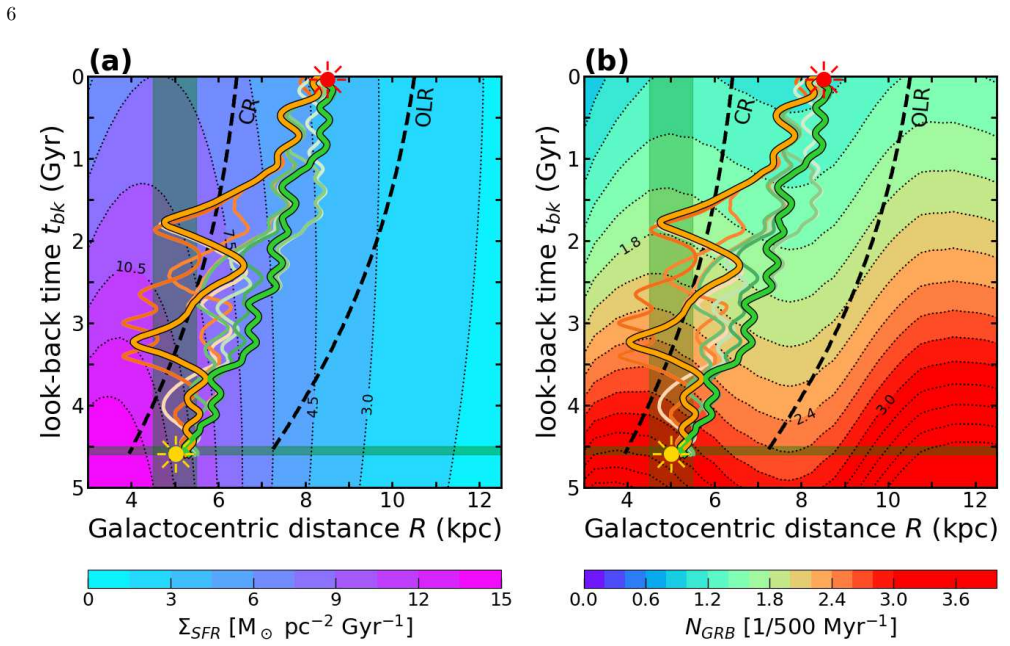
The authors use test-particle integrations in a time-dependent Milky Way potential to show that the Sun's outward migration from about 5 kpc to 8.5–9 kpc can be produced by either a slowing bar or dynamic spiral arms, provided both structures evolve. With a rigid bar and a steady density-wave spiral, migration is negligible and stars cannot cross the bar's corotation barrier, the Jacobi-energy peak at roughly 6.4 kpc. When the bar's pattern speed falls from 55 to 36 $\mathrm{km\,s^{-1}\,kpc^{-1}}$ over 4.6 Gyr, its corotation radius moves outward from about 4 kpc to 6.4 kpc, carrying 'trapped migrators' with it. When spiral arms are short-lived, winding patterns whose pitch angle changes with time, 'untrapped migrators' are scattered outward more broadly; in the fully evolving model about 0.8% of test particles reach the Sun's present-day guiding radius, and the fraction rises to 0.4–1.4% as the dynamic-arm amplitude is varied over the observed 20–30% range. The two pathways place the Sun in markedly different environments: trapped migrators linger in the inner disk for up to 2 Gyr, with roughly twice the star-formation density, about three times the lethal gamma-ray-burst rate, higher comet flux, and roughly ten times the stellar-encounter rate of the present solar neighborhood, while untrapped migrators move outward to a quieter environment.
Load-bearing premise
The Sun was born at about 5 kpc, inside the Galactic bar's corotation radius; if the Sun actually formed farther out beyond roughly 6.5 kpc, the Jacobi barrier never applied and the trapped scenario is moot.
Editorial extensions
If this is right
- The Sun's birth radius inside the bar's corotation does not forbid its outward migration; a slowing bar and dynamic spiral arms can each overcome the Jacobi barrier.
- The fully evolving model produces stars at the Sun's present guiding radius, so the Sun's 4.6 Gyr journey is consistent with current Galactic structure without requiring an unusually high initial Jacobi energy.
- The two migration paths are environmentally distinguishable: trapped migrators spend longer in high-radiation, high-comet-flux regions, which could have affected early Earth, including during the Archean.
- The proposed 'Galactic habitable orbits' concept implies that a star's habitability is set by its migration history, not just its present location, changing how the Galactic habitable zone is defined and used.
- The radiation and comet-flux estimates along the Sun's trajectory indicate that the early solar system experienced higher star-formation density, higher gamma-ray-burst rates, and higher stellar encounter rates than the present-day solar neighborhood.
Reading between the lines
- If the trapped scenario is correct, one might expect a population of Sun-like, chemically enriched stars near the bar's current corotation radius with distinctive resonant orbital signatures; Gaia-based surveys could search for such a 'bar-trapped' cohort to test the model.
- The framework suggests that exoplanet habitability assessments should incorporate the stellar orbital history: two planets around stars at the same Galactocentric radius today can have had very different radiation and comet histories, which may bias biosignature interpretations.
- The same machinery generalizes to other barred spiral galaxies: habitability predictions for their planetary systems should depend on bar pattern-speed evolution and spiral-arm transience, not on a static annular zone.
- A quantitative test of the environmental story would couple the two migration time series to terrestrial models: the early Earth's irradiation and comet-delivery history should match one of the two pathways, not a time-averaged Galactic background.
Signed reviews
Editorial analysis
A structured set of objections, weighed in public.
Referee Report
Summary. The paper uses test-particle integrations in analytic, time-dependent Milky Way potentials to ask whether the Sun could have migrated from a birth radius of 4.5–5.5 kpc to its present guiding radius near 8.5–9 kpc. It compares four combinations: rigid or slowing bar, and steady (SDW) or dynamic (DYN) spiral arms, and identifies two migration pathways, which it calls trapped (bar-corotation capture) and untrapped (dynamic-arm scattering). It then evaluates environmental quantities along representative orbits—SFR density, lethal GRB rate, comet flux, and stellar encounter rate—and proposes replacing the static Galactic habitable zone with the idea of 'Galactic habitable orbits.'
Significance. If the central claim is valid, the paper would provide a concrete dynamical scenario for the Sun's large radial migration and would make a useful conceptual point: habitability should be understood along a star's orbital history rather than as a fixed spatial zone. The paper has genuine strengths: a controlled parameter study isolating bar slowdown versus spiral-arm dynamism, use of observationally motivated parameter ranges, and an explicit attempt to connect orbital histories with radiation and comet-delivery hazards. The environmental analysis is transparently based on published models. However, the headline claim in the abstract is not actually supported by the paper's own simulations, because the trapped pathway is shown to stall near 6.5 kpc. The useful and defensible result is that the untrapped dynamic-arm pathway can bring some particles to the present solar radius, but the wording of the abstract and parts of the discussion overstate this as 'both mechanisms.'
major comments (3)
- [Abstract; §2.1; Fig. 1(b)] The abstract states that 'both mechanisms can explain how the Sun migrated from its birth radius (≈5 kpc) to its current orbital radius around 8.5–9 kpc,' but the simulations in §2.1 show that the slowing bar alone, or a slowing bar with SDW arms, confines particles near the current corotation radius of ~6.5 kpc and prevents further outward migration. Only the fully evolving model with slowing bar plus DYN arms produces particles in the 8.5–9 kpc range, at a level of about 0.8%. Thus the trapped scenario cannot by itself explain the Sun's present radius; the abstract's claim is internally inconsistent with Figure 1(b) and the text in §2.1. The claim should be corrected to attribute the final radius specifically to the untrapped dynamic-arm pathway, or to phrase the conclusion as 'the evolving combination of a slowing bar and dynamic spiral arms can explain...' rather than 'both mechanisms.'
- [§2.3] The fast, short bar case discussed in §2.3 introduces a tension with the paper's premise. If the bar pattern speed was ≈55 km/s/kpc at the Sun's birth, the corotation radius would be about 4 kpc, placing the Sun's birth radius of ~5 kpc outside corotation. In that case the CR barrier would not apply, and the trapped scenario becomes irrelevant for the Sun. The paper notes this but does not run the corresponding quantitative model; it simply asserts that migration would then be driven by DYN arms. Because the abstract's 'both mechanisms' claim depends on the Sun having been born inside the bar's corotation, this alternative parameter choice should be incorporated into the model comparison or explicitly shown not to change the qualitative conclusion.
- [§2.1; Fig. 1(b)] The fraction of particles reaching the present solar radius is about 0.8% (≈80 of 10,000 particles). This is a small tail of the distribution, and the paper does not report how sensitive this tail is to the number of particles, the random initial phases, or the assumed DYN arm lifetime σs(t>t_peak)=200 Myr. Since the headline conclusion rests on the existence of this tail, a convergence test or a variation of the spiral-arm recurrence parameters would strengthen the claim. Without this, the reader cannot tell whether 0.8% is a robust prediction or a numerical artifact of a particular realization.
minor comments (5)
- [Title] The title contains a formatting artifact: 'Galacti c Habitable Orbits' should read 'Galactic Habitable Orbits.'
- [Fig. 3 caption] The caption uses 'NGBR' in the description of panel (b); this should be 'N_GRB' (the lethal GRB event rate) for consistency with the text.
- [§3.2] The comet flux formula is written as 'fcomets ≈ 10 (Gz/(4.5×10^3 (km/s/kpc)^2)) comets/year'; the dimensional normalization should be stated more carefully, since Gz has units of (km/s/kpc)^2 only after division by a length scale, and the reader should be told where the coefficient 10 comes from.
- [Appendix A, Eq. (A3)] In the exponential slowdown formula, the roles of t0 and tslow are initially unclear; a brief sentence defining 't0' as the integration endpoint and 'tslow' as the e-folding timescale before the equation would improve readability.
- [§2.2] The terms 'trapped migrators' and 'untrapped migrators' are introduced with reference to Figure 3, but the selection criterion for classifying particles into these two groups is never stated quantitatively; the authors should specify how the classification was made in the simulation data.
Circularity Check
No significant circularity: the simulated guiding-radius distribution is an output, not a fitted target; the abstract's overstatement is a consistency issue, not a circular one.
full rationale
The central migration result is not equivalent to its inputs. The simulation integrates a specified analytic potential (Appendix A) with initial guiding radii fixed at 4.5-5.5 kpc from the literature compilation in Figure 1a, and the final Rg distribution in Figure 1b is an output; no model parameter is tuned to make particles land at 8.5-9 kpc. The 0.8% success fraction is a tail of the distribution, and the paper uses it as a probability statement, not as a fitted prediction. The birth-radius input is partly drawn from the authors' own GCE papers (Tsujimoto & Baba 2020; Baba et al. 2023), but the same range is also supported by independent references (e.g., Nieva & Przybilla 2012; Haywood et al. 2019; Frankel et al. 2020; Prantzos et al. 2023; Lu et al. 2024; Ratcliffe et al. 2023), so the adopted input does not reduce to self-citation. The environmental sections are downstream applications: SFR density and GRB rates come from the published Baba et al. (2023) GCE model and the Spinelli et al. (2021) formalism, while comet flux and encounter rates use Gardner et al. (2011) and Rickman et al. (2008). These are external formulas, not the present migration simulation's outputs. The most serious issue is an internal consistency problem, not circularity: Section 2.1 states that the slowing bar plus SDW model traps the system near 6.5 kpc and prevents further outward migration, while the abstract credits 'both mechanisms' with reaching 8.5-9 kpc; only the fully evolving model achieves that radius at the 0.8% level. That mismatch is a claim-support problem that belongs in correctness assessment, not in the circularity score. Score 2 reflects the paper's repeated, though non-load-bearing, reliance on the authors' own prior models and data compilations.
Assumptions & free parameters
free parameters (8)
- Bar strength normalization A_b =
0.4
- Initial bar pattern speed Omega_b,SSF =
55 km/s/kpc
- Bar slowdown timescale t_slow =
2 Gyr
- Spiral arm amplitude ratio Sigma_s/Sigma_disk =
20%, 25%, 30%
- DYN spiral arm lifetime parameter sigma_s(t>t_peak) =
200 Myr
- Spiral pitch angle i_s =
13.5 degrees
- Spiral radial scale length R_s/R_d =
1.25 and 2.0
- Adopted solar birth radius range =
4.5-5.5 kpc
assumptions (8)
- standard math The Jacobi energy constraint for a rotating bar potential (Binney & Tremaine 2008) is valid and implies the corotation barrier.
- domain assumption The analytic bar potential of Binney (2018), Eq. A2, adequately represents the Milky Way bar.
- ad hoc to paper The bar's pattern speed evolved exponentially from 55 to 36 km/s/kpc over 4.6 Gyr, Eq. A3.
- domain assumption Dynamic spiral arms are transient, winding density patterns as modeled by Hunt et al. (2018), with lifetime about 200 Myr.
- domain assumption Test particles in a fixed analytic potential, without self-gravity or giant molecular cloud encounters, capture the Sun's essential migration.
- domain assumption The Galactic chemical evolution model of Baba et al. (2023) provides accurate star formation rate density and stellar density histories.
- domain assumption The Sun's birth radius is about 5 kpc, inside the bar's corotation at birth, based on metallicity and age-metallicity gradients.
- domain assumption The lethal GRB rate method of Spinelli et al. (2021) and the comet flux scaling of Gardner et al. (2011) apply to the Milky Way environments along the orbits.
Cite this review
Pith. "Pith review of Solar System Migration Points to a Renewed Concept: Galactic Habitable Orbits." pith.science (2026). https://pith.science/paper/33TOOSRB
@misc{pith2026241202963,
  author       = {Pith},
  title        = {Pith review of: Solar System Migration Points to a Renewed Concept: Galactic Habitable Orbits},
  year         = {2026},
  howpublished = {\url{https://pith.science/paper/33TOOSRB}},
  note         = {Machine review of arXiv:2412.02963}
}
read the original abstract
Astrophysical evidence suggests that the Sun was born near 5 kpc from the Galactic center, within the corotation radius of the Galactic bar, around 6-7 kpc. This presents challenges for outward migration due to the Jacobi energy constraint, preventing stars from easily overcoming the corotation barrier. In this study, we use test particle simulations to explore two possible migration pathways for the Sun: a "trapped" scenario, where the Sun's orbit was influenced by a slowing Galactic bar, and an "untrapped" scenario driven by dynamic spiral arms. Our results demonstrate that both mechanisms can explain how the Sun migrated from its birth radius (approximately 5 kpc) to its current orbital radius around 8.5-9 kpc. Furthermore, we investigate the environmental changes experienced by the Sun along these migration pathways, focusing on variations in radiation hazards and comet fluxes, which may have impacted planetary habitability. These findings highlight the dynamic nature of galactic habitability, emphasizing that the path a star takes within the Milky Way can significantly affect its surrounding environment and the potential for life. We propose a new concept of "Galactic habitable orbits," which accounts for evolving galactic structures and their effects on stellar and planetary systems. This work contributes to a deeper understanding of the solar system's migration and its implications for habitability within the Milky Way.
Figures


Figures from the paper (3 more)


Forward citations
Cited by 1 Pith paper
-
Paleodetectors for neutrino signals from diverse Galactic stellar collapses
Paleodetectors can reach burst-like Galactic core-collapse activity of several tens of supernovae at 10 pc, with sensitivity enhanced by high-mass NS and failed-SN neutrino emission that depends on the nuclear EOS.
Reference graph
Works this paper leans on
-
[1]
, " * write output.state after.block = add.period write newline
ENTRY address archivePrefix author booktitle chapter doi edition editor eprint howpublished institution journal key month number organization pages publisher school series title misctitle type volume year version url label extra.label sort.label short.list INTEGERS output.state before.all mid.sentence after.sentence after.block FUNCTION init.state.consts ...
-
[2]
write newline
" write newline "" before.all 'output.state := FUNCTION format.url url empty "" new.block "" url * "" * if FUNCTION format.eprint eprint empty "" archivePrefix empty "" archivePrefix "arXiv" = new.block " " eprint * " " * new.block " " eprint * " " * if if if FUNCTION format.doi doi empty "" " " doi * " " * if FUNCTION format.pid doi empty eprint empty ur...
-
[3]
oSE =+UC&s+13 s+13 s+13 s1nYb > JcG`L!WG(W!!*`'ir9&:
thebibliography [1] 20pt to REFERENCES 6pt =0pt -12pt 10pt plus 3pt =0pt =0pt =1pt plus 1pt =0pt =0pt -12pt =13pt plus 1pt =20pt =13pt plus 1pt \@M =10000 =-1.0em =0pt =0pt 0pt =0pt =1.0em @enumiv\@empty 10000 10000 `\.\@m \@noitemerr \@latex@warning Empty `thebibliography' environment \@ifnextchar \@reference \@latexerr Missing key on reference command E...
-
[4]
Adams , F. C. 2010, , 48, 47, 10.1146/annurev-astro-081309-130830
-
[5]
Asano , T., Kawata , D., Fujii , M. S., & Baba , J. 2024, , 529, L7, 10.1093/mnrasl/slad190
-
[6]
2015, , 454, 2954, 10.1093/mnras/stv2220
Baba , J. 2015, , 454, 2954, 10.1093/mnras/stv2220
-
[7]
Baba , J., Morokuma-Matsui , K., & Saitoh , T. R. 2017, , 464, 246, 10.1093/mnras/stw2378
-
[8]
Baba , J., Saitoh , T. R., & Tsujimoto , T. 2023, , 526, 6088, 10.1093/mnras/stad3188
Show all 64 references
-
[9]
R., & Wada , K
Baba , J., Saitoh , T. R., & Wada , K. 2013, , 763, 46, 10.1088/0004-637X/763/1/46
2013 doi
-
[10]
Bailer-Jones , C. A. L. 2018, , 609, A8, 10.1051/0004-6361/201731453
2018 doi
-
[11]
A., P \'e rez-Villegas , A., Michtchenko , T
Barros , D. A., P \'e rez-Villegas , A., Michtchenko , T. A., & L \'e pine , J. R. D. 2021, Frontiers in Astronomy and Space Sciences, 8, 48, 10.3389/fspas.2021.644098
2021
-
[12]
2014, , 52, 43, 10.1146/annurev-astro-081913-035926
Berger , E. 2014, , 52, 43, 10.1146/annurev-astro-081913-035926
2014 doi
-
[13]
2018, , 474, 2706, 10.1093/mnras/stx2835
Binney , J. 2018, , 474, 2706, 10.1093/mnras/stx2835
2018 doi
-
[14]
2008, Galactic Dynamics: Second Edition (Princeton University Press)
Binney , J., & Tremaine , S. 2008, Galactic Dynamics: Second Edition (Princeton University Press)
2008
-
[15]
2016, , 54, 529, 10.1146/annurev-astro-081915-023441
Bland-Hawthorn , J., & Gerhard , O. 2016, , 54, 529, 10.1146/annurev-astro-081915-023441
2016 doi
-
[16]
Chiba , R., Friske , J. K. S., & Sch \"o nrich , R. 2021, , 500, 4710, 10.1093/mnras/staa3585
2021 doi
-
[17]
2021, , 505, 2412, 10.1093/mnras/stab1094
Chiba , R., & Sch \"o nrich , R. 2021, , 505, 2412, 10.1093/mnras/stab1094
2021 doi
- [18]
-
[19]
1989, , 1, 261, 10.1007/BF00873080
Contopoulos , G., & Grosbol , P. 1989, , 1, 261, 10.1007/BF00873080
1989 doi
- [20]
- [21]
-
[22]
W., Rix , H.-W., et al
Eilers , A.-C., Hogg , D. W., Rix , H.-W., et al. 2020, , 900, 186, 10.3847/1538-4357/abac0b
2020 doi
-
[23]
2020, , 896, 15, 10.3847/1538-4357/ab910c
Frankel , N., Sanders , J., Ting , Y.-S., & Rix , H.-W. 2020, , 896, 15, 10.3847/1538-4357/ab910c
2020 doi
-
[24]
S., B \'e dorf , J., Baba , J., & Portegies Zwart , S
Fujii , M. S., B \'e dorf , J., Baba , J., & Portegies Zwart , S. 2018, , 477, 1451, 10.1093/mnras/sty711
2018 doi
-
[25]
2023, , 523, 3049, 10.1093/mnras/stad1612
Fujimoto , Y., Inutsuka , S.-i., & Baba , J. 2023, , 523, 3049, 10.1093/mnras/stad1612
2023 doi
-
[26]
2024, , 533, 4324, 10.1093/mnras/stae2041
Funakoshi , N., Matsunaga , N., Kawata , D., et al. 2024, , 533, 4324, 10.1093/mnras/stae2041
2024 doi
-
[28]
G., Patton , D
Gowanlock , M. G., Patton , D. R., & McConnell , S. M. 2011, Astrobiology, 11, 855, 10.1089/ast.2010.0555
2011
-
[30]
2015, , 578, A58, 10.1051/0004-6361/201525612
Halle , A., Di Matteo , P., Haywood , M., & Combes , F. 2015, , 578, A58, 10.1051/0004-6361/201525612
2015 doi
-
[31]
D., Di Matteo , P., & Khoperskov , S
Haywood , M., Snaith , O., Lehnert , M. D., Di Matteo , P., & Khoperskov , S. 2019, , 625, A105, 10.1051/0004-6361/201834155
2019 doi
-
[32]
1986, , 65, 13, 10.1016/0019-1035(86)90060-6
Heisler , J., & Tremaine , S. 1986, , 65, 13, 10.1016/0019-1035(86)90060-6
1986 doi
-
[33]
Hunt , J. A. S., Hong , J., Bovy , J., Kawata , D., & Grand , R. J. J. 2018, , 481, 3794, 10.1093/mnras/sty2532
2018 doi
-
[34]
1985, , 90, 1548, 10.1086/113868
Hut , P., & Tremaine , S. 1985, , 90, 1548, 10.1086/113868
1985 doi
-
[35]
A., Ro s kar , R., & Quinn , T
Kaib , N. A., Ro s kar , R., & Quinn , T. 2011, , 215, 491, 10.1016/j.icarus.2011.07.037
2011 doi
-
[36]
Kokaia , G., & Davies , M. B. 2019, , 489, 5165, 10.1093/mnras/stz813
2019 doi
-
[37]
2013, , 436, 1479, 10.1093/mnras/stt1667
Kubryk , M., Prantzos , N., & Athanassoula , E. 2013, , 436, 1479, 10.1093/mnras/stt1667
2013 doi
-
[38]
H., Fenner , Y., & Gibson , B
Lineweaver , C. H., Fenner , Y., & Gibson , B. K. 2004, Science, 303, 59, 10.1126/science.1092322
2004 doi
-
[39]
L., Minchev , I., Buck , T., et al
Lu , Y. L., Minchev , I., Buck , T., et al. 2024, , 535, 392, 10.1093/mnras/stae2364
2024 doi
-
[40]
Lynden-Bell , D., & Kalnajs , A. J. 1972, , 157, 1
1972
-
[41]
A., Brown , A
Mart \' nez-Barbosa , C. A., Brown , A. G. A., & Portegies Zwart , S. 2015, , 446, 823, 10.1093/mnras/stu2094
2015 doi
-
[42]
D., Vel \'a zquez , H., Pichardo , B., et al
Mata-Ch \'a vez , M. D., Vel \'a zquez , H., Pichardo , B., et al. 2019, , 876, 6, 10.3847/1538-4357/ab12d4
2019 doi
-
[43]
2010, , 722, 112, 10.1088/0004-637X/722/1/112
Minchev , I., & Famaey , B. 2010, , 722, 112, 10.1088/0004-637X/722/1/112
2010 doi
-
[44]
Nakar , E., Gal-Yam , A., & Fox , D. B. 2006, , 650, 281, 10.1086/505855
2006 doi
-
[45]
M., & Staniucha , M
Napier , W. M., & Staniucha , M. 1982, , 198, 723, 10.1093/mnras/198.3.723
1982 doi
-
[46]
F., & Przybilla , N
Nieva , M. F., & Przybilla , N. 2012, , 539, A143, 10.1051/0004-6361/201118158
2012 doi
-
[47]
2023, , 523, 2126, 10.1093/mnras/stad1551
Prantzos , N., Abia , C., Chen , T., et al. 2023, , 523, 2126, 10.1093/mnras/stad1551
2023 doi
-
[48]
2023, , 525, 2208, 10.1093/mnras/stad1573
Ratcliffe , B., Minchev , I., Anders , F., et al. 2023, , 525, 2208, 10.1093/mnras/stad1573
2023 doi
-
[49]
Rickman , H., Fouchard , M., Froeschl \'e , C., & Valsecchi , G. B. 2008, Celestial Mechanics and Dynamical Astronomy, 102, 111, 10.1007/s10569-008-9140-y
2008 doi
-
[50]
Ruderman , M. A. 1974, Science, 184, 1079, 10.1126/science.184.4141.1079
1974
-
[51]
Saitoh , T. R. 2017, , 153, 85, 10.3847/1538-3881/153/2/85
2017 doi
-
[52]
L., Kawata , D., Matsunaga , N., et al
Sanders , J. L., Kawata , D., Matsunaga , N., et al. 2024, , 530, 2972, 10.1093/mnras/stae711
2024 doi
-
[53]
A., & Binney , J
Sellwood , J. A., & Binney , J. J. 2002, MNRAS, 336, 785, 10.1046/j.1365-8711.2002.05806.x
2002
-
[54]
Shu , F. H. 2016, , 54, 667, 10.1146/annurev-astro-081915-023426
2016 doi
-
[55]
2012, , 425, 2335, 10.1111/j.1365-2966.2012.21638.x
Siebert , A., Famaey , B., Binney , J., et al. 2012, , 425, 2335, 10.1111/j.1365-2966.2012.21638.x
2012
-
[56]
D., Zari , E., Elia , D., et al
Soler , J. D., Zari , E., Elia , D., et al. 2023, , 678, A95, 10.1051/0004-6361/202347608
2023 doi
-
[57]
2021, , 647, A41, 10.1051/0004-6361/202039507
Spinelli , R., Ghirlanda , G., Haardt , F., Ghisellini , G., & Scuderi , G. 2021, , 647, A41, 10.1051/0004-6361/202039507
2021 doi
-
[58]
C., Melott , A
Thomas , B. C., Melott , A. L., Jackman , C. H., et al. 2005, , 634, 509, 10.1086/496914
2005 doi
-
[59]
2020, , 904, 137, 10.3847/1538-4357/abc00a
Tsujimoto , T., & Baba , J. 2020, , 904, 137, 10.3847/1538-4357/abc00a
2020 doi
-
[60]
J., Zhang , B., Nagamine , K., & Choi , J.-H
Virgili , F. J., Zhang , B., Nagamine , K., & Choi , J.-H. 2011, , 417, 3025, 10.1111/j.1365-2966.2011.19459.x
2011
-
[61]
2024, , 528, 3576, 10.1093/mnras/stae083
Vislosky , E., Minchev , I., Khoperskov , S., et al. 2024, , 528, 3576, 10.1093/mnras/stae083
2024 doi
-
[62]
R., Rigley , J
Walton , C. R., Rigley , J. K., Lipp , A., et al. 2024, Nature Astronomy, 8, 556, 10.1038/s41550-024-02212-z
2024 doi
-
[63]
2010, , 406, 1944, 10.1111/j.1365-2966.2010.16787.x
Wanderman , D., & Piran , T. 2010, , 406, 1944, 10.1111/j.1365-2966.2010.16787.x
2010
-
[64]
1996, , 314, 438
Wielen , R., Fuchs , B., & Dettbarn , C. 1996, , 314, 438
1996
-
[65]
E., & Bloom , J
Woosley , S. E., & Bloom , J. S. 2006, , 44, 507, 10.1146/annurev.astro.43.072103.150558
2006 arXiv
-
[66]
2018, Research in Astronomy and Astrophysics, 18, 146, 10.1088/1674-4527/18/12/146
Xu , Y., Hou , L.-G., & Wu , Y.-W. 2018, Research in Astronomy and Astrophysics, 18, 146, 10.1088/1674-4527/18/12/146
2018 doi
Reviewed August 11, 2026 · model on record in the stance chip above.
Discussion (0). Continue with ORCID to comment.