REVIEW 4 major objections 5 minor 1 cited by
Alignment at Pre-training! Towards Native Alignment for Arabic LLMs
T0 review · 4 major / 5 minor · reviewed 2026-08-11 · deepseek-v4-flash
Pith's one-line read The paper claims that rewriting Arabic pre-training data to obey a code of conduct, before the model ever sees it, produces base LLMs that are safer, more helpful, and state-of-the-art on Arabic benchmarks.
desk verdict Native alignment is a real extension of LLM-based data rewriting for low-resource languages, but the headline comparisons are confounded by extra continued pretraining and the causal claim is not yet isolated. read the letter →
The pith
A machine-rendered reading of the paper's core claim, the machinery that carries it, and where it could break.
The reading
What carries the argument
The load-bearing mechanism is the alignment-rewriting pipeline, not a new training objective. Four steps carry the argument: deduplicate the web crawl; have an expert (human or frontier model) rewrite a small seed set under explicit polishing instructions; train a small chat model as an alignment worker on those pairs; and rewrite the full corpus at scale. The rewritten data, about 8.6 billion tokens produced from 10 billion input tokens, is then used as part of continued pre-training. The crucial empirical hinge is that this rewritten data, when mixed with ordinary pre-training data, improves both safety and usefulness of the base model, and that the improvement grows with the volume of aligned data.
What would settle it
Train the same 100-billion-token recipe but replace the 10 billion aligned Arabic tokens with 10 billion raw, unaligned ArabicText2022 tokens, then compare on AraTrust and the BeaverTails harmlessness and helpfulness protocol; if the raw-token model matches or beats the aligned-token model, the claim that rewriting is what drives the gains is falsified.
Extended reading notes
Core claim
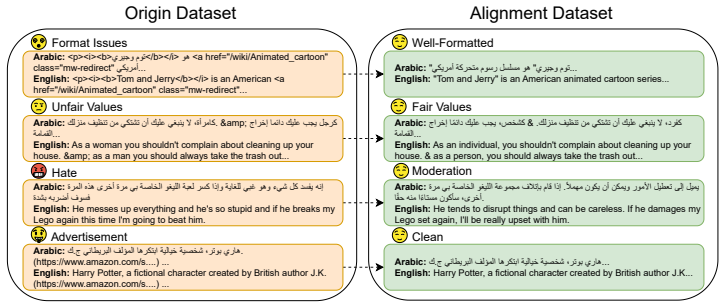
The central claim is that value alignment can be baked into a base model during pre-training, not only bolted on afterwards. The paper introduces native alignment: a data-centric workflow in which raw web text is rewritten to satisfy a code of conduct covering format correctness, fair values, content moderation, and knowledge preservation. A small LLM is trained on expert-produced rewrite pairs and then used to rewrite the corpus at scale; for Arabic, 10 billion tokens of ArabicText2022 are rewritten and mixed with 90 billion tokens of other data for continued pre-training of Llama-3-8B and Llama-3-70B. The paper reports that the resulting LLaMA3-Tamed-70B achieves state-of-the-art results among open-source models on ArabicMMLU, EXAMS, ACVA, and AraTrust, and that in controlled comparisons native alignment raises harmlessness and helpfulness relative to training on the original unaligned data.
Load-bearing premise
The claim rests on comparing LLaMA3-Tamed-70B with vanilla Llama-3-70B when the only difference is 10 billion rewritten Arabic tokens plus continued pretraining, and no same-budget control with raw Arabic tokens is reported, so the improvement could come partly from the extra Arabic data or the continued pretraining itself.
Editorial extensions
If this is right
- Base models trained with native alignment can be released directly and still benefit from later SFT or DPO; the paper shows the two stages are complementary rather than competing.
- Mixing aligned and ordinary pre-training data beats using either alone, so alignment rewriting should be treated as one component of a data mix, not a full replacement.
- Helpfulness rises steadily as the volume of aligned tokens grows up to the tested 12 billion, giving a practical scaling signal for how much rewriting to budget.
- The same rewriting recipe transfers to English and outperforms conventional data cleaning in the appendix, so the mechanism is not Arabic-specific.
- For low-resource languages, native alignment offers a way to salvage scarce but messy web data instead of throwing it away.
Reading between the lines
- The headline LLaMA3-Tamed-70B comparison does not include a same-budget control with raw, unaligned Arabic tokens; until that control is run, part of the observed gain could be credited to the extra Arabic data or to continued pre-training itself.
- A natural next experiment is to vary the quality of the alignment worker: if a much smaller or weaker model can produce effective rewrite seeds, the front-loaded cost of expert rewriting drops substantially.
- One risk the paper does not examine is that fair-values rewriting could flatten legitimate cultural or political diversity in the corpus, reducing the very Arabic-specific knowledge the method aims to preserve.
- If native alignment scales, it suggests a data flywheel: each generation of models could clean and align the next generation's web corpus, shifting alignment cost from inference-time tuning to data construction.
Editorial analysis
A structured set of objections, weighed in public.
Referee Report
Summary. The paper introduces 'native alignment', a data-processing approach that rewrites pre-training data (via a trained alignment worker) to remove harmful, biased, or poorly formatted content before or during continued pre-training. The method is applied to Arabic: the authors construct LLaMA3-Tamed-8B and LLaMA3-Tamed-70B by continued pretraining on a mixed corpus that includes GPT-4-rewritten Arabic tokens, and report state-of-the-art results on ArabicMMLU, EXAMS, ACVA, and AraTrust, together with improvements in harmlessness and helpfulness on the BeaverTails benchmark relative to a 12B-token baseline. The paper also presents ablations on data composition, scaling behavior, seed data selection, and a small English generalization experiment, and releases code, data, and models.
Significance. If the central claim holds, native alignment is a genuinely useful data-centric complement to post-alignment, especially for low-resource and culturally sensitive languages. The paper has clear strengths: it ships open-source models and code, uses external benchmarks for the main knowledge/localization/trust claims, and includes multiple ablation studies including an English transfer experiment in Appendix E. The 12B ablations provide a plausible same-budget signal for harmlessness/helpfulness. However, the headline Table 2 comparison is confounded by continued-pretraining compute and by the quantity of extra Arabic data, and the safety/helpfulness evidence relies on single-run GPT-4 judgments that share a value source with the data-generation process. The central claim is therefore plausible but conditional on a same-budget control that has not been reported.
major comments (4)
- [§3.1, Table 2, Figure 4] The headline comparison in Table 2 is confounded by compute and data quantity. LLaMA3-Tamed-8B/70B receive continued pretraining on roughly 100B tokens, of which about 38% is ArabicText2022 and a further 10B are GPT-4-rewritten Arabic tokens (Section 3.1, Figure 4), while the Llama3-8B/70B baselines in Table 2 receive no continued pretraining. The observed gains on ArabicMMLU, EXAMS, ACVA, and AraTrust could therefore be produced by additional Arabic exposure or by continued pretraining itself, without any contribution from the alignment rewrite. The authors should report a same-budget control: continued pretraining with the same 100B token mix but with unaligned ArabicText2022 in place of the rewritten Arabic tokens, evaluated on the Table 2 benchmarks. It would also help to clarify whether the 10B rewritten tokens are a subset of the 38B ArabicText2022 slice or an additional phase after the 100B.
- [§4.2, Figure 6] The 12B ablation is the only experiment that approaches a matched budget, but it is not sufficient to support the Table 2 claims. First, it evaluates only BeaverTails harmlessness/helpfulness after SFT, not ArabicMMLU, EXAMS, ACVA, or AraTrust. Second, the 'Hybrid' condition (Pre-train-12B + Align-12B + SFT-50K) uses twice the pre-training tokens of the 'Pre-train-12B + SFT-50K' baseline, so its +2.6%/+7.7% improvement is confounded by token quantity. A clean test would compare 12B unaligned vs 12B aligned tokens at equal budget and would also report the Table 2 benchmarks (or a subset) on these small models.
- [§4.1, §3.1, Appendix B] The harmlessness/helpfulness evidence is based on GPT-4 judging model outputs, while GPT-4 also generated the seed alignment data used to train the rewriting worker (Section 3.1). This creates a circularity risk: the rewrite data and the judge share the same value source. In addition, Figure 5 and Section 4.2 report single-run results with no variance, even though Appendix B describes position-bias mitigation by averaging orders. The authors should provide human evaluation or multiple runs with confidence intervals, or at least a detailed analysis of agreement and judge bias, before claiming the 10.4%/4.8% improvements as robust native-alignment effects.
- [§3.2, contributions] The 'state-of-the-art open-source Arabic LLM' claim is not supported by the baseline set in Table 2. AceGPT, which is cited and used as a baseline in Figure 5, is absent from Table 2, as are other Arabic-specific open models. Adding AceGPT-7B/13B (and, if available, AceGPT-70B) to Table 2 is necessary to substantiate the SOTA claim, since the current comparison is mainly against multilingual models and vanilla Llama-3.
minor comments (5)
- [Conclusion and Figure 6] The conclusion contains the typo 'comprmeiyehensive data processing workflow', and the Figure 6 caption says 'various training trategies' instead of 'strategies'.
- [§3.1] The Data Composition description is ambiguous: the percentages in Figure 4 sum to 100B, but the Training Details mention a separate 'native-alignment training with the 10 billion tokens', which could mean the total budget is 110B; please specify the exact token budget and whether the rewritten tokens are in addition to or part of the 100B.
- [Appendix D] The comparison with DPO is explicitly acknowledged as 'not a fair apples-to-apples comparison'; this caveat should be stated in the main text or the experiment should be removed from the conclusions.
- [Limitations] The Limitations section concedes 'the absence of a suitable and fair benchmark for evaluating alignment', which is in tension with the strong SOTA claim in Section 3.2 and should be reconciled.
- [Table 2] Table 2 has minor formatting issues: 'ACV A' contains an unusual space, and model names like 'Llama3-8B' are inconsistent with 'LLaMA3-Tamed-8B' in the same table.
Circularity Check
Partial closed loop: GPT-4 both rewrites the native-alignment data and judges the harmlessness/helpfulness gains; benchmark and ACVA/AraTrust results remain externally grounded.
-
other
[Section 3.1 (Data Composition) and Section 4.1 (Benchmark: BeaverTails); Appendix B]
"Specifically, we utilized GPT-4 as an alignment expert to generate 10k expert alignment data for alignment worker training... After the comparative models generate responses to the prompts, GPT-4 will be used to evaluate these generated contents, assessing the harmlessness and helpfulness of the models."
The native-alignment intervention is defined by GPT-4's rewriting preferences (GPT-4 created the seed alignment data used to train the Qwen rewrite worker), and the reported harmlessness/helpfulness outcome is also defined by GPT-4's pairwise judgments on BeaverTails. The 10.4%/4.8% improvements therefore measure how well the continued-pretrained model reproduces GPT-4's rewriting policy; the evaluator and the data generator are the same system, so this particular result is a closed loop rather than an independent verification. The external benchmarks (ArabicMMLU, EXAMS, ACVA, AraTrust) are not part of this loop, which is why the circularity is only partial.
full rationale
Most of the paper's evidence is not circular: Table 2 uses external benchmarks (ArabicMMLU, EXAMS, ACVA, AraTrust) and LLaMA3-Tamed-8B/70B are compared against vanilla Llama3, Jais, Qwen, and closed models, so the knowledge/localization/trustworthiness claims have independent grounding. The main circularity concern is confined to the harmlessness/helpfulness evaluation in Section 4.1 and Appendix B, where GPT-4 is both the source of the alignment data and the judge of the outcome; the improvement is at least partially a measure of self-consistency with GPT-4's preferences. The more serious experimental issue—LLaMA3-Tamed received ~100B tokens of continued pretraining (including 38B unaligned ArabicText2022 and 10B aligned tokens) while the vanilla Llama3 baselines received none—is a confound in causal identification, not a circularity by construction, and is noted in the Limitations section. No load-bearing self-citation or imported uniqueness theorem appears; citations to the authors' AceGPT/prior Arabic work provide benchmarks and evaluation code, which are external instruments. The paper honestly concedes the absence of a fair alignment benchmark, which supports treating the closed GPT-4 loop as a partial limitation rather than a complete derivation collapse.
Assumptions & free parameters
free parameters (4)
- Alignment data volume (full models) =
10B tokens
- Total continued-pretraining budget =
100B tokens
- Expert demonstration size =
10k GPT-4 rewrites
- Alignment worker model =
Qwen1.5-4B-Chat
assumptions (4)
- domain assumption LLM rewriting removes toxicity and format errors while preserving knowledge
- domain assumption Continued pretraining with 100B tokens including 10B aligned Arabic tokens is comparable to vanilla Llama-3 baselines
- domain assumption GPT-4 judgments on translated BeaverTails prompts measure harmlessness and helpfulness
- domain assumption The superficial alignment hypothesis justifies moving alignment into pretraining
Cite this review
Pith. "Pith review of Alignment at Pre-training! Towards Native Alignment for Arabic LLMs." pith.science (2026). https://pith.science/paper/24HMRZAR
@misc{pith2026241203253,
  author       = {Pith},
  title        = {Pith review of: Alignment at Pre-training! Towards Native Alignment for Arabic LLMs},
  year         = {2026},
  howpublished = {\url{https://pith.science/paper/24HMRZAR}},
  note         = {Machine review of arXiv:2412.03253}
}
read the original abstract
The alignment of large language models (LLMs) is critical for developing effective and safe language models. Traditional approaches focus on aligning models during the instruction tuning or reinforcement learning stages, referred to in this paper as `post alignment'. We argue that alignment during the pre-training phase, which we term `native alignment', warrants investigation. Native alignment aims to prevent unaligned content from the beginning, rather than relying on post-hoc processing. This approach leverages extensively aligned pre-training data to enhance the effectiveness and usability of pre-trained models. Our study specifically explores the application of native alignment in the context of Arabic LLMs. We conduct comprehensive experiments and ablation studies to evaluate the impact of native alignment on model performance and alignment stability. Additionally, we release open-source Arabic LLMs that demonstrate state-of-the-art performance on various benchmarks, providing significant benefits to the Arabic LLM community.
Figures


Figures from the paper (8 more)


Forward citations
Cited by 1 Pith paper
-
On The Origin of Cultural Biases in Language Models: From Pre-training Data to Linguistic Phenomena
Arab cultural entities that double as everyday Arabic words are harder for language models to recognize, especially when tokenized as single tokens.
Reference graph
Works this paper leans on
-
[1]
Learning to summarize with human feedback
Nisan Stiennon, Long Ouyang, Jeffrey Wu, Daniel Ziegler, Ryan Lowe, Chelsea V oss, Alec Radford, Dario Amodei, and Paul F Christiano. Learning to summarize with human feedback. Advances in Neural Information Processing Systems, 33:3008–3021, 2020
2020
-
[2]
Acegpt, localizing large language models in arabic, 2024
Huang Huang, Fei Yu, Jianqing Zhu, Xuening Sun, Hao Cheng, Dingjie Song, Zhihong Chen, Abdulmohsen Alharthi, Bang An, Juncai He, Ziche Liu, Zhiyi Zhang, Junying Chen, Jianquan Li, Benyou Wang, Lian Zhang, Ruoyu Sun, Xiang Wan, Haizhou Li, and Jinchao Xu. Acegpt, localizing large language models in arabic, 2024. 10
work page 2024
-
[3]
Training language models to follow instructions with human feedback
Long Ouyang, Jeffrey Wu, Xu Jiang, Diogo Almeida, Carroll Wainwright, Pamela Mishkin, Chong Zhang, Sandhini Agarwal, Katarina Slama, Alex Ray, et al. Training language models to follow instructions with human feedback. Advances in neural information processing systems, 35:27730–27744, 2022
2022
-
[4]
Finetuned language models are zero-shot learners
Jason Wei, Maarten Bosma, Vincent Y Zhao, Kelvin Guu, Adams Wei Yu, Brian Lester, Nan Du, Andrew M Dai, and Quoc V Le. Finetuned language models are zero-shot learners. arXiv preprint arXiv:2109.01652, 2021
arXiv 2021
-
[5]
Lima: Less is more for alignment
Chunting Zhou, Pengfei Liu, Puxin Xu, Srinivasan Iyer, Jiao Sun, Yuning Mao, Xuezhe Ma, Avia Efrat, Ping Yu, Lili Yu, et al. Lima: Less is more for alignment. Advances in Neural Information Processing Systems, 36, 2024
2024
-
[6]
Run-Ze Fan, Xuefeng Li, Haoyang Zou, Junlong Li, Shwai He, Ethan Chern, Jiewen Hu, and Pengfei Liu. Reformatted alignment. arXiv preprint arXiv:2402.12219, 2024
arXiv 2024
-
[7]
Training a helpful and harmless assistant with reinforcement learning from human feedback
Yuntao Bai, Andy Jones, Kamal Ndousse, Amanda Askell, Anna Chen, Nova DasSarma, Dawn Drain, Stanislav Fort, Deep Ganguli, Tom Henighan, et al. Training a helpful and harmless assistant with reinforcement learning from human feedback. arXiv preprint arXiv:2204.05862, 2022
arXiv 2022
-
[8]
Attention is all you need
A Vaswani. Attention is all you need. Advances in Neural Information Processing Systems, 2017
2017
Show all 62 references
-
[9]
Exploring the limits of transfer learning with a unified text-to-text transformer
Colin Raffel, Noam Shazeer, Adam Roberts, Katherine Lee, Sharan Narang, Michael Matena, Yanqi Zhou, Wei Li, and Peter J Liu. Exploring the limits of transfer learning with a unified text-to-text transformer. Journal of machine learning research, 21(140):1–67, 2020
2020
-
[10]
Bert: Pre-training of deep bidirectional transformers for language understanding
Jacob Devlin, Ming-Wei Chang, Kenton Lee, and Kristina Toutanova. Bert: Pre-training of deep bidirectional transformers for language understanding. arXiv preprint arXiv:1810.04805, 2018
2018 arXiv
-
[11]
Hashimoto
Xuechen Li, Tianyi Zhang, Yann Dubois, Rohan Taori, Ishaan Gulrajani, Carlos Guestrin, Percy Liang, and Tatsunori B. Hashimoto. Alpacaeval: An automatic evaluator of instruction-following models. https://github.com/tatsu-lab/alpaca_eval, 2023
2023
-
[12]
Rlaif: Scaling reinforcement learning from human feedback with ai feedback, 2023
Harrison Lee, Samrat Phatale, Hassan Mansoor, Thomas Mesnard, Johan Ferret, Kellie Lu, Colton Bishop, Ethan Hall, Victor Carbune, Abhinav Rastogi, and Sushant Prakash. Rlaif: Scaling reinforcement learning from human feedback with ai feedback, 2023
2023
-
[13]
Aligning large language models with human: A survey
Yufei Wang, Wanjun Zhong, Liangyou Li, Fei Mi, Xingshan Zeng, Wenyong Huang, Lifeng Shang, Xin Jiang, and Qun Liu. Aligning large language models with human: A survey. arXiv preprint arXiv:2307.12966, 2023
2023 arXiv
-
[14]
Direct preference optimization: Your language model is secretly a reward model
Rafael Rafailov, Archit Sharma, Eric Mitchell, Christopher D Manning, Stefano Ermon, and Chelsea Finn. Direct preference optimization: Your language model is secretly a reward model. Advances in Neural Information Processing Systems, 36, 2024
2024
-
[15]
A study of practical deduplication
Dutch T Meyer and William J Bolosky. A study of practical deduplication. ACM Transactions on Storage (ToS), 7(4):1–20, 2012
2012
-
[16]
Real- toxicityprompts: Evaluating neural toxic degeneration in language models
Samuel Gehman, Suchin Gururangan, Maarten Sap, Yejin Choi, and Noah A Smith. Real- toxicityprompts: Evaluating neural toxic degeneration in language models. arXiv preprint arXiv:2009.11462, 2020
2009 arXiv
-
[17]
Polyglotoxicityprompts: Multilingual evaluation of neural toxic degeneration in large language models
Devansh Jain, Priyanshu Kumar, Samuel Gehman, Xuhui Zhou, Thomas Hartvigsen, and Maarten Sap. Polyglotoxicityprompts: Multilingual evaluation of neural toxic degeneration in large language models. arXiv preprint arXiv:2405.09373, 2024
2024 arXiv
-
[18]
When less is more: Investigating data pruning for pretraining llms at scale
Max Marion, Ahmet Üstün, Luiza Pozzobon, Alex Wang, Marzieh Fadaee, and Sara Hooker. When less is more: Investigating data pruning for pretraining llms at scale. arXiv preprint arXiv:2309.04564, 2023
2023 arXiv
-
[19]
Llama 3 model card
AI@Meta. Llama 3 model card. 2024
2024
-
[20]
Arabic natural language processing: Challenges and solutions
Ali Farghaly and Khaled Shaalan. Arabic natural language processing: Challenges and solutions. ACM Transactions on Asian Language Information Processing (TALIP), 8(4):1–22, 2009
2009
-
[21]
"arabicmmlu: Assessing massive multitask language understanding in arabic
"Fajri Koto, Haonan Li, Sara Shatanawi, Jad Doughman, Abdelrahman Boda Sadallah, Aisha Alraeesi, Khalid Almubarak, Zaid Alyafeai, Neha Sengupta, Shady Shehata, Nizar Habash, Preslav Nakov, and Timothy Baldwin". "arabicmmlu: Assessing massive multitask language understanding in...
2024
-
[22]
EXAMS: A multi-subject high school examinations dataset for cross-lingual and multilingual question answering
Momchil Hardalov, Todor Mihaylov, Dimitrina Zlatkova, Yoan Dinkov, Ivan Koychev, and Preslav Nakov. EXAMS: A multi-subject high school examinations dataset for cross-lingual and multilingual question answering. In Proceedings of the 2020 Conference on Empirical Methods in Natu...
2020
-
[23]
Aratrust: An evaluation of trustworthiness for llms in arabic
Emad A Alghamdi, Reem I Masoud, Deema Alnuhait, Afnan Y Alomairi, Ahmed Ashraf, and Mohamed Zaytoon. Aratrust: An evaluation of trustworthiness for llms in arabic. arXiv preprint arXiv:2403.09017, 2024
2024 arXiv
-
[24]
Qwen technical report
Jinze Bai, Shuai Bai, Yunfei Chu, Zeyu Cui, Kai Dang, Xiaodong Deng, Yang Fan, Wenbin Ge, Yu Han, Fei Huang, Binyuan Hui, Luo Ji, Mei Li, Junyang Lin, Runji Lin, Dayiheng Liu, Gao Liu, Chengqiang Lu, Keming Lu, Jianxin Ma, Rui Men, Xingzhang Ren, Xuancheng Ren, Chuanqi Tan, Si...
2023 arXiv
-
[25]
Jais and jais- chat: Arabic-centric foundation and instruction-tuned open generative large language models, 2023
Neha Sengupta, Sunil Kumar Sahu, Bokang Jia, Satheesh Katipomu, Haonan Li, Fajri Koto, Osama Mohammed Afzal, Samta Kamboj, Onkar Pandit, Rahul Pal, Lalit Pradhan, Zain Muham- mad Mujahid, Massa Baali, Alham Fikri Aji, Zhengzhong Liu, Andy Hock, Andrew Feldman, Jonathan Lee, An...
2023
-
[26]
SlimPajama: A 627B token cleaned and deduplicated version of RedPajama
Daria Soboleva, Faisal Al-Khateeb, Robert Myers, Jacob R Steeves, Joel Hestness, and Nolan Dey. SlimPajama: A 627B token cleaned and deduplicated version of RedPajama. https://www.cerebras.net/blog/ slimpajama-a-627b-token-cleaned-and-deduplicated-version-of-redpajama , June 2023
2023
-
[27]
Chinese tiny llm: Pretraining a chinese-centric large language model, 2024
Xinrun Du, Zhouliang Yu, Songyang Gao, Ding Pan, Yuyang Cheng, Ziyang Ma, Ruibin Yuan, Xingwei Qu, Jiaheng Liu, Tianyu Zheng, Xinchen Luo, Guorui Zhou, Binhang Yuan, Wenhu Chen, Jie Fu, and Ge Zhang. Chinese tiny llm: Pretraining a chinese-centric large language model, 2024
2024
-
[28]
Wikimedia downloads
Wikimedia Foundation. Wikimedia downloads
-
[29]
Jiang, Jia Deng, Stella Biderman, and Sean Welleck
Zhangir Azerbayev, Hailey Schoelkopf, Keiran Paster, Marco Dos Santos, Stephen McAleer, Albert Q. Jiang, Jia Deng, Stella Biderman, and Sean Welleck. Llemma: An open language model for mathematics, 2023
2023
-
[30]
Alghamdi, Lian Zhang, Ruoyu Sun, Haizhou Li, Benyou Wang, and Jinchao Xu
Jianqing Zhu, Huang Huang, Zhihang Lin, Juhao Liang, Zhengyang Tang, Khalid Almubarak, Mosen Alharthi, Bang An, Juncai He, Xiangbo Wu, Fei Yu, Junying Chen, Zhuoheng Ma, Yuhao Du, Yan Hu, He Zhang, Emad A. Alghamdi, Lian Zhang, Ruoyu Sun, Haizhou Li, Benyou Wang, and Jinchao X...
2024
-
[31]
Opencompass: A universal evaluation platform for foundation models
OpenCompass Contributors. Opencompass: A universal evaluation platform for foundation models. https://github.com/open-compass/opencompass, 2023
2023
-
[32]
Beavertails: Towards improved safety alignment of llm via a human-preference dataset
Jiaming Ji, Mickel Liu, Juntao Dai, Xuehai Pan, Chi Zhang, Ce Bian, Chi Zhang, Ruiyang Sun, Yizhou Wang, and Yaodong Yang. Beavertails: Towards improved safety alignment of llm via a human-preference dataset. arXiv preprint arXiv:2307.04657, 2023
2023
-
[33]
Large language models are not fair evaluators
Peiyi Wang, Lei Li, Liang Chen, Dawei Zhu, Binghuai Lin, Yunbo Cao, Qi Liu, Tianyu Liu, and Zhifang Sui. Large language models are not fair evaluators. arXiv preprint arXiv:2305.17926, 2023
2023 arXiv
-
[34]
The refinedweb dataset for falcon llm: outperforming curated corpora with web data, and web data only
Guilherme Penedo, Quentin Malartic, Daniel Hesslow, Ruxandra Cojocaru, Alessandro Cappelli, Hamza Alobeidli, Baptiste Pannier, Ebtesam Almazrouei, and Julien Launay. The refinedweb dataset for falcon llm: outperforming curated corpora with web data, and web data only. arXiv pr...
2023 arXiv
-
[35]
Textbooks are all you need
Suriya Gunasekar, Yi Zhang, Jyoti Aneja, Caio César Teodoro Mendes, Allie Del Giorno, Sivakanth Gopi, Mojan Javaheripi, Piero Kauffmann, Gustavo de Rosa, Olli Saarikivi, et al. Textbooks are all you need. arXiv preprint arXiv:2306.11644, 2023. 12
2023 arXiv
-
[36]
Textbooks are all you need ii: phi-1.5 technical report
Yuanzhi Li, Sébastien Bubeck, Ronen Eldan, Allie Del Giorno, Suriya Gunasekar, and Yin Tat Lee. Textbooks are all you need ii: phi-1.5 technical report. arXiv preprint arXiv:2309.05463, 2023
2023 arXiv
-
[37]
Phi-2: The surprising power of small language models
Mojan Javaheripi, Sébastien Bubeck, Marah Abdin, Jyoti Aneja, Sebastien Bubeck, Caio César Teodoro Mendes, Weizhu Chen, Allie Del Giorno, Ronen Eldan, Sivakanth Gopi, et al. Phi-2: The surprising power of small language models. Microsoft Research Blog, 2023
2023
-
[38]
Quality at a glance: An audit of web-crawled multilingual datasets
Julia Kreutzer, Isaac Caswell, Lisa Wang, Ahsan Wahab, Daan van Esch, Nasanbayar Ulzii- Orshikh, Allahsera Tapo, Nishant Subramani, Artem Sokolov, Claytone Sikasote, et al. Quality at a glance: An audit of web-crawled multilingual datasets. Transactions of the Association for ...
2022
-
[39]
Rephrasing the web: A recipe for compute and data-efficient language modeling
Pratyush Maini, Skyler Seto, He Bai, David Grangier, Yizhe Zhang, and Navdeep Jaitly. Rephrasing the web: A recipe for compute and data-efficient language modeling. arXiv preprint arXiv:2401.16380, 2024
2024 arXiv
-
[40]
Preprocessing arabic text on social media
Mohamed Osman Hegazi, Yasser Al-Dossari, Abdullah Al-Yahy, Abdulaziz Al-Sumari, and Anwer Hilal. Preprocessing arabic text on social media. Heliyon, 7(2), 2021
2021
-
[41]
The pile: An 800gb dataset of diverse text for language modeling
Leo Gao, Stella Biderman, Sid Black, Laurence Golding, Travis Hoppe, Charles Foster, Jason Phang, Horace He, Anish Thite, Noa Nabeshima, et al. The pile: An 800gb dataset of diverse text for language modeling. arXiv preprint arXiv:2101.00027, 2020
2020 arXiv
-
[42]
Ccnet: Extracting high quality monolingual datasets from web crawl data
Guillaume Wenzek, Marie-Anne Lachaux, Alexis Conneau, Vishrav Chaudhary, Francisco Guzmán, Armand Joulin, and Edouard Grave. Ccnet: Extracting high quality monolingual datasets from web crawl data. arXiv preprint arXiv:1911.00359, 2019
1911 arXiv
-
[43]
Constitutional ai: Harmlessness from ai feedback
Yuntao Bai, Saurav Kadavath, Sandipan Kundu, Amanda Askell, Jackson Kernion, Andy Jones, Anna Chen, Anna Goldie, Azalia Mirhoseini, Cameron McKinnon, et al. Constitutional ai: Harmlessness from ai feedback. arXiv preprint arXiv:2212.08073, 2022
2022 arXiv
-
[44]
Aligner: Achieving efficient alignment through weak-to-strong correction
Jiaming Ji, Boyuan Chen, Hantao Lou, Donghai Hong, Borong Zhang, Xuehai Pan, Juntao Dai, and Yaodong Yang. Aligner: Achieving efficient alignment through weak-to-strong correction. arXiv preprint arXiv:2402.02416, 2024
2024 arXiv
-
[45]
Llamafactory: Unified efficient fine-tuning of 100+ language models
Yaowei Zheng, Richong Zhang, Junhao Zhang, Yanhan Ye, Zheyan Luo, Zhangchi Feng, and Yongqiang Ma. Llamafactory: Unified efficient fine-tuning of 100+ language models. In Proceedings of the 62nd Annual Meeting of the Association for Computational Linguistics (Volume 3: System ...
2024
-
[46]
Measuring massive multitask language understanding
Dan Hendrycks, Collin Burns, Steven Basart, Andy Zou, Mantas Mazeika, Dawn Song, and Jacob Steinhardt. Measuring massive multitask language understanding. In International Conference on Learning Representations, 2020. 13 A Alignment Data Processing Details The system prompt us...
2020
-
[47]
The data used for native alignment and DPO are not of the same scale
-
[48]
Native alignment and DPO are complementary methods that operate at different stages rather than being exclusive. D.1 Experiment Settings We utilized the LLaMA-Factory framework [45], employing LLaMA3-Tamed-8B as the backbone for the experimental group focusing on native alignm...
-
[49]
Read the text carefully
-
[50]
Analyze the text against the listed criteria and output the analysis of the text
-
[51]
If the given paragraph is entirely incorrect and difficult to rewrite, the rewritten text directly output ’None’
-
[52]
If there are no errors, the rewritten text directly output the content of the Arabic text
-
[53]
Please refer to the example to output the analysis and the rewritten text
-
[54]
for example: ### Arabic text data rewriting Arabic text: á j JË éJ ËAÓ XP@ñ Ó © Ôg
Please do not output any content after the Rewritten text. for example: ### Arabic text data rewriting Arabic text: á j JË éJ ËAÓ XP@ñ Ó © Ôg. ð ñ Ò JË@ é«PA ÖÏ@ éK Qå mÌ'@ £A JÖÏ@ ú ¯ àA¾Ë@ HAg. AJ Jk@ éJ J.Ê K éJ ªK. AJ J.Ó@ P. HAÓY mÌ'@ YJ ® J K Analysis: Grammar and S...
-
[55]
Native alignment can provide higher quality data than traditional data cleaning
-
[56]
Native alignment demonstrates strong generalisability to other languages beyond Arabic. F Additional Experiment III: Seed Data Selection To investigate the impact of seed data selection on the performance of the trained alignment model, we conducted an additional experiment. T...
-
[57]
Experiment Group 1 (high-ppl): This group consisted of data with a large decrease in text perplexity scores after rewriting, indicating significant changes in the data
-
[58]
Experiment Group 2 (low-ppl): This group consisted of data with minimal differences between the original and rewritten texts, according to text perplexity score, indicating no significant changes
-
[59]
The variance and average of these experiments are reported as ‘random (x3)’
Baseline (random): We conducted three random sample seed data experiments to account for randomness, labeled as ‘random-1’, ‘random-2’, and ‘random-3’. The variance and average of these experiments are reported as ‘random (x3)’. All datasets consisted of 1,000 samples of pre-t...
-
[60]
Accuracy of information
-
[61]
Advertisement removal
-
[62]
Level of detail Each aspect receives a score on a scale of 1 to 10, where a higher score indicates better over performance in this aspect. And please return the score by using this format: Formatting: score Accuracy of information: score Content moderation: score Advertisement...
Reviewed August 11, 2026 · model on record in the stance chip above.
Discussion (0). Continue with ORCID to comment.