REVIEW 4 major objections 4 minor 65 references
Beyond Local Sharpness: Communication-Efficient Global Sharpness-aware Minimization for Federated Learning
T0 review · 4 major / 4 minor · reviewed 2026-08-11 · deepseek-v4-flash
Pith's one-line read FedGloSS claims that global sharpness, not local flatness, should be minimized in heterogeneous federated learning, and shows that server-side SAM with a one-round-delayed gradient achieves flatter minima at FedAvg-level communication cost.
desk verdict Solid FL paper: server-side SAM with a previous-gradient trick is genuinely new and well tested, but the main-text algorithm omits the ADMM terms that the appendix and experiments actually use. read the letter →
The pith
A machine-rendered reading of the paper's core claim, the machinery that carries it, and where it could break.
The reading
What carries the argument
The central mechanism is server-side Sharpness-Aware Minimization (SAM) with a delayed pseudo-gradient: the server perturbs the global model by $\rho\, \tilde{\Delta}^{t-1}/\|\tilde{\Delta}^{t-1}\|$ instead of computing a live ascent gradient, then descends along the resulting sharpness-aware direction. ADMM with per-client dual variables $\sigma_k$ is layered on top to align local and global updates, keeping the approximation error $\delta^t_\epsilon$ small across rounds. The paper argues that SAM's tendency toward small weight updates also prevents the parameter explosion that historically breaks ADMM-based federated methods.
What would settle it
Run FedGloSS on CIFAR-100 with $\alpha=0$ using stateless clients (dual variables reset to zero each round) and compare final accuracy and the maximum Hessian eigenvalue against the stateful version; the paper's mechanism predicts clear degradation in both. A second check is to measure $\delta^t_\epsilon$ from Eq. (6) under randomly changing client subsets: the claim implies the gap stays bounded with ADMM and grows without it.
Extended reading notes
Core claim
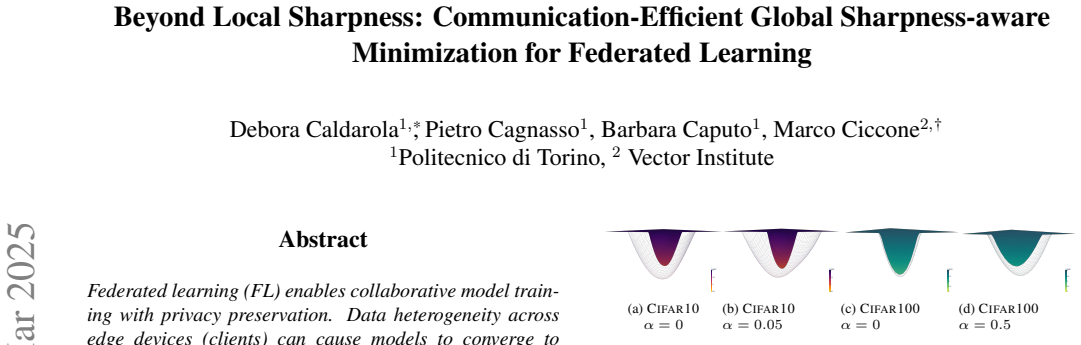
FedGloSS solves the global sharpness-aware objective $\min_{w} F(w) = \frac{1}{C}\sum_k \max_{\|\epsilon\|\le\rho} f_k(w+\epsilon)$ on the server, replacing the expensive SAM ascent direction with the pseudo-gradient from the previous round, $\tilde{\epsilon}^{t} = \rho\, \tilde{\Delta}^{t-1}/\|\tilde{\Delta}^{t-1}\|$. The authors claim this yields flatter global minima and better accuracy than both local-sharpness methods (FedSAM, FedSpeed, FedGamma) and the global-consistency method FedSMOO, while keeping FedAvg's per-round communication cost. The loss-landscape and Hessian-eigenvalue measurements in the paper support the claim that FedGloSS converges to the flattest global minima among all compared methods.
Load-bearing premise
The method depends on stateful clients that keep and return an ADMM dual variable across rounds; the paper itself calls this 'a key limitation of our approach.' If clients are stateless, drop in and out, or the dual variables drift, the alignment that keeps the previous pseudo-gradient close to the true SAM perturbation is lost, and the central approximation has no guarantee.
Editorial extensions
If this is right
- Global flatness becomes optimizable at the same communication cost as FedAvg, removing the main practical barrier to global-sharpness methods.
- Any client optimizer (SGD or SAM) can be used, so clients can avoid SAM's doubled local compute when needed.
- The method reaches FedAvg-level accuracy about three to five times faster in bits exchanged, and matches the exact two-step server SAM (Naive FedGloSS) in final accuracy.
- The combination of server-side SAM and ADMM avoids the parameter explosion observed in FedDyn and FedSMOO, keeping model norms bounded under extreme heterogeneity.
- On the large-scale Landmarks-User-160K benchmark, FedGloSS is among the few methods that beat FedAvg, with the lowest bit cost of the top performers.
Reading between the lines
- Because the perturbation relies on the previous round's direction, the benefit likely shrinks when the client population changes rapidly or data is non-stationary; a direct measure of $\delta^t_\epsilon$ under such conditions would tell how much of the ADMM alignment is actually load-bearing.
- The Hessian-eigenvalue evidence is correlational; a stronger test would compare FedGloSS and FedSMOO solutions of equal sharpness to see whether the accuracy gap persists independently of flatness.
- The main-text update rule (Eq. 4) omits the ADMM term that appears in Algorithm 1, leaving the exact implemented update ambiguous; a clean reproduction would need to state which of the two is the deployed rule.
- A stateless variant that moves the dual variable entirely to the server would be the natural test of whether the paper's gains survive the least restrictive cross-device setting.
Signed reviews
Editorial analysis
A structured set of objections, weighed in public.
Referee Report
Summary. This paper proposes FedGloSS, a federated learning method that applies Sharpness-Aware Minimization on the server side, approximating the global sharpness perturbation with the pseudo-gradient from the previous round to avoid extra client-server communication. The method is combined with ADMM to align local and global updates, and the authors report extensive experiments on CIFAR-10, CIFAR-100, ResNet18, and Landmarks-User-160K, measuring accuracy, Hessian-based flatness, and communication cost. The central empirical claim is that FedGloSS reaches flatter global minima and higher accuracy than prior FL sharpness methods, including FedSMOO, while maintaining FedAvg-level communication cost.
Significance. If the method as described in Algorithm 1 is the intended contribution, the paper addresses a real gap: existing sharpness-aware FL methods either optimize local flatness only, which can be inconsistent with the global landscape, or they pay doubled communication cost as in FedSMOO. The experimental study is broad and includes multiple architectures, heterogeneity levels, a large-scale benchmark, standard deviations over seeds, Hessian eigenvalue flatness measurements, and a communication-cost analysis. The comparison with a 'NaiveFedGloSS' two-exchange baseline in Section 6.4.1 is a particularly useful control. The main weakness is a load-bearing mismatch between the main-text update rule and the implemented algorithm: the ADMM terms in Algorithm 1 are not present in Eq. (4), and the paper itself identifies the stateful-client ADMM machinery as a key limitation. Because the consistency mechanism that keeps the approximation error of Eq. (6) small is precisely the ADMM alignment, the paper as written does not establish that the communication-efficient server-side SAM idea works without that machinery.
major comments (4)
- [Section 5.2 and Algorithm 1 (Appendix A)] The paper should also clarify what happens when Algorithm 1 is used with client-side SGD: as printed, lines 12-15 always compute a sharpness-aware gradient, so the pseudocode does not actually implement the 'any CLIENT OPT' claim without a conditional branch that is not shown.
- [Section 5.2.1 and Table 2] This issue is load-bearing because the paper's communication-efficiency argument depends on FedGloSS being a drop-in server-side change, whereas Algorithm 1 changes the clients as well.
- [Eq. (6) and Figure 5] Without such an experiment or a revised narrative, the central claim 'global server-side SAM at FedAvg cost' is supported only for a method that is not defined in Section 5.2.
- [Section 5.2.1 and Section 6.4.2] The conclusion in Section 7 and the abstract describe the method without this caveat, so the stated scope in the abstract is stronger than what the stateful-client design can support.
minor comments (4)
- [Table 1] In Table 1, the class 'airplane' appears twice in the CIFAR-10 block; one of these rows should presumably be a different class, and the local client identity labels are inconsistent with the accompanying text.
- [Algorithm 1] Algorithm 1's text says it uses 'SGD or SAM as local optimizers, differently highlighted,' but the pseudocode as printed has no visible distinction between the two cases; lines 12-14 always compute a SAM perturbation and line 14 overwrites the gradient with the sharpness-aware gradient. The authors should add explicit conditionals, remove the claim, or clarify in a caption how the SGD variant is obtained.
- [Section 5.2.1, Eq. (7)] The ADMM augmented Lagrangian in Eq. (7) uses the notation σ_k^T (w^t - w_k^t) but the text below writes the subproblem with a negative sign; the sign convention is confusing and should be made consistent.
- [Notation] The name 'FedGloSS' is written in different typographical styles across the paper (FEDGLOSS in the abstract, FedGloSS in section headings, and FedGloss in some tables); a consistent style would improve readability.
Circularity Check
No significant circularity: FedGloSS is evaluated against external benchmarks and its central server-side SAM approximation is derived from previous pseudo-gradients, not from the quantities it claims to predict.
full rationale
The central derivation chain is self-contained: FedGloSS defines its server-side perturbation as rho times the normalized previous pseudo-gradient (Sec. 5.2, steps 1-4), defines the approximation error delta_t^epsilon in Eq. (6), and then empirically evaluates accuracy, Hessian sharpness, and communication cost against external baselines (FedAvg, FedSAM, FedSMOO, etc.). The accuracy numbers in Tables 3-5 are not constructed from the method's own assumptions; they are benchmark results. The only self-citations, Refs. [4] and [5], are prior FedSAM and window-averaging works by overlapping authors, but they are used as baselines and background, not as the justification for the FedGloSS update or for the claim that server-side SAM yields flatter minima. The ADMM argument cites FedDyn [1] for convergence under heterogeneity, and Ref. [1] is not by the present authors; moreover the ADMM convergence claim is not what makes the accuracy results true. The measured decrease of delta_t^epsilon under ADMM (Fig. 5) is a self-consistency check, not a fitted target, and the method's final claims rest on external accuracy and flatness measurements. The mismatch between the main-text update (Eq. 4, which omits the ADMM dual term) and Algorithm 1 (which includes it) is a real reproducibility/correctness concern, but it is an ambiguity about which variant was actually evaluated, not a case where a prediction reduces by definition to its inputs. No fitted parameter is renamed as a prediction, no uniqueness theorem is imported from the authors' own prior work, and no known empirical pattern is merely relabeled. Under the hard rules, nothing here qualifies as circular.
Assumptions & free parameters
free parameters (4)
- server-side SAM radius rho_s =
grid-searched per dataset/model; e.g., 0.01-0.5 in Table 15
- local SAM radius rho =
grid-searched; e.g., 0.01-0.2
- ADMM penalty beta =
grid-searched; e.g., 1-100
- rho scheduling length Ts =
grid-searched; e.g., 0, 1000-15000
assumptions (6)
- standard math The SAM inner maximization is solved by a single normalized gradient ascent step (Eq. 5).
- domain assumption The server-side pseudo-gradient Delta-tilde^t is an estimate of the global gradient.
- domain assumption ADMM converges under arbitrary heterogeneity and its dual variables remain bounded when combined with SAM.
- domain assumption The maximum Hessian eigenvalue lambda_1 is a valid proxy for flatness and generalization.
- ad hoc to paper The previous pseudo-gradient direction Delta-tilde^{t-1} approximates the current global sharpness direction.
- domain assumption The loss-landscape visualizations in 2D random directions represent the relevant geometry.
Cite this review
Pith. "Pith review of Beyond Local Sharpness: Communication-Efficient Global Sharpness-aware Minimization for Federated Learning." pith.science (2026). https://pith.science/paper/WE62MRDT
@misc{pith2026241203752,
  author       = {Pith},
  title        = {Pith review of: Beyond Local Sharpness: Communication-Efficient Global Sharpness-aware Minimization for Federated Learning},
  year         = {2026},
  howpublished = {\url{https://pith.science/paper/WE62MRDT}},
  note         = {Machine review of arXiv:2412.03752}
}
read the original abstract
Federated learning (FL) enables collaborative model training with privacy preservation. Data heterogeneity across edge devices (clients) can cause models to converge to sharp minima, negatively impacting generalization and robustness. Recent approaches use client-side sharpness-aware minimization (SAM) to encourage flatter minima, but the discrepancy between local and global loss landscapes often undermines their effectiveness, as optimizing for local sharpness does not ensure global flatness. This work introduces FedGloSS (Federated Global Server-side Sharpness), a novel FL approach that prioritizes the optimization of global sharpness on the server, using SAM. To reduce communication overhead, FedGloSS cleverly approximates sharpness using the previous global gradient, eliminating the need for additional client communication. Our extensive evaluations demonstrate that FedGloSS consistently reaches flatter minima and better performance compared to state-of-the-art FL methods across various federated vision benchmarks.
Figures


Figures from the paper (18 more)


Reference graph
Works this paper leans on
-
[1]
Federated learning based on dynamic regular- ization
Durmus Alp Emre Acar, Yue Zhao, Ramon Matas Navarro, Matthew Mattina, Paul N Whatmough, and Venkatesh Saligrama. Federated learning based on dynamic regular- ization. ICLR, 2021. 1, 2, 3, 5, 6, 16, 18, 19
work page 2021
-
[2]
Fed- erated learning for healthcare: Systematic review and archi- tecture proposal
Rodolfo Stoffel Antunes, Cristiano Andr ´e da Costa, Arne K¨uderle, Imrana Abdullahi Yari, and Bj ¨orn Eskofier. Fed- erated learning for healthcare: Systematic review and archi- tecture proposal. ACM Transactions on Intelligent Systems and Technology (TIST), 13(4):1–23, 2022. 1
work page 2022
-
[3]
Stephen Boyd, Neal Parikh, Eric Chu, Borja Peleato, Jonathan Eckstein, et al. Distributed optimization and sta- tistical learning via the alternating direction method of mul- tipliers. Foundations and Trends® in Machine learning , 3 (1):1–122, 2011. 2, 5
work page 2011
-
[4]
Im- proving generalization in federated learning by seeking flat minima
Debora Caldarola, Barbara Caputo, and Marco Ciccone. Im- proving generalization in federated learning by seeking flat minima. In European Conference on Computer Vision, pages 654–672. Springer, 2022. 1, 2, 3, 4, 5, 6, 7, 16, 18, 19, 20
work page 2022
-
[5]
Window-based model averaging improves generalization in heterogeneous federated learning
Debora Caldarola, Barbara Caputo, and Marco Ciccone. Window-based model averaging improves generalization in heterogeneous federated learning. In Proceedings of the IEEE/CVF International Conference on Computer Vision , pages 2263–2271, 2023. 3, 19
work page 2023
-
[6]
Leaf: A benchmark for federated set- tings
Sebastian Caldas, Sai Meher Karthik Duddu, Peter Wu, Tian Li, Jakub Kone ˇcn`y, H Brendan McMahan, Virginia Smith, and Ameet Talwalkar. Leaf: A benchmark for federated set- tings. Workshop on Data Privacy and Confidentiality, 2019. 6
work page 2019
-
[7]
Fedgamma: Federated learn- ing with global sharpness-aware minimization
Rong Dai, Xun Yang, Yan Sun, Li Shen, Xinmei Tian, Meng Wang, and Yongdong Zhang. Fedgamma: Federated learn- ing with global sharpness-aware minimization. IEEE Trans- actions on Neural Networks and Learning Systems, 2023. 1, 2, 5, 6
work page 2023
-
[8]
Imagenet: A large-scale hierarchical image database
Jia Deng, Wei Dong, Richard Socher, Li-Jia Li, Kai Li, and Li Fei-Fei. Imagenet: A large-scale hierarchical image database. In 2009 IEEE conference on computer vision and pattern recognition, pages 248–255. Ieee, 2009. 19
work page 2009
Show all 65 references
-
[9]
Effi- cient sharpness-aware minimization for improved training of neural networks
Jiawei Du, Hanshu Yan, Jiashi Feng, Joey Tianyi Zhou, Lian- gli Zhen, Rick Siow Mong Goh, and Vincent YF Tan. Effi- cient sharpness-aware minimization for improved training of neural networks. ICLR, 2022. 3
2022
-
[10]
Sharpness-aware training for free
Jiawei Du, Daquan Zhou, Jiashi Feng, Vincent Tan, and Joey Tianyi Zhou. Sharpness-aware training for free. Advances in Neural Information Processing Systems , 35: 23439–23451, 2022. 3
2022
-
[11]
Feddrive: Generalizing federated learning to seman- tic segmentation in autonomous driving
Lidia Fantauzzo, Eros Fan `ı, Debora Caldarola, Antonio Tavera, Fabio Cermelli, Marco Ciccone, and Barbara Ca- puto. Feddrive: Generalizing federated learning to seman- tic segmentation in autonomous driving. In 2022 IEEE/RSJ International Conference on Intelligent Robots and ...
2022
-
[12]
Sharpness-aware minimization for efficiently improving generalization
Pierre Foret, Ariel Kleiner, Hossein Mobahi, and Behnam Neyshabur. Sharpness-aware minimization for efficiently improving generalization. Int. Conf. Machine Learn., 2021. 1, 2, 3, 20
2021
-
[13]
Feddc: Federated learning with non-iid data via local drift decoupling and correction
Liang Gao, Huazhu Fu, Li Li, Yingwen Chen, Ming Xu, and Cheng-Zhong Xu. Feddc: Federated learning with non-iid data via local drift decoupling and correction. InProceedings of the IEEE/CVF conference on computer vision and pattern recognition, pages 10112–10121, 2022. 3
2022
-
[14]
Loss surfaces, mode connectivity, and fast ensembling of dnns
Timur Garipov, Pavel Izmailov, Dmitrii Podoprikhin, Dmitry P Vetrov, and Andrew G Wilson. Loss surfaces, mode connectivity, and fast ensembling of dnns. Advances in neural information processing systems, 31, 2018. 20
2018
-
[15]
pytorch-hessian-eigenthings: efficient pytorch hessian eigendecomposition, 2018
Noah Golmant, Zhewei Yao, Amir Gholami, Michael Ma- honey, and Joseph Gonzalez. pytorch-hessian-eigenthings: efficient pytorch hessian eigendecomposition, 2018. 20
2018
-
[16]
Deep residual learning for image recognition
Kaiming He, Xiangyu Zhang, Shaoqing Ren, and Jian Sun. Deep residual learning for image recognition. corr abs/1512.03385 (2015), 2015. 6, 19
2015 arXiv
-
[17]
Flat minima.Neu- ral computation, 9(1):1–42, 1997
Sepp Hochreiter and J ¨urgen Schmidhuber. Flat minima.Neu- ral computation, 9(1):1–42, 1997. 1, 2
1997
-
[18]
The non-iid data quagmire of decentralized ma- chine learning
Kevin Hsieh, Amar Phanishayee, Onur Mutlu, and Phillip Gibbons. The non-iid data quagmire of decentralized ma- chine learning. In Int. Conf. Machine Learn. , pages 4387–
-
[19]
Mea- suring the effects of non-identical data distribution for fed- erated visual classification
Tzu-Ming Harry Hsu, Hang Qi, and Matthew Brown. Mea- suring the effects of non-identical data distribution for fed- erated visual classification. Neurips Workshop on Federated Learning, 2019. 3, 6, 18
2019
-
[20]
Feder- ated visual classification with real-world data distribution
Tzu-Ming Harry Hsu, Hang Qi, and Matthew Brown. Feder- ated visual classification with real-world data distribution. In Computer Vision–ECCV 2020: 16th European Conference, Glasgow, UK, August 23–28, 2020, Proceedings, Part X 16, pages 76–92. Springer, 2020. 1, 6, 16, 18, 19
2020
-
[21]
Batch normalization: Accelerating deep network training by reducing internal co- variate shift
Sergey Ioffe and Christian Szegedy. Batch normalization: Accelerating deep network training by reducing internal co- variate shift. In International conference on machine learn- ing, pages 448–456. PMLR, 2015. 19
2015
-
[22]
Averaging weights leads to wider optima and better generalization
Pavel Izmailov, Dmitrii Podoprikhin, Timur Garipov, Dmitry Vetrov, and Andrew Gordon Wilson. Averaging weights leads to wider optima and better generalization. Conference on Uncertainty in Artificial Intelligence, 2018. 3
2018
-
[23]
Fantastic generalization mea- sures and where to find them
Yiding Jiang, Behnam Neyshabur, Hossein Mobahi, Dilip Krishnan, and Samy Bengio. Fantastic generalization mea- sures and where to find them. ICLR, 2019. 1
2019
-
[24]
Advances and open problems in federated learn- ing
Peter Kairouz, H Brendan McMahan, Brendan Avent, Aur´elien Bellet, Mehdi Bennis, Arjun Nitin Bhagoji, Kallista Bonawitz, Zachary Charles, Graham Cormode, Rachel Cum- mings, et al. Advances and open problems in federated learn- ing. Foundations and Trends® in Machine Learning, ...
2021
-
[25]
Mime: Mimicking centralized stochastic algorithms in federated learning
Sai Praneeth Karimireddy, Martin Jaggi, Satyen Kale, Mehryar Mohri, Sashank J Reddi, Sebastian U Stich, and Ananda Theertha Suresh. Mime: Mimicking centralized stochastic algorithms in federated learning. Advances in Neural Information Processing Systems, 2020. 1, 3
2020
-
[26]
Scaffold: Stochastic controlled averaging for fed- erated learning
Sai Praneeth Karimireddy, Satyen Kale, Mehryar Mohri, Sashank Reddi, Sebastian Stich, and Ananda Theertha Suresh. Scaffold: Stochastic controlled averaging for fed- erated learning. In Int. Conf. Machine Learn., pages 5132–
-
[27]
On large- batch training for deep learning: Generalization gap and sharp minima
Nitish Shirish Keskar, Dheevatsa Mudigere, Jorge Nocedal, Mikhail Smelyanskiy, and Ping Tak Peter Tang. On large- batch training for deep learning: Generalization gap and sharp minima. ICLR, 2017. 1, 2
2017
-
[28]
Communication-efficient federated learning with accelera- tion of global momentum
Geeho Kim, Jinkyu Kim, and Bohyung Han. Communication-efficient federated learning with accelera- tion of global momentum. arXiv preprint arXiv:2201.03172,
-
[29]
Learning multiple layers of features from tiny images
Alex Krizhevsky. Learning multiple layers of features from tiny images. Technical report, University of Toronto, 2009. 6
2009
-
[30]
Gradient-based learning applied to document recog- nition
Yann LeCun, L ´eon Bottou, Yoshua Bengio, and Patrick Haffner. Gradient-based learning applied to document recog- nition. Proceedings of the IEEE , 86(11):2278–2324, 1998. 6, 19
1998
-
[31]
Visualizing the loss landscape of neural nets
Hao Li, Zheng Xu, Gavin Taylor, Christoph Studer, and Tom Goldstein. Visualizing the loss landscape of neural nets. Ad- vances in neural information processing systems , 31, 2018. 20
2018
-
[32]
A review of applications in federated learning
Li Li, Yuxi Fan, Mike Tse, and Kuo-Yi Lin. A review of applications in federated learning. Computers & Industrial Engineering, 149:106854, 2020. 1, 7
2020
-
[33]
Fed- erated learning on non-iid data silos: An experimental study
Qinbin Li, Yiqun Diao, Quan Chen, and Bingsheng He. Fed- erated learning on non-iid data silos: An experimental study. In 2022 IEEE 38th International Conference on Data Engi- neering (ICDE), pages 965–978. IEEE, 2022. 7
2022
-
[34]
Federated learning: Challenges, methods, and future directions
Tian Li, Anit Kumar Sahu, Ameet Talwalkar, and Virginia Smith. Federated learning: Challenges, methods, and future directions. IEEE signal processing magazine, 37(3):50–60,
-
[35]
Federated optimiza- tion in heterogeneous networks
Tian Li, Anit Kumar Sahu, Manzil Zaheer, Maziar Sanjabi, Ameet Talwalkar, and Virginia Smith. Federated optimiza- tion in heterogeneous networks. Proceedings of Machine learning and systems, 2:429–450, 2020. 1, 3, 6
2020
-
[36]
On the convergence of fedavg on non-iid data
Xiang Li, Kaixuan Huang, Wenhao Yang, Shusen Wang, and Zhihua Zhang. On the convergence of fedavg on non-iid data. ICLR, 2020. 1, 2
2020
-
[37]
Feddg: Federated domain generalization on medical image segmentation via episodic learning in continuous fre- quency space
Quande Liu, Cheng Chen, Jing Qin, Qi Dou, and Pheng-Ann Heng. Feddg: Federated domain generalization on medical image segmentation via episodic learning in continuous fre- quency space. In Proceedings of the IEEE/CVF Conference on Computer Vision and Pattern Recognition , page...
2021
-
[38]
Towards efficient and scalable sharpness-aware minimization
Yong Liu, Siqi Mai, Xiangning Chen, Cho-Jui Hsieh, and Yang You. Towards efficient and scalable sharpness-aware minimization. In Proceedings of the IEEE/CVF Conference on Computer Vision and Pattern Recognition, pages 12360– 12370, 2022. 3
2022
-
[39]
Communication- efficient learning of deep networks from decentralized data
Brendan McMahan, Eider Moore, Daniel Ramage, Seth Hampson, and Blaise Aguera y Arcas. Communication- efficient learning of deep networks from decentralized data. In Artificial intelligence and statistics , pages 1273–1282. PMLR, 2017. 1, 2, 3, 6
2017
-
[40]
Fed- seg: Class-heterogeneous federated learning for semantic segmentation
Jiaxu Miao, Zongxin Yang, Leilei Fan, and Yi Yang. Fed- seg: Class-heterogeneous federated learning for semantic segmentation. In Proceedings of the IEEE/CVF Conference on Computer Vision and Pattern Recognition , pages 8042– 8052, 2023. 1, 2
2023
-
[41]
A survey on federated learning applications in healthcare, finance, and data privacy/data security
Theodora Nevrataki, Anastasia Iliadou, George Ntolkeras, Ioannis Sfakianakis, Lazaros Lazaridis, George Maraslidis, Nikolaos Asimopoulos, and George F Fragulis. A survey on federated learning applications in healthcare, finance, and data privacy/data security. In AIP Conferenc...
2023
-
[42]
Dif- ferentially private sharpness-aware training
Jinseong Park, Hoki Kim, Yujin Choi, and Jaewook Lee. Dif- ferentially private sharpness-aware training. Int. Conf. Ma- chine Learn., 2023. 3, 5
2023
-
[43]
Pytorch: An imperative style, high-performance deep learning library
Adam Paszke, Sam Gross, Francisco Massa, Adam Lerer, James Bradbury, Gregory Chanan, Trevor Killeen, Zem- ing Lin, Natalia Gimelshein, Luca Antiga, Alban Desmai- son, Andreas Kopf, Edward Yang, Zachary DeVito, Mar- tin Raison, Alykhan Tejani, Sasank Chilamkurthy, Benoit Steine...
2019
-
[44]
Relative flatness and gen- eralization, 2021
Henning Petzka, Michael Kamp, Linara Adilova, Cristian Sminchisescu, and Mario Boley. Relative flatness and gen- eralization, 2021. 2
2021
-
[45]
Generalized federated learning via sharpness aware minimization
Zhe Qu, Xingyu Li, Rui Duan, Yao Liu, Bo Tang, and Zhuo Lu. Generalized federated learning via sharpness aware minimization. In Int. Conf. Machine Learn. , pages 18250– 18280. PMLR, 2022. 1, 2, 3, 4, 5, 6
2022
-
[46]
Federated learning for medical applica- tions: A taxonomy, current trends, challenges, and future re- search directions
Ashish Rauniyar, Desta Haileselassie Hagos, Debesh Jha, Jan Erik H ˚akeg˚ard, Ulas Bagci, Danda B Rawat, and Vladimir Vlassov. Federated learning for medical applica- tions: A taxonomy, current trends, challenges, and future re- search directions. IEEE Internet of Things Journ...
2023
-
[47]
Adaptive federated optimization
Sashank Reddi, Zachary Charles, Manzil Zaheer, Zachary Garrett, Keith Rush, Jakub Kone ˇcn`y, Sanjiv Kumar, and H Brendan McMahan. Adaptive federated optimization. ICLR, 2021. 1, 2, 3
2021
-
[48]
FedJAX: Federated learning simulation with JAX
Jae Hun Ro, Ananda Theertha Suresh, and Ke Wu. FedJAX: Federated learning simulation with JAX. arXiv preprint arXiv:2108.02117, 2021. 19
2021 arXiv
-
[49]
An overview of gradient descent optimiza- tion algorithms
Sebastian Ruder. An overview of gradient descent optimiza- tion algorithms. arXiv preprint arXiv:1609.04747, 2016. 3
2016 arXiv
-
[50]
Mobilenetv2: Inverted residuals and linear bottlenecks
Mark Sandler, Andrew Howard, Menglong Zhu, Andrey Zh- moginov, and Liang-Chieh Chen. Mobilenetv2: Inverted residuals and linear bottlenecks. In Proceedings of the IEEE conference on computer vision and pattern recogni- tion, pages 4510–4520, 2018. 6, 19
2018
-
[51]
Learning across domains and devices: Style-driven source-free domain adaptation in clustered federated learning
Donald Shenaj, Eros Fan `ı, Marco Toldo, Debora Caldarola, Antonio Tavera, Umberto Michieli, Marco Ciccone, Pietro Zanuttigh, and Barbara Caputo. Learning across domains and devices: Style-driven source-free domain adaptation in clustered federated learning. In Proceedings of ...
2023
-
[52]
Make landscape flatter in differentially private federated learning
Yifan Shi, Yingqi Liu, Kang Wei, Li Shen, Xueqian Wang, and Dacheng Tao. Make landscape flatter in differentially private federated learning. In Proceedings of the IEEE/CVF Conference on Computer Vision and Pattern Recognition , pages 24552–24562, 2023. 2
2023
-
[53]
Dynamic regularized sharpness aware minimization in federated learning: Approaching global consistency and smooth landscape
Yan Sun, Li Shen, Shixiang Chen, Liang Ding, and Dacheng Tao. Dynamic regularized sharpness aware minimization in federated learning: Approaching global consistency and smooth landscape. Int. Conf. Machine Learn., 2023. 1, 2, 4, 5, 6, 16, 18
2023
-
[54]
Fedspeed: Larger local interval, less commu- nication round, and higher generalization accuracy
Yan Sun, Li Shen, Tiansheng Huang, Liang Ding, and Dacheng Tao. Fedspeed: Larger local interval, less commu- nication round, and higher generalization accuracy. ICLR,
-
[55]
On the importance of initialization and momentum in deep learning
Ilya Sutskever, James Martens, George Dahl, and Geoffrey Hinton. On the importance of initialization and momentum in deep learning. In Int. Conf. Machine Learn., pages 1139–
-
[56]
Adabest: Minimizing client drift in federated learning via adaptive bias estimation
Farshid Varno, Marzie Saghayi, Laya Rafiee Sevyeri, Sharut Gupta, Stan Matwin, and Mohammad Havaei. Adabest: Minimizing client drift in federated learning via adaptive bias estimation. In European Conference on Computer Vi- sion, pages 710–726. Springer, 2022. 1, 2, 3, 4, 7
2022
-
[57]
A survey on federated learning: chal- lenges and applications
Jie Wen, Zhixia Zhang, Yang Lan, Zhihua Cui, Jianghui Cai, and Wensheng Zhang. A survey on federated learning: chal- lenges and applications. International Journal of Machine Learning and Cybernetics, 14(2):513–535, 2023. 1
2023
-
[58]
Google landmarks dataset v2-a large-scale benchmark for instance-level recognition and retrieval
Tobias Weyand, Andre Araujo, Bingyi Cao, and Jack Sim. Google landmarks dataset v2-a large-scale benchmark for instance-level recognition and retrieval. In Proceedings of the IEEE/CVF conference on computer vision and pattern recognition, pages 2575–2584, 2020. 6
2020
-
[59]
Group normalization
Yuxin Wu and Kaiming He. Group normalization. In Pro- ceedings of the European conference on computer vision (ECCV), pages 3–19, 2018. 19
2018
-
[60]
Accelerated stochastic power iteration
Peng Xu, Bryan He, Christopher De Sa, Ioannis Mitliagkas, and Chris Re. Accelerated stochastic power iteration. In In- ternational Conference on Artificial Intelligence and Statis- tics, pages 58–67. PMLR, 2018. 20
2018
-
[61]
Communication-efficient heterogeneous federated learning with generalized heavy-ball momentum
Riccardo Zaccone, Carlo Masone, and Marco Ciccone. Communication-efficient heterogeneous federated learning with generalized heavy-ball momentum. arXiv preprint arXiv:2311.18578, 2023. 3, 16, 18
2023 arXiv
-
[62]
Federated learning for the internet of things: Applications, challenges, and op- portunities
Tuo Zhang, Lei Gao, Chaoyang He, Mi Zhang, Bhaskar Kr- ishnamachari, and A Salman Avestimehr. Federated learning for the internet of things: Applications, challenges, and op- portunities. IEEE Internet of Things Magazine, 5(1):24–29,
-
[65]
Local loss
selected in the last round, comparing the behavior of clients’ models trained with F EDGLOSS from the local and global perspectives. These results highlight the effectiveness of F EDGLOSS in achieving local models with consistent local-global behavior. Indeed, these models end...
-
[2022]
Algorithm Alg
1 Beyond Local Sharpness: Communication-Efficient Global Sharpness-aware Minimization for Federated Learning Appendix A. Algorithm Alg. 1 summarizes FEDGLOSS, using as an example SGD or SAM as local optimizers, differently highlighted. The comment colors replicate those of Fig...
-
[5143]
1, 3, 5, 6, 16
PMLR, 2020. 1, 3, 5, 6, 16
2020
Reviewed August 11, 2026 · model on record in the stance chip above.
Discussion (0). Continue with ORCID to comment.