REVIEW 3 major objections 5 minor 47 references
Community Detection with Heterogeneous Block Covariance Model
T0 review · 3 major / 5 minor · reviewed 2026-08-11 · deepseek-v4-flash
Pith's one-line read The paper introduces the heterogeneous block covariance model for clustering features from signed, continuous weighted data and proves that the variational objective's maximizer recovers the true community memberships up to label…
desk verdict Solid model-plus-algorithm paper, but the consistency theorem covers a global maximizer of a simplified objective, not the coordinate-ascent EM that is actually run; the gap is real and the paper's own experiments show it. read the letter →
The pith
A machine-rendered reading of the paper's core claim, the machinery that carries it, and where it could break.
The reading
What carries the argument
The machinery is a variational expectation-maximization objective built on an augmented latent structure: the model writes each observation as $X_{ij} = \lambda_j \alpha_{i c_j} + \sigma_j \epsilon_{ij}$, where $\alpha_i$ is a $K$-dimensional random effect with community-level covariance $\Omega$. This second latent layer puts the complete-data likelihood in the exponential family, yielding closed-form E- and M-steps and reducing the posterior to factorized forms $q_1(c)=\prod_j q_{1j}(c_j)$ and $q_2(\alpha)=\prod_i N(\mu_i, V_i)$. The consistency proof works with the population version of the core objective, showing its unique maximizer is the true label/\$\alpha$ pair up to permutation, and then uses uniform convergence of the sample core objective plus a soft confusion matrix $R$ to transfer the separation to the estimated label distribution.
What would settle it
Take a small HBCM instance (e.g., $P = 12$ features, $K = 3$), enumerate all $3^{12}$ labelings to find the exact global maximizer of the estimated variational objective, and run Algorithm 1 from many random initializations; if the algorithm's output regularly has higher misclassification error than the global maximizer and does not converge to the true labels as $N$ grows to thousands, the practical claim of membership consistency would be refuted.
Extended reading notes
Core claim
On its own terms, the paper's central discovery is that community detection on covariance-structured data can be carried out as likelihood-based inference under a model that separates community-level covariance (a $K\times K$ matrix $\Omega$) from per-feature heterogeneity (scales $\lambda_j$ and variance offsets $\sigma_j^2$). Theorems 1 and 2 are the load-bearing results: Theorem 1 characterizes all parameter systems giving the same covariance and shows membership is uniquely defined up to label permutation, and Theorem 2 states that, as $N$ and $P$ grow with $\log(P)/N = o(1)$ and under separation conditions on the canonical parameters, the maximizer of the variational objective satisfies $P( \min_{\tilde{I}^c \in \mathcal{E}_{I^c}} 1 - \operatorname{Tr}(R(\hat{q}^c, \tilde{I}^c)) \ge \epsilon \mid c^*) \to 0$ for every $\epsilon > 0$. In words, the optimal variational label distribution becomes a Dirac measure on the true memberships.
Load-bearing premise
The proof shows that the global maximizer of the variational objective recovers the true labels, but Algorithm 1 is a coordinate-ascent variational EM that is only guaranteed to reach a local optimum, so the consistency guarantee may not cover the labels the algorithm actually outputs.
Editorial extensions
If this is right
- Signed, continuous edge weights can be clustered directly without thresholding or taking absolute values, so negatively correlated features can share a community.
- For gene-expression studies, the model gives a principled replacement for ad-hoc correlation-network thresholds and WGCNA-style pipelines.
- The algorithm is polynomial-time per iteration ($O(NP)$), so feature clustering scales to thousands of features.
- The cross-validation procedure in Algorithm 2 provides an ARI-based rule for choosing the number of communities $K$.
- Because the membership is scale invariant, standard preprocessing of columns does not change the recovered clustering.
Reading between the lines
- The paper's theory covers the global maximizer of the variational objective; a natural test is whether the coordinate-ascent algorithm from random starts reliably reaches that maximizer, since local optima would break the link between Theorem 2 and Algorithm 1.
- The same augmented-latent-variable trick could be applied to other profile-likelihood problems with intractable label sums, such as extensions of the latent block model to row and column clustering simultaneously.
- If Theorem 2 extends to growing $K$, the model could be used for hierarchical community detection in large correlation networks such as genome-wide co-expression or financial sector graphs.
Editorial analysis
A structured set of objections, weighed in public.
Referee Report
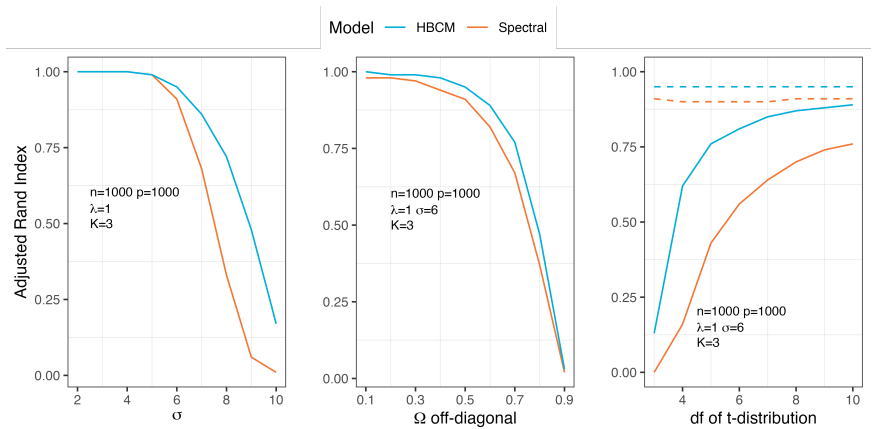
Summary. The paper introduces the heterogeneous block covariance model (HBCM), a covariance-based model for clustering P features from an N × P data matrix. The population covariance is modeled as Σ_jj' = λ_j λ_j' ω_{c_j c_j'} for j≠j' and λ_j² ω_{c_j c_j} + σ_j² for j=j', which permits signed, continuous, and heterogeneous edge weights. The authors propose a variational EM algorithm built on a second layer of latent variables α_i and a mean-field factorization q(c,α)=q1(c)q2(α). The theoretical section proves identifiability of the membership up to permutation and a scale ambiguity between λ and Ω, and establishes consistency of the community memberships for the maximizer of a sample variational objective (Theorem 2). The paper also provides simulations comparing HBCM with spectral clustering, SBM, and DC-SBM, a cross-validation procedure for selecting the number of communities, and applications to mouse embryo single-cell RNA-seq data and stock price data.
Significance. If the consistency guarantee covered the implemented algorithm, the paper would be a useful contribution: it extends block-model ideas to weighted, signed, covariance-type data without dichotomization, accounts for per-feature heterogeneity, and provides detailed identifiability analysis and a computationally efficient variational EM scheme. The simulations are broad, the applications provide external validation through GICS sectors and MSigDB gene sets, and the theoretical development is largely self-contained. However, the central load-bearing issue is that Theorem 2 concerns a global maximizer of a simplified variational objective, while Algorithm 1 is a coordinate-ascent method on a different objective; the paper's own random-initialization experiments show that local optima with poor labels exist. This gap is real and currently prevents the paper from supporting the headline claim that the proposed algorithm gives provably consistent estimates.
major comments (3)
- [§3.2, Theorem 2 and Algorithm 1] Theorem 2 establishes label consistency for the global maximizer (q̂c, q̂2, π̂, Ω̂) of the sample objective Ĵ over the constraint sets, but Algorithm 1 is a coordinate-ascent variational EM that alternately updates q1, q2, and Φ. Coordinate ascent on a nonconvex objective is only guaranteed to reach a local stationary point, and no result in the paper shows that the trajectory of Algorithm 1 approaches a global maximizer of Ĵ or attains a comparable objective value. Supplementary Section S.1.3 and Figure 7 provide direct empirical evidence that local optima with low ARI exist even when ten random starts are used and the highest objective value is selected. Since the abstract and Section 6 attribute consistency to the proposed algorithm, the theorem and the implemented method are currently different objects; this is the main load-bearing gap that must be closed or explicitly acknowledged.
- [§2.2, Eq. (4) and §3.2 definition of Ĵ] The objective actually maximized by Algorithm 1, J(q1,q2,Φ) in Eq. (4), includes λ and σ² as parameters to be updated in the M-step, whereas the theoretical sample objective Ĵ fixes λ at the moment estimator λ̂_j and omits {σ²_j}. Thus even the exact global maximizer of Ĵ need not be a fixed point of the algorithm. The paper should either prove a quantitative relation between the two optimizations under the stated assumptions, or redefine the theoretical analysis so that it applies to the objective used by Algorithm 1.
- [§3.2, Proposition 5 assumptions] Proposition 5 assumes |α*_ik| ≤ B1 for a fixed constant B1, while the model generates α*_i ∼ N(0, Ω*). For fixed B1, max_{i,k} |α*_ik| diverges almost surely as N → ∞, so the assumed constraint is violated with probability tending to one under the paper's own data-generating process. Because Theorem 2's probability statement conditions only on c* and not on α*, the theorem as written does not cover the generative model. The authors should either state the result conditionally on a high-probability event and allow B1 to grow at an appropriate rate, or treat α* as fixed non-random and replace the Gaussian-tail argument for d_min with an assumption stated directly on the realized α*.
minor comments (5)
- [§3.2, definition of C_Ω] The constraint set C_Ω is written as a set of P × P matrices, but the model's Ω is K × K; the eigenvalue bounds should be stated for the K × K block matrix.
- [Supplement S.4, Proposition 7 proof] The proof contains the typo 'Jensen's ineqaulity'; it should read 'Jensen's inequality'.
- [References] The Tabu search reference is cited as 'Glover and Lagunas'; the correct author name is Laguna.
- [§3.2, Proposition 4] Proposition 4 says the objective 'is maximized by ω', but the maximization is over (q^c, μ); the symbol ω appears to be a typo and should be corrected.
- [§5, mouse embryo analysis] The text says the cross-validation result is 'shown in the left panel of Figure 6', but the cross-validation plot appears as panel (a) of Figure 5; the figure reference should be corrected.
Circularity Check
No circularity: the consistency proof is a self-contained derivation from the HBCM assumptions, and the gap between the global maximizer theorem and the local-optimum algorithm is a correctness risk, not a circular reduction.
full rationale
The paper's central claim, label consistency of the variational objective's global maximizer, is derived in-paper: Proposition 4 characterizes the unique maximizer of the population core objective, Proposition 5 gives a well-separatedness lower bound, and Proposition 6 proves uniform convergence of the sample core objective to its population counterpart. Theorem 2 then combines these propositions; no equation in this chain is defined in terms of the target labels, and no fitted parameter is renamed as a prediction. The moment estimator of lambda is proved consistent under model assumptions rather than assumed equal to the truth. Simulations use pre-specified parameters and external benchmarks (MSigDB gene sets, GICS sectors), so the empirical validation is not circular. The self-citations to Zhao (2017), Zhao et al. (2012), and Hao and Zhang (2014) are background or technical concentration bounds and are not load-bearing in the sense of importing the paper's own conclusions. The concern that Theorem 2 concerns a global maximizer while Algorithm 1 is coordinate ascent with possible local optima is a real gap between theory and implementation, but it is not a circularity: it does not reduce the claimed consistency result to its own inputs by construction. Under the review rules, this is scored as no circularity.
Assumptions & free parameters
assumptions (6)
- domain assumption Rows of X are independent and identically distributed from N(0,Σ) with Σ as in equation (1).
- domain assumption Community-level covariance Ω is positive definite, so within-community covariances dominate between-community ones.
- domain assumption Every community contains at least 3 features (Condition 1).
- ad hoc to paper The posterior is approximated by the mean-field factorization q(c,α)=q1(c)q2(α).
- domain assumption For consistency, max_j σ_j*^2=O(1), min_j |λ_j*|≥γ1>0, and B3=min_{k<l}(ω*_kk+ω*_ll−2ω*_kl)>0.
- ad hoc to paper The variational EM algorithm converges to the global maximizer of Ĵ over the constraint sets.
invented entities (1)
-
α_i, the K-dimensional row-level random effect latent variable
Cite this review
Pith. "Pith review of Community Detection with Heterogeneous Block Covariance Model." pith.science (2026). https://pith.science/paper/F44BC3UM
@misc{pith2026241203780,
  author       = {Pith},
  title        = {Pith review of: Community Detection with Heterogeneous Block Covariance Model},
  year         = {2026},
  howpublished = {\url{https://pith.science/paper/F44BC3UM}},
  note         = {Machine review of arXiv:2412.03780}
}
read the original abstract
Community detection is the task of clustering objects based on their pairwise relationships. Most of the model-based community detection methods, such as the stochastic block model and its variants, are designed for networks with binary (yes/no) edges. In many practical scenarios, edges often possess continuous weights, spanning positive and negative values, which reflect varying levels of connectivity. To address this challenge, we introduce the heterogeneous block covariance model (HBCM) that defines a community structure within the covariance matrix, where edges have signed and continuous weights. Furthermore, it takes into account the heterogeneity of objects when forming connections with other objects within a community. A novel variational expectation-maximization algorithm is proposed to estimate the group membership. The HBCM provides provable consistent estimates of memberships, and its promising performance is observed in numerical simulations with different setups. The model is applied to a single-cell RNA-seq dataset of a mouse embryo and a stock price dataset. Supplementary materials for this article are available online.
Figures


Figures from the paper (6 more)


Reference graph
Works this paper leans on
-
[1]
Abbe, E. (2017). Community detection and stochastic block models: recent developments. The Journal of Machine Learning Research , 18(1):6446--6531
2017
-
[2]
Amini, A. A., Chen, A., Bickel, P. J., Levina, E., et al. (2013). Pseudo-likelihood methods for community detection in large sparse networks. The Annals of Statistics , 41(4):2097--2122
work page 2013
-
[3]
Barrat, A., Barthelemy, M., Pastor-Satorras, R., and Vespignani, A. (2004). The architecture of complex weighted networks. Proceedings of the national academy of sciences , 101(11):3747--3752
work page 2004
-
[4]
Bickel, P. J. and Chen, A. (2009). A nonparametric view of network models and N ewman- G irvan and other modularities. Proc. Natl. Acad. Sci. USA , 106:21068--21073
work page 2009
-
[5]
M., Kucukelbir, A., and McAuliffe, J
Blei, D. M., Kucukelbir, A., and McAuliffe, J. D. (2017). Variational inference: A review for statisticians. Journal of the American statistical Association , 112(518):859--877
2017
-
[6]
Bouveyron, C. and Brunet-Saumard, C. (2014). Model-based clustering of high-dimensional data: A review. Computational Statistics & Data Analysis , 71:52--78
work page 2014
-
[7]
Bunea, F., Giraud, C., Luo, X., Royer, M., and Verzelen, N. (2020). Model assisted variable clustering: minimax-optimal recovery and algorithms. The Annals of Statistics , 48(1):111--137
work page 2020
-
[8]
Devijver, E. and Gallopin, M. (2018). Block-diagonal covariance selection for high-dimensional gaussian graphical models. Journal of the American Statistical Association , 113(521):306--314
work page 2018
Show all 47 references
-
[9]
S., Marcotte, E
Dhillon, I. S., Marcotte, E. M., and Roshan, U. (2003). Diametrical clustering for identifying anti-correlated gene clusters. Bioinformatics , 19(13):1612--1619
2003
-
[10]
Fortunato, S. (2010). Community detection in graphs. Physics Reports , 486(3-5):75 -- 174
2010
-
[11]
and Raftery, A
Fraley, C. and Raftery, A. E. (2002). Model-based clustering, discriminant analysis, and density estimation. Journal of the American statistical Association , 97(458):611--631
2002
-
[12]
Gan, G., Ma, C., and Wu, J. (2020). Data clustering: theory, algorithms, and applications . SIAM
2020
-
[13]
Ghosh, M. (2021). Exponential tail bounds for chisquared random variables. Journal of Statistical Theory and Practice , 15(2):35
2021
-
[14]
Glover, F. W. and Lagunas, M. (1997). Tabu search . Kluwer Academic
1997
-
[15]
and Nadif, M
Govaert, G. and Nadif, M. (2008). Block clustering with bernoulli mixture models: Comparison of different approaches. Computational Statistics & Data Analysis , 52(6):3233--3245
2008
-
[16]
and Zhang, H
Hao, N. and Zhang, H. H. (2014). Interaction screening for ultrahigh-dimensional data. Journal of the American Statistical Association , 109(507):1285--1301
2014
-
[17]
Hastie, T., Tibshirani, R., and Friedman, J. (2009). The Elements of Statistical Learning , pages 61 -- 73. Springer New York Inc., New York, 2 edition
2009
-
[18]
and Yang, L
Huang, J. and Yang, L. (2010). Correlation matrix with block structure and efficient sampling methods. Journal of Computational Finance , 14(1):81
2010
-
[19]
a llquist, U., Moliner, A., Zajac, P., Fan, J.-B., L \
Islam, S., Kj \"a llquist, U., Moliner, A., Zajac, P., Fan, J.-B., L \"o nnerberg, P., and Linnarsson, S. (2011). Characterization of the single-cell transcriptional landscape by highly multiplex rna-seq. Genome research , 21(7):1160--1167
2011
-
[20]
Jain, A. K. (2010). Data clustering: 50 years beyond k-means. Pattern recognition letters , 31(8):651--666
2010
-
[21]
and Loh, P.-L
Jog, V. and Loh, P.-L. (2015). Information-theoretic bounds for exact recovery in weighted stochastic block models using the renyi divergence. arXiv preprint arXiv:1509.06418
2015 arXiv
-
[22]
and Newman, M
Karrer, B. and Newman, M. E. J. (2011). Stochastic blockmodels and community structure in networks. Physical Review E , 83:016107
2011
-
[23]
and Rousseeuw, P
Kaufman, L. and Rousseeuw, P. J. (2009). Finding groups in data: an introduction to cluster analysis . John Wiley & Sons
2009
-
[24]
and Horvath, S
Langfelder, P. and Horvath, S. (2008). Wgcna: an r package for weighted correlation network analysis. BMC bioinformatics , 9(1):559
2008
-
[25]
Liu, H., Han, F., Yuan, M., Lafferty, J., and Wasserman, L. (2012). The nonparanormal skeptic. In Proceedings of the 29th International Conference on Machine Learning , pages 1415--1422
2012
-
[26]
Lloyd, S. (1982). Least squares quantization in pcm. IEEE Transactions on Information Theory , 28(2):129--137
1982
-
[27]
K., and Zhou, J
Luo, F., Yang, Y., Zhong, J., Gao, H., Khan, L., Thompson, D. K., and Zhou, J. (2007). Constructing gene co-expression networks and predicting functions of unknown genes by random matrix theory. BMC bioinformatics , 8(1):299
2007
-
[28]
MacQueen, J. (1967). Some methods for classification and analysis of multivariate observations. In Proceedings of 5-th Berkeley Symposium on Mathematical Statistics and Probability/University of California Press
1967
-
[29]
S., Berchuck, A., and Murphy, S
Matsumura, N., Huang, Z., Mori, S., Baba, T., Fujii, S., Konishi, I., Iversen, E. S., Berchuck, A., and Murphy, S. K. (2011). Epigenetic suppression of the tgf-beta pathway revealed by transcriptome profiling in ovarian cancer. Genome research , 21(1):74--82
2011
-
[30]
Neal, R. M. and Hinton, G. E. (1998). A view of the em algorithm that justifies incremental, sparse, and other variants. In Learning in graphical models , pages 355--368. Springer
1998
-
[31]
Newman, M. E. J. (2004). Detecting community structure in networks. Eur. Phys. J. B , 38:321--330
2004
-
[32]
Y., Jordan, M
Ng, A. Y., Jordan, M. I., and Weiss, Y. (2002). On spectral clustering: Analysis and an algorithm. In Advances in neural information processing systems , pages 849--856
2002
-
[33]
Palowitch, J., Bhamidi, S., and Nobel, A. B. (2017). Significance-based community detection in weighted networks. The Journal of Machine Learning Research , 18(1):6899--6946
2017
-
[34]
and Shen, X
Pan, W. and Shen, X. (2007). Penalized model-based clustering with application to variable selection. Journal of machine learning research , 8(5)
2007
-
[35]
Rand, W. M. (1971). Objective criteria for the evaluation of clustering methods. Journal of the American Statistical Association , 66(336):846--850
1971
-
[36]
Saelens, W., Cannoodt, R., and Saeys, Y. (2018). A comprehensive evaluation of module detection methods for gene expression data. Nature communications , 9(1):1090
2018
-
[37]
Sun, S., Zhu, Y., and Xu, J. (2014). Adaptive variable clustering in gaussian graphical models. In Artificial Intelligence and Statistics , pages 931--939. PMLR
2014
-
[38]
M., Witten, D., and Shojaie, A
Tan, K. M., Witten, D., and Shojaie, A. (2015). The cluster graphical lasso for improved estimation of gaussian graphical models. Computational statistics & data analysis , 85:23--36
2015
-
[39]
Von Luxburg, U. et al. (2010). Clustering stability: an overview. Foundations and Trends in Machine Learning , 2(3):235--274
2010
-
[40]
Wang, J., Liu, B., and Guo, J. (2021). Efficient split likelihood-based method for community detection of large-scale networks. Stat , 10(1):e349
2021
-
[41]
and Zhu, J
Wang, S. and Zhu, J. (2008). Variable selection for model-based high-dimensional clustering and its application to microarray data. Biometrics , 64(2):440--448
2008
-
[42]
Xu, M., Jog, V., and Loh, P.-L. (2020). Optimal rates for community estimation in the weighted stochastic block model. The Annals of Statistics , 48(1):183--204
2020
-
[43]
and Wunsch, D
Xu, R. and Wunsch, D. (2005). Survey of clustering algorithms. IEEE Transactions on neural networks , 16(3):645--678
2005
-
[44]
Yang, L. (2020). Clustering Models with Applications in Gene Expression Profiles . PhD thesis, George Washington University
2020
-
[45]
and Li, J
Zeng, T. and Li, J. (2010). Maximization of negative correlations in time-course gene expression data for enhancing understanding of molecular pathways. Nucleic acids research , 38(1):e1--e1
2010
-
[46]
Zhao, Y. (2017). A survey on theoretical advances of community detection in networks. Wiley Interdisciplinary Reviews: Computational Statistics , 9(5)
2017
-
[47]
Zhao, Y., Levina, E., and Zhu, J. (2012). Consistency of community detection in networks under degree-corrected stochastic block models. Annals of Statistics . arxiv.org/1110.3854
2012 arXiv
Reviewed August 11, 2026 · model on record in the stance chip above.
Discussion (0). Continue with ORCID to comment.