REVIEW 4 major objections 6 minor 64 references
CLIP-FSAC++: Few-Shot Anomaly Classification with Anomaly Descriptor Based on CLIP
T0 review · 4 major / 6 minor · reviewed 2026-08-11 · deepseek-v4-flash
Pith's one-line read A small cross-modal attention module lets CLIP classify industrial defects from as few as one normal image per category.
desk verdict A credible incremental CLIP-based few-shot anomaly classifier whose own tables contradict its SOTA claim; fix the claim and add variance and it deserves review. read the letter →
The pith
A machine-rendered reading of the paper's core claim, the machinery that carries it, and where it could break.
The reading
What carries the argument
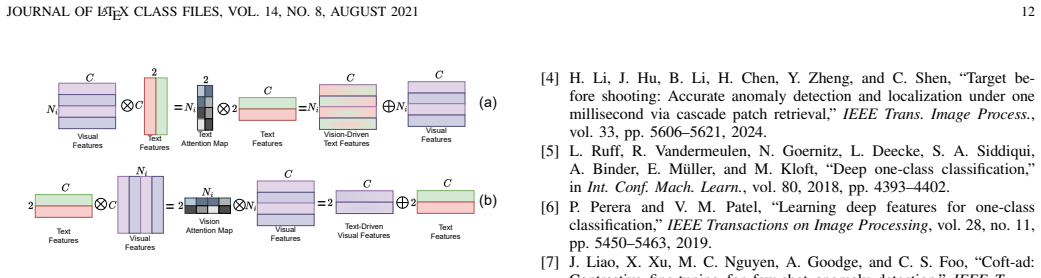
The central object is the Anomaly Descriptor, a cross-modality interaction module with two attention directions. Image-to-text cross-attention turns each visual embedding into a vision-driven text feature by attending over the normal and anomalous text embeddings; text-to-image cross-attention then turns those text features into text-driven visual features by attending over the visual embeddings. These two sets of modality-specific features are added back to the adapted CLIP embeddings, so the final anomaly score is computed between representations that already contain each other's information.
What would settle it
Train the same pipeline but replace synthetic anomalies with real defect crops from a held-out set of anomaly categories and test on the remaining categories; if I-AUROC does not improve over training with synthetic patches, the cross-attention module is learning from the synthetic distribution rather than a general abnormality signal. A simpler check is to measure on classes with tiny defects, such as screw and pill in MVTEC-AD, whether the gap to the zero-shot baseline widens as defect size shrinks.
Extended reading notes
Core claim
On the paper's own terms, the central discovery is that a lightweight cross-modal attention stage placed after CLIP's frozen encoders resolves the vision-language mismatch that limits zero-shot anomaly classification. By synthesizing anomalies on the few normal shots and then jointly optimizing image and text adapters plus the Anomaly Descriptor under a symmetric image-to-text and text-to-image contrastive loss, the visual features of normal and anomalous test images are pulled into separated clusters. The result is state-of-the-art few-shot anomaly classification on VisA for 1-, 2-, 4-, and 8-shot settings, and on MVTEC-AD for 2- and 4-shot settings, with performance approaching full-shot methods on VisA.
Load-bearing premise
The load-bearing premise is that synthetic anomalies, random noise patches on MVTEC-AD and natural-looking patches on VisA, are representative enough of real defects that contrastive training on them teaches the model to separate true anomalies from normal parts; the authors themselves note that worse synthetic quality in the 8-shot setting misleads the model.
Editorial extensions
If this is right
- If a production line can supply one normal image per category, the method reports 97.6% I-AUROC on VisA, competitive with full-shot industrial anomaly detectors.
- The one-stage joint training replaces the two-stage procedure of the conference version, saving training cost while improving classification performance.
- Because only the adapters and Anomaly Descriptor are trainable, the framework can move to a new category by fine-tuning with fewer than ten normal images.
- The choice of synthetic anomaly generator matters: natural synthetic anomalies help on VisA while random perturbations work on MVTEC-AD, so practitioners need to match the synthesis method to the defect distribution.
Reading between the lines
- The results suggest the bottleneck in few-shot anomaly classification is not the size of the normal sample set but the alignment of pre-trained visual and text representations to the target domain; if so, further gains should come from better anomaly simulation rather than more few-shot examples.
- The 8-shot MVTEC-AD drop, which the authors attribute to lower-quality synthetic anomalies, implies that synthetic anomaly quality rather than shot count is the limiting factor; a testable extension is to filter or refine synthetic anomalies based on how cleanly they separate in feature space.
- The method's partial failure on hard classes like screw and pill hints that texture-level anomalies are easier to synthesize than tiny structural defects; a targeted extension would evaluate whether the cross-attention adapters generalize to other fine-grained defect domains such as semiconductor or food inspection.
Editorial analysis
A structured set of objections, weighed in public.
Referee Report
Summary. The paper proposes CLIP-FSAC++, a few-shot anomaly classification method built on CLIP and the authors' earlier CLIP-FSAC. It adds lightweight image and text adapters and a cross-modality Anomaly Descriptor with two cross-attention branches, trained jointly with contrastive and classification losses on synthetic anomalies generated from k normal images. Experiments on VisA and MVTEC-AD report I-AUROC, I-AUPR, and F1-MAX for k = 1, 2, 4, 8, together with ablations on the loss, the Anomaly Descriptor, the anomaly generator, hyperparameters, and optimizers. The central claim is state-of-the-art few-shot anomaly classification on both benchmarks, with source code publicly available.
Significance. The method is simple and the VisA gains are consistent and large relative to WinCLIP and CLIP-FSAC; Table VI shows a clear contribution from the Anomaly Descriptor, and the paper includes useful visualizations and prompt-robustness experiments. If the empirical claims were corrected to match the reported tables, the work would be a reasonable incremental contribution to few-shot anomaly classification. However, the headline claim of universal superiority is false under the paper's own data, and the absence of reported standard errors prevents assessing small margins. The architecture description for the Anomaly Descriptor is internally inconsistent and needs repair before the method can be reproduced from the text alone.
major comments (4)
- [§I, §VII, Table III] The contribution bullet in §I and the conclusion in §VII state that CLIP-FSAC++ 'outperforms previous few-shot methods on VisA and MVTEC-AD for 1-shot, 2-shot, 4-shot and 8-shot'. This is contradicted by Table III: on MVTEC-AD 1-shot CLIP-FSAC++ scores 94.0 I-AUROC versus 95.5 for CLIP-FSAC and 94.1 for AnomalyGPT and AnoPLe; on MVTEC-AD 8-shot it scores 94.5 versus 95.9 for GraphCore and 95.6 for WinCLIP; on VisA 4-shot it scores 97.6 versus 97.7 for CLIP-FSAC. The universal-SOTA claim should be replaced by a claim restricted to the settings where it holds, and the 8-shot MVTEC-AD regression should be acknowledged rather than described as a state-of-the-art result.
- [§IV.B.1, Tables I-III] Section IV.B.1 states that 'our experiments run five times using different random seeds and we also report the corresponding standard error', but no standard error, confidence interval, or per-seed value is reported in Tables I, II, III, or in any ablation table. Without uncertainty estimates, margins such as the 0.1 I-AUROC difference on VisA 4-shot (97.6 versus 97.7) cannot be distinguished from seed noise. Please report standard errors or per-seed results for at least the main benchmark tables.
- [§III.E, Eqs. (7)-(9), Table VI] The Anomaly Descriptor is described inconsistently. Equation (7) computes TF+/- as vision-driven text features using visual queries and text keys/values; Equation (8) then computes VT using psi and TF, both of which are text-side representations. The prose then says to 'add text-driven visual features TF+/- on adapted visual embeddings' and 'add vision-driven text features VT on adapted text embeddings'. Under the equations, TF+/- is added to visual features (CF = AF + TF) and VT is added to text features (CT = psi + gamma1*VT), so the labels 'text-driven visual' and 'vision-driven text' are swapped relative to the prose. The ablation rows in Table VI discuss TF and VT without resolving this ambiguity. Please rewrite Section III.E so the two cross-attention branches, their inputs and outputs, and their names match the equations.
- [§IV.A.3, §IV.C.3] The paper chooses different anomaly generators per dataset (random perturbation for MVTEC-AD, NSA for VisA) and sets multiple hyperparameters per dataset (alpha1/alpha2, beta1/beta2, gamma1, gamma2, batch sizes). Table VII shows that swapping the generators changes results by up to 1.6-1.7 I-AUROC. The manuscript does not state how these per-dataset choices were selected or whether they were fixed before seeing test performance. Please specify the model selection protocol, such as a validation split, fixed seeds, or predetermined settings, so the reported numbers can be interpreted as honest test-set evaluations rather than post hoc selections.
minor comments (6)
- [Throughout] Typos and grammar: 'consine similarity' in §III.F, 'MCTEC-AD' in §IV.C.5, 'a a cross-modality' in §VII, a stray 'd' in '13.8%, 12.8%,d 10.3%' in §IV.B.1, and 'robust' where 'robustness' is meant.
- [§III.F, Eq. (12)] Equation (12) writes CrossEntropy(s(CF, CT-), Label) with s a scalar cosine similarity and a binary label; this is not the standard CrossEntropy form. Please specify the exact loss, such as binary cross-entropy with logits, and the label convention.
- [§III.B] The overview says 'with less than 8 normal training samples' but experiments include the 8-shot setting; change to 'at most 8' or 'up to 8'.
- [Figures 7-8] Figures 7 and 8 lack axis labels and legends; in particular Figure 8 plots three optimizers but the curves are not clearly identified. Please add clearer captions and legends.
- [Table II] Table II reports the GraphCore 2-shot mean as 91.91 while all other entries have one decimal place; align numerical precision across all entries.
- [§IV.A.3] The sentence 'Batch size is set to 1,1,2,2 and 1,2,2,2 for VisA and MVTEC-AD respectively' does not state which value corresponds to which k-shot setting; specify the order explicitly.
Circularity Check
No significant circularity: the few-shot anomaly classification results are an external benchmark evaluation; the self-citation of CLIP-FSAC is a baseline, not a load-bearing premise.
full rationale
The paper's derivation chain is an empirical fine-tuning pipeline, not a formal derivation: synthetic anomalies are generated (Eq. 1), adapters and the Anomaly Descriptor are trained with contrastive and cross-entropy losses (Eqs. 10-13), and test anomaly scores are computed from held-out images (Eqs. 14-16). No claimed prediction reduces to a fitted constant or to an equation of the paper: the benchmark numbers come from public VisA and MVTEC-AD test sets, and the synthetic-anomaly assumption is an external transfer assumption, not a definitional equivalence. The authors' self-citation of CLIP-FSAC [15] is as a baseline and starting point, not as the justification of the new contribution; the Anomaly Descriptor is supported by ablations (Table VI) on the same external benchmarks. Hyperparameters (alpha, beta, gamma1) are per-dataset tuning choices, not fitted to the test labels in a way that makes the reported I-AUROC equal to the training objective by construction. Two non-circularity concerns should be flagged explicitly. First, the contribution bullet and conclusion state that CLIP-FSAC++ 'outperforms previous few-shot methods on VisA and MVTEC-AD for 1-shot, 2-shot, 4-shot and 8-shot', but Table III shows CLIP-FSAC++ trails CLIP-FSAC on MVTEC-AD 1-shot (94.0 vs 95.5) and VisA 4-shot (97.6 vs 97.7), and trails GraphCore and WinCLIP on MVTEC-AD 8-shot (94.5 vs 95.9 and 95.6); this is a correctness/consistency issue, not circularity. Second, Section IV.B.1 says 'our experiments run five times using different random seeds and we also report the corresponding standard error', but Tables I-III report only point estimates, so the reported margins cannot be assessed against seed noise; this is a missing-support issue, not circularity. Neither concern makes the derivation circular.
Assumptions & free parameters
free parameters (6)
- alpha1/alpha2 (image adapter residual ratios) =
0.4/0.6 for MVTEC-AD; 0.1/0.9 for VisA
- beta1/beta2 (text adapter residual ratios) =
0.4/0.6 for MVTEC-AD; 0.1/0.9 for VisA
- gamma1 (text-driven visual feature coefficient) =
0.7 VisA; 0.01 MVTEC-AD
- gamma2 (cross-entropy loss weight) =
0.7 both
- temperature tau =
not reported
- optimizer hyperparameters (learning rate, epochs, batch size) =
LR 0.0005/0.0001; 100 epochs; batch sizes 1-2
assumptions (4)
- domain assumption Frozen CLIP encoders pretrained on LAION-400M provide sufficiently transferable visual and text representations for anomaly classification after light adaptation.
- domain assumption Synthetic anomalies are representative of real anomalies for the target dataset (random perturbation for MVTEC-AD, NSA for VisA).
- domain assumption WinCLIP's compositional prompt ensemble is a suitable text vocabulary for normality and abnormality.
- domain assumption The k-shot normal samples are representative of the category's normal appearance.
Cite this review
Pith. "Pith review of CLIP-FSAC++: Few-Shot Anomaly Classification with Anomaly Descriptor Based on CLIP." pith.science (2026). https://pith.science/paper/2V2ZSRZT
@misc{pith2026241203829,
  author       = {Pith},
  title        = {Pith review of: CLIP-FSAC++: Few-Shot Anomaly Classification with Anomaly Descriptor Based on CLIP},
  year         = {2026},
  howpublished = {\url{https://pith.science/paper/2V2ZSRZT}},
  note         = {Machine review of arXiv:2412.03829}
}
read the original abstract
Industrial anomaly classification (AC) is an indispensable task in industrial manufacturing, which guarantees quality and safety of various product. To address the scarcity of data in industrial scenarios, lots of few-shot anomaly detection methods emerge recently. In this paper, we propose an effective few-shot anomaly classification (FSAC) framework with one-stage training, dubbed CLIP-FSAC++. Specifically, we introduce a cross-modality interaction module named Anomaly Descriptor following image and text encoders, which enhances the correlation of visual and text embeddings and adapts the representations of CLIP from pre-trained data to target data. In anomaly descriptor, image-to-text cross-attention module is used to obtain image-specific text embeddings and text-to-image cross-attention module is used to obtain text-specific visual embeddings. Then these modality-specific embeddings are used to enhance original representations of CLIP for better matching ability. Comprehensive experiment results are provided for evaluating our method in few-normal shot anomaly classification on VisA and MVTEC-AD for 1, 2, 4 and 8-shot settings. The source codes are at https://github.com/Jay-zzcoder/clip-fsac-pp
Figures


Figures from the paper (8 more)


Reference graph
Works this paper leans on
-
[1]
Z. Zuo, Z. Wu, B. Chen, and X. Zhong, “A reconstruction-based feature adaptation for anomaly detection with self-supervised multi-scale aggregation,” in Proc. IEEE Int. Conf. Acoust. Speech Signal Process. , 2024, pp. 5840–5844
work page 2024
-
[2]
Simplenet: A simple network for image anomaly detection and localization,
Z. Liu, Y . Zhou, Y . Xu, and Z. Wang, “Simplenet: A simple network for image anomaly detection and localization,” in Proc. IEEE Conf. Comput. Vis. Pattern Recog., 2023, pp. 20 402–20 411
work page 2023
-
[3]
Omni-frequency channel-selection representations for unsupervised anomaly detection,
Y . Liang, J. Zhang, S. Zhao, R. Wu, Y . Liu, and S. Pan, “Omni-frequency channel-selection representations for unsupervised anomaly detection,” IEEE Trans. Image Process. , vol. 32, pp. 4327–4340, 2023
work page 2023
-
[4]
H. Li, J. Hu, B. Li, H. Chen, Y . Zheng, and C. Shen, “Target be- fore shooting: Accurate anomaly detection and localization under one millisecond via cascade patch retrieval,” IEEE Trans. Image Process. , vol. 33, pp. 5606–5621, 2024
work page 2024
-
[5]
Deep one-class classification,
L. Ruff, R. Vandermeulen, N. Goernitz, L. Deecke, S. A. Siddiqui, A. Binder, E. M ¨uller, and M. Kloft, “Deep one-class classification,” in Int. Conf. Mach. Learn. , vol. 80, 2018, pp. 4393–4402
work page 2018
-
[6]
Learning deep features for one-class classification,
P. Perera and V . M. Patel, “Learning deep features for one-class classification,” IEEE Transactions on Image Processing, vol. 28, no. 11, pp. 5450–5463, 2019
work page 2019
-
[7]
Coft-ad: Contrastive fine-tuning for few-shot anomaly detection,
J. Liao, X. Xu, M. C. Nguyen, A. Goodge, and C. S. Foo, “Coft-ad: Contrastive fine-tuning for few-shot anomaly detection,” IEEE Trans. Image Process., vol. 33, pp. 2090–2103, 2024
work page 2024
-
[8]
Few-shot anomaly detection with adversarial loss for robust feature representations,
J. Y . Lee, W. Lee, J. Choi, Y . LEE, and Y . S. Yoon, “Few-shot anomaly detection with adversarial loss for robust feature representations,” inBrit. Mach. Vis. Conf., 2023
work page 2023
Show all 64 references
-
[9]
Zero-shot versus many-shot: Unsupervised texture anomaly detection,
T. Aota, L. T. T. Tong, and T. Okatani, “Zero-shot versus many-shot: Unsupervised texture anomaly detection,” in Proc. IEEE/CVF Winter Conf. Appl. Comput. Vis. , 2023, pp. 5553–5561
2023
-
[10]
Pushing the limits of fewshot anomaly detection in industry vision: Graphcore,
G. Xie, J. Wang, J. Liu, Y . Jin, and F. Zheng, “Pushing the limits of fewshot anomaly detection in industry vision: Graphcore,” in Int. Conf. Learn. Represent., 2023
2023
-
[11]
Minigpt-4: Enhancing vision-language understanding with advanced large language models,
D. Zhu, J. Chen, X. Shen, X. Li, and M. Elhoseiny, “Minigpt-4: Enhancing vision-language understanding with advanced large language models,” ArXiv Preprint arXiv:2304.10592 , 2023
2023 arXiv
-
[12]
Flamingo: a visual language model for few-shot learning,
J.-B. Alayrac, J. Donahue, P. Luc, A. Miech, I. Barr, Y . Hasson, K. Lenc, A. Mensch, K. Millican, M. Reynolds, R. Ring, E. Ruther- ford, S. Cabi, T. Han, Z. Gong, S. Samangooei, M. Monteiro, J. L. Menick, S. Borgeaud, A. Brock, A. Nematzadeh, S. Sharifzadeh, M. a. Bi´nkowski,...
2022
-
[13]
AnomalyCLIP: Object-agnostic prompt learning for zero-shot anomaly detection,
Z. Qihang, P. Guansong, T. Yu, H. Shibo, and C. Jiming, “AnomalyCLIP: Object-agnostic prompt learning for zero-shot anomaly detection,” in Int. Conf. Learn. Represent. , 2024
2024
-
[14]
Learning transferable visual models from natural language supervi- sion,
A. Radford, J. W. Kim, C. Hallacy, A. Ramesh, G. Goh, S. Agarwal, G. Sastry, A. Askell, P. Mishkin, J. Clark, G. Krueger, and I. Sutskever, “Learning transferable visual models from natural language supervi- sion,” in Int. Conf. Mach. Learn. , vol. 139, 2021, pp. 8748–8763
2021
-
[15]
Clip-fsac: Boosting clip for few-shot anomaly classification with synthetic anomalies,
Z. Zuo, Y . Wu, B. Li, J. Dong, Y . Zhou, L. Zhou, Y . Qu, and Z. Wu, “Clip-fsac: Boosting clip for few-shot anomaly classification with synthetic anomalies,” in Proc. Int. Joint Conf. Artif. Intell. , 8 2024, pp. 1834–1842
2024
-
[16]
Clip-adapter: Better vision-language models with feature adapters,
P. Gao, S. Geng, R. Zhang, T. Ma, R. Fang, Y . Zhang, H. Li, and Y . Qiao, “Clip-adapter: Better vision-language models with feature adapters,” ArXiv Preprint arXiv:2110.04544 , 2021
2021 arXiv
-
[17]
Pni: Industrial anomaly detection using position and neighborhood information,
J. Bae, J.-H. Lee, and S. Kim, “Pni: Industrial anomaly detection using position and neighborhood information,” in Proc. Int. Conf. Comput. Vis., 2023, pp. 6350–6360
2023
-
[18]
Multiresolution knowledge distillation for anomaly detection,
M. Salehi, N. Sadjadi, S. Baselizadeh, M. H. Rohban, and H. R. Rabiee, “Multiresolution knowledge distillation for anomaly detection,” in Proc. IEEE Conf. Comput. Vis. Pattern Recog. , 2021, pp. 14 897–14 907
2021
-
[19]
Filo: Zero-shot anomaly detection by fine-grained description and high-quality localization,
Z. Gu, B. Zhu, G. Zhu, Y . Chen, H. Li, M. Tang, and J. Wang, “Filo: Zero-shot anomaly detection by fine-grained description and high-quality localization,” in Proc ACM Int Conf Multimedia , 2024, p. 2041–2049
2024
-
[20]
Ganomaly: Semi- supervised anomaly detection via adversarial training,
S. Akcay, A. Atapour-Abarghouei, and T. P. Breckon, “Ganomaly: Semi- supervised anomaly detection via adversarial training,” in Asian Conf. Comput. Vis., 2019, pp. 622–637
2019
-
[21]
Focus the discrepancy: Intra- and inter-correlation learning for image anomaly detection,
X. Yao, R. Li, Z. Qian, Y . Luo, and C. Zhang, “Focus the discrepancy: Intra- and inter-correlation learning for image anomaly detection,” in Proc. Int. Conf. Comput. Vis. , 2023, pp. 6780–6790
2023
-
[22]
Unsupervised anomaly detection for surface defects with dual-siamese network,
X. Tao, D. Zhang, W. Ma, Z. Hou, Z. Lu, and C. Adak, “Unsupervised anomaly detection for surface defects with dual-siamese network,” IEEE Trans. Ind. Inform. , vol. 18, no. 11, pp. 7707–7717, 2022
2022
-
[23]
Cutpaste: Self-supervised learning for anomaly detection and localization,
C.-L. Li, K. Sohn, J. Yoon, and T. Pfister, “Cutpaste: Self-supervised learning for anomaly detection and localization,” in Proc. IEEE Conf. Comput. Vis. Pattern Recog., 2021, pp. 9659–9669
2021
-
[24]
Generative adversarial nets,
I. J. Goodfellow, J. Pouget-Abadie, M. Mirza, B. Xu, D. Warde-Farley, S. Ozair, A. Courville, and Y . Bengio, “Generative adversarial nets,” in Proc. Adv. Neural Inform. Process. Syst. , 2014, p. 2672–2680
2014
-
[25]
Diad: A diffusion-based frame- work for multi-class anomaly detection,
H. Haoyang, Z. Jiangning, C. Hongxu, C. Xuhai, L. Zhishan, C. Xu, W. Yabiao, W. Chengjie, and L. Xie, “Diad: A diffusion-based frame- work for multi-class anomaly detection,” in Proc. AAAI Conf. Artif. Intell., 2024, pp. 8472–8480. JOURNAL OF LATEX CLASS FILES, VOL. 14, NO. 8,...
2024
-
[26]
Diffusionad: Norm-guided one-step denoising diffusion for anomaly detection,
H. Zhang, Z. Wang, Z. Wu, and Y .-G. Jiang, “Diffusionad: Norm-guided one-step denoising diffusion for anomaly detection,” ArXiv Preprint arXiv:2303.08730, 2023
2023 arXiv
-
[27]
12-in-1: Multi- task vision and language representation learning,
J. Lu, V . Goswami, M. Rohrbach, D. Parikh, and S. Lee, “12-in-1: Multi- task vision and language representation learning,” in Proc. IEEE Conf. Comput. Vis. Pattern Recog., 2020, pp. 10 434–10 443
2020
-
[28]
Alpha-clip: A clip model focusing on wherever you want,
Z. Sun, Y . Fang, T. Wu, P. Zhang, Y . Zang, S. Kong, Y . Xiong, D. Lin, and J. Wang, “Alpha-clip: A clip model focusing on wherever you want,” in 2024 IEEE/CVF Conference on Computer Vision and Pattern Recognition (CVPR), 2024, pp. 13 019–13 029
2024
-
[29]
Interpreting CLIP’s image representation via text-based decomposition,
Y . Gandelsman, A. A. Efros, and J. Steinhardt, “Interpreting CLIP’s image representation via text-based decomposition,” in Int. Conf. Learn. Represent., 2024
2024
-
[30]
Pointclip: Point cloud understanding by clip,
R. Zhang, Z. Guo, W. Zhang, K. Li, X. Miao, B. Cui, Y . Qiao, P. Gao, and H. Li, “Pointclip: Point cloud understanding by clip,” in Proc. IEEE Conf. Comput. Vis. Pattern Recog. , 2022, pp. 8542–8552
2022
-
[31]
Actionclip: Adapting language-image pretrained models for video action recognition,
M. Wang, J. Xing, J. Mei, Y . Liu, and Y . Jiang, “Actionclip: Adapting language-image pretrained models for video action recognition,” IEEE Trans. Neural Networks Learn. Syst. , pp. 1–13, 2023
2023
-
[32]
Grounded language-image pre-training,
L. H. Li, P. Zhang, H. Zhang, J. Yang, C. Li, Y . Zhong, L. Wang, L. Yuan, L. Zhang, J.-N. Hwang, K.-W. Chang, and J. Gao, “Grounded language-image pre-training,” in Proc. IEEE Conf. Comput. Vis. Pattern Recog., 2022, pp. 10 955–10 965
2022
-
[33]
Denseclip: Language-guided dense prediction with context-aware prompting,
Y . Rao, W. Zhao, G. Chen, Y . Tang, Z. Zhu, G. Huang, J. Zhou, and J. Lu, “Denseclip: Language-guided dense prediction with context-aware prompting,” in Proc. IEEE Conf. Comput. Vis. Pattern Recog., 2022, pp. 18 061–18 070
2022
-
[34]
In defense of clip-based video relation detection,
M. Wei, L. Chen, W. Ji, X. Yue, and R. Zimmermann, “In defense of clip-based video relation detection,” IEEE Trans. Image Process. , vol. 33, pp. 2759–2769, 2024
2024
-
[35]
Clip-driven fine-grained text- image person re-identification,
S. Yan, N. Dong, L. Zhang, and J. Tang, “Clip-driven fine-grained text- image person re-identification,” IEEE Trans. Image Process. , vol. 32, pp. 6032–6046, 2023
2023
-
[36]
Turning a clip model into a scene text spotter,
W. Yu, Y . Liu, X. Zhu, H. Cao, X. Sun, and X. Bai, “Turning a clip model into a scene text spotter,” IEEE Trans. Pattern Anal. Mach. Intell., vol. 46, no. 9, pp. 6040–6054, 2024
2024
-
[37]
Winclip: Zero-/few-shot anomaly classification and segmentation,
J. Jeong, Y . Zou, T. Kim, D. Zhang, A. Ravichandran, and O. Dabeer, “Winclip: Zero-/few-shot anomaly classification and segmentation,” in Proc. IEEE Conf. Comput. Vis. Pattern Recog., 2023, pp. 19 606–19 616
2023
-
[38]
Fastrecon: Few- shot industrial anomaly detection via fast feature reconstruction,
Z. Fang, X. Wang, H. Li, J. Liu, Q. Hu, and J. Xiao, “Fastrecon: Few- shot industrial anomaly detection via fast feature reconstruction,” in Proc. Int. Conf. Comput. Vis. , 2023, pp. 17 435–17 444
2023
-
[39]
Few- shot fast-adaptive anomaly detection,
Z. Wang, Y . Zhou, R. Wang, T.-Y . Lin, A. Shah, and S. N. Lim, “Few- shot fast-adaptive anomaly detection,” in Proc. Adv. Neural Inform. Process. Syst., vol. 35, 2022, pp. 4957–4970
2022
-
[40]
Toward generalist anomaly detection via in-context residual learning with few-shot sample prompts,
J. Zhu and G. Pang, “Toward generalist anomaly detection via in-context residual learning with few-shot sample prompts,” in Proc. IEEE Conf. Comput. Vis. Pattern Recog., 2024, pp. 17 826–17 836
2024
-
[41]
Fewsome: One- class few shot anomaly detection with siamese networks,
N. Belton, M. T. Hagos, A. Lawlor, and K. M. Curran, “Fewsome: One- class few shot anomaly detection with siamese networks,” in Proc. IEEE Conf. Comput. Vis. Pattern Recog. Worksh. , 2023, pp. 2978–2987
2023
-
[42]
Registration based few-shot anomaly detection,
C. Huang, H. Guan, A. Jiang, Y . Zhang, M. Spratling, and Y .-F. Wang, “Registration based few-shot anomaly detection,” in Proc. Eur. Conf. Comput. Vis., 2022, p. 303–319
2022
-
[43]
Clipsam: Clip and sam collaboration for zero-shot anomaly segmentation,
S. Li, J. Cao, P. Ye, Y . Ding, C. Tu, and T. Chen, “Clipsam: Clip and sam collaboration for zero-shot anomaly segmentation,” ArXiv Preprint arXiv:2401.12665, 2024
2024 arXiv
-
[44]
Clip-ad: A language-guided staged dual-path model for zero- shot anomaly detection,
X. Chen, J. Zhang, G. Tian, H. He, W. Zhang, Y . Wang, C. Wang, and Y . Liu, “Clip-ad: A language-guided staged dual-path model for zero- shot anomaly detection,” ArXiv Preprint arXiv:2311.00453 , 2024
2024 arXiv
-
[45]
Anomalygpt: Detecting industrial anomalies using large vision- language models,
G. Zhaopeng, Z. Bingke, Z. Guibo, C. Yingying, T. Ming, and W. Jin- qiao, “Anomalygpt: Detecting industrial anomalies using large vision- language models,” in Proc. AAAI Conf. Artif. Intell. , 2024, pp. 1932– 1940
2024
-
[46]
Promptad: Learning prompts with only normal samples for few-shot anomaly detection,
X. Li, Z. Zhang, X. Tan, C. Chen, Y . Qu, Y . Xie, and L. Ma, “Promptad: Learning prompts with only normal samples for few-shot anomaly detection,” in Proc. IEEE Conf. Comput. Vis. Pattern Recog. , 2024, pp. 16 848–16 858
2024
-
[47]
Collaborative discrepancy optimization for reliable image anomaly localization,
Y . Cao, X. Xu, Z. Liu, and W. Shen, “Collaborative discrepancy optimization for reliable image anomaly localization,” IEEE Trans. Ind. Inform., vol. 19, no. 11, pp. 10 674–10 683, 2023
2023
-
[48]
Natural synthetic anomalies for self-supervised anomaly detection and localization,
H. M. Schl ¨uter, J. Tan, B. Hou, and B. Kainz, “Natural synthetic anomalies for self-supervised anomaly detection and localization,” in Proc. Eur. Conf. Comput. Vis. , 2022, pp. 474–489
2022
-
[49]
Momentum contrast for unsupervised visual representation learning,
K. He, H. Fan, Y . Wu, S. Xie, and R. Girshick, “Momentum contrast for unsupervised visual representation learning,” in Proc. IEEE Conf. Comput. Vis. Pattern Recog., 2020, pp. 9726–9735
2020
-
[50]
Padim: A patch distribution modeling framework for anomaly detection and localiza- tion,
T. Defard, A. Setkov, A. Loesch, and R. Audigier, “Padim: A patch distribution modeling framework for anomaly detection and localiza- tion,” in Proc. IEEE Conf. Comput. Vis. Pattern Recog. Worksh. , 2021, p. 475–489
2021
-
[51]
Towards total recall in industrial anomaly detection,
K. Roth, L. Pemula, J. Zepeda, B. Sch ¨olkopf, T. Brox, and P. Gehler, “Towards total recall in industrial anomaly detection,” in Proc. IEEE Conf. Comput. Vis. Pattern Recog. , 2022, pp. 14 298–14 308
2022
-
[52]
Sub-image anomaly detection with deep pyramid correspondences,
N. Cohen and Y . Hoshen, “Sub-image anomaly detection with deep pyramid correspondences,” 2021
2021
-
[53]
Mvtec ad — a comprehensive real-world dataset for unsupervised anomaly detection,
P. Bergmann, M. Fauser, D. Sattlegger, and C. Steger, “Mvtec ad — a comprehensive real-world dataset for unsupervised anomaly detection,” in Proc. IEEE Conf. Comput. Vis. Pattern Recog., 2019, pp. 9584–9592
2019
-
[54]
Spot-the- difference self-supervised pre-training for anomaly detection and seg- mentation,
Y . Zou, J. Jeong, L. Pemula, D. Zhang, and O. Dabeer, “Spot-the- difference self-supervised pre-training for anomaly detection and seg- mentation,” in Proc. Eur. Conf. Comput. Vis. , 2022, pp. 392–408
2022
-
[55]
X. Chen, Y . Han, and J. Zhang, “April-gan: A zero-/few-shot anomaly classification and segmentation method for cvpr 2023 vand workshop challenge tracks 1&2: 1st place on zero-shot ad and 4th place on few- shot ad,” 2023
2023
-
[56]
Anople: Few-shot anomaly detection via bi-directional prompt learning with only normal samples,
Y . Lee, S. Jang, and H. Yoon, “Anople: Few-shot anomaly detection via bi-directional prompt learning with only normal samples,” ArXiv Preprint arXiv:2408.13516, 2024
2024
-
[57]
Openclip,
G. Ilharco, M. Wortsman, R. Wightman, C. Gordon, N. Carlini, R. Taori, A. Dave, V . Shankar, H. Namkoong, J. Miller, H. Hajishirzi, A. Farhadi, and L. Schmidt, “Openclip,” Jul. 2021. [Online]. Available: https://doi.org/10.5281/zenodo.5143773
2021 doi
-
[58]
Laion-400m: Open dataset of clip-filtered 400 million image-text pairs,
C. Schuhmann, R. Vencu, R. Beaumont, R. Kaczmarczyk, C. Mullis, A. Katta, T. Coombes, J. Jitsev, and A. Komatsuzaki, “Laion-400m: Open dataset of clip-filtered 400 million image-text pairs,” 2021
2021
-
[59]
Efficientad: Accurate visual anomaly detection at millisecond-level latencies,
K. Batzner, L. Heckler, and R. K ¨onig, “Efficientad: Accurate visual anomaly detection at millisecond-level latencies,” in Proc. IEEE/CVF Winter Conf. Appl. Comput. Vis. , 2024, pp. 127–137
2024
-
[60]
Fair: Frequency-aware image restoration for industrial visual anomaly detection,
T. Liu, B. Li, X. Du, B. Jiang, L. Geng, F. Wang, and Z. Zhao, “Fair: Frequency-aware image restoration for industrial visual anomaly detection,” ArXiv Preprint arXiv:2309.07068 , 2023
2023 arXiv
-
[61]
Reconstruction from edge image combined with color and gradient difference for industrial surface anomaly detection,
T. Liu, B. Li, Z. Zhao, X. Du, B. Jiang, and L. Geng, “Reconstruction from edge image combined with color and gradient difference for industrial surface anomaly detection,” ArXiv Preprint arXiv:2210.14485, 2022
2022 arXiv
-
[62]
A unified anomaly synthesis strategy with gradient ascent for industrial anomaly detection and localization,
Q. Chen, H. Luo, C. Lv, and Z. Zhang, “A unified anomaly synthesis strategy with gradient ascent for industrial anomaly detection and localization,” in Proc. Eur. Conf. Comput. Vis. , 2024
2024
-
[63]
Visualizing data using t-sne,
L. van der Maaten and G. Hinton, “Visualizing data using t-sne,” J. Mach. Learn. Res. , vol. 9, no. 86, pp. 2579–2605, 2008
2008
-
[64]
Learning to prompt for vision- language models,
K. Zhou, J. Yang, C. C. Loy, and Z. Liu, “Learning to prompt for vision- language models,” Int. J. Comput. Vis. , vol. 130, no. 9, p. 2337–2348, 2022
2022
Reviewed August 11, 2026 · model on record in the stance chip above.
Discussion (0). Continue with ORCID to comment.