REVIEW 5 major objections 6 minor 53 references
Multi-View Pose-Agnostic Change Localization with Zero Labels
T0 review · 5 major / 6 minor · reviewed 2026-08-11 · deepseek-v4-flash
Pith's one-line read Embedding per-Gaussian change channels in a 3D Gaussian Splatting model yields multi-view change masks that outperform single-view baselines and can be rendered from unseen viewpoints.
desk verdict A genuinely new change-localization method with a strong unseen-view result, but the untested COLMAP registration boundary is the thing a referee should push on. read the letter →
The pith
A machine-rendered reading of the paper's core claim, the machinery that carries it, and where it could break.
The reading
What carries the argument
The central object is a change-aware 3D Gaussian Splatting model of the post-change scene: each Gaussian carries an extra change magnitude $\tilde{c}$ and change opacity $\tilde{\alpha}$, rendered through the standard splatting rasterizer to produce change masks in any requested viewpoint. The design choice that makes it work is modeling change with spherical harmonics of degree zero, so view-dependent false positives such as reflections, shadows, and minor misalignment average out across views while true changes persist. Candidate per-view change masks are formed by multiplying a DINOv2 feature-difference mask with an SSIM structure-difference mask, and these candidates supervise the change channel. A separate $\alpha$ channel filters out regions never observed in the reconstruction, and a data-augmentation step renders the inference model from reference poses and compares it with the original reference images to double the set of training change masks.
What would settle it
Take one PASLCD scene and capture its post-change images with illumination far darker than any reference image (the paper's own excluded 'extremely dark' regime), then run the full pipeline and count how many inference images COLMAP registers into the reference model. If registration coverage drops enough to misalign the rendered reference views, the change masks should degrade toward the single-view baseline; demonstrating that would falsify the claim that the method remains pose-agnostic and multi-view-accurate under severe appearance change.
Extended reading notes
Core claim
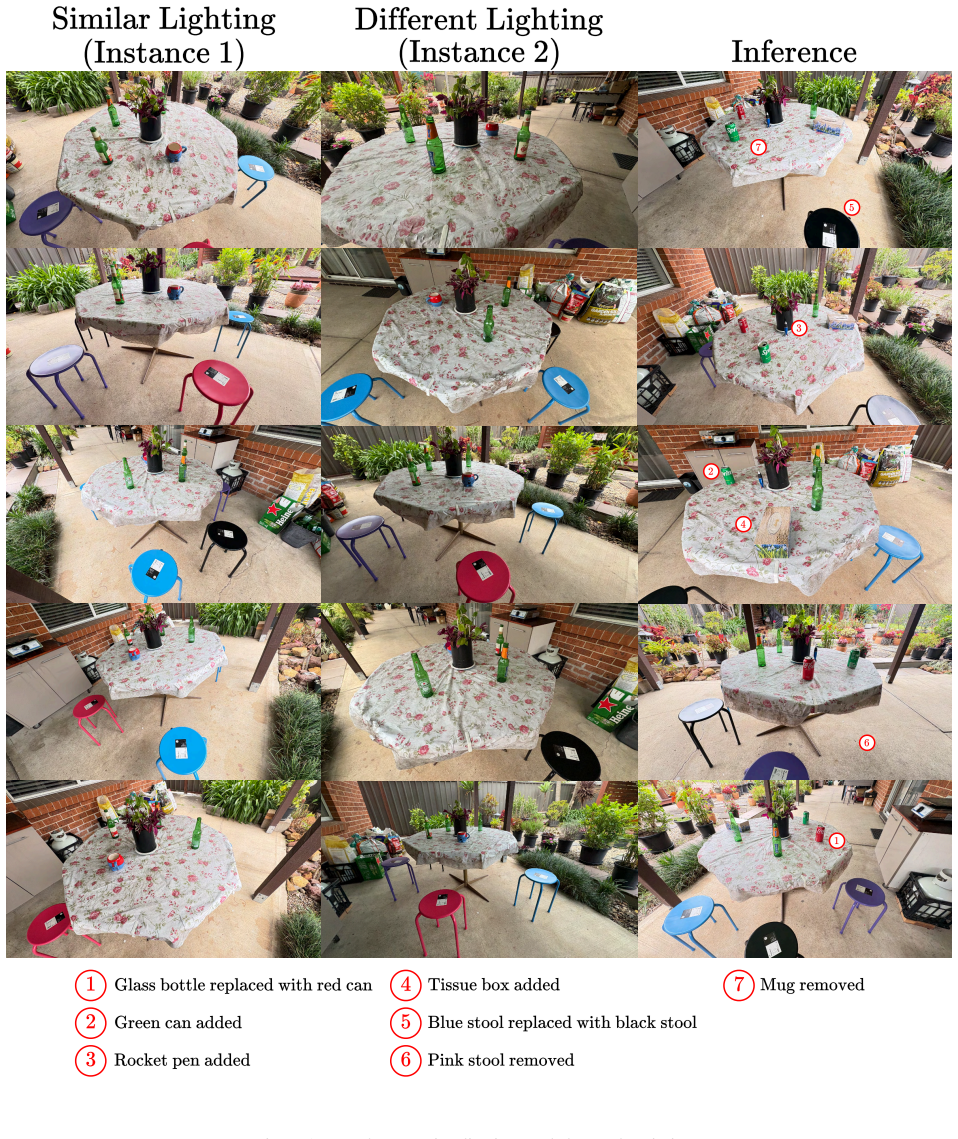
The paper's central claim is that change information can be embedded directly into a 3D Gaussian Splatting representation of the post-change scene, and that rendering this change channel from multiple viewpoints produces more accurate change localizations than any single-view comparison. On the introduced PASLCD benchmark, this multi-view fusion lifts mIoU to 0.461 and F1 to 0.612, roughly 1.7x and 1.5x the best competing method, and it does so without labels or pose constraints. The same representation can be queried from held-out viewpoints, generating change masks for views never captured after the change; with only five inference images it still outperforms the per-view feature-difference baseline by about 1.8x in mIoU. The paper also demonstrates that this change-aware 3D model can be used as a multi-view extension for arbitrary single-view change-mask methods.
Load-bearing premise
The whole pipeline assumes the post-change photos can be registered into the same 3D reconstruction as the pre-change photos; if lighting, darkness, occlusion, or object movement is severe enough to break that registration, the rendered pre-change views are misaligned and the change masks become unreliable.
Editorial extensions
If this is right
- A robot that captures as few as five post-change images can produce change masks for all relevant viewpoints, including ones it never visited, as long as the post-change images register into the reference reconstruction.
- Existing per-view change-mask methods can be upgraded by feeding their masks into the change-channel 3DGS: CYWS-2D's mIoU rises by about 44% when combined with Change-3DGS.
- Combining feature-based (DINOv2) differences with SSIM-based structural differences gives roughly 1.4x the mIoU of either signal alone in the learned 3D change channel.
- Modeling change with spherical-harmonics degree zero instead of color-like higher degrees suppresses view-dependent false positives, cutting false-positive pixels by about 70% from degree 3 to degree 0 while false negatives rise only modestly.
- Under changing illumination, the method degrades far less than baselines (about 7.2% mIoU loss versus 16-17% for CYWS-2D and Feature Difference), suggesting the multi-view fusion filters out distractor lighting changes.
Reading between the lines
- An implicit stress point not explored by the paper: if post-change lighting is so dark or geometry so altered that COLMAP registration fails, the rendered reference views become misaligned and the change channel learns from garbage; the paper explicitly excludes this case, so an online fallback that detects low registration confidence would be a natural extension.
- The low-degree spherical-harmonics inductive bias is a statement about the nature of change: true changes are largely view-independent while artifacts are view-dependent, and that same bias could be imported into other 3D representations or used for temporal change monitoring by letting the change channel evolve over time.
- Because the feature mask comes from a frozen foundation model, surface-level changes that do not move DINOv2 features (color swaps, light spills) are missed even when SSIM catches them; a testable extension is to replace the fixed thresholded feature mask with a learned per-scene calibration of feature distances.
Signed reviews
Editorial analysis
A structured set of objections, weighed in public.
Referee Report
Summary. The paper proposes a label-free, pose-agnostic change localization method. The pipeline builds a 3D Gaussian Splatting (3DGS) model of a pre-change reference scene, registers post-change inference images into the same reference frame using COLMAP, and renders reference views at the inference poses. Per-view candidate change masks are computed from DINOv2 feature differences and SSIM (Eqs. 1-3). A second 3DGS of the post-change scene is then trained with additional per-Gaussian change channels (change magnitude and change opacity), allowing it to render change masks for any viewpoint, including unseen views. Experiments are reported on MAD-Real, ChangeSim, and a new PASLCD dataset, with the headline being roughly 1.7x mIoU improvement over baselines and an unseen-view generalization experiment.
Significance. If the central claim holds, the paper contributes a useful capability: zero-label multi-view change localization with novel-view change-mask rendering, backed by a new public dataset and public code. The unseen-view experiment is a strong point because it validates that the learned change channel captures 3D change rather than merely memorizing the per-view training masks. However, the method's operating envelope hinges on COLMAP registration of the post-change images into the reference reconstruction, an assumption the paper states but never quantifies. Moreover, the seen-view headline results are partly a reconstruction of the per-view pseudo-labels. These issues are addressable within the scope of a revision.
major comments (5)
- [Sec. 3.3] The pipeline's operating envelope rests on an untested COLMAP registration assumption. The method obtains Pinf by registering Iinf to the reference SfM reconstruction, and the paper explicitly states that this assumes the appearance change is not severe enough to break registration (e.g., "inference scene is extremely dark"). All candidate masks M_F,S (Eqs. 1-3), the Change-3DGSinf training (Sec. 3.4), and the unseen-view renderings (Sec. 3.5) depend on Pinf being correct. No experiment measures registration success, pose accuracy, or the distance to the failure boundary. Table 7 shows that the method degrades gracefully under different lighting, but it does not establish that the boundary is far. Please add a registration diagnostic (e.g., COLMAP inlier ratio or pose error on held-out views) and a stress test with graded appearance change (e.g., increasing darkness or lighting shift) to show when the method fails and how close the reported results are to that failure.
- [Sec. 3.4 and Eq. (3)] The seen-view results in Tab. 3 are partly a reconstruction of the training targets. Change-3DGSinf is optimized to render change masks that match the per-view candidate masks M_F,S, which are computed from the same rendered-reference vs. inference comparisons that are later evaluated. Consequently, the reported seen-view mIoU conflates candidate-mask quality with the multi-view fusion benefit. Since Tab. 3 does not include the candidate mask M_F,S as a row, the reader cannot isolate what the 3D consistency adds. Table 4 provides the right comparison (F&S Mask alone at 0.372 vs. F&S Mask + Change-3DGS at 0.449), but it is not the headline table. Please report the candidate-mask baseline in Tab. 3, or clearly state that the headline gain is the stacked pipeline relative to Feature Difference, and quantify the multi-view fusion gain separately.
- [Tabs. 1-3] The headline improvements (e.g., the 1.7x mIoU claim) are means across scenes without variance, confidence intervals, or significance tests. With only 10 scenes in PASLCD and high per-scene variance (e.g., Playground mIoU 0.249 vs. OmniPoseAD 0.076, versus Zen 0.500 vs. CYWS-2D 0.450), a paired statistical test across scenes is needed to support the assertion of state-of-the-art performance. Please report per-split confidence intervals or per-scene error bars; Fig. 4 already does this for the limited-view study and sets the appropriate reporting standard.
- [Secs. 3.3-3.5] Several thresholds are fixed at 0.5 without any ablation: the feature-mask binarization threshold, the SSIM threshold in Eq. (2), the alpha-channel threshold in Eq. (4), and the final change-mask rendering threshold. The paper justifies the choice by saying 0.5 is the midpoint of the value range, but it does not test sensitivity. Since the method is label-free and cannot choose thresholds on a validation set, it is important to show that the reported results are not an artifact of a specific value. Please include a threshold sweep (e.g., values from 0.3 to 0.7) for the candidate-mask binarization and the alpha-channel filter.
- [Sec. 4.2 and Tab. 3] The comparison against supervised SCD baselines is partly a distribution-shift test rather than a head-to-head method comparison, because CSCDNet and CYWS-2D/3D are trained on COCO-Inpainted or ChangeSim and then evaluated on PASLCD. The paper acknowledges this, but the claim of state-of-the-art should be qualified accordingly. To strengthen the claim about the 3D change channel, please add an additional self-supervised multi-view baseline that aggregates the per-view candidate masks without a learned 3D model (e.g., average or median of M_F,S across views). This would isolate the benefit of the 3D consistency and make the comparison more direct.
minor comments (6)
- [Sec. 3.3] The phrase "We testH with Iren and Iinf" appears to be a typo; it should likely read "We pass Iren and Iinf through H" or "We apply H to Iren and Iinf."
- [Eq. (1)] The notation f^{k,j} is not defined; please clarify that j indexes the embedding dimension and that the operation is an L1 distance over that dimension.
- [Sec. 5.4 and Tab. 5] The abbreviations "# FPim" and "# FNim" are not defined; please spell out "false-positive pixels per image" and "false-negative pixels per image" in the caption or table.
- [Sec. 5.1 and 5.4] There are missing spaces in "approximately1.7×" (Sec. 5.1) and "approximate70%" (Sec. 5.4); please correct.
- [Sec. 3.4] The loss formulation for the change channels is described only as "additional L1 and D-SSIM loss terms"; please specify the exact supervision (e.g., L1 between rendered change mask and M_F,S), the loss weights, and how the change channels are regularized during the 3000-iteration fine-tuning.
- [Sec. 5.3] The description of the 25-image setting is ambiguous because PASLCD has two instances per scene (similar and different lighting). Please clarify whether the limited-view experiment uses one instance per scene or both, and whether the 10 unseen views are held out from the same instance.
Circularity Check
No significant circularity: the change channel is supervised by per-view pseudo-labels, but the multi-view fusion is an independent filtering step, and unseen-view rendering provides genuine held-out prediction.
full rationale
The paper's derivation chain is self-contained and does not reduce to its own inputs. Per-view candidate masks M_F,S are computed from rendered reference views and inference views (Eqs. 1-3), then used as pseudo-labels to train an additional change channel in a 3DGS of the inference scene (Sec. 3.4). This is a self-supervised denoising/filtering procedure, not a circular prediction: the rendered change masks are not constrained to equal the input masks by construction, and the reported improvements over the Feature Difference baseline (Tab. 6) are empirical gains from multi-view geometric consistency. The strongest independent claim, generation of change masks for unseen viewpoints (Sec. 5.3, Fig. 4), is a genuine held-out prediction for poses never used in training, so it cannot be a reconstruction of input masks. The COLMAP registration assumption (Sec. 3.3) is a load-bearing external dependency and a potential correctness risk, but it is not a circularity: registration failure would break the pipeline, not make the output equivalent to the input. No load-bearing self-citations or imported uniqueness theorems are present. The method does not rename a known result or fit a parameter and then call it a prediction; the change-channel parameters are learned from pseudo-labels and evaluated against human-annotated ground truth. Therefore no circular step meeting the evidence bar is identified.
Assumptions & free parameters
free parameters (5)
- Feature mask binarization threshold =
0.5
- SSIM binarization threshold =
0.5
- Alpha channel unseen-region threshold =
0.5
- Training iterations =
7000 reference, 3000 inference, 3000 augmentation
- Spherical harmonics degree =
0
assumptions (5)
- domain assumption COLMAP can register inference images to the reference SfM reconstruction under moderate appearance change.
- domain assumption The reference image set is sufficient to build a 3DGS representation.
- domain assumption DINOv2 features are sensitive to relevant changes and insensitive to distractors.
- domain assumption SSIM captures structural change independent of feature change.
- domain assumption Changes are largely view-independent, so low SH degree for the change channel is appropriate.
invented entities (2)
-
Change magnitude channel (c~)
-
Change opacity factor (alpha~)
Cite this review
Pith. "Pith review of Multi-View Pose-Agnostic Change Localization with Zero Labels." pith.science (2026). https://pith.science/paper/FA6GGHLV
@misc{pith2026241203911,
  author       = {Pith},
  title        = {Pith review of: Multi-View Pose-Agnostic Change Localization with Zero Labels},
  year         = {2026},
  howpublished = {\url{https://pith.science/paper/FA6GGHLV}},
  note         = {Machine review of arXiv:2412.03911}
}
read the original abstract
Autonomous agents often require accurate methods for detecting and localizing changes in their environment, particularly when observations are captured from unconstrained and inconsistent viewpoints. We propose a novel label-free, pose-agnostic change detection method that integrates information from multiple viewpoints to construct a change-aware 3D Gaussian Splatting (3DGS) representation of the scene. With as few as 5 images of the post-change scene, our approach can learn an additional change channel in a 3DGS and produce change masks that outperform single-view techniques. Our change-aware 3D scene representation additionally enables the generation of accurate change masks for unseen viewpoints. Experimental results demonstrate state-of-the-art performance in complex multi-object scenes, achieving a 1.7x and 1.5x improvement in Mean Intersection Over Union and F1 score respectively over other baselines. We also contribute a new real-world dataset to benchmark change detection in diverse challenging scenes in the presence of lighting variations.
Figures


Figures from the paper (16 more)




Reference graph
Works this paper leans on
-
[1]
Supervisely: All Computer Vision in One Platform . https://supervisely.com/ . Accessed: 2025-03-
work page 2025
-
[2]
Edward H. Adelson and James R. Bergen. The Plenoptic Function and the Elements of Early Vision. In Computa- tional Models of Visual Processing . The MIT Press, 1991. 3
work page 1991
-
[3]
Alcantarilla, Simon Stent, Germ´an Ros, Roberto Ar- royo, and Riccardo Gherardi
Pablo F. Alcantarilla, Simon Stent, Germ´an Ros, Roberto Ar- royo, and Riccardo Gherardi. Street-view change detection with deconvolutional networks. Autonomous Robots, 42(7): 1301–1322, 2018. 1, 2, 6
work page 2018
-
[4]
Wele Gedara Chaminda Bandara and Vishal M. Patel. A Transformer-Based Siamese Network for Change Detection. In IGARSS 2022 - 2022 IEEE International Geoscience and Remote Sensing Symposium, pages 207–210, Kuala Lumpur, Malaysia, 2022. IEEE. 2
work page 2022
-
[5]
Barron, Ben Mildenhall, Dor Verbin, Pratul P
Jonathan T. Barron, Ben Mildenhall, Dor Verbin, Pratul P. Srinivasan, and Peter Hedman. Mip-NeRF 360: Unbounded Anti-Aliased Neural Radiance Fields. In 2022 IEEE/CVF Conference on Computer Vision and Pattern Recognition (CVPR), pages 5460–5469, New Orleans, LA, USA, 2022. IEEE. 3
work page 2022
-
[6]
MVTec AD — A Comprehensive Real- World Dataset for Unsupervised Anomaly Detection
Paul Bergmann, Michael Fauser, David Sattlegger, and Carsten Steger. MVTec AD — A Comprehensive Real- World Dataset for Unsupervised Anomaly Detection. In 2019 IEEE/CVF Conference on Computer Vision and Pat- tern Recognition (CVPR) , pages 9584–9592, 2019. ISSN: 2575-7075. 2
work page 2019
-
[7]
Fully Convolutional Siamese Networks for Change Detec- tion
Rodrigo Caye Daudt, Bertr Le Saux, and Alexandre Boulch. Fully Convolutional Siamese Networks for Change Detec- tion. In 2018 25th IEEE International Conference on Image Processing (ICIP), pages 4063–4067, Athens, 2018. IEEE. 1, 2
work page 2018
-
[8]
Hao Chen and Zhenwei Shi. A Spatial-Temporal Attention- Based Method and a New Dataset for Remote Sensing Im- age Change Detection. Remote Sensing, 12(10):1662, 2020. Number: 10 Publisher: Multidisciplinary Digital Publishing Institute. 1, 2
work page 2020
Show all 53 references
-
[9]
An image is worth 16x16 words: Transformers for image recognition at scale
Alexey Dosovitskiy, Lucas Beyer, Alexander Kolesnikov, Dirk Weissenborn, Xiaohua Zhai, Thomas Unterthiner, Mostafa Dehghani, Matthias Minderer, Georg Heigold, Syl- vain Gelly, Jakob Uszkoreit, and Neil Houlsby. An image is worth 16x16 words: Transformers for image recognition ...
2021
-
[10]
Changer: Feature In- teraction is What You Need for Change Detection
Sheng Fang, Kaiyu Li, and Zhe Li. Changer: Feature In- teraction is What You Need for Change Detection. IEEE Transactions on Geoscience and Remote Sensing , 61:1–11,
-
[11]
Plenox- els: Radiance Fields without Neural Networks
Sara Fridovich-Keil, Alex Yu, Matthew Tancik, Qinhong Chen, Benjamin Recht, and Angjoo Kanazawa. Plenox- els: Radiance Fields without Neural Networks. In 2022 IEEE/CVF Conference on Computer Vision and Pattern Recognition (CVPR), pages 5491–5500, New Orleans, LA, USA, 2022. IEEE. 3
2022
-
[12]
Learning to Describe Differences Between Pairs of Similar Images
Harsh Jhamtani and Taylor Berg-Kirkpatrick. Learning to Describe Differences Between Pairs of Similar Images. In Proceedings of the 2018 Conference on Empirical Methods in Natural Language Processing , pages 4024–4034, Brus- sels, Belgium, 2018. Association for Computational L...
2018
-
[13]
3d gaussian splatting for real-time radiance field rendering
Bernhard Kerbl, Georgios Kopanas, Thomas Leimk ¨uhler, and George Drettakis. 3d gaussian splatting for real-time radiance field rendering. ACM Transactions on Graphics, 42 (4), 2023. 2, 3, 4, 1
2023
-
[14]
Learning deep structured network for weakly supervised change detection
Salman Khan, Xuming He, Fatih Porikli, Mohammed Ben- namoun, Ferdous Sohel, and Roberto Togneri. Learning deep structured network for weakly supervised change detection. In Proceedings of the Twenty-Sixth International Joint Con- ference on Artificial Intelligence , pages 2008...
2008
-
[15]
Fentanes, Oscar M
Tom ´aˇs Krajn´ık, Jaime P. Fentanes, Oscar M. Mozos, Tom Duckett, Johan Ekekrantz, and Marc Hanheide. Long-term topological localisation for service robots in dynamic envi- ronments using spectral maps. In 2014 IEEE/RSJ Interna- tional Conference on Intelligent Robots and Sys...
2014
-
[16]
Splatpose & detect: Pose-agnostic 3d anomaly detection
Mathis Kruse, Marco Rudolph, Dominik Woiwode, and Bodo Rosenhahn. Splatpose & detect: Pose-agnostic 3d anomaly detection. In Proceedings of the IEEE/CVF Con- ference on Computer Vision and Pattern Recognition, pages 3950–3960, 2024. 2, 3, 5, 6, 7, 4
2024
-
[17]
Semi-Supervised Scene Change Detection by Distillation from Feature-metric Align- ment
Seonhoon Lee and Jong-Hwan Kim. Semi-Supervised Scene Change Detection by Distillation from Feature-metric Align- ment. In 2024 IEEE/CVF Winter Conference on Applications of Computer Vision (WACV) , pages 1215–1224, Waikoloa, HI, USA, 2024. IEEE. 1
2024
-
[18]
Hierarchical Paired Channel Fusion Network for Street Scene Change Detection
Yinjie Lei, Duo Peng, Pingping Zhang, Qiuhong Ke, and Haifeng Li. Hierarchical Paired Channel Fusion Network for Street Scene Change Detection. IEEE Transactions on Image Processing, 30:55–67, 2021. 6
2021
-
[19]
Cognitive visual anomaly detection with constrained latent representations for industrial inspection robot
Jie Li, Xing Xu, Lianli Gao, Zheng Wang, and Jie Shao. Cognitive visual anomaly detection with constrained latent representations for industrial inspection robot. Applied Soft Computing, 95:106539, 2020. 2
2020
-
[20]
Omni-Frequency Channel- Selection Representations for Unsupervised Anomaly De- tection
Yufei Liang, Jiangning Zhang, Shiwei Zhao, Runze Wu, Yong Liu, and Shuwen Pan. Omni-Frequency Channel- Selection Representations for Unsupervised Anomaly De- tection. IEEE Transactions on Image Processing, 32:4327– 4340, 2023. 2
2023
-
[21]
Robust Scene Change Detection Using Visual Foundation Models and Cross-Attention Mechanisms, 2024
Chun-Jung Lin, Sourav Garg, Tat-Jun Chin, and Feras Dayoub. Robust Scene Change Detection Using Visual Foundation Models and Cross-Attention Mechanisms, 2024. arXiv:2409.16850 [cs]. 1, 2, 6
2024 arXiv
-
[22]
Fully convolutional networks for semantic segmentation
Jonathan Long, Evan Shelhamer, and Trevor Darrell. Fully convolutional networks for semantic segmentation. In Pro- ceedings of the IEEE Conference on Computer Vision and Pattern Recognition (CVPR), 2015. 2
2015
-
[23]
Meaningful Change De- tection in Indoor Environments Using CLIP Models and NeRF-Based Image Synthesis
Eric Martinson and Paula Lauren. Meaningful Change De- tection in Indoor Environments Using CLIP Models and NeRF-Based Image Synthesis. In 2024 21st International Conference on Ubiquitous Robots (UR) , pages 603–610,
2024
-
[24]
Occupancy Net- works: Learning 3D Reconstruction in Function Space
Lars Mescheder, Michael Oechsle, Michael Niemeyer, Se- bastian Nowozin, and Andreas Geiger. Occupancy Net- works: Learning 3D Reconstruction in Function Space. In 2019 IEEE/CVF Conference on Computer Vision and Pat- tern Recognition (CVPR) , pages 4455–4465. IEEE Com- puter So...
2019
-
[25]
Srinivasan, Matthew Tancik, Jonathan T
Ben Mildenhall, Pratul P. Srinivasan, Matthew Tancik, Jonathan T. Barron, Ravi Ramamoorthi, and Ren Ng. Nerf: Representing scenes as neural radiance fields for view syn- thesis. In ECCV, 2020. 2
2020
-
[26]
Srinivasan, Matthew Tancik, Jonathan T
Ben Mildenhall, Pratul P. Srinivasan, Matthew Tancik, Jonathan T. Barron, Ravi Ramamoorthi, and Ren Ng. NeRF: representing scenes as neural radiance fields for view syn- thesis. Communications of the ACM, 65(1):99–106, 2021. 2, 3
2021
-
[27]
Instant neural graphics primitives with a multires- olution hash encoding
Thomas M ¨uller, Alex Evans, Christoph Schied, and Alexan- der Keller. Instant neural graphics primitives with a multires- olution hash encoding. ACM Transactions on Graphics, 41 (4):102:1–102:15, 2022. 3
2022
-
[28]
Maxime Oquab, Timoth ´ee Darcet, Theo Moutakanni, Huy V . V o, Marc Szafraniec, Vasil Khalidov, Pierre Fernandez, Daniel Haziza, Francisco Massa, Alaaeldin El-Nouby, Rus- sell Howes, Po-Yao Huang, Hu Xu, Vasu Sharma, Shang- Wen Li, Wojciech Galuba, Mike Rabbat, Mido Assran, Ni...
2023
-
[29]
DeepSDF: Learning Continuous Signed Distance Functions for Shape Represen- tation
Jeong Joon Park, Peter Florence, Julian Straub, Richard Newcombe, and Steven Lovegrove. DeepSDF: Learning Continuous Signed Distance Functions for Shape Represen- tation. In 2019 IEEE/CVF Conference on Computer Vi- sion and Pattern Recognition (CVPR), pages 165–174. IEEE Compu...
2019
-
[30]
Changesim: To- wards end-to-end online scene change detection in indus- trial indoor environments
Jin-Man Park, Jae-Hyuk Jang, Sahng-Min Yoo, Sun-Kyung Lee, Ue-Hwan Kim, and Jong-Hwan Kim. Changesim: To- wards end-to-end online scene change detection in indus- trial indoor environments. In 2021 IEEE/RSJ International Conference on Intelligent Robots and Systems (IROS), pag...
2021
-
[31]
ChangeSim: To- wards End-to-End Online Scene Change Detection in Indus- trial Indoor Environments
Jin-Man Park, Jae-Hyuk Jang, Sahng-Min Yoo, Sun-Kyung Lee, Ue-Hwan Kim, and Jong-Hwan Kim. ChangeSim: To- wards End-to-End Online Scene Change Detection in Indus- trial Indoor Environments. In 2021 IEEE/RSJ International Conference on Intelligent Robots and Systems (IROS), pag...
2021
-
[32]
The Change You Want to See (Now in 3D)
Ragav Sachdeva and Andrew Zisserman. The Change You Want to See (Now in 3D). In 2023 IEEE/CVF International Conference on Computer Vision Workshops (ICCVW), pages 2052–2061, Paris, France, 2023. IEEE. 1, 2, 6, 8
2023
-
[33]
The Change You Want To See
Ragav Sachdeva and Andrew Zisserman. The Change You Want To See. In Proceedings of the IEEE/CVF Winter Con- ference on Applications of Computer Vision (WACV), pages 3993–4002, 2023. 2, 6, 7, 8, 4
2023
-
[34]
Change Detection from a Street Image Pair using CNN Features and Superpixel Segmentation
Ken Sakurada and Takayuki Okatani. Change Detection from a Street Image Pair using CNN Features and Superpixel Segmentation. In Procedings of the British Machine Vision Conference 2015, pages 61.1–61.12, Swansea, 2015. British Machine Vision Association. 2, 6
2015
-
[35]
Dense Optical Flow based Change De- tection Network Robust to Difference of Camera Viewpoints,
Ken Sakurada, Weimin Wang, Nobuo Kawaguchi, and Ryosuke Nakamura. Dense Optical Flow based Change De- tection Network Robust to Difference of Camera Viewpoints,
-
[36]
Weakly Supervised Silhouette-based Semantic Scene Change Detec- tion
Ken Sakurada, Mikiya Shibuya, and Weimin Wang. Weakly Supervised Silhouette-based Semantic Scene Change Detec- tion. In 2020 IEEE International Conference on Robotics and Automation (ICRA) , pages 6861–6867, Paris, France,
2020
-
[37]
Structure-from-Motion Revisited
Johannes Lutz Sch ¨onberger and Jan-Michael Frahm. Structure-from-Motion Revisited. In Conference on Com- puter Vision and Pattern Recognition (CVPR), 2016. 3
2016
-
[38]
A Divided Spatial and Temporal Context Network for Remote Sens- ing Change Detection
Nian Shi, Keming Chen, and Guangyao Zhou. A Divided Spatial and Temporal Context Network for Remote Sens- ing Change Detection. IEEE Journal of Selected Topics in Applied Earth Observations and Remote Sensing , 15:4897– 4908, 2022. 2
2022
-
[39]
Neural Geomet- ric Level of Detail: Real-time Rendering with Implicit 3D Shapes
Towaki Takikawa, Joey Litalien, Kangxue Yin, Karsten Kreis, Charles Loop, Derek Nowrouzezahrai, Alec Jacob- son, Morgan McGuire, and Sanja Fidler. Neural Geomet- ric Level of Detail: Real-time Rendering with Implicit 3D Shapes. In 2021 IEEE/CVF Conference on Computer Vi- sion ...
2021
-
[40]
Balamuralidhar
Ashley Varghese, Jayavardhana Gubbi, Akshaya Ra- maswamy, and P. Balamuralidhar. ChangeNet: A Deep Learning Architecture for Visual Change Detection. In Computer Vision – ECCV 2018 Workshops, pages 129–145, Cham, 2019. Springer International Publishing. 1, 2, 6
2018
-
[41]
Attention is All you Need
Ashish Vaswani, Noam Shazeer, Niki Parmar, Jakob Uszko- reit, Llion Jones, Aidan N Gomez, Ł ukasz Kaiser, and Illia Polosukhin. Attention is All you Need. In Advances in Neu- ral Information Processing Systems. Curran Associates, Inc.,
-
[42]
How to reduce change detection to semantic segmentation
Guo-Hua Wang, Bin-Bin Gao, and Chengjie Wang. How to reduce change detection to semantic segmentation. Pattern Recognition, 2023. 1, 2
2023
-
[43]
Image quality assessment: From error visibility to structural similarity
Zhou Wang, Alan C Bovik, Hamid R Sheikh, and Eero P Si- moncelli. Image quality assessment: From error visibility to structural similarity. IEEE Transactions on Image Process- ing, 13(4):600–612, 2004. 2, 4
2004
-
[44]
Transcd: scene change detection via transformer-based architecture
Zhixue Wang, Yu Zhang, Lin Luo, and Nan Wang. Transcd: scene change detection via transformer-based architecture. Opt. Express, 29(25):41409–41427, 2021. 2
2021
-
[45]
Barron, Alberto Rodriguez, Phillip Isola, and Tsung-Yi Lin
Lin Yen-Chen, Pete Florence, Jonathan T. Barron, Alberto Rodriguez, Phillip Isola, and Tsung-Yi Lin. iNeRF: Invert- ing neural radiance fields for pose estimation. In IEEE/RSJ International Conference on Intelligent Robots and Systems (IROS), 2021. 2
2021
-
[46]
DRÆM – A discriminatively trained reconstruction embedding for surface anomaly detection
Vitjan Zavrtanik, Matej Kristan, and Danijel Skocaj. DRÆM – A discriminatively trained reconstruction embedding for surface anomaly detection. In 2021 IEEE/CVF International Conference on Computer Vision (ICCV), pages 8310–8319, Montreal, QC, Canada, 2021. IEEE. 2
2021
-
[47]
DSR – A Dual Subspace Re-Projection Network for Surface Anomaly Detection
Vitjan Zavrtanik, Matej Kristan, and Danijel Sko ˇcaj. DSR – A Dual Subspace Re-Projection Network for Surface Anomaly Detection. In Computer Vision – ECCV 2022 , pages 539–554, Cham, 2022. Springer Nature Switzerland
2022
-
[48]
Real- Net: A Feature Selection Network with Realistic Synthetic Anomaly for Anomaly Detection, 2024
Ximiao Zhang, Min Xu, and Xiuzhuang Zhou. Real- Net: A Feature Selection Network with Realistic Synthetic Anomaly for Anomaly Detection, 2024. arXiv:2403.05897 [cs]. 2
2024 arXiv
-
[49]
Pad: A dataset and benchmark for pose-agnostic anomaly detection
Qiang Zhou, Weize Li, Lihan Jiang, Guoliang Wang, Guyue Zhou, Shanghang Zhang, and Hao Zhao. Pad: A dataset and benchmark for pose-agnostic anomaly detection. Advances in Neural Information Processing Systems, 36, 2024. 2, 3, 5, 6, 7, 1, 4 Multi-View Pose-Agnostic Change Local...
2024
-
[51]
Motivation for change-specific opacity factor As discussed in Sec
Additional Details on our Methodology 7.1. Motivation for change-specific opacity factor As discussed in Sec. 3.4, our Change-3DGS can render both RGB images of the inference scene and change maps in par- allel. To achieve this, we incorporate a separate opacity fac- tor ( ˜α)...
-
[52]
Additional Details on MAD-Real The MAD-Real dataset [49] has publicly released 10 scenes each containing a LEGO toy object
Additional Details on Datasets 8.1. Additional Details on MAD-Real The MAD-Real dataset [49] has publicly released 10 scenes each containing a LEGO toy object. We illustrate each scene at the end of this Supp. Material: Bear, Bird, Ele- phant, Parrot, Pig, Puppy, Scorpion, Tur...
-
[53]
Instance-level Results for PASLCD Tabs
Additional Experimental Results 9.1. Instance-level Results for PASLCD Tabs. 8 and 9 show per-scene quantitative results for our PASLCD dataset under similar lighting conditions and dif- ferent lighting conditions respectively. We consistently im- prove the change localization...
-
[2017]
arXiv:1712.02941 [cs]
Reviewed August 11, 2026 · model on record in the stance chip above.
Discussion (0). Continue with ORCID to comment.