REVIEW 3 major objections 5 minor 60 references
Revealing Physical Mechanisms of Pattern Formation and Switching in Ecosystems via Nonequilibrium Landscape and Flux
T0 review · 3 major / 5 minor · reviewed 2026-08-11 · deepseek-v4-flash
Pith's one-line read This paper claims that a nonequilibrium landscape-flux construction in a reduced three-mode space explains vegetation pattern formation and switching in semi-arid ecosystems, with flux and entropy production peaks near phase boundaries…
desk verdict Competent and internally consistent landscape-flux analysis of vegetation pattern switching, but every quantitative claim sits on an unvalidated 8-to-3 mode reduction, and the early-warning label outruns what is actually shown. read the letter →
The pith
A machine-rendered reading of the paper's core claim, the machinery that carries it, and where it could break.
The reading
What carries the argument
The machinery is the nonequilibrium landscape-flux decomposition applied to a Fokker-Planck equation in a truncated Fourier-mode space. The vegetation and water fields are expanded in cosine modes; keeping $N_{00}, N_{01}, N_{10}, N_{11}$ and $W_{00}, W_{01}, W_{10}, W_{11}$, the authors adiabatically eliminate the five fast modes and work with the three slow modes $N_{01}, N_{10}, N_{11}$. From the steady-state probability $P_{ss}$ they define the effective potential $U = -\ln P_{ss}$ and the steady-state flux $J_{ss} = F P_{ss} - \nabla \cdot (D P_{ss})$, decomposing the driving force as $F = -D \cdot \nabla U + J_{ss}/P_{ss} + \nabla \cdot D$. The nonequilibrium character is quantified by the averaged flux $J_{ave} = \langle |J_{ss}| \rangle$ and the entropy production rate $e_p = \int (J_{ss}^T D^{-1} J_{ss} / P_{ss}) \, dN_{01} dN_{10} dN_{11}$; the flux opposes the gradient to drive switching, while the entropy production measures the thermodynamic cost of the broken detailed balance.
What would settle it
Directly simulate the full stochastic PDE (Eq. 1) and compute the steady-state distribution projected onto $N_{01}$, $N_{10}$, and $N_{11}$; if the barrier heights, transition paths, or the $\beta$-locations of the averaged-flux and entropy-production peaks differ from the three-mode predictions by more than the reported resolution, the mode truncation is not faithfully representing the spatial system.
Extended reading notes
Core claim
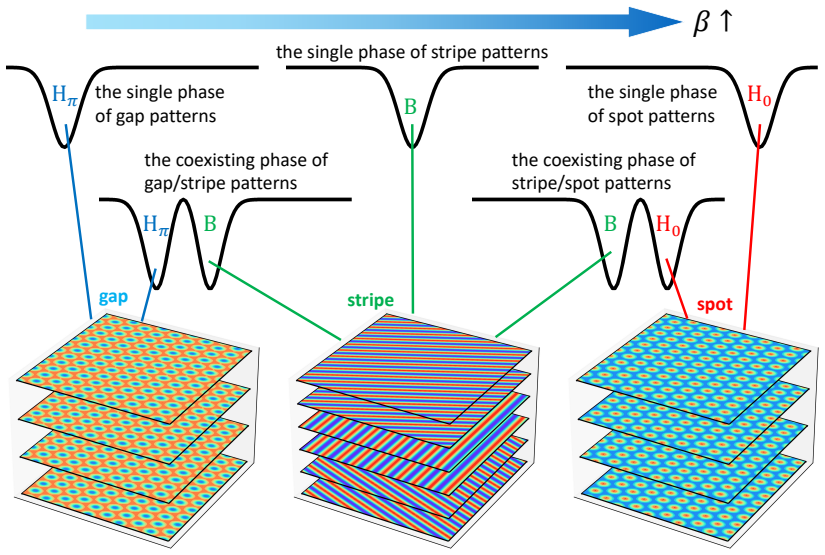
The central claim is that pattern switching in the semi-arid ecosystem is driven by the nonequilibrium flux rather than by thermal activation over a static barrier alone. In the three-mode space, the potential landscape $U = -\ln P_{ss}$ transitions with increasing water-uptake feedback $\beta$ from a single gap basin to gap/stripe coexistence, a single stripe basin, stripe/spot coexistence, and finally a single spot basin. Inside the coexistence phases, the steady-state flux field points against the potential gradient and acts as a driving force for switching; the optimal transition paths between basins do not coincide for forward and reverse directions, quantifying time-reversal symmetry breaking. The averaged flux $J_{ave}$ and the entropy production rate $e_p$ are computed from the steady-state flux, and both show peaks near the phase boundaries, which the paper interprets as the dynamical and thermodynamical origin of the critical transitions, and hence as early warning signals for desertification. Switching times are shown to be exponentially controlled by inter-state barrier height but also to depend on the distance between closest basins.
Load-bearing premise
The load-bearing assumption is that three slow Fourier modes capture everything that matters for pattern switching, so the landscape, flux, and entropy production computed in that reduced space faithfully represent the full spatial vegetation field.
Editorial extensions
If this is right
- If the three-mode reduction is faithful, barrier heights computed from the mode-space landscape give a quantitative stability measure for each spatial pattern state, with higher barriers meaning harder switching.
- The near-boundary peaks in averaged flux and entropy production imply that monitoring increases in these nonequilibrium indicators can serve as early warning signals for the onset of spot patterns and desertification.
- The non-overlap of forward and reverse optimal transition paths provides a measurable signature of time-reversal symmetry breaking in pattern-switching dynamics.
- Changing ecosystem size or noise intensity shifts the critical transition from discontinuous to continuous, and can even remove it, so the landscape-flux approach captures how noise alters pattern stability.
- The approach generalizes to other spatially extended nonequilibrium systems, such as chemical Turing patterns, developmental patterning, and turbulence, wherever a low-dimensional mode set can reproduce the patterns of interest.
Reading between the lines
- A natural next step is to test the three-mode truncation by comparing its flux and entropy-production peaks against direct simulations of the full stochastic PDE; if they coincide, the mode-space indicators could be computed from observable vegetation imagery without solving the full field equations.
- The paper's 'distance between basins' correction to Kramers-like switching rates suggests that in systems with many degenerate pattern orientations, switching times may be governed more by basin geometry than by barrier height alone; this could be checked in higher-mode truncations.
- Because the entropy production rate is a global thermodynamic quantity, its peak near boundaries implies that pattern switches carry a measurable thermodynamic cost that might be observable in field data as increased variance or irreversibility of vegetation and soil-moisture time series.
- The fixed mode set $(N_{01}, N_{10}, N_{11})$ may miss patterns with different wave-vectors; testing the method with a parameter scan that includes modes with other spatial frequencies would reveal whether the reported gap-stripe-spot sequence is robust to the truncation.
Signed reviews
Editorial analysis
A structured set of objections, weighed in public.
Referee Report
Summary. The manuscript develops a nonequilibrium landscape-flux theory for spatial pattern formation and switching, applied to a stochastic reaction-diffusion model of semi-arid vegetation. The authors expand the biomass and water fields in Fourier cosine modes, truncate to eight spatial modes, then adiabatically eliminate five faster modes to obtain a three-dimensional Fokker-Planck equation for the slow modes N01, N10, and N11. They define the landscape as U = -ln Pss and the steady-state flux as Jss = F Pss - div(D Pss), and use these objects to compute barrier heights, transition paths, switching times, averaged flux, entropy production rate, and time-reversal asymmetry. The central claims are that the nonequilibrium flux drives pattern switching and that peaks in averaged flux and entropy production near phase boundaries provide early warning signals for desertification.
Significance. If the mode-reduction program is quantitatively reliable, the paper offers a genuinely useful bridge from stochastic partial differential equations to global stability and thermodynamic characterizations of spatial patterns. The approach is a natural extension of earlier landscape-flux work to spatially extended systems, and the paper contains several admirable elements: the phase diagram in the reduced mode space is consistent with real-space simulations; the dominant-path analysis gives non-overlapping forward and backward transition paths, illustrating time-reversal symmetry breaking; and the exponential relation between switching time and barrier height (Fig. 5D) is a concrete, testable prediction. The claims about averaged flux and entropy production peaks near phase boundaries are also falsifiable in principle. The main weakness is that the load-bearing reduction from the full stochastic PDE to the three-mode Fokker-Planck equation is asserted rather than validated, and the causal interpretation of the flux decomposition is not distinguished from an algebraic identity.
major comments (3)
- [§II.A, Eq. (5)] The reduction from the stochastic PDE (Eq. 1) to the three-mode Fokker-Planck equation (Eq. 5) is the central approximation of the paper, but no convergence test, error estimate, or sensitivity analysis is provided. The adiabatic elimination of N00, W00, W01, W10, and W11 is justified only by Fig. S3, which appears to show slower relaxation of N01, N10, and N11 at selected parameter values. This does not establish that the eliminated modes remain slaved for the entire β range studied, especially near the phase boundaries where the spectral gap may close. I request explicit evidence: (i) comparison of stationary statistics (U, Jss, barrier heights, and entropy production rate) between the three-mode and full eight-mode truncations as functions of β; (ii) comparison with a higher-mode truncation (e.g., including N02, N20, N12, N21) to show convergence of the quantities used in Eqs. (7)-(11); and (iii) checks of the slow-fast separation at the coexistence boundaries. Without such evidence, the quantitative claims are properties of the truncated model rather than of the original spatial ecosystem.
- [§II.A, Eq. (9)] The statement that 'the nonequilibrium flux drives the switchings of spatial patterns' is not established by the equations as written. Because U and Jss are both computed from the same simulated steady-state distribution Pss of the truncated model, Eq. (9) is an exact decomposition of the drift F for any stationary distribution; it does not by itself identify a causal mechanism. The transition-path analysis in §II.C is suggestive, but to support the causal claim the authors should compare the full dynamics with a control in which the flux contribution is removed or suppressed, and show that switching is reduced or the paths change materially. Please also quantify the relative magnitudes of the gradient, curl, and noise-induced force components along the computed transition paths (e.g., for the paths in Fig. 4A and 4C).
- [§II.D, Fig. 6] The interpretation of the averaged flux and entropy production rate peaks as early warning signals for desertification needs a prospective test. As presented, Jave and ep are computed from the steady-state distribution at each β, so a peak at the phase boundary is a static feature of the bifurcation diagram. To justify the early-warning claim, the authors should estimate these quantities from sliding windows of a single trajectory approaching the transition and show that they rise before the switching point, and compare their performance with standard indicators such as variance and lag-1 autocorrelation. This is especially important because the abstract and conclusion present the peaks as offering early warning signals, not merely as signatures of the boundary.
minor comments (5)
- [Fig. 4 caption] The caption contains a typo: 'spatial dependent noise focre' should read 'spatial dependent noise force'.
- [Eq. (3)] The Fokker-Planck operator ordering in Eq. (3) is unclear: the terms such as ∂Ā_n,ij/∂N_ij P should be written with explicit parentheses, e.g., ∂/∂N_ij (Ā_n,ij P), so that the reader can see where the derivative acts.
- [§II.B, X1-X2 mapping] The mapping X1 = sqrt(N01^2+N10^2+N11^2), X2 = sgn(N01N10N11)(|N01|+|N10|+|N11|-X1) is introduced without a derivation or a statement of its properties. Please explain why this mapping is one-to-one on the relevant regions of mode space and how it merges degenerate basins without distorting barrier heights.
- [Fig. 6] The labels '1-5' in panels A-C and '1-3' in panel D are inconsistent; please ensure the same labeling convention is used across all panels.
- [§II.A, parameter choices] The choices Lb = 80 and k = 23 are stated without explanation. Please provide the relation of these parameters to the physical domain size and wavenumber, and indicate whether the results are robust to reasonable variations in these values.
Circularity Check
Partial definitional circularity in the central mechanistic claim: the flux is defined as the non-gradient force, so attributing pattern switching to the flux is an interpretation of the defining decomposition, while the quantitative outputs remain independent simulation results.
-
self definitional
[Sec. II.A, Eqs. (7)-(9); abstract]
"U (N01, N10, N11) = − ln Pss(N01, N10, N11), (7) Jss = FPss − ∇ ·(DPss), (8) ... F = Fgradient + Fcurl + FD = −D · ∇U + Jss/Pss + ∇ ·D. (9) ... revealing that the nonequilibrium flux drives the switchings of spatial patterns."
The steady-state flux Jss is defined in Eq. (8) as the difference between the probability current FPss and the diffusion divergence, and Eq. (9) is the immediate identity obtained by dividing that definition by Pss. Therefore, any deterministic force not already accounted for by the landscape gradient term −D·∇U or the noise-induced divergence ∇·D is, by construction, Jss/Pss. The abstract's conclusion that 'the nonequilibrium flux drives the switchings' is thus not an independent derived result but an interpretation of the defining decomposition: the flux is built to be the non-gradient part of the force.
full rationale
The paper's quantitative chain from the stochastic PDE (Eq. 1) to the phase diagram, barrier heights, switching times, and the averaged-flux/EPR peaks is not circular in the statistical sense: no parameter is fitted to the predicted quantities, and those quantities are nontrivial outputs of the truncated mode-space Fokker-Planck equation. The main definitional issue is the causal claim that the nonequilibrium flux drives pattern switching. Since Jss is defined in Eq. (8) as the part of the probability current not balanced by diffusion, and Eq. (9) then decomposes the force into gradient, flux, and divergence terms, the assertion that the flux is a driving force is essentially a restatement of the construction. The paper's mode truncation and adiabatic elimination (Sec. II.A) are modeling assumptions whose accuracy is not demonstrated with convergence or sensitivity tests; this is a correctness risk, not circularity. Self-citations to the landscape-flux framework and dominant-path method are methodological and not load-bearing in the sense of importing an unverified uniqueness theorem. Overall, the central mechanism wording is partially definitional, but the paper also contains concrete model computations that are not equivalent to their inputs, so a moderate score of 4 is appropriate.
Assumptions & free parameters
free parameters (3)
- Mode truncation set and slow subspace =
Keep modes N00,N01,N10,N11 and W00,W01,W10,W11; adiabatically eliminate to N01,N10,N11
- Domain size Lb and wavenumber k =
Lb=80, k=23
- Beta sampling range =
0.003 to 0.026
assumptions (5)
- ad hoc to paper The selected cosine modes and truncation reproduce all relevant Turing patterns of the full stochastic PDE
- ad hoc to paper Adiabatic elimination of five fast modes is valid across the studied beta range
- domain assumption The stochastic PDE with the given multiplicative noise matrix M describes the ecosystem
- domain assumption The steady-state distribution of the truncated three-mode Langevin system equals the relevant global measure of the original spatial system
- standard math Fourier cosine transform with reflecting boundary conditions is a complete basis for the solution space
Cite this review
Pith. "Pith review of Revealing Physical Mechanisms of Pattern Formation and Switching in Ecosystems via Nonequilibrium Landscape and Flux." pith.science (2026). https://pith.science/paper/HUEJFAQX
@misc{pith2026241203978,
  author       = {Pith},
  title        = {Pith review of: Revealing Physical Mechanisms of Pattern Formation and Switching in Ecosystems via Nonequilibrium Landscape and Flux},
  year         = {2026},
  howpublished = {\url{https://pith.science/paper/HUEJFAQX}},
  note         = {Machine review of arXiv:2412.03978}
}
read the original abstract
Spatial patterns are widely observed in numerous nonequilibrium natural systems, often undergoing complex transitions and bifurcations, thereby exhibiting significant importance in many physical and biological systems such as embryonic development, ecosystem desertification, and turbulence. However, how spatial pattern formation emerges and how the spatial pattern switches are not fully understood. Here, we developed a landscape-flux field theory via the spatial mode expansion method to uncover the underlying physical mechanism of the pattern formation and switching. We identified the landscape and flux field as the driving force for spatial dynamics and applied this theory to the critical transitions between spatial vegetation patterns in semi-arid ecosystems, revealing that the nonequilibrium flux drives the switchings of spatial patterns. We uncovered how the pattern switching emerges through the optimal pathways and how fast this occurs via the speed of pattern switching. Furthermore, both the averaged flux and the entropy production rate exhibit peaks near pattern switching boundaries, revealing dynamical and thermodynamical origins for pattern transitions, and further offering early warning signals for anticipating spatial pattern switching. Our work thus reveals physical mechanisms on spatial pattern-switching in semi-arid ecosystems and, more generally, introduces a useful approach for quantifying spatial pattern switching in nonequilibrium systems, which further offers practical applications such as early warning signals for critical transitions of spatial patterns.
Figures


Figures from the paper (3 more)


Reference graph
Works this paper leans on
-
[1]
Modeling of turing structures in the chlo- rite—iodide—malonic acid—starch reaction system
Istvan Lengyel and Irving R Epstein. Modeling of turing structures in the chlo- rite—iodide—malonic acid—starch reaction system. Science, 251(4994):650–652, 1991
work page 1991
-
[2]
A chemical approach to designing turing patterns in reaction-diffusion systems
Istvan Lengyel and Irving R Epstein. A chemical approach to designing turing patterns in reaction-diffusion systems. Proceedings of the National Academy of Sciences, 89(9):3977–3979, 1992
work page 1992
-
[3]
Complex patterns in a simple system
John E Pearson. Complex patterns in a simple system. Science, 261(5118):189–192, 1993
work page 1993
-
[4]
The segmentation clock: converting embryonic time into spatial pattern
Olivier Pourqui´ e. The segmentation clock: converting embryonic time into spatial pattern. Science, 301(5631):328–330, 2003. 19
work page 2003
-
[5]
Xiaoying Fan, Yuanyuan Fu, Xin Zhou, Le Sun, Ming Yang, Mengdi Wang, Ruiguo Chen, Qian Wu, Jun Yong, Ji Dong, et al. Single-cell transcriptome analysis reveals cell lineage specification in temporal-spatial patterns in human cortical development. Science Advances, 6(34):eaaz2978, 2020
work page 2020
-
[6]
Multimodal transcriptional control of pattern formation in embryonic development
Nicholas C Lammers, Vahe Galstyan, Armando Reimer, Sean A Medin, Chris H Wiggins, and Hernan G Garcia. Multimodal transcriptional control of pattern formation in embryonic development. Proceedings of the National Academy of Sciences , 117(2):836–847, 2020
work page 2020
-
[7]
Morphogen rules: design principles of gradient-mediated embryo patterning
James Briscoe and Stephen Small. Morphogen rules: design principles of gradient-mediated embryo patterning. Development, 142(23):3996–4009, 2015
work page 2015
-
[8]
Probabilistic foundations of spatial mean-field models in ecology and applications
Denis D Patterson, Simon A Levin, Carla Staver, and Jonathan D Touboul. Probabilistic foundations of spatial mean-field models in ecology and applications. SIAM journal on applied dynamical systems, 19(4):2682–2719, 2020
work page 2020
Show all 60 references
-
[9]
Pattern formation in mesic savannas
Denis Patterson, Simon Levin, Ann Carla Staver, and Jonathan Touboul. Pattern formation in mesic savannas. Bulletin of mathematical biology , 86(1):3, 2024
2024
-
[10]
Spatial dy- namics with heterogeneity
Denis D Patterson, A Carla Staver, Simon A Levin, and Jonathan D Touboul. Spatial dy- namics with heterogeneity. SIAM journal on applied mathematics , pages S225–S248, 2023
2023
-
[11]
Pattern formation of a spatial predator–prey system
Gui-Quan Sun, Juan Zhang, Li-Peng Song, Zhen Jin, and Bai-Lian Li. Pattern formation of a spatial predator–prey system. Applied Mathematics and Computation , 218(22):11151–11162, 2012
2012
-
[12]
Existence and non-existence of spatial patterns in a ratio- dependent predator–prey model
Malay Banerjee and Syed Abbas. Existence and non-existence of spatial patterns in a ratio- dependent predator–prey model. Ecological complexity, 21:199–214, 2015
2015
-
[13]
Spatial ecology via reaction-diffusion equations
Robert Stephen Cantrell and Chris Cosner. Spatial ecology via reaction-diffusion equations . John Wiley & Sons, 2004
2004
-
[14]
Pattern formation and dynamics in nonequilibrium systems
Michael Cross and Henry Greenside. Pattern formation and dynamics in nonequilibrium systems. Cambridge University Press, 2009
2009
-
[15]
Transition to chemical turbulence
Qi Ouyang and Harry L Swinney. Transition to chemical turbulence. Chaos: An Interdisci- plinary Journal of Nonlinear Science , 1(4):411–420, 1991
1991
-
[16]
Statistical models for spatial patterns of heavy particles in turbulence
K Gustavsson and B Mehlig. Statistical models for spatial patterns of heavy particles in turbulence. Advances in Physics , 65(1):1–57, 2016
2016
-
[17]
Evasion of tipping in complex systems through spatial pattern 20 formation
Max Rietkerk, Robbin Bastiaansen, Swarnendu Banerjee, Johan van de Koppel, Mara Bau- dena, and Arjen Doelman. Evasion of tipping in complex systems through spatial pattern 20 formation. Science, 374(6564):eabj0359, 2021
2021
-
[18]
Spatial patterns of tumour growth impact clonal diversification in a computational model and the tracerx renal study
Xiao Fu, Yue Zhao, Jose I Lopez, Andrew Rowan, Lewis Au, Annika Fendler, Steve Hazell, Hang Xu, Stuart Horswell, Scott TC Shepherd, et al. Spatial patterns of tumour growth impact clonal diversification in a computational model and the tracerx renal study. Nature ecology & evo...
2022
-
[19]
Resilience indica- tors: prospects and limitations for early warnings of regime shifts
Vasilis Dakos, Stephen R Carpenter, Egbert H van Nes, and Marten Scheffer. Resilience indica- tors: prospects and limitations for early warnings of regime shifts. Philosophical Transactions of the Royal Society B: Biological Sciences , 370(1659):20130263, 2015
2015
-
[20]
Early warning signals of ecological transitions: methods for spatial patterns
Sonia K´ efi, Vishwesha Guttal, William A Brock, Stephen R Carpenter, Aaron M Ellison, Va- lerie N Livina, David A Seekell, Marten Scheffer, Egbert H Van Nes, and Vasilis Dakos. Early warning signals of ecological transitions: methods for spatial patterns. PloS one, 9(3):e92097, 2014
2014
-
[21]
Early warning signals of regime shifts from cross-scale connectivity of land-cover patterns
Giovanni Zurlini, Kenneth Bruce Jones, Kurt Hans Riitters, Bai-Lian Li, and Irene Petrosillo. Early warning signals of regime shifts from cross-scale connectivity of land-cover patterns. Ecological indicators, 45:549–560, 2014
2014
-
[22]
Non-equilibrium early-warning signals for critical transitions in ecological systems
Li Xu, Denis Patterson, Simon Asher Levin, and Jin Wang. Non-equilibrium early-warning signals for critical transitions in ecological systems. Proceedings of the National Academy of Sciences, 120(5):e2218663120, 2023
2023
-
[23]
Potential landscape and flux framework of nonequilibrium networks: robustness, dissipation, and coherence of biochemical oscillations
Jin Wang, Li Xu, and Erkang Wang. Potential landscape and flux framework of nonequilibrium networks: robustness, dissipation, and coherence of biochemical oscillations. Proc. Natl. Acad. Sci. U. S. A. , 105(34):12271–12276, 2008
2008
-
[24]
Landscape and flux reveal a new global view and physical quan- tification of mammalian cell cycle
Chunhe Li and Jin Wang. Landscape and flux reveal a new global view and physical quan- tification of mammalian cell cycle. Proc. Natl. Acad. Sci. U. S. A. , 111(39):14130–14135, 2014
2014
-
[25]
Nonequilibrium physics in biology
Xiaona Fang, Karsten Kruse, Ting Lu, and Jin Wang. Nonequilibrium physics in biology. Rev. Mod. Phys. , 91(4):045004, 2019
2019
-
[26]
Conformational state switching and pathways of chromosome dynamics in cell cycle
Xiakun Chu and Jin Wang. Conformational state switching and pathways of chromosome dynamics in cell cycle. Appl. Phys. Rev. , 7(3):031403, 2020
2020
-
[27]
Landscape and flux theory of non-equilibrium dynamical systems with application to biology
Jin Wang. Landscape and flux theory of non-equilibrium dynamical systems with application to biology. Adv. Phys., 64(1):1–137, 2015. 21
2015
-
[28]
Dynamical and ther- modynamical origins of motility-induced phase separation
Jie Su, Zhiyu Cao, Jin Wang, Huijun Jiang, and Zhonghuai Hou. Dynamical and ther- modynamical origins of motility-induced phase separation. Cell Reports Physical Science , 5(2):101817, 2024
2024
-
[29]
Nonequilibrium thermodynamics in cell biology: Extending equilibrium formalism to cover living systems
Xiaona Fang and Jin Wang. Nonequilibrium thermodynamics in cell biology: Extending equilibrium formalism to cover living systems. Annu. Rev. Biophys. , 49(1), 2020
2020
-
[30]
Quantifying the landscape for development and cancer from a core cancer stem cell circuit
Chunhe Li and Jin Wang. Quantifying the landscape for development and cancer from a core cancer stem cell circuit. Cancer research, 75(13):2607–2618, 2015
2015
-
[31]
Nonequilibrium landscape theory of neural networks
Han Yan, Lei Zhao, Liang Hu, Xidi Wang, Erkang Wang, and Jin Wang. Nonequilibrium landscape theory of neural networks. Proceedings of the National Academy of Sciences , 110(45):E4185–E4194, 2013
2013
-
[32]
Unifying deterministic and stochastic ecological dynamics via a landscape-flux approach
Li Xu, Denis Patterson, Ann Carla Staver, Simon Asher Levin, and Jin Wang. Unifying deterministic and stochastic ecological dynamics via a landscape-flux approach. Proceedings of the National Academy of Sciences , 118(24):e2103779118, 2021
2021
-
[33]
Landscape framework and global stability for stochastic reaction diffusion and general spatially extended systems with intrinsic fluctuations
Wei Wu and Jin Wang. Landscape framework and global stability for stochastic reaction diffusion and general spatially extended systems with intrinsic fluctuations. The Journal of Physical Chemistry B , 117(42):12908–12934, 2013
2013
-
[34]
Potential and flux field landscape theory
Wei Wu and Jin Wang. Potential and flux field landscape theory. i. global stability and dynamics of spatially dependent non-equilibrium systems. The Journal of chemical physics , 139(12), 2013
2013
-
[35]
Potential and flux field landscape theory
Wei Wu and Jin Wang. Potential and flux field landscape theory. ii. non-equilibrium thermo- dynamics of spatially inhomogeneous stochastic dynamical systems. The Journal of Chemical Physics, 141(10), 2014
2014
-
[36]
Generalized fluctuation-dissipation theorem for non-equilibrium spa- tially extended systems
Wei Wu and Jin Wang. Generalized fluctuation-dissipation theorem for non-equilibrium spa- tially extended systems. Frontiers in Physics, 8:567523, 2020
2020
-
[37]
An introduction to quantum field theory
Michael E Peskin. An introduction to quantum field theory . CRC press, 2018
2018
-
[38]
Statistical field theory: volume 2, strong coupling, Monte Carlo methods, conformal field theory and random systems , volume 2
Claude Itzykson and Jean-Michel Drouffe. Statistical field theory: volume 2, strong coupling, Monte Carlo methods, conformal field theory and random systems , volume 2. Cambridge University Press, 1991
1991
-
[39]
Effects of molecular noise on bistable protein distribu- tions in rod-shaped bacteria
L Wettmann, M Bonny, and K Kruse. Effects of molecular noise on bistable protein distribu- tions in rod-shaped bacteria. Interface Focus, 4(6):20140039, 2014. 22
2014
-
[40]
Regular and irregular patterns in semiarid vegetation
Christopher A Klausmeier. Regular and irregular patterns in semiarid vegetation. Science, 284(5421):1826–1828, 1999
1999
-
[41]
Diversity of vegetation patterns and desertification
Jost von Hardenberg, Ehud Meron, Moshe Shachak, and Yair Zarmi. Diversity of vegetation patterns and desertification. Physical review letters , 87(19):198101, 2001
2001
-
[42]
Effects of feedback regulation on vegetation patterns in semi-arid environments
Gui-Quan Sun, Cui-Hua Wang, Li-Li Chang, Yong-Ping Wu, Li Li, and Zhen Jin. Effects of feedback regulation on vegetation patterns in semi-arid environments. Applied Mathematical Modelling, 61:200–215, 2018
2018
-
[43]
Soil and water components of banded vegetation patterns
Christian Valentin, Jean-Marc d’Herb` es, and Jean Poesen. Soil and water components of banded vegetation patterns. Catena, 37(1-2):1–24, 1999
1999
-
[44]
The butana grass patterns
GA Worrall. The butana grass patterns. Journal of Soil Science , 10(1):34–53, 1959
1959
-
[45]
Brousse tigr´ ee patterns in southern niger
LP White. Brousse tigr´ ee patterns in southern niger. The Journal of Ecology , pages 549–553, 1970
1970
-
[46]
Revegetation of natural and human-caused disturbances in the serengeti national park, tanzania
A Joy Belsky. Revegetation of natural and human-caused disturbances in the serengeti national park, tanzania. Vegetatio, 70(1):51–60, 1987
1987
-
[47]
Vegetation banding in arid western australia
JA Mabbutt and PC Fanning. Vegetation banding in arid western australia. Journal of arid environments, 12(1):41–59, 1987
1987
-
[48]
Landscape ecology, function and management: principles from Australia’s rangelands
John Ludwig, David Tongway, K Hodgkinson, D Freudenberger, and J Noble. Landscape ecology, function and management: principles from Australia’s rangelands . Csiro Publishing, 1996
1996
-
[49]
The response of two woody species to the conditions created by a shifting ecotone in an arid ecosystem
C Montana, J Lopez-Portillo, and A Mauchamp. The response of two woody species to the conditions created by a shifting ecotone in an arid ecosystem. The Journal of Ecology , pages 789–798, 1990
1990
-
[50]
Self-organized patchiness and catastrophic shifts in ecosystems
Max Rietkerk, Stefan C Dekker, Peter C De Ruiter, and Johan van de Koppel. Self-organized patchiness and catastrophic shifts in ecosystems. Science, 305(5692):1926–1929, 2004
1926
-
[51]
Emerged or imposed: a theory on the role of physical templates and self-organisation for vegetation patchiness
Efrat Sheffer, Jost von Hardenberg, Hezi Yizhaq, Moshe Shachak, and Ehud Meron. Emerged or imposed: a theory on the role of physical templates and self-organisation for vegetation patchiness. Ecology letters, 16(2):127–139, 2013
2013
-
[52]
Catas- trophic shifts in ecosystems
Marten Scheffer, Steve Carpenter, Jonathan A Foley, Carl Folke, and Brian Walker. Catas- trophic shifts in ecosystems. Nature, 413(6856):591–596, 2001
2001
-
[53]
Spatial vegetation patterns and imminent desertifi- 23 cation in mediterranean arid ecosystems
Sonia K´ efi, Max Rietkerk, Concepci´ on L Alados, Yolanda Pueyo, Vasilios P Papanastasis, Ahmed ElAich, and Peter C De Ruiter. Spatial vegetation patterns and imminent desertifi- 23 cation in mediterranean arid ecosystems. Nature, 449(7159):213–217, 2007
2007
-
[54]
Early- warning signals for critical transitions
Marten Scheffer, Jordi Bascompte, William A Brock, Victor Brovkin, Stephen R Carpenter, Vasilis Dakos, Hermann Held, Egbert H Van Nes, Max Rietkerk, and George Sugihara. Early- warning signals for critical transitions. Nature, 461(7260):53–59, 2009
2009
-
[55]
Vegetation patterns along a rainfall gradient
Ehud Meron, Erez Gilad, Jost Von Hardenberg, Moshe Shachak, and Yair Zarmi. Vegetation patterns along a rainfall gradient. Chaos, Solitons & Fractals , 19(2):367–376, 2004
2004
-
[56]
Modeling dryland landscapes
Ehud Meron. Modeling dryland landscapes. Mathematical Modelling of Natural Phenomena , 6(1):163–187, 2011
2011
-
[57]
Nonlinear physics of ecosystems
Ehud Meron. Nonlinear physics of ecosystems . CRC Press, Taylor & Francis Group Boca Raton, FL, USA, 2015
2015
-
[58]
Handbook of stochastic methods , volume 3
Crispin W Gardiner et al. Handbook of stochastic methods , volume 3. springer Berlin, 1985
1985
-
[59]
Kinetic paths, time scale, and underlying land- scapes: A path integral framework to study global natures of nonequilibrium systems and networks
Jin Wang, Kun Zhang, and Erkwang Wang. Kinetic paths, time scale, and underlying land- scapes: A path integral framework to study global natures of nonequilibrium systems and networks. The Journal of chemical physics , 133(12), 2010
2010
-
[60]
Stochastic thermodynamics, fluctuation theorems and molecular machines
Udo Seifert. Stochastic thermodynamics, fluctuation theorems and molecular machines. Rep. Prog. Phys., 75(12):126001, 2012. 24
2012
Reviewed August 11, 2026 · model on record in the stance chip above.
Discussion (0). Continue with ORCID to comment.