REVIEW 3 major objections 6 minor 1 cited by
Towards scalable active steering protocols for genuinely entangled state manifolds
T0 review · 3 major / 6 minor · reviewed 2026-08-11 · deepseek-v4-flash
Pith's one-line read A greedy measurement-feedback rule built on the Quantum Fisher Information steers N-qubit states into the genuinely entangled GHZ manifold, with numerical evidence for up to 22 qubits and a step count growing only logarithmically with N.
desk verdict Useful new QFI-based steering protocol with real numerical evidence; the scalability claim is softer than the abstract suggests because the metric is always measurement-averaged QFI, never per-trajectory fidelity. read the letter →
The pith
A machine-rendered reading of the paper's core claim, the machinery that carries it, and where it could break.
The reading
What carries the argument
The central machinery is the measurement-averaged QFI increment $\langle dF_Q\rangle_{\mathrm{ms}}$. For every allowed steering coupling $K=(K_n,K_{n+1})$, chosen from Pauli system operators $\sigma_x,\sigma_y,\sigma_z$ and detector operators $\tau_x,\tau_z$, the protocol computes how much the QFI is expected to change after one weak coupling step followed by a Bell-basis measurement of the detector pair, then applies the coupling with the largest $\langle dF_Q\rangle_{\mathrm{ms}}$ and repeats. The evaluation is done in a Bloch tensor representation, and the formula for $\langle dF_Q\rangle_{\mathrm{ms}}$ depends only on single-qubit Bloch vectors and two-qubit correlators, so the classical control computation costs polynomially in $N$ rather than exponentially.
What would settle it
Run the same protocol for, say, $N=30$ or $N=40$ and record both the step count needed to reach $F_Q=0.9N^2$ and the direct overlap with the GHZ manifold; the scalability claim fails if the step count departs from the $A+B\ln N$ fit, if the QFI saturates below $N^2$, or if the state's fidelity to the manifold is low.
Extended reading notes
Core claim
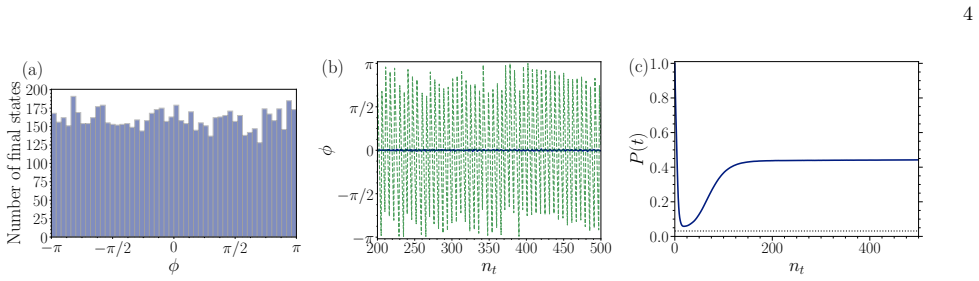
The paper's central claim is that a purely local, greedy optimization of the measurement-averaged QFI—choosing the system-detector coupling $(K_n,K_{n+1})$ for each qubit pair independently at every timestep—drives the $N$-qubit state into the one-parameter family of GHZ states $|\Psi\rangle = (|0\cdots0\rangle + e^{i\phi}|1\cdots1\rangle)/\sqrt{2}$ that saturates the QFI bound $F_Q = N^2$. The evidence is numerical: for $N$ up to 22, the averaged QFI reaches $0.9N^2$ in a number of steps that fits $A + B\ln N$, and for $N=5$ the phase $\phi$ is sampled uniformly across the manifold, indicating that trajectories keep cycling through the manifold rather than settling into a dark state. The paper further claims that the same QFI-based cost, applied to a fixed target value $F_Q^*$, prepares Dicke-state manifolds.
Load-bearing premise
Everything rests on the numerical finding that greedily choosing, for each qubit pair, the couplings that maximize the expected QFI increase steers the whole $N$-qubit state into the GHZ manifold; there is no analytic convergence proof, and the simulations stop at $N=22$.
Editorial extensions
If this is right
- For $N$ up to 22, the averaged QFI approaches its maximum $N^2$ after roughly 200 steps, essentially independent of $N$, so repeated weak measurements plus feedback can create genuine multipartite entanglement without deep circuits.
- The number of steps needed to reach $F_Q = 0.9N^2$ fits $A + B\ln N$, which is the basis of the paper's scalability claim for larger systems.
- Because the phase $\phi$ of the GHZ state keeps cycling uniformly over the manifold under continued steering, adding a termination rule lets the experimenter select a GHZ state with a predetermined phase.
- Replacing the cost function by $|F_Q - F_Q^*|$ targets other highly entangled manifolds such as symmetric Dicke states, which converge in roughly 70 steps for the cases shown.
- Allowing Bell measurements between arbitrary detector-qubit pairs speeds up convergence compared with nearest-neighbor-only pairings.
Reading between the lines
- If the log-step scaling extends beyond $N=22$, this is a practical preparation route for GHZ states in platforms with fast weak measurement and feedback, because the per-step classical control cost is only polynomial in $N$.
- Since $\langle dF_Q\rangle_{\mathrm{ms}}$ depends only on one- and two-body correlators, the algorithm could in principle run without storing the full quantum state, using weak measurements of those correlators; that version would remove the exponential simulation bottleneck and make noisy-system tests feasible.
- The uniform cycling over $\phi$ under active steering, in contrast to passive steering's convergence to a dark state, suggests that the phase could be exploited as an effectively random but steerable parameter, for example for random-access phase encoding in quantum sensing.
- By changing the collective operator $O$ in the QFI definition, the same greedy protocol should target other maximal-QFI manifolds, such as spin-squeezed states, not just GHZ and Dicke states.
Signed reviews
Editorial analysis
A structured set of objections, weighed in public.
Referee Report
Summary. The manuscript proposes an active steering protocol for preparing multipartite entangled states. Each protocol step couples qubit pairs to detector qubits, evolves under a feedback Hamiltonian chosen to maximize the measurement-averaged change of the Quantum Fisher Information, and then performs weak Bell-pair measurements on the detectors. The protocol is applied to the one-parameter GHZ manifold of Eq. (1), with numerical simulations for N up to 22 showing that the average QFI approaches N^2 and that the number of steps to reach F_Q = 0.9 N^2 grows approximately logarithmically with N. The same cost-function framework is also used to target Dicke states for N up to 18. The paper claims that using the QFI as a cost function makes active steering scalable to larger system sizes, and it provides source code and data for the simulations.
Significance. If the central claims are correct, this is a genuinely useful step: replacing fidelity-based cost functions with the QFI avoids the exponential classical overhead of fidelity-based active steering and extends the reach of such protocols to larger N. The manuscript also provides reproducible code and data, and it demonstrates a concrete non-GHZ application to Dicke states. However, the convergence and scalability claims rest on trajectory-averaged QFI values and fits without error bars, rather than on direct per-trajectory fidelity to the target manifold or on success probabilities. Those gaps need to be closed before the abstract-level claims are fully supported.
major comments (3)
- [Sec. III, Figs. 2 and 3] The assertion that the protocol 'efficiently reaches' the GHZ manifold is supported only by the trajectory-averaged QFI and by an N=5 phase histogram. For a pure state, F_Q/N^2 >= 0.9 does imply a large overlap with the GHZ subspace, but the average over trajectories could be dominated by a subset of successful runs. Please report the full distribution of F_Q at the final time (or at first-passage time), the fraction of trajectories satisfying F_Q >= 0.9 N^2, and the per-trajectory fidelity to the manifold of Eq. (1). Without these data, the convergence claim is not established at the level stated in the abstract.
- [Sec. III, Fig. 5] The scalability conclusion n_t ~ A + B ln N is based on fits to data points without error bars, and the text reports fit parameters for only one curve (A ≈ 104.7, B ≈ 123.9 for nearest-neighbor couplings with J δt = 0.1). Please provide statistical uncertainties for A and B, fit residuals, and the number of trajectories used for each N; also clarify whether n_t is the average first-passage time per trajectory or the time at which the averaged QFI first crosses 0.9 N^2. With only about 100 trajectories for the largest N and visible scatter in Fig. 5, the logarithmic scaling is not yet compelling against other slowly growing scalings.
- [Sec. II, Eq. (6) and Table I] The protocol chooses (K_n, K_{n+1}) by greedy local maximization of the measurement-averaged QFI change, and global convergence to the GHZ manifold is demonstrated only numerically for N ≤ 22. Because the state space grows exponentially, the possibility of local traps for larger N is not addressed. Since the scalability claim extrapolates beyond the simulated range, please either provide a convergence argument or report additional diagnostics, such as dependence on the initial state and long-time saturation behavior for intermediate N. This is load-bearing for the central claim.
minor comments (6)
- [Introduction] The paper refers to 'Green-Hornberger-Zeilinger (GHZ) states'; the standard name is 'Greenberger-Horne-Zeilinger' and should be corrected.
- [Sec. II] The entanglement-depth criterion is stated imprecisely: F_Q > m N implies that at least m+1 parties are entangled, so m is not itself 'the size of the biggest entangled block' as written.
- [Sec. II, Eq. (9)] The quantity Γ_m in Eq. (9) is not defined in the main text; please define it or state explicitly that it follows Ref. [6].
- [Abstract and Sec. III] The phrase 'efficiently reaches' should be qualified as referring to numerical simulations of the ideal, noiseless model, since the paper explicitly leaves error channels and non-ideal measurements for future work.
- [Data availability] The dataset and code titles contain the typo 'manifods'; this should be corrected in the Zenodo records as well as in the reference list.
- [Sec. III, Fig. 2 inset] The three individual measurement trajectories shown in the inset are not labeled; please clarify whether they are representative, best, or worst cases.
Circularity Check
No significant circularity: the QFI-based target choice is a control design, and the claimed convergence and scaling rest on direct numerical simulation rather than on equations or citations that presuppose the result.
full rationale
The paper's central claim is that a greedy feedback rule maximizing the measurement-averaged QFI change steers a product state close to the GHZ manifold. Although the QFI appears both as the controller's cost function and as the reported success metric, this is a design choice, not a circular reduction: the nontrivial assertion is that the local, per-pair maximization of Eq. (6) actually drives the full many-body pure state to FQ = N^2, and this is verified by propagating the stochastic Schrödinger equation (Eq. (4)) over many trajectories and by phase histograms (Fig. 3). The identification of the target manifold with the states of Eq. (1) follows from the standard saturation condition of the QFI for collective observables, not from a parameter fitted to the target. The claim nt ~ A + B ln N in Fig. 5 is a fit to simulation data and is explicitly presented as a scaling observation, not as a prediction derived from the model; no fitted parameter is renamed as an outcome. The self-citations to Ref. [6] supply explicit formulas for the measurement-averaged correlator updates and background on entanglement swapping, but they are not used to prove convergence or to rule out alternatives, so they are not load-bearing in a circular sense. The paper also transparently labels its extrapolations and open problems, including the lack of an analytic convergence proof and the cost of error-channel simulations. Overall, the derivation chain is self-contained with respect to its numerical evidence, and no step reduces by construction to its own input.
Assumptions & free parameters
free parameters (3)
- time step delta_t (as J*delta_t) =
0.1 and 0.2
- local observable orientation s_n =
(1,0,1)/sqrt(2)
- fit parameters A and B in nt* = A + B ln N =
A ~ 104.7, B ~ 123.9 for NN, J*delta_t = 0.1
assumptions (4)
- domain assumption The weak-measurement stochastic Schrodinger equation (4) and the averaged QFI change formula (8) correctly describe the protocol for J*delta_t << 1.
- domain assumption The system state remains pure, with no external noise and ideal detectors.
- ad hoc to paper Greedy local maximization of <dFQ>_ms yields global convergence to the GHZ manifold.
- standard math The QFI witness criterion FQ > mN signals at least (m+1)-party entanglement.
Cite this review
Pith. "Pith review of Towards scalable active steering protocols for genuinely entangled state manifolds." pith.science (2026). https://pith.science/paper/N7PORMWX
@misc{pith2026241204168,
  author       = {Pith},
  title        = {Pith review of: Towards scalable active steering protocols for genuinely entangled state manifolds},
  year         = {2026},
  howpublished = {\url{https://pith.science/paper/N7PORMWX}},
  note         = {Machine review of arXiv:2412.04168}
}
read the original abstract
We introduce and analyze an active steering protocol designed to target multipartite entangled states. The protocol involves multiple qubits subjected to weak Bell pair measurements with active feedback, where the feedback operations are optimized to maximize the Quantum Fisher Information. Our scheme efficiently reaches a genuinely entangled one-parameter state manifold. Numerical simulations for systems with up to 22 qubits suggest that the protocol is scalable and allows high multipartite entanglement across the system.
Figures


Figures from the paper (2 more)


Forward citations
Cited by 1 Pith paper
-
Viewing protected superconducting qubits through the lens of the cat qubit
Fluxonium's heavy-limit ground states are squeezed coherent states, producing exponential bit-flip protection in E_j/(k_B T) with constant phase-flip rate, analogous to a squeezed cat code.
Reference graph
Works this paper leans on
-
[1]
V. V. Sivak, A. Eickbusch, H. Liu, B. Royer, I. Tsioutsios, and M. H. Devoret, Model-Free Quantum Control with ReinforcementLearning,Phys.Rev.X 12,011059(2022)
2022
-
[2]
symmetry
Symmetric (η = +1) 0 200 400 nt 0 100 200 300 400FQ N = 18 N = 19 N = 20 0 200 400 0 5 10 15 20 25FQ N = 5 FIG. 2. Average QFIFQ vs number of time stepsnt = t/δt for different N and J δt= 0.2. Note thatFQ ≤ N 2. Averages are over 100 trajectories. The inset showsFQ vs nt (solid curve) for N = 5 (averaged over 8000 trajectories), together with three indivi...
-
[3]
Q. Liu, K. Ziegler, D. A. Kessler, and E. Barkai, Driving quantum systems with periodic conditional measurements, Phys. Rev. Res.4, 023129 (2022)
2022
-
[4]
A. J. Friedman, O. Hart, and R. Nandkishore, Measurement-Induced Phases of Matter Require Feedback, PRX Quantum4, 040309 (2023)
2023
-
[5]
Herasymenko, I
Y. Herasymenko, I. Gornyi, and Y. Gefen, Measurement- Driven Navigation in Many-Body Hilbert Space: Active- Decision Steering, PRX Quantum4, 020347 (2023)
2023
-
[6]
Ravindranath, Y
V. Ravindranath, Y. Han, Z.-C. Yang, and X. Chen, Entanglement steering in adaptive circuits with feedback, Phys. Rev. B108, L041103 (2023)
2023
-
[7]
Morales, Y
S. Morales, Y. Gefen, I. Gornyi, A. Zazunov, and R. Egger, Engineering unsteerable quantum states with active feedback, Phys. Rev. Res.6, 013244 (2024). 8
2024
-
[8]
Hauser, Y
J. Hauser, Y. Li, S. Vijay, and M. P. A. Fisher, Continuous symmetry breaking in adaptive quantum dynamics, Phys. Rev. B109, 214305 (2024)
2024
Show all 88 references
-
[9]
Ackermann, S
N. Ackermann, S. Morales, A. L. Yeyati, S. Diehl, and R. Egger, Error threshold in active steering protocols for few-qubit systems, Phys. Rev. Res.7, 013045 (2025)
2025
-
[10]
S. Roy, J. T. Chalker, I. V. Gornyi, and Y. Gefen, Measurement-induced steering of quantum systems, Phys. Rev. Res.2, 033347 (2020)
2020
-
[11]
R. Uola, A. C. S. Costa, H. C. Nguyen, and O. Gühne, Quantum steering, Rev. Mod. Phys.92, 015001 (2020)
2020
-
[12]
H. M. Wiseman and G. J. Milburn, Quantum measurements and control (Cambridge University Press, Cambridge, UK, 2010)
2010
-
[13]
C. W. Helstrom, Quantum detection and estimation theory, Journal of Statistical Physics , 231 (1969)
1969
-
[14]
Giovannetti, S
V. Giovannetti, S. Lloyd, and L. Maccone, Advances in quantum metrology, Nature photonics5, 222 (2011)
2011
-
[15]
Hyllus, W
P. Hyllus, W. Laskowski, R. Krischek, C. Schwemmer, W. Wieczorek, H. Weinfurter, L. Pezzé, and A. Smerzi, Fisher information and multiparticle entanglement, Phys. Rev. A85, 022321 (2012)
2012
-
[16]
Tóth, Multipartite entanglement and high-precision metrology, Phys
G. Tóth, Multipartite entanglement and high-precision metrology, Phys. Rev. A85, 022322 (2012)
2012
-
[17]
M. G. Paris, Quantum estimation for quantum technology, International Journal of Quantum Information 7, 125 (2009)
2009
-
[18]
Pezzé and A
L. Pezzé and A. Smerzi, Entanglement, nonlinear dynamics, andtheheisenberglimit,Phys.Rev.Lett. 102, 100401 (2009)
2009
-
[19]
Tóth and I
G. Tóth and I. Apellaniz, Quantum metrology from a quantum information science perspective, Journal of Physics A: Mathematical and Theoretical 47, 424006 (2014)
2014
-
[20]
Pezzè, A
L. Pezzè, A. Smerzi, M. K. Oberthaler, R. Schmied, and P.Treutlein,Quantummetrologywithnonclassicalstates of atomic ensembles, Rev. Mod. Phys.90, 035005 (2018)
2018
-
[21]
J. Liu, H. Yuan, X.-M. Lu, and X. Wang, Quantum Fisher information matrix and multiparameter estimation, Journal of Physics A: Mathematical and Theoretical 53, 023001 (2019)
2019
-
[22]
M. A. Nielsen and I. L. Chuang,Quantum Computation and Quantum Information (Cambridge University Press, Cambridge, UK, 2000)
2000
-
[23]
E. H. Chen, G.-Y. Zhu, R. Verresen, A. Seif, E. Bäumer, D. Layden, N. Tantivasadakarn, G. Zhu, S. Sheldon, A. Vishwanath, S. Trebst, and A. Kandala, Nishimori transition across the error threshold for constant-depth quantum circuits, Nature Physics21, 161 (2024)
2024
-
[24]
Sahay and R
R. Sahay and R. Verresen, Classifying One-Dimensional Quantum States Prepared by a Single Round of Measurements, PRX Quantum6, 010329 (2025)
2025
-
[25]
Sahay and R
R. Sahay and R. Verresen, Finite-Depth Preparation of Tensor Network States from Measurement (2024), arXiv:2404.17087 [quant-ph]
2024 arXiv
-
[26]
Hosten and P
O. Hosten and P. Kwiat, Observation of the Spin Hall Effect of Light via Weak Measurements, Science319, 787 (2008)
2008
-
[27]
P. B. Dixon, D. J. Starling, A. N. Jordan, and J. C. Howell, Ultrasensitive Beam Deflection Measurement via Interferometric Weak Value Amplification, Phys. Rev. Lett. 102, 173601 (2009)
2009
-
[28]
Palacios-Laloy, F
A. Palacios-Laloy, F. Mallet, F. Nguyen, P. Bertet, D. Vion, D. Esteve, and A. N. Korotkov, Experimental violation of a Bell’s inequality in time with weak measurement, Nature Physics6, 442 (2010)
2010
-
[29]
Riste, M
D. Riste, M. Dukalski, C. A. Watson, G. de Lange, M. J. Tiggelman, Y. M. Blanter, K. W. Lehnert, R. N. Schouten, and L. DiCarlo, Deterministic entanglement of superconducting qubits by parity measurement and feedback, Nature 502, 359 (2013)
2013
-
[30]
J. P. Groen, D. Ristè, L. Tornberg, J. Cramer, P. C. de Groot, T. Picot, G. Johansson, and L. DiCarlo, Partial-Measurement Backaction and Nonclassical Weak Values in a Superconducting Circuit, Phys. Rev. Lett. 111, 090506 (2013)
2013
-
[31]
Zhang, Y
J. Zhang, Y. Liu, R.-B. Wu, K. Jacobs, and F. Nori, Quantum feedback: Theory, experiments, and applications, Physics Reports679, 1 (2017)
2017
-
[32]
Z. K. Minev, S. O. Mundhada, S. Shankar, P. Reinhold, R. Gutiérrez-Jáuregui, R. J. Schoelkopf, M. Mirrahimi, H. J. Carmichael, and M. H. Devoret, To catch and reverse a quantum jump mid-flight, Nature 570, 200 (2019)
2019
-
[33]
K. S. Cujia, J. M. Boss, K. Herb, J. Zopes, and C. L. Degen, Tracking the precession of single nuclear spins by weak measurements, Nature571, 230 (2019)
2019
-
[34]
Kim, D.-G
Y. Kim, D.-G. Im, Y.-S. Kim, S.-W. Han, S. Moon, Y.-H. Kim, and Y.-W. Cho, Observing the quantum Cheshire cat effect with noninvasive weak measurement, npj Quantum Information7, 13 (2021)
2021
-
[35]
Jacobs and D
K. Jacobs and D. A. Steck, A straightforward introduction to continuous quantum measurement, Contemporary Physics 47, 279 (2006)
2006
-
[36]
Janvier, L
C. Janvier, L. Tosi, L. Bretheau, Ç. Ö. Girit, M. Stern, P. Bertet, P. Joyez, D. Vion, D. Esteve, M. F. Goffman, H. Pothier, and C. Urbina, Coherent manipulation of Andreev states in superconducting atomic contacts, Science 349, 1199 (2015)
2015
-
[37]
Pita-Vidal, J
M. Pita-Vidal, J. J. Wesdorp, and C. K. Andersen, BlueprintforAll-to-All-ConnectedSuperconductingSpin Qubits, PRX Quantum6, 010308 (2025)
2025
-
[38]
Volya and P
D. Volya and P. Mishra, Quantum steering of surface error correcting codes, in 2023 IEEE International Conference on Quantum Computing and Engineering (QCE), Vol. 01 (2023) p. 1394
2023
-
[39]
Volya and P
D. Volya and P. Mishra, FL State Preparation on Quantum Computers via Quantum Steering, IEEE Transactions on Quantum Engineering , 1 (2024)
2024
-
[40]
Boschi, S
D. Boschi, S. Branca, F. De Martini, L. Hardy, and S. Popescu, Experimental Realization of Teleporting an Unknown Pure Quantum State via Dual Classical and Einstein-Podolsky-Rosen Channels, Phys. Rev. Lett.80, 1121 (1998)
1998
-
[41]
J.-W. Pan, D. Bouwmeester, H. Weinfurter, and A. Zeilinger, Experimental Entanglement Swapping: Entangling Photons That Never Interacted, Phys. Rev. Lett. 80, 3891 (1998)
1998
-
[42]
Jennewein, G
T. Jennewein, G. Weihs, J.-W. Pan, and A. Zeilinger, Experimental Nonlocality Proof of Quantum Teleportation and Entanglement Swapping, Phys. Rev. Lett. 88, 017903 (2001)
2001
-
[43]
de Riedmatten, I
H. de Riedmatten, I. Marcikic, J. A. W. van Houwelingen, W. Tittel, H. Zbinden, and N. Gisin, Long-distance entanglement swapping with photons from separated sources, Phys. Rev. A71, 050302 (2005)
2005
-
[44]
Riebe, T
M. Riebe, T. Monz, K. Kim, A. S. Villar, P. Schindler, M. Chwalla, M. Hennrich, and R. Blatt, Deterministic 9 entanglement swapping with an ion-trap quantum computer, Nature Physics4, 839 (2008)
2008
-
[45]
Kaltenbaek, R
R. Kaltenbaek, R. Prevedel, M. Aspelmeyer, and A. Zeilinger, High-fidelity entanglement swapping with fully independent sources, Phys. Rev. A 79, 040302 (2009)
2009
-
[46]
Horodecki, P
R. Horodecki, P. Horodecki, M. Horodecki, and K. Horodecki, Quantum entanglement, Rev. Mod. Phys. 81, 865 (2009)
2009
-
[47]
Huang, C.-F
C.-X.Huang, X.-M.Hu, Y.Guo, C.Zhang, B.-H.Liu, Y.- F. Huang, C.-F. Li, G.-C. Guo, N. Gisin, C. Branciard, and A. Tavakoli, Entanglement Swapping and Quantum Correlations via Symmetric Joint Measurements, Phys. Rev. Lett. 129, 030502 (2022)
2022
-
[48]
H. P. Breuer and F. Petruccione, The theory of open quantum systems (Oxford University Press, Oxford, UK, 2002)
2002
-
[49]
Schumacher and M
B. Schumacher and M. A. Nielsen, Quantum data processing and error correction, Physical Review A54, 2629 (1996)
1996
-
[50]
Lloyd, Capacity of the noisy quantum channel, Physical Review A55, 1613 (1997)
S. Lloyd, Capacity of the noisy quantum channel, Physical Review A55, 1613 (1997)
1997
-
[51]
R. Fan, Y. Bao, E. Altman, and A. Vishwanath, Diagnostics of Mixed-State Topological Order and Breakdown of Quantum Memory, PRX Quantum 5, 020343 (2024)
2024
-
[52]
Buchhold, Y
M. Buchhold, Y. Minoguchi, A. Altland, and S. Diehl, Effective Theory for the Measurement-Induced Phase Transition of Dirac Fermions, Phys. Rev. X11, 041004 (2021)
2021
-
[53]
J. F. Kam, H. Kang, C. D. Hill, G. J. Mooney, and L. C. L. Hollenberg, Characterization of entanglement on superconducting quantum computers of up to 414 qubits, Phys. Rev. Res.6, 033155 (2024)
2024
-
[54]
E.Medina-Guerra, P.Kumar, I.V.Gornyi,andY.Gefen, Quantum state engineering by steering in the presence of errors, Phys. Rev. Res.6, 023159 (2024)
2024
-
[55]
J. F. Poyatos, J. I. Cirac, and P. Zoller, Quantum Reservoir Engineering with Laser Cooled Trapped Ions, Phys. Rev. Lett.77, 4728 (1996)
1996
-
[56]
Diehl, A
S. Diehl, A. Micheli, A. Kantian, B. Kraus, H. P. Büchler, and P. Zoller, Quantum states and phases in driven open quantum systems with cold atoms, Nat. Phys. 4, 878 (2008)
2008
-
[57]
Verstraete, M
F. Verstraete, M. Wolf, and J. Ignacio Cirac, Quantum computation and quantum-state engineering driven by dissipation, Nature Physics5, 633 (2009)
2009
-
[58]
J. T. Barreiro, M. Müller, P. Schindler, D. Nigg, T. Monz, M. Chwalla, M. Hennrich, C. F. Roos, P. Zoller, and R. Blatt, An open-system quantum simulator with trapped ions, Nature470, 486 (2011)
2011
-
[59]
Krauter, C
H. Krauter, C. A. Muschik, K. Jensen, W. Wasilewski, J. M. Petersen, J. I. Cirac, and E. S. Polzik, Entanglement generated by dissipation and steady state entanglement of two macroscopic objects, Phys. Rev. Lett. 107, 080503 (2011)
2011
-
[60]
J. P. Paz and W. H. Zurek, Continuous error correction, Proceedings of the Royal Society of London. Series A: Mathematical, Physical and Engineering Sciences 454, 355 (1998)
1998
-
[61]
J. P. Barnes and W. S. Warren, Automatic Quantum Error Correction, Phys. Rev. Lett.85, 856 (2000)
2000
-
[62]
C. Ahn, A. C. Doherty, and A. J. Landahl, Continuous quantum error correction via quantum feedback control, Phys. Rev. A65, 042301 (2002)
2002
-
[63]
C. Ahn, H. M. Wiseman, and G. J. Milburn, Quantum error correction for continuously detected errors, Phys. Rev. A 67, 052310 (2003)
2003
-
[64]
Sarovar, C
M. Sarovar, C. Ahn, K. Jacobs, and G. J. Milburn, Practical scheme for error control using feedback, Phys. Rev. A 69, 052324 (2004)
2004
-
[65]
Oreshkov and T
O. Oreshkov and T. A. Brun, Continuous quantum error correction for non-markovian decoherence, Phys. Rev. A 76, 022318 (2007)
2007
-
[66]
Kerckhoff, H
J. Kerckhoff, H. I. Nurdin, D. S. Pavlichin, and H. Mabuchi, Designing Quantum Memories with Embedded Control: Photonic Circuits for Autonomous Quantum Error Correction, Phys. Rev. Lett.105, 040502 (2010)
2010
-
[67]
Kapit, Hardware-Efficient and Fully Autonomous Quantum Error Correction in Superconducting Circuits, Phys
E. Kapit, Hardware-Efficient and Fully Autonomous Quantum Error Correction in Superconducting Circuits, Phys. Rev. Lett.116, 150501 (2016)
2016
-
[68]
Kapit, Error-Transparent Quantum Gates for Small Logical Qubit Architectures, Phys
E. Kapit, Error-Transparent Quantum Gates for Small Logical Qubit Architectures, Phys. Rev. Lett. 120, 050503 (2018)
2018
-
[69]
M. Gau, R. Egger, A. Zazunov, and Y. Gefen, Driven Dissipative Majorana Dark Spaces, Phys. Rev. Lett.125, 147701 (2020)
2020
-
[70]
M. Gau, R. Egger, A. Zazunov, and Y. Gefen, Towards dark space stabilization and manipulation in driven dissipative Majorana platforms, Phys. Rev. B 102, 134501 (2020)
2020
-
[71]
S. Lieu, R. Belyansky, J. T. Young, R. Lundgren, V. V. Albert, and A. V. Gorshkov, Symmetry Breaking and Error Correction in Open Quantum Systems, Phys. Rev. Lett. 125, 240405 (2020)
2020
-
[72]
Lieu, Y.-J
S. Lieu, Y.-J. Liu, and A. V. Gorshkov, Candidate for a Passively Protected Quantum Memory in Two Dimensions, Phys. Rev. Lett.133, 030601 (2024)
2024
-
[73]
Shtanko, Y.-J
O. Shtanko, Y.-J. Liu, S. Lieu, A. V. Gorshkov, and V. V. Albert, Bounds on Autonomous Quantum Error Correction (2023), arXiv:2308.16233 [quant-ph]
2023 arXiv
-
[74]
L. B. Kristensen, M. Kjaergaard, C. K. Andersen, and N. T. Zinner, Hybrid quantum error correction in qubit architectures, Phys. Rev. A108, 022403 (2023)
2023
-
[75]
Leghtas, U
Z. Leghtas, U. Vool, S. Shankar, M. Hatridge, S. M. Girvin, M. H. Devoret, and M. Mirrahimi, Stabilizing a Bell state of two superconducting qubits by dissipation engineering, Phys. Rev. A88, 023849 (2013)
2013
-
[76]
Campagne-Ibarcq, A
P. Campagne-Ibarcq, A. Eickbusch, S. Touzard, E. Zalys- Geller, N. E. Frattini, V. V. Sivak, P. Reinhold, S. Puri, S. Shankar, R. J. Schoelkopf, L. Frunzio, M. Mirrahimi, and M. H. Devoret, Quantum error correction of a qubit encoded in grid states of an oscillator, Nature584,...
2020
-
[77]
J. M. Gertler, B. Baker, J. Li, S. Shirol, J. Koch, and C. Wang, Protecting a bosonic qubit with autonomous quantum error correction, Nature590, 243 (2021)
2021
-
[78]
W. P. Livingston, M. S. Blok, E. Flurin, J. Dressel, A. N. Jordan, and I. Siddiqi, Experimental demonstration of continuous quantum error correction, Nature Communications 13, 2307 (2022)
2022
-
[79]
Lachance-Quirion, M.-A
D. Lachance-Quirion, M.-A. Lemonde, J. O. Simoneau, L. St-Jean, P. Lemieux, S. Turcotte, W. Wright, A. Lacroix, J. Fréchette-Viens, R. Shillito, F. Hopfmueller, M. Tremblay, N. E. Frattini, J. Camirand Lemyre, and P. St-Jean, Autonomous Quantum Error Correction of Gottesman-Ki...
2024
-
[80]
Zanardi and L
P. Zanardi and L. Campos Venuti, Coherent Quantum Dynamics in Steady-State Manifolds of Strongly Dissipative Systems, Phys. Rev. Lett. 113, 240406 (2014)
2014
-
[81]
Ticozzi and L
F. Ticozzi and L. Viola, Stabilizing entangled states with quasi-local quantum dynamical semigroups, Philosophical Transactions of the Royal Society A: Mathematical, Physical and Engineering Sciences 370, 5259 (2012)
2012
-
[82]
Ahmadi and E
A. Ahmadi and E. Greplova, Quantifying non- stabilizerness via information scrambling, SciPost Phys. 16, 043 (2024)
2024
-
[83]
P. S. Tarabunga, M. Frau, T. Haug, E. Tirrito, and L. Piroli, A nonstabilizerness monotone from stabilizerness asymmetry (2024), arXiv:2411.05766 [quant-ph]
2024 arXiv
-
[84]
Davis, G
E. Davis, G. Bentsen, and M. Schleier-Smith, Approaching the Heisenberg Limit without Single- Particle Detection, Phys. Rev. Lett. 116, 053601 (2016)
2016
-
[85]
Macrì, A
T. Macrì, A. Smerzi, and L. Pezzè, Loschmidt echo for quantum metrology, Phys. Rev. A94, 010102 (2016)
2016
-
[86]
Dooley, S
S. Dooley, S. Pappalardi, and J. Goold, Entanglement enhanced metrology with quantum many-body scars, Phys. Rev. B107, 035123 (2023)
2023
-
[87]
Towards scalable active steering protocols for genuinely entangled state manifods
S. Morales, S. Pappalardi, and R. Egger, Data for "Towards scalable active steering protocols for genuinely entangled state manifods" (2025), [Data Set] Zenodo
2025
-
[88]
Towards scalable active steering protocols for genuinely entangled state manifods
S. Morales, S. Pappalardi, and R. Egger, Code for "Towards scalable active steering protocols for genuinely entangled state manifods" (2025)
2025
Reviewed August 11, 2026 · model on record in the stance chip above.
Discussion (0). Continue with ORCID to comment.