REVIEW 3 major objections 4 minor 114 references
A resource- and computationally-efficient protocol for multipartite entanglement distribution in Bell-pair networks
T0 review · 3 major / 4 minor · reviewed 2026-08-11 · deepseek-v4-flash
Pith's one-line read This paper presents a protocol that distributes GHZ states over arbitrary Bell-pair networks using only O(N) local gates, O(N^2) classical planning time, exactly N−1 consumed Bell pairs in the complete case, and near-optimal Bell-pair…
desk verdict The greedy star-fusion protocol is sound and the O(N) gate result is real, but the source-optimality claim rests on an invalid dominating-set equivalence and needs revision. read the letter →
The pith
A machine-rendered reading of the paper's core claim, the machinery that carries it, and where it could break.
The reading
What carries the argument
The carrying object is the star decomposition of the Bell-pair network: Protocol 1 repeatedly takes the highest-degree remaining node together with its neighbors as a star, then merges the star GHZ states along a tree through Protocols 2 and 3. The key identities are the permutation invariance of the GHZ state, which allows the star center to be moved without a gate, and the fact that fusing two GHZ states at a common node requires only one CNOT gate followed by a Z-basis measurement, with Pauli-X corrections determined by the measurement outcomes. Counting the number of stars and merges yields the $N-2$ gate formula, while the source-cost equivalence comes from viewing a node-hosted source as covering itself and its neighbors, which is exactly the domination number of the network graph.
What would settle it
Take a path of six nodes and run Protocol 1: the domination number is 2, with sources at nodes 2 and 5, but the stars around those nodes are disjoint; the protocol must also consume the edge (3,4), requiring a third source. Observing that the protocol's own source count exceeds the domination number on this graph falsifies the claim that the domination number is the minimal Bell-pair source cost for GHZ distribution and shows that the lower bound needs to be reformulated.
Extended reading notes
Core claim
The central claim is that Protocol 1 distributes a GHZ state over any connected Bell-pair network with simultaneous resource efficiency: $N-2$ gates (Theorem 3), $N-1$ consumed Bell pairs (Theorem 7), $O(N^2)$ time (Theorem 1), and a number of Bell-pair sources close to the domination number, which is identified as the lower bound (Theorem 9). The protocol selects stars centered at high-degree nodes, prunes duplicate nodes and edges, and fuses the resulting star GHZ states along a tree; each fusion costs one CNOT gate and one Z-basis measurement. Because the GHZ state is permutation invariant, the center of any star can be shifted at no extra gate cost, and this is what makes the gate count independent of topology. In the subset case, a BFS-based subgraph (Protocol 4) replaces the Steiner tree, yielding polynomial-time planning with near-optimal Bell-pair consumption in numerical tests. The paper also proves exact fidelity formulas for arbitrary noise models on Bell pairs and gates.
Load-bearing premise
The load-bearing premise is that a set of Bell-pair sources that merely touches every node is enough to build the GHZ state, but in reality the small GHZ states built around those sources must overlap at shared nodes before they can be fused, so a source plan that only covers the network may leave disconnected pieces that cannot be merged.
Editorial extensions
If this is right
- For any connected Bell-pair network with $N$ nodes, a GHZ state can be planned in $O(N^2)$ time and executed with $N-2$ two-qubit gates, independent of topology.
- In the complete case, Bell-pair consumption is exactly $N-1$, matching the information-theoretic lower bound for connecting $N$ nodes.
- In the subset case, GHZ distribution no longer requires solving the Steiner tree problem; the BFS subgraph gives near-optimal Bell-pair counts on Erdős–Rényi and Barabási–Albert networks, with the ratios approaching optimality as the network grows.
- Bell-pair source placement can be guided by the minimum dominating set, and the number of stars produced by Protocol 1 is a directly computable heuristic for that quantity.
- The noise analysis yields exact expressions for the final GHZ fidelity under arbitrary Bell-pair and gate noise models, with the fidelity depending on the total number of CNOT gates used in the fusion operations.
Reading between the lines
- Beyond the paper, the same star-around-high-degree-nodes then fuse-along-a-tree recipe may extend to other graph states, but for non-GHZ states the free center shift disappears and the gate count would likely acquire a dependence on topology.
- The domination-number lower bound in Theorem 9 is really a coverage bound; a sharper lower bound for source cost should account for connectedness of the union of the stars, for instance through a connected dominating set or a tree cover.
- A testable extension is to replace the BFS subgraph in Protocol 4 with a Steiner-tree approximation when users prefer fewer consumed Bell pairs over faster planning, producing a tunable trade-off between $O(N^2)$ speed and Bell-pair optimality.
Editorial analysis
A structured set of objections, weighed in public.
Referee Report
Summary. The manuscript proposes Protocol 1 for distributing a GHZ state over an arbitrary Bell-pair network, with claimed guarantees of O(N) local gates, O(N^2) classical time complexity, exactly N-1 consumed Bell pairs in the complete case, and near-optimal Bell-pair source count. It also presents numerical comparisons on Erdős–Rényi, Barabási–Albert, and Waxman networks, and derives exact fidelity formulas for noisy Bell pairs and noisy gates. The central constructive steps—star-shaped GHZ creation around high-degree nodes and tree fusion—are presented with proofs of gate count (Theorem 3), Bell-pair count (Theorem 7), and noise analysis (Theorems 10 and 11). The main advertised source-cost result, however, relies on Theorem 9, which equates minimal Bell-pair source placement with the minimum dominating set problem; this equivalence is the load-bearing weakness of the paper.
Significance. If the resource claims are correct, the protocol would be a practical improvement over Steiner-tree-based GHZ distribution: it avoids NP-hard planning, uses a topology-independent linear gate count, and matches the optimal complete-case Bell-pair count. The paper also ships parameter-free derivations and exact noise formulas for arbitrary single-pair noise models, which is a genuine strength. However, the headline near-optimality claim for Bell-pair sources is not supported, because the dominating-set lower bound used in Theorem 9 and Fig. 9 can be unattainable by any feasible source placement for GHZ generation. The core protocol itself appears internally consistent and the gate/Bell-pair theorems check out under the stated star-merge model, so the flaw is localized to the source-cost optimality claim and to one questionable upper bound in the subset case.
major comments (3)
- [Sec. IIID, Theorem 9] The claimed equivalence between minimal Bell-pair source cost and the minimum dominating set is not valid for GHZ generation. A dominating set D whose covered neighborhoods are disconnected cannot support any LOCC protocol that creates a global GHZ state, because the available Bell-pair edges form a disconnected graph. For example, on a 6-node path 1-2-3-4-5-6, D={2,5} is a dominating set of size γ(G)=2, but the edges generated by sources at 2 and 5 are the two disconnected components {1,2,3} and {4,5,6}; no LOCC protocol can create a 6-party GHZ state from them. Thus γ(G) can be strictly smaller than the minimum feasible source count, and the abstract's statement that the minimal Bell-pair source cost is given by solving the dominating set problem is false. The lower-bound direction is true (every feasible source set is a dominating set), but the claimed equivalence and the resulting 'near-optimal' source-count statement need to be re-derived with a connectivity constraint on the union of covered neighborhoods, or with a connected dominating set variant.
- [Sec. IIIC, Theorem 8] The upper bound d_S(S−1) in Theorem 8 appears incorrect and inconsistent with the protocol's own complete-case analysis. Protocol 1 on a connected subgraph of S nodes produces a tree spanning exactly those S nodes, which has exactly S−1 edges regardless of the subgraph's diameter. The proof's 'maximally distant nodes' argument counts distances between pairs of nodes, but the protocol does not consume Bell pairs per pair of desired nodes; it consumes one Bell pair per edge of the produced tree. For instance, a path on S nodes has diameter S−1 and uses S−1 Bell pairs, not (S−1)^2. Please replace this upper bound with the correct statement that the protocol uses S−1 Bell pairs whenever the subgraph used by Protocol 1 is a tree on S nodes.
- [Sec. IV, Fig. 9] The numerical evidence for near-optimal source count is benchmarked against the wrong quantity. Fig. 9 compares the number of stars produced by Protocol 1 with the domination number of the generated tree, but Theorem 9's domination-number lower bound can be unattainable by any feasible source placement, as the 6-node path example in the previous comment shows. Consequently, a protocol whose source count is close to the domination number is not necessarily close to the true optimal source cost. To support the abstract's near-optimal-source claim, the simulations should compare against a lower bound that incorporates the connectivity required for GHZ generation, such as the minimum size of a source set whose covered neighborhoods form a connected spanning subgraph.
minor comments (4)
- [Sec. II, Protocol 1, Step 6] The instruction 'If any edges remain in G, add them along with their two incident nodes to SG' is ambiguous when both incident nodes are already covered by earlier stars; please clarify whether such edges are only added as two-node stars when they contribute new Bell pairs to the final tree.
- [Sec. IIIB and App. B] The text uses 'star' interchangeably for a GHZ state and for the star graph state, which are equivalent only up to local Hadamard gates. Since the gate count excludes single-qubit corrections, this is harmless, but the distinction should be stated when Protocol 2 is first introduced to avoid confusion.
- [Sec. V, Theorem 10] The theorem statement says the expression holds for arbitrary noise models, but the displayed formula is for tensor-product input Bell pairs; the general correlated case appears only later in App. D1. Please make the domain of validity explicit in the statement of Theorem 10.
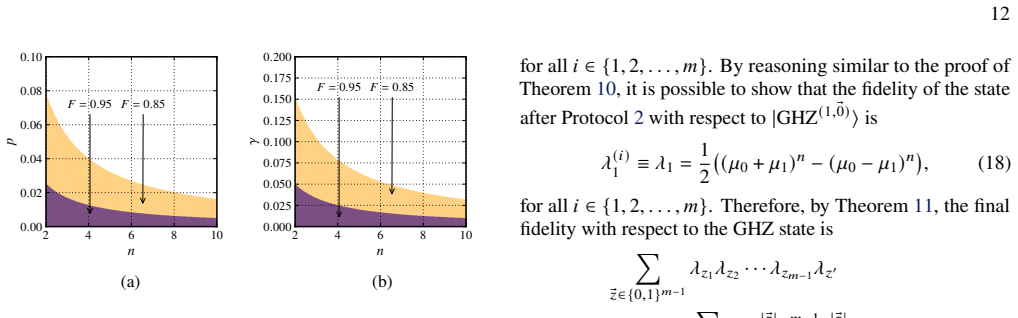
- [Sec. IV, Fig. 10] The shaded regions in Fig. 10 are not fully labeled; please add axis labels for the noise parameters and a legend for the two fidelity thresholds so that the reader can interpret the tolerance regions without consulting the main text.
Circularity Check
The protocol's main gate, time, Bell-pair, and fidelity results are self-contained, but Theorem 9's equivalence of Bell-pair source cost to the domination number is definitional: 'covered' is defined exactly as domination, so the claimed source-cost optimality is established by construction.
-
self definitional
[Sec. IIID, Theorem 9 (Bell-pair source cost)]
"A Bell pair source placed at a node s∈V can generate a Bell pair locally and distribute one qubit to itself and the other to any one of its neighbors. Thus, a node v∈V is said to be covered if it either hosts a source or is adjacent to a node that hosts a source. ... This is precisely the definition of a dominating set in graph theory: a set D⊆V such that every node u∈V is either in D or adjacent to a node in D. Therefore, finding the minimum number of Bell pair sources required to cover the network is equivalent to finding a minimum dominating set in G."
The theorem's notion of a node being 'covered' is defined by the closed-neighborhood condition {v}∪N(v), and the proof's equation (8) is literally the defining condition for D to be a dominating set. The claimed equivalence between minimal Bell-pair source cost and the minimum dominating set problem is therefore a restatement of the definition chosen for 'covered,' not a derived property of GHZ generation. The proof does not show that an arbitrary dominating set yields a connected set of Bell-pair stars, so the domination number is only a necessary-condition lower bound, not the actual minimal source cost for generating a GHZ state.
full rationale
Most of the derivation chain is self-contained and not circular. Theorem 1's O(N^2) time complexity, Theorem 3's N−2 gate count, Theorem 7's N−1 Bell-pair count, and the noisy-fidelity expressions in Theorems 10 and 11 are all proven from explicit protocol steps, standard CNOT/fusion identities, and stated noise models; no fitted parameters are renamed as predictions. The numerical comparisons use independent baselines (Mehlhorn's Steiner approximation and an MWDS approximation), and Proposition 12 from the authors' Ref. [85] is background material in an appendix, not load-bearing for the central claims. The significant circular element is Theorem 9: the paper defines 'covered' exactly as the dominating-set condition and then presents the equivalence as a proved result. This makes the abstract's assertion that 'the minimal Bell-pair source cost is given by solving the graph-theoretic dominating set problem' true by construction, while the physical sufficiency of domination for GHZ generation is not established. Because one of the stated main contributions—near-optimal source cost—reduces in this way, the overall circularity score is 6 rather than a lower value.
Assumptions & free parameters
assumptions (5)
- domain assumption Each node with degree k has exactly k qubits, one for each incident Bell pair.
- domain assumption Only two-qubit CNOT gates count toward gate cost; single-qubit Pauli corrections and classical communication are free.
- ad hoc to paper A Bell-pair source at a node can generate a Bell pair to any neighbor, and every node must be either a source or adjacent to a source.
- domain assumption Resource analysis assumes lossless Bell pairs with unit fidelity; noise is treated separately in Section V.
- domain assumption A connected graph is necessary and sufficient for an LOCC protocol to create a GHZ state among all nodes of a Bell-pair network.
Cite this review
Pith. "Pith review of A resource- and computationally-efficient protocol for multipartite entanglement distribution in Bell-pair networks." pith.science (2026). https://pith.science/paper/3RANB4MA
@misc{pith2026241204252,
  author       = {Pith},
  title        = {Pith review of: A resource- and computationally-efficient protocol for multipartite entanglement distribution in Bell-pair networks},
  year         = {2026},
  howpublished = {\url{https://pith.science/paper/3RANB4MA}},
  note         = {Machine review of arXiv:2412.04252}
}
abstract
Multipartite entangled states, such as Greenberger--Horne--Zeilinger (GHZ) states, are important resources in multiparty quantum networking tasks. We consider protocols for generating such states from networks of Bell pairs and local operations and classical communication. We present a computationally-efficient protocol for generating GHZ states that is also efficient with respect to the number of consumed Bell pairs, (local) gates, and Bell-pair sources. Our protocol: (1) requires $O(N)$ gates in a network with $N$ nodes, independent of the network topology; (2) has time complexity $O(N^2)$, avoiding the Steiner tree and any other computationally-hard problem; (3) maintains a near-optimal number of consumed Bell pairs. Numerically, our protocol outperforms those based on (approximate) Steiner trees with respect to number of gates and Bell-pair sources. We prove that the minimal Bell-pair source cost is given by solving the graph-theoretic dominating set problem, and we demonstrate numerically that our protocol is nearly optimal for this quantity. Finally, we analytically characterize the impact of noisy Bell pairs and gates on the fidelity of the distributed GHZ states.
Figures


Figures from the paper (7 more)



Reference graph
Works this paper leans on
-
[1]
Start with the complete graph (i.e., all-to-all connected graph) of𝑐+ 1 nodes
-
[2]
preferential attachment
Until the total number𝑁 of nodes is reached, add a new node with𝑐 edges that links the new node to𝑐 different nodesalreadypresentinthenetwork. Theprobabilitythat a new node connects to an existing node𝑖 with degree 𝑘𝑖 is given by the so-called “preferential attachment” model, in which nodes of higher degree are more likely to receive a new edge. Specifica...
-
[3]
S. Pirandola, B. R. Bardhan, T. Gehring, C. Weedbrook, and S. Lloyd, Advances in photonic quantum sensing, Nature Pho- tonics12, 724 (2018), 1811.01969
arXiv 2018
-
[4]
Tseet al., Quantum-Enhanced Advanced LIGO Detectors in the Era of Gravitational-Wave Astronomy, Physical Review Letters123, 231107 (2019)
M. Tseet al., Quantum-Enhanced Advanced LIGO Detectors in the Era of Gravitational-Wave Astronomy, Physical Review Letters123, 231107 (2019)
2019
-
[5]
Gambetta, IBM’s roadmap for scaling quantum technology, IBM Research Blog (2020)
J. Gambetta, IBM’s roadmap for scaling quantum technology, IBM Research Blog (2020)
2020
-
[6]
W. Luo, L. Cao, Y. Shi, L. Wan, H. Zhang, S. Li, G. Chen, Y. Li, S. Li, Y. Wang, S. Sun, M. F. Karim, H. Cai, L. C. Kwek, and A. Q. Liu, Recent progress in quantum photonic chips for quantum communication and internet, Light: Science & Applications 12, 175 (2023)
2023
-
[7]
A.S.Cacciapuoti,M.Caleffi,F.Tafuri,F.S.Cataliotti,S.Gher- ardini, and G. Bianchi, Quantum Internet: Networking Chal- lenges in Distributed Quantum Computing, IEEE Network34, 137 (2020), 1810.08421
arXiv 2020
-
[8]
Awschalom, K
D. Awschalom, K. K. Berggren, H. Bernien, S. Bhave, L. D. Carr, P. Davids, S. E. Economou, D. Englund, A. Faraon, M. Fejer, S. Guha, M. V. Gustafsson, E. Hu, L. Jiang, J. Kim, B.Korzh,P.Kumar,P.G.Kwiat,M.Lončar,M.D.Lukin,D.A. Miller, C. Monroe, S. W. Nam, P. Narang, J. S. Orcutt, M. G. Raymer, A. H. Safavi-Naeini, M. Spiropulu, K. Srinivasan, S.Sun,J.Vučk...
2021
Show all 114 references
-
[9]
T. S. Humble, A. McCaskey, D. I. Lyakh, M. Gowrishankar, A. Frisch, and T. Monz, Quantum Computers for High- Performance Computing, IEEE Micro41, 15 (2021)
2021
-
[10]
C. H. Bennett, G. Brassard, C. Crépeau, R. Jozsa, A. Peres, andW.K.Wootters,Teleportinganunknownquantumstatevia dual classical and Einstein-Podolsky-Rosen channels, Physical Review Letters70, 1895 (1993)
1993
-
[11]
C. H. Bennett, G. Brassard, S. Popescu, B. Schumacher, J. A. Smolin,andW.K.Wootters,Purificationofnoisyentanglement 15 and faithful teleportation via noisy channels, Physical Review Letters76, 722 (1996)
1996
-
[12]
Gottesman and I
D. Gottesman and I. L. Chuang, Demonstrating the viability of universal quantum computation using teleportation and single- qubit operations, Nature402, 390 (1999), quant-ph/9908010
1999 arXiv
-
[13]
J.Eisert,K.Jacobs,P.Papadopoulos,andM.B.Plenio,Optimal local implementation of nonlocal quantum gates, Physical Review A62, 052317 (2000), quant-ph/0005101
2000 arXiv
-
[14]
Raussendorf and H
R. Raussendorf and H. J. Briegel, A One-Way Quantum Com- puter, Physical Review Letters86, 5188 (2001)
2001
-
[15]
D.W.Leung,Two-qubitProjectiveMeasurementsareUniversal for Quantum Computation, arXiv:quant-ph/0111122 (2001)
2001 arXiv
-
[16]
M. A. Nielsen, Quantum computation by measurement and quantum memory, Physics Letters A308, 96 (2003), quant- ph/0108020
2003
-
[17]
D. W. Leung, Quantum Computation by Measurements, In- ternational Journal of Quantum Information02, 33 (2004), quant-ph/0310189
2004 arXiv
-
[18]
Jozsa, An introduction to measurement based quantum computation, arXiv:quant-ph/0508124 (2005)
R. Jozsa, An introduction to measurement based quantum computation, arXiv:quant-ph/0508124 (2005)
2005 arXiv
-
[19]
Danos, E
V. Danos, E. D’Hondt, E. Kashefi, and P. Panangaden, Dis- tributedMeasurement-basedQuantumComputation,Electronic Notes in Theoretical Computer Science170, 73 (2007), Pro- ceedings of the 3rd International Workshop on Quantum Pro- gramming Languages (QPL 2005), quant-ph/0506070
2007 arXiv
-
[20]
Piveteau and D
C. Piveteau and D. Sutter, Circuit Knitting With Classical Communication, IEEE Transactions on Information Theory70, 2734 (2024), 2205.00016
2024 arXiv
-
[21]
Broadbent, J
A. Broadbent, J. Fitzsimons, and E. Kashefi, Universal Blind Quantum Computation, in2009 50th Annual IEEE Symposium on Foundations of Computer Science (FOCS 2009)(2009) pp. 517–526, 0807.4154
2009 arXiv
-
[22]
Tóth, Multipartite entanglement and high-precision metrol- ogy, Physical Review A85, 022322 (2012), 1006.4368
G. Tóth, Multipartite entanglement and high-precision metrol- ogy, Physical Review A85, 022322 (2012), 1006.4368
2012 arXiv
-
[23]
Weinfurter, L
P.Hyllus,W.Laskowski,R.Krischek,C.Schwemmer,W.Wiec- zorek, H. Weinfurter, L. Pezzé, and A. Smerzi, Fisher infor- mation and multiparticle entanglement, Physical Review A85, 022321 (2012), 1006.4366
2012 arXiv
-
[24]
Zhuang, Z
Q. Zhuang, Z. Zhang, and J. H. Shapiro, Distributed quantum sensing using continuous-variable multipartite entanglement, Physical Review A97, 032329 (2018)
2018
-
[25]
Y.Xia, Q.Zhuang, W.Clark,andZ.Zhang,Repeater-enhanced distributed quantum sensing based on continuous-variable mul- tipartite entanglement, Physical Review A99, 012328 (2019)
2019
-
[26]
X. Guo, C. R. Breum, J. Borregaard, S. Izumi, M. V. Larsen, T. Gehring, M. Christandl, J. S. Neergaard-Nielsen, and U. L. Andersen,Distributedquantumsensinginacontinuous-variable entangled network, Nature Physics16, 281 (2020), 1905.09408
2020 arXiv
-
[27]
Delteil, Z
A. Delteil, Z. Sun, W.-b. Gao, E. Togan, S. Faelt, and A. Imamoˇglu, Generation of heralded entanglement between distant hole spins, Nature Physics12, 218 (2016)
2016
-
[28]
R.Stockill,M.J.Stanley,L.Huthmacher,E.Clarke,M.Hugues, A. J. Miller, C. Matthiesen, C. Le Gall, and M. Atatüre, Phase- tuned entangled state generation between distant spin qubits, Physical Review Letters119, 010503 (2017)
2017
-
[29]
Vermeulen, D
P.C.Humphreys,N.Kalb,J.P.J.Morits,R.N.Schouten,R.F.L. Vermeulen, D. J. Twitchen, M. Markham, and R. Hanson, Deterministic delivery of remote entanglement on a quantum network, Nature558, 268 (2018)
2018
-
[30]
Pompili, S
M. Pompili, S. L. N. Hermans, S. Baier, H. K. C. Beukers, P. C. Humphreys, R. N. Schouten, R. F. L. Vermeulen, M. J. Tiggelman, L. dos Santos Martins, B. Dirkse, S. Wehner, and R. Hanson, Realization of a multi-node quantum network of remote solid-state qubits, Science372, 259 (2021)
2021
-
[31]
S. L. N. Hermans, M. Pompili, H. K. C. Beukers, S. Baier, J. Borregaard, and R. Hanson, Qubit teleportation between non-neighbouring nodes in a quantum network, Nature605, 663 (2022)
2022
-
[32]
Pompili, C
M. Pompili, C. Delle Donne, I. te Raa, B. van der Vecht, M. Skrzypczyk, G. Ferreira, L. de Kluijver, A. J. Stolk, S.L.N.Hermans,P.Pawełczak,W.Kozlowski,R.Hanson,and S. Wehner, Experimental demonstration of entanglement deliv- ery using a quantum network stack, npj Quantum Infor...
2022
-
[33]
Botma, J
A.J.Stolk,K.L.vanderEnden,M.-C.Slater,I.teRaa-Derckx, P. Botma, J. van Rantwijk, J. J. B. Biemond, R. A. J. Hagen, R. W. Herfst, W. D. Koek, A. J. H. Meskers, R. Vollmer, E. J. van Zwet, M. Markham, A. M. Edmonds, J. F. Geus, F.Elsen,B.Jungbluth,C.Haefner,C.Tresp,J.Stuhler,S.Ri...
2024 arXiv
-
[34]
C. M. Knaut, A. Suleymanzade, Y.-C. Wei, D. R. Assumpcao, P.-J. Stas, Y. Q. Huan, B. Machielse, E. N. Knall, M. Sutula, G.Baranes,N.Sinclair,C.De-Eknamkul,D.S.Levonian,M.K. Bhaskar, H. Park, M. Lončar, and M. D. Lukin, Entanglement of nanophotonic quantum memory nodes in a tel...
2024 arXiv
-
[35]
Kucera, C
S. Kucera, C. Haen, E. Arenskötter, T. Bauer, J. Meiers, M. Schäfer, R. Boland, M. Yahyapour, M. Lessing, R. Holzwarth, C. Becher, and J. Eschner, Demonstration of quantum network protocols over a 14-km urban fiber link, npj Quantum Information10 (2024), 2404.04958
2024 arXiv
-
[36]
Y. Zhou, P. Malik, F. Fertig, M. Bock, T. Bauer, T. van Leent, W. Zhang, C. Becher, and H. Weinfurter, Long-Lived Quantum Memory Enabling Atom-Photon Entanglement over 101 km of Telecom Fiber, PRX Quantum5, 020307 (2024), 2308.08892
2024 arXiv
-
[37]
Hartung, M
L. Hartung, M. Seubert, S. Welte, E. Distante, and G. Rempe, A quantum-network register assembled with optical tweezers in an optical cavity, Science385, 179 (2024), 2407.09109
2024 arXiv
-
[38]
Pirker, J
A. Pirker, J. Wallnöfer, and W. Dür, Modular architectures for quantum networks, New Journal of Physics20, 053054 (2018)
2018
-
[39]
A.PirkerandW.Dür,Aquantumnetworkstackandprotocolsfor reliable entanglement-based networks, New Journal of Physics 21, 033003 (2019)
2019
-
[40]
F. Hahn, A. Pappa, and J. Eisert, Quantum network routing and local complementation, npj Quantum Information5, 76 (2019)
2019
-
[41]
Freund, A
J. Freund, A. Pirker, and W. Dür, Flexible quantum data bus for quantum networks, Physical Review Research6, 033267 (2024), 2404.06578
2024
-
[42]
Cuquet and J
M. Cuquet and J. Calsamiglia, Growth of graph states in quantum networks, Physical Review A86, 042304 (2012), 1208.0710
2012 arXiv
-
[43]
M.Epping,H.Kampermann,andD.Bruß,Large-scalequantum networks based on graphs, New Journal of Physics18, 053036 (2016)
2016
-
[44]
Fischer and D
A. Fischer and D. Towsley, Distributing Graph States Across Quantum Networks, in2021 IEEE International Conference on Quantum Computing and Engineering (QCE)(2021) pp. 324–333, 2009.10888
2021
-
[45]
G. Avis, F. Rozpędek, and S. Wehner, Analysis of multipartite entanglement distribution using a central quantum-network node, Physical Review A107, 012609 (2023), 2203.05517
2023 arXiv
-
[46]
Briegel, W
H.-J. Briegel, W. Dür, J. I. Cirac, and P. Zoller, Quantum repeaters: The role of imperfect local operations in quantum communication, Physical Review Letters81, 5932 (1998)
1998
-
[47]
Dür, H.-J
W. Dür, H.-J. Briegel, J. I. Cirac, and P. Zoller, Quantum repeaters based on entanglement purification, Physical Review 16 A 59, 169 (1999)
1999
-
[48]
Sangouard, C
N. Sangouard, C. Simon, H. de Riedmatten, and N. Gisin, Quantum repeaters based on atomic ensembles and linear optics, Reviews of Modern Physics83, 33 (2011)
2011
-
[49]
Azuma, S
K. Azuma, S. Bäuml, T. Coopmans, D. Elkouss, and B. Li, Tools for quantum network design, AVS Quantum Science3, 014101 (2021)
2021
-
[50]
Azuma, S
K. Azuma, S. E. Economou, D. Elkouss, P. Hilaire, L. Jiang, H.-K. Lo, and I. Tzitrin, Quantum repeaters: From quantum networks to the quantum internet, Reviews of Modern Physics 95, 045006 (2023), 2212.10820
2023 arXiv
-
[51]
Meignant, D
C. Meignant, D. Markham, and F. Grosshans, Distributing graph states over arbitrary quantum networks, Physical Review A 100, 052333 (2019)
2019
-
[52]
F. K. Hwang, D. S. Richards, and P. Winter,The Steiner Tree Problem, Annals of Discrete Mathematics, Vol. 53 (North- Holland, 1992)
1992
-
[53]
Brazil and M
M. Brazil and M. Zachariasen, Steiner Trees in Graphs and Hypergraphs, inOptimal Interconnection Trees in the Plane: Theory, Algorithms and Applications(Springer International Publishing, 2015) pp. 301–317
2015
-
[54]
D. M. Greenberger, M. A. Horne, and A. Zeilinger, Going Beyond Bell’s Theorem, inBell’s Theorem, Quantum Theory andConceptionsoftheUniverse ,editedbyM.Kafatos(Springer Netherlands, Dordrecht, 1989) pp. 69–72
1989
-
[55]
G.Murta,F.Grasselli,H.Kampermann,andD.Bruß,Quantum Conference Key Agreement: A Review, Advanced Quantum Technologies3, 2000025 (2020), 2003.10186
2020 arXiv
-
[56]
P. L. Erdős and A. Rényi, On random graphs. I., Publicationes Mathematicae Debrecen6, 290 (1959)
1959
-
[57]
P. L. Erdős and A. Rényi, On the evolution of random graphs, Magyar Tudományos Akadémia Matematikai Kutató Intézetének Kőzleményei5, 17 (1960)
1960
-
[58]
Waxman, Routing of multipoint connections, IEEE Journal on Selected Areas in Communications6, 1617 (1988)
B. Waxman, Routing of multipoint connections, IEEE Journal on Selected Areas in Communications6, 1617 (1988)
1988
-
[59]
D. J. Watts and S. H. Strogatz, Collective dynamics of ‘small- world’ networks, Nature393, 440 (1998)
1998
-
[60]
Albert, H
R. Albert, H. Jeong, and A.-L. Barabási, Diameter of the World-Wide Web, Nature401, 130 (1999), cond-mat/9907038
1999 arXiv
-
[61]
A.-L.BarabásiandR.Albert,EmergenceofScalinginRandom Networks, Science286, 509 (1999), cond-mat/9910332
1999 arXiv
-
[62]
Barabási,Network Science(Cambridge University Press, 2016)
A.-L. Barabási,Network Science(Cambridge University Press, 2016)
2016
-
[63]
Newman,Networks(Oxford University Press, 2018)
M. Newman,Networks(Oxford University Press, 2018)
2018
-
[64]
V. V. Vazirani,Approximation Algorithms(Springer Science & Business Media, 2001)
2001
-
[65]
M. R. Garey and D. S. Johnson,Computers and Intractability: A Guide to the Theory of NP-Completeness, 1st ed., Series of Books in the Mathematical Sciences (W. H. Freeman and Company, New York, 1979)
1979
-
[66]
C.Kruszynska,A.Miyake,H.J.Briegel,andW.Dür,Entangle- mentpurificationprotocolsforallgraphstates,PhysicalReview A 74, 052316 (2006), quant-ph/0606090
2006 arXiv
-
[67]
M.R.Garey,R.L.Graham,andD.S.Johnson,TheComplexity ofComputingSteinerMinimalTrees,SIAMJournalonApplied Mathematics32, 835 (1977)
1977
-
[68]
T. H. Cormen, C. E. Leiserson, R. L. Rivest, and C. Stein, Introduction to Algorithms, 3rd ed. (MIT Press, Cambridge, MA, 2009)
2009
-
[69]
L. Kou, G. Markowsky, and L. Berman, A fast algorithm for steiner trees, Acta Informatica15, 141 (1981)
1981
-
[70]
Mehlhorn, A faster approximation algorithm for the Steiner problem in graphs, Information Processing Letters27, 125 (1988)
K. Mehlhorn, A faster approximation algorithm for the Steiner problem in graphs, Information Processing Letters27, 125 (1988)
1988
-
[71]
G.RobinsandA.Zelikovsky,TighterBoundsforGraphSteiner Tree Approximation, SIAM Journal on Discrete Mathematics 19, 122 (2005)
2005
-
[72]
M. L. Fredman and D. E. Willard, Trans-dichotomous algo- rithms for minimum spanning trees and shortest paths, Journal of Computer and System Sciences48, 533 (1994)
1994
-
[73]
S.A.Moses,C.H.Baldwin,M.S.Allman,R.Ancona,L.Ascar- runz, C.Barnes, J.Bartolotta, B.Bjork, P.Blanchard, M.Bohn, J. G. Bohnet, N. C. Brown, N. Q. Burdick, W. C. Burton, S. L. Campbell, J. P. Campora, C. Carron, J. Chambers, J. W. Chan, Y. H. Chen, A. Chernoguzov, E. Chertkov, J....
2023
-
[74]
Weinfurter, Extending Quantum Links: Modules for Fiber- and Memory-Based Quantum Repeaters, Advanced Quantum Technologies3(2020)
P.vanLoock,W.Alt,C.Becher,O.Benson,H.Boche,C.Deppe, J.Eschner,S.Höfling,D.Meschede,P.Michler,F.Schmidt,and H. Weinfurter, Extending Quantum Links: Modules for Fiber- and Memory-Based Quantum Repeaters, Advanced Quantum Technologies3(2020)
2020
-
[75]
Bollobás,Random Graphs, 2nd ed., Cambridge Studies in Advanced Mathematics (Cambridge University Press, 2001)
B. Bollobás,Random Graphs, 2nd ed., Cambridge Studies in Advanced Mathematics (Cambridge University Press, 2001)
2001
-
[76]
M. E. J. Newman, S. H. Strogatz, and D. J. Watts, Random graphswitharbitrarydegreedistributionsandtheirapplications, Physical Review E64, 026118 (2001)
2001
-
[77]
A. A. Hagberg, D. A. Schult, and P. J. Swart, Exploring Net- work Structure, Dynamics, and Function using NetworkX, in Proceedings of the 7th Python in Science Conference, edited by G. Varoquaux, T. Vaught, and J. Millman (Pasadena, CA USA,
-
[78]
S. Das, S. Khatri, and J. P. Dowling, Robust quantum net- workarchitecturesandtopologiesforentanglementdistribution, Physical Review A97, 012335 (2018)
2018
-
[79]
Penrose, Random geometric graphs(Oxford University Press, 2003)
M. Penrose, Random geometric graphs(Oxford University Press, 2003)
2003
-
[80]
Albert, H
R. Albert, H. Jeong, and A.-L. Barabási, Error and attack tolerance of complex networks, Nature406, 378 (2000), cond- mat/0008064
2000
-
[81]
Khatri, C
S. Khatri, C. T. Matyas, A. U. Siddiqui, and J. P. Dowling, Practical figures of merit and thresholds for entanglement distribution in quantum networks, Physical Review Research1, 023032 (2019)
2019
-
[82]
B. C. Coutinho, W. J. Munro, K. Nemoto, and Y. Omar, Ro- bustness of noisy quantum networks, Communications Physics 5, 105 (2022), 2103.03266
2022 arXiv
-
[83]
Sadhu, M
A. Sadhu, M. A. Somayajula, K. Horodecki, and S. Das, Practi- callimitationsonrobustnessandscalabilityofquantumInternet, arXiv:2308.12739 (2023)
2023 arXiv
-
[84]
Khatri, Policies for elementary links in a quantum network, Quantum 5, 537 (2021)
S. Khatri, Policies for elementary links in a quantum network, Quantum 5, 537 (2021)
2021
-
[85]
Shchukin, F
E. Shchukin, F. Schmidt, and P. van Loock, Waiting time in quantum repeaters with probabilistic entanglement swapping, Physical Review A100, 032322 (2019), 1710.06214
2019 arXiv
-
[86]
Haldar, P
S. Haldar, P. J. Barge, X. Cheng, K.-C. Chang, B. T. Kirby, 17 S. Khatri, C. W. Wong, and H. Lee, Reducing classical commu- nicationcostsinmultiplexedquantumrepeatersusinghardware- aware quasi-local policies, arXiv:2401.13168 (2024)
2024 arXiv
-
[87]
S. D. Reiß and P. van Loock, Deep reinforcement learning for key distribution based on quantum repeaters, Physical Review A 108, 012406 (2023), 2207.09930
2023 arXiv
-
[88]
S.Khatri,Onthedesignandanalysisofnear-termquantumnet- workprotocolsusingMarkovdecisionprocesses,AVSQuantum Science4, 030501 (2022), 2207.03403
2022 arXiv
-
[89]
Haldar, P
S. Haldar, P. J. Barge, S. Khatri, and H. Lee, Fast and reliable entanglement distribution with quantum repeaters: Principles for improving protocols using reinforcement learning, Physical Review Applied21, 024041 (2024), 2303.00777
2024 arXiv
-
[90]
L.Kamin,E.Shchukin,F.Schmidt,andP.vanLoock,Exactrate analysis for quantum repeaters with imperfect memories and entanglement swapping as soon as possible, Physical Review Research5, 023086 (2023), 2203.10318
2023 arXiv
-
[91]
E.ShchukinandP.vanLoock,OptimalEntanglementSwapping in Quantum Repeaters, Physical Review Letters128, 150502 (2022), 2109.00793
2022 arXiv
-
[92]
Goodenough, T
K. Goodenough, T. Coopmans, and D. Towsley, On noise in swap ASAP repeater chains: exact analytics, distributions and tight approximations, arXiv:2404.07146 (2024)
2024 arXiv
-
[93]
S.Brito,A.Canabarro,R.Chaves,andD.Cavalcanti,Statistical Properties of the Quantum Internet, Physical Review Letters 124, 210501 (2020)
2020
-
[94]
Wallnöfer, M
J. Wallnöfer, M. Zwerger, C. Muschik, N. Sangouard, and W. Dür, Two-dimensional quantum repeaters, Physical Review A 94, 052307 (2016)
2016
-
[95]
V. V. Kuzmin, D. V. Vasilyev, N. Sangouard, W. Dür, and C. A. Muschik, Scalable repeater architectures for multi-party states, npj Quantum Information5, 115 (2019)
2019
-
[96]
W. Roga, R. Ikuta, T. Horikiri, and M. Takeoka, Efficient Dicke-statedistributioninanetworkoflossychannels,Physical Review A108, 012612 (2023), 2211.15138
2023 arXiv
-
[97]
de Bone, R
S. de Bone, R. Ouyang, K. Goodenough, and D. Elkouss, Protocols for Creating and Distilling Multipartite GHZ States With Bell Pairs, IEEE Transactions on Quantum Engineering1, 1 (2020), 2010.12259
2020 arXiv
-
[98]
Bugalho, B
L. Bugalho, B. C. Coutinho, F. A. Monteiro, and Y. Omar, Distributing Multipartite Entanglement over Noisy Quantum Networks, Quantum7, 920 (2023)
2023
-
[99]
H. J. Briegel and R. Raussendorf, Persistent entanglement in arrays of interacting particles, Physical Review Letters86, 910 (2001)
2001
-
[100]
Shimizu, W
H. Shimizu, W. Roga, D. Elkouss, and M. Takeoka, Simple loss-tolerant protocol for GHZ-state distribution in a quantum network, arXiv:2404.19458 (2024)
2024 arXiv
-
[101]
A.Sen,K.Goodenough,andD.Towsley,MultipartiteEntangle- mentinQuantumNetworksusingSubgraphComplementations, arXiv:2308.13700 (2023)
2023
-
[103]
H. J. Briegel, Cluster States, inCompendium of Quantum Physics,editedbyD.Greenberger,K.Hentschel,andF.Weinert (Springer, Berlin, Heidelberg, 2009) pp. 96–105
2009
-
[104]
Y.-A. Chen, X. Liu, C. Zhu, L. Zhang, J. Liu, and X. Wang, Quantum Entanglement Allocation through a Central Hub, arXiv:2409.08173 (2024). APPENDICES A. Relation to prior work 17 B. Overview of graph states 18 C. Graph state distribution in the star topology 19 D. Analysis of ...
2024 arXiv
-
[105]
Protocols for fusing GHZ states 21
Proof of Theorem 10 20 E. Protocols for fusing GHZ states 21
-
[106]
Fusion of two GHZ states (Protocol 6) 22
-
[107]
Fusion of GHZ states in a star topology (Protocol 7) 23
-
[108]
Fusion of GHZ states in a linear topology (Protocol 8) 25
-
[109]
Bipartite A
Fusion of GHZ states in a tree topology (Protocol 3) 28 Appendix A: Relation to prior work Prior work on the distribution of multipartite entanglement in genuine network settings, going beyond repeater chains, includes Refs. [36,37,40,42,43,49,80,91–98]. Below, we highlight an...
-
[110]
Proof of Theorem 10 Theorem 13(Restatement of Theorem 10). If in Protocol 2 the Bell pairs are noisy and given by arbitrary two-qubit density operators𝜌1 𝐴1𝐵1 ,𝜌 2 𝐴2𝐵2 ,...,𝜌 𝑛 𝐴𝑛𝐵𝑛 , then the fidelity of the state after Protocol 2 with respect to the target GHZ state is give...
-
[111]
The protocol for fusing these two states into a larger GHZ state is provided in Protocol 6
Fusion of two GHZ states (Protocol 6) Consider the following two GHZ states: |GHZ𝑛+1⟩𝐴1𝐵1:𝑛 = 1√ 2 |0⟩𝐴1⊗| 0⟩⊗𝑛 𝐵1:𝑛+| 1⟩𝐴1⊗| 1⟩⊗𝑛 𝐵1:𝑛 , (E1) |GHZ𝑚+1⟩𝐴2𝐶1:𝑚 = 1√ 2 |0⟩𝐴2⊗| 0⟩⊗𝑚 𝐶1:𝑚 +| 1⟩𝐴2⊗| 1⟩⊗𝑚 𝐶1:𝑚 , (E2) such that the qubits𝐴1 and𝐴2 are located at the same node. The prot...
-
[112]
Fusion of GHZ states in a star topology (Protocol 7) Protocol 6 generalizes to fusing multiple (more than two) GHZ states in a star topology; see Fig. 11(a). It is analogous to Protocol 2. Consider𝑁∈{ 2, 3,... } GHZ states,|GHZ𝑛1+1⟩𝐴1𝐵1 1:𝑛1 ,|GHZ𝑛2+1⟩𝐴1𝐵2 1:𝑛2 ,..., |GHZ𝑛𝑁+1⟩...
-
[113]
11(b)) proceeds similarly, as we outline in Protocol 8
Fusion of GHZ states in a linear topology (Protocol 8) Fusing GHZ states in a linear topology (see Fig. 11(b)) proceeds similarly, as we outline in Protocol 8. Protocol 8Fusion of GHZ states in a linear topology Input: 𝑁∈{ 2, 3,... } GHZ states,|GHZ𝑛1+1⟩𝐴1 1:𝑛1 𝑅1,|GHZ𝑛2+2⟩𝑅2𝐴...
-
[114]
downward
Fusion of GHZ states in a tree topology (Protocol 3) Protocol 8 can be used almost identically in the case that the GHZ states are in a tree topology, as shown in Fig. 11. (Observe that, in fact, the previous examples of a star topology and a linear topology are both special c...
-
[2008]
11–15, https://networkx.org/
pp. 11–15, https://networkx.org/
Reviewed August 11, 2026 · model on record in the stance chip above.
Discussion (0). Continue with ORCID to comment.