REVIEW 3 major objections 5 minor 43 references
Spinon Singlet in Quantum Colored String: Origin of $d$-Wave Pairing in a Partially-Filled Stripe
T0 review · 3 major / 5 minor · reviewed 2026-08-11 · deepseek-v4-flash
Pith's one-line read Spinon singlet is the origin of d-wave pairing in stripe phases
desk verdict A genuinely new sign-rule derivation for d-wave PPC from a spinon-singlet string picture, with real DMRG backing; the main soft spot is the truncated Hilbert space controlling the mechanism claim. read the letter →
The pith
A machine-rendered reading of the paper's core claim, the machinery that carries it, and where it could break.
The reading
What carries the argument
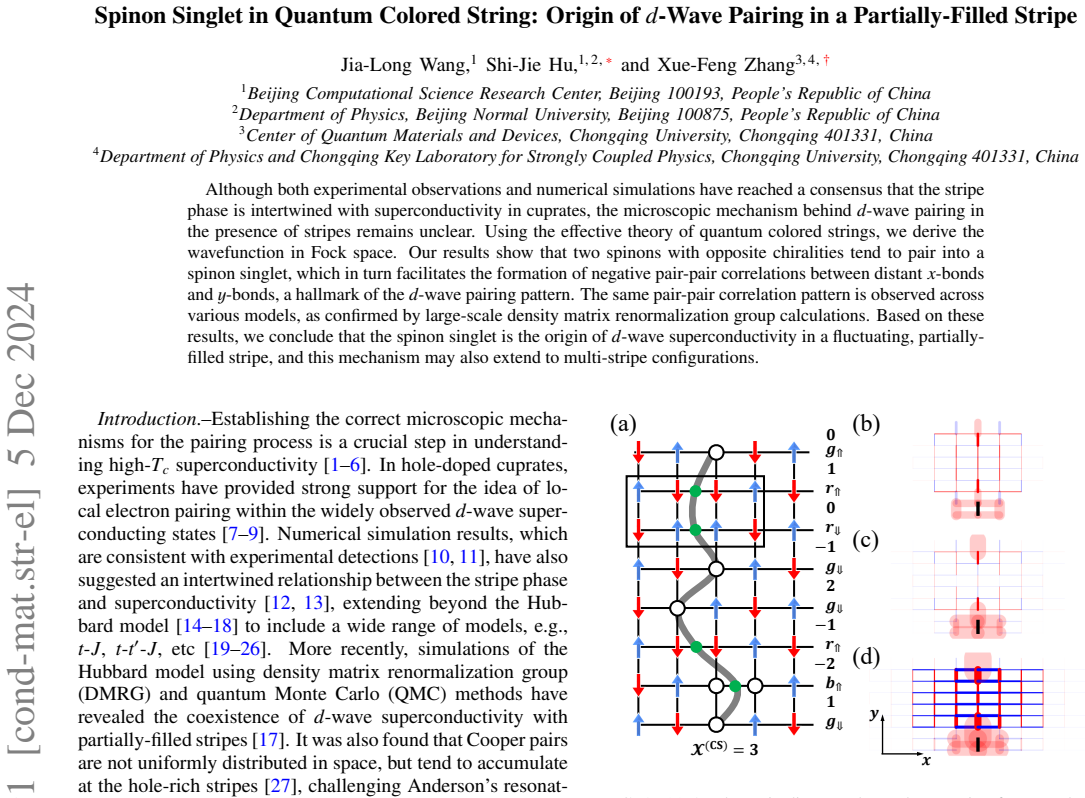
The central object is the two-spinon quantum colored string (QCS): a fluctuating one-dimensional string of color quasi-particles—spinons, holons, and dual-holes—embedded in a π-phase-shifted antiferromagnetic background, described by an effective Hamiltonian $H_{\rm CS}^{e}$ that combines a diagonal confinement energy proportional to $|\Gamma_z|$ with off-diagonal hopping and fluctuation terms. The load-bearing identity is the sign rule for the ground-state expansion coefficients: a two-spinon basis with chirality sequence $\chi_1\chi_2$ has ${\rm Sgn}_s = -1$ for $\Uparrow\Downarrow$ and $+1$ for $\Downarrow\Uparrow$ (up to the global sign convention), and the long-distance pair-pair correlation between two bonds carries sign ${\rm Sgn}_s\,{\rm Sgn}_{s'}\,{\rm Sgn}_\Delta$, where ${\rm Sgn}_\Delta$ accounts for spin exchange. Because the spinon singlet configurations have the lowest potential energy and dominate the wavefunction, this sign product yields positive correlations for same-oriented bonds and negative correlations between x- and y-bonds.
What would settle it
Compute the pair-pair correlation function G_{b,b'} directly from the full DMRG ground state |ψ_D⟩ for the t-Jz model on an 11×6 cylinder at J = 0.6, without projecting onto the truncated QCS space, and compare the sign between a distant y-bond and x-bond; if that sign is positive or the d-wave pattern disappears, the spinon-singlet mechanism's central claim is falsified. Alternatively, increasing the truncation bound |Γ_z| from 5 to 8 and checking whether the leading basis contributions' signs change would test whether the sign rule is a truncation artifact.
Extended reading notes
Core claim
On its own terms, the paper establishes that doping a fully-filled stripe with two electrons creates a two-spinon quantum colored string whose ground state is dominated by spinon singlet configurations with chirality sequences $\chi_1\chi_2 = \Uparrow\Downarrow$ and $\Downarrow\Uparrow$. The sign of the wavefunction expansion coefficient of such a basis is determined by the chirality order, and the pair-pair correlation function between distant bonds obeys a sign product rule. This rule forces positive correlations between same-oriented bonds (y-y and x-x) and negative correlations between distant x-bonds and y-bonds—the defining signature of d-wave pairing. The same negative sign between x- and y-bonds is observed by DMRG for the t-Jz model, the t-J-α model with α from 0 to 1, and the Hubbard model, and the pattern persists for a half-filled stripe on a cylinder of circumference Ly = 8.
Load-bearing premise
The central assumption is that the truncated QCS Hilbert space (|Γ_z| ≤ 5) faithfully represents the low-energy physics, even though at J = 0.6 the DMRG wavefunction projected onto this space retains only 44.3% of its weight, with renormalized fidelity 90.8%, so the omitted components could in principle carry opposing sign correlations.
Editorial extensions
If this is right
- The mechanism implies that d-wave pairing is generated locally along the fluctuating string, so Cooper pairs should be concentrated around the hole-rich stripe rather than distributed uniformly.
- Enhancing antiferromagnetic xy-exchange stabilizes the spinon singlet and strengthens the d-wave pattern, as confirmed by DMRG for increasing α.
- The same spinon-singlet sign rule is conjectured to extend to multi-stripe configurations and to a Luttinger-liquid description of the half-filled stripe.
- The 4×4 hole-checkerboard structure seen by STM in underdoped cuprates may correspond to two holons placed above and below a spinon singlet, connecting the mechanism to local pairing observations.
Reading between the lines
- If the sign rule is robust, the same mechanism should predict a sensitive dependence of d-wave pairing on chirality-breaking perturbations, such as a magnetic field or staggered flux, which could be tested in DMRG or cold-atom simulators.
- A direct test would be to compute the pair-pair correlation directly from the full DMRG wavefunction without projection onto the truncated QCS space; if the negative x-y sign flips, the truncation is the source of the pattern.
- The mechanism may apply to other geometries where quantum strings form, such as doped ladders or two-leg stripes, and could be probed by measuring the muon-spin-rotation or neutron-scattering signatures of local singlet formation.
Editorial analysis
A structured set of objections, weighed in public.
Referee Report
Summary. This paper constructs an effective quantum colored string model (QCSM), Eq. (2), for the t-J_z model and obtains its ground-state wavefunction by exact diagonalization in a truncated Hilbert space Ω with |Γ_z|≤5. The authors identify two-spinon configurations with opposite chiralities as a spinon singlet and derive sign rules for the pair-pair correlation function G_{b,b'} between bonds: positive between two y-bonds and between two x-bonds, and negative between an x-bond and a y-bond, which is the d-wave pairing pattern. The predicted PPC patterns are compared with DMRG results for the t-J_z, t-J-α, and Hubbard models. The paper concludes that the spinon singlet is the microscopic origin of d-wave superconductivity in a fluctuating, partially-filled stripe.
Significance. If the mechanism is correct, this work offers a concrete microscopic picture for d-wave pairing in striped superconductors, connecting stripe geometry with Cooper-pair correlations in a way that goes beyond the RVB paradigm. The paper has clear strengths: the renormalized fidelity FR≈96% at J=1 and ≈90.8% at J=0.6 demonstrates good sign control of the projected wavefunction; the qualitative reproduction of the d-wave PPC pattern across t-J_α and Hubbard models by independent DMRG is nontrivial and supportive; and the explicit identification of the contributing basis states gives a falsifiable sign rule that can be tested in future calculations. The central burden is that the sign-rule derivation is performed inside a truncated Hilbert space that at J=0.6 contains only 44.3% of the DMRG weight, so the causal claim about the spinon singlet needs additional quantitative control over the omitted component.
major comments (3)
- [Appendix B and 'd-wave pairing'] The central mechanism is established inside the truncated space Ω. At J=0.6, the value used throughout the main text, the DMRG weight in Ω is only W≈44.3%, with renormalized fidelity FR≈90.8%. The sign enumeration of the basis pairs in Figs. 3 and 4 is restricted to Ω, and no decomposition of the full DMRG G_{b,b'} into inside-Ω and outside-Ω contributions is given. The reported FR only controls the relative phase of the projected component; it does not control the sign of the omitted 55.7% of the DMRG wavefunction, which could in principle reverse the x-y PPC sign. Please provide a direct check, for example by computing G_{b,b'} from the DMRG wavefunction projected onto Ω and comparing with the full DMRG result, or by evaluating the contribution from the complement, or by demonstrating convergence of the sign with respect to the cutoff |Γ_z|. Without such a check, the statement that the spinon singlet is the origin of the observed d-wave pattern is not fully controlled.
- ['d-wave pairing'] The derivation of negative G_{b,b'} for x-bonds and y-bonds is based on a small number of representative basis pairs, with the text stating that four basis pairs contribute over 86% to G_{b,b'} for the color-shaded bonds. The paper claims that all contributing pairs can be systematically identified, but no exhaustive enumeration, weight table, or general algebraic sign rule is provided. Since G_{b,b'} is a signed sum over many basis pairs, a sign rule established for 86% of the weight of one bond pair does not by itself establish the sign for all long-distance pairs. I ask for an exhaustive classification of the contributing basis pairs for representative target bonds, including their signs and weights, or an explicit proof of the sign rule for arbitrary long-distance x-y pairs.
- [Conclusion and Outlook / 'Four-spinon QCS'] The abstract and conclusion make a causal claim that the spinon singlet is the origin of d-wave pairing in t-J-α and Hubbard models. The QCSM, however, is derived from the t-J_z model, and the evidence for α>0 and for the Hubbard model is only the qualitative similarity of PPC patterns; the text itself states that the effective theory has not yet fully captured the t-J model. Unless the spinon-singlet content of the actual t-J/Hubbard ground states is quantified (for example, by projecting those DMRG wavefunctions onto a colored-string basis or by measuring the weight of the two-spinon singlet component), the across-models 'origin' statement is stronger than the evidence presented. This does not weaken the t-J_z result, but it requires either additional data or a more cautious phrasing.
minor comments (5)
- [Conclusion and Outlook] The text contains several typos: 'emergency' should be 'emergence', 'spionon' should be 'spinon', and 'dule-hole-spinon' in the caption of Fig. 4 should be 'dual-hole-spinon'.
- ['d-wave pairing'] The word 'violet' in the sentence 'their interference violet the simple behavior of Sgn0' should be 'violate'.
- [Appendix A] The abbreviation 'PCC' is used ('the PCC between two x-bonds'), but the paper consistently uses 'PPC' for the pair-pair correlation function; please unify the terminology.
- [Appendix C, Table II] The labels '2/3 hole-filled stripe' and '1/2 hole-filled stripe' are confusing because the main text uses '2/3 hole-doped' and 'half-filled' for the same objects; please make the filling notation consistent throughout.
- ['d-wave pairing'] The notation 'Sgn Δ = ∓' is introduced without a prior definition; define explicitly what 'Sgn' of an operator or a basis state means, and state the convention used to fix the overall sign of the wavefunction.
Circularity Check
No significant circularity; the d-wave PPC sign is an emergent ED output validated against independent DMRG, not imposed by construction.
full rationale
The central derivation is not circular. The QCSM (Eq. 2) is taken from the authors' prior Ref. [34], which is a self-citation, but the present paper does not rely on it as an unverified premise: Eq. (2) is explicitly constructed as a bottom-up effective theory from the t-Jz model, and its ground state is obtained by exact diagonalization in the truncated space Ω. The resulting signs and the pair-pair correlation pattern are outputs of the ED calculation, not fitted inputs. The spinon-singlet sign rule (Sgn_s = ∓1 for opposite chiralities) is read off the ED coefficients in Fig. 3(a), and the negative x-y PPC follows from the derived product Sgn_s Sgn_s' Sgn_Δ, not from imposing a d-wave pattern. Independent DMRG calculations for the t-Jz, t-J-α, and Hubbard models reproduce the same negative x-y PPC (Figs. 1, 2, 6, and 7), providing external anchoring outside the fitted or truncated model. The reported QCS-space fidelity (W≈44.3%, F_R≈90.8% at J=0.6, App. B) is a truncation-robustness limitation and a possible correctness concern, but it is not circularity: the truncated wavefunction is not adjusted to match the target PPC, and the DMRG comparison is an independent check. The self-citation to Ref. [34] supplies the effective model, not the d-wave conclusion, so it does not make the derivation circular.
Assumptions & free parameters
assumptions (4)
- domain assumption The QCS representation with CQPs and ESF Gamma_z, truncated at |Gamma_z| <= 5, captures the physically relevant low-energy subspace of the t-Jz stripe ground state.
- domain assumption Only two-spinon and three-spinon bases need be kept in the PPC sign analysis, with two-spinon bases dominating.
- domain assumption The long-distance sign of the matrix element entering G_b,b' is given by the product of the basis sign, the source basis sign, and the spin-exchange sign, with no other interference terms.
- domain assumption Negative finite-cylinder PPC between distant x-bonds and y-bonds is a sufficient hallmark of d-wave pairing.
invented entities (3)
-
Color quasi-particles (spinons, holons, dual-holes) with chirality labels c = r,g,b and chi = up/down
-
Spinon singlet as the pairing object in a partially-filled stripe
-
Quantum colored string (QCS) with pi-phase shift and ESF Gamma_z
Cite this review
Pith. "Pith review of Spinon Singlet in Quantum Colored String: Origin of $d$-Wave Pairing in a Partially-Filled Stripe." pith.science (2026). https://pith.science/paper/GRXAWZQX
@misc{pith2026241204379,
  author       = {Pith},
  title        = {Pith review of: Spinon Singlet in Quantum Colored String: Origin of $d$-Wave Pairing in a Partially-Filled Stripe},
  year         = {2026},
  howpublished = {\url{https://pith.science/paper/GRXAWZQX}},
  note         = {Machine review of arXiv:2412.04379}
}
abstract
Although both experimental observations and numerical simulations have reached a consensus that the stripe phase is intertwined with superconductivity in cuprates, the microscopic mechanism behind $d$-wave pairing in the presence of stripes remains unclear. Using the effective theory of quantum colored strings, we derive the wavefunction in Fock space. Our results show that two spinons with opposite chiralities tend to pair into a spinon singlet, which in turn facilitates the formation of negative pair-pair correlations between distant $x$-bonds and $y$-bonds, a hallmark of the $d$-wave pairing pattern. The same pair-pair correlation pattern is observed across various models, as confirmed by large-scale density matrix renormalization group calculations. Based on these results, we conclude that the spinon singlet is the origin of $d$-wave superconductivity in a fluctuating, partially-filled stripe, and this mechanism may also extend to multi-stripe configurations.
Figures


Figures from the paper (5 more)


Reference graph
Works this paper leans on
-
[34]
Quantum colored strings in the hole-doped $t$-$J_z$ model
Jia-Long Wang, Shi-Jie Hu, and Xue-Feng Zhang, “Quan- tum colored strings in the hole-doped t- jz model,” (2024), arXiv:2406.01980 [cond-mat.str-el]
work page Pith review arXiv 2024
-
[1]
Theory of su- perconductivity,
J. Bardeen, L. N. Cooper, and J. R. Schrie ffer, “Theory of su- perconductivity,” Phys. Rev.108, 1175–1204 (1957)
1957
-
[2]
Correlated electrons in high-temperature super- conductors,
Elbio Dagotto, “Correlated electrons in high-temperature super- conductors,” Rev. Mod. Phys.66, 763 (1994)
work page 1994
-
[3]
Magnetic, transport, and optical properties of monolayer cop- per oxides,
M. A. Kastner, R. J. Birgeneau, G. Shirane, and Y . Endoh, “Magnetic, transport, and optical properties of monolayer cop- per oxides,” Reviews of Modern Physics 70, 897–928 (1998)
work page 1998
-
[4]
Doping a mott insulator: Physics of high-temperature superconductiv- ity,
Patrick A. Lee, Naoto Nagaosa, and Xiao-Gang Wen, “Doping a mott insulator: Physics of high-temperature superconductiv- ity,” Rev. Mod. Phys.78, 17 (2006)
work page 2006
-
[5]
From quantum matter to high-temperature super- conductivity in copper oxides,
B. Keimer, S. A. Kivelson, M. R. Norman, S. Uchida, and J. Zaanen, “From quantum matter to high-temperature super- conductivity in copper oxides,” Nature (London) 518, 179–186 (2015)
work page 2015
-
[6]
When superconductivity crosses over: From bcs to bec,
Qijin Chen, Zhiqiang Wang, Rufus Boyack, Shuolong Yang, and K. Levin, “When superconductivity crosses over: From bcs to bec,” Rev. Mod. Phys.96, 025002 (2024)
work page 2024
-
[7]
Detection of a Cooper-pair density wave in Bi2Sr2CaCu2O8+x,
M. H. Hamidian, S. D. Edkins, Sang Hyun Joo, A. Kostin, H. Eisaki, S. Uchida, M. J. Lawler, E. A. Kim, A. P. MacKen- zie, K. Fujita, Jinho Lee, and J. C. S´eamus Davis, “Detection of a Cooper-pair density wave in Bi2Sr2CaCu2O8+x,” Nature (Lon- don) 532, 343–347 (2016), arXiv:1511.08124 [cond-mat.supr- con]
arXiv 2016
Show all 43 references
-
[8]
Pre-formed Cooper pairs in copper oxides and LaAlO 3—SrTiO3 heterostructures,
Ivan Bo ˇzovi´c and Jeremy Levy, “Pre-formed Cooper pairs in copper oxides and LaAlO 3—SrTiO3 heterostructures,” Nature Physics 16, 712–717 (2020)
2020
-
[9]
The emergence of global phase coherence from local pairing in underdoped cuprates,
Shusen Ye, Changwei Zou, Hongtao Yan, Yu Ji, Miao Xu, Ze- hao Dong, Yiwen Chen, Xingjiang Zhou, and Yayu Wang, “The emergence of global phase coherence from local pairing in underdoped cuprates,” Nature Physics 19, 1301–1307 (2023), arXiv:2306.05926 [cond-mat.supr-con]
2023 arXiv
-
[10]
One-dimensional nature of the magnetic fluctuations in YBa 2Cu3O6.6,
H. A. Mook, Pengcheng Dai, F. Dogan, and R. D. Hunt, “One-dimensional nature of the magnetic fluctuations in YBa 2Cu3O6.6,” Nature (London) 404, 729–731 (2000), arXiv:cond-mat/0004362 [cond-mat.supr-con]
2000 arXiv
-
[11]
Imaging the energy gap modulations of the cuprate pair-density-wave state,
Zengyi Du, Hui Li, Sang Hyun Joo, Elizabeth P. Donoway, Jinho Lee, J. C. S ´eamus Davis, Genda Gu, Peter D. Johnson, and Kazuhiro Fujita, “Imaging the energy gap modulations of the cuprate pair-density-wave state,” Nature (London)580, 65– 70 (2020), arXiv:2109.14033 [cond-mat....
2020 arXiv
-
[12]
Colloquium: Theory of intertwined orders in high temperature superconductors,
Eduardo Fradkin, Steven A. Kivelson, and John M. Tranquada, “Colloquium: Theory of intertwined orders in high temperature superconductors,” Rev. Mod. Phys.87, 457–482 (2015)
2015
-
[13]
Spins, stripes, and superconductivity in hole-doped cuprates,
John M. Tranquada, “Spins, stripes, and superconductivity in hole-doped cuprates,” in AIP Conference Proceedings (AIP, 2013)
2013
-
[14]
Stripe order in the underdoped region of the two-dimensional hubbard model,
B. Zheng, Chia-Min Chung, Philippe Corboz, Georg Ehlers, Mingpu Qin, Reinhard M. Noack, Hao Shi, Steven R. White, Shiwei Zhang, and Garnet Kin-Lic Chan, “Stripe order in the underdoped region of the two-dimensional hubbard model,” Science 358, 1155 – 1160 (2016)
2016
-
[15]
Tangent space approach for thermal tensor net- work simulations of the 2d hubbard model,
Qiaoyi Li, Yuan Gao, Yuan-Yao He, Yang Qi, Bin-Bin Chen, and Wei Li, “Tangent space approach for thermal tensor net- work simulations of the 2d hubbard model,” Phys. Rev. Lett. 130, 226502 (2023)
2023
-
[16]
Stripes, antiferromag- netism, and the pseudogap in the doped hubbard model at finite temperature,
Alexander Wietek, Yuan-Yao He, Steven R. White, Antoine Georges, and E. Miles Stoudenmire, “Stripes, antiferromag- netism, and the pseudogap in the doped hubbard model at finite temperature,” Phys. Rev. X11, 031007 (2021)
2021
-
[17]
Coexistence of superconductivity with partially filled stripes in the hubbard model,
Hao Xu, Chia-Min Chung, Mingpu Qin, Ulrich Schollw ¨ock, Steven R. White, and Shiwei Zhang, “Coexistence of superconductivity with partially filled stripes in the hubbard model,” Science 384, eadh7691 (2024), https://www.science.org/doi/pdf/10.1126/science.adh7691
2024 doi
-
[18]
Temperature Dependence of Spin and Charge Orders in the Doped Two-Dimensional Hubbard Model,
Bo Xiao, Yuan-Yao He, Antoine Georges, and Shiwei Zhang, “Temperature Dependence of Spin and Charge Orders in the Doped Two-Dimensional Hubbard Model,” Physical Review X 13, 011007 (2023), arXiv:2202.11741 [cond-mat.str-el]
2023 arXiv
-
[19]
Energetics of domain walls in the 2d t- j model,
Steven R. White and D. J. Scalapino, “Energetics of domain walls in the 2d t- j model,” Phys. Rev. Lett. 81, 3227–3230 (1998)
1998
-
[20]
Robust d-wave superconductivity in the square-lattice t- j model,
Shoushu Gong, W. Zhu, and D. N. Sheng, “Robust d-wave superconductivity in the square-lattice t- j model,” Physical Re- view Letters 127, 097003 (2021)
2021
-
[21]
Plaquette versus ordinary d- wave pairing in the t ′ -hubbard model on a width-4 cylinder,
Chia-Min Chung, Mingpu Qin, Shiwei Zhang, Ulrich Schollw¨ock, and Steven R. White (The Simons Collaboration on the Many-Electron Problem), “Plaquette versus ordinary d- wave pairing in the t ′ -hubbard model on a width-4 cylinder,” Phys. Rev. B 102, 041106 (2020)
2020
-
[22]
Emergent superconductivity and competing charge or- ders in hole-doped square-lattice t- j model,
Xin Lu, Feng Chen, W. Zhu, D. N. Sheng, and Shou-Shu Gong, “Emergent superconductivity and competing charge or- ders in hole-doped square-lattice t- j model,” Phys. Rev. Lett. 132, 066002 (2024)
2024
-
[23]
Ground-state phase diagram and superconductivity of the doped hubbard model on six-leg square cylinders,
Yi-Fan Jiang, Thomas P. Devereaux, and Hong-Chen Jiang, “Ground-state phase diagram and superconductivity of the doped hubbard model on six-leg square cylinders,” Phys. Rev. 6 B 109, 085121 (2024)
2024
-
[24]
Superconductiv- ity in the doped hubbard model and its interplay with next- nearest hopping t’,
Hong-Chen Jiang and Thomas P. Devereaux, “Superconductiv- ity in the doped hubbard model and its interplay with next- nearest hopping t’,” Science 365, 1424–1428 (2019)
2019
-
[25]
Ground state phase diagram of the doped hub- bard model on the four-leg cylinder,
Yi-Fan Jiang, Jan Zaanen, Thomas P. Devereaux, and Hong- Chen Jiang, “Ground state phase diagram of the doped hub- bard model on the four-leg cylinder,” Phys. Rev. Res.2, 033073 (2020)
2020
-
[26]
d-wave superconduc- tivity, pseudogap, and the phase diagram oft-t′- j model at finite temperature,
Dai-Wei Qu, Bin-Bin Chen, Xin Lu, Qiaoyi Li, Shou-Shu Gong, Yang Qi, Wei Li, and Gang Su, “ d-wave superconduc- tivity, pseudogap, and the phase diagram oft-t′- j model at finite temperature,” (2023), arXiv:2211.06322 [cond-mat.str-el]
2023 arXiv
-
[27]
Fragmented cooper pair condensation in striped superconductors,
Alexander Wietek, “Fragmented cooper pair condensation in striped superconductors,” Physical Review Letters129, 177001 (2022)
2022
-
[28]
The resonating valence bond state in La2CuO4 and superconductivity,
P. W. Anderson, “The resonating valence bond state in La2CuO4 and superconductivity,” Science 235, 1196–1198 (1987)
1987
-
[29]
Direct evidence for Cooper pairing without a spectral gap in a disor- dered superconductor above Tc,
Koen M. Bastiaans, Damianos Chatzopoulos, Jian-Feng Ge, Doohee Cho, Willem O. Tromp, Jan M. van Ruitenbeek, Mark H. Fischer, Pieter J. de Visser, David J. Thoen, Eduard F. C. Driessen, Teunis M. Klapwijk, and Milan P. Allan, “Direct evidence for Cooper pairing without a spectr...
2021 arXiv
-
[30]
Origin and fate of the pseudogap in the doped Hub- bard model,
Fedor ˇSimkovic, Riccardo Rossi, Antoine Georges, and Michel Ferrero, “Origin and fate of the pseudogap in the doped Hub- bard model,” Science 385, eade9194 (2024), arXiv:2209.09237 [cond-mat.str-el]
2024 arXiv
-
[31]
Order out of disorder in a gas of elastic quantum strings in 2 + 1 dimensions,
J. Zaanen, “Order out of disorder in a gas of elastic quantum strings in 2 + 1 dimensions,” Phys. Rev. Lett. 84, 753–756 (2000)
2000
-
[32]
The geometric order of stripes and Luttinger liq- uids,
J. Zaanen, O. Y . Osman, H. V . Kruis, Z. Nussinov, and J. Tworzydlo, “The geometric order of stripes and Luttinger liq- uids,” Philosophical Magazine, Part B 81, 1485–1531 (2001), arXiv:cond-mat/0102103 [cond-mat.str-el]
2001 arXiv
-
[33]
Quantum-fluctuation-induced collisions and subsequent excitation gap of an elastic string between walls,
Yoshihiro Nishiyama, “Quantum-fluctuation-induced collisions and subsequent excitation gap of an elastic string between walls,” Phys. Rev. B66, 184501 (2002)
2002
-
[35]
Ferromagnetism in a narrow, almost half- filled s band,
Yosuke Nagaoka, “Ferromagnetism in a narrow, almost half- filled s band,” Phys. Rev.147, 392–405 (1966)
1966
-
[36]
Extension of nagaoka’s theorem on the large-u hubbard model,
Hal Tasaki, “Extension of nagaoka’s theorem on the large-u hubbard model,” Phys. Rev. B40, 9192–9193 (1989)
1989
-
[37]
Strings in strongly correlated electron systems,
P. Fulde and F. Pollmann, “Strings in strongly correlated electron systems,” Annalen der Physik 520, 441–449 (2008), arXiv:0711.2129 [cond-mat.str-el]
2008 arXiv
-
[38]
Chiral edge states and fractional charge separation in a system of interacting bosons on a kagome lattice,
Xue-Feng Zhang and Sebastian Eggert, “Chiral edge states and fractional charge separation in a system of interacting bosons on a kagome lattice,” Phys. Rev. Lett.111, 147201 (2013)
2013
-
[39]
Quantum dynamics of topological strings in a frustrated Ising antiferromagnet,
Zheng Zhou, Changle Liu, Zheng Yan, Yan Chen, and Xue- Feng Zhang, “Quantum dynamics of topological strings in a frustrated Ising antiferromagnet,” npj Quantum Materials 7, 60 (2022), arXiv:2010.01750 [cond-mat.str-el]
2022 arXiv
-
[40]
Quantum strings in quan- tum spin ice,
Yuan Wan and Oleg Tchernyshyov, “Quantum strings in quan- tum spin ice,” Phys. Rev. Lett.108, 247210 (2012)
2012
-
[41]
Quantum domain walls induce incommensurate super- solid phase on the anisotropic triangular lattice,
Xue-Feng Zhang, Shijie Hu, Axel Pelster, and Sebastian Eg- gert, “Quantum domain walls induce incommensurate super- solid phase on the anisotropic triangular lattice,” Phys. Rev. Lett. 117, 193201 (2016)
2016
-
[42]
Charge stripe manipulation of superconducting pairing sym- metry transition,
Chao Chen, Peigeng Zhong, Xuelei Sui, Runyu Ma, Ying Liang, Shijie Hu, Tianxing Ma, Hai-Qing Lin, and Bing Huang, (a) (b) (c) (d) (e) (f) FIG. 6. The PPC function, starting from a target x-bond (black line), is calculated using: (a) QCSM (2), (b-e) DMRG in the t-J- α model (1)...
2024
-
[43]
Phase string effect in a doped antiferromagnet,
D. N. Sheng, Y . C. Chen, and Z. Y . Weng, “Phase string effect in a doped antiferromagnet,” Phys. Rev. Lett. 77, 5102–5105 (1996). APPENDIX A. PPC function starting from a target x-bond The d-wave pairing pattern means that the PPCs between x-bonds and y-bonds are negative, w...
1996
Reviewed August 11, 2026 · model on record in the stance chip above.
Discussion (0). Continue with ORCID to comment.