REVIEW 4 major objections 5 minor 13 references
Privacy-Preserving Gesture Tracking System Utilizing Frequency-Hopping RFID Signals
T0 review · 4 major / 5 minor · reviewed 2026-08-11 · deepseek-v4-flash
Pith's one-line read Frequency-hopping RFID keeps gesture data private without losing tracking accuracy.
desk verdict The privacy claim is asserted in the abstract but never tested, and the paper's own Conformer recovery model gives an eavesdropper the very de-hopping capability the system is supposed to prevent; the tracking eval is too thin to check. read the letter →
The pith
A machine-rendered reading of the paper's core claim, the machinery that carries it, and where it could break.
The reading
What carries the argument
The load-bearing mechanism is a two-sided signal transformation. On the transmission side, frequency hopping switches the RFID carrier frequency rapidly across the channel, so passive interception yields discontinuous, de-phased fragments instead of one coherent raw signal. On the reception side, the system uses a Conformer generative model—a neural architecture that couples convolutional layers for local features with multi-head self-attention for global dependencies—to invert the hopping and recover the original signal. RSSI is used as an auxiliary label and supervision signal to stabilize recovery, and the initial tag position is seeded by the phase-difference confidence score $V$ computed across antennas.
What would settle it
A concrete falsifying test is to let an eavesdropper with a software-defined radio learn the hopping pattern from captured traffic or protocol metadata, train the same Conformer-based recovery network on synchronized frequency-hopped samples, and attempt gesture tracking from the recovered signals. If the reconstructed trajectories match the legitimate system's accuracy, the paper's privacy claim is refuted.
Extended reading notes
Core claim
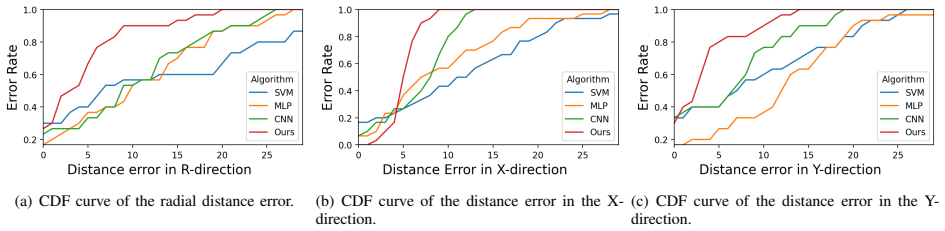
The central claim is that frequency hopping is a workable privacy mechanism at the physical layer of RFID gesture tracking, because it denies eavesdroppers a clean raw signal while a legitimate receiver can reconstruct the signal and track accurately. The system first finds the tag's initial position by scoring hypothetical positions with a phase-difference confidence value $V$; it then collects frequency-hopped RFID signals together with RSSI, which serves as auxiliary supervision. A Conformer-based generative model—combining attention and depthwise convolution—recovers the original signal from the hopped samples, and phase and RSSI feature maps derived from that recovery feed the tracker. In the reported experiments the recovered-signal tracking has lower X, Y, and radial errors than SVM, MLP, and CNN baselines, with an initial-position localization error around 10 cm and ablation results showing that both convolutional and transformer components contribute to the accuracy.
Load-bearing premise
The paper assumes an eavesdropper cannot learn or synchronize to the frequency-hopping sequence and cannot train a similar signal-recovery model; if any of that fails, the frequency-hopped signal no longer protects privacy.
Editorial extensions
If this is right
- A passive eavesdropper that records raw wireless samples receives frequency-hopped fragments, so simply intercepting the channel no longer yields usable gesture data.
- Tracking accuracy is preserved despite the privacy layer: the reported MAE stays near 5 cm with $R^2$ 0.76–0.86 on both datasets.
- Removing either the convolution module or the transformer module from the recovery model degrades accuracy, so both local feature extraction and global sequence modeling are load-bearing parts of the claimed result.
- The system runs on commodity RFID readers and software-defined radios, which makes the privacy layer practical for smart-home and human-computer interaction deployment.
Reading between the lines
- The privacy guarantee implicitly treats the hopping pattern as a secret; a natural extension is to model the pattern as a cryptographic key and measure how much pattern entropy is needed to stop a synchronized eavesdropper.
- Because the recovery network is trained on known hopping patterns, an adversary with a set of synchronized captures could plausibly train an equivalent network, so a testable defense is to key the hopping pattern to information unavailable to the recorder.
- The paper does not compare recovered-signal spectra or gesture-classification outputs against original-signal outputs, so one could test whether the recovery model leaves identifiable artifacts that an eavesdropper could exploit despite not seeing the raw signal.
Signed reviews
Editorial analysis
A structured set of objections, weighed in public.
Referee Report
Summary. The manuscript proposes a gesture tracking system based on frequency-hopping RFID signals, in which a Conformer-based generative model is trained to recover the original RFID signals from the hopped signals, after which phase and RSSI features are used for initial-position localization and trajectory tracking. The central claim is that frequency hopping prevents eavesdroppers from obtaining raw RFID signals and thereby enhances privacy, while tracking accuracy and real-time performance are maintained. Experiments compare the proposed model with SVM, MLP, and CNN baselines using CDF curves, and ablation experiments on two datasets evaluate the contribution of CNN and Transformer components.
Significance. If the privacy claim were established, the paper would address a real and under-served problem: RFID gesture tracking is indeed susceptible to eavesdropping, and privacy-preserving alternatives are valuable. The paper also gives a concrete, trainable architecture and reports an ablation study. However, the central novelty is the privacy guarantee, and that claim is asserted without a threat model, without a security experiment, and in apparent tension with the paper's own signal-recovery model. The tracking evaluation also lacks basic statistical reporting. These issues affect the paper's core contribution, not merely its presentation.
major comments (4)
- [I.C and II.B] The privacy claim is not supported and is undermined by the paper's own architecture. The abstract states that frequency hopping 'prevents potential eavesdroppers from obtaining raw RFID signals,' but the paper never defines an adversary model, never states whether the hopping sequence is secret or shared via a key, and never analyzes synchronization or key management. In I.C and II.B, the authors train a Conformer-based generative model that 'recover[s] the original signals from the frequency-hopped signals.' This is precisely the capability an eavesdropper needs. An eavesdropper with a wideband receiver and a labeled dataset could plausibly train the same model, since the model architecture is described in the paper. The privacy guarantee therefore collapses unless an explicit secret (e.g., a cryptographically protected hopping sequence) is introduced and analyzed. This is a load-bearing gap in the central claim.
- [III.D and IV] There is no privacy-protection experiment. The paper claims 'significantly improves privacy protection levels' and 'effectively protects user privacy,' but no metric measures privacy, no adversarial interception is simulated, no comparison is made between the legitimate receiver and a simulated eavesdropper, and no baseline (e.g., fixed-frequency RFID) is compared on an eavesdropping axis. A security claim of this strength needs quantitative evidence, such as signal-recovery error at an eavesdropper's location, or a demonstrated advantage for the legitimate receiver based on secret hopping-sequence knowledge. Without such evidence, the paper's main contribution is asserted rather than demonstrated.
- [III.D and III.E, Table I] The tracking evaluation is statistically underspecified. The manuscript reports CDF curves and an ablation table, but it does not state the number of gesture traces, number of subjects, number of trials per configuration, or whether the reported MAE/RMSE/R2 values are means over repeated runs. There are no error bars, confidence intervals, or significance tests for any comparison. Table I, for example, reports R2 differences as small as 0.01 between configurations, but without variance estimates these differences cannot be interpreted. The claim that the full model is 'robust' across scenarios also needs a description of dataset sizes and scenario differences.
- [III.C] The baseline description contains a factual error: 'MLP' is defined as 'Multiple Hypothesis Tracking,' but the abbreviation and the experimental context indicate Multilayer Perceptron, and the cited reference [12] is about RFID-PUF authentication, not multiple hypothesis tracking. This mislabeling makes the baseline comparison difficult to interpret and should be corrected.
minor comments (5)
- [II.A] The 'normal distribution coefficient' added to the phase difference is not defined. It is unclear whether this is a fixed hyperparameter, a learned parameter, or an ad-hoc term, and how its variance is chosen affects the initial-position confidence V.
- [III.A.3] The training setup reports a loss threshold of 0.01 with MSE loss, but the resulting MAE values in Table I are around 5–9, so the stopping criterion and the reported error scale need clarification.
- [III.A.1] The paper states that the antennas are separated by 14.0 cm 'less than half the wavelength of the RFID signal,' but no operating frequency is given. Since the wavelength depends on the frequency, this claim cannot be verified; the hopping frequencies should be specified.
- [Figure 7] The CDF curves would be more informative if the number of samples, the gesture types, and the legend entries for 'Ours' were explicitly described in the caption or in Section III.D.
- [II.C] The Conformer architecture is described only at the level of standard formulas. The specific model size, number of attention heads, number of Conformer blocks, input feature dimensionality, and the exact form of the 'generation' output are not given, which makes the experiments hard to reproduce.
Circularity Check
No circular derivation found; the privacy claim is under-evidenced but not circular.
full rationale
I walked the paper's claimed derivation chain: signal collection, de-hopping via a Conformer-based generative model, and trajectory tracking evaluated against measured ground-truth positions. The tracking evaluation uses Euclidean distance between predicted and true coordinates, so the accuracy result is not equivalent to any fitted input or model output; it is benchmarked externally. The privacy claim is not derived by equations at all, and no parameter is fitted and then renamed as a prediction. The paper's own statement that a generative model is trained to recover original signals from frequency-hopped signals does undercut the privacy argument, because an eavesdropper might train a similar model, but that is a correctness and security-evidence gap, not circularity: the paper never defines privacy in terms of the model's inability to recover signals, nor does it use the model's success as evidence of privacy. Citations in the paper are to external work (Conformer, prior RFID tracking systems, SVM/CNN baselines), and there are no load-bearing self-citations or imported uniqueness theorems. Therefore the paper is not circular; its central privacy claim is simply asserted without an adversary model or security experiment, which should be reported as missing evidence rather than circularity.
Assumptions & free parameters
free parameters (1)
- Normal distribution coefficient for initial position confidence =
not stated
assumptions (4)
- domain assumption An eavesdropper cannot obtain the raw RFID signal if the signal frequency hops.
- domain assumption Phase differences measured by two antennas are sufficient to track a gesture keypoint.
- domain assumption The Conformer model can recover original signals from frequency-hopped signals.
- domain assumption RSSI contains environmental reflection and scattering information useful for prediction.
Cite this review
Pith. "Pith review of Privacy-Preserving Gesture Tracking System Utilizing Frequency-Hopping RFID Signals." pith.science (2026). https://pith.science/paper/PM6EMJND
@misc{pith2026241204518,
  author       = {Pith},
  title        = {Pith review of: Privacy-Preserving Gesture Tracking System Utilizing Frequency-Hopping RFID Signals},
  year         = {2026},
  howpublished = {\url{https://pith.science/paper/PM6EMJND}},
  note         = {Machine review of arXiv:2412.04518}
}
read the original abstract
Gesture tracking technology provides users with a hands free interactive experience without the need to hold or touch devices. However, current gesture tracking research has primarily focused on tracking accuracy while neglecting issues of user privacy protection and security. This study aims to develop a gesture tracking system based on frequency hopping RFID signals that effectively protects user privacy without compromising tracking efficiency and accuracy. By introducing frequency hopping technology, we have designed a mechanism that prevents potential eavesdroppers from obtaining raw RFID signals, thereby enhancing the systems privacy protection capabilities. The system architec ture includes the collection of RFID signals, data processing, signal recovery, and gesture tracking. Experimental results show that our method significantly improves privacy protection levels while maintaining real time and accuracy. This research not only provides a new perspective for the field of gesture tracking but also offers valuable insights for the use of RFID technology in privacy-sensitive applications.
Figures


Figures from the paper (4 more)


Reference graph
Works this paper leans on
-
[12]
A mutual security authentication method for rfid-puf circuit based on deep learning,
W. Liang, S. Xie, D. Zhang, X. Li, and K.-C. Li, “A mutual security authentication method for rfid-puf circuit based on deep learning,” ACM Transactions on Internet Technology (TOIT) , vol. 22, no. 2, pp. 34:1– 34:20, 2022
work page 2022
-
[1]
Mediapipe hands: On-device real-time hand tracking,
F. Zhang, V . Bazarevsky, A. Vakunov, A. Tkachenka, G. Sung, C.-L. Chang, and M. Grundmann, “Mediapipe hands: On-device real-time hand tracking,” 2020. [Online]. Available: https://arxiv.org/abs/2006. 10214
work page 2020
-
[2]
Spatial-temporal multi-cue net- work for sign language recognition and translation,
H. Zhou, W. Zhou, Y . Zhou, and H. Li, “Spatial-temporal multi-cue net- work for sign language recognition and translation,” IEEE Transactions on Multimedia, vol. 24, pp. 768–779, 2022
work page 2022
-
[3]
Towards position-independent sensing for gesture recognition with wi- fi,
R. Gao, M. Zhang, J. Zhang, Y . Li, E. Yi, D. Wu, L. Wang, and D. Zhang, “Towards position-independent sensing for gesture recognition with wi- fi,” Proceedings of the ACM on Interactive, Mobile, Wearable and Ubiquitous Technologies, vol. 5, no. 2, pp. 1–28, 2021
work page 2021
-
[4]
Fingerdraw: Sub-wavelength level finger motion tracking with wifi signals,
D. Wu, R. Gao, Y . Zeng, J. Liu, L. Wang, T. Gu, and D. Zhang, “Fingerdraw: Sub-wavelength level finger motion tracking with wifi signals,” Proceedings of the ACM on Interactive, Mobile, Wearable and Ubiquitous Technologies, vol. 4, no. 1, pp. 1–27, 2020
work page 2020
-
[5]
Itracku: Tracking a pen-like instrument via uwb-imu fusion,
Y . Cao, A. Dhekne, and M. Ammar, “Itracku: Tracking a pen-like instrument via uwb-imu fusion,” in Proceedings of the 19th Annual International Conference on Mobile Systems, Applications, and Services, 2021, pp. 453–466
work page 2021
-
[6]
Fine- grained and real-time gesture recognition by using imu sensors,
D. Zhang, Z. Liao, W. Xie, X. Wu, H. Xie, J. Xiao, and L. Jiang, “Fine- grained and real-time gesture recognition by using imu sensors,” IEEE Transactions on Mobile Computing , vol. XX, no. X, pp. XXX–XXX, 2021
work page 2021
-
[7]
Rf-pen: Practical real-time rfid tracking in the air,
H. Wang and W. Gong, “Rf-pen: Practical real-time rfid tracking in the air,” IEEE Transactions on Mobile Computing , vol. 20, no. 11, pp. 3227–3238, 2020
work page 2020
Show all 13 references
-
[8]
Rf-idraw: Virtual touch screen in the air using rf signals,
J. Wang, D. Vasisht, and D. Katabi, “Rf-idraw: Virtual touch screen in the air using rf signals,” ACM SIGCOMM Computer Communication Review, vol. 44, no. 4, pp. 235–246, 2014
2014
-
[9]
Gyro in the air: Tracking 3d orientation of batteryless internet of things,
T. Wei and X. Zhang, “Gyro in the air: Tracking 3d orientation of batteryless internet of things,” in ACM, 2017, pp. 35–38
2017
-
[10]
Conformer: Convolution-augmented transformer for speech recognition,
A. Gulati, J. Qin, C.-C. Chiu, N. Parmar, Y . Zhang, J. Yu, W. Han, S. Wang, Z. Zhang, Y . Wu, and R. Pang, “Conformer: Convolution-augmented transformer for speech recognition,” 2020. [Online]. Available: https://arxiv.org/abs/2005.08100
2020 arXiv
-
[11]
Rfid backscatter based sport motion sensing using ecoc-based svm,
L. Han and X. Hua, “Rfid backscatter based sport motion sensing using ecoc-based svm,” Sensors, vol. 23, no. 17, 2023. [Online]. Available: https://www.mdpi.com/1424-8220/23/17/7324
2023
-
[13]
An improved moea based on adaptive adjustment strategy for optimizing deep model of rfid indoor positioning,
J. Liu, L. Yang, S. Chen, W. Dong, B. Yu, and Q. Wang, “An improved moea based on adaptive adjustment strategy for optimizing deep model of rfid indoor positioning,” in Proceedings of the 2023 Chinese Conference on Computer Supported Cooperative Work and Social Computing (CSCW...
2023
Reviewed August 11, 2026 · model on record in the stance chip above.
Discussion (0). Continue with ORCID to comment.