REVIEW 3 major objections 6 minor 140 references
Uniform characterisation of an ensemble of main-sequence benchmark stars: effect of Gaia-based data on grid search models
T0 review · 3 major / 6 minor · reviewed 2026-08-11 · deepseek-v4-flash
Pith's one-line read Including a Gaia-based luminosity in asteroseismic grid searches tightens inferred stellar masses to 0.8 per cent scatter while radii come out about 1.9 per cent low.
desk verdict A useful empirical benchmark for grid-based stellar characterization with Gaia luminosities, but the headline percentages rest on a fixed-mixing-length grid and only seven heterogeneous stars. read the letter →
The pith
A machine-rendered reading of the paper's core claim, the machinery that carries it, and where it could break.
The reading
What carries the argument
The argument runs on a pre-computed grid of main-sequence stellar tracks generated with the MESA code, the GYRE code for adiabatic oscillation frequencies, and the AIMS code for the Markov-chain Monte Carlo grid search that interpolates between models. The optimisation minimises a chi-squared that combines seismic frequencies, corrected for surface effects with the Ball-Gizon two-term formula, with atmospheric constraints of effective temperature, metallicity, and either a Gaia-parallax luminosity or an interferometric radius. Gaia luminosities are built from DR3 parallaxes via the standard distance-luminosity relation with bolometric corrections and reddening, while interferometric radii combine angular diameters with parallaxes. Accuracy is judged by the offset and scatter between the inferred values and these independent measurements.
What would settle it
Re-run the same grid search on the same stars with an independent stellar grid (for instance, varying the mixing-length parameter over 1.5–2.0 or using a different evolution code) and check whether the inferred radii still fall about 1.9 per cent below the interferometric values. If the offset disappears or changes sign, the reported radius underestimate is a grid artefact; if it persists across grids, it indicates a genuine systematic in the modelling or in the interferometric comparison.
Extended reading notes
Core claim
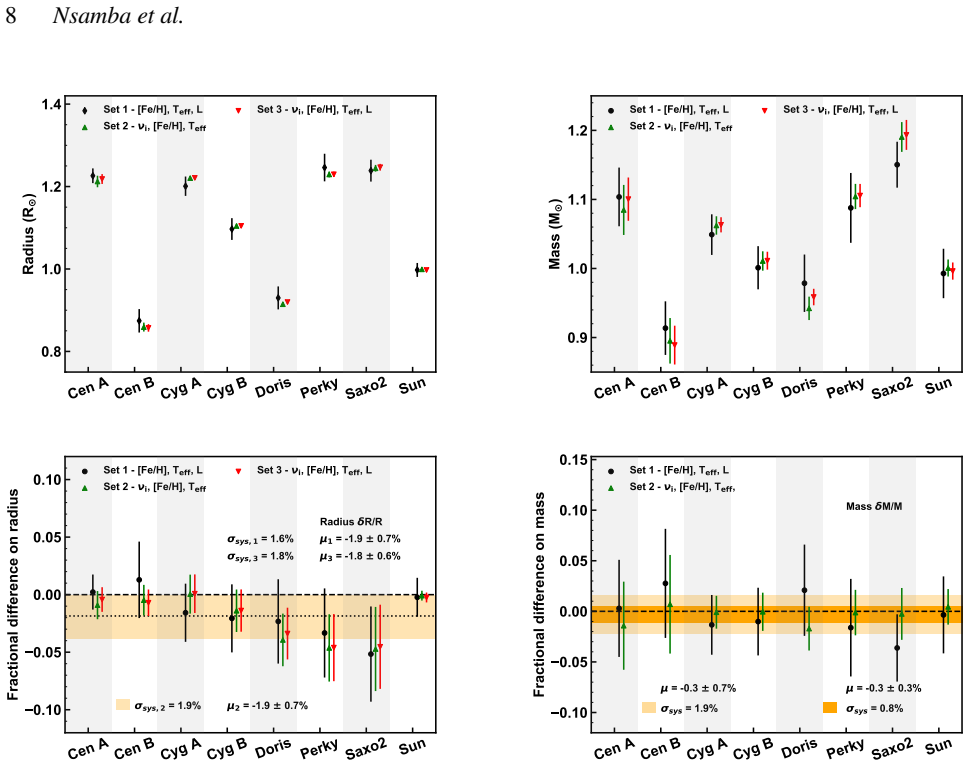
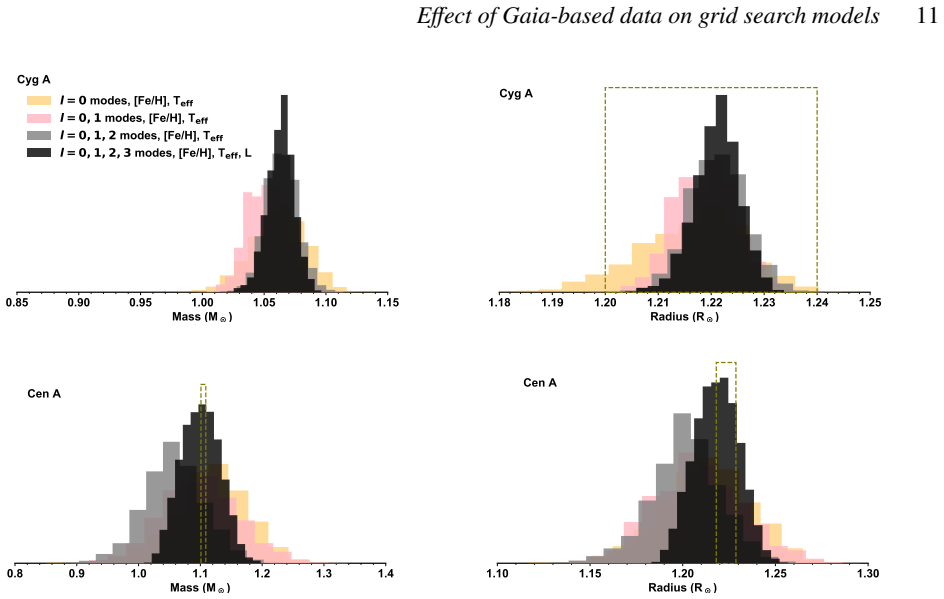
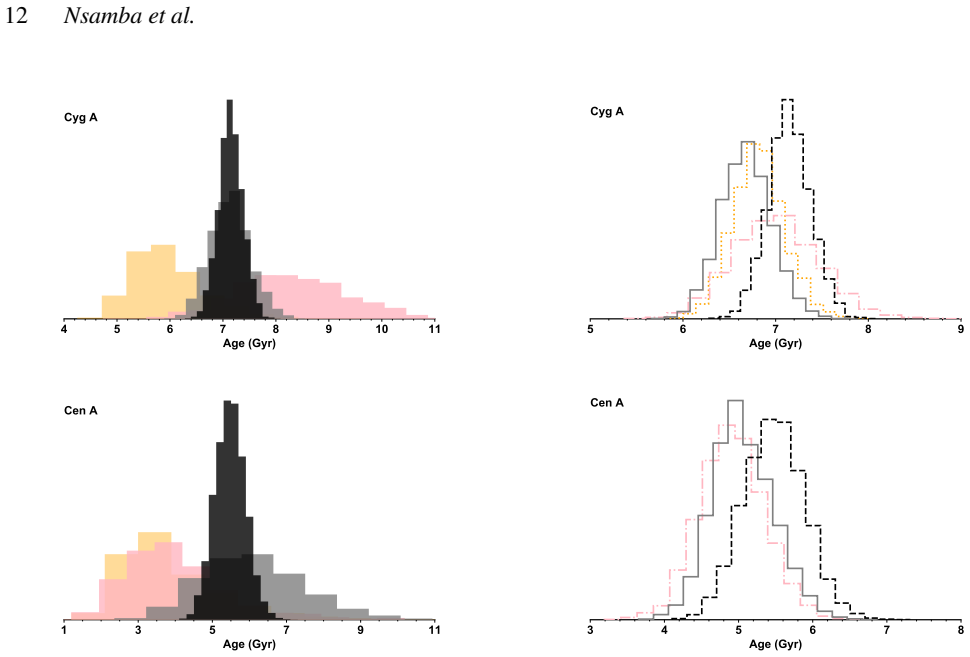
The central claim is that a parallax-based luminosity from Gaia acts as a genuinely informative extra constraint in asteroseismic grid searches: adding it to individual oscillation frequencies, effective temperature, and metallicity lowers the scatter on inferred stellar masses from 1.9 per cent (seismic plus spectroscopic constraints) to 0.8 per cent. When the inferred radii are checked against model-independent interferometric radii, they are systematically lower by -1.9 ± 0.7 per cent with a scatter near 1.9 per cent, indicating a persistent small bias in the model grid or the comparison itself. Injecting an interferometric radius with uncertainty ≲1 per cent into the optimisation yields masses with uncertainty ≲1.5 per cent, and this benefit saturates once the radius uncertainty exceeds about 1.5 per cent, after which the seismic data dominate. Finally, using only radial l=0 oscillation frequencies, robust masses and radii are still attainable provided more than eight precise l=0 frequencies are paired with atmospheric constraints, including the Gaia-based luminosity where available.
Load-bearing premise
The grid's radius scale—fixed by the solar-calibrated mixing length of 1.71, the exponential overshoot parameter of 0.01, and the Ball-Gizon surface correction—is assumed to represent the true radius scale of every benchmark star to better than the reported ~1.9 per cent offset; if that scale is biased, the radius underestimate and the mass scatter comparison are artefacts of the grid rather than properties of the data.
Editorial extensions
If this is right
- Adding a Gaia-parallax luminosity to seismic and spectroscopic constraints reduces the systematic scatter on inferred stellar masses from 1.9 per cent to 0.8 per cent.
- Grid-inferred radii for these benchmark stars sit about 1.9 per cent below interferometric radii, implying a small but consistent bias in the modelling or comparison.
- An interferometric radius with precision ≲1 per cent, when included in the optimisation, yields stellar masses with precision ≲1.5 per cent.
- When only l=0 modes are available, more than eight precise l=0 frequencies combined with atmospheric constraints are needed to obtain reliable masses and radii.
- The results argue for pushing interferometric radius measurements of solar-type stars toward 1 per cent precision, a step relevant to PLATO's stellar-characterisation work packages.
Reading between the lines
- If the -1.9 per cent radius offset survives tests with other stellar grids, asteroseismically calibrated radii—and exoplanet and Galactic properties built on them—may carry a small systematic low bias for solar-type stars.
- The fixed solar-calibrated mixing length and exponential overshoot in the grid are the most plausible grid-side causes of the offset; a grid with varied mixing length would separate a grid artefact from a genuine data-model discrepancy.
- The l=0-only result implies that for space missions with sparse mode visibility, such as short-cadence TESS targets, atmospheric constraints and Gaia luminosities become the limiting factor for parameter precision.
- A natural extension is to apply the same uniform luminosity injection to a larger sample with eclipsing-binary masses, where mass and radius accuracy can be checked simultaneously.
Editorial analysis
A structured set of objections, weighed in public.
Referee Report
Summary. This paper uses the AIMS grid-search code with a MESA/GYRE model grid to infer masses and radii of seven main-sequence benchmark stars plus the Sun under five combinations of seismic and atmospheric constraints. The constraint sets are Set 1 ([Fe/H], Teff, L), Set 2 (individual frequencies, [Fe/H], Teff), Set 3 (Set 2 plus L), Set 4 ([Fe/H], Teff, interferometric R), and Set 5 (Set 4 plus frequencies). The main claims are that adding a parallax-based luminosity (Gaia for five of the non-solar stars, Hipparcos for alpha Cen A/B) reduces the scatter of inferred masses relative to Set 3 from 1.9% to 0.8%; that radii inferred with seismic constraints are systematically underestimated by -1.9 ± 0.7% with about 1.9% scatter compared with interferometric radii; that an interferometric radius with precision better than about 1% yields masses with precision around 1.5-2.5%; and that l = 0-only frequency sets of more than eight modes, combined with atmospheric constraints, can still give robust masses and radii. The paper also compares Gaia- and Hipparcos-based luminosities, finding a 1.4% scatter and a -0.5 ± 0.6% offset.
Significance. The question is relevant for PLATO preparation and for the asteroseismic community: it quantifies the value of Gaia parallax-based luminosities and of high-precision interferometric radii in grid-based forward modelling. The manuscript's strengths are that it uses a uniform pipeline for all stars, includes genuinely external validation data (interferometric radii, alpha Cen A/B dynamical masses, the Sun), and tabulates the inferred quantities so that the main comparisons are transparent. The claimed scatter values are, however, based on a small and heterogeneous sample and are tied to one particular model grid, so the results are more indicative than conclusive; with appropriate reframing and sensitivity tests they would be a useful contribution.
major comments (3)
- [Section 2.1 and 3.1] The interpretation of the headline radius offset and mass scatter is tied to a single grid prescription. Section 2.1 fixes alpha_MLT = 1.71 (solar-calibrated) and exponential overshoot f = 0.01 for all models. At fixed Teff and L, the model radius of a main-sequence star depends on alpha_MLT, and a fixed solar value can introduce a Teff- and metallicity-dependent bias. The pattern in Figure 2 (Sun within 0.2%, alpha Cen within about 1%, Doris about -3.4%, Perky and Saxo2 about -4.6% for Set 3) is qualitatively consistent with such a bias. The quoted systematic scatter from Eq. (11) therefore measures the internal scatter of this specific grid, not a general systematic uncertainty of the method. I ask the authors to either repeat the fits with alpha_MLT (and, if feasible, overshoot) varied within plausible ranges, or to explicitly restrict the conclusions to the adopted grid and remove the implication that the -1.9% offset is a property of grid-search modelling per se.
- [Section 3.1, Figure 3, and Eq. (11)] The mass-scatter improvement from 1.9% to 0.8% is computed using the Set 3 masses from the same grid as the reference (Section 3.1: 'we considered the inferred masses from Set 3 as a reference'). For five of the seven stars there is no independent mass, so this comparison tests consistency between constraint sets, not accuracy. The external benchmarks that do exist (alpha Cen A/B dynamical masses and the Sun) should be used to report accuracy separately. In addition, the scatter is computed over N = 7 with no uncertainty on the scatter itself; the sample mixes Kepler-quality seismic data with ground-based data for alpha Cen A/B, and for the latter two the 'Gaia-based' luminosity is actually from Hipparcos (Section 2.3, Table 2). The quoted 1.9% and 0.8% values therefore need a stated N and list of included stars, a bootstrap or similar uncertainty on the scatter, and a version computed without alpha Cen A/B to show the Gaia-only effect.
- [Section 3.2 and abstract/conclusions] There is a numerical inconsistency in the mass-precision claim from interferometric radii. Section 3.2 states that for a radius uncertainty of about 1 per cent the inferred mass uncertainty is about 2.5 per cent, and that a radius uncertainty of 0.5 per cent gives a mass uncertainty of about 1.5 per cent. The abstract and Section 4 instead state that a radius precision of about 1 per cent yields a mass precision of about 1.5 per cent. Please reconcile these statements; if the 1.5 per cent mass precision only holds at about 0.5 per cent radius precision, that is a materially different recommendation for interferometric campaigns.
minor comments (6)
- [Section 2.4, Eq. (10)] The expression for chi2_[Fe/H] appears to use Teff in both the numerator and denominator rather than the observed and model [Fe/H]; this is presumably a typographical error but should be fixed.
- [Section 2.2] The phrase 'high quality sesimic data' should read 'high quality seismic data'.
- [Figure 6] The bottom-panel y-axis label 'Fractional difference on Mass' should specify that the difference is (M_inferred - M_dynamical)/M_dynamical.
- [Section 4] The reference to 'Kamulali et al. (in preperation)' should be 'in preparation'.
- [Section 2.3] The reference 'Pijpers, F. P. 2003' would be easier to read as a standard author-year citation in the text.
- [Tables 4 and 5] Because the quoted scatter values in Section 3.1 depend on the exact posterior medians, the printed two-decimal values should be supplemented (for example in an online table or appendix) so that Eq. (11) can be reproduced.
Circularity Check
No significant circularity: the headline claims are checked against independent interferometric radii and dynamical masses, and the internal Set 3 reference is explicitly disclosed rather than used as a hidden input.
full rationale
The paper's central results do not reduce to their inputs. The radius comparison in Fig. 2 uses interferometric angular diameters from White et al. (2013) and Huber et al. (2012b) that are not used to construct the MESA grid or to fit Set 1-3 models; the deduced radii are external benchmarks. Mass accuracy is checked against dynamical masses for alpha Cen A and B (Kervella et al. 2017) and against the Sun. The only potentially self-referential choice is the bottom panel of Fig. 3, where 'since no independent stellar masses are available ... we considered the inferred masses from Set 3 as a reference' (Sec. 3.1); this is explicitly disclosed, it is a precision/consistency comparison rather than an external accuracy claim, and the reduction in scatter from 1.9 per cent to 0.8 per cent is not forced by construction because Set 3 is not an input to Sets 1 and 2. The grid assumptions (fixed solar-calibrated alpha_MLT=1.71, f=0.01 overshoot, Ball-Gizon surface correction) are model-physics limitations that could bias the absolute radius scale, but they are not circular: they are stated inputs, not conclusions derived from the benchmarks. Self-citations (e.g., Nsamba et al. 2018b for alpha Cen spectroscopic values) are contextual and not load-bearing for any uniqueness or derivation claim. The paper itself flags model dependence and the lack of independent masses for most stars, so no hidden circular step is present.
Assumptions & free parameters
free parameters (3)
- alpha_MLT (mixing length parameter) =
1.71 (solar-calibrated)
- Overshoot parameter f =
0.01
- Ball-Gizon two-term surface correction coefficients =
not stated (possibly per-star fit)
assumptions (3)
- domain assumption The MESA grid input physics (NACRE rates, OPAL EOS, Asplund 2009 mixtures, Krishna-Swamy atmosphere, solar-calibrated alpha_MLT) is appropriate for all benchmark stars.
- domain assumption The Ball-Gizon two-term surface correction removes the near-surface frequency offset adequately for all stars.
- domain assumption Gaia parallax-based luminosities computed from Eq. 3 with Flower/Torres bolometric corrections and STILISM extinction are unbiased at the few-percent level.
Cite this review
Pith. "Pith review of Uniform characterisation of an ensemble of main-sequence benchmark stars: effect of Gaia-based data on grid search models." pith.science (2026). https://pith.science/paper/63LEKOWS
@misc{pith2026241204921,
  author       = {Pith},
  title        = {Pith review of: Uniform characterisation of an ensemble of main-sequence benchmark stars: effect of Gaia-based data on grid search models},
  year         = {2026},
  howpublished = {\url{https://pith.science/paper/63LEKOWS}},
  note         = {Machine review of arXiv:2412.04921}
}
abstract
The inference of stellar parameters (such as radius and mass) through asteroseismic forward modelling depends on the number, accuracy, and precision of seismic and atmospheric constraints. ESA's Gaia space mission is providing precise parallaxes which yield an additional constraint to be included in the model grid search. Using a handful of main-sequence benchmark stars, we perform a uniform characterisation of these stars. We assess the accuracy and precision of stellar parameters inferred from grid-based searches when a Gaia-based luminosity is combined with different stellar constraints. We also examine the precision needed for an interferometric radius (model-independent radius) to have a significant contribution towards the determination of stellar mass in the optimisation process. Our findings show that more precise stellar masses are inferred for some stars when seismic and spectroscopic constraints are complemented with a Gaia-based luminosity, with a scatter varying from 1.9 per cent to 0.8 per cent. However, the inferred stellar radii are underestimated when compared to the interferometric radii and yield a scatter of $\sim$1.9 per cent. In addition, we demonstrate that a precisely measured interferometric radius ($\lesssim$ 1 per cent) when applied in the optimisation process yields a mass with a precision $\lesssim$ 1.5 per cent. Finally, we find that when only $l=0$ mode oscillation frequencies are available, robust masses and radii are still attainable. However, this requires precise and numerous $l=0$ mode oscillations frequencies ($>$ 8) to be coupled with atmospheric constraints.
Figures


Figures from the paper (4 more)


Reference graph
Works this paper leans on
-
[1]
write newline
" write newline "" before.all 'output.state := FUNCTION fin.entry write newline FUNCTION new.block output.state before.all = 'skip after.block 'output.state := if FUNCTION new.sentence output.state after.block = 'skip output.state before.all = 'skip after.sentence 'output.state := if if FUNCTION not #0 #1 if FUNCTION and 'skip pop #0 if FUNCTION or pop #1...
-
[2]
Ahlborn F., Kupka F., Weiss A., Flaskamp M., 2022, @doi [A&A] 10.1051/0004-6361/202243126 , https://ui.adsabs.harvard.edu/abs/2022A&A...667A..97A 667, A97
-
[3]
Akeson R., Beichman C., Kervella P., Fomalont E., Benedict G. F., 2021, @doi [AJ] 10.3847/1538-3881/abfaff , https://ui.adsabs.harvard.edu/abs/2021AJ....162...14A 162, 14
-
[4]
Angulo C., et al., 1999, @doi [Nuclear Physics A] https://doi.org/10.1016/S0375-9474(99)00030-5 , 656, 3
-
[5]
Asplund M., Grevesse N., Sauval A. J., Scott P., 2009, @doi [ARA&A] 10.1146/annurev.astro.46.060407.145222 , https://ui.adsabs.harvard.edu/abs/2009ARA&A..47..481A 47, 481
arXiv 2009
-
[6]
Auvergne M., et al., 2009, @doi [A&A] 10.1051/0004-6361/200810860 , https://ui.adsabs.harvard.edu/abs/2009A&A...506..411A 506, 411
-
[7]
Ball W. H., Gizon L., 2014, @doi [A&A] 10.1051/0004-6361/201424325 , https://ui.adsabs.harvard.edu/abs/2014A&A...568A.123B 568, A123
-
[8]
Basu S., Kinnane A., 2018, @doi [ApJ] 10.3847/1538-4357/aae922 , https://ui.adsabs.harvard.edu/abs/2018ApJ...869....8B 869, 8
Show all 140 references
-
[9]
Bazot M., Bourguignon S., Christensen-Dalsgaard J., 2012, @doi [Monthly Notices of the Royal Astronomical Society] 10.1111/j.1365-2966.2012.21818.x , 427, 1847
2012
-
[10]
Bazot M., Christensen-Dalsgaard J., Gizon L., Benomar O., 2016, @doi [MNRAS] 10.1093/mnras/stw921 , https://ui.adsabs.harvard.edu/abs/2016MNRAS.460.1254B 460, 1254
2016 doi
- [11]
-
[12]
R., Kjeldsen H., Butler R
Bedding T. R., Kjeldsen H., Butler R. P., McCarthy C., Marcy G. W., O’Toole S. J., Tinney C. G., Wright J. T., 2004, @doi [The Astrophysical Journal] 10.1086/423484 , 614, 380
2004 doi
-
[13]
R., et al., 2005, @doi [A&A] 10.1051/0004-6361:200500019 , https://ui.adsabs.harvard.edu/abs/2005A&A...432L..43B 432, L43
Bedding T. R., et al., 2005, @doi [A&A] 10.1051/0004-6361:200500019 , https://ui.adsabs.harvard.edu/abs/2005A&A...432L..43B 432, L43
2005 doi
-
[14]
P., Basu S., Hekker S., Ball W
Bellinger E. P., Basu S., Hekker S., Ball W. H., 2017, @doi [ApJ] 10.3847/1538-4357/aa9848 , https://ui.adsabs.harvard.edu/abs/2017ApJ...851...80B 851, 80
2017 doi
-
[15]
Benomar O., Masuda K., Shibahashi H., Suto Y., 2014, @doi [Publications of the Astronomical Society of Japan] 10.1093/pasj/psu069 , 66
2014 doi
-
[16]
Boltzmann L., 1884, @doi [Annalen der Physik] 10.1002/andp.18842580616 , https://ui.adsabs.harvard.edu/abs/1884AnP...258..291B 258, 291
-
[17]
J., et al., 2010, @doi [Science] 10.1126/science.1185402 , 327, 977
Borucki W. J., et al., 2010, @doi [Science] 10.1126/science.1185402 , 327, 977
2010 doi
-
[18]
Bouchy F., Carrier F., 2002, @doi [A&A] 10.1051/0004-6361:20020706 , https://ui.adsabs.harvard.edu/abs/2002A&A...390..205B 390, 205
2002 doi
-
[19]
A., Latham D
Buchhave L. A., Latham D. W., 2015, @doi [The Astrophysical Journal] 10.1088/0004-637X/808/2/187 , 808, 187
2015 doi
-
[20]
L., et al., 2016, @doi [The Astrophysical Journal] 10.3847/0004-637x/819/1/85 , 819, 85
Campante T. L., et al., 2016, @doi [The Astrophysical Journal] 10.3847/0004-637x/819/1/85 , 819, 85
2016 doi
-
[21]
L., et al., 2019, arXiv e-prints, https://ui.adsabs.harvard.edu/abs/2019arXiv190905961C p
Campante T. L., et al., 2019, arXiv e-prints, https://ui.adsabs.harvard.edu/abs/2019arXiv190905961C p. arXiv:1909.05961
2019 arXiv
-
[22]
L., Elyajouri M., Monreal-Ibero A., 2017, @doi [A&A] 10.1051/0004-6361/201730831 , https://ui.adsabs.harvard.edu/abs/2017A&A...606A..65C 606, A65
Capitanio L., Lallement R., Vergely J. L., Elyajouri M., Monreal-Ibero A., 2017, @doi [A&A] 10.1051/0004-6361/201730831 , https://ui.adsabs.harvard.edu/abs/2017A&A...606A..65C 606, A65
2017 doi
-
[23]
Carrier F., Bourban G., 2003, @doi [A&A] 10.1051/0004-6361:20030856 , https://ui.adsabs.harvard.edu/abs/2003A&A...406L..23C 406, L23
2003 doi
-
[24]
J., 1997, @doi [MNRAS] 10.1093/mnras/284.3.527 , https://ui.adsabs.harvard.edu/abs/1997MNRAS.284..527C 284, 527
Christensen-Dalsgaard J., Thompson M. J., 1997, @doi [MNRAS] 10.1093/mnras/284.3.527 , https://ui.adsabs.harvard.edu/abs/1997MNRAS.284..527C 284, 527
1997 doi
-
[25]
Christensen-Dalsgaard J., Dappen W., Lebreton Y., 1988, @doi [Nature] 10.1038/336634a0 , https://ui.adsabs.harvard.edu/abs/1988Natur.336..634C 336, 634
1988 doi
-
[26]
D., Hatzes A
Cochran W. D., Hatzes A. P., Butler R. P., Marcy G. W., 1997, @doi [ApJ] 10.1086/304245 , https://ui.adsabs.harvard.edu/abs/1997ApJ...483..457C 483, 457
1997 doi
-
[27]
L., Bedding T
Compton D. L., Bedding T. R., Ball W. H., Stello D., Huber D., White T. R., Kjeldsen H., 2018, @doi [MNRAS] 10.1093/mnras/sty1632 , https://ui.adsabs.harvard.edu/abs/2018MNRAS.479.4416C 479, 4416
2018 doi
-
[28]
P., Giuli R
Cox J. P., Giuli R. T., 1968, Principles of stellar structure
1968
-
[29]
L., Monteiro M
Creevey O. L., Monteiro M. J. P. F. G., Metcalfe T. S., Brown T. M., Jim \'e nez-Reyes S. J., Belmonte J. A., 2007, @doi [ApJ] 10.1086/512097 , https://ui.adsabs.harvard.edu/abs/2007ApJ...659..616C 659, 616
2007 doi
-
[30]
L., et al., 2012, @doi [A&A] 10.1051/0004-6361/201219651 , https://ui.adsabs.harvard.edu/abs/2012A&A...545A..17C 545, A17
Creevey O. L., et al., 2012, @doi [A&A] 10.1051/0004-6361/201219651 , https://ui.adsabs.harvard.edu/abs/2012A&A...545A..17C 545, A17
2012 doi
-
[31]
L., et al., 2015, @doi [A&A] 10.1051/0004-6361/201424310 , https://ui.adsabs.harvard.edu/abs/2015A&A...575A..26C 575, A26
Creevey O. L., et al., 2015, @doi [A&A] 10.1051/0004-6361/201424310 , https://ui.adsabs.harvard.edu/abs/2015A&A...575A..26C 575, A26
2015 doi
-
[32]
S., et al., 2021, @doi [MNRAS] 10.1093/mnras/stab2886 , https://ui.adsabs.harvard.edu/abs/2021MNRAS.508.5864C 508, 5864
Cunha M. S., et al., 2021, @doi [MNRAS] 10.1093/mnras/stab2886 , https://ui.adsabs.harvard.edu/abs/2021MNRAS.508.5864C 508, 5864
2021 doi
-
[33]
H., Fields B
Cyburt R. H., Fields B. D., Olive K. A., 2003, @doi [Physics Letters B] https://doi.org/10.1016/j.physletb.2003.06.026 , 567, 227
2003 doi
-
[34]
R., et al., 2015, @doi [Monthly Notices of the Royal Astronomical Society] 10.1093/mnras/stv2593 , 456, 2183
Davies G. R., et al., 2015, @doi [Monthly Notices of the Royal Astronomical Society] 10.1093/mnras/stv2593 , 456, 2183
2015 doi
-
[35]
J., Marques J
Deal M., Alecian G., Lebreton Y., Goupil M. J., Marques J. P., LeBlanc F., Morel P., Pichon B., 2018, @doi [A&A] 10.1051/0004-6361/201833361 , https://ui.adsabs.harvard.edu/abs/2018A&A...618A..10D 618, A10
2018 doi
-
[36]
J., Marques J
Deal M., Goupil M. J., Marques J. P., Reese D. R., Lebreton Y., 2020, @doi [A&A] 10.1051/0004-6361/201936666 , https://ui.adsabs.harvard.edu/abs/2020A&A...633A..23D 633, A23
2020 doi
-
[37]
o ner S., Ak S., \
D \"o ner S., Ak S., \"O nal Ta s \"O ., Plevne O., 2023, @doi [Physics and Astronomy Reports] 10.26650/PAR.2023.00002 , https://ui.adsabs.harvard.edu/abs/2023PARep...1...11D 1, 11
2023
-
[38]
Do g an G., et al., 2013, @doi [ApJ] 10.1088/0004-637X/763/1/49 , https://ui.adsabs.harvard.edu/abs/2013ApJ...763...49D 763, 49
2013 doi
-
[39]
A., Paterno L., Ventura R., 1988, A&A, https://ui.adsabs.harvard.edu/abs/1988A&A...200..213D 200, 213
Dziembowski W. A., Paterno L., Ventura R., 1988, A&A, https://ui.adsabs.harvard.edu/abs/1988A&A...200..213D 200, 213
1988
-
[40]
Eggenberger P., Charbonnel C., Talon S., Meynet G., Maeder A., Carrier F., Bourban G., 2004, @doi [A&A] 10.1051/0004-6361:20034203 , https://ui.adsabs.harvard.edu/abs/2004A&A...417..235E 417, 235
2004 doi
-
[41]
A., Buldgen G., Salmon S
Farnir M., Dupret M. A., Buldgen G., Salmon S. J. A. J., Noels A., Pin c on C., Pezzotti C., Eggenberger P., 2020, @doi [A&A] 10.1051/0004-6361/202038522 , https://ui.adsabs.harvard.edu/abs/2020A&A...644A..37F 644, A37
2020 doi
-
[42]
W., Alexander D
Ferguson J. W., Alexander D. R., et al., 2005, @doi [ApJ] 10.1086/428642 , http://adsabs.harvard.edu/abs/2005ApJ...623..585F 623, 585
2005 doi
-
[43]
L., 1999, @doi [Publications of the Astronomical Society of the Pacific] 10.1086/316293 , 111, 63
Fitzpatrick E. L., 1999, @doi [Publications of the Astronomical Society of the Pacific] 10.1086/316293 , 111, 63
1999 doi
-
[44]
J., 1996, @doi [ApJ] 10.1086/177785 , https://ui.adsabs.harvard.edu/abs/1996ApJ...469..355F 469, 355
Flower P. J., 1996, @doi [ApJ] 10.1086/177785 , https://ui.adsabs.harvard.edu/abs/1996ApJ...469..355F 469, 355
1996 doi
-
[45]
Gaia Collaboration et al., 2018, @doi [ ] 10.1051/0004-6361/201833051 , https://ui.adsabs.harvard.edu/abs/2018A&A...616A...1G 616, A1
2018 doi
-
[46]
Gaia Collaboration et al., 2023, @doi [ ] 10.1051/0004-6361/202243940 , https://ui.adsabs.harvard.edu/abs/2023A&A...674A...1G 674, A1
2023 doi
-
[47]
Gamerman D., 1998, Biometrika, 85, 215
1998
-
[48]
https://doi.org/10.1201/b14835
Gilks W., Richardson S., Spiegelhalter D., 1995, Chapman and Hall/CRC. https://doi.org/10.1201/b14835
1995 doi
-
[49]
L., et al., 2010, @doi [PASP] 10.1086/650399 , https://ui.adsabs.harvard.edu/abs/2010PASP..122..131G 122, 131
Gilliland R. L., et al., 2010, @doi [PASP] 10.1086/650399 , https://ui.adsabs.harvard.edu/abs/2010PASP..122..131G 122, 131
2010 doi
-
[50]
Guo Z., Jiang C., 2023, @doi [Astronomy and Computing] 10.1016/j.ascom.2023.100686 , https://ui.adsabs.harvard.edu/abs/2023A&C....4200686G 42, 100686
2023
-
[51]
L., et al., 2020, @doi [MNRAS] 10.1093/mnras/staa1571 , https://ui.adsabs.harvard.edu/abs/2020MNRAS.496.1355H 496, 1355
Halbwachs J. L., et al., 2020, @doi [MNRAS] 10.1093/mnras/staa1571 , https://ui.adsabs.harvard.edu/abs/2020MNRAS.496.1355H 496, 1355
2020 doi
-
[52]
M., Marcy G
Hauser H. M., Marcy G. W., 1999, @doi [PASP] 10.1086/316328 , https://ui.adsabs.harvard.edu/abs/1999PASP..111..321H 111, 321
1999 doi
- [53]
-
[54]
R., Chaplin W
Huber D., Stello D., Bedding T. R., Chaplin W. J., Arentoft T., Quirion P.-O., Kjeldsen H., 2009, Communications in Asteroseismology, https://ui.adsabs.harvard.edu/abs/2009CoAst.160...74H 160, 74
2009
-
[55]
Huber D., et al., 2012a, @doi [MNRAS] 10.1111/j.1745-3933.2012.01242.x , https://ui.adsabs.harvard.edu/abs/2012MNRAS.423L..16H 423, L16
2012
-
[56]
Huber D., et al., 2012b, @doi [ApJ] 10.1088/0004-637X/760/1/32 , https://ui.adsabs.harvard.edu/abs/2012ApJ...760...32H 760, 32
-
[57]
Huber D., et al., 2017, @doi [ApJ] 10.3847/1538-4357/aa75ca , https://ui.adsabs.harvard.edu/abs/2017ApJ...844..102H 844, 102
2017 doi
-
[58]
Huber D., et al., 2019, @doi [AJ] 10.3847/1538-3881/ab1488 , https://ui.adsabs.harvard.edu/abs/2019AJ....157..245H 157, 245
2019 doi
-
[59]
F., Barfield W
Huebner W. F., Barfield W. D., 2014, Equations of State and Opacities for Mixtures. Springer New York, New York, NY, pp 405--410, @doi 10.1007/978-1-4614-8797-5_10 , https://doi.org/10.1007/978-1-4614-8797-5_10
2014 doi
-
[60]
A., Rogers F
Iglesias C. A., Rogers F. J., 1996, @doi [ApJ] 10.1086/177381 , http://adsabs.harvard.edu/abs/1996ApJ...464..943I 464, 943
1996 doi
-
[61]
Imbriani G., Costantini H., et al., 2005, @doi [EPJ A] 10.1140/epja/i2005-10138-7 , http://adsabs.harvard.edu/abs/2005EPJA...25..455I 25, 455
2005 doi
-
[62]
J., et al., 2008, in Sch \"o ller M., Danchi W
Ireland M. J., et al., 2008, in Sch \"o ller M., Danchi W. C., Delplancke F., eds, Society of Photo-Optical Instrumentation Engineers (SPIE) Conference Series Vol. 7013, Optical and Infrared Interferometry. p. 701324, @doi 10.1117/12.788386
2008 doi
-
[63]
Jiang C., et al., 2020, @doi [ApJ] 10.3847/1538-4357/ab8f29 , https://ui.adsabs.harvard.edu/abs/2020ApJ...896...65J 896, 65
2020 doi
-
[64]
J rgensen A. C. S., et al., 2020, @doi [MNRAS] 10.1093/mnras/staa1480 , https://ui.adsabs.harvard.edu/abs/2020MNRAS.495.4965J 495, 4965
2020 doi
-
[65]
Joyce M., Chaboyer B., 2018, @doi [ApJ] 10.3847/1538-4357/aad464 , https://ui.adsabs.harvard.edu/abs/2018ApJ...864...99J 864, 99
2018 doi
-
[66]
Karoff C., et al., 2018, @doi [ApJ] 10.3847/1538-4357/aaa026 , https://ui.adsabs.harvard.edu/abs/2018ApJ...852...46K 852, 46
2018 doi
-
[67]
R., Nordlander T., Casagrand e L., Ireland M., Huber D., Jofr \'e P., 2020, arXiv e-prints, https://ui.adsabs.harvard.edu/abs/2020arXiv200605411K p
Karovicova I., White T. R., Nordlander T., Casagrand e L., Ireland M., Huber D., Jofr \'e P., 2020, arXiv e-prints, https://ui.adsabs.harvard.edu/abs/2020arXiv200605411K p. arXiv:2006.05411
2020 arXiv
-
[68]
Kervella P., Th \'e venin F., S \'e gransan D., Berthomieu G., Lopez B., Morel P., Provost J., 2003, @doi [A&A] 10.1051/0004-6361:20030570 , https://ui.adsabs.harvard.edu/abs/2003A&A...404.1087K 404, 1087
2003 doi
-
[69]
Kervella P., Mignard F., M \'e rand A., Th \'e venin F., 2016, @doi [A&A] 10.1051/0004-6361/201629201 , https://ui.adsabs.harvard.edu/abs/2016A&A...594A.107K 594, A107
2016 doi
-
[70]
Kervella P., Bigot L., Gallenne A., Th \'e venin F., 2017, @doi [ ] 10.1051/0004-6361/201629505 , https://ui.adsabs.harvard.edu/abs/2017A&A...597A.137K 597, A137
2017 doi
-
[71]
Kiefer R., Broomhall A.-M., 2020, @doi [Monthly Notices of the Royal Astronomical Society] 10.1093/mnras/staa1807 , 496, 4593
2020 doi
-
[72]
Kiefer R., Schad A., Davies G., Roth M., 2017, @doi [A&A] 10.1051/0004-6361/201628469 , https://ui.adsabs.harvard.edu/abs/2017A&A...598A..77K 598, A77
2017 doi
-
[73]
R., 2004, in Danesy D., ed., ESA Special Publication Vol
Kjeldsen H., Bedding T. R., 2004, in Danesy D., ed., ESA Special Publication Vol. 559, SOHO 14 Helio- and Asteroseismology: Towards a Golden Future. p. 101
2004
-
[74]
R., 2005, Highlights of Astronomy, https://ui.adsabs.harvard.edu/abs/2005HiA....13..407K 13, 407
Kjeldsen H., Bedding T. R., 2005, Highlights of Astronomy, https://ui.adsabs.harvard.edu/abs/2005HiA....13..407K 13, 407
2005
-
[75]
Kjeldsen H., et al., 2005, @doi [The Astrophysical Journal] 10.1086/497530 , 635, 1281
2005 doi
-
[76]
S., 1966, @doi [ApJ] 10.1086/148752 , https://ui.adsabs.harvard.edu/abs/1966ApJ...145..174K 145, 174
Krishna Swamy K. S., 1966, @doi [ApJ] 10.1086/148752 , https://ui.adsabs.harvard.edu/abs/1966ApJ...145..174K 145, 174
1966 doi
-
[77]
L., Valette B., Puspitarini L., Eyer L., Casagrande L., 2014, @doi [A&A] 10.1051/0004-6361/201322032 , https://ui.adsabs.harvard.edu/abs/2014A&A...561A..91L 561, A91
Lallement R., Vergely J. L., Valette B., Puspitarini L., Eyer L., Casagrande L., 2014, @doi [A&A] 10.1051/0004-6361/201322032 , https://ui.adsabs.harvard.edu/abs/2014A&A...561A..91L 561, A91
2014 doi
-
[78]
J., Montalb \'a n J., 2014, in Lebreton Y., Valls-Gabaud D., Charbonnel C., eds, EAS Publications Series Vol
Lebreton Y., Goupil M. J., Montalb \'a n J., 2014, in Lebreton Y., Valls-Gabaud D., Charbonnel C., eds, EAS Publications Series Vol. 65, EAS Publications Series. pp 177--223 ( @eprint arXiv 1410.5337 ), @doi 10.1051/eas/1465005
2014 arXiv
-
[79]
Ligi R., et al., 2016, @doi [A&A] 10.1051/0004-6361/201527054 , https://ui.adsabs.harvard.edu/abs/2016A&A...586A..94L 586, A94
2016 doi
-
[80]
N., et al., 2017, @doi [ApJ] 10.3847/1538-4357/835/2/172 , https://ui.adsabs.harvard.edu/abs/2017ApJ...835..172L 835, 172
Lund M. N., et al., 2017, @doi [ApJ] 10.3847/1538-4357/835/2/172 , https://ui.adsabs.harvard.edu/abs/2017ApJ...835..172L 835, 172
2017 doi
-
[81]
S., et al., 2016, @doi [Nature Communications] 10.1038/ncomms11201 , https://ui.adsabs.harvard.edu/abs/2016NatCo...711201L 7, 11201
Lundkvist M. S., et al., 2016, @doi [Nature Communications] 10.1038/ncomms11201 , https://ui.adsabs.harvard.edu/abs/2016NatCo...711201L 7, 11201
2016 doi
-
[82]
Mathur S., et al., 2012, @doi [ApJ] 10.1088/0004-637X/749/2/152 , https://ui.adsabs.harvard.edu/abs/2012ApJ...749..152M 749, 152
2012 doi
-
[83]
Mazumdar A., et al., 2009, @doi [A&A] 10.1051/0004-6361/200912351 , https://ui.adsabs.harvard.edu/abs/2009A&A...503..521M 503, 521
2009 doi
-
[84]
et al., 2018, @doi [A&A] 10.1051/0004-6361/201732159 , 616, A64
Meftah, M. et al., 2018, @doi [A&A] 10.1051/0004-6361/201732159 , 616, A64
2018 doi
-
[85]
S., Charbonneau P., 2003, @doi [Journal of Computational Physics] 10.1016/S0021-9991(02)00053-0 , https://ui.adsabs.harvard.edu/abs/2003JCoPh.185..176M 185, 176
Metcalfe T. S., Charbonneau P., 2003, @doi [Journal of Computational Physics] 10.1016/S0021-9991(02)00053-0 , https://ui.adsabs.harvard.edu/abs/2003JCoPh.185..176M 185, 176
2003 doi
-
[86]
S., et al., 2010, @doi [ApJ] 10.1088/0004-637X/723/2/1583 , https://ui.adsabs.harvard.edu/abs/2010ApJ...723.1583M 723, 1583
Metcalfe T. S., et al., 2010, @doi [ApJ] 10.1088/0004-637X/723/2/1583 , https://ui.adsabs.harvard.edu/abs/2010ApJ...723.1583M 723, 1583
2010 doi
-
[87]
S., et al., 2012, @doi [ApJL] 10.1088/2041-8205/748/1/L10 , https://ui.adsabs.harvard.edu/abs/2012ApJ...748L..10M 748, L10
Metcalfe T. S., et al., 2012, @doi [ApJL] 10.1088/2041-8205/748/1/L10 , https://ui.adsabs.harvard.edu/abs/2012ApJ...748L..10M 748, L10
2012 doi
-
[88]
S., et al., 2014, @doi [The Astrophysical Journal Supplement Series] 10.1088/0067-0049/214/2/27 , 214, 27
Metcalfe T. S., et al., 2014, @doi [The Astrophysical Journal Supplement Series] 10.1088/0067-0049/214/2/27 , 214, 27
2014 doi
-
[89]
Metcalfe T., Townsend R., Ball W., 2023, @doi [Research Notes of the AAS] 10.3847/2515-5172/acebef , 7
2023 doi
-
[90]
Miglio A., Montalb \'a n J., 2005, @doi [ ] 10.1051/0004-6361:20052988 , https://ui.adsabs.harvard.edu/abs/2005A&A...441..615M 441, 615
2005 doi
-
[91]
Miglio A., et al., 2017, @doi [Astronomische Nachrichten] 10.1002/asna.201713385 , https://ui.adsabs.harvard.edu/abs/2017AN....338..644M 338, 644
2017 doi
-
[92]
T., 2020, arXiv e-prints, https://ui.adsabs.harvard.edu/abs/2020arXiv200703362M p
Moedas N., Nsamba B., Clara M. T., 2020, arXiv e-prints, https://ui.adsabs.harvard.edu/abs/2020arXiv200703362M p. arXiv:2007.03362
2020 arXiv
-
[93]
Moedas N., Deal M., Bossini D., Campilho B., 2022, @doi [ ] 10.1051/0004-6361/202243210 , https://ui.adsabs.harvard.edu/abs/2022A&A...666A..43M 666, A43
2022 doi
-
[94]
Montambaux G., 2018, @doi [Foundations of Physics] 10.1007/s10701-018-0153-4 , https://ui.adsabs.harvard.edu/abs/2018FoPh...48..395M 48, 395
2018 doi
-
[95]
Monteiro M. J. P. F. G., 2009, Evolution and Seismic Tools for Stellar Astrophysics . Vol. 316
2009
-
[96]
B., et al., 2020, arXiv e-prints, https://ui.adsabs.harvard.edu/abs/2020arXiv200700497N p
Nielsen M. B., et al., 2020, arXiv e-prints, https://ui.adsabs.harvard.edu/abs/2020arXiv200700497N p. arXiv:2007.00497
2020 arXiv
-
[97]
L., Monteiro M
Nsamba B., Campante T. L., Monteiro M. J. P. F. G., Cunha M. S., Rendle B. M., Reese D. R., Verma K., 2018a, @doi [MNRAS] 10.1093/mnras/sty948 , https://ui.adsabs.harvard.edu/abs/2018MNRAS.477.5052N 477, 5052
-
[98]
Nsamba B., Monteiro M. J. P. F. G., Campante T. L., Cunha M. S., Sousa S. G., 2018b, @doi [MNRAS] 10.1093/mnrasl/sly092 , https://ui.adsabs.harvard.edu/abs/2018MNRAS.479L..55N 479, L55
-
[99]
L., Monteiro M
Nsamba B., Campante T. L., Monteiro M. J. P. F. G., Cunha M. S., Sousa S. G., 2019, @doi [Frontiers in Astronomy and Space Sciences] 10.3389/fspas.2019.00025 , 6, 25
2019
-
[100]
Nsamba B., et al., 2021, @doi [MNRAS] 10.1093/mnras/staa3228 , https://ui.adsabs.harvard.edu/abs/2021MNRAS.500...54N 500, 54
2021 doi
-
[101]
S., Rocha C
Nsamba B., Cunha M. S., Rocha C. I. S. A., Pereira C. J. G. N., Monteiro M. J. P. F. G., Campante T. L., 2022, @doi [MNRAS] 10.1093/mnras/stac1370 , https://ui.adsabs.harvard.edu/abs/2022MNRAS.514..893N 514, 893
2022 doi
-
[102]
M., Stenholm S
Paul H., Greenberger D. M., Stenholm S. T., Schleich W. P., 2015, @doi [Physica Scripta Volume T] 10.1088/0031-8949/2015/T165/014027 , https://ui.adsabs.harvard.edu/abs/2015PhST..165a4027P 165, 014027
2015 doi
-
[103]
Paxton B., Bildsten L., Dotter A., Herwig F., Lesaffre P., Timmes F., 2011, @doi [ApJS] 10.1088/0067-0049/192/1/3 , http://adsabs.harvard.edu/abs/2011ApJS..192....3P 192, 3
2011 doi
-
[104]
Paxton B., et al., 2013, @doi [ApJS] 10.1088/0067-0049/208/1/4 , http://adsabs.harvard.edu/abs/2013ApJS..208....4P 208, 4
2013 doi
-
[105]
Paxton B., et al., 2015, @doi [ApJS] 10.1088/0067-0049/220/1/15 , http://adsabs.harvard.edu/abs/2015ApJS..220...15P 220, 15
2015 doi
-
[106]
Paxton B., et al., 2018, @doi [ApJS] 10.3847/1538-4365/aaa5a8 , http://adsabs.harvard.edu/abs/2018ApJS..234...34P 234, 34
2018 doi
-
[107]
Paxton B., et al., 2019, @doi [ApJS] 10.3847/1538-4365/ab2241 , https://ui.adsabs.harvard.edu/abs/2019ApJS..243...10P 243, 10
2019 doi
-
[108]
Pijpers, F. P. 2003, @doi [A&A] 10.1051/0004-6361:20021839 , 400, 241
2003 doi
-
[109]
Pourbaix D., Boffin H. M. J., 2016, @doi [A&A] 10.1051/0004-6361/201527859 , https://ui.adsabs.harvard.edu/abs/2016A&A...586A..90P 586, A90
2016 doi
-
[110]
Pr s a A., et al., 2016, @doi [AJ] 10.3847/0004-6256/152/2/41 , https://ui.adsabs.harvard.edu/abs/2016AJ....152...41P 152, 41
2016 doi
-
[111]
Ram \' rez I., Mel \'e ndez J., Asplund M., 2009, @doi [ ] 10.1051/0004-6361/200913038 , https://ui.adsabs.harvard.edu/abs/2009A&A...508L..17R 508, L17
2009 doi
-
[112]
Rauer H., et al., 2014, @doi [Experimental Astronomy] 10.1007/s10686-014-9383-4 , 38, 249
2014 doi
-
[113]
M., et al., 2019, @doi [MNRAS] 10.1093/mnras/stz031 , https://ui.adsabs.harvard.edu/abs/2019MNRAS.484..771R 484, 771
Rendle B. M., et al., 2019, @doi [MNRAS] 10.1093/mnras/stz031 , https://ui.adsabs.harvard.edu/abs/2019MNRAS.484..771R 484, 771
2019 doi
-
[114]
R., et al., 2014, in Jr
Ricker G. R., et al., 2014, in Jr. J. M. O., Clampin M., Fazio G. G., MacEwen H. A., eds, Vol. 9143, Space Telescopes and Instrumentation 2014: Optical, Infrared, and Millimeter Wave. SPIE, pp 556 -- 570, @doi 10.1117/12.2063489 , https://doi.org/10.1117/12.2063489
2014 doi
-
[115]
Rogers F., Iglesias C., 1998, 135, 254
1998
-
[116]
J., Nayfonov A., 2002, @doi [ApJ] 10.1086/341894 , http://adsabs.harvard.edu/abs/2002ApJ...576.1064R 576, 1064
Rogers F. J., Nayfonov A., 2002, @doi [ApJ] 10.1086/341894 , http://adsabs.harvard.edu/abs/2002ApJ...576.1064R 576, 1064
2002 doi
-
[117]
W., Vorontsov S
Roxburgh I. W., Vorontsov S. V., 2003, @doi [A&A] 10.1051/0004-6361:20031318 , https://ui.adsabs.harvard.edu/abs/2003A&A...411..215R 411, 215
2003 doi
-
[118]
Salmon S. J. A. J., Van Grootel V., Buldgen G., Dupret M. A., Eggenberger P., 2021, @doi [A&A] 10.1051/0004-6361/201937174 , https://ui.adsabs.harvard.edu/abs/2021A&A...646A...7S 646, A7
2021 doi
-
[119]
Santos A. R. G., et al., 2018, @doi [ApJS] 10.3847/1538-4365/aac9b6 , https://ui.adsabs.harvard.edu/abs/2018ApJS..237...17S 237, 17
2018 doi
-
[120]
Santos A. R. G., et al., 2023, @doi [A&A] 10.1051/0004-6361/202245430 , https://ui.adsabs.harvard.edu/abs/2023A&A...672A..56S 672, A56
2023 doi
-
[121]
Serenelli A., et al., 2021, @doi [A&ARv] 10.1007/s00159-021-00132-9 , https://ui.adsabs.harvard.edu/abs/2021A&ARv..29....4S 29, 4
2021 doi
-
[122]
M., Weiss A., 2011, @doi [A&A] 10.1051/0004-6361/201015847 , https://ui.adsabs.harvard.edu/abs/2011A&A...529A..63S 529, A63
Silva Aguirre V., Ballot J., Serenelli A. M., Weiss A., 2011, @doi [A&A] 10.1051/0004-6361/201015847 , https://ui.adsabs.harvard.edu/abs/2011A&A...529A..63S 529, A63
2011 doi
-
[123]
Silva Aguirre V., et al., 2015, @doi [MNRAS] 10.1093/mnras/stv1388 , https://ui.adsabs.harvard.edu/abs/2015MNRAS.452.2127S 452, 2127
2015 doi
-
[124]
Silva Aguirre V., et al., 2017, @doi [ApJ] 10.3847/1538-4357/835/2/173 , https://ui.adsabs.harvard.edu/abs/2017ApJ...835..173S 835, 173
2017 doi
-
[125]
S \"o derhjelm S., 1999, , https://ui.adsabs.harvard.edu/abs/1999A&A...341..121S 341, 121
1999
-
[126]
A., Bahcall J
Thoul A. A., Bahcall J. N., Loeb A., 1994, @doi [ApJ] 10.1086/173695 , https://ui.adsabs.harvard.edu/abs/1994ApJ...421..828T 421, 828
1994 doi
-
[127]
Torres G., Andersen J., Gim \'e nez A., 2010, @doi [A&ARv] 10.1007/s00159-009-0025-1 , https://ui.adsabs.harvard.edu/abs/2010A&ARv..18...67T 18, 67
2010 doi
-
[128]
Townsend R. H. D., Teitler S. A., 2013, @doi [MNRAS] 10.1093/mnras/stt1533 , https://ui.adsabs.harvard.edu/abs/2013MNRAS.435.3406T 435, 3406
2013 doi
-
[129]
G., Degl'Innocenti S., 2014, @doi [A&A] 10.1051/0004-6361/201322210 , https://ui.adsabs.harvard.edu/abs/2014A
Valle G., Dell'Omodarme M., Prada Moroni P. G., Degl'Innocenti S., 2014, @doi [A&A] 10.1051/0004-6361/201322210 , https://ui.adsabs.harvard.edu/abs/2014A
2014 doi
-
[130]
G., Degl'Innocenti S., 2015, @doi [A&A] 10.1051/0004-6361/201424686 , https://ui.adsabs.harvard.edu/abs/2015A
Valle G., Dell'Omodarme M., Prada Moroni P. G., Degl'Innocenti S., 2015, @doi [A&A] 10.1051/0004-6361/201424686 , https://ui.adsabs.harvard.edu/abs/2015A
2015 doi
-
[131]
G., Degl'Innocenti S., 2019, @doi [Frontiers in Astronomy and Space Sciences] 10.3389/fspas.2019.00030 , https://ui.adsabs.harvard.edu/abs/2019FrASS...6...30D 6, 30
Valle G., Dell'Omodarme M., Prada Moroni P. G., Degl'Innocenti S., 2019, @doi [Frontiers in Astronomy and Space Sciences] 10.3389/fspas.2019.00030 , https://ui.adsabs.harvard.edu/abs/2019FrASS...6...30D 6, 30
2019
-
[132]
Verma K., et al., 2014, @doi [The Astrophysical Journal] 10.1088/0004-637X/790/2/138 , 790, 138
2014 doi
-
[133]
R., Lund M
Verma K., Raodeo K., Basu S., Silva Aguirre V., Mazumdar A., Mosumgaard J. R., Lund M. N., Ranadive P., 2019, @doi [MNRAS] 10.1093/mnras/sty3374 , https://ui.adsabs.harvard.edu/abs/2019MNRAS.483.4678V 483, 4678
2019 doi
-
[134]
R., et al., 2013, @doi [MNRAS] 10.1093/mnras/stt802 , https://ui.adsabs.harvard.edu/abs/2013MNRAS.433.1262W 433, 1262
White T. R., et al., 2013, @doi [MNRAS] 10.1093/mnras/stt802 , https://ui.adsabs.harvard.edu/abs/2013MNRAS.433.1262W 433, 1262
2013 doi
-
[135]
R., et al., 2015, in European Physical Journal Web of Conferences
White T. R., et al., 2015, in European Physical Journal Web of Conferences. p. 06068, @doi 10.1051/epjconf/201510106068
2015
-
[136]
Y ld z M., 2007, @doi [ ] 10.1111/j.1365-2966.2006.11218.x , https://ui.adsabs.harvard.edu/abs/2007MNRAS.374.1264Y 374, 1264
2007
-
[137]
C., Pinsonneault M
Zinn J. C., Pinsonneault M. H., Huber D., Stello D., Stassun K., Serenelli A., 2019, @doi [ApJ] 10.3847/1538-4357/ab44a9 , https://ui.adsabs.harvard.edu/abs/2019ApJ...885..166Z 885, 166
2019 doi
-
[138]
R., Campante T
de Meulenaer P., Carrier F., Miglio A., Bedding T. R., Campante T. L., Eggenberger P., Kjeldsen H., Montalb \'a n J., 2010, @doi [A&A] 10.1051/0004-6361/201014966 , https://ui.adsabs.harvard.edu/abs/2010A&A...523A..54D 523, A54
2010 doi
-
[139]
A., et al., 2005, @doi [ApJ] 10.1086/430729 , https://ui.adsabs.harvard.edu/abs/2005ApJ...628..453T 628, 453
ten Brummelaar T. A., et al., 2005, @doi [ApJ] 10.1086/430729 , https://ui.adsabs.harvard.edu/abs/2005ApJ...628..453T 628, 453
2005 doi
-
[140]
van Leeuwen F., 2007, Hipparcos, the New Reduction of the Raw Data . Vol. 350, @doi 10.1007/978-1-4020-6342-8,
2007 doi
Reviewed August 11, 2026 · model on record in the stance chip above.
Discussion (0). Continue with ORCID to comment.