REVIEW 2 major objections 4 minor 97 references
Rational Control of Magnonic and Electronic Band Splittings
T0 review · 2 major / 4 minor · reviewed 2026-08-11 · deepseek-v4-flash
Pith's one-line read The paper claims that in MnF2 the non-relativistic spin splitting of electronic bands and the d-wave splitting of chiral magnon bands have a single structural cause, the fluorine ligand environment, and can be continuously tuned—and fully…
desk verdict A careful computational study that cleanly derives a d-wave magnon splitting in MnF2 and shows phonon-mode control of both magnonic and electronic splittings, but the quantitative prediction rests on tiny exchange anisotropies that are not stress-tested. read the letter →
The pith
A machine-rendered reading of the paper's core claim, the machinery that carries it, and where it could break.
The reading
What carries the argument
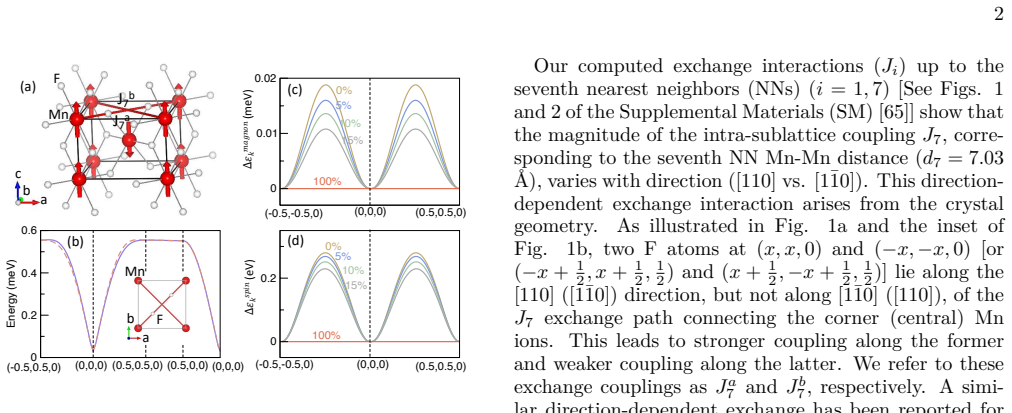
The load-bearing mechanism is exchange-path anisotropy: the seventh-neighbor exchange coupling between Mn ions differs along [110] and [1̵10] ($J_7^a$ vs $J_7^b$) because fluorine ligands occupy one path but not the other. In spin-wave theory this difference enters the bosonic Hamiltonian and produces the analytic identity $\Delta\varepsilon_k^{\mathrm{magnon}} = 4(J_7^b - J_7^a) \sin(k_x a)\sin(k_y a)$, the central formula of the paper. The same fluorine geometry shapes the anisotropic magnetization density (the ferroic magnetic octupole) that gives the electronic bands their non-relativistic spin splitting. Because the reference $P4_2/nnm$ structure can be reached by the two stable $\Gamma$-point phonon modes $A_{2u}$ and $A_{1g}$, the combination of those modes serves as the control parameter that drives $\Delta J_7$ and the octupole to zero together.
What would settle it
A systematic scan of the Coulomb-repulsion parameter $U$ for $J_7^a$ and $J_7^b$, or a polarized-neutron search for handedness-dependent magnon splitting at $\mathbf{k} = (\pm\pi/2a, \pm\pi/2a, \pm\pi/c)$ with resolution below about $0.02\,\mathrm{meV}$, would settle the claim: if the coupling difference changes sign or vanishes under $U$ variation, or if no chiral $d$-wave splitting appears at the predicted wave vector, the central claim fails.
Extended reading notes
Core claim
On the paper's own terms, the central discovery is that electronic and magnonic spin splittings in MnF2 are not independent phenomena but two manifestations of one ligand-driven anisotropy. The fluorine arrangement makes the seventh-neighbor exchange paths inequivalent, and the spin-wave solution gives $\Delta\varepsilon_k^{\mathrm{magnon}} = 4(J_7^b - J_7^a) \sin(k_x a)\sin(k_y a)$, a d-wave splitting that switches sign under $C_{4z}$ rotation of the wave vector. The same anisotropic magnetization density, quantified by ferroically ordered magnetic octupoles, drives the non-relativistic electronic spin splitting. Interpolating the ground-state $P4_2/mnm$ structure to the higher-energy $P4_2/nnm$ structure along the $A_{2u}$ and $A_{1g}$ phonon eigenvectors eliminates the $J_7$ anisotropy and the magnetic octupole moment, so both band splittings vanish continuously while the antiferromagnetic order is preserved. The paper further argues this control is general to other spin-split antiferromagnets, including g-wave ones.
Load-bearing premise
The whole prediction rests on a small computed difference between two magnetic coupling strengths, obtained with one particular choice of the Coulomb-repulsion parameter (Ueff = 5 eV); if that difference is an artifact of the calculation, the magnon splitting and its structural control disappear.
Editorial extensions
If this is right
- Magnonic and electronic band splittings in MnF2 are controlled by the same structural distortion path, so tuning one tunes the other.
- At $\mathbf{k} = (\pm\pi/2a, \pm\pi/2a, \pm\pi/c)$ the magnon eigenvectors take the pure forms $[1\ 0]^T$ and $[0\ 1]^T$, giving left- and right-handed modes that can be probed with circularly polarized photons or polarized neutrons.
- External electric fields of roughly 6.5 to 15 MV/cm along the c axis induce 5 to 15 percent $A_{2u}$ distortion, changing the electronic spin splitting by 4 to 18 percent.
- The mechanism is not restricted to MnF2: any spin-split antiferromagnet whose anisotropic magnetization density comes from nonmagnetic ligand positions could in principle be tuned by analogous phonon distortions, including g-wave systems.
- The transition from a spin-split antiferromagnet to a conventional antiferromagnet is continuous in distortion amplitude, with both splittings vanishing at the 100 percent distorted reference structure.
Reading between the lines
- Editorial inference: because the electronic and magnonic splittings track a single $\Delta J_7$, the magnon d-wave splitting could serve as a bulk, momentum-resolved probe of the altermagnetic order parameter in materials where surface electronic probes are unavailable.
- Editorial inference: the paper's own strain estimate (a 7.7 percent softening of the $A_{2u}$ mode under 2 percent biaxial strain) suggests that epitaxial strain engineering could lower the control fields well below the quoted 6.5–15 MV/cm, making phonon-mediated switching more practical.
- Editorial inference: a femtosecond pump tuned to the $A_{2u}$ mode should transiently suppress both splittings within the phonon period, offering an optical route to ultrafast altermagnet manipulation that the paper motivates but does not explicitly simulate.
- Editorial inference: materials isostructural to MnF2 with softer polar modes or larger ligand-mediated anisotropy should show a larger, easier-to-detect magnon splitting, so the mechanism suggests a design rule for future spin-split antiferromagnets.
Editorial analysis
A structured set of objections, weighed in public.
Referee Report
Summary. The manuscript studies MnF2 as a model d-wave altermagnet and proposes a structural-control mechanism for both the non-relativistic spin splitting of the electronic bands and the d-wave splitting of the magnon bands. From a Heisenberg spin Hamiltonian with exchange couplings computed by DFT+U energy mapping up to the seventh nearest neighbor, the authors derive an analytic magnon splitting Δε_k = 4(J7^b - J7^a) sin(kx a) sin(ky a). They then show that a reference P42/nnm structure, reached by a linear combination of the A2u and A1g phonon distortions, has equal J7 couplings, zero magnetic octupole, and zero electronic spin splitting, thereby establishing a correlation between the three quantities. The paper also develops a Landau expansion in the distortion amplitudes and estimates the electric fields needed to drive the distortions.
Significance. The paper is a timely and well-executed theoretical contribution to altermagnetism. It provides an analytically transparent magnon-splitting formula, a clean first-principles study of exchange couplings, and a concrete proposal for phonon-assisted engineering of both electronic and magnonic splittings. The honest discussion of the neutron-scattering null result (Ref. [71]) and the identification of momentum points with pure handedness are strengths. If the quantitative predictions survive systematic error checks, the proposed mechanism would be of clear interest to the altermagnet and magnonics communities.
major comments (2)
- [Magnon spectra in MnF2 / Eq. (3); SM §I] The central quantitative prediction is the magnon splitting Δε_k, which is controlled by the difference J7^b - J7^a. These couplings are small (the splitting is about 0.02 meV) and are extracted from LDA+U total-energy differences using a single U_eff = 5 eV. The manuscript reports no test of the dependence of ΔJ7 on U_eff, nor any variation of the supercell shape or size used in the mapping, despite the fact that the SCF tolerance of 10^-8 eV only controls numerical noise and not systematic errors. Because a few μeV of error in ΔJ7 can change the sign or magnitude of the predicted splitting, and because the only existing neutron experiment (Ref. [71]) has resolution an order of magnitude larger, this is a load-bearing gap. I request a U-convergence study (e.g., U_eff = 4, 4.5, 5, 5.5, 6 eV) and at least one alternative supercell for the J7 mapping, with the resulting J7^a, J7^b, and Δε_k tabulated. If the sign of ΔJ7 changes, the d-wave formula and the control claim in Fig. 2c would need to be reassessed.
- [Control of magnon splitting / Fig. 2c; Eq. (4)] The tuning curve is computed only along the one-dimensional path β(Q_A2u + Q_A1g). Since the free energy in Eq. (4) contains a Q^2_A2u Q_A1g term, the optimal path is not necessarily a straight line, and the exchange couplings for off-path distortions are never computed. To support the claim of joint control, the authors should show either that ΔJ7 depends only on the sum QA2u + QA1g, or present a small two-dimensional scan of ΔJ7 over the distortion plane. Without this, the reader cannot tell whether the vanishing of the splitting at the reference structure is generic or an artifact of the chosen interpolation path.
minor comments (4)
- [Abstract and Introduction] The phrase spin splitting in magnonic bands is potentially misleading; magnons carry handedness rather than spin polarization in the same sense as electrons. The authors use handedness later in the text, and the abstract would be clearer if it referred to handedness splitting or chiral splitting of magnon bands.
- [Fig. 1 caption and 'Magnon spectra in MnF2'] The statement that the γ_k term has been scaled by a factor of 0.1 is not reflected in the main text, and the reader cannot infer the true magnon bandwidth relative to the 0.02 meV splitting. The authors should state the unscaled bandwidth and explicitly describe how the scaling was applied to the plotted curve.
- [SM §I and main text] The actual values of J7^a and J7^b at the ground-state structure are not reported in the main text; including them (and the resulting ΔJ7) in meV would make it easier to judge the smallness of the difference and the sensitivity of the result.
- [SM Eq. (5)] The notation 'ci' in the phonon expansion should be formatted as c_i (with a subscript). The units of the normalized amplitudes QA2u and QA1g (Å) are not stated in the SM or the main text; please clarify.
Circularity Check
No substantive circularity: the magnon d-wave splitting is an analytical consequence of independently computed J7 exchange couplings and the phonon-control trend is recomputed at distorted geometries; only the by-construction zero-splitting endpoint is definitional.
-
self definitional
[Main text, 'Control of magnon splitting' (construction of P42/nnm reference) and 'Connection to spin splitting in the electronic bands' (vanishing at 100% distortion).]
"we construct a higher-energy structure with zero spin splitting, corresponding to the space group P 42/nnm, by linearly interpolating the two structural domains of MnF 2 ... with opposite spin splitting [49]. ... As evident from the figure, the spin splitting between electronic bands decreases with increasing distortion and, eventually, vanishes for the higher-energy P 42/nnm structure, similar to what we observe with the magnon bands."
The reference structure is introduced as a zero-spin-splitting structure obtained by interpolating two opposite-spin-splitting domains. The later statement that the electronic splitting vanishes at the 100% distorted structure is therefore a restatement of how that endpoint was defined, not an independently predicted property. This is peripheral: the intermediate 0-80% behavior is computed from DFT, the magnon splitting is derived from recomputed exchange couplings, and the central phonon-control claim does not reduce to this endpoint.
full rationale
The central derivation is self-contained. The magnon splitting in Eq. (3) is an analytical spin-wave result obtained from a Heisenberg Hamiltonian whose exchange couplings Ji, including the direction-dependent J7, are computed from DFT+U total-energy mappings; the splitting is not fitted to the magnon data. The structural-control trend is obtained by recomputing the exchange couplings and electronic bands at intermediate distorted geometries, not by imposing the desired splitting. The Landau expansion in Eq. (4) is fitted to DFT energies, but it is used only to rationalize the QA1g = QA2u path, while the tuning curves themselves are direct DFT results. The self-citation to Ref. [49] for the magnetic octupole mechanism is supported by an independent recomputation of O32- in this paper, so it is not load-bearing in a circular sense. The P42/nnm reference's zero-splitting property is a symmetry constraint, and the one definitional endpoint flagged above is minor. Remaining limitations, such as the single Hubbard U value, the absence of systematic U/supercell convergence tests, and the small magnitude of the splitting relative to the 0.1 meV neutron resolution, are correctness risks rather than circularity.
Assumptions & free parameters
free parameters (2)
- Hubbard Ueff at Mn 3d =
5 eV
- Landau expansion coefficients alpha1, alpha2, beta1, beta2, lambda1, lambda2 =
1.061, 0.346, 2.944, 0.907, -6.253, 1.812 eV/f.u.
assumptions (4)
- domain assumption Heisenberg Hamiltonian with exchange couplings up to 7th nearest neighbors plus single-ion anisotropy Dc captures the magnon physics of MnF2.
- domain assumption Four-state energy mapping of DFT+U total energies gives accurate exchange couplings.
- ad hoc to paper The P42/nnm structure has zero spin and magnon splitting and is reachable by a linear interpolation path along A2u and A1g phonon modes with QA1g ≈ QA2u.
- standard math Born-Oppenheimer approximation applies, so static lattice distortions determine electronic and magnonic properties that respond instantaneously.
Cite this review
Pith. "Pith review of Rational Control of Magnonic and Electronic Band Splittings." pith.science (2026). https://pith.science/paper/DCQFKT2B
@misc{pith2026241204934,
  author       = {Pith},
  title        = {Pith review of: Rational Control of Magnonic and Electronic Band Splittings},
  year         = {2026},
  howpublished = {\url{https://pith.science/paper/DCQFKT2B}},
  note         = {Machine review of arXiv:2412.04934}
}
abstract
We provide a theoretical demonstration of controllable non-relativistic spin splitting in both electronic and magnonic bands via targeted structural distortions tied to specific phonon modes. Using MnF$_2$ as a model system, we identify a $d$-wave magnon band splitting between magnon modes of specific handedness, directly correlated with the non-relativistic spin splitting observed in the electronic structure. Crucially, we show that structural distortions associated with the A$_{2u}$ and A$_{1g}$ phonon modes (8.52 and 9.74 THz) modulate these splittings without altering the antiferromagnetic order. The effect originates from changes in the nonmagnetic ligand environment, highlighting the key role of lattice degrees of freedom in governing spin dynamics. Our findings establish a novel route for structure-mediated control of spin splitting, opening possibilities for tunable magnonic and spintronic functionalities in antiferromagnetic materials.
Figures


Figures from the paper (2 more)


Reference graph
Works this paper leans on
-
[71]
V. C. Morano, Z. Maesen, S. E. Nikitin, J. Lass, D. G. Mazzone, and O. Zaharko, Absence of altermagnetic magnon band splitting in MnF 2 (2024), arXiv:2412.03545 [cond-mat.str-el]
work page Pith review arXiv 2024
-
[1]
Hayami, Y
S. Hayami, Y. Yanagi, and H. Kusunose, Momentum- dependent spin splitting by collinear antiferromagnetic ordering, J. Phys. Soc. Jpn. 88, 123702 (2019)
2019
-
[2]
L.-D. Yuan, Z. Wang, J.-W. Luo, E. I. Rashba, and A. Zunger, Giant momentum-dependent spin splitting in centrosymmetric low- z antiferromagnets, Phys. Rev. B 102, 014422 (2020)
2020
-
[3]
L.-D. Yuan, Z. Wang, J.-W. Luo, and A. Zunger, Predic- tion of low-z collinear and noncollinear antiferromagnetic compounds having momentum-dependent spin splitting even without spin-orbit coupling, Phys. Rev. Materials 5, 014409 (2021)
2021
-
[4]
Šmejkal, J
L. Šmejkal, J. Sinova, and T. Jungwirth, Beyond conven- tional ferromagnetism and antiferromagnetism: A phase with nonrelativistic spin and crystal rotation symmetry, Phys. Rev. X 12, 031042 (2022)
2022
-
[5]
Yuan and A
L.-D. Yuan and A. Zunger, Degeneracy removal of spin bands in collinear antiferromagnets with non- interconvertible spin-structure motif pair, Advanced Ma- terials 35, 2211966 (2023)
2023
-
[6]
Y. Guo, H. Liu, O. Janson, I. C. Fulga, J. van den Brink, and J. I. Facio, Spin-split collinear antiferromag- nets: A large-scale ab-initio study, Mater. Today Phys. 32, 100991 (2023)
2023
-
[7]
Zeng and Y.-J
S. Zeng and Y.-J. Zhao, Description of two-dimensional altermagnetism: Categorization using spin group theory, Phys. Rev. B 110, 054406 (2024)
2024
Show all 97 references
-
[8]
S. Lee, S. Lee, S. Jung, J. Jung, D. Kim, Y. Lee, B. Seok, J. Kim, B. G. Park, L. Šmejkal, C.-J. Kang, and C. Kim, Broken Kramers degeneracy in altermag- netic MnTe, Phys. Rev. Lett. 132, 036702 (2024)
2024
-
[9]
Krempaský, L
J. Krempaský, L. Šmejkal, S. W. D’Souza, M. Ha- jlaoui, G. Springholz, K. Uhlířová, F. Alarab, P. C. Constantinou, V. Strocov, D. Usanov, W. R. Pudelko, R. González-Hernández, A. Birk Hellenes, Z. Jansa, H. Reichlová, Z. Šobáň, R. D. Gonzalez Betancourt, P. Wadley, J. Sinova, ...
2024
-
[10]
Reimers, L
S. Reimers, L. Odenbreit, L. Šmejkal, V. N. Strocov, P. Constantinou, A. B. Hellenes, R. Jaeschke Ubiergo, W. H. Campos, V. K. Bharadwaj, A. Chakraborty, T. Denneulin, W. Shi, R. E. Dunin-Borkowski, S. Das, M. Kläui, J. Sinova, and M. Jourdan, Direct observation of altermagnet...
2024
-
[11]
Aoyama and K
T. Aoyama and K. Ohgushi, Piezomagnetic properties in altermagnetic MnTe, Phys. Rev. Mater. 8, L041402 (2024)
2024
-
[12]
Z. Lin, D. Chen, W. Lu, X. Liang, S. Feng, K. Yamagami, J. Osiecki, M. Leandersson, B. Thiagarajan, J. Liu, C. Felser, and J. Ma, Observation of giant spin splitting and d-wave spin texture in room temperature altermag- net RuO 2 (2024), arXiv:2402.04995 [cond-mat.mtrl-sci]
2024 arXiv
-
[13]
K.-H. Ahn, A. Hariki, K.-W. Lee, and J. Kuneš, Antifer- romagnetism in RuO 2 as d-wave Pomeranchuk instabil- ity, Phys. Rev. B 99, 184432 (2019)
2019
-
[14]
Šmejkal, R
L. Šmejkal, R. González-Hernández, T. Jungwirth, and J. Sinova, Crystal time-reversal symmetry breaking and spontaneous Hall effect in collinear antiferromagnets, Sci. Adv. 6, eaaz8809 (2020) , https://www.science.org/doi/pdf/10.1126/sciadv.aaz8809
2020 doi
-
[15]
Šmejkal, J
L. Šmejkal, J. Sinova, and T. Jungwirth, Emerging re- search landscape of altermagnetism, Phys. Rev. X 12, 040501 (2022)
2022
-
[16]
P. A. McClarty and J. G. Rau, Landau theory of alter- magnetism, Phys. Rev. Lett. 132, 176702 (2024)
2024
-
[17]
L. Bai, W. Feng, S. Liu, L. Šmejkal, Y. Mokrousov, and Y. Yao, Altermagnetism: Exploring new frontiers in mag- netism and spintronics (2024), arXiv:2406.02123 [cond- 6 mat.mtrl-sci]
2024 arXiv
-
[18]
M. Naka, S. Hayami, H. Kusunose, Y. Yanagi, Y. Mo- tome, and H. Seo, Spin current generation in organic an- tiferromagnets, Nat. Commun. 10, 4305 (2019)
2019
-
[19]
González-Hernández, L
R. González-Hernández, L. Šmejkal, K. Výborný, Y. Ya- hagi, J. Sinova, T. Jungwirth, and J. Železný, Ef- ficient electrical spin splitter based on nonrelativis- tic collinear antiferromagnetism, Phys. Rev. Lett. 126, 127701 (2021)
2021
-
[20]
Shao, S.-H
D.-F. Shao, S.-H. Zhang, M. Li, C.-B. Eom, and E. Y. Tsymbal, Spin-neutral currents for spintronics, Nat. Commun. 12, 7061 (2021)
2021
-
[21]
A. Bose, N. J. Schreiber, R. Jain, D.-F. Shao, H. P. Nair, J. Sun, X. S. Zhang, D. A. Muller, E. Y. Tsymbal, D. G. Schlom, and D. C. Ralph, Tilted spin current generated by the collinear antiferromagnet ruthenium dioxide, Nat. Electron. 5, 267 (2022)
2022
-
[22]
M. Hu, O. Janson, C. Felser, P. McClarty, J. van den Brink, and M. G. Vergniory, Spin Hall and edelstein effects in novel chiral noncollinear altermagnets (2024), arXiv:2410.17993 [cond-mat.mtrl-sci]
2024
-
[23]
H. Bai, L. Han, X. Y. Feng, Y. J. Zhou, R. X. Su, Q. Wang, L. Y. Liao, W. X. Zhu, X. Z. Chen, F. Pan, X. L. Fan, and C. Song, Observation of spin splitting torque in a collinear antiferromagnet RuO 2, Phys. Rev. Lett. 128, 197202 (2022)
2022
-
[24]
Karube, T
S. Karube, T. Tanaka, D. Sugawara, N. Kadoguchi, M. Kohda, and J. Nitta, Observation of spin-splitter torque in collinear antiferromagnetic RuO 2, Phys. Rev. Lett. 129, 137201 (2022)
2022
-
[25]
Šmejkal, A
L. Šmejkal, A. B. Hellenes, R. González-Hernández, J. Sinova, and T. Jungwirth, Giant and tunneling mag- netoresistance in unconventional collinear antiferromag- nets with nonrelativistic spin-momentum coupling, Phys. Rev. X 12, 011028 (2022)
2022
-
[26]
Šmejkal, A
L. Šmejkal, A. H. MacDonald, J. Sinova, S. Nakatsuji, and T. Jungwirth, Anomalous Hall antiferromagnets, Na- ture Reviews Materials 7, 482 (2022)
2022
-
[27]
Reichlová, R
H. Reichlová, R. L. Seeger, R. González-Hernández, I. Kounta, R. Schlitz, D. Kriegner, P. Ritzinger, M. Lam- mel, M. Leiviskä, V. Petříček, P. Doležal, E. Schmoranze- rová, A. Bad’ura, A. Thomas, V. Baltz, L. Michez, J. Sinova, S. T. B. Goennenwein, T. Jungwirth, and L. Šmejka...
2020 arXiv
-
[28]
Z. Feng, X. Zhou, L. Šmejkal, L. Wu, Z. Zhu, H. Guo, R. González-Hernández, X. Wang, H. Yan, P. Qin, X. Zhang, H. Wu, H. Chen, Z. Meng, L. Liu, Z. Xia, J. Sinova, T. Jungwirth, and Z. Liu, An anomalous Hall effect in altermagnetic ruthenium dioxide, Nat. Electron. 5, 735 (2022)
2022
-
[29]
R. D. Gonzalez Betancourt, J. Zubáč, R. Gonzalez- Hernandez, K. Geishendorf, Z. Šobáň, G. Springholz, K. Olejník, L. Šmejkal, J. Sinova, T. Jungwirth, S. T. B. Goennenwein, A. Thomas, H. Reichlová, J. Železný, and D. Kriegner, Spontaneous anomalous Hall effect arising from an ...
2023
-
[30]
Šmejkal, A
L. Šmejkal, A. H. MacDonald, J. Sinova, S. Nakatsuji, and T. Jungwirth, Anomalous Hall antiferromagnets, Nat. Rev. Mater. 7, 482 (2022)
2022
-
[31]
Cheong and F.-T
S.-W. Cheong and F.-T. Huang, Altermagnetism with non-collinear spins, npj Quantum Materials 9, 13 (2024)
2024
-
[32]
T. Sato, S. Haddad, I. C. Fulga, F. F. Assaad, and J. van den Brink, Altermagnetic anomalous Hall effect emerging from electronic correlations, Phys. Rev. Lett. 133, 086503 (2024)
2024
-
[33]
I. I. Mazin, Notes on altermagnetism and superconduc- tivity, arXiv 2203.05000 (2022)
2022 arXiv
-
[34]
Zhu, Z.-Y
D. Zhu, Z.-Y. Zhuang, Z. Wu, and Z. Yan, Topological superconductivity in two-dimensional altermagnetic met- als, Phys. Rev. B 108, 184505 (2023)
2023
-
[35]
Banerjee and M
S. Banerjee and M. S. Scheurer, Altermagnetic supercon- ducting diode effect, Phys. Rev. B 110, 024503 (2024)
2024
-
[36]
Chakraborty and A
D. Chakraborty and A. M. Black-Schaffer, Zero-field finite-momentum and field-induced superconductivity in altermagnets, Phys. Rev. B 110, L060508 (2024)
2024
-
[37]
Zhang, L.-H
S.-B. Zhang, L.-H. Hu, and T. Neupert, Finite- momentum cooper pairing in proximitized altermagnets, Nat. Commun. 15, 1801 (2024)
2024
-
[38]
S. H. Lee, Y. Qian, and B.-J. Yang, Fermi surface spin texture and topological superconductivity in spin-orbit free noncollinear antiferromagnets, Phys. Rev. Lett. 132, 196602 (2024)
2024
-
[39]
X. Zhou, W. Feng, R.-W. Zhang, L. Šmejkal, J. Sinova, Y. Mokrousov, and Y. Yao, Crystal thermal transport in altermagnetic ruo2, Phys. Rev. Lett. 132, 056701 (2024)
2024
-
[40]
K. V. Yershov, V. P. Kravchuk, M. Daghofer, and J. van den Brink, Fluctuation-induced piezomagnetism in local moment altermagnets, Phys. Rev. B 110, 144421 (2024)
2024
-
[41]
Šmejkal, A
L. Šmejkal, A. Marmodoro, K.-H. Ahn, R. González- Hernández, I. Turek, S. Mankovsky, H. Ebert, S. W. D’Souza, O. c. v. Šipr, J. Sinova, and T. c. v. Jungwirth, Chiral magnons in altermagnetic RuO 2, Phys. Rev. Lett. 131, 256703 (2023)
2023
-
[42]
P. A. McClarty, A. Gukasov, and J. G. Rau, Ob- serving altermagnetism using polarized neutrons (2024), arXiv:2410.10771 [cond-mat.str-el]
2024 arXiv
-
[43]
Z. Liu, M. Ozeki, S. Asai, S. Itoh, and T. Masuda, Chiral split magnon in altermagnetic MnTe, Phys. Rev. Lett. 133, 156702 (2024)
2024
-
[44]
We will stick to handedness in the rest of the article
-
[45]
Q. Cui, B. Zeng, P. Cui, T. Yu, and H. Yang, Efficient spin seebeck and spin nernst effects of magnons in alter- magnets, Phys. Rev. B 108, L180401 (2023)
2023
-
[46]
de Haas, B
W. de Haas, B. Schultz, and J. Koolhaas, Further mea- surements of the magnetic properties of some salts of the iron group at low temperatures, Physica 7, 57 (1940)
1940
-
[47]
M. S. Seehra and R. E. Helmick, Anomalous changes in the dielectric constants of MnF 2 near its néel tempera- ture, J. Appl. Phys. 55, 2330 (1984)
1984
-
[48]
Yamani, Z
Z. Yamani, Z. Tun, and D. H. Ryan, Neutron scatter- ing study of the classical antiferromagnet MnF 2: a per- fect hands-on neutron scattering teaching course, Can. J. Phys. 88, 771 (2010)
2010
-
[49]
Bhowal and N
S. Bhowal and N. A. Spaldin, Ferroically ordered mag- netic octupoles in d-wave altermagnets, Phys. Rev. X 14, 011019 (2024)
2024
-
[50]
Costa and P
M. Costa and P. Brown, Magnetisation density in MnF 2, Physica B: Condensed Matter 156-157, 329 (1989)
1989
-
[51]
E. A. Mashkovich, K. A. Grishunin, R. M. Dubrovin, A. K. Zvezdin, R. V. Pisarev, and A. V. Kimel, Tera- hertz light–driven coupling of antiferromagnetic spins to lattice, Science 374, 1608 (2021)
2021
-
[52]
A. S. Disa, M. Fechner, T. F. Nova, B. Liu, M. Först, D. Prabhakaran, P. G. Radaelli, and A. Cavalleri, Po- 7 larizing an antiferromagnet by optical engineering of the crystal field, Nat. Phys. 16, 937 (2020)
2020
-
[53]
T. W. J. Metzger, K. A. Grishunin, C. Reinhoffer, R. M. Dubrovin, A. Arshad, I. Ilyakov, T. V. A. G. de Oliveira, A. Ponomaryov, J.-C. Deinert, S. Kovalev, R. V. Pis- arev, M. I. Katsnelson, B. A. Ivanov, P. H. M. van Loos- drecht, A. V. Kimel, and E. A. Mashkovich, Magnon- ph...
2024
-
[54]
R. M. Dubrovin, A. Tellez-Mora, A. C. Garcia-Castro, N. V. Siverin, N. N. Novikova, K. N. Boldyrev, E. A. Mashkovich, A. H. Romero, and R. V. Pisarev, Polar phonons and magnetic excitations in the antiferromagnet CoF2, Phys. Rev. B 109, 224312 (2024)
2024
-
[55]
X. Duan, J. Zhang, Z. Zhu, Y. Liu, Z. Zhang, I. Žutić, and T. Zhou, Antiferroelectric altermagnets: Antiferro- electricity alters magnets, Phys. Rev. Lett. 134, 106801 (2025)
2025
-
[56]
M. Gu, Y. Liu, H. Zhu, K. Yananose, X. Chen, Y. Hu, A. Stroppa, and Q. Liu, Ferroelectric switchable alter- magnetism, Phys. Rev. Lett. 134, 106802 (2025)
2025
-
[57]
Šmejkal, Altermagnetic multiferroics and alter- magnetoelectric effect (2024), arXiv:2411.19928 [cond- mat.mtrl-sci]
L. Šmejkal, Altermagnetic multiferroics and alter- magnetoelectric effect (2024), arXiv:2411.19928 [cond- mat.mtrl-sci]
2024 arXiv
-
[58]
Kirilyuk, A
A. Kirilyuk, A. V. Kimel, and T. Rasing, Ultrafast optical manipulation of magnetic order, Rev. Mod. Phys. 82, 2731 (2010)
2010
-
[59]
P. E. Blöchl, Projector augmented-wave method, Phys. Rev. B 50, 17953 (1994)
1994
-
[60]
Kresse and D
G. Kresse and D. Joubert, From ultrasoft pseudopoten- tials to the projector augmented-wave method, Phys. Rev. B 59, 1758 (1999)
1999
-
[61]
Kresse and J
G. Kresse and J. Hafner, Ab initio molecular dynamics for liquid metals, Phys. Rev. B 47, 558 (1993)
1993
-
[62]
Kresse and J
G. Kresse and J. Furthmüller, Efficient iterative schemes for ab initio total-energy calculations using a plane-wave basis set, Phys. Rev. B 54, 11169 (1996)
1996
-
[63]
H. J. Xiang, E. J. Kan, S.-H. Wei, M.-H. Whangbo, and X. G. Gong, Predicting the spin-lattice order of frus- trated systems from first principles, Phys. Rev. B 84, 224429 (2011)
2011
-
[64]
Šabani, C
D. Šabani, C. Bacaksiz, and M. V. Milošević, Ab initio methodology for magnetic exchange parameters: Generic four-state energy mapping onto a heisenberg spin hamil- tonian, Phys. Rev. B 102, 014457 (2020)
2020
-
[65]
Supplemental materials for the computational details of the DFT and the magnon calculations, and the additional results for the exchange coupling calculations
-
[66]
[41] considers an antiferromagnetic ground state, the ground state magnetism of RuO 2 remains de- batable [ 67–69]
Although Ref. [41] considers an antiferromagnetic ground state, the ground state magnetism of RuO 2 remains de- batable [ 67–69]
-
[67]
Smolyanyuk, I
A. Smolyanyuk, I. I. Mazin, L. Garcia-Gassull, and R. Valentí, Fragility of the magnetic order in the pro- totypical altermagnet RuO 2, Phys. Rev. B 109, 134424 (2024)
2024
-
[68]
Hiraishi, H
M. Hiraishi, H. Okabe, A. Koda, R. Kadono, T. Muroi, D. Hirai, and Z. Hiroi, Nonmagnetic ground state in RuO2 revealed by muon spin rotation, Phys. Rev. Lett. 132, 166702 (2024)
2024
-
[69]
Keßler, L
P. Keßler, L. Garcia-Gassull, A. Suter, T. Prokscha, Z. Salman, D. Khalyavin, P. Manuel, F. Orlandi, I. I. Mazin, R. Valentí, and S. Moser, Absence of magnetic order in RuO 2: insights from µsr spectroscopy and neu- tron diffraction, npj Spintronics 2, 50 (2024)
2024
-
[70]
Holstein and H
T. Holstein and H. Primakoff, Field dependence of the intrinsic domain magnetization of a ferromagnet, Phys. Rev. 58, 1098 (1940)
1940
-
[72]
Togo and I
A. Togo and I. Tanaka, First principles phonon calcu- lations in materials science, Scripta Materialia 108, 1 (2015)
2015
-
[73]
H. T. Stokes, D. M. Hatch, and B. J. Campbell, ISODIS- TORT, ISOTROPY software suite, https://iso.byu. edu ()
-
[74]
B. J. Campbell, H. T. Stokes, D. E. Tanner, and D. M. Hatch, ISODISPLACE: a web-based tool for exploring structural distortions, Journal of Applied Crystallogra- phy 39, 607 (2006)
2006
-
[75]
Bandyopadhyay and P
S. Bandyopadhyay and P. Ghosez, Structurally triggered orbital and charge orderings in TlMnO 3 and related com- pounds (2024), arXiv:2407.21406 [cond-mat.str-el]
2024 arXiv
-
[76]
QA2u and QA1g are normalized to their amplitudes at P 42/nnm structure
-
[77]
Hioki, Y
T. Hioki, Y. Hashimoto, and E. Saitoh, Coherent oscil- lation between phonons and magnons, Communications Physics 5, 115 (2022)
2022
-
[78]
S. Liu, A. Granados del Águila, D. Bhowmick, C. K. Gan, T. Thu Ha Do, M. A. Prosnikov, D. Sedmidub- ský, Z. Sofer, P. C. M. Christianen, P. Sengupta, and Q. Xiong, Direct observation of magnon-phonon strong coupling in two-dimensional antiferromagnet at high magnetic fields, P...
2021
-
[79]
T. T. Mai, K. F. Garrity, A. McCreary, J. Argo, J. R. Simpson, V. Doan-Nguyen, R. V. Aguilar, and A. R. H. Walker, Magnon-phonon hybridization in 2d antiferro- magnet MnPSe 3, Science Advances 7, eabj3106 (2021)
2021
-
[80]
The symmetry allowed terms in the free energy are ob- tained using the INV ARIANTS software [ 81, 82]
-
[81]
H. T. Stokes, D. M. Hatch, and B. J. Campbell, INV ARI- ANTS, ISOTROPY Software Suite ()
-
[82]
D. M. Hatch and H. T. Stokes, INV ARIANTS: program for obtaining a list of invariant polynomials of the order- parameter components associated with irreducible repre- sentations of a space group, Journal of Applied Crystal- lography 36, 951 (2003)
2003
-
[83]
K. D. Kim, Y. B. Lee, S. H. Lee, I. S. Lee, S. K. Ryoo, S. Byun, J. H. Lee, H. Kim, H. W. Park, and C. S. Hwang, Evolution of the ferroelectric properties of alscn film by electrical cycling with an inhomogeneous field distribution, Advanced Electronic Materials 9, 2201142 (2023)
2023
-
[84]
Varignon, N
J. Varignon, N. C. Bristowe, and P. Ghosez, Electric field control of jahn-teller distortions in bulk perovskites, Phys. Rev. Lett. 116, 057602 (2016)
2016
-
[85]
Y. Yang, J. Íñiguez, A.-J. Mao, and L. Bellaiche, Predic- tion of a novel magnetoelectric switching mechanism in multiferroics, Phys. Rev. Lett. 112, 057202 (2014)
2014
-
[86]
altermagnetic
or strain engineering [ 65]. Connection to spin splitting in the electronic bands- To investigate the impact of joint control of A 2u and A 1g structural distortions on the electronic bands, we further analyze the corresponding electronic bands for intermedi- ate distortions. ...
2022
-
[87]
Cricchio, Multipoles in Correlated Electron Materials , Ph.D
F. Cricchio, Multipoles in Correlated Electron Materials , Ph.D. thesis , Uppsala University (2010)
2010
-
[88]
Bandyopadhyay, S
S. Bandyopadhyay, S. Picozzi, and S. Bhowal, Designing non-relativistic spin splitting in oxide perovskites (2025), arXiv:2503.17001 [cond-mat.mtrl-sci]
2025 arXiv
-
[89]
N. A. Spaldin, M. Fechner, E. Bousquet, A. Balatsky, and L. Nordström, Monopole-based formalism for the diago- nal magnetoelectric response, Phys. Rev. B 88, 094429 (2013)
2013
-
[90]
Grånäs, Theoretical Studies of Magnetism and Elec- tron Correlation in Solids , Ph.D
O. Grånäs, Theoretical Studies of Magnetism and Elec- tron Correlation in Solids , Ph.D. thesis, Uppsala Univer- sity (2012). 8
2012
-
[91]
Hoyer, P
R. Hoyer, P. P. Stavropoulos, A. Razpopov, R. Valentí, L. Šmejkal, and A. Mook, Altermagnetic splitting of magnons in hematite ( α-fe2o3) (2025), arXiv:2503.11623 [cond-mat.str-el]
2025 arXiv
-
[92]
X. H. Verbeek, D. Voderholzer, S. Schären, Y. Gachnang, N. A. Spaldin, and S. Bhowal, Nonrelativistic ferromag- netotriakontadipolar order and spin splitting in hematite, Phys. Rev. Res. 6, 043157 (2024)
2024
-
[93]
Resta, Macroscopic electric polarization as a geomet- ric quantum phase, Europhysics Letters 22, 133 (1993)
R. Resta, Macroscopic electric polarization as a geomet- ric quantum phase, Europhysics Letters 22, 133 (1993)
1993
-
[94]
R. D. King-Smith and D. Vanderbilt, Theory of polariza- tion of crystalline solids, Phys. Rev. B 47, 1651 (1993)
1993
-
[96]
Resta, Macroscopic polarization in crystalline di- electrics: the geometric phase approach, Rev
R. Resta, Macroscopic polarization in crystalline di- electrics: the geometric phase approach, Rev. Mod. Phys. 66, 899 (1994) . Supplemental Materials for Rational Control of Magnonic and Electronic Band Splittings I. COMPUT A TIONAL DET AILS The electronic structure of MnF 2,...
1994
-
[97]
∆J7 vanishes for P 42/nnm structure, explaining the suppression of the magnon band splitting
The corresponding distances are also listed in Table II. ∆J7 vanishes for P 42/nnm structure, explaining the suppression of the magnon band splitting. We note that the J2 and J5 exchange couplings, in contrast, become inequivalent for the P 42/nnm structure. We further compute...
-
[110]
magnon splitting
([1¯10]) direction, but not along [1¯10] ([110]), of the J7 exchange path connecting the corner (central) Mn ions. This leads to stronger coupling along the former and weaker coupling along the latter. We refer to these exchange couplings as J a 7 and J b 7, respectively. A si...
Reviewed August 11, 2026 · model on record in the stance chip above.
Discussion (0). Continue with ORCID to comment.