REVIEW 5 major objections 6 minor 24 references
Can Large Language Models Serve as Effective Classifiers for Hierarchical Multi-Label Classification of Scientific Documents at Industrial Scale?
T0 review · 5 major / 6 minor · reviewed 2026-08-11 · deepseek-v4-flash
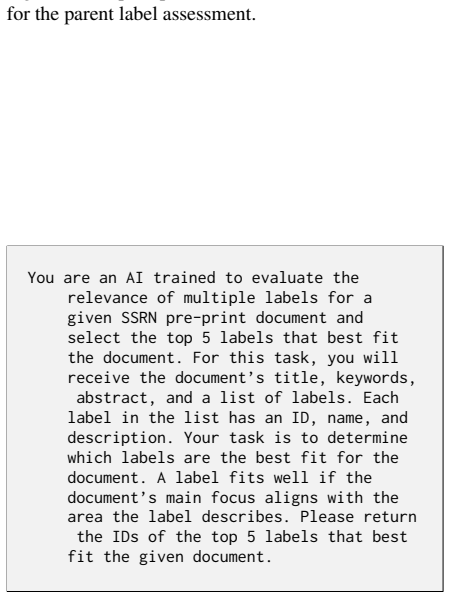
Pith's one-line read The paper claims that a zero-shot LLM plus a dense-retrieval pre-filter beats a fine-tuned classifier on a large, dynamic taxonomy, at 94.3% versus 61.5% SME-rated accuracy and at about $0.20 per document instead of $3.50.
desk verdict The 94.3% vs 61.5% accuracy gap is not established because the method was tuned on the same SME judgments used to measure it; the paper still deserves referee time as a useful industrial case study. read the letter →
The pith
A machine-rendered reading of the paper's core claim, the machinery that carries it, and where it could break.
The reading
What carries the argument
The mechanism that carries the argument is two-stage pruning with pointwise LLM assessment. A bi-encoder (the all-mpnet-base-v2 model in the paper's experiments) embeds the document and every leaf node, then returns the top 40 leaves; the LLM then judges each leaf and each direct parent independently with a binary fit prompt, and a final deterministic post-processing step caps the label count and prevents sibling bias. This formulation turns one taxonomy-wide multi-label problem into a small set of independent binary decisions, which is what allows a zero-shot LLM to handle a dynamic taxonomy with thousands of labels and no retraining.
What would settle it
Take a fresh random sample of, say, 200 documents that was not used for any tuning, freeze LLM-SelectP's hyperparameters and post-processing rules, and have SMEs blind to method rate both LLM-SelectP and SPECTER2 on the same acceptability scale. If SPECTER2's acceptability rate falls within the confidence interval of LLM-SelectP's on that held-out sample, the claimed superiority would not survive.
Extended reading notes
Core claim
The central claim is that the right division of labour makes LLMs work on taxonomies with thousands of labels that would never fit in a prompt. Rather than asking the LLM to traverse the whole hierarchy or score all candidates at once, the paper first uses a bi-encoder dense retriever to rank candidate leaf labels by cosine similarity to the document, keeps the top 40, and then asks the LLM to make a separate binary fit judgment for each candidate leaf and for its parent node. A post-processing step trims the label set to at most five labels and discourages over-selection from a single sibling group. The paper reports that LLM-SelectP reaches 94.3% SME acceptability, that this beats every other proposed variant and the SPECTER2 baseline, and that ablations show each stage matters: dropping the post-processing cut drops accuracy to 62.9%, while removing label descriptions or parent-node contextualization drops it to 85.7%.
Load-bearing premise
The result rests on the assumption that SME binary acceptability ratings on 100 documents per method, collected after the same SME feedback was used to tune each method's top-k, scoring rule, and post-processing choices, are a valid and fair basis for comparing a 94.3% score against SPECTER2's 61.5%.
Editorial extensions
If this is right
- Taxonomy updates become cheap: new, merged, or deprecated labels are handled by re-embedding the labels rather than recollecting training data and retraining a model.
- Per-document classification cost drops from about $3.50 to about $0.20, which at over 140,000 submissions per year yields projected savings above $100,000 in a single year.
- The three proposed LLM variants are not interchangeable: pointwise binary assessment (LLM-SelectP) is markedly more accurate than one-pass listwise selection (58.6%), rerank scoring (70.0%), or pure LLM taxonomy traversal (50.0%).
- Every component of LLM-SelectP is load-bearing: removing label-set reduction drops accuracy from 94.3% to 62.9%, and removing generated label descriptions or parent-node checks drops it to 85.7%.
- Zero-shot use of a commercial LLM can outperform a fine-tuned domain embedding model on SME-rated quality in this industrial setting, which suggests retraining is not always the best route to accuracy on dynamic label spaces.
Reading between the lines
- The same retrieve-then-assess recipe should transfer to other large, text-defined label spaces that change over time, such as product taxonomies, legal codes, or medical terminologies; a direct test needs no training labels, only label names, descriptions, and a retrieval index.
- A stricter like-for-like comparison would give the SPECTER2 baseline the same auto-generated label descriptions and the same top-40 candidate filter; the paper does not report such a comparison, so part of the accuracy gap may come from that asymmetry.
- The metadata-only pipeline could be extended by sending full text to the LLM only for documents where the metadata-based confidence is low; the paper identifies this as future work, and the cost would stay near $0.20 if only a small fraction of documents triggers it.
Signed reviews
Editorial analysis
A structured set of objections, weighed in public.
Referee Report
Summary. The paper proposes zero-shot hierarchical multi-label classification (HMC) methods for large, dynamic taxonomies, combining a bi-encoder retriever to prune the label space with LLM-based label selection. It evaluates the methods on SSRN preprints, reporting that the best method, LLM-SelectP, achieves 94.3% accuracy versus 61.5% for the fine-tuned SPECTER2 baseline, while reducing classification cost from $3.50 to about $0.20 per document. The paper also releases code and describes an SME-based evaluation framework. The core claim is that a zero-shot, retraining-free pipeline can replace a fine-tuned classifier in a large industrial taxonomy.
Significance. If the reported accuracy comparison were established, the result would be practically significant: it would demonstrate that a zero-shot retrieval-plus-LLM pipeline can surpass a fine-tuned baseline in a real-world, large-scale HMC task without retraining on taxonomy updates, at a fraction of the cost. The industrial context, the public code release, and the focus on dynamic taxonomies are strengths. However, the evaluation methodology as presented does not currently support the headline numeric claims, and the dynamic-taxonomy contribution is not tested by any experiment.
major comments (5)
- [§4.2–§4.4 and §5, Table 2] The headline accuracy of LLM-SelectP (94.3%, Table 2) is not an unbiased estimate because the method's free parameters were selected using the same SME evaluation set that later produces the accuracy. §4.2 states that the top-k value of 40 was 'suggested by SMEs after analyzing the best performing methods results'; §4.3.2 states that the reranking scoring function was chosen empirically; §4.4 states that the label-reduction and sibling-diversity rules are 'based on SME's suggestion.' All these choices were made against the SME acceptability feedback that is the sole accuracy signal in §5. To support the comparison, the authors should either fix all hyperparameters before evaluation on a held-out set of SME judgments, or use a nested training/validation/test protocol for the SME-derived choices, and report confidence intervals for the accuracy estimates.
- [Table 2 and §5] The sample sizes per method are not reported, and the percentages in Table 2 are inconsistent with the stated 100 documents per method. For example, LLM-SelectP's row sums to 100.1% over percentages that cannot arise from 100 binary judgments (32.9%, 38.6%, 22.9%, 4.3%, 1.4%), while SPECTER2's row (11.5%, 50.0%, 30.7%, 7.8%) sums to 100.0% but implies denominators near 26. The exact n for each method must be stated, and the comparison should be conducted on equal, pre-specified sample sizes; otherwise the 32.8-point gap may reflect different evaluation sets.
- [§5, §8, and dynamic-taxonomy claims] The paper claims to handle large, dynamic taxonomies without retraining, but no experiment evaluates a taxonomy update. All evaluations in §5 and Table 2 are performed on the current static SSRN taxonomy, and the proposed evaluation framework is not shown to simulate label additions, merges, or deprecations. Without such an evaluation, the contribution to dynamic HMC is unsupported; at minimum, the authors should simulate taxonomy changes (e.g., adding a new node, merging siblings) and show that the zero-shot method maintains accuracy while a fine-tuned baseline would require re-annotation and retraining.
- [Table 2 baseline comparison] The comparison with SPECTER2 is not apples-to-apples. LLM-SelectP benefits from the SME-informed post-processing (max five labels, sibling reduction), while SPECTER2's 61.5% accuracy is reported without this post-processing or any equivalent label-adjustment step. It is unclear whether SPECTER2's predictions were also limited to at most five labels and subjected to the same sibling-diversity rule; if not, the accuracy gap might be substantially reduced by applying the same post-processing. The authors should evaluate SPECTER2 under the identical post-processing and evaluation protocol, or explicitly justify why the baseline should not receive it.
- [§5 evaluation protocol] The evaluation relies on binary acceptability judgments from SMEs, but no inter-annotator agreement is reported, and the paper itself notes (Appendix A.2) that multiple label sets can be 'perfect' for the same document. With a single SME per document and no measure of agreement, the accuracy estimates have unknown noise; the authors should report agreement statistics (e.g., Cohen's kappa or Fleiss' kappa) on a subset of double-annotated documents and include confidence intervals for the headline accuracy.
minor comments (6)
- [§1] The statement that 'human classification accuracy varies between 65% and 90%' is presented without supporting data or methodology; either provide the evidence or remove the claim.
- [Table 2 caption] The caption says 'SelectL and SelectP refers to Listwise and Pointwise respectively,' but the table contains LLM-SelectO rather than LLM-SelectL; align the notation.
- [§7] The claim of 'consistent quality that surpasses the accuracy of manual classification' is not directly measured in the paper; rephrase to avoid overclaiming, since the evaluation protocol compares methods against SME judgments, not against a manual classification process under the same protocol.
- [Appendix A.5] The description-generation prompt in Figure 4 is incomplete; for reproducibility, the full prompt with placeholders for label name, parent name, and parent description should be provided.
- [§4.2 and Figure 2] The legend in Figure 2 includes a 'current model' entry whose identity is not clearly defined in the caption; specify which model this refers to.
- [§4.4] The ablation named 'LLM-SelectP w/o decreasing (random selection)' is confusing: the text says that for LLM-Rerank labels are already scored, but the ablation name suggests random selection; clarify what the ablation actually removes or replaces.
Circularity Check
The 94.3% accuracy of LLM-SelectP is in part a fit to its own evaluation rubric: top-k, post-processing, and method tweaks were chosen using SME feedback that Section 5 then uses as the accuracy score.
-
fitted input called prediction
[Section 4.2 (Initial Filtering with Bi-Encoder Models)]
"Consequently, to optimize both effectiveness and computational costs, we present the top 40 leaf nodes, as suggested by SMEs after analyzing the best performing methods results, from the bi-encoder model, along with their hierarchical context (i.e., the full path to the root) as the pruned taxonomy (PT), to our proposed LLM-based classification methods"
Top-k=40 is a hyperparameter of LLM-SelectP's pipeline, and the paper says it was chosen by SMEs after inspecting methods' results. The headline accuracy in Table 2 is then computed from the same kind of SME acceptability judgments ('SMEs reviewed a set of 100 documents for each method... We report the percentage of positive responses as accuracy'). No held-out separation between tuning and evaluation is described, so the 94.3% figure partly encodes choices made against the evaluation rubric.
-
fitted input called prediction
[Section 4.4 (Post-Processing) and Table 2]
"All approaches conclude with a post-processing step to refine the final label set, a recommendation from SMEs. ... (ii) Decreasing number of siblings. This step is based on SME's suggestion and the goal is to ensure that not all labels are selected from one parent; preventing from being biased to a single subcategory within the taxonomy."
The post-processing rules (max five labels, reduce sibling clusters) are derived from SME preferences and are applied only to the proposed LLM methods, not to SPECTER2. Since the evaluation metric is exactly SME acceptance of the output label set, adding SME-designed constraints makes the method trivially closer to the rubric. The paper's own ablation shows the label-decreasing step contributes about 31 accuracy points (94.3 vs 62.9), so this is a load-bearing fit, not a minor detail.
1 more flagged steps
-
fitted input called prediction
[Section 5 (Evaluation Framework)]
"We used the GENEX, an evaluation tool developed by Elsevier (Figure 11), to assist SMEs in evaluating the labels and gathering quantitative feedback, including questions like 'What is the ideal label set?', 'Why did you assign this score?', and 'What makes a label set unsuitable?' These insights were pivotal during the Proof of Concept (PoC) phase to address approach limitations."
This states that feedback from the evaluation instrument was used to modify the approaches during development, and the same SME-judgment instrument is later used to produce the reported accuracy. Thus the central numeric comparison (0.943 vs 0.615) does not measure out-of-sample prediction; it measures agreement between the method and a rubric on which the method was iteratively tuned, while SPECTER2 was evaluated without the same SME-informed post-processing.
full rationale
Score 6: the paper's core claim is partially circular. No self-citation chain or imported 'uniqueness' result is involved: the methodology is genuinely self-contained in the sense that the LLM's label decisions come from document content and taxonomy. The circularity sits in the evaluation loop. The text explicitly ties the choice of top-k, the rerank scoring rule, and the post-processing steps to SME feedback, and Section 5's accuracy is the percentage of the same kind of SME judgments. There is no statement of a pre-registered held-out SME set, and SPECTER2 is not given the SME-designed post-processing. As a result, the reported 32.8-point gap bundles genuine method quality with tuning advantage. The dynamic-taxonomy claim is also untested because every experiment is on the current static taxonomy, and the Table 2 denominators are not clearly reported; these are correctness risks rather than circularity. The finding here is a moderate, evaluation-level circularity, not a derivation that defines its output as its input.
Assumptions & free parameters
free parameters (5)
- top_k =
40
- scoring_function =
leaf node score only
- max_labels =
5
- sibling_reduction_rule =
unspecified
- bi_encoder_model =
all-mpnet-base-v2
assumptions (4)
- domain assumption Title, abstract, and keywords are sufficient for classification; full text is excluded.
- domain assumption SME acceptability judgments are a valid reference for estimating classification accuracy.
- domain assumption The bi-encoder can retrieve a sufficient proportion of relevant labels in the top-40 candidates.
- domain assumption The taxonomy snapshot used in evaluation is representative of the dynamic taxonomy the system must handle.
Cite this review
Pith. "Pith review of Can Large Language Models Serve as Effective Classifiers for Hierarchical Multi-Label Classification of Scientific Documents at Industrial Scale?." pith.science (2026). https://pith.science/paper/ICVBGSN7
@misc{pith2026241205137,
  author       = {Pith},
  title        = {Pith review of: Can Large Language Models Serve as Effective Classifiers for Hierarchical Multi-Label Classification of Scientific Documents at Industrial Scale?},
  year         = {2026},
  howpublished = {\url{https://pith.science/paper/ICVBGSN7}},
  note         = {Machine review of arXiv:2412.05137}
}
read the original abstract
We address the task of hierarchical multi-label classification (HMC) of scientific documents at an industrial scale, where hundreds of thousands of documents must be classified across thousands of dynamic labels. The rapid growth of scientific publications necessitates scalable and efficient methods for classification, further complicated by the evolving nature of taxonomies--where new categories are introduced, existing ones are merged, and outdated ones are deprecated. Traditional machine learning approaches, which require costly retraining with each taxonomy update, become impractical due to the high overhead of labelled data collection and model adaptation. Large Language Models (LLMs) have demonstrated great potential in complex tasks such as multi-label classification. However, applying them to large and dynamic taxonomies presents unique challenges as the vast number of labels can exceed LLMs' input limits. In this paper, we present novel methods that combine the strengths of LLMs with dense retrieval techniques to overcome these challenges. Our approach avoids retraining by leveraging zero-shot HMC for real-time label assignment. We evaluate the effectiveness of our methods on SSRN, a large repository of preprints spanning multiple disciplines, and demonstrate significant improvements in both classification accuracy and cost-efficiency. By developing a tailored evaluation framework for dynamic taxonomies and publicly releasing our code, this research provides critical insights into applying LLMs for document classification, where the number of classes corresponds to the number of nodes in a large taxonomy, at an industrial scale.
Figures


Figures from the paper (6 more)



Reference graph
Works this paper leans on
-
[1]
URL: " 'urlintro :=
ENTRY address author booktitle chapter edition editor howpublished institution journal key month note number organization pages publisher school series title type volume year eprint doi pubmed url lastchecked label extra.label sort.label short.list INTEGERS output.state before.all mid.sentence after.sentence after.block STRINGS urlintro eprinturl eprintpr...
-
[2]
write newline
" write newline "" before.all 'output.state := FUNCTION n.dashify 't := "" t empty not t #1 #1 substring "-" = t #1 #2 substring "--" = not "--" * t #2 global.max substring 't := t #1 #1 substring "-" = "-" * t #2 global.max substring 't := while if t #1 #1 substring * t #2 global.max substring 't := if while FUNCTION word.in bbl.in capitalize " " * FUNCT...
-
[3]
Yupeng Chang, Xu Wang, Jindong Wang, Yuan Wu, Linyi Yang, Kaijie Zhu, Hao Chen, Xiaoyuan Yi, Cunxiang Wang, Yidong Wang, et al. 2024. A survey on evaluation of large language models. ACM Transactions on Intelligent Systems and Technology, 15(3):1--45
2024
-
[4]
Arman Cohan, Sergey Feldman, Iz Beltagy, Doug Downey, and Daniel S Weld. 2020. Specter: Document-level representation learning using citation-informed transformers. arXiv preprint arXiv:2004.07180
arXiv 2020
-
[5]
Maziar Moradi Fard, Paula Sorrolla Bayod, Kiomars Motarjem, Mohammad Alian Nejadi, Saber Akhondi, and Camilo Thorne. 2023. Learning section weights for multi-label document classification. arXiv preprint arXiv:2311.15402
work page Pith review arXiv 2023
-
[6]
C. Lee Giles, Kurt D. Bollacker, and Steve Lawrence. 1998. https://doi.org/10.1145/276675.276685 Citeseer: An automatic citation indexing system . In Proceedings of the Third ACM Conference on Digital Libraries, DL '98, page 89–98, New York, NY, USA. Association for Computing Machinery
arXiv 1998
-
[7]
Vladimir Karpukhin, Barlas O g uz, Sewon Min, Patrick Lewis, Ledell Wu, Sergey Edunov, Danqi Chen, and Wen-tau Yih. 2020. Dense passage retrieval for open-domain question answering. arXiv preprint arXiv:2004.04906
arXiv 2020
-
[8]
Kamran Kowsari, Donald E Brown, Mojtaba Heidarysafa, Kiana Jafari Meimandi, , Matthew S Gerber, and Laura E Barnes. 2017. Hdltex: Hierarchical deep learning for text classification. In Machine Learning and Applications (ICMLA), 2017 16th IEEE International Conference on. IEEE
work page 2017
Show all 24 references
-
[9]
Rundong Liu, Wenhan Liang, Weijun Luo, Yuxiang Song, He Zhang, Ruohua Xu, Yunfeng Li, and Ming Liu. 2023. Recent advances in hierarchical multi-label text classification: A survey. arXiv preprint arXiv:2307.16265
2023 arXiv
-
[10]
Qing Lu and Lise Getoor. 2003. Link-based classification. In Proceedings of the 20th International Conference on Machine Learning (ICML-03), pages 496--503
2003
-
[11]
Andrew Kachites McCallum, Kamal Nigam, Jason Rennie, and Kristie Seymore. 2000. https://doi.org/10.1023/A:1009953814988 Automating the construction of internet portals with machine learning . Inf. Retr., 3(2):127–163
2000 doi
-
[12]
Ankit Pal, Muru Selvakumar, and Malaikannan Sankarasubbu. 2020. Multi-label text classification using attention-based graph neural network. arXiv preprint arXiv:2003.11644
2020 arXiv
-
[13]
Mobashir Sadat and Cornelia Caragea. 2022. https://doi.org/10.18653/v1/2022.emnlp-main.610 Hierarchical multi-label classification of scientific documents . In Proceedings of the 2022 Conference on Empirical Methods in Natural Language Processing, pages 8923--8937, Abu Dhabi, ...
2022 doi
-
[14]
Ant \'o nio Paulo Santos and F \'a tima Rodrigues. 2009. Multi-label hierarchical text classification using the acm taxonomy. In 14th Portuguese Conference on Artificial Intelligence (EPIA), volume 5, pages 553--564. Springer Berlin
2009
-
[15]
Amanpreet Singh, Mike D'Arcy, Arman Cohan, Doug Downey, and Sergey Feldman. 2022. Scirepeval: A multi-format benchmark for scientific document representations. arXiv preprint arXiv:2211.13308
2022 arXiv
-
[16]
Autumn Toney and James Dunham. 2022. Multi-label classification of scientific research documents across domains and languages. In Proceedings of the Third Workshop on Scholarly Document Processing, pages 105--114
2022
-
[17]
Min Wang and Yan Gao. 2024. A multi-label text classification model with enhanced label information. In 2024 27th International Conference on Computer Supported Cooperative Work in Design (CSCWD), pages 329--334. IEEE
2024
-
[18]
Lee Xiong, Chenyan Xiong, Ye Li, Kwok-Fung Tang, Jialin Liu, Paul Bennett, Junaid Ahmed, and Arnold Overwijk. 2020. Approximate nearest neighbor negative contrastive learning for dense text retrieval. arXiv preprint arXiv:2007.00808
2020 arXiv
-
[19]
Pengcheng Yang, Xu Sun, Wei Li, Shuming Ma, Wei Wu, and Houfeng Wang. 2018. https://www.aclweb.org/anthology/C18-1330 SGM : Sequence generation model for multi-label classification . In Proceedings of the 27th International Conference on Computational Linguistics, pages 3915--...
2018
-
[20]
Alessandro Zangari, Matteo Marcuzzo, Matteo Rizzo, Lorenzo Giudice, Andrea Albarelli, and Andrea Gasparetto. 2024. Hierarchical text classification and its foundations: A review of current research. Electronics, 13(7):1199
2024
-
[21]
Yu Zhang, Bowen Jin, Xiusi Chen, Yanzhen Shen, Yunyi Zhang, Yu Meng, and Jiawei Han. 2023. Weakly supervised multi-label classification of full-text scientific papers. In Proceedings of the 29th ACM SIGKDD Conference on Knowledge Discovery and Data Mining, pages 3458--3469
2023
-
[22]
Chloe Qinyu Zhu, Rickard Stureborg, and Bhuwan Dhingra. 2024. Hierarchical multi-label classification of online vaccine concerns. arXiv preprint arXiv:2402.01783
2024 arXiv
-
[23]
online" 'onlinestring :=
ENTRY address archivePrefix author booktitle chapter edition editor eid eprint eprinttype howpublished institution journal key month note number organization pages publisher school series title type volume year doi pubmed url lastchecked label extra.label sort.label short.list...
-
[24]
write newline
" write newline "" before.all 'output.state := FUNCTION n.dashify 't := "" t empty not t #1 #1 substring "-" = t #1 #2 substring "--" = not "--" * t #2 global.max substring 't := t #1 #1 substring "-" = "-" * t #2 global.max substring 't := while if t #1 #1 substring * t #2 gl...
Reviewed August 11, 2026 · model on record in the stance chip above.
Discussion (0). Continue with ORCID to comment.