REVIEW 3 major objections 5 minor 1 cited by
$\epsilon$-rank and the Staircase Phenomenon: New Insights into Neural Network Training Dynamics
T0 review · 3 major / 5 minor · reviewed 2026-08-11 · deepseek-v4-flash
Pith's one-line read The paper establishes that as a neural network trains with standard SGD, the effective rank of its last hidden layer's features rises in steps, and it proves a lower bound making high effective rank necessary for large loss reductions.
desk verdict Useful empirical observation and a simple initialization trick, but the 'rank growth is necessary for loss reduction' claim is oversold; worth a serious referee. read the letter →
The pith
A machine-rendered reading of the paper's core claim, the machinery that carries it, and where it could break.
The reading
What carries the argument
The load-bearing object is the $\epsilon$-rank $r_\epsilon(M_u)$, defined as the number of eigenvalues of the Gram matrix $M_u$ (with entries $\int_\Omega \phi_i(x;\theta)\phi_j(x;\theta)\,dx$ for the last-hidden-layer neuron functions $\phi_j$) that exceed a tolerance $\epsilon$. It converts the question of how many useful features a layer has into a linear-algebra count. The argument then runs through two steps: a matrix perturbation lemma (Lemma 3.1, based on rank-revealing QR factorizations) showing that any $n$-function set with $\epsilon$-rank $p$ has a $p$-function subset that approximates the original span to within a controlled error, and Theorem 3.2, which combines that approximation with a stability condition on the solution operator to lower-bound the loss of any low-$p$ approximator. The same machinery motivates the pre-training strategy: by constructing the first hidden layer with localized, well-separated neurons (via explicit centers in 1D and random directions on the unit sphere in higher dimensions), the $\epsilon$-rank is forced to $O(n)$ from the start, bypassing the staircase.
What would settle it
Train a wide network on a target that is exactly a linear combination of two fixed basis functions (for example, $u^*(x)=\cos x+2\sin x$). If the training loss can be driven to machine precision while the last hidden layer's Gram matrix has $\epsilon$-rank near 2 throughout the run, the necessity claim is refuted. The same test can be run on a classification dataset whose labels depend linearly on a low-dimensional projection of the input.
Extended reading notes
Core claim
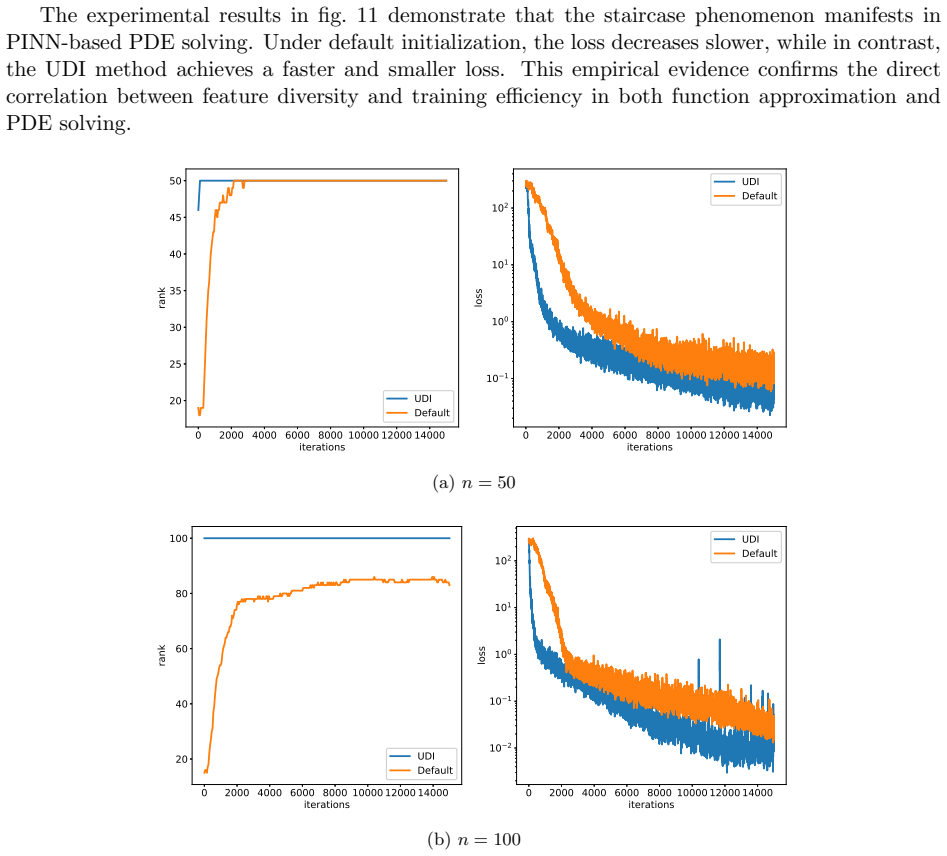
On the paper's own terms, the central discovery is that the evolution of a network's last-hidden-layer feature diversity is not smooth but stepwise, and that this stepwise behavior is forced by a quantitative relation between loss and effective rank. The relevant bound is $\sqrt{L(u_n)} \ge \frac{1}{C_S}\left(\operatorname{dist}(u^*, F_p) - \sqrt{C(p+1)(n-p)^2\epsilon}\right)$ for any approximator $u_n$ whose $\epsilon$-rank is $p$; here $u^*$ is the exact solution, $F_p$ is the class of networks with $p$ neurons, $C_S$ is a stability constant, and $\epsilon$ is the tolerance defining the rank. Since $\epsilon$ is small, the bound says the best possible loss is controlled by how far the true solution is from the $p$-neuron network class. Reducing the loss therefore requires reducing that distance, which in turn requires increasing $p$. The paper interprets this as the theoretical explanation of the staircase: when the $\epsilon$-rank is stuck at a low level, the loss is trapped at a plateau; when the rank jumps up, the loss drops sharply. It then shows experimentally that raising the initial $\epsilon$-rank of the first hidden layer through a tailored initialization produces the same final accuracy in fewer iterations.
Load-bearing premise
The paper's necessity conclusion rests on the assumption, stated in Section 3.1, that the exact solution $u^*$ does not belong to the network function class $F_n$; if the target can be represented exactly or very accurately by a small number of features, loss can go to zero while the $\epsilon$-rank stays low, and the claimed necessity would fail.
Editorial extensions
If this is right
- If the necessity claim holds, a flat loss curve with a stagnant $\epsilon$-rank is a capacity signal: the network is not failing because of learning rate or optimizer choice, but because its last hidden layer lacks functionally independent features.
- A practical corollary is that initialization and architecture choices that raise the initial $\epsilon$-rank should reduce or remove the early-training plateau, which the paper demonstrates with its first-layer pre-training strategy.
- The lower bound ties optimization to approximation theory: the achievable loss after training is limited by $\operatorname{dist}(u^*, F_p)$, so progress requires effective rank to grow until the target is well approximated by the feature span.
- Layer-wise experiments showing higher $\epsilon$-rank in deeper layers suggest that feature diversity is built up through the network, so shallow bottlenecks can be identified by comparing per-layer ranks.
- The staircase is observed across function fitting, PDE solving, and image classification, so if universal it applies to the common deep-learning pipeline for scientific computing as much as to vision tasks.
Reading between the lines
- The paper stops short of prescribing rank monitoring as an adaptive training control; an immediate extension would be to trigger learning-rate changes or early stopping when $\epsilon$-rank plateaus, which the staircase observation suggests.
- The necessity result may fail to transfer to classification losses: for a dataset whose classes are separated by a low-dimensional manifold, cross-entropy loss can plausibly reach near zero while the last-layer $\epsilon$-rank stays small. That is testable by measuring ranks on well-trained classifiers.
- The UDI initialization samples directions uniformly on the sphere; a natural extension is to replace random directions with data-dependent or learned directions, or to apply the same rank-boosting idea to convolutional filters, which the paper does not explore.
- The conjecture that the sharp constant in Lemma 3.1 is $1/\sqrt{n}$ for all $p$ is a standalone mathematical question; resolving it would tighten the loss lower bound and sharpen the claimed necessity.
Editorial analysis
A structured set of objections, weighed in public.
Referee Report
Summary. The paper introduces the ε-rank of the Gram matrix of last-hidden-layer neuron functions, reports a 'staircase phenomenon' in which loss plateaus are accompanied by stepwise increases in this rank across function fitting, PINN, and MNIST experiments, and proves in Theorem 3.2 a lower bound on L2 residual loss in terms of dist(u*, F_p). It interprets this bound as showing that a sufficiently high ε-rank is a necessary condition for significant loss reduction. It then proposes a uniform-distribution initialization (UDI) that gives O(n) ε-rank at initialization and reports faster convergence and improved accuracy in 1D/2D function fitting and PINN tests.
Significance. The ε-rank is a clean, computable diagnostic, and the empirical staircase pattern across several tasks is a useful observation that connects naturally to spectral bias and feature-learning dynamics. The UDI initialization is simple, cheap, and appears to help in the tested settings, with numerical settings documented in Appendix A. The theoretical result, however, is a static approximation bound rather than a training-dynamics necessity theorem; the paper's central claim overstates what Eq. (9) actually establishes. With a weaker, properly qualified statement and additional numerical checks of dist(u*, F_p), the contribution would be valuable to the deep-learning theory community.
major comments (3)
- [§3.1, Eq. (9), Remark 3.2] The central claim that a sufficiently high ε-rank is essential for significant loss reduction is not a consequence of Theorem 3.2. For a fixed p, Eq. (9) is a static lower bound; the loss can decrease toward dist(u*,F_p)/C_s − O(√ε) while the ε-rank remains p. Necessity of rank growth follows only if the final loss is below the bound computed at the initial p and dist(u*,F_p)>0 for all smaller p. The manuscript never estimates dist(u*,F_p) for its problems, and the assumption u*∉F_n is too weak to imply it: a target fδ = tanh(a1·x)+tanh(a2·x)+δg with g∉F_n and δ small is not in F_n yet has dist(fδ,F_2)=O(δ), so Eq. (9) does not rule out reaching O(δ²) loss with ε-rank O(2). The abstract, Section 1, and Remark 3.2 should be revised to state this conditional form of the claim.
- [§2.2, Example 2.3 and §3] Theorem 3.2 is stated for losses L(u)=||G(u)−f||² with a stable solution operator G^{-1}, but Figure 5 (MNIST) uses cross-entropy loss, for which the theorem does not apply. Since Fig. 5 is presented as evidence of universality and Section 3 as its theoretical explanation, this is a gap. Either extend the theory to classification losses or explicitly present the MNIST observation as an empirical phenomenon outside the scope of the theorem.
- [§4.2, Eq. (11), Fig. 8] The pre-training strategy is motivated by the layer-wise observation in Fig. 8, but that observation is reported for a single network (L=4, n=50) on one task. Since Section 4.2 states a general 'depth-dependent growth in ε-rank', supporting evidence across widths, depths, and tasks, or an explicit disclaimer that this is a single-run observation, is needed before the motivation for UDI is fully established.
minor comments (5)
- [Example 4.3] The example title contains a typo: 'Possion's equation' should be 'Poisson's equation'.
- [Figures 2, 3, 10] Several axis labels are malformed (for example, 'L oss' in Figures 2 and 3, and broken superscripts in Figure 10); please regenerate the figures with correct typography.
- [§4] The term 'pre-training' is used for a one-time initialization scheme rather than a separate training phase; consider renaming it 'specialized initialization' to avoid confusion with standard pretraining.
- [Definition 2.4 and Eq. (12)] The ε-rank is computed in practice from a quadrature or Monte Carlo approximation of the Gram matrix, but the paper does not state an error bound connecting the discrete and continuous ranks; a short remark on how m and the quadrature weights affect the reported ranks would help.
- [§3.1] The assumption u*∉F_n is not verified for any of the numerical examples; the paper should at least acknowledge that this is an assumption rather than a checked condition.
Circularity Check
No circularity: the epsilon-rank definitions, Theorem 3.2 bound, and UDI experiments do not reduce to fitted inputs or self-citations.
full rationale
The paper's central theoretical result (Theorem 3.2) is derived from Definition 2.4 and Theorem 3.1 using an external rank-revealing lemma [13]. The lower bound sqrt(L(u_n)) >= (dist(u*,F_p) - O(sqrt(eps)))/C_s is a mathematical consequence of the fact that an epsilon-rank-p Gram matrix leaves a tail of eigenvalues below epsilon; it does not fit any parameter to the loss data and does not assume the staircase conclusion. This is a definitional consequence rather than a circular prediction, and the paper does not use the theorem's bound as the source of the training curves it reports. The staircase phenomenon is an empirical observation recovered independently from loss and rank measurements, and the UDI pretraining method is evaluated by loss/accuracy, not solely by the epsilon-rank it was designed to raise. No load-bearing self-citations appear; reference [13] is external and [38] is used for inspiration, not as justification of the necessity claim. The main weakness is logical, not circular: Remark 3.2 moves from a static lower bound to the dynamic conclusion that loss reduction forces rank growth, and the standing assumption u* not in F_n does not guarantee dist(u*,F_p)>0 for p<n. That is an overclaim or missing support, but it is not an input-output equivalence. Also, the near-tautological status of the bound does not make the derivation circular, because Definition 2.4 does not mention loss or training dynamics. Score 0.
Assumptions & free parameters
free parameters (4)
- epsilon tolerance for rank =
1e-6 for most examples, 1e-8 for Example 2.2, 1e-12 for Example 3.2
- gamma (UDI shape parameter) =
gamma = 2 for Example 4.2, gamma = n/50 for Example 4.3
- PINN loss weights mu_bc and mu_ic =
1 or 20 depending on example
- Gram matrix quadrature size m =
129, 100, 65, or 50 depending on example
assumptions (6)
- domain assumption The exact solution u* does not belong to the network function class F_n
- domain assumption Stability condition (8): G^{-1} is Lipschitz with constant C_S
- domain assumption Coefficient norm bound ||beta||_2 <= C
- standard math Hong-Pan rank-revealing QR bound (Lemma 3.1 of [13])
- standard math Universal approximation theorem for the activation functions used
- domain assumption Discrete quadrature or Monte Carlo samples approximate the L2 Gram matrix
Cite this review
Pith. "Pith review of $\epsilon$-rank and the Staircase Phenomenon: New Insights into Neural Network Training Dynamics." pith.science (2026). https://pith.science/paper/5ZYOL75F
@misc{pith2026241205144,
  author       = {Pith},
  title        = {Pith review of: $\epsilon$-rank and the Staircase Phenomenon: New Insights into Neural Network Training Dynamics},
  year         = {2026},
  howpublished = {\url{https://pith.science/paper/5ZYOL75F}},
  note         = {Machine review of arXiv:2412.05144}
}
abstract
Understanding the training dynamics of deep neural networks (DNNs), particularly how they evolve low-dimensional features from high-dimensional data, remains a central challenge in deep learning theory. In this work, we introduce the concept of $\epsilon$-rank, a novel metric quantifying the effective feature of neuron functions in the terminal hidden layer. Through extensive experiments across diverse tasks, we observe a universal staircase phenomenon: during training process implemented by the standard stochastic gradient descent methods, the decline of the loss function is accompanied by an increase in the $\epsilon$-rank and exhibits a staircase pattern. Theoretically, we rigorously prove a negative correlation between the loss lower bound and $\epsilon$-rank, demonstrating that a high $\epsilon$-rank is essential for significant loss reduction. Moreover, numerical evidences show that within the same deep neural network, the $\epsilon$-rank of the subsequent hidden layer is higher than that of the previous hidden layer. Based on these observations, to eliminate the staircase phenomenon, we propose a novel pre-training strategy on the initial hidden layer that elevates the $\epsilon$-rank of the terminal hidden layer. Numerical experiments validate its effectiveness in reducing training time and improving accuracy across various tasks. Therefore, the newly introduced concept of $\epsilon$-rank is a computable quantity that serves as an intrinsic effective metric characteristic for deep neural networks, providing a novel perspective for understanding the training dynamics of neural networks and offering a theoretical foundation for designing efficient training strategies in practical applications.
Figures


Figures from the paper (8 more)


Forward citations
Cited by 1 Pith paper
-
Structured First-Layer Initialization Pre-Training Techniques to Accelerate Training Process Based on $\varepsilon$-Rank
A structured first-layer initialization raises the ε-rank of neuron functions and accelerates training of PINNs and function approximators.
Reference graph
Works this paper leans on
-
[1]
On the Inductive Bias of Neural Tangent Kernels
Alberto Bietti and Julien Mairal. On the Inductive Bias of Neural Tangent Kernels. In Advances in Neural Information Processing Systems , volume 32, pages 12893–12904. Curran Associates, Inc., 2019
work page 2019
-
[2]
The Random Feature Method for Time-Dependent Problems
Jingrun Chen, Weinan E, and Yixin Luo. The Random Feature Method for Time-Dependent Problems. East Asian Journal on Applied Mathematics , 13(3):435–463, January 2023. 22 Table 2: Numerical experiment settings in function fitting and solving PDEs Example L n m N ϵ Other Parameters F unction Fitting example 2.1(a) 2/4 25/50 129 250 10 −6 - example 2.1(b) 3 ...
work page 2023
-
[3]
Optimization of Random Feature Method in the High- Precision Regime
Jingrun Chen, Weinan E, and Yifei Sun. Optimization of Random Feature Method in the High- Precision Regime. Communications on Applied Mathematics and Computation , 6(2):1490– 1517, June 2024
work page 2024
-
[4]
A Generalized Neural Tangent Kernel Analysis for Two-layer Neural Networks
Zixiang Chen, Yuan Cao, Quanquan Gu, and Tong Zhang. A Generalized Neural Tangent Kernel Analysis for Two-layer Neural Networks. In Advances in Neural Information Processing Systems, volume 33, pages 13363–13373. Curran Associates, Inc., 2020
work page 2020
-
[5]
Sharp Minima Can Gener- alize For Deep Nets
Laurent Dinh, Razvan Pascanu, Samy Bengio, and Yoshua Bengio. Sharp Minima Can Gener- alize For Deep Nets. In Proceedings of the 34th International Conference on Machine Learning, pages 1019–1028. PMLR, July 2017
work page 2017
-
[6]
Suchuan Dong and Zongwei Li. Local extreme learning machines and domain decomposition for solving linear and nonlinear partial differential equations. Computer Methods in Applied Mechanics and Engineering , 387:114129, December 2021
work page 2021
-
[7]
Weinan E, Jiequn Han, and Arnulf Jentzen. Deep learning-based numerical methods for high-dimensional parabolic partial differential equations and backward stochastic differential equations. Communications in Mathematics and Statistics , 5(4):349–380, 2017
work page 2017
-
[8]
The deep Ritz method: A deep learning-based numerical algorithm for solving variational problems
Weinan E and Bing Yu. The deep Ritz method: A deep learning-based numerical algorithm for solving variational problems. Communications in Mathematics and Statistics , 6(1):1–12, 2018. 23
work page 2018
Show all 38 references
-
[9]
Understanding the difficulty of training deep feedforward neural networks
Xavier Glorot and Yoshua Bengio. Understanding the difficulty of training deep feedforward neural networks. In Proceedings of the Thirteenth International Conference on Artificial In- telligence and Statistics , pages 249–256, 2010
2010
-
[10]
ReLU deep neural networks from the hierarchical basis perspective
Juncai He, Lin Li, and Jinchao Xu. ReLU deep neural networks from the hierarchical basis perspective. Computers & Mathematics with Applications , 120:105–114, August 2022
2022
-
[11]
Relu Deep Neural Networks and Linear Finite Elements
Juncai He, Lin Li, Jinchao Xu, and Chunyue Zheng. Relu Deep Neural Networks and Linear Finite Elements. Journal of Computational Mathematics , 38(3):502–527, 2020
2020
-
[12]
Flat Minima
Sepp Hochreiter and J¨ urgen Schmidhuber. Flat Minima. Neural Computation , 9(1):1–42, January 1997
1997
-
[13]
Y. P. Hong and C.-T. Pan. Rank-revealing QR factorizations and the singular value decom- position. Mathematics of Computation , 58(197):213–232, 1992
1992
-
[14]
Approximation capabilities of multilayer feedforward networks
Kurt Hornik. Approximation capabilities of multilayer feedforward networks. Neural Networks, 4(2):251–257, 1991
1991
-
[15]
Universal Approximation using Incre- mental Constructive Feedforward Networks with Random Hidden Nodes
Guang-Bin Huang, Lei Chen, and Chee-Kheong Siew. Universal Approximation using Incre- mental Constructive Feedforward Networks with Random Hidden Nodes. IEEE Transactions on Neural Networks , 17(4):879–892, July 2006
2006
-
[16]
Extreme learning machine: Theory and applications
Guang-Bin Huang, Qin-Yu Zhu, and Chee-Kheong Siew. Extreme learning machine: Theory and applications. Neurocomputing, 70(1):489–501, December 2006
2006
-
[17]
Neural Tangent Kernel: Convergence and Generalization in Neural Networks
Arthur Jacot, Franck Gabriel, and Clement Hongler. Neural Tangent Kernel: Convergence and Generalization in Neural Networks. In Advances in Neural Information Processing Systems , volume 31, pages 8580–8589. Curran Associates, Inc., 2018
2018
-
[18]
On large-batch training for deep learning: Generalization gap and sharp minima
Nitish Shirish Keskar, Dheevatsa Mudigere, Jorge Nocedal, Mikhail Smelyanskiy, and Ping Tak Peter Tang. On large-batch training for deep learning: Generalization gap and sharp minima. In International Conference on Learning Representations , 2017
2017
-
[19]
Wight and Jia Zhao
Colby L. Wight and Jia Zhao. Solving Allen-Cahn and Cahn-Hilliard Equations Using the Adaptive Physics Informed Neural Networks. Communications in Computational Physics , 29(3):930–954, 2021
2021
-
[20]
Visualizing the Loss Landscape of Neural Nets
Hao Li, Zheng Xu, Gavin Taylor, Christoph Studer, and Tom Goldstein. Visualizing the Loss Landscape of Neural Nets. In Advances in Neural Information Processing Systems, volume 31, pages 6391–6401. Curran Associates, Inc., 2018
2018
-
[21]
Multi-Scale Deep Neural Network (MscaleDNN) for Solving Poisson-Boltzmann Equation in Complex Domains.Communications in Computational Physics, 28(5):1970–2001, 2020
Ziqi Liu, Wei Cai, and Zhi-Qin John Xu. Multi-Scale Deep Neural Network (MscaleDNN) for Solving Poisson-Boltzmann Equation in Complex Domains.Communications in Computational Physics, 28(5):1970–2001, 2020
1970
-
[22]
Meethal, Anoop Kodakkal, Mohamed Khalil, Aditya Ghantasala, Birgit Obst, Kai- Uwe Bletzinger, and Roland W¨ uchner
Rishith E. Meethal, Anoop Kodakkal, Mohamed Khalil, Aditya Ghantasala, Birgit Obst, Kai- Uwe Bletzinger, and Roland W¨ uchner. Finite element method-enhanced neural network for forward and inverse problems. Advanced Modeling and Simulation in Engineering Sciences , 10(1):6, Ma...
2023
-
[23]
Mitusch, Simon W
Sebastian K. Mitusch, Simon W. Funke, and Miroslav Kuchta. Hybrid FEM-NN models: Combining artificial neural networks with the finite element method.Journal of Computational Physics, 446:110651, December 2021
2021
-
[24]
Nelsen and Andrew M
Nicholas H. Nelsen and Andrew M. Stuart. The Random Feature Model for Input-Output Maps between Banach Spaces. SIAM Journal on Scientific Computing , 43(5):A3212–A3243, January 2021
2021
-
[25]
On the Spectral Bias of Neural Networks
Nasim Rahaman, Aristide Baratin, Devansh Arpit, Felix Draxler, Min Lin, Fred Hamprecht, Yoshua Bengio, and Aaron Courville. On the Spectral Bias of Neural Networks. In Proceedings of the 36th International Conference on Machine Learning , pages 5301–5310. PMLR, May 2019
-
[26]
Random features for large-scale kernel machines
Ali Rahimi and Benjamin Recht. Random features for large-scale kernel machines. Advances in neural information processing systems , 20:1177–1184, 2007
2007
-
[27]
Physics-informed neural networks: A deep learning framework for solving forward and inverse problems involving nonlinear partial differential equations
Maziar Raissi, Paris Perdikaris, and George E Karniadakis. Physics-informed neural networks: A deep learning framework for solving forward and inverse problems involving nonlinear partial differential equations. Journal of Computational Physics , 378:686–707, 2019
2019
-
[28]
Ramuhalli, L
P. Ramuhalli, L. Udpa, and S.S. Udpa. Finite-Element Neural Networks for Solving Differential Equations. IEEE Transactions on Neural Networks , 16(6):1381–1392, November 2005
2005
-
[29]
DGM: A deep learning algorithm for solving partial differential equations
Justin Sirignano and Konstantinos Spiliopoulos. DGM: A deep learning algorithm for solving partial differential equations. Journal of Computational Physics , 375:1339–1364, 2018
2018
-
[30]
When and why PINNs fail to train: A neural tangent kernel perspective
Sifan Wang, Xinling Yu, and Paris Perdikaris. When and why PINNs fail to train: A neural tangent kernel perspective. Journal of Computational Physics , 449:110768, January 2022
2022
-
[31]
Multi-scale deep neural network (MscaleDNN) methods for oscillatory stokes flows in complex domains
Wenzhong Wang, BoZhang and Wei Cai. Multi-scale deep neural network (MscaleDNN) methods for oscillatory stokes flows in complex domains. Communications in Computational Physics, 28(5):2139–2157, 2020
2020
-
[32]
Frequency Principle: Fourier Analysis Sheds Light on Deep Neural Networks
Zhi-Qin John Xu. Frequency Principle: Fourier Analysis Sheds Light on Deep Neural Networks. Communications in Computational Physics , 28(5):1746–1767, June 2020
2020
-
[33]
Overview Frequency Principle/Spectral Bias in Deep Learning
Zhi-Qin John Xu, Yaoyu Zhang, and Tao Luo. Overview Frequency Principle/Spectral Bias in Deep Learning. Communications on Applied Mathematics and Computation , September 2024
2024
-
[34]
Training Behavior of Deep Neural Network in Frequency Domain
Zhi-Qin John Xu, Yaoyu Zhang, and Yanyang Xiao. Training Behavior of Deep Neural Network in Frequency Domain. In Tom Gedeon, Kok Wai Wong, and Minho Lee, editors, Neural Information Processing, pages 264–274, Cham, 2019. Springer International Publishing
2019
-
[35]
Weak adversarial networks for high-dimensional partial differential equations
Yaohua Zang, Gang Bao, Xiaojing Ye, and Haomin Zhou. Weak adversarial networks for high-dimensional partial differential equations. Journal of Computational Physics , 411:109409, 2020
2020
-
[36]
Zeiler and Rob Fergus
Matthew D. Zeiler and Rob Fergus. Visualizing and Understanding Convolutional Networks. In David Fleet, Tomas Pajdla, Bernt Schiele, and Tinne Tuytelaars, editors, Computer Vision – ECCV 2014 , pages 818–833, Cham, 2014. Springer International Publishing. 25
2014
-
[37]
Why shallow networks struggle with approximating and learning high frequency: A numerical study, 2023
Shijun Zhang, Hongkai Zhao, Yimin Zhong, and Haomin Zhou. Why shallow networks struggle with approximating and learning high frequency: A numerical study, 2023
2023
-
[38]
Transferable Neural Networks for Partial Differential Equations
Zezhong Zhang, Feng Bao, Lili Ju, and Guannan Zhang. Transferable Neural Networks for Partial Differential Equations. Journal of Scientific Computing , 99(1):2, February 2024. 26
2024
Reviewed August 11, 2026 · model on record in the stance chip above.
Discussion (0). Continue with ORCID to comment.