REVIEW 3 major objections 6 minor 1 cited by
Diffusion cascade in a model of interacting random walkers
T0 review · 3 major / 6 minor · reviewed 2026-08-11 · deepseek-v4-flash
Pith's one-line read Density waves in a nonlinear diffusive gas relax on a wavelength-independent clock at late times.
desk verdict The paper's surprise—a Q-independent stretched-exponential decay rate—is plausible but not yet proven; the data quality and analysis fall short of the claim. read the letter →
The pith
A machine-rendered reading of the paper's core claim, the machinery that carries it, and where it could break.
The reading
What carries the argument
The central object is the nonlinear diffusion equation with a density-dependent diffusion constant, D(ρ) = D0(1+αρ), realized by a one-dimensional hardcore lattice gas updated in random trimers with tunable mobilities. The cascade mechanism is the repeated decay of a density wave at Q into pairs at Q/2, which relax more slowly, so the slowest relaxation is carried by a cascade to progressively smaller wavevectors. The paper's main quantitative tool is the numerical extraction of the density autocorrelation G(Q,t) in large lattices (up to $10^{6}$ samples), supported by exact noise-averaged dynamics in small rings and a field-theoretic path-integral calculation of the two-wave correlator at first order in the nonlinearity. The empirical form log G(Q,t) ~ -C $\sqrt$(t) with Q-independent C ≈ 0.4 is the load-bearing identity: it implies a finite length scale that replaces $Q^{2}$ in the relaxation rate.
What would settle it
Measure log G(Q,t) for several wavevectors at times well beyond the current simulation window (or push the crossover later by weakening the nonlinearity) and check whether the late-time slope of log G versus $\sqrt$(t) is still zero over Q; a slope that scales as $\sqrt$(D $Q^{2}$) would refute the paper's central claim.
Extended reading notes
Core claim
The paper's central claim is that in a facilitated lattice gas with strong hydrodynamic nonlinearities, the late-time relaxation of a weak density modulation at wavevector Q follows f(Q) exp(-C $\sqrt$(t)) with a scale C that is essentially independent of Q, contradicting the diffusion-cascade prediction exp(-$\sqrt$(D $Q^{2}$ t)). The crossover from ordinary diffusion (log G ~ -D $Q^{2}$ t) to this stretched-exponential regime is controlled by the diffusive timescale t ~ 1/$Q^{2}$, so the Q-dependence hides in the prefactor f(Q) rather than in the exponent. The paper also shows that the underlying cascade does occur: second-harmonic generation matches perturbative theory at short times, and a three-point correlation function shows coherent generation of wave pairs. The discrepancy with theory is therefore attributed to the treatment of the high-order, nonperturbative diagrams that dominate the extremely late-time asymptotics.
Load-bearing premise
The claim that the late-time decay rate does not depend on the wavelength is inferred from slopes fitted in a finite simulation window, with no error bars and residual curvature, so the result assumes those slopes are the true late-time limit.
Editorial extensions
If this is right
- At sufficiently late times, every finite-wavevector density perturbation in a strongly nonlinear one-dimensional diffusive system relaxes at the same rate, so the wavelength controls the crossover time but not the asymptotic decay constant.
- The crossover time from diffusive to cascade-dominated relaxation scales as 1/Q^2, meaning short-wavelength modes enter the universal tail much earlier than long-wavelength ones.
- The cascade 'shower' mechanism is verified at the perturbative level through second-harmonic generation and coherent two-wave correlations, so the breakdown of the prediction is confined to the nonperturbative, high-order diagram sector.
- In finite systems, the low-lying relaxation rates are not simply n times the fundamental mode rate; residual wave interactions produce corrections that vanish as 1/L^2, a signature that can be tested in exact small-system simulations.
Reading between the lines
- A testable extension would be to measure the same autocorrelation in a model where the nonlinear coupling can be tuned independently of the bare diffusion constant, to see whether the Q-independent scale C shifts with the lattice-scale physics as the paper's dimensional argument suggests.
- The paper's finding implies that other one-dimensional stochastic lattice gases with density-dependent mobility should show the same universal stretched-exponential tail with a model-dependent C; this could be checked with existing code by scanning the update rule.
- If C is indeed set by the lattice scale, then the same relaxation form should appear in the response of conserved higher-charge densities, not just the density, which would provide a sharp consistency test.
Signed reviews
Editorial analysis
A structured set of objections, weighed in public.
Referee Report
Summary. The paper studies relaxation of finite-wavevector density perturbations in a one-dimensional facilitated classical lattice gas with trimer updates. It tests Delacretaz's prediction that nonlinear diffusion produces a stretched-exponential tail log G ~ -sqrt(D Q^2 t). Using stochastic simulations with L=99999 and exact small-system evolution, the authors find stretched-exponential decay but report that the extracted scale C in log G ~ f(Q) - C sqrt(t) is approximately independent of Q, contradicting the predicted Q dependence. They also characterize second-harmonic generation, mesoscopic relaxation spectra, and coherent two-wave correlators via the Martin-Siggia-Rose formalism.
Significance. If the Q-independent C is correct, the result is significant: it would mean a finite-Q density perturbation in a diffusive system relaxes with a wavevector-independent stretched-exponential rate, implying an emergent length scale beyond the diffusive fixed point and indicating a failure of the high-order diagrammatic argument in Ref. [1]. The paper is careful in several respects: the model is explicitly defined, D0 and D1 are calibrated from independent measurements (Fig. 2), second-harmonic generation is validated at short times, and small systems are treated by exact noise-averaged evolution. However, the central quantitative claim currently rests on slope extraction without error bars or convergence checks, so its significance cannot be fully assessed until the asymptotics are established with controlled statistics.
major comments (3)
- [III A, Fig. 4] The claim that C is independent of Q is not supported by the reported analysis: the slopes are obtained from data binned on the sqrt(t) axis without quoted uncertainties, the caption does not state t_max, and Fig. 4(c) itself shows weak residual Q-dependent curvature at the largest times. Please report bootstrap or jackknife confidence intervals for C(Q), show that the extracted slopes are stable as t_max is increased and as the binning scheme is varied, and verify that the smallest Q value is followed well beyond the diffusive-to-stretched crossover Q^2 t ~ 1. Without such a convergence check, C approximately 0.4 could be an effective finite-window slope rather than the true asymptote.
- [III A] The functional form G(Q,t) = f(Q) exp(-C sqrt(t)) is not tested as a full model: f(Q) is allowed to be rapidly varying and is not fitted simultaneously with C, so the apparent momentum-independence of C could be an artifact of underfitting a crossover with a Q-dependent prefactor. Please perform joint fits of f(Q) and C over a stated time window, report parameter correlations and goodness of fit for each Q, and repeat the procedure for the parameter sets in Appendix C to demonstrate that the conclusion is robust.
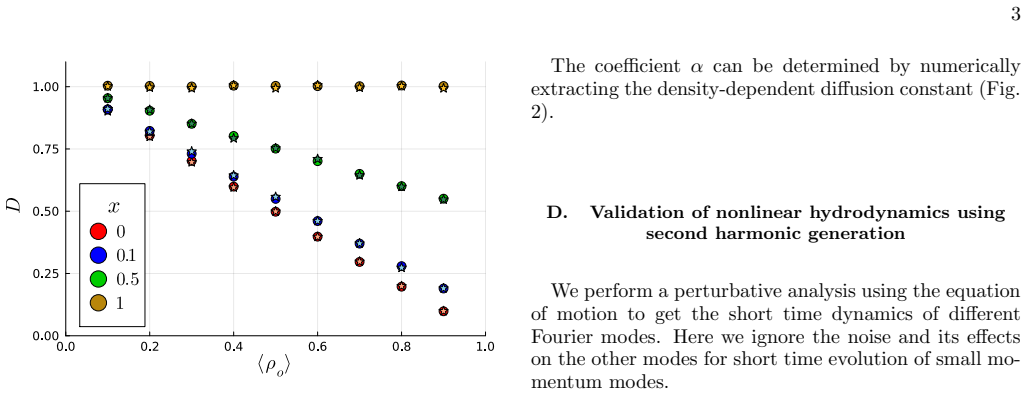
- [III A, III C] The dimensional argument that C is set by lattice-scale physics is not backed by a quantitative comparison: the manuscript does not report D0, D1, or the lattice scale for the main x=0, y=1 run, nor does it quote C for the Appendix C models beyond saying they are consistent. A table of C(Q) with uncertainties together with D0 and D1 for each parameter set would make the Q-independence claim falsifiable and would clarify whether C is indeed nonperturbative in D1.
minor comments (6)
- [II B, Eq. (6)] The notation D(t) is defined as a Q-derivative limit, but the relation <r^2> = 2D(t)t is only valid for a constant diffusion coefficient; please clarify whether D(t) is an integrated or instantaneous quantity.
- [Fig. 4 caption] Please state t_max and specify which panels are plotted versus sqrt(t) and which versus sqrt(Q^2 t), and include the values of Q used in the figure.
- [Fig. 9 caption] The caption contains a typo: 'A glimps' should be 'A glimpse'.
- [Acknowledgments and Appendix C] There are minor typographical errors: 'delacr` etaz' in the acknowledgments should be 'Delacretaz', and 'Floquet patter' in Appendix C should be 'Floquet pattern'.
- [II D] The sentence 'the signal decays slower than predicted this short time analysis' should read 'the signal decays slower than predicted by this short-time analysis'.
- [III C, Fig. 8] Fig. 8 is described as a qualitative comparison; please state explicitly which discrepancies are expected from the first-order truncation, since the plots are normalized to their maxima and amplitude information is therefore not displayed.
Circularity Check
No load-bearing circularity: central claim is a direct numerical observation; the only self-reference is a non-essential companion-paper citation and some calibrated analytic comparisons.
full rationale
The paper's central claim—that late-time relaxation follows f(Q) exp(-sqrt(C t)) with approximately Q-independent C—is an empirical fit to direct stochastic and exact simulations, not a consequence of the theory being tested (Ref. [1]). It is therefore not circular by construction. The analytic MSR correlators in Sec. III C use D0, D1, and noise couplings extracted from the same model (Fig. 2), but the plotted comparisons are normalized by their maximum value, so they test the qualitative shape in (q, t) rather than forcing the amplitude; this is calibrated consistency checking, not an input-output equivalence. Similarly, the second-harmonic generation check in Sec. II D is a short-time cross-check of the nonlinear hydrodynamic coupling, not a renamed fit that produces the main conclusion. The only self-citation is to the companion paper [4] for model-specific facts (e.g., stuck configurations); this is not load-bearing for the stretched-exponential claim. Concerns about finite-time slope convergence, binning, and residual curvature in Fig. 4 are correctness risks, not circularity, because they do not amount to the derivation reducing to its inputs. Thus no specific circular step can be quoted and exhibited; the appropriate score is low and reflects only the minor, non-load-bearing self-citation.
Assumptions & free parameters
free parameters (2)
- D0 =
D0 = 1 - rho0 for (x,y)=(0,1), from Fig. 2
- D1 =
D1 = -1 for (x,y)=(0,1), from Fig. 2
assumptions (6)
- domain assumption Hydrodynamic description: the lattice gas is captured by Fick's law with Gaussian white noise and a density-dependent diffusion constant (Eqs. 5 and 11).
- domain assumption Weak-quench linear response: amplitude A <= 0.2 makes the response equal to the equilibrium correlation function (Eq. 2).
- domain assumption Thermodynamic-limit representativeness: L=99999 random-update runs and exact L=12,18 Floquet runs capture the infinite-system asymptotics.
- ad hoc to paper Asymptotic extraction: binning log G on the sqrt(t) axis and reading late-time slopes gives the true t to infinity exponent.
- domain assumption MSR perturbative expansion is valid to first order in D1 and sigma1, with sigma1 = D1 chi at half-filling.
- domain assumption The trimer model with x=0,y=1 is a representative realization of nonlinear diffusion and is not dominated by model-specific jamming.
Cite this review
Pith. "Pith review of Diffusion cascade in a model of interacting random walkers." pith.science (2026). https://pith.science/paper/B7X736IW
@misc{pith2026241205222,
  author       = {Pith},
  title        = {Pith review of: Diffusion cascade in a model of interacting random walkers},
  year         = {2026},
  howpublished = {\url{https://pith.science/paper/B7X736IW}},
  note         = {Machine review of arXiv:2412.05222}
}
read the original abstract
We consider the relaxation of finite-wavevector density waves in a facilitated classical lattice gas. Linear hydrodynamics predicts that such perturbations should relax exponentially, but nonlinear effects were predicted to cause subexponential relaxation via nonperturbative long-time tails. We present a detailed numerical study of this effect. While our results clearly indicate the importance of nonlinear effects, we find that the wavevector-dependence of the late-time relaxation is clearly inconsistent with theoretical predictions. We discuss manifestations of hydrodynamic nonlinearities in mesoscopic samples and at short times.
Figures


Figures from the paper (9 more)


Forward citations
Cited by 1 Pith paper
-
A kinetically constrained model exhibiting non-linear diffusion and jamming
A kinetically constrained model on a triangular ladder is shown to have mean-field diffusion coefficient D = 3(1 - ρ), with a jamming transition at density ρ = 2/3.
Reference graph
Works this paper leans on
-
[1]
by observing exponential decay of density autocor- relation at momentum Q with rate Γ Q = DQ2t (as implied by combining Eqs.4, 5 to eliminate cur- rent)
-
[2]
3) The configurations 000 and 111 remain unchanged
similarly, 101 has probability x/2 of transitioning into either 011 or 110, and probability 1 − x of staying 101, and reverse transitions have the same probability. 3) The configurations 000 and 111 remain unchanged. Writing the Markov matrix for a trimer in the basis of configura- tions {cj} = {(000), (001), (010),(011), (100) . . .(111)} ↓ {m} = {0, 1, ...
-
[3]
by observing both density and current at momen- tum Q and computing the appropriate ratio as im- plied by Eq. 5 (this assumes the noise vanishes on average). Note, these implicitly require taking thermodynamic L → ∞limit first. As we explore in Sec. III B and a companion paper[4] the diffusion constant may be ex- tracted from asymptotic late time decay al...
-
[4]
Onset and decay of wave coherences in the diffusion cascade FIG. 6. Fourier cascade in real time: initial single wave ex- pectation value at Q seeds a coherent wave pair with the same Fourier momentum. Density dependent diffusion constant is natural[7]. With an eye towards experimental detection of the dif- fusion cascade in such systems we now explore co...
-
[5]
Mukerjee, V
S. Mukerjee, V. Oganesyan, and D. Huse, Statistical the- ory of transport by strongly interacting lattice fermions, Phys. Rev. B 73, 035113 (2006)
2006
-
[6]
Non-gaussian statistics Another observable and potentially interesting sig- nature of the diffusive cascade is its (transient) non- gaussianity. Inspired by basic observables used in fluid turbulence we examined variance, skewness and kurtosis of the initially excited wave. Local equlibrium at t = 0 and t → ∞is characterized by strictly Gaussian (normal) ...
-
[7]
We perform this this path integral in the fourier space to first order in the interaction
There are two distinct types of diagrams contributing to the first order in perturbation. We perform this this path integral in the fourier space to first order in the interaction. For the quench setup we have ⟨ρq(t)ρQ−q(t)⟩µ = Tr [Poρq(t)ρQ−q(t)] (B10) Po = Y x eµ(x)ρ(x,0) 1 + eµ(x) (B11) = Y x 1 2 1 − µ(x) 2 δ(ρ(x, 0)) + 1 + µ(x) 2 δ(ρ(x, 0) − 1) (B12) ...
-
[8]
L. V. Delacretaz, Heavy operators and hydrodynamic tails, SciPost Phys. 9, 034 (2020)
work page 2020
Show all 16 references
-
[9]
Collier, A
S. Collier, A. Maloney, H. Maxfield, and I. Tsiares, Uni- versal dynamics of heavy operators in cft2, Journal of High Energy Physics 2020, 1 (2020)
2020
-
[10]
Karlsson, A
R. Karlsson, A. Parnachev, and P. Tadi´ c, Thermalization in large-n cfts, Journal of High Energy Physics 2021, 1 (2021)
2021
-
[11]
A. Raj, V. Oganesyan, and A. Scardicchio, A kinetically constrained model exhibiting non-linear diffusion and jam- ming, Journal of Statistical Mechanics: Theory and Ex- periment 2025, 073208 (2025)
2025
-
[13]
However, if the diffusion constant is random in space, even the finite- Q response is dominated by a power-law long- time tail [8, 9]
-
[14]
Upadhyay, D
P. Upadhyay, D. G. Su´ arez-Forero, T.-S. Huang, M. J. Mehrabad, B. Gao, S. Sarkar, D. Session, K. Watanabe, T. Taniguchi, Y. Zhou, et al. , Giant enhancement of ex- citon diffusion near an electronic mott insulator, arXiv preprint arXiv:2409.18357 (2024)
2024 arXiv
-
[15]
and also extended to higher orders if necessary. Cru- cially, these multi-point correlators owe their existence to perfect phase coherence among generated waves, thus any of the individual wave observables with k ̸= Q is zero due to random phases, which are nevertheless ex- 6 ...
-
[16]
Ernst, J
M. Ernst, J. Machta, J. Dorfman, and H. Van Beijeren, Long time tails in stationary random media. i. theory, Journal of statistical physics 34, 477 (1984)
1984
-
[17]
P. J. H. Denteneer and M. H. Ernst, Diffusion in systems with static disorder, Phys. Rev. B 29, 1755 (1984). 11 FIG. 10. Cascade plots for update rules ( x, y) = (0.2, 0.8). Floquet updates FIG. 11. Late-time dynamics in large lattices to compare with Fig. 4. Upper panel shows...
1984
Reviewed August 11, 2026 · model on record in the stance chip above.
Discussion (0). Continue with ORCID to comment.