REVIEW 4 major objections 5 minor 34 references
Vortex lattice melting and critical temperature shift in rotating Bose-Einstein condensates
T0 review · 4 major / 5 minor · reviewed 2026-08-11 · deepseek-v4-flash
Pith's one-line read The vortex lattice in a rotating Bose-Einstein condensate actively raises the critical temperature when the condensate volume is held fixed.
desk verdict The ensemble-dependent sign flip in the Tc shift is a genuinely interesting numerical observation, but the fixed-volume positive shift is not yet nailed down because the order parameter and volume control both have plausible artifact routes. read the letter →
The pith
A machine-rendered reading of the paper's core claim, the machinery that carries it, and where it could break.
The reading
What carries the argument
The load-bearing object is the vortex-energy model, a lattice Hamiltonian $H_T = -\frac{1}{2\pi}\Gamma_0^2 \sum_{\ll ij\gg} \sigma_i \sigma_j \ln(r_{ij}) - \alpha h N_c \Omega \sum_i \sigma_i + \sum_i |\sigma_i|[\varepsilon_0 + V(r_i)]$ on a triangular Abrikosov lattice, where $\sigma_i \in \{0,\pm1\}$ marks empty sites, corotating vortices, and antivortices. The logarithmic interaction term captures long-range 2D vortex coupling; the rotation term aligns vortices with the imposed angular momentum; the local term adds core energy and trap potential. Solving this model with Metropolis-Hastings Monte Carlo reproduces the edge-inward lattice melting and the positive shift in vortex number versus temperature seen in the full stochastic Ginzburg-Landau simulations, showing that vortex interactions and positional energy are sufficient to produce the reported critical-temperature shift.
What would settle it
A fixed-volume experiment (e.g., a hard-wall box trap) that measures the critical temperature as a function of rotation speed would settle the claim: if $T_c$ does not rise with $\Omega$, the reported positive shift is not generic. A second check is to verify in the fixed-volume simulations that the Thomas-Fermi radius and mean density stay constant across $\Omega$ at finite temperature; any drift would indicate the shift is an artifact of imperfect volume control.
Extended reading notes
Core claim
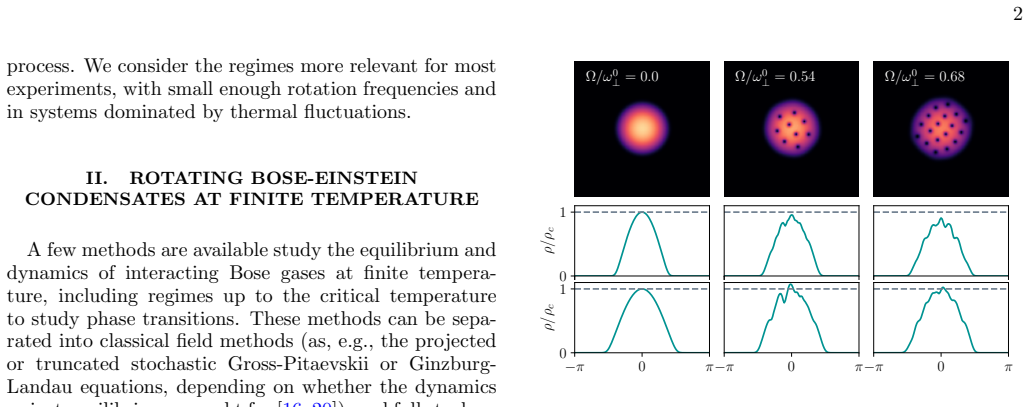
The paper reports that the critical temperature of a rotating BEC shifts in opposite directions depending on the control protocol. With fixed trap frequency, rotation expands the condensate, lowers its central density, and decreases $T_c$. With fixed volume, achieved by adjusting the trap frequency so the effective potential $m(\omega_\perp^2 - \Omega^2) r_\perp^2/2$ is unchanged, rotation increases $T_c$. The vortex-energy model—an Ising-type Hamiltonian on a triangular Abrikosov lattice with logarithmic vortex interactions, rotation coupling, and a trap potential at each site—qualitatively reproduces the vortex population and the melting pattern, indicating that vortex interactions and positional energy, rather than the full field dynamics, drive the shift. The paper concludes that the vortex lattice's rigidity provides the long-range order that allows the condensate to survive to higher temperatures.
Load-bearing premise
The fixed-volume protocol assumes that adjusting the trap frequency together with rotation keeps the condensate volume and density profile unchanged, but that adjustment is tested directly only in the non-rotating case.
Editorial extensions
If this is right
- At fixed volume, stronger rotation lets the condensate persist to higher temperatures than without rotation.
- The vortex lattice melts from the condensate boundary inward, so the central region is the last to lose phase coherence.
- The vortex-energy model can predict vortex-lattice melting in other geometries without solving the full field equations.
- The positive shift links the Bose-Einstein transition to a two-dimensional melting transition, paralleling vortex-lattice melting in type-II superconductors.
- At fixed potential, rotation dilutes the condensate and lowers $T_c$, so the sign of the rotation-induced shift depends on which thermodynamic variable is held fixed.
Reading between the lines
- The lattice-rigidity mechanism may generalize: any imposed lattice that stiffens a fluctuating order parameter could raise the transition temperature at constant density, a prediction testable in photonic or exciton-polariton condensates with imposed periodic potentials.
- The paper does not compute thermodynamic response functions; if the vortex lattice is thermodynamically active, heat capacity or susceptibility measurements near $T_c$ in fixed-volume rotating condensates should show a two-stage feature corresponding to lattice melting.
- The fixed-volume protocol could be realized experimentally with box traps or repulsive optical potentials that compensate centrifugal expansion, making the predicted positive shift testable with current cold-atom technology.
- The overshoot in vortex number at low temperature hints at metastable vortex states accessible by thermal excitation; measuring vortex population as a function of heating rate could distinguish equilibrium melting from transient lattice dynamics.
Editorial analysis
A structured set of objections, weighed in public.
Referee Report
Summary. The manuscript studies the critical temperature of a rotating trapped BEC by numerically evolving the stochastic rotating Ginzburg-Landau equation (SRGLE) and by simulating an Ising-like vortex-lattice model with Metropolis Monte Carlo. Using the inflection point of a normalized central-density contrast as the Tc estimator, it reports a negative Tc shift at fixed trap frequency and a positive shift when the trap frequency is adjusted to keep the Thomas-Fermi volume fixed. The vortex-energy model reproduces the qualitative temperature dependence of the vortex number, and the authors conclude that vortex-lattice rigidity stabilizes the condensate against thermal fluctuations.
Significance. If established, the claimed positive Tc shift at fixed volume would be a conceptually interesting link between vortex-lattice melting and the Bose-Einstein transition, with possible parallels to type-II superconductors. The numerical method is well established, the GHOST code is publicly available, and the qualitative trends in the figures are visually consistent. However, the central quantitative claim currently rests on visual inspection of a surrogate order parameter and on a model with an explicit rotation-dependent term, so the significance will depend on the additional evidence requested below.
major comments (4)
- [§III, Fig. 2] The central claim of a positive Tc shift in the fixed-volume case rests on the inflection point of (⟨ρc⟩−ρm)/(⟨ρc⟩(T=0)−ρm) as the Tc estimator. This quantity is not a condensate fraction; in a rotating condensate the central density contains vortex-core depletion, and as the lattice melts the distribution of cores near the center changes, so the estimator can shift even if the condensate fraction does not. The text states that other methods yield similar Tc values, but no comparison is shown. Please report Tc from at least one independent estimator (e.g., momentum-spectrum occupation or first-order correlation function) for each Ω, together with numerical Tc values and their uncertainties.
- [§III and Appendix] The fixed-volume protocol is validated only for Ω=0 in the Appendix. For Ω>0, no finite-temperature radial density profiles or volume diagnostics are reported, so one cannot exclude that the apparent positive shift is caused by imperfect volume control, for example thermal-cloud expansion or vortex kinetic-energy density changing the effective radius. Please provide, for each Ω, a volume or mean-radius diagnostic as a function of T and show that it stays constant within the same tolerance as the Ω=0 case.
- [§IV, Eq. (4)] The vortex-energy model includes the explicit term −α h Nc Ω Σᵢ σᵢ, which lowers the energy of configurations with positive vortices as Ω grows. A model with this term will naturally predict more vortices and a higher melting temperature at larger Ω, so the agreement in Fig. 4 does not by itself provide independent evidence that vortex-lattice rigidity causes the positive Tc shift. Please specify how α, ε0, and the lattice geometry are determined, and ideally test whether the model reproduces the SRGLE results when this rotation-coupling term is removed or varied.
- [§III, Fig. 2] No numerical values of Tc or of the Tc shift are reported; the reader sees only normalized curves and a vertical line for the non-rotating case. The error bars shown in Fig. 2 are confidence intervals of the mean density, not uncertainties of the inflection-point estimate. Please report Tc(Ω)/Tc(0) with errors for all Ω in both the fixed-potential and fixed-volume cases, so that the claimed sign and magnitude of the shift are quantitative results rather than visual impressions.
minor comments (5)
- [Eq. (1)] The notation ψ*(Ω·J)ψ for the rotation term is unconventional and the operator ordering is unclear; please clarify.
- [Throughout] The acronyms 'SRGLE' and 'RSGLE' are used inconsistently (e.g., the Fig. 4 caption uses 'RSGLE' while the text uses 'SRGLE'); please standardize.
- [§IV, Eq. (4)] The statement 'αΩ ≈ Ω+Ω′' and the Bethe mean-field argument are not derived; please expand this step or give a reference.
- [§IV, Eq. (4)] The truncation of vortex interactions at fifth neighbours is asserted but not tested; a brief convergence check with respect to the interaction range would strengthen the model.
- [Throughout] There are several typos, including 'perifery', 'anti-paralell', and 'reminicent'; a careful proofreading pass is needed.
Circularity Check
The vortex-energy model's positive Tc shift is largely encoded in its explicit rotation term; the SRGLE simulations are independent but the supporting model reduces to its input by construction.
-
self definitional
[Section IV, Eq. (4) and the discussion of the bottom panel of Fig. 4.]
"HT = − 1/2π Γ0^2 Σ_{≪ij≫} σiσj ln(rij) − αhNcΩ Σ_i σ_i + Σ_i |σ_i| [ε0 + V (ri)] , (4) ... The second term is the rotation energy, as hNc is approximately the angular momentum of a vortex. ... The model, that takes into account only vortex interactions and positional energies in the lattice, captures qualitatively features seen in the RSGLE simulations ... For increasing Ω indeed more vortices remain at a fixed T ... resulting in a positive shift in Tc."
In Eq. (4), the term −αhNcΩΣ_i σ_i directly lowers the energy of co-rotating vortices as Ω increases, so the model's melting temperature must rise with Ω. This is an immediate consequence of the chosen Hamiltonian, not an emergent effect of vortex–vortex interactions or positional energy. The paper nevertheless states that the model 'takes into account only vortex interactions and positional energies in the lattice' and uses it to conclude 'this shift is driven by interactions between vortices and their positional energy,' omitting that the explicit rotation term is what injects the Ω dependence. The model's positive-shift 'prediction' is therefore equivalent to the input term by construction, rather than an independent confirmation of the proposed mechanism.
full rationale
The paper is not globally circular: the finite-temperature SRGLE simulations are self-contained numerical experiments run with a public spectral code, and the fixed-volume protocol is a legitimate control (with the Ω=0 trap-frequency check in the Appendix). No load-bearing self-citation chain is present; citations to the authors' earlier work concern numerical methodology and a general discussion of central-density estimators, not the uniqueness of the physical conclusion. The main circularity is in the explanatory chain: the vortex-energy model of Eq. (4) contains an explicit rotation-energy term −αhNcΩΣ_i σ_i that directly favors vortices at larger Ω, so its prediction of a positive melting-temperature shift is largely written into the Hamiltonian. The paper presents this model as evidence that the shift is driven by vortex interactions and positional energy, which overstates what the model can show. A further, non-circular validity risk is that Tc is estimated as the inflection point of the central-density order parameter (⟨ρc⟩−ρm); in a rotating condensate this quantity is depleted by vortex cores at T=0, so part of the shift could reflect lattice melting rather than a genuine condensate-fraction shift, and the paper asserts but does not display its claimed cross-checks with other estimators. These concerns lower confidence in the mechanistic attribution, but the central simulation result is not derived from the model, so the circularity is partial rather than total.
Assumptions & free parameters
free parameters (3)
- alpha
- epsilon_0
- Lattice geometry in the vortex-energy model
assumptions (6)
- domain assumption Truncated stochastic Ginzburg-Landau evolution converges to thermal states in the grand canonical or canonical ensemble.
- domain assumption The critical temperature Tc can be estimated from the inflection point of the central-density curve, and other estimators agree.
- domain assumption The vortex-lattice melting temperature is approximately equal to the BEC critical temperature under the studied conditions.
- ad hoc to paper The vortex lattice is a perfect triangular Abrikosov lattice, and only site defects sigma = 0, +/-1 are allowed.
- domain assumption Vortex interactions beyond the fifth neighbor can be absorbed into the effective coupling alpha.
- domain assumption The angular momentum per vortex is constant and approximately 2 N hbar / 7 in the Thomas-Fermi approximation.
Cite this review
Pith. "Pith review of Vortex lattice melting and critical temperature shift in rotating Bose-Einstein condensates." pith.science (2026). https://pith.science/paper/L4OKFBXM
@misc{pith2026241205477,
  author       = {Pith},
  title        = {Pith review of: Vortex lattice melting and critical temperature shift in rotating Bose-Einstein condensates},
  year         = {2026},
  howpublished = {\url{https://pith.science/paper/L4OKFBXM}},
  note         = {Machine review of arXiv:2412.05477}
}
read the original abstract
We investigate a shift in the critical temperature of rotating Bose-Einstein condensates mediated by the melting of the vortex lattice. Numerical simulations reveal that this temperature exhibits contrasting behavior depending on the system configuration: a negative shift occurs for fixed trap potentials due to the expansion of the condensate, while a positive shift is observed for fixed volumes, where vortex lattice rigidity suppresses thermal fluctuations. We introduce a vortex-energy model that captures the role of vortex interactions, the positional energy of the vortex lattice, as well as the phase transition and how the vortex lattice disappears. The findings provide insights into the thermodynamic properties of rotating condensates and the dynamics of vortex lattice melting, offering potential parallels with other quantum systems such as type-II superconductors.
Figures


Figures from the paper (2 more)


Reference graph
Works this paper leans on
- [1]
-
[2]
R. P. Feynman, Chapter ii application of quantum me- chanics to liquid helium, in Progress in Low Temperature Physics (Elsevier, 1955) p. 17–53
work page 1955
-
[3]
J. T. M¨ akinen, S. Autti, P. J. Heikkinen, J. J. Hosio, R. H¨ anninen, V. S. L’vov, P. M. Walmsley, V. V. Zav- jalov, and V. B. Eltsov, Nature Physics 19, 898 (2023)
work page 2023
-
[4]
V. K. Tkachenko, Solid state physics 22, 1282 (1965)
work page 1965
-
[5]
J. R. Abo-Shaeer, C. Raman, J. M. Vogels, and W. Ket- terle, Science 292, 476–479 (2001)
work page 2001
-
[6]
K. W. Madison, F. Chevy, V. Bretin, and J. Dalibard, Physical Review Letters 86, 4443–4446 (2001)
work page 2001
-
[7]
V. Schweikhard, I. Coddington, P. Engels, V. P. Mogen- dorff, and E. A. Cornell, Physical Review Letters 92, 040404 (2004)
work page 2004
-
[9]
J. M. Kosterlitz and D. J. Thouless, Journal of Physics C: Solid State Physics 6, 1181–1203 (1973)
work page 1973
Show all 34 references
-
[10]
B. I. Halperin and D. R. Nelson, Physical Review Letters 41, 121–124 (1978)
1978
-
[11]
S. A. Gifford and G. Baym, Physical Review A 78, 10.1103/physreva.78.043607 (2008)
2008 doi
-
[12]
Guillam´ on, H
I. Guillam´ on, H. Suderow, A. Fern´ andez-Pacheco, J. Ses´ e, R. C´ ordoba, J. M. De Teresa, M. R. Ibarra, and S. Vieira, Nature Physics 5, 651–655 (2009)
2009
-
[13]
Sharma, D
R. Sharma, D. Rey, L. Longchambon, A. Perrin, H. Per- rin, and R. Dubessy, Physical Review Letters 133, 10.1103/physrevlett.133.143401 (2024)
2024 doi
-
[14]
R. E. Hetzel, A. Sudbø, and D. A. Huse, Physical Review Letters 69, 518–521 (1992)
1992
-
[15]
Kragset, E
S. Kragset, E. Babaev, and A. Sudbø, Physical Review Letters 97, 10.1103/physrevlett.97.170403 (2006)
2006 doi
-
[16]
N. G. Berloff and B. V. Svistunov, Physical Review A 66, 10.1103/physreva.66.013603 (2002)
2002 doi
-
[17]
P. B. Blakie and M. J. Davis, Physical Review A 72, 10.1103/physreva.72.063608 (2005)
2005 doi
-
[18]
M. J. Davis and P. B. Blakie, Physical Review Letters 96, 060404 (2006)
2006
-
[19]
N. G. Berloff and A. J. Youd, Physical Review Letters 99, 10.1103/physrevlett.99.145301 (2007)
2007 doi
-
[20]
Shukla, P
V. Shukla, P. D. Mininni, G. Krstulovic, P. Clark di Leoni, and M. E. Brachet, Physical Review A 99, 043605 (2019). 8
2019
-
[21]
Gardiner, J
C. Gardiner, J. Anglin, and T. Fudge, Journal of Physics B: Atomic, Molecular and Optical Physics 35, 1555 (2002)
2002
-
[22]
Calzetta, B
E. Calzetta, B. Hu, and E. Verdaguer, International Jour- nal of Modern Physics B 21, 4239 (2007)
2007
-
[23]
N. P. Proukakis and B. Jackson, Journal of Physics B: Atomic, Molecular and Optical Physics 41, 203002 (2008)
2008
-
[24]
Amette Estrada, M
J. Amette Estrada, M. E. Brachet, and P. D. Mininni, A VS Quantum Science4, 046201 (2022)
2022
-
[25]
N. G. Berloff, M. Brachet, and N. P. Proukakis, Proc. Nat. Acad. Sci. USA 111, 4675 (2014)
2014
-
[26]
Clark Di Leoni, P
P. Clark Di Leoni, P. D. Mininni, and M. E. Bra- chet, Physical Review A 97, 10.1103/physreva.97.043629 (2018)
2018 doi
-
[27]
P. D. Mininni, D. Rosenberg, R. Reddy, and A. Pouquet, Parallel Computing 37, 316 (2011)
2011
-
[28]
Amette Estrada, M
J. Amette Estrada, M. E. Brachet, and P. D. Mininni, Physical Review A 105, 063321 (2022)
2022
-
[29]
A. C. White, B. P. Anderson, and V. S. Bagnato, Pro- ceedings of the National Academy of Sciences 111, 4719 (2014)
2014
-
[30]
A. L. Fetter, Reviews of Modern Physics 81, 647 (2009)
2009
-
[31]
K. B. Davis, M. O. Mewes, M. R. Andrews, N. J. van Druten, D. S. Durfee, D. M. Kurn, and W. Ketterle, Physical Review Letters 75, 3969–3973 (1995)
1995
-
[32]
C.-C. Chen, R. Gonz´ alez Escudero, J. Min´ aˇ r, B. Pasquiou, S. Bennetts, and F. Schreck, Nature 606, 683–687 (2022)
2022
-
[33]
Amette Estrada, F
J. Amette Estrada, F. Mayo, A. J. Roncaglia, and P. D. Mininni, Physical Review A 109, 10.1103/phys- reva.109.012202 (2024)
2024 doi
-
[34]
R. P. Smith, R. L. D. Campbell, N. Tammuz, and Z. Hadzibabic, Physical Review Letters 106, 10.1103/physrevlett.106.250403 (2011)
2011 doi
-
[35]
Metropolis, A
N. Metropolis, A. W. Rosenbluth, M. N. Rosenbluth, A. H. Teller, and E. Teller, The Journal of Chemical Physics 21, 1087–1092 (1953)
1953
Reviewed August 11, 2026 · model on record in the stance chip above.
Discussion (0). Continue with ORCID to comment.