REVIEW 4 major objections 5 minor 49 references
Enhancing the Charging Performance of Many-Body Quantum Batteries through Landau-Zener Driving
T0 review · 4 major / 5 minor · reviewed 2026-08-11 · deepseek-v4-flash
Pith's one-line read A linearly ramped magnetic field charges a many-body quantum battery more effectively than a sinusoidal field, with the advantage growing for long-range interactions and larger systems.
desk verdict The headline LZ-vs-periodic comparison is not a fair contest: the LZ field amplitude grows linearly to 200B while the periodic field is capped at 10B, so the reported advantage is expected from drive strength alone. read the letter →
The pith
A machine-rendered reading of the paper's core claim, the machinery that carries it, and where it could break.
The reading
What carries the argument
The central object is the charging Hamiltonian H_c(τ)=H_0+V(τ), where H_0 is the Heisenberg XY chain with coupling g_ij and anisotropy γ, and V(τ) is a global σ_z field. For Landau-Zener driving, V(τ)=vτ Σ_i σ_z^i, a many-body version of the classic linear level-crossing problem; for the comparator, V(τ)=v sin(ωτ) Σ_i σ_z^i. The work deposited is W(τ)=Tr[ρ(τ)H_0]-Tr[ρ(0)H_0], with ρ(τ) obtained by exact time-ordered evolution from the ground state of H_0, and the average power is P(τ)=W(τ)/τ. The Landau-Zener ramp is what carries the argument: its non-periodic, monotonically increasing field is claimed to resonate with the broad energy-level structure of long-range interacting chains, yielding larger and smoother energy deposition than the oscillating field.
What would settle it
Run the same N=8 long-range calculation while sweeping the periodic drive's frequency ω (and amplitude v) over a wide range and compare the maximum W over the charging window; if any periodic choice matches or exceeds the Landau-Zener Wmax, the paper's central comparison is not robust. A complementary check is to compute ergotropy rather than bare energy, since the paper defines storage as energy relative to H0.
Extended reading notes
Core claim
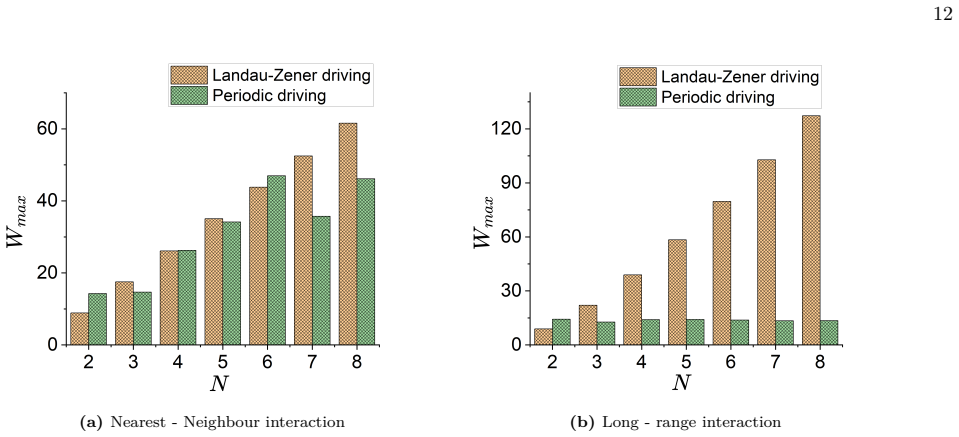
The paper's central claim is that Landau-Zener driving, a charging field that grows linearly in time (V(τ)=vτ∑σ_z^i), is a superior charging protocol for a many-body XY spin-chain quantum battery compared with periodic sinusoidal driving (V(τ)=v sin(ωτ)∑σ_z^i). For fixed parameters (g=20B or 10B, γ=0.5 or 1.0, v=10B, ω=4B), the maximum deposited work Wmax increases with N under both drives, but the linear drive's growth is steeper, and for long-range interactions at N=8 the Wmax exceeds 100B while the periodic drive remains below 30B. The underlying mechanism is that the linear ramp sweeps the system through avoided crossings in a way that lets the many-body system absorb energy more effectively, especially when long-range couplings allow collective response; nearest-neighbor chains show stronger oscillations and lower saturation. The paper also reports that optimal charging occurs at short times (Bτ around 2) and that increasing anisotropy toward γ=±1, interaction strength g, and ramp rate v all enhance work deposition.
Load-bearing premise
The periodic drive is tested at a single fixed frequency ω=4B, so the claimed superiority of the linear ramp could fail if some other frequency makes the sinusoidal drive deposit at least as much energy.
Editorial extensions
If this is right
- For long-range spin chains, the maximum work a Landau-Zener ramp deposits grows roughly linearly with N, so larger chains store proportionally more energy without needing stronger fields.
- For nearest-neighbor chains, the linear ramp's advantage is weaker and can reverse at smaller N, so periodic driving remains a reasonable choice for short-range, small systems.
- Tuning the XY anisotropy toward ±1, increasing the spin-spin coupling g, and increasing the ramp rate v all raise the peak stored energy, giving a parameter menu for optimizing a Landau-Zener charged battery.
- The very short optimal charging time (Bτ around 2) means high average power can be achieved with a fast ramp, not a long one.
- If the comparison holds, linearly driven spin chains with long-range interactions are a promising scalable design for quantum batteries.
Reading between the lines
- A natural next test is whether the Landau-Zener advantage survives after optimizing the periodic drive's frequency and pulse shape; the paper's fixed ω=4B leaves that open.
- Since W is measured against the bare Hamiltonian rather than ergotropy, a follow-up could check how much of the deposited energy is actually extractable; the two can differ substantially in driven many-body systems.
- Decoherence and dissipation would likely erode the coherent Landau-Zener advantage; a master-equation extension would show whether the protocol remains useful in realistic open systems.
- Trapped-ion and Rydberg-atom platforms allow tunable long-range couplings, so the predicted linear-in-N scaling is directly testable in experiment.
Signed reviews
Editorial analysis
A structured set of objections, weighed in public.
Referee Report
Summary. The manuscript studies a many-body quantum battery modeled by an XY spin chain with N spin-1/2 particles, charged by a time-dependent external field. The authors define work deposition as W(τ) = Tr[ρ(τ)H0] − Tr[ρ(0)H0] and average power as W(τ)/τ, starting from the ground state of H0. They numerically investigate nearest-neighbor and long-range interactions under a Landau-Zener linear drive h(τ)=vτ and compare it with a sinusoidal periodic drive h(τ)=v sin(ωτ). They report that Landau-Zener driving achieves higher maximum deposited work in long-range systems at large N (Figs. 7–9), while periodic driving can be better in some nearest-neighbor cases, and they infer that optimizing parameters such as γ, g, and v can enhance battery performance.
Significance. If the two protocols were compared at a fair common operating point, the observation that the interaction range changes which drive deposits more energy would be a useful contribution to the quantum battery literature. The paper provides exact numerical simulations (QuTiP), several phase diagrams in g, v, γ, and N, and does not fit parameters to a target result. However, the central quantitative claim of Landau-Zener superiority is not yet established because the two protocols are compared with different effective drive strengths and a single unoptimized periodic frequency; the reported Wmax gap is expected from the unbounded linear field alone.
major comments (4)
- [Sec. V, Eq. (5) vs Eq. (11), Figs. 7–9] The Landau-Zener and periodic protocols are not compared at a common operating point. The LZ field in Eq. (5), h(τ)=vτ, grows linearly and reaches 200B at Bτ=20 with v=10B, whereas the periodic field in Eq. (11), h(τ)=v sin(ωτ), is bounded by v=10B; additionally, the parameter v has units of energy/time in Eq. (5) but energy in Eq. (11). Under these conditions the reported Wmax advantage (e.g., >100 vs <30 for long-range interactions at N=8 in Fig. 9b) follows from the much larger time-integrated drive amplitude alone. To support the claim of superior energy deposition and storage efficiency, the comparison should normalize by drive strength or input energy (e.g., equal time-integrated |h| or equal pulse energy) and/or use a bounded linear ramp with a defined amplitude.
- [Sec. V.C, Fig. 9a] The unqualified central claim that LZ driving is superior is contradicted by the authors' own nearest-neighbor results for g=10B, γ=0.5, v=10B: over all N, periodic driving deposits more work (Wmax≈70 at N=8 vs LZ below ~50). The abstract and conclusion should either restrict the claimed superiority to long-range interactions with sufficiently large coupling, or present a criterion for when each protocol wins.
- [Sec. V, Figs. 7–9] The periodic comparator is tested at a single frequency, ω=4B, with no scan over ω or discussion of why this frequency is representative. A fair comparison requires optimizing or at least scanning the periodic frequency and amplitude; otherwise the periodic protocol may simply be operated far from resonance. This concern is separate from the normalization issue, because even an optimized ω does not remove the unbounded-field asymmetry.
- [Sec. I and Eq. (9)] The paper's 'storage efficiency' is quantified by energy deposited with respect to the bare Hamiltonian H0, not by ergotropy, although the introduction identifies ergotropy as the maximum useful extractable work. Since a state with large W(τ) may have little ergotropic energy, the efficiency claims would be strengthened by computing ergotropy or by explicitly defining storage efficiency as raw energy deposition.
minor comments (5)
- [Throughout] The term 'work deposition' is used for the energy change with respect to H0; consider calling it 'energy deposition' to avoid confusion with thermodynamic work.
- [Eq. (2)] The brace annotations appear as raw LaTeX artifacts ('/bracehtipupleft/...'); the equation should be typeset cleanly.
- [Figs. 2, 4 vs Figs. 1, 3, 5, 6] The manuscript alternates between N=7 (Figs. 2 and 4) and N=8 elsewhere; state explicitly that different system sizes are used for different scans and explain why.
- [Eq. (4)] The long-range interaction exponent is fixed at a=1; no dependence on a is reported, so the conclusions about long-range interactions are limited to this single choice.
- [Sec. V.C] The statement that v=10B is the 'maximum allowed value' of the driving amplitude is unexplained; define the allowed range of v.
Circularity Check
No significant circularity: the Landau-Zener advantage is an emergent numerical result, not a fitted or self-referential one.
full rationale
The central claim—that Landau-Zener driving deposits more energy than periodic driving in a long-range XY spin-chain battery—is obtained by exact numerical evolution of the specified charging Hamiltonian (Eqs. 5–8) and direct evaluation of W(τ) via Eq. (9), with parameters g, v, γ, ω, and N fixed before simulation. No parameter is fitted to reproduce Wmax, and no stated result is defined in terms of the target conclusion. The only self-citations are to the standard XY spin-chain form (Ref. 13, by a coauthor) and to a background review (Ref. 25); neither is load-bearing, because the Hamiltonian is a standard model and the LZ-versus-periodic comparison is computed independently from the given equations. The comparison at equal numerical v is indeed unnormalized—the LZ field h(τ)=vτ is unbounded over the window while the periodic field h(τ)=v sin(ωτ) is bounded—so the reported Wmax advantage may reflect drive-strength asymmetry rather than protocol efficiency. That is a correctness/fairness concern about the benchmark, not circularity: the numerical Wmax values are not constructed from the drive amplitudes, nor does the paper's derivation reduce to an equality of inputs and outputs. The paper is therefore self-contained against its own stated model, and no circular step is present.
Assumptions & free parameters
free parameters (2)
- Periodic driving frequency omega =
4B
- Long-range interaction exponent a =
1
assumptions (4)
- domain assumption The relevant figure of merit for battery performance is the deposited energy W(tau)=Tr[rho(tau)H0]-Tr[rho(0)H0] (Eq. 9), not ergotropy.
- domain assumption The initial state is the ground state of H0 for all N and parameters.
- domain assumption The charging field couples only through sum sigma_z^i with linear time dependence h(tau)=v tau (Eq. 5).
- domain assumption Numerical integration with QuTiP accurately captures the unitary dynamics of the XY chain up to N=8.
Cite this review
Pith. "Pith review of Enhancing the Charging Performance of Many-Body Quantum Batteries through Landau-Zener Driving." pith.science (2026). https://pith.science/paper/AAA7EAWZ
@misc{pith2026241205537,
  author       = {Pith},
  title        = {Pith review of: Enhancing the Charging Performance of Many-Body Quantum Batteries through Landau-Zener Driving},
  year         = {2026},
  howpublished = {\url{https://pith.science/paper/AAA7EAWZ}},
  note         = {Machine review of arXiv:2412.05537}
}
abstract
We explore the charging advantages of a many-body quantum battery driven by a Landau-Zener field. Such a system may be modeled as a Heisenberg XY spin chain with $\textit{N}$ interacting spin-$\frac{1}{2}$ particles under an external magnetic field. Here we consider both nearest-neighbor and long-range spin interactions. The charging performance of this many-body quantum battery is evaluated by comparing Landau-Zener and periodic driving protocols within these interaction regimes. Our findings show that the Landau-Zener driving can offer superior energy deposition and storage efficiency compared to periodic driving. Notably, the Landau-Zener protocol may deliver optimal performance when combined with long-range interactions. The efficiency of a Landau-Zener quantum battery can be significantly enhanced by optimizing key parameters, such as XY anisotropy, the magnitude of the driving field, and interaction strength.
Figures


Figures from the paper (6 more)



Reference graph
Works this paper leans on
-
[1]
M. A. Nielsen and I. L. Chuang,Quantum computation and quantum information (Cambridge University Press, 2010)
2010
-
[2]
F. Xu, X. Ma, Q. Zhang, H.-K. Lo, and J.-W. Pan, Re- views of modern physics92, 025002 (2020)
work page 2020
-
[3]
F. Campaioli, F. A. Pollock, and S. Vinjanampathy, Ther- modynamics in the Quantum Regime: Fundamental As- pects and New Directions pp. 207–225 (2018)
work page 2018
-
[4]
J. Q. Quach, G. Cerullo, and T. Virgili, Joule7, 2195 (2023)
work page 2023
-
[5]
Campaioli, S
F. Campaioli, S. Gherardini, J. Q. Quach, M. Polini, and G. M. Andolina, Reviews of Modern Physics96, 031001 (2024)
2024
- [6]
-
[7]
Alicki and M
R. Alicki and M. Fannes, Physical Review E87, 042123 (2013)
2013
-
[8]
D. Ferraro, M. Campisi, G. M. Andolina, V. Pellegrini, and M. Polini, Physical review letters120, 117702 (2018)
work page 2018
Show all 49 references
-
[9]
Rossini, G
D. Rossini, G. M. Andolina, D. Rosa, M. Carrega, and M. Polini, Physical Review Letters125, 236402 (2020)
2020
-
[10]
Xu, H.-J
K. Xu, H.-J. Zhu, G.-F. Zhang, and W.-M. Liu, Physical Review E104, 064143 (2021)
2021
-
[11]
S. Seah, M. Perarnau-Llobet, G. Haack, N. Brunner, and S. Nimmrichter, Physical Review Letters127, 100601 (2021)
2021
-
[12]
Campaioli, F
F. Campaioli, F. A. Pollock, F. C. Binder, L. Céleri, J. Goold, S. Vinjanampathy, and K. Modi, Physical review letters 118, 150601 (2017)
2017
-
[13]
Ghosh, T
S. Ghosh, T. Chanda, and A. Sen, Physical Review A 101, 032115 (2020)
2020
-
[14]
Polini, Physical review letters122, 047702 (2019)
G.M.Andolina,M.Keck,A.Mari,M.Campisi,V.Giovan- netti, and M. Polini, Physical review letters122, 047702 (2019)
2019
-
[15]
Bhattacharjee and A
S. Bhattacharjee and A. Dutta, The European Physical Journal B94, 1 (2021)
2021
-
[16]
L. M. Cangemi, C. Bhadra, and A. Levy, Physics Reports 1087, 1 (2024)
2024
-
[17]
T. P. Le, J. Levinsen, K. Modi, M. M. Parish, and F. A. Pollock, Physical Review A97, 022106 (2018)
2018
-
[18]
Hadipour, S
M. Hadipour, S. Haseli, H. Dolatkhah, and M. Rashidi, Scientific Reports13, 10672 (2023)
2023
-
[19]
Šafránek, D
D. Šafránek, D. Rosa, and F. C. Binder, Physical Review Letters 130, 210401 (2023)
2023
-
[20]
M. T. Mitchison, J. Goold, and J. Prior, Quantum5, 500 (2021). 14
2021
-
[21]
C. A. Downing and M. S. Ukhtary, Communications Physics 6, 322 (2023)
2023
-
[22]
J. Liu, D. Segal, and G. Hanna, The Journal of Physical Chemistry C123, 18303 (2019)
2019
-
[23]
A. G. Catalano, S. M. Giampaolo, O. Morsch, V. Giovan- netti, and F. Franchini, arXiv preprint arXiv:2307.02529 (2023)
2023 arXiv
-
[24]
D. S. Jin and J. Ye, Physics Today64, 27 (2011)
2011
-
[25]
Lewenstein, A
M. Lewenstein, A. Sanpera, V. Ahufinger, B. Damski, A. Sen, and U. Sen, Advances in Physics56, 243 (2007)
2007
-
[26]
G. M. Andolina, D. Farina, A. Mari, V. Pellegrini, V. Gio- vannetti, and M. Polini, Physical Review B98, 205423 (2018)
2018
-
[27]
Grazi, D
R. Grazi, D. S. Shaikh, M. Sassetti, N. T. Ziani, and D. Ferraro, arXiv preprint arXiv:2402.09169 (2024)
2024 arXiv
-
[28]
Y. Du, W. Chen, Y. Wang, Y. Yu, K. Guo, G. Qu, and J. Zhang, Nano-Micro Letters16, 100 (2024)
2024
-
[29]
Zueco, F
D. Zueco, F. Galve, S. Kohler, and P. Hänggi, Physical Review A80, 042303 (2009)
2009
-
[30]
O. V. Marchukov, A. G. Volosniev, M. Valiente, D. Pet- rosyan, and N. Zinner, Nature communications7, 13070 (2016)
2016
-
[31]
J. J. Cullen and D. Landau, Physical Review B27, 297 (1983)
1983
-
[32]
J. R. Johansson, P. D. Nation, and F. Nori, Computer physics communications183, 1760 (2012)
2012
-
[33]
Rossini, G
D. Rossini, G. M. Andolina, and M. Polini, Physical Review B100, 115142 (2019)
2019
-
[34]
Mondal and S
S. Mondal and S. Bhattacharjee, Physical Review E105, 044125 (2022)
2022
-
[35]
Zhang, T.-R
Y.-Y. Zhang, T.-R. Yang, L. Fu, and X. Wang, Physical Review E99, 052106 (2019)
2019
-
[36]
Dziarmaga, Physical review letters95, 245701 (2005)
J. Dziarmaga, Physical review letters95, 245701 (2005)
2005
-
[37]
Caravelli, B
F. Caravelli, B. Yan, L. P. García-Pintos, and A. Hamma, Quantum 5, 505 (2021)
2021
-
[38]
Bäuerle, D
C. Bäuerle, D. C. Glattli, T. Meunier, F. Portier, P. Roche, P. Roulleau, S. Takada, and X. Waintal, Reports on Progress in Physics81, 056503 (2018)
2018
-
[39]
Mazzoncini, V
F. Mazzoncini, V. Cavina, G. M. Andolina, P. A. Erd- man, and V. Giovannetti, Physical Review A107, 032218 (2023)
2023
-
[40]
J. R. Rubbmark, M. M. Kash, M. G. Littman, and D. Kleppner, Physical Review A23, 3107 (1981)
1981
-
[41]
E. P. Glasbrenner and W. P. Schleich, Journal of Physics B: Atomic, Molecular and Optical Physics56, 104001 (2023)
2023
-
[42]
Bose, Physical review letters91, 207901 (2003)
S. Bose, Physical review letters91, 207901 (2003)
2003
-
[43]
Casanova, A
J. Casanova, A. Mezzacapo, L. Lamata, and E. Solano, Physical review letters108, 190502 (2012)
2012
-
[44]
Zener, Proceedings of the Royal Society of London
C. Zener, Proceedings of the Royal Society of London. Se- ries A, Containing Papers of a Mathematical and Physical Character 137, 696 (1932)
1932
-
[45]
Landau, Physikalische Zeitschrift der Sowjetunion2, 46 (1932)
L. Landau, Physikalische Zeitschrift der Sowjetunion2, 46 (1932)
1932
-
[46]
L. Wang, X. Huang, and X. Yi, The European Physical Journal D46, 345 (2008)
2008
-
[47]
Guo, F.-M
W.-X. Guo, F.-M. Yang, and F.-Q. Dou, Physical Review A 109, 032201 (2024)
2024
-
[48]
Polkovnikov, K
A. Polkovnikov, K. Sengupta, A. Silva, and M. Vengalat- tore, Reviews of Modern Physics83, 863 (2011)
2011
-
[49]
M. Heyl, A. Polkovnikov, and S. Kehrein, Physical review letters 110, 135704 (2013)
2013
Reviewed August 11, 2026 · model on record in the stance chip above.
Discussion (0). Continue with ORCID to comment.