REVIEW 4 major objections 6 minor 43 references
Impact of Sunglasses on One-to-Many Facial Identification Accuracy
T0 review · 4 major / 6 minor · reviewed 2026-08-11 · deepseek-v4-flash
Pith's one-line read Dark sunglasses in a probe image degrade one-to-many face identification accuracy about as much as strong blur or low resolution, and adding synthetic sunglasses to the gallery can recover up to 38% of that loss without retraining.
desk verdict First systematic sunglasses occlusion study for one-to-many identification, with a valuable dataset, but the headline equivalence to blur/resolution is calibrated rather than measured, and the synthetic proxy is optimistic. read the letter →
The pith
A machine-rendered reading of the paper's core claim, the machinery that carries it, and where it could break.
The reading
What carries the argument
The argument is carried by the ND-sunglasses paired-image set: 15,088 mugshot-quality images, each with a FaceLab synthetic sunglasses version that alters only the sunglasses region, making sunglasses the sole controlled variable in the probe. The quantitative engine is the comparison of the (mated minus non-mated) rank-one score distributions against a fixed gallery, measured by $d'$ and Wasserstein distance. Two secondary mechanisms support the remedies: gallery-side augmentation, where synthetic sunglasses are added to enrolled images to re-align the probe-gallery appearance mismatch, and training-set augmentation, where a custom sunglasses detector estimates prevalence in WebFace4M and a generative model produces new sunglasses-wearing training images.
What would settle it
Acquire a paired set where the same people are photographed with and without actual dark sunglasses under otherwise identical conditions, run one-to-many search against a sunglasses-free gallery, and compare the shift in the (mated minus non-mated) score distributions to the FaceLab synthetic condition. If the real-sunglasses shift is appreciably larger than the synthetic shift, the paper's headline equivalence and recovery estimates are optimistic.
Extended reading notes
Core claim
On the paper's own terms, the discovery is that sunglasses are a first-order quality factor, not a cosmetic nuisance. Measured by the $d'$ separation between rank-one mated and non-mated similarity score distributions with the AdaFace and ArcFace matchers, a sunglasses-occluded probe shifts accuracy roughly as much as Gaussian blur with $\sigma=4.6$ or a face reduced to $37\times37$ pixels. Combining sunglasses with either degradation roughly doubles the distribution-level effect and raises the false-positive identification rate sharply. The paper also reports that adding synthetic sunglasses to every gallery image recovers 28% to 38% of the lost accuracy depending on matcher and demographic group, and that wearing-sunglasses images are very rare in existing training sets: increasing their share from 0% to 23% reduced the female false-positive identification rate by about 43% with real augmented images and about 57% with generated ones.
Load-bearing premise
The load-bearing premise is that FaceLab synthetic sunglasses behave like real dark sunglasses in matcher similarity: if real sunglasses remove more identity information than synthetic ones, the measured degradation is an underestimate and the blur equivalence and 38% recovery would not transfer to live surveillance probes.
Editorial extensions
If this is right
- If the central claim is correct, a probe image with dark sunglasses should be treated as degraded quality for one-to-many search, comparable to visible blur or low resolution.
- Operators could, without retraining their matcher, synthetically add sunglasses to gallery images in settings where surveillance probes commonly contain sunglasses, recovering a meaningful fraction of lost accuracy.
- Because sunglasses combine additively with blur and low resolution, real surveillance probes with multiple quality problems should be expected to produce much higher false-positive rates than single-factor tests suggest.
- Raising the fraction of sunglasses-wearing training images is a direct data-side lever: in the downscaled experiments, reaching 23% sunglasses prevalence cut female FPIR by roughly 43% with real images and 57% with generated images.
- The higher female false-positive rates observed across conditions indicate that sunglasses effects may interact with demographic accuracy gaps already known in one-to-many identification.
Reading between the lines
- If the synthetic-sunglasses proxy is valid, the reported recovery percentages are a conservative floor for deployments where the gallery sunglasses style is matched to the expected probe style; matching styles could recover more than 38%.
- The same paired-image and score-distribution machinery could be turned on other subject occlusions such as hats, masks, or scarves to produce equivalent quality-degradation charts for one-to-many search.
- Because the ND-sunglasses set is frontal and controlled, real surveillance probes add pose and illumination variation on top of the tested factors, so real-world combined degradation is likely larger than the single-factor numbers.
- The higher female FPIR throughout suggests that underrepresentation of sunglasses images in training data may contribute to demographic accuracy gaps, a connection this paper does not fully develop.
Signed reviews
Editorial analysis
A structured set of objections, weighed in public.
Referee Report
Summary. The paper investigates how wearing dark sunglasses in probe images affects one-to-many facial identification accuracy. The authors assemble the ND-sunglasses dataset of 15,088 paired images (original and FaceLab-synthesized sunglasses) from ND-MFAD, run ArcFace and AdaFace matchers in a gallery-probe protocol, and measure degradation using d-prime, Wasserstein distance, and FPIR. They report that sunglasses degrade accuracy comparably to Gaussian blur with sigma=4.6 or 37x37 resolution, that combining sunglasses with these degradations roughly doubles the effect, that adding synthetic sunglasses to gallery images recovers up to about 38% of lost accuracy without model re-training, and that increasing the representation of wearing-sunglasses images in training data reduces FPIR. The dataset is released for replication.
Significance. If the results transfer to real surveillance probes, the paper provides a useful, controlled quantification of a common occlusion and two practical mitigation strategies. Strengths include the paired-image design that isolates the sunglasses occlusion, the use of two matchers with separate male/female analyses, the public dataset release, and the reporting of multiple distributional and operational metrics. The central direction--sunglasses hurt one-to-many identification accuracy--is consistent across matchers and demographic groups. However, the headline quantitative equivalences and recovery rates are partly self-selected and rely on synthetic sunglasses, so the significance is currently qualified pending external validation.
major comments (4)
- [Section IV.B and Table I] The claim that sunglasses degrade accuracy by an amount "similar to strong blur or noticeably lower resolution" is enforced by construction, because sigma=4.6 and 37x37 were explicitly selected to produce d-prime values matching the sunglasses condition. This is not an independent discovery about the relative severity of these degradations; it is a calibration. The abstract and conclusion present this equivalence as a key finding, so the text should be revised to state that these particular blur and resolution levels were chosen to match the sunglasses effect, rather than implying the equivalence emerged from the data.
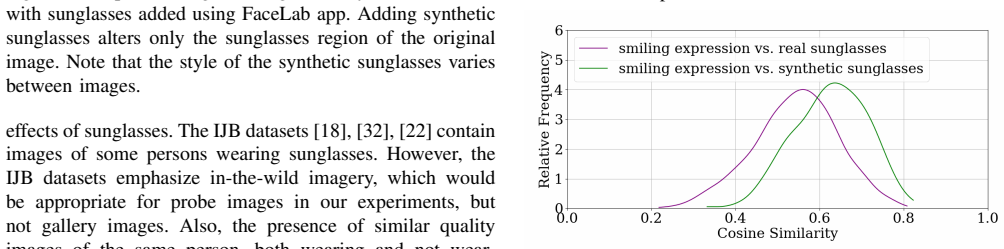
- [Sections III and IV.A with Figures 5 and 12] The central measurements use FaceLab-synthesized sunglasses as a proxy for real sunglasses, but the paper's own validation shows that synthetic sunglasses preserve identity better than real ones: Figure 5 shows higher cosine-similarity distributions for synthetic sunglasses, and Figure 12 gives 0.819 cosine similarity for synthetic versus 0.773 for physical sunglasses. Consequently, the measured d-prime/Wasserstein degradations, the matched blur/resolution levels, the FPIR values in Table III, and the 38% recovery estimate may all be optimistic for real-world probe images. The authors should either add a real-sunglasses one-to-many experiment or substantially temper the quantitative claims in the abstract and conclusions regarding surveillance scenarios.
- [Table III] The d-prime and Wasserstein equivalences in Tables I and II do not translate to operational error rates. Table III shows that 37x37 low-resolution probes produce zero FPIR in all demographic and matcher conditions, while sunglasses probes produce non-zero FPIR in some conditions (e.g., 0.522% for AdaFace Caucasian females). Since FPIR is the operational metric for one-to-many identification, the abstract's statement that sunglasses degrade accuracy "by an amount similar to ... noticeably lower resolution" is too strong. The authors should explicitly discuss this discrepancy and either recalibrate the equivalence using FPIR or restrict the equivalence claim to the distributional metrics.
- [Section IV.D and Table V] The "38% recovery" is a relative reduction in the Wasserstein distance between (mated - non-mated) score-difference distributions, not a recovery of FPIR or rank-one identification accuracy. The paper does not report FPIR for the augmented-gallery conditions, so readers cannot tell whether the 38% recovery corresponds to fewer false positives in a practically meaningful sense. The abstract should state that the recovery is measured on distributional separation, and the authors should consider reporting FPIR for the gallery-augmentation experiment to support the practical claim.
minor comments (6)
- [Table I] The AdaFace low-resolution (37x37) row for Caucasian males shows mated d-prime 3.2738 and non-mated d-prime 0.0686, values that are not visually "similar" to the sunglasses row (2.8283 and 0.4357). The selection criterion should be stated explicitly, and the table should indicate whether the match is based on mated d-prime only or on a combined measure, because the current presentation is confusing.
- [Section IV.D] The text contains color words ("Blue", "Purple", "Green", "Orange") that are artifacts of table highlighting and do not make sense in the prose. These should be removed or replaced with explicit row/column references.
- [Section IV.E] The numbers of identities are inconsistent: the text says "38,802 identities" when downscaling the dataset but later "all 38,082 identities" for Vec2Face generation. Please correct the discrepancy.
- [Section III] The sentence "These images were manually processed to have a 'sunglasses-added' version for all the original images" is awkward and unclear. Rephrase to say that failed images were manually processed or re-run so that every original image obtained a sunglasses-added version.
- [Section IV.A] The statement that the d-prime values "suggest a more pronounced effect on males" is not directly supported because d-prime measures shift from baseline, and baseline accuracy differs between demographic groups. Interpret the gender comparison with an appropriate baseline adjustment or caution.
- [Table VI] The caption "A general face recognition test accuracy (%) on real and synthetic sunglasses datasets" is ambiguous. Clarify which datasets and protocols are used and what "real" versus "synthetic" sunglasses means for the training and test sets.
Circularity Check
Blur/resolution equivalence is calibrated by construction; the abstract presents this selected match as an empirical finding, while the FaceLab proxy issue is a validity concern rather than circularity.
-
fitted input called prediction
[Abstract; Section IV.B; Table II discussion]
"we selected a degree of blur and lower resolution that causes a similar impact on accuracy as sunglasses. Table I shows that when adding σ = 4.6 Gaussian blur to the original probe image or resizing the probe image to 37x37, we obtain a similar d-prime value for the mated distribution as the probe having sunglasses. ... This is to be expected, as the particular blur and resolution values were selected for this."
The claim that sunglasses degrade accuracy by an amount 'similar to strong blur or noticeably lower resolution' is enforced by the selection of blur and resolution parameters, not discovered from data. The paper chose σ = 4.6 and 37x37 specifically so that the d-prime shift equals the sunglasses shift, so the reported similarity is true by construction. The passage even acknowledges this ('This is to be expected...'), yet the abstract restates the calibrated match as an empirical demonstration. This fits the fitted-input-called-prediction pattern: the calibration target (sunglasses d-prime) is also the reported result.
full rationale
The paper's central independent contribution is the measurement that synthetically added sunglasses lower one-to-many identification accuracy, and that gallery-side augmentation recovers part of the loss; those results do not reduce to their inputs by definition. The FaceLab synthetic-sunglasses proxy is a legitimate external-validity concern, but the paper offers an independent check against the AR real-sunglasses data (Fig. 5, Fig. 12), so it is evidence rather than circularity. The one clear circular step is the blur/resolution equivalence: because σ = 4.6 and 37x37 were explicitly chosen to match the sunglasses-induced d-prime shift, the abstract's headline that the degradation is 'similar to strong blur or noticeably lower resolution' is a restatement of the selection criterion. The paper is transparent about this, but the abstract and conclusion still present the equivalence as a finding. No load-bearing self-citation chain or imported uniqueness theorem is present; self-citations to the authors' prior dataset and matcher are normal research infrastructure. Overall, one advertised quantitative claim reduces by construction, while the main degradation and recovery measurements retain independent content, giving a partial-circularity score of 6.
Assumptions & free parameters
free parameters (2)
- Gaussian blur sigma =
4.6
- Low resolution size =
37x37
assumptions (5)
- domain assumption FaceLab synthetic sunglasses preserve identity and are a valid proxy for real sunglasses in probe images.
- domain assumption The two pretrained matchers (AdaFace and ArcFace, ResNet100, Glint360K) are representative of face identification systems.
- domain assumption Rank-one mated/non-mated score distributions and d-prime/Wasserstein distances capture one-to-many identification accuracy.
- domain assumption Gaussian blur with sigma=4.6 and 37x37 downsampling are representative of surveillance-video quality degradation.
- domain assumption The 500K-image WebFace4M subset and the authors' sunglasses detector provide a valid basis for training-augmentation conclusions.
Cite this review
Pith. "Pith review of Impact of Sunglasses on One-to-Many Facial Identification Accuracy." pith.science (2026). https://pith.science/paper/MAFBAYG4
@misc{pith2026241205721,
  author       = {Pith},
  title        = {Pith review of: Impact of Sunglasses on One-to-Many Facial Identification Accuracy},
  year         = {2026},
  howpublished = {\url{https://pith.science/paper/MAFBAYG4}},
  note         = {Machine review of arXiv:2412.05721}
}
read the original abstract
One-to-many facial identification is documented to achieve high accuracy in the case where both the probe and the gallery are "mugshot quality" images. However, an increasing number of documented instances of wrongful arrest following one-to-many facial identification have raised questions about its accuracy. Probe images used in one-to-many facial identification are often cropped from frames of surveillance video and deviate from "mugshot quality" in various ways. This paper systematically explores how the accuracy of one-to-many facial identification is degraded by the person in the probe image choosing to wear dark sunglasses. We show that sunglasses degrade accuracy for mugshot-quality images by an amount similar to strong blur or noticeably lower resolution. Further, we demonstrate that the combination of sunglasses with blur or lower resolution results in even more pronounced loss in accuracy. These results have important implications for developing objective criteria to qualify a probe image for the level of accuracy to be expected if it used for one-to-many identification. To ameliorate the accuracy degradation caused by dark sunglasses, we show that it is possible to recover about 38% of the lost accuracy by synthetically adding sunglasses to all the gallery images, without model re-training. We also show that the frequency of wearing-sunglasses images is very low in existing training sets, and that increasing the representation of wearing-sunglasses images can greatly reduce the error rate. The image set assembled for this research is available at https://cvrl.nd.edu/projects/data/ to support replication and further research.
Figures


Figures from the paper (14 more)


Reference graph
Works this paper leans on
-
[1]
V . Albiero, K. W. Bowyer, and M. C. King. Face regions impact recognition accuracy differently across demographics. In IJCB, 2022
work page 2022
-
[2]
V . Albiero, X. Chen, X. Yin, G. Pang, and T. Hassner. img2pose: Face alignment and detection via 6dof, face pose estimation. CVPR, pages 7613–7623, 2020
work page 2020
-
[3]
X. An, X. Zhu, Y . Gao, Y . Xiao, Y . Zhao, Z. Feng, L. Wu, B. Qin, M. Zhang, D. Zhang, and Y . Fu. Partial FC: training 10 million identities on a single machine. In ICCVW, pages 1445–1449, 2021
work page 2021
- [4]
- [5]
-
[6]
J. Deng, J. Guo, N. Xue, and S. Zafeiriou. Arcface: Additive angular margin loss for deep face recognition. In CVPR, pages 4690–4699, 2019
work page 2019
-
[7]
M. E. Erak ιn, U. Demir, and H. K. Ekenel. On recognizing occluded faces in the wild. In 2021 International Conference of the Biometrics Special Interest Group (BIOSIG) , pages 1–5. IEEE, 2021
work page 2021
-
[8]
B. Fung. Lawsuit: Facial recognition software leads to wrongful arrest of texas man; he was in sacramento at time of robbery. CBS News , January 23, 2024
work page 2024
Show all 43 references
-
[9]
Grother, M
P. Grother, M. Ngan, and K. Hanaoka. Face recognition vendor test (FRVT) part 2: Identification. NISTIR, 8271, 2019
2019
-
[10]
Grother, M
P. Grother, M. Ngan, and K. Hanaoka. Ongoing face recognition vendor test (FRVT) part 3: Demographic effects. NISTIR, 8280, 2019
2019
-
[11]
J. Guo, X. Zhu, Z. Lei, and S. Z. Li. Face synthesis for eyeglass-robust face recognition. In CCBR, pages 275–284, 2018
2018
-
[12]
K. He, X. Zhang, S. Ren, and J. Sun. Deep residual learning for image recognition. In CVPR, pages 770–778, 2016
2016
-
[13]
Z. He, W. Zuo, M. Kan, S. Shan, and X. Chen. Attgan: Facial attribute editing by only changing what you want. IEEE transactions on image processing, 28(11):5464–5478, 2019
2019
-
[14]
Hou, C.-P
L. Hou, C.-P. Yu, and D. Samaras. Squared earth mover’s distance- based loss for training deep neural networks. arXiv preprint arXiv:1611.05916, 2016
2016 arXiv
-
[15]
G. B. Huang, M. Mattar, T. Berg, and E. Learned-Miller. Labeled faces in the wild: A database forstudying face recognition in unconstrained environments. In Workshop on faces in’Real-Life’Images: detection, alignment, and recognition , 2008
2008
-
[16]
K. Johnson. How wrongful arrests based on AI derailed 3 men’s lives. Wired News, March 7, 2022
2022
-
[17]
M. Kim, A. K. Jain, and X. Liu. Adaface: Quality adaptive margin for face recognition. In CVPR, pages 18729–18738, 2022
2022
-
[18]
B. F. Klare, B. Klein, E. Taborsky, A. Blanton, J. Cheney, K. Allen, P. Grother, A. Mah, M. J. Burge, and A. K. Jain. Pushing the frontiers of unconstrained face detection and recognition: IARPA janus benchmark A. In CVPR, 2015
2015
-
[19]
Krishnapriya, V
K. Krishnapriya, V . Albiero, K. Vangara, M. King, and K. Bowyer. Issues related to face recognition accuracy varying based on race and skin tone. 2020
2020
-
[20]
M. Liu, Y . Ding, M. Xia, X. Liu, E. Ding, W. Zuo, and S. Wen. Stgan: A unified selective transfer network for arbitrary image attribute editing. In Proceedings of the IEEE/CVF conference on computer vision and pattern recognition , pages 3673–3682, 2019
2019
-
[21]
Martinez and R
A. Martinez and R. Benavente. The AR face database. CVC TechRep #24, 1998
1998
-
[22]
B. Maze, J. C. Adams, J. A. Duncan, N. D. Kalka, T. Miller, C. Otto, A. K. Jain, W. T. Niggel, J. Anderson, J. Cheney, and P. Grother. IARPA janus benchmark - C: face dataset and protocol. In International Conference on Biometrics , pages 158–165, 2018
2018
-
[23]
Moschoglou, A
S. Moschoglou, A. Papaioannou, C. Sagonas, J. Deng, I. Kotsia, and S. Zafeiriou. Agedb: The first manually collected, in-the-wild age database. In CVPRW, pages 1997–2005, 2017
1997
-
[24]
Pangelinan, A
G. Pangelinan, A. Bhatta, H. Wu, M. C. King, and K. W. Bowyer. Analyzing the impact of demographic and operational variables on 1- to-many face id search. IEEE Transactions on Technology and Society, 2024
2024
-
[25]
P. J. Phillips, P. J. Flynn, W. T. Scruggs, K. Bowyer, J. Chang, K. Hoffman, J. Marques, J. Min, and W. J. Worek. Overview of the face recognition grand challenge. CVPR, 1:947–954 vol. 1, 2005
2005
-
[26]
Ricanek and T
K. Ricanek and T. Tesafaye. Morph: A longitudinal image database of normal adult age-progression. In IEEE Face & Gesture Recognition , pages 341–345, 2006
2006
-
[27]
Sengupta, J
S. Sengupta, J. Chen, C. D. Castillo, V . M. Patel, R. Chellappa, and D. W. Jacobs. Frontal to profile face verification in the wild. In WACV, pages 1–9, 2016
2016
-
[28]
Shen and R
W. Shen and R. Liu. Learning residual images for face attribute manipulation. In CVPR, pages 4030–4038, 2017
2017
-
[29]
Thanawala
S. Thanawala. Facial recognition technology jailed a man for days. his lawsuit joins others from black plaintiffs. Associated Press, September 25, 2023
2023
-
[30]
M. C. K. Vitor Albiero, Kevin W. Bowyer. Notre dame male/female accuracy dataset
-
[31]
T. Y . Wang and A. Kumar. Recognizing human faces under disguise and makeup. In 2016 IEEE International Conference on Identity, Security and Behavior Analysis (ISBA) , pages 1–7. IEEE, 2016
2016
-
[32]
Whitelam, E
C. Whitelam, E. Taborsky, A. Blanton, B. Maze, J. C. Adams, T. Miller, N. D. Kalka, A. K. Jain, J. A. Duncan, K. Allen, J. Cheney, and P. Grother. IARPA janus benchmark-b face dataset. In CVPRW, pages 592–600, 2017
2017
-
[33]
H. Wu, V . Albiero, K. Krishnapriya, M. C. King, and K. W. Bowyer. Face recognition accuracy across demographics: Shining a light into the problem. In CVPR, pages 1041–1050, 2023
2023
-
[34]
H. Wu, G. Bezold, A. Bhatta, and K. W. Bowyer. Logical consistency and greater descriptive power for facial hair attribute learning. In CVPR, pages 8588–8597, 2023
2023
-
[35]
H. Wu, J. Singh, S. Tian, L. Zheng, and K. W. Bowyer. Vec2face: Scaling face dataset generation with loosely constrained vectors. arXiv preprint arXiv:2409.02979, 2024
2024 arXiv
-
[36]
H. Wu, S. Tian, A. Bhatta, J. Gutierrez, G. Bezold, G. Argueta, K. Ricanek, M. C. King, and K. W. Bowyer. What is a goldilocks face verification test set? ArXiv, abs/2405.15965, 2024
2024
-
[37]
H. Wu, S. Tian, H. Li, and K. W. Bowyer. Logicnet: A logical consistency embedded face attribute learning network. WACV, 2025
2025
-
[38]
I. Yip. Detroit police chief says ‘poor investigative work’ led to arrest of black mom who claims facial recognition technology played a role. CNN, August 10, 2023
2023
-
[39]
Zheng and W
T. Zheng and W. Deng. Cross-pose LFW: A database for studying cross-pose face recognition in unconstrained environments. Beijing University of Posts and Telecommunications, Tech. Rep , 5(7), 2018
2018
-
[40]
Zheng, W
T. Zheng, W. Deng, and J. Hu. Cross-age LFW: A database for studying cross-age face recognition in unconstrained environments. arXiv preprint arXiv:1708.08197 , 2017
2017 arXiv
-
[41]
Z. Zhu, G. Huang, J. Deng, Y . Ye, J. Huang, X. Chen, J. Zhu, T. Yang, D. Du, J. Lu, and J. Zhou. Webface260m: A benchmark for million- scale deep face recognition. PAMI, 45(2):2627–2644, 2023. Supplementary Material The experiments in the paper primarily utilize the AdaFace m...
2023
-
[42]
The face matcher is AdaFace
37x37 resolution, 4) sunglasses + blur, 5) sunglasses + 37x37 resolution. The face matcher is AdaFace. Fig. 16: Comparison mated and non-mated distributions for original probe images and different conditions of degraded probes (top to bottom): 1) sunglasses, 2) blur of σ = 4.6,
-
[43]
The face matcher is ArcFace
37x37 resolution, 4) sunglasses + blur, 5) sunglasses + 37x37 resolution. The face matcher is ArcFace. Fig. 17: Score difference (mated - non-mated) distributions for original probe images and different conditions of de- graded probes (top to bottom): 1) sunglasses, 2) blur of...
Reviewed August 11, 2026 · model on record in the stance chip above.
Discussion (0). Continue with ORCID to comment.