REVIEW 4 major objections 5 minor 85 references
Proximal Iteration for Nonlinear Adaptive Lasso
T0 review · 4 major / 5 minor · reviewed 2026-08-11 · deepseek-v4-flash
Pith's one-line read Treating adaptive Lasso penalty strengths as decision variables yields one proximal-gradient algorithm for debiased variable selection with any smooth likelihood and sparsity structure.
desk verdict A genuinely useful framework for debiased structured sparsity with a new proximal operator, but Theorem 2 is numerically wrong as stated (swapped inequality) and needs correction before the method can be trusted. read the letter →
The pith
A machine-rendered reading of the paper's core claim, the machinery that carries it, and where it could break.
The reading
What carries the argument
The load-bearing object is the proximal operator — the map sending a point to the minimizer of the function plus a quadratic proximity term — applied to the variable-penalty norm $g(\beta,\lambda)=\lambda|\beta|$ and its log-augmented variant $\lambda|\beta|+a\log\lambda$. Because the MAP objective separates across coordinates, the proximal problem reduces to a two-dimensional scalar problem, and the paper gives its closed-form solution: for $s_\beta s_\lambda<1$, the optimal $\lambda^*$ is $\lambda_0$ when $\lambda_0\ge|\beta_0|/s_\beta$, and otherwise $(\lambda_0-s_\lambda|\beta_0|)_+/(1-s_\lambda s_\beta)$, with $\beta^*=(|\beta_0|-s_\beta\lambda^*)_+\operatorname{sgn}(\beta_0)$; the log term replaces this with a square-root formula that keeps $\lambda$ strictly positive. This operator lets a single proximal-gradient loop optimize $\beta$ and $\lambda$ together, and because sparsity structure lives in the smooth prior $p_\lambda$, the same operator handles arbitrary structure.
What would settle it
Take a small negative-binomial regression with correlated predictors, run the paper's proximal-gradient algorithm from many random starting points with its default step-size schedule, and check whether all runs settle on the same coefficients at a point where no small perturbation improves the joint objective; disagreement or non-stationary endpoints would falsify the claim that one algorithm reliably handles arbitrary smooth likelihoods.
Extended reading notes
Core claim
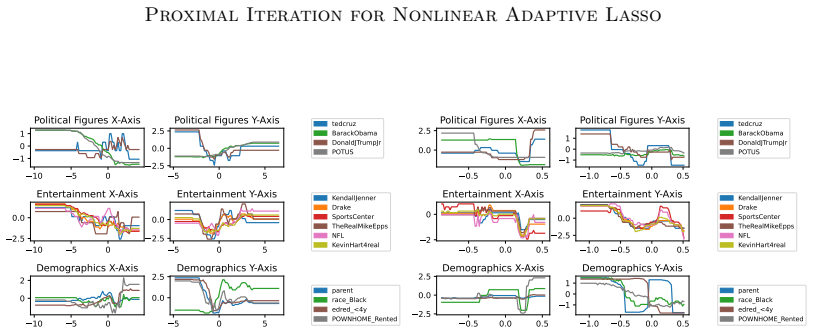
The central claim is that adaptive Lasso can be learned end to end: instead of preselecting penalty coefficients $\lambda_p$ with a pilot estimator or iteratively reweighting them, one minimizes $$\min_{\$\beta$,\$\lambda$} L(\$\beta$)+\sum_p(\tau\lambda_p|\beta_p|-\log\lambda_p)-\log p_\$\lambda$(\$\lambda$)$$ over coefficients and penalty strengths jointly. The authors establish a closed-form proximal operator for the nonconvex term $\lambda|\beta|$, including a log-barrier variant, so proximal gradient iterations can update $\beta$ and $\lambda$ together. They prove that with an independent sufficiently diffuse prior the estimator has the oracle property: it recovers the zero pattern with probability tending to one and is asymptotically normal with the same covariance as if the zero coefficients were known. The same machinery, they argue, imposes group, overlapping-group, or hierarchical sparsity simply by choosing a smooth hyperprior on $\lambda$, shifting structure from the nonsmooth to the smooth part of the objective. Numerical studies on synthetic and real data and two social-science applications are offered as evidence that one algorithm is competitive with structure-specific implementations.
Load-bearing premise
The whole method depends on the iterative optimization landing on a good solution rather than stalling or drifting, and the paper does not verify that its chosen step sizes satisfy the conditions its convergence guarantee requires.
Editorial extensions
If this is right
- A single proximal operator replaces the bespoke prox computations for group Lasso, overlapping group Lasso, and hierarchical sparsity; users can impose new structures by writing a smooth prior.
- For large-data nonlinear models the method scales to objects such as the hurdle gravity model with about two hundred thousand candidate interaction terms, by building the interactions on the fly inside minibatches.
- The oracle property means that, asymptotically, the estimator selects the zero pattern correctly and has the same limiting distribution for nonzero coefficients as an oracle that knew the pattern.
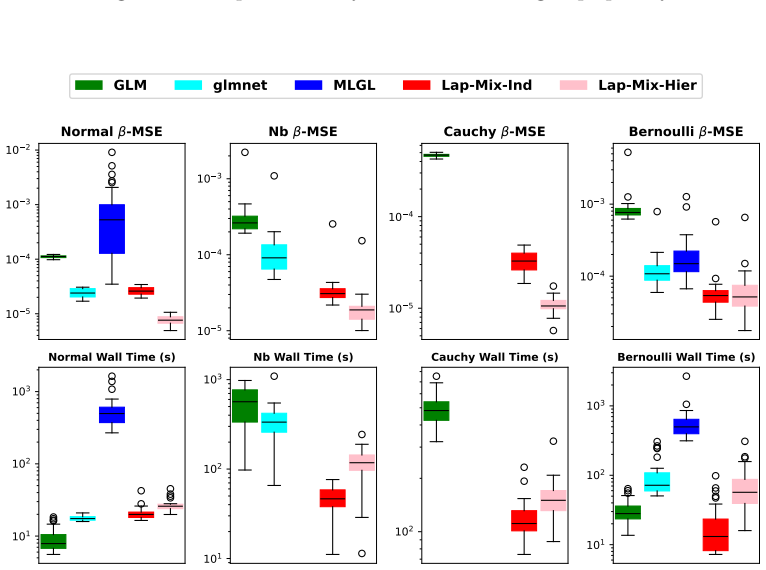
- On synthetic non-Gaussian regressions and eight benchmark datasets the method is competitive in accuracy and usually faster than specialized packages, and it also handles Cauchy and negative-binomial likelihoods that those packages do not.
- Active coefficients are less biased than under a fixed-penalty Lasso because each $\lambda_p$ can shrink to a small value for strong signals.
Reading between the lines
- If the convergence gap is closed, this framework could become a default black-box sparse-estimation routine, since the same proximal operator would serve any likelihood and any sparsity structure; a testable extension is to compare it against bespoke solvers on graph- and tree-structured sparsity benchmarks.
- The same variable-coefficient prox idea may extend to other penalties such as SCAD, MCP, or bridge penalties by letting their tuning parameters vary; closed forms for those proximal operators would generalize the approach beyond Lasso-type terms.
- Numerical evidence that structured priors can improve prediction even when the effect-hierarchy principle is weak suggests that group assumptions in complicated likelihoods are best chosen by validation rather than by prior belief.
- With the log term removed, the bare $\lambda|\beta|$ proximal operator exhibits the possibility of driving $\lambda$ to zero, hinting at a formulation that induces sparsity directly in penalty strengths as well as coefficients.
Signed reviews
Editorial analysis
A structured set of objections, weighed in public.
Referee Report
Summary. The paper proposes a unified proximal-gradient framework for adaptive Lasso problems in which the per-coordinate penalty coefficients λ are treated as decision variables and optimized jointly with the regression coefficients β. The central objects are closed-form proximal operators for the variable-penalty L1 function λ|β| (Theorem 2) and for its log-penalized variant λ|β| + a log λ (Theorem 5). The authors state oracle properties for the resulting estimator, introduce priors that encode group and overlapping-group sparsity structure, and evaluate the method on synthetic data, UCI benchmarks, and two social-science case studies. The main claim is that this one-algorithm-fits-all approach is competitive with, and often faster than, specialized solvers such as glmnet and MLGL across Gaussian, Bernoulli, Negative Binomial, and Cauchy likelihoods.
Significance. If the central construction were correct, the paper would make a useful contribution: moving sparsity structure from the nonsmooth penalty into a smooth prior while keeping a single proximal operator is an attractive idea, and the empirical scope is broad, including non-Gaussian likelihoods, structured sparsity, real data, and large-scale case studies. The authors provide code and appear to have run a substantial battery of comparisons. However, the load-bearing proximal operator is stated incorrectly in Theorem 2, and several theoretical statements either are unverified or appear false as written. These issues affect the correctness of the algorithm actually deployed, not merely the presentation, so the current version cannot be accepted. With careful correction of the proximal operators and a honest restatement of the convergence and oracle-property results, the framework could be a valuable addition to the sparse-regression toolbox.
major comments (4)
- [Section 3.1, Theorem 2] The sβsλ ≥ 1 branch is incorrect as stated. The theorem gives λ* = λ0 when λ0√sλ > |β0|√sβ and λ* = 0 otherwise, but the proof in Appendix A compares the costs λ0²/(2sλ) and β0²/(2sβ) and therefore yields the opposite placement of sβ and sλ: λ* = λ0 when |β0|√sλ < λ0√sβ. A concrete counterexample: with sβ = 4, sλ = 1, β0 = 1, λ0 = 1.5, the theorem's condition is false (1.5 > 2), so it predicts λ* = 0 with proximal cost 1.125, whereas (β*,λ*) = (0,1.5) has proximal cost 0.125 and is the true minimizer. Since the algorithm in Section 3.3 applies exactly this proximal operator, the central construction is not correctly specified as written. Remark 3 reproduces the same incorrect branch and should be corrected together with the theorem.
- [Section 3.2, Theorem 5] The log-term proximal operator has several apparent errors. In the zero branch, Eq. (12) and the surrounding condition use λ0² where the stationarity equation gives λ0; the correct λ* at β = 0 is (λ0 + sqrt(λ0² + 4 sλ a))/2, not (λ0² + sqrt(λ0² + 4 sλ a))/2. The condition should also involve |β0|, not β0, since the theorem is stated for arbitrary real β0. In addition, the theorem is written for the objective λ|β| + a log λ, while the algorithm in Section 3.3 applies the prox of λ|β| − (1/τ) log λ; with the implemented sign, a is negative and the square root in the formulas can fail to be real. The relation between a and τ and the sign convention must be clarified and the formulas re-derived for the objective actually used in the experiments.
- [Section 3.3.1, Convergence] The convergence discussion invokes Li and Pong (2015), Theorem 5, but none of the hypotheses are verified for the objectives in this paper. The theorem requires a twice continuously differentiable convex q such that ∇²h + ∇²q has spectrum bounded by l, and a step size below 1/l; the paper does not establish such a bound for any of the negative log-likelihoods or priors used in Section 6. Moreover, the actual algorithm uses Adam-based step sizes and stochastic minibatches, for which the deterministic proximal-gradient result does not directly apply. The text itself concedes that the theorem does not imply the existence of cluster points. This leaves the main algorithmic claim—that the proximal iteration reliably finds a useful stationary point—without theoretical support, and the gap is load-bearing for the 'one-algorithm-fits-all' statement in Section 7.1.
- [Section 4, Theorem 8] Part 2 of Theorem 8 is not established by the given proof and appears to be false under the paper's own assumptions. The proof states that both |β| and τλ* are decreasing in |β|, but the first term is increasing. For the half-Cauchy prior used in Section 5.1, one can compute the derivative of |β| + g'_{τn}(|β|) at |β| = 0 as 1 − τn²/(ρ'(1)² + ρ''(1)) = 1 − τn² (with the paper's normalization), which is negative for the linearly growing τn = nτ0 used in Theorem 12. Hence the minimum is not at β = 0 for large n. The proof of the oracle property in Appendix B is also a sketch: the zero-coordinate result is asserted after a sign-of-derivative argument, and the expansion mixes terms of different orders in √N without a complete justification. Since the oracle property is one of the paper's stated contributions, this needs a correct statement and a complete proof.
minor comments (5)
- [Throughout] There are numerous typos, including 'Deonte' for 'Denote' in Section 1, 'wieghts' in Section 2.1, and 'sythetic' in the abstract; the paper would benefit from a careful proofreading pass.
- [Figure 2 and Section 3.1] The notation is inconsistent: the main text uses sβ and sλ, while the figure caption and the reduced form in Eq. (11) use sx and sλ (or sxsλ); unify the notation.
- [Section 5.2] The notation pγ = C(0,1)+ and λi|γg(i) ∼ N(γg(i), 1/√N)+ is nonstandard; please define the half-Cauchy and truncated-normal conventions explicitly, including which side is truncated.
- [Lemma 7 and Theorem 8] Lemma 7, part 4, contains an n in the denominator that is absent from the corresponding statement in Theorem 8; the subscripted τn and τ notation should be made consistent throughout Section 4.
- [Appendix B and theorem numbering] The oracle property is stated as Theorem 12 in the main text but is labeled Theorem 9 in Appendix B; align the numbering and the assumptions between the two statements.
Circularity Check
No significant circularity: the proximal-operator and oracle-property derivations are self-contained, and the only self-citations are data-source references that do not carry the load.
full rationale
The paper's derivation chain is not circular. The central construction, the closed-form proximal operators in Section 3.1 and Section 3.2, is derived from the definition of the proximal cost (P1 and P2) using nested optimization and the known soft-thresholding operator; it does not assume the target proximal mapping as an input. The statistical claims in Section 4 likewise start from an explicit profiling identity (Eq. 14-15) and then prove properties of the resulting penalty via implicit differentiation and a Fan-Li-style argument, rather than importing the oracle property as an assumption. The reweighted-L1 connection in Section 2.4 is presented as an a posteriori interpretation, not as a premise for the main results. Numerical comparisons are run against external baselines (glmnet, MLGL, unpenalized regression), so the empirical claims are not forced by construction. The only self-citations are to Singh et al. (2024) for the vaccination survey data, which is a data provenance reference and is not load-bearing for the method's derivation. The reviewer-flagged algebraic discrepancy in Theorem 2's stated condition is a correctness concern about the closed form, not a circularity: a miscalculated expression can still be derived from the stated cost rather than assumed from the conclusion. The paper also explicitly limits its convergence claims in Section 3.3.1, which further supports a non-circular reading. Overall, no step reduces by definition to its own inputs, so no circularity is found.
Assumptions & free parameters
free parameters (4)
- Global penalty strength tau =
0.025N (independent), 0.015N (structured)
- Group prior variance scale =
1/sqrt(N)
- Softmax temperature for overlapping groups =
sqrt(P)
- Adam learning rate =
1e-2
assumptions (4)
- standard math The proximal operator concept extends to nonconvex functions.
- domain assumption The conditions of Li and Pong (2015) Theorem 5 hold for the proposed proximal gradient iteration.
- domain assumption The likelihood satisfies standard regularity conditions (identifiability, bounded third derivatives, positive definite Fisher information).
- domain assumption The prior density on lambda is decreasing with bounded logarithmic derivative.
Cite this review
Pith. "Pith review of Proximal Iteration for Nonlinear Adaptive Lasso." pith.science (2026). https://pith.science/paper/JAHUTQEX
@misc{pith2026241205726,
  author       = {Pith},
  title        = {Pith review of: Proximal Iteration for Nonlinear Adaptive Lasso},
  year         = {2026},
  howpublished = {\url{https://pith.science/paper/JAHUTQEX}},
  note         = {Machine review of arXiv:2412.05726}
}
abstract
Augmenting a smooth cost function with an $\ell_1$ penalty allows analysts to efficiently conduct estimation and variable selection simultaneously in sophisticated models and can be efficiently implemented using proximal gradient methods. However, one drawback of the $\ell_1$ penalty is bias: nonzero parameters are underestimated in magnitude, motivating techniques such as the Adaptive Lasso which endow each parameter with its own penalty coefficient. But it's not clear how these parameter-specific penalties should be set in complex models. In this article, we study the approach of treating the penalty coefficients as additional decision variables to be learned in a \textit{Maximum a Posteriori} manner, developing a proximal gradient approach to joint optimization of these together with the parameters of any differentiable cost function. Beyond reducing bias in estimates, this procedure can also encourage arbitrary sparsity structure via a prior on the penalty coefficients. We compare our method to implementations of specific sparsity structures for non-Gaussian regression on synthetic and real datasets, finding our more general method to be competitive in terms of both speed and accuracy. We then consider nonlinear models for two case studies: COVID-19 vaccination behavior and international refugee movement, highlighting the applicability of this approach to complex problems and intricate sparsity structures.
Figures


Figures from the paper (6 more)



Reference graph
Works this paper leans on
-
[1]
Bayesian inference for spatio-temporal spike-and-slab priors
Michael Riis Andersen, Aki Vehtari, Ole Winther, and Lars Kai Hansen. Bayesian inference for spatio-temporal spike-and-slab priors. The Journal of Machine Learning Research, 18 0 (1): 0 5076--5133, 2017
2017
-
[2]
Gravity with gravitas: A solution to the border puzzle
James E Anderson and Eric Van Wincoop. Gravity with gravitas: A solution to the border puzzle. American economic review, 93 0 (1): 0 170--192, 2003
2003
-
[3]
Structured sparsity through convex optimization
Francis Bach, Rodolphe Jenatton, Julien Mairal, and Guillaume Obozinski. Structured sparsity through convex optimization. Statistical Science, 27 0 (4): 0 450--468, 2012 a
2012
-
[4]
Optimization with sparsity-inducing penalties
Francis Bach, Rodolphe Jenatton, Julien Mairal, Guillaume Obozinski, et al. Optimization with sparsity-inducing penalties. Foundations and Trends in Machine Learning , 4 0 (1): 0 1--106, 2012 b
2012
-
[5]
Adaptive regression and model selection in data mining problems
Sergey Bakin et al. Adaptive regression and model selection in data mining problems. 1999
1999
-
[6]
Model-based compressive sensing
Richard G Baraniuk, Volkan Cevher, Marco F Duarte, and Chinmay Hegde. Model-based compressive sensing. IEEE Transactions on information theory, 56 0 (4): 0 1982--2001, 2010
work page 1982
-
[7]
Convex Analysis and Monotone Operator Theory in Hilbert Spaces
Heinz H Bauschke and Patrick L Combettes. Convex Analysis and Monotone Operator Theory in Hilbert Spaces. Springer Publishing Company, Incorporated, 2011
work page 2011
-
[8]
Lasso meets horseshoe: A survey
Anindya Bhadra, Jyotishka Datta, Nicholas G Polson, and Brandon Willard. Lasso meets horseshoe: A survey. Statistical Science, 34 0 (3): 0 405--427, 2019
work page 2019
Show all 85 references
-
[9]
Bayesian shrinkage
Anirban Bhattacharya, Debdeep Pati, Natesh S Pillai, and David B Dunson. Bayesian shrinkage. arXiv preprint arXiv:1212.6088, 2012
2012 arXiv
-
[10]
JAX : composable transformations of P ython+ N um P y programs, 2018
James Bradbury, Roy Frostig, Peter Hawkins, Matthew James Johnson, Chris Leary, Dougal Maclaurin, George Necula, Adam Paszke, Jake Vander P las, Skye Wanderman- M ilne, and Qiao Zhang. JAX : composable transformations of P ython+ N um P y programs, 2018. URL http://github.com/...
2018
-
[11]
Discussion: One-step sparse estimates in nonconcave penalized likelihood models
Peter Bühlmann and Lukas Meier. Discussion: One-step sparse estimates in nonconcave penalized likelihood models . The Annals of Statistics, 36 0 (4): 0 1534 -- 1541, 2008. doi:10.1214/07-AOS0316A. URL https://doi.org/10.1214/07-AOS0316A
2008 doi
-
[12]
Robust uncertainty principles: Exact signal reconstruction from highly incomplete frequency information
Emmanuel J Cand \`e s, Justin Romberg, and Terence Tao. Robust uncertainty principles: Exact signal reconstruction from highly incomplete frequency information. IEEE Transactions on information theory, 52 0 (2): 0 489--509, 2006
2006
-
[13]
Enhancing sparsity by reweighted _1 minimization
Emmanuel J Candes, Michael B Wakin, and Stephen P Boyd. Enhancing sparsity by reweighted _1 minimization. Journal of Fourier analysis and applications, 14: 0 877--905, 2008
2008
-
[14]
Carvalho, Nicholas G
Carlos M. Carvalho, Nicholas G. Polson, and James G. Scott. The horseshoe estimator for sparse signals. Biometrika, 97 0 (2): 0 465--480, 2010. ISSN 00063444, 14643510. URL http://www.jstor.org/stable/25734098
2010
-
[15]
Some statistical models for limited dependent variables with application to the demand for durable goods
John G Cragg. Some statistical models for limited dependent variables with application to the demand for durable goods. Econometrica: journal of the Econometric Society, pages 829--844, 1971
1971
-
[16]
Tensorflow distributions
Joshua V Dillon, Ian Langmore, Dustin Tran, Eugene Brevdo, Srinivas Vasudevan, Dave Moore, Brian Patton, Alex Alemi, Matt Hoffman, and Rif A Saurous. Tensorflow distributions. arXiv preprint arXiv:1711.10604, 2017
2017 arXiv
-
[17]
D. L. Donoho. De-noising by soft-thresholding. IEEE Transactions on Information Theory, 41 0 (3): 0 613--627, May 1995
1995
-
[18]
Boltzmann machine and mean-field approximation for structured sparse decompositions
Ang \'e lique Dr \'e meau, C \'e dric Herzet, and Laurent Daudet. Boltzmann machine and mean-field approximation for structured sparse decompositions. IEEE Transactions on Signal Processing, 60 0 (7): 0 3425--3438, 2012
2012
-
[19]
On the deep active-subspace method
Wouter Edeling. On the deep active-subspace method. SIAM/ASA Journal on Uncertainty Quantification, 11 0 (1): 0 62--90, 2023
2023
-
[20]
Least angle regression
Bradley Efron, Trevor Hastie, Iain Johnstone, and Robert Tibshirani. Least angle regression . The Annals of Statistics, 32 0 (2): 0 407 -- 499, 2004. doi:10.1214/009053604000000067. URL https://doi.org/10.1214/009053604000000067
2004 doi
-
[21]
Variable selection via nonconcave penalized likelihood and its oracle properties
Jianqing Fan and Runze Li. Variable selection via nonconcave penalized likelihood and its oracle properties. Journal of the American statistical Association, 96 0 (456): 0 1348--1360, 2001
2001
-
[22]
Regularization paths for generalized linear models via coordinate descent
Jerome Friedman, Trevor Hastie, and Rob Tibshirani. Regularization paths for generalized linear models via coordinate descent. Journal of statistical software, 33 0 (1): 0 1, 2010 a
2010
-
[23]
Regularization paths for generalized linear models via coordinate descent
Jerome Friedman, Robert Tibshirani, and Trevor Hastie. Regularization paths for generalized linear models via coordinate descent. Journal of Statistical Software, 33 0 (1): 0 1--22, 2010 b . doi:10.18637/jss.v033.i01
2010 doi
-
[24]
Near-optimal sparse fourier representations via sampling
Anna C Gilbert, Sudipto Guha, Piotr Indyk, Shanmugavelayutham Muthukrishnan, and Martin Strauss. Near-optimal sparse fourier representations via sampling. In Proceedings of the thiry-fourth annual ACM symposium on Theory of computing, pages 152--161, 2002
2002
-
[25]
MLGL : an R package implementing correlated variable selection by hierarchical clustering and group-lasso
Quentin Grimonprez, Samuel Blanck, Alain Celisse, and Guillemette Marot. MLGL : an R package implementing correlated variable selection by hierarchical clustering and group-lasso. Journal of Statistical Software, 106: 0 1--33, 2023
2023
-
[26]
Feature selection based on structured sparsity: A comprehensive study
Jie Gui, Zhenan Sun, Shuiwang Ji, Dacheng Tao, and Tieniu Tan. Feature selection based on structured sparsity: A comprehensive study. IEEE transactions on neural networks and learning systems, 28 0 (7): 0 1490--1507, 2016
2016
-
[27]
Computing proximal points of nonconvex functions
Warren Hare and Claudia Sagastiz \'a bal. Computing proximal points of nonconvex functions. Mathematical Programming, 116 0 (1): 0 221--258, 2009
2009
- [28]
-
[29]
Ridge regression: Biased estimation for nonorthogonal problems
Arthur E Hoerl and Robert W Kennard. Ridge regression: Biased estimation for nonorthogonal problems. Technometrics, 12 0 (1): 0 55--67, 1970
1970
-
[30]
Learning with structured sparsity
Junzhou Huang, Tong Zhang, and Dimitris Metaxas. Learning with structured sparsity. Journal of Machine Learning Research, 12: 0 3371--3412, 2011
2011
-
[31]
Hunter and Runze Li
David R. Hunter and Runze Li. Variable selection using MM algorithms . The Annals of Statistics, 33 0 (4): 0 1617 -- 1642, 2005. doi:10.1214/009053605000000200. URL https://doi.org/10.1214/009053605000000200
2005 doi
-
[32]
Fast sparse group L asso
Yasutoshi Ida, Yasuhiro Fujiwara, and Hisashi Kashima. Fast sparse group L asso. Advances in Neural Information Processing Systems, 32, 2019
2019
-
[33]
Group lasso with overlap and graph lasso
Laurent Jacob, Guillaume Obozinski, and Jean-Philippe Vert. Group lasso with overlap and graph lasso. In Proceedings of the 26th annual international conference on machine learning, pages 433--440, 2009
2009
-
[34]
Structured variable selection with sparsity-inducing norms
Rodolphe Jenatton, Jean-Yves Audibert, and Francis Bach. Structured variable selection with sparsity-inducing norms. The Journal of Machine Learning Research, 12: 0 2777--2824, 2011 a
2011
-
[35]
Proximal methods for hierarchical sparse coding
Rodolphe Jenatton, Julien Mairal, Guillaume Obozinski, and Francis Bach. Proximal methods for hierarchical sparse coding. The Journal of Machine Learning Research, 12: 0 2297--2334, 2011 b
2011
-
[36]
Accelerating stochastic gradient descent using predictive variance reduction
Rie Johnson and Tong Zhang. Accelerating stochastic gradient descent using predictive variance reduction. Advances in neural information processing systems, 26, 2013
2013
-
[37]
Self-adaptive lasso and its B ayesian estimation
Jian Kang and Jian Guo. Self-adaptive lasso and its B ayesian estimation. Technical report, Working Paper, 2009
2009
-
[38]
Tree-guided group lasso for multi-response regression with structured sparsity, with an application to eqtl mapping
Seyoung Kim and Eric P Xing. Tree-guided group lasso for multi-response regression with structured sparsity, with an application to eqtl mapping. The Annals of Applied Statistics, 6 0 (3): 0 1095--1117, 2012
2012
-
[39]
Adam: A method for stochastic optimization
Diederik P Kingma and Jimmy Ba. Adam: A method for stochastic optimization. arXiv preprint arXiv:1412.6980, 2014
2014 arXiv
-
[40]
Bayesian adaptive lasso
Chenlei Leng, Minh-Ngoc Tran, and David Nott. Bayesian adaptive lasso. Annals of the Institute of Statistical Mathematics, 66 0 (2): 0 221--244, 2014
2014
-
[41]
Global convergence of splitting methods for nonconvex composite optimization
Guoyin Li and Ting Kei Pong. Global convergence of splitting methods for nonconvex composite optimization. SIAM Journal on Optimization, 25 0 (4): 0 2434--2460, 2015
2015
-
[42]
Sliced inverse regression for dimension reduction
Ker-Chau Li. Sliced inverse regression for dimension reduction. Journal of the American Statistical Association, 86 0 (414): 0 316--327, 1991
1991
-
[43]
A simple sampler for the horseshoe estimator
Enes Makalic and Daniel F Schmidt. A simple sampler for the horseshoe estimator. IEEE Signal Processing Letters, 23 0 (1): 0 179--182, 2015
2015
-
[44]
A new B ayesian lasso
Himel Mallick and Nengjun Yi. A new B ayesian lasso. Statistics and its interface, 7 0 (4): 0 571, 2014
2014
-
[45]
On exact _q denoising
Goran Marjanovic and Victor Solo. On exact _q denoising. In 2013 IEEE International Conference on Acoustics, Speech and Signal Processing, pages 6068--6072. IEEE, 2013
2013
-
[46]
Notes on cepii’s distances measures: The geodist database
Thierry Mayer and Soledad Zignago. Notes on cepii’s distances measures: The geodist database. 2011
2011
-
[47]
Relaxed lasso
Nicolai Meinshausen. Relaxed lasso. Computational Statistics & Data Analysis, 52 0 (1): 0 374--393, 2007
2007
-
[48]
T. J. Mitchell and J. J. Beauchamp. Bayesian variable selection in linear regression. Journal of the American Statistical Association, 83 0 (404): 0 1023--1032, 1988. doi:10.1080/01621459.1988.10478694. URL https://www.tandfonline.com/doi/abs/10.1080/01621459.1988.10478694
1988
-
[49]
Solving structured sparsity regularization with proximal methods
Sofia Mosci, Lorenzo Rosasco, Matteo Santoro, Alessandro Verri, and Silvia Villa. Solving structured sparsity regularization with proximal methods. In Machine Learning and Knowledge Discovery in Databases: European Conference, ECML PKDD 2010, Barcelona, Spain, September 20-24,...
2010
-
[50]
Convex relaxation for combinatorial penalties
Guillaume Obozinski and Francis Bach. Convex relaxation for combinatorial penalties. arXiv preprint arXiv:1205.1240, 2012
2012 arXiv
-
[51]
Group lasso with overlaps: the latent group lasso approach
Guillaume Obozinski, Laurent Jacob, and Jean-Philippe Vert. Group lasso with overlaps: the latent group lasso approach. arXiv preprint arXiv:1110.0413, 2011
2011 arXiv
-
[52]
Segmentation of ARX -models using sum-of-norms regularization
Henrik Ohlsson, Lennart Ljung, and Stephen Boyd. Segmentation of ARX -models using sum-of-norms regularization. Automatica, 46 0 (6): 0 1107--1111, 2010
2010
-
[53]
Proximal algorithms
Neal Parikh, Stephen Boyd, et al. Proximal algorithms. Foundations and Trends in Optimization, 1 0 (3): 0 127--239, 2014
2014
-
[54]
The B ayesian lasso
Trevor Park and George Casella. The B ayesian lasso. Journal of the American Statistical Association, 103 0 (482): 0 681--686, 2008. doi:10.1198/016214508000000337. URL https://doi.org/10.1198/016214508000000337
2008 doi
-
[55]
Proximal algorithms in statistics and machine learning
Nicholas G Polson, James G Scott, and Brandon T Willard. Proximal algorithms in statistics and machine learning. Statistical Science, 30 0 (4): 0 559--581, 2015
2015
-
[56]
Generalized approximate message passing for estimation with random linear mixing
Sundeep Rangan. Generalized approximate message passing for estimation with random linear mixing. In 2011 IEEE International Symposium on Information Theory Proceedings, pages 2168--2172. IEEE, 2011
2011
-
[57]
Convergence of stochastic proximal gradient algorithm
Lorenzo Rosasco, Silvia Villa, and Bang C \^o ng V \ u . Convergence of stochastic proximal gradient algorithm. arXiv preprint arXiv:1403.5074, 2014
2014 arXiv
-
[58]
Nonlinear sparse B ayesian learning for physics-based models
Rimple Sandhu, Mohammad Khalil, Chris Pettit, Dominique Poirel, and Abhijit Sarkar. Nonlinear sparse B ayesian learning for physics-based models. Journal of Computational Physics, 426: 0 109728, 2021
2021
-
[59]
Turbo reconstruction of structured sparse signals
Philip Schniter. Turbo reconstruction of structured sparse signals. In 2010 44th Annual Conference on Information Sciences and Systems (CISS), pages 1--6. IEEE, 2010
2010
-
[60]
statsmodels: Econometric and statistical modeling with python
Skipper Seabold and Josef Perktold. statsmodels: Econometric and statistical modeling with python. In 9th Python in Science Conference, 2010
2010
-
[61]
Towards closing the gap between the theory and practice of svrg
Othmane Sebbouh, Nidham Gazagnadou, Samy Jelassi, Francis Bach, and Robert Gower. Towards closing the gap between the theory and practice of svrg. Advances in neural information processing systems, 32, 2019
2019
-
[62]
Learning the structure for structured sparsity
Nino Shervashidze and Francis Bach. Learning the structure for structured sparsity. IEEE Transactions on Signal Processing, 63 0 (18): 0 4894--4902, 2015
2015
-
[63]
The log of gravity
JMC Santos Silva and Silvana Tenreyro. The log of gravity. The Review of Economics and statistics, 88 0 (4): 0 641--658, 2006
2006
-
[64]
A sparse-group lasso
Noah Simon, Jerome Friedman, Trevor Hastie, and Robert Tibshirani. A sparse-group lasso. Journal of computational and graphical statistics, 22 0 (2): 0 231--245, 2013
2013
-
[65]
Understanding the rationales and information environments for early, late, and nonadopters of the covid-19 vaccine
Lisa Singh, Le Bao, Leticia Bode, Ceren Budak, Josh Pasek, Trivellore Raghunathan, Michael Traugott, Yanchen Wang, and Nathan Wycoff. Understanding the rationales and information environments for early, late, and nonadopters of the covid-19 vaccine. npj Vaccines, 9 0 (1): 0 168, 2024
2024
-
[66]
Feature selection guided by structural information
Martin Slawski, Wolfgang zu Castell, and Gerhard Tutz. Feature selection guided by structural information. The Annals of Applied Statistics, 4 0 (2): 0 1056--1080, 2010
2010
-
[67]
Deconvolution with the _1 norm
Howard L Taylor, Stephen C Banks, and John F McCoy. Deconvolution with the _1 norm. Geophysics, 44 0 (1): 0 39--52, 1979
1979
-
[68]
GPU -accelerated G ibbs sampling: a case study of the horseshoe probit model
Alexander Terenin, Shawfeng Dong, and David Draper. GPU -accelerated G ibbs sampling: a case study of the horseshoe probit model. Statistics and Computing, 29 0 (2): 0 301--310, 2019
2019
-
[69]
Regression shrinkage and selection via the lasso
Robert Tibshirani. Regression shrinkage and selection via the lasso. Journal of the Royal Statistical Society. Series B (Methodological), 58 0 (1): 0 267--288, 1996. ISSN 00359246. URL http://www.jstor.org/stable/2346178
1996
-
[70]
Sparsity and smoothness via the fused lasso
Robert Tibshirani, Michael Saunders, Saharon Rosset, Ji Zhu, and Keith Knight. Sparsity and smoothness via the fused lasso. Journal of the Royal Statistical Society: Series B (Statistical Methodology), 67 0 (1): 0 91--108, 2005
2005
-
[71]
Strong rules for discarding predictors in lasso-type problems
Robert Tibshirani, Jacob Bien, Jerome Friedman, Trevor Hastie, Noah Simon, Jonathan Taylor, and Ryan J Tibshirani. Strong rules for discarding predictors in lasso-type problems. Journal of the Royal Statistical Society: Series B (Statistical Methodology), 74 0 (2): 0 245--266, 2012
2012
-
[72]
Tinbergen
J. Tinbergen. Shaping the World Economy: Suggestions for an International Economic Policy. Twentieth Century Fund study. Twentieth Century Fund, 1962. URL https://books.google.com/books?id=yD4EAAAAMAAJ
1962
-
[73]
Sparse B ayesian learning and the relevance vector machine
Michael E Tipping. Sparse B ayesian learning and the relevance vector machine. Journal of machine learning research, 1 0 (Jun): 0 211--244, 2001
2001
-
[74]
Deep active subspaces: A scalable method for high-dimensional uncertainty propagation
Rohit Tripathy and Ilias Bilionis. Deep active subspaces: A scalable method for high-dimensional uncertainty propagation. In International Design Engineering Technical Conferences and Computers and Information in Engineering Conference, volume 59179, page V001T02A074. American...
2019
-
[75]
Experiments: planning, analysis, and optimization
CF Jeff Wu and Michael S Hamada. Experiments: planning, analysis, and optimization. John Wiley & Sons, 2011
2011
-
[76]
A proximal stochastic gradient method with progressive variance reduction
Lin Xiao and Tong Zhang. A proximal stochastic gradient method with progressive variance reduction. SIAM Journal on Optimization, 24 0 (4): 0 2057--2075, 2014
2014
-
[77]
Efficient methods for overlapping group lasso
Lei Yuan, Jun Liu, and Jieping Ye. Efficient methods for overlapping group lasso. Advances in neural information processing systems, 24, 2011
2011
-
[78]
Model selection and estimation in regression with grouped variables
Ming Yuan and Yi Lin. Model selection and estimation in regression with grouped variables. Journal of the Royal Statistical Society: Series B (Statistical Methodology), 68 0 (1): 0 49--67, 2006
2006
-
[79]
Nearly unbiased variable selection under minimax concave penalty
Cun-Hui Zhang. Nearly unbiased variable selection under minimax concave penalty . The Annals of Statistics, 38 0 (2): 0 894 -- 942, 2010. doi:10.1214/09-AOS729. URL https://doi.org/10.1214/09-AOS729
2010 doi
-
[80]
Bayesian group factor analysis with structured sparsity
Shiwen Zhao, Chuan Gao, Sayan Mukherjee, and Barbara E Engelhardt. Bayesian group factor analysis with structured sparsity. The Journal of Machine Learning Research, 2016
2016
-
[81]
Modeling disease progression via fused sparse group lasso
Jiayu Zhou, Jun Liu, Vaibhav A Narayan, and Jieping Ye. Modeling disease progression via fused sparse group lasso. In Proceedings of the 18th ACM SIGKDD international conference on Knowledge discovery and data mining, pages 1095--1103, 2012
2012
-
[82]
A generalized framework for learning and recovery of structured sparse signals
Justin Ziniel, Sundeep Rangan, and Philip Schniter. A generalized framework for learning and recovery of structured sparse signals. In 2012 IEEE Statistical Signal Processing Workshop (SSP), pages 325--328. IEEE, 2012
2012
-
[83]
The adaptive lasso and its oracle properties
Hui Zou. The adaptive lasso and its oracle properties. Journal of the American statistical association, 101 0 (476): 0 1418--1429, 2006
2006
-
[84]
One-step sparse estimates in nonconcave penalized likelihood models
Hui Zou and Runze Li. One-step sparse estimates in nonconcave penalized likelihood models . The Annals of Statistics, 36 0 (4): 0 1509 -- 1533, 2008. doi:10.1214/009053607000000802. URL https://doi.org/10.1214/009053607000000802
2008 doi
-
[85]
Sparse principal component analysis
Hui Zou, Trevor Hastie, and Robert Tibshirani. Sparse principal component analysis. Journal of computational and graphical statistics, 15 0 (2): 0 265--286, 2006
2006
Reviewed August 11, 2026 · model on record in the stance chip above.
Discussion (0). Continue with ORCID to comment.