REVIEW 4 major objections 5 minor 49 references
Geomagnetic and Inertial Combined Navigation Approach Based on Flexible Correction-Model Predictive Control Algorithm
T0 review · 4 major / 5 minor · reviewed 2026-08-11 · deepseek-v4-flash
Pith's one-line read The paper claims a map-free geomagnetic-inertial navigation method, built on a flexible correction model predictive controller, that reaches a circular error probable of 0.19 km in no-interference simulation, versus 8.92 km and 35.18 km…
desk verdict The paper's central claim is undermined by a simulation that cancels the disturbance by construction; the real-data improvement is modest. read the letter →
The pith
A machine-rendered reading of the paper's core claim, the machinery that carries it, and where it could break.
The reading
What carries the argument
The load-bearing mechanism is the flexible uniform-compensation condition that converts a model with unknown interference, S(k+1)=A S(k)+B(k−1)U(k)+ξ(k), into an interference-free prediction model by subtracting a correction input Ua(k) with B(k−1)Ua(k)=−ξ(k). This correction is computed from the difference between consecutive geomagnetic gradient matrices, [B(k)−B(k−1)]U(k). The controller solves a convex quadratic program with state and input constraints over a prediction horizon N, using the local gradient matrix G(k) as the input matrix and heading and velocity as the control. A Kalman filter fuses the position error between the inertial reading and the geomagnetic position to produce longitude and latitude corrections.
What would settle it
Take a short simulated leg with known WMM field values, compute G(k+1) from Eq. (10) using D, I, heading, and velocity, and compare each element to the directly computed local gradients; the update adds the same scalar 1/(vT) to all four entries, so a test where the field varies strongly in one direction and weakly in the other will show the updated matrix unchanged in shape, not rotated. A second check is to rerun the no-interference Monte Carlo simulation with the algorithm exactly as specified and see whether the 0.19 km CEP is reproduced; if not, the reported number is not reproducible from the given equations.
Extended reading notes
Core claim
The central claim is that a combined geomagnetic-inertial navigation system can be driven by a model predictive controller that uses only real-time measurements of magnetic declination D and inclination I plus inertial readings, with no prior geomagnetic map. The innovation is a flexible correction term Ua(k) that compensates unknown random interference ξ(k) under the uniform compensation condition B(k−1)Ua(k) = −ξ(k), so the prediction model reverts to the map-free form S(k+1) = A S(k) + B(k−1) Uh(k). A Kalman filter then fuses the inertial navigation error equation with the geomagnetic position error to correct longitude and latitude. In no-interference Monte Carlo simulations the method reports a circular error probable of 0.19 km, versus 8.92 km for the LTV-MPC baseline and 35.18 km for the LTI-MPC baseline, and it also reports smaller path deviation, higher path matching rate, and improved stability under long- and short-term magnetic storm interference and in a real-data experiment from Xi'an to Jiayuguan.
Load-bearing premise
The reported navigation accuracy rests on the claim that Eq. (10) correctly updates the local geomagnetic gradient from the measured change in declination and inclination; if that gradient estimate is wrong, the predicted magnetic states and the reported CEP are not reproducible from the equations given.
Editorial extensions
If this is right
- Combined navigation can operate in unmapped regions where geomagnetic maps are unavailable or outdated, since only D and I measurements are needed at runtime.
- The uniform compensation condition gives a principled way to absorb unknown time-varying magnetic interference into the control input, so long missions can tolerate magnetic storms without a stored magnetic map.
- The reported numbers suggest the method could outperform existing map-based geomagnetic matching in accuracy (CEP 0.19 km versus kilometers) and in path stability.
- Fusing inertial error with geomagnetic position error over short intervals prevents long-term inertial drift accumulation, potentially enabling long-range autonomous missions.
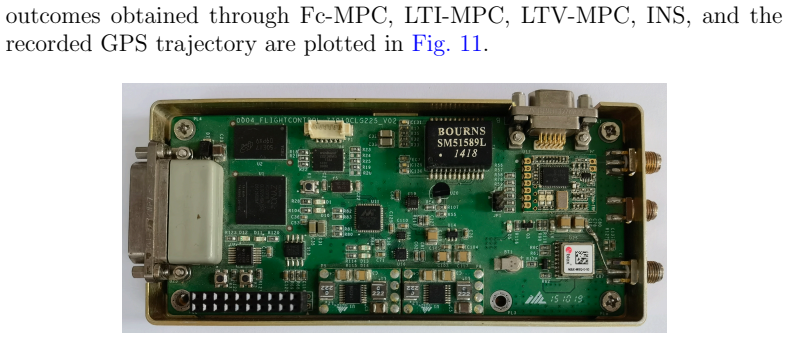
- The algorithm solves a convex quadratic program, so the computational cost stays within real-time feasibility on embedded hardware, as demonstrated on the ZYNQ-7020 experiment.
Reading between the lines
- If the gradient update in Eq. (10) is not a valid direction-sensitive estimator, the reported improvement is not reproducible from the equations as written; a corrected update would need to rotate or scale the gradient based on the bearing of the step, not add the same scalar to all four entries.
- The success of the method in simulations depends on the assumption that D and I change smoothly over the prediction interval; applying it in regions with strong magnetic anomalies would need a mechanism to detect when the local gradient assumption breaks.
- The framework suggests a family of map-free MPC navigation variants: any two scalar fields with locally linear gradients (for example, gravity anomalies or bathymetry) could replace D and I, extending the same flexible correction scheme to other geophysical navigation modalities.
- The Kalman fusion stage is only activated when min(G(k)) is below a threshold sigma that is left unspecified in the paper; the sensitivity of the results to that threshold is a testable extension.
Signed reviews
Editorial analysis
A structured set of objections, weighed in public.
Referee Report
Summary. The paper proposes Fc-MPC, a mapless geomagnetic/inertial combined navigation algorithm that predicts magnetic declination and inclination with an online gradient update, adds a 'flexible correction' input claimed to compensate model-plant mismatch, and fuses inertial and geomagnetic positions with a Kalman filter. The authors report Monte Carlo simulations and a real-data experiment showing CEP 0.19 km for Fc-MPC versus 8.92 km for LTV-MPC and 35.18 km for LTI-MPC, plus improved stability and efficiency metrics.
Significance. If the method worked as claimed, eliminating prior geomagnetic maps while resisting magnetic storms would be a valuable contribution to GPS-denied navigation. The paper contains a substantial Monte Carlo evaluation and a real-data comparison against GPS, which are commendable. However, the central computational mechanism is not implemented as described: the simulation loop propagates the compensated model rather than the physical plant, so the reported numerical gains do not demonstrate closed-loop performance of the proposed controller. The significance of the headline results is therefore not established.
major comments (4)
- [§3.1, Eqs. (39)-(44), Algorithm 1] The flexible correction is tautological and never realized in the algorithm. ξ(k) is defined by Eq. (40) as the deterministic mismatch [B(k)-B(k-1)]U(k), yet it is called an unknown random interference; Ua is then defined by Eq. (43) to cancel it. But Eq. (43) cannot be solved because ξ(k) depends on the unknown control U(k), and Algorithm 1 never computes Ua. Line 9 takes 'the first result of U(k)' from the optimization Eq. (45), whose decision variable is U_h, and no mapping U = U_h + Ua is given. Line 11 updates S(k+1) with Eq. (44), the compensated model, instead of the physical plant Eq. (39). Consequently, the CEP in Table 5 and the storm results in Tables 6-7 simulate the cancellation identity rather than the closed-loop response of the plant.
- [§3.1, Eq. (45) vs Eqs. (37)-(38) and Eq. (44)] The optimization and the state update use inconsistent models. H(k), h(k), and the constraint matrices W, w in Eqs. (33)-(38) are built from C(k), the block Toeplitz matrix formed from the current gradient B(k)=G(k)^T, while the compensated prediction Eq. (44) uses B(k-1). The optimizer therefore minimizes a cost over a different predicted trajectory than the one propagated in Algorithm 1 line 11, so the optimization problem in Eq. (45) is not the one whose solution is applied to the system.
- [§2.2, Eq. (10)] The gradient update in Eq. (10) cannot estimate a directional gradient as written. With v_xk = v cos θk and v_yk = v sin θk, the row [cosθk/(v_xk T), sinθk/(v_yk T)] equals [1/(vT), 1/(vT)]; hence all four entries of G(k+1) are incremented by the same scalar pair ΔD/(vT), ΔI/(vT). No spatial direction information enters the update, so the mapless gradient estimator used in the prediction Eq. (20) is not valid, and the predicted magnetic states used for control are ill-founded.
- [§4.2.2, Table 6 and accompanying text] The long-term storm reporting is internally inconsistent. The text states that 'the trajectory length of the Fc-MPC method is 2.42% shorter than that of the LTV-MPC method', but Table 6 lists 942.12 km for Fc-MPC versus 937.18 km for LTV-MPC, i.e., Fc-MPC is longer. The text also reports a median trajectory length of 917.29 km for Fc-MPC for the Monte Carlo results, which differs substantially from the optimal value in Table 6. These contradictions obscure the claimed efficiency advantage and should be resolved before the simulation results can be credited.
minor comments (5)
- [Table 8] The column header 'Itrations' should be spelled 'Iterations'.
- [Eq. (24)] Equation (24) contains garbled markup in the displayed quadratic form; the intended norm notation should be typeset cleanly.
- [Tables 3 and 4] The symbol F is used both for the 15x15 Kalman state matrix in Table 3 and for the 2x2 'State transition matrix' in Table 4; these are different objects and should have distinct symbols.
- [Algorithm 1, line 1] The distance d to the destination is used in the termination condition d>ϵ, but no formula for computing d from the current position and destination is provided in the algorithm.
- [Table 4 and Eq. (4)] Table 4 lists the heading angle as (θ1, θ2)=(0, 270), while Eq. (4) defines a single θk; the use of two heading angles should be explained.
Circularity Check
The magnetic-storm robustness results are generated from the compensation identity, not feedback: Algorithm 1 updates the simulated state with Eq. (44), which is Eq. (39) after assuming B(k-1)U_a = -ξ(k), so the unknown interference is removed by construction.
-
self definitional
[Section 3.1, Eqs. (39)-(44); Algorithm 1 lines 9-11; storm simulations in Section 4.2, Tables 5-7]
"Then, the following equation is the conditions for uniform compensation: B(k − 1)Ua(k) = −ξ(k). (43) Finally, combining the Eq. (41), Eq. (42) and Eq. (43) the system state prediction model after compensation is: S(k + 1) = AS(k) + B(k − 1)Uh(k). (44) ... Algorithm 1: ‘Take the first result of U (k), u∗(k); ... Update S(k + 1) by Eq. (44);’"
Eq. (44) is not the physical plant Eq. (39); it is obtained by substituting U = Uh + Ua into Eq. (39) and imposing the compensation condition Eq. (43), B(k−1)Ua = −ξ(k). That condition is chosen so that the compensation cancels the disturbance exactly, so Eq. (44) is simply the plant with ξ(k) removed by definition. Algorithm 1 uses Eq. (44) as the state-update rule in the simulations, while the optimization (45) solves for Uh and the pseudocode never computes or applies Ua. The simulated trajectory therefore never contains the unknown interference ξ(k), and the magnetic-storm metrics in Tables 5–7 express the cancellation identity rather than closed-loop disturbance rejection. The paper’s claimed storm robustness is thus an algebraic consequence of Eq.
full rationale
The no-interference baseline is not circular: with ξ(k)=0, Eq. (44) coincides with the nominal model Eq. (13), so the LTI/LTV-MPC comparison in Table 5 has independent content. However, the paper’s advertised novelty and headline storm robustness come from the ‘flexible correction,’ and that part is self-definitional. The compensation input Ua is defined by Eq. (43) to cancel the unknown interference exactly, and Algorithm 1 then updates the simulated state with the compensated model Eq. (44) rather than the noisy plant Eq. (39); no computation of Ua is present. Hence the storm simulations are constructed from the compensation identity, not from applying a controller to the disturbed plant. This is a concrete reduction of the central claim by the paper’s own equations. Self-citation is not load-bearing; the cited MPC and geomagnetic works provide background, not the cancellation result. The gradient update Eq. (10) is degenerate and would make the estimate wrong, but that is a correctness and conditioning issue rather than circularity, so it is not scored here. Overall, the central storm-resistance result is forced by construction, while the map-free baseline retains independent content, giving a score of 7.
Assumptions & free parameters
free parameters (4)
- MPC weights Q, R, and terminal weight F =
Q=[1 0;0 1], R=[10 0;0 10], F not explicitly specified
- Kalman covariance matrices Qc, Rc, P0 =
Qc=diag(0,0,0,0.05,0.05,0,...), Rc=diag(2,2), P0=diag(0,0,0,1,1,0,...)
- Constraint bounds and prediction horizon =
Umin=[0;0], Umax=[40;40], Smin=[-10;10], Smax=[100;100], N=2, T=10 s
- Termination threshold epsilon and gradient threshold sigma =
Not specified
assumptions (5)
- domain assumption The geomagnetic declination and inclination pair (D,I) uniquely determines the location L.
- domain assumption G(k) and B(k) are constant over the prediction horizon because D and I change little within 1 degree.
- ad hoc to paper The rank-one gradient update in Eq. (10) correctly estimates the local geomagnetic gradient without prior maps.
- ad hoc to paper The inertial error dynamics can be represented by a 15-state equation with F=I15 and the chosen Qc, Rc, P0 matrices.
- domain assumption Magnetic storm effects can be represented by superimposing dBH, dBx, and dBy anomalies from Kriged observatory data onto WMM2020.
Cite this review
Pith. "Pith review of Geomagnetic and Inertial Combined Navigation Approach Based on Flexible Correction-Model Predictive Control Algorithm." pith.science (2026). https://pith.science/paper/FZW3WQOY
@misc{pith2026241205820,
  author       = {Pith},
  title        = {Pith review of: Geomagnetic and Inertial Combined Navigation Approach Based on Flexible Correction-Model Predictive Control Algorithm},
  year         = {2026},
  howpublished = {\url{https://pith.science/paper/FZW3WQOY}},
  note         = {Machine review of arXiv:2412.05820}
}
read the original abstract
This paper proposes a geomagnetic and inertial combined navigation approach based on the flexible correction-model predictive control algorithm (Fc-MPC). This approach aims to overcome the limitations of existing combined navigation methods that require prior geomagnetic maps and the inertial navigation drift of long-range missions. The proposed method uses geomagnetic gradient information and the model predictive control (MPC) algorithm with heading control and state constraints, eliminating the dependence on prior geomagnetic maps. Instead, the proposed method achieves real-time measurements of the geomagnetic declination, geomagnetic inclination, and inertial navigation data and introduces uniform compensation conditions to adjust and correct the predictive results in real-time. Simulation and real experiment results demonstrate that the proposed Fc-MPC algorithm significantly improves the precision, efficiency, and stability of the geomagnetic and inertial combined navigation system.
Figures


Figures from the paper (8 more)



Reference graph
Works this paper leans on
-
[1]
+ is cited as + ESG96 +. In connection with cross-referencing and possible future hyperlinking it is not a good idea to collect more that one literature item in one + +. The so-called Harvard or author-year style of referencing is enabled by the package natbib . With this package the literature can be cited as follows: enumerate [ ] Parenthetical: + WB96 ...
work page 1996
-
[2]
write newline
" write newline "" before.all 'output.state := FUNCTION n.dashify 't := "" t empty not t #1 #1 substring "-" = t #1 #2 substring "--" = not "--" * t #2 global.max substring 't := t #1 #1 substring "-" = "-" * t #2 global.max substring 't := while if t #1 #1 substring * t #2 global.max substring 't := if while FUNCTION word.in bbl.in ":" * " " * FUNCTION f...
-
[3]
author Bet, G. , author Fischer, M. , year 2022 . title An algorithm to construct subsolutions of convex optimal control problems . journal SIAM Journal on Control and Optimization volume 60 , pages 2902--2926 . :DOI:10.1137/21m1402005
-
[4]
author Chang, Y. , author Cheng, Y. , author Manzoor, U. , author Murray, J. , year 2023 . title A review of uav autonomous navigation in gps-denied environments . journal Robotics and Autonomous Systems volume 170 , pages 104533 . :10.1016/j.robot.2023.104533
-
[5]
author Chen, K. , author Liang, W.c. , author Liu, M.x. , author Sun, H.y. , year 2020 . title Comparison of geomagnetic aided navigation algorithms for hypersonic vehicles . journal Journal of Zhejiang University-SCIENCE A volume 21 , pages 673--683 . :https://doi.org/10.1631/jzus.A1900648
-
[6]
author Chen, Z. , author Liu, Z. , author Zhang, Q. , author Chen, D. , author Pan, M. , author Hu, J. , author Xu, Y. , author Wang, Z. , author Wang, Z. , year 2022 . title An improved geomagnetic navigation method based on two-component gradient weighting . journal IEEE Geoscience and Remote Sensing Letters volume 19 , pages 1--5 . :10.1109/LGRS.2022.3213779
arXiv 2022
-
[7]
author Choi, W.Y. , author Lee, S.H. , author Chung, C.C. , year 2022 . title Horizonwise model-predictive control with application to autonomous driving vehicle . journal IEEE Transactions on Industrial Informatics volume 18 , pages 6940--6949 . :10.1109/TII.2021.3137169
arXiv 2022
-
[8]
author Civicioglu, P. , year 2012 . title Transforming geocentric cartesian coordinates to geodetic coordinates by using differential search algorithm . journal Computers and amp; Geosciences volume 46 , pages 229--247 . :10.1016/j.cageo.2011.12.011
Show all 49 references
-
[9]
, year 2024 a
author Cun, J.G. , year 2024 a. title Space environment prediction center . howpublished http://blog.sepc.ac.cn/?p=10001 . note Accessed: 2024-08-04
2024
-
[10]
, year 2024 b
author Cun, J.G. , year 2024 b. title Space environment prediction center . howpublished http://www.sepc.ac.cn/blog/?p=9965 . note Accessed: 2024-08-04
2024
-
[11]
, author Tozzi, R
author De Michelis, P. , author Tozzi, R. , author Consolini, G. , year 2010 . title Principal components’ features of mid-latitude geomagnetic daily variation . journal Annales Geophysicae volume 28 , pages 2213--2226 . :https://doi.org/10.5194/angeo-28-2213-2010
2010 doi
-
[12]
, author Cheng, X
author Ding, P. , author Cheng, X. , year 2022 . title A new contour-based combined matching algorithm for underwater terrain-aided strapdown inertial navigation system . journal Measurement volume 202 , pages 111870 . :https://doi.org/10.1016/j.measurement.2022.111870
2022
-
[13]
, author Xiao, J
author Duan, X. , author Xiao, J. , author Qi, X. , author Liu, Y. , year 2019 . title An ins/geomagnetic integrated navigation algorithm based on matching strategy and hierarchical filtering . journal Electronics volume 8 , pages 460 . :https://doi.org/10.3390/electronics8040460
2019 doi
-
[14]
, author Klein, I
author Engelsman, D. , author Klein, I. , year 2023 . title Information-aided inertial navigation: A review . journal IEEE Transactions on Instrumentation and Measurement volume 72 , pages 1--18 . :10.1109/tim.2023.3303496
2023
-
[15]
, author Pajares, G
author García-Pulido, J. , author Pajares, G. , author Dormido, S. , author de la Cruz, J. , year 2017 . title Recognition of a landing platform for unmanned aerial vehicles by using computer vision-based techniques . journal Expert Systems with Applications volume 76 , pages ...
2017 doi
-
[16]
, author Gibert, D
author Gavoret, J. , author Gibert, D. , author Menvielle, M. , author Le Mouël, J.L. , year 1986 . title Long‐term variations of the external and internal components of the earth’s magnetic field . journal Journal of Geophysical Research: Solid Earth volume 91 , pages 4787--4...
1986 doi
-
[17]
, year 2024
author Gjerloev, J.W. , year 2024 . title Supermag . howpublished https://supermag.jhuapl.edu/mag/?tab=download . note Accessed: 2024-08-04
2024
-
[18]
, year 2006
author Goldenberg, F. , year 2006 . title Geomagnetic navigation beyond the magnetic compass , in: booktitle 2006 IEEE/ION Position, Location, And Navigation Symposium , publisher IEEE . pp. pages 684--694 . :10.1109/plans.2006.1650662
2006 arXiv
-
[19]
, author Cai, H
author Guo, C. , author Cai, H. , author van der Heijden, G. , year 2013 . title Feature extraction and geomagnetic matching . journal Journal of Navigation volume 66 , pages 799--811 . :https://doi.org/10.1017/S0373463313000490
2013 doi
-
[20]
, author Liu, M
author Guo, J. , author Liu, M. , author Liu, K. , author Niu, Y. , author Wang, M. , year 2019 . title Research of bio-inspired geomagnetic navigation for auv based on evolutionary gradient search . journal Xibei Gongye Daxue Xuebao/Journal of Northwestern Polytechnical Unive...
2019
-
[21]
, author Xu, Z
author Hu, H. , author Xu, Z. , year 2024 . title Global-gmds: The global map of geomagnetic disturbances . journal SoftwareX volume 25 , pages 101619 . :https://doi.org/10.1016/j.softx.2023.101619
2024
-
[22]
, author Hoover, R.C
author Kaji, C.V. , author Hoover, R.C. , author Ragi, S. , year 2019 . title Underwater navigation using geomagnetic field variations , in: booktitle 2019 IEEE International Conference on Electro Information Technology (EIT) , publisher IEEE . pp. pages 1--6 . :10.1109/EIT.20...
2019
-
[23]
, author Liu, X
author Li, H. , author Liu, X. , author Wang, C. , year 2024 . title How solar wind controls the recovery phase morphology of intense magnetic storms . journal Journal of Geophysical Research: Space Physics volume 129 . :https://doi.org/10.1029/2023JA032057
2024 doi
-
[24]
, author Wu, M
author Liu, Y. , author Wu, M. , author Hu, X. , author Xie, H. , year 2007 . title Research on geomagnetic matching method , in: booktitle 2007 2nd IEEE Conference on Industrial Electronics and Applications , publisher IEEE . pp. pages 2707--2711 . :10.1109/ICIEA.2007.4318904
2007
-
[25]
, author Aksakalli, V
author Madadi, B. , author Aksakalli, V. , year 2020 . title A stochastic approximation approach to spatio-temporal anchorage planning with multiple objectives . journal Expert Systems with Applications volume 146 , pages 113170 . :10.1016/j.eswa.2019.113170
2020
-
[26]
, year 2024
author Min, G.Y. , year 2024 . title Precise strapdown inertial navigation system (psins) toolbox for matlab . howpublished http://www.psins.org.cn/ . note Accessed: 2024-08-04
2024
-
[27]
, author Heshmati, Z
author Mousavi, M.A. , author Heshmati, Z. , author Moshiri, B. , year 2013 . title Ltv-mpc based path planning of an autonomous vehicle via convex optimization , in: booktitle 2013 21st Iranian Conference on Electrical Engineering (ICEE) , publisher IEEE . pp. pages 1--7 . :1...
2013
-
[28]
title World magnetic model 2020
author NCEI Geomagnetic Modeling Team and British Geological Survey , year 2020 . title World magnetic model 2020 . howpublished NOAA National Centers for Environmental Information . https://doi.org/10.25921/11v3-da71, :10.25921/11v3-da71. note accessed: July 9, 2024
2020 doi
-
[29]
, author Kim, D
author Nguyen, H.D. , author Kim, D. , author Son, Y.S. , author Han, K. , year 2023 . title Linear time-varying mpc-based autonomous emergency steering control for collision avoidance . journal IEEE Transactions on Vehicular Technology volume 72 , pages 12713--12727 . :10.110...
2023
-
[30]
, author Zhou, Z
author Pang, Y. , author Zhou, Z. , author Pan, X. , author Song, N. , year 2023 . title An ins/geomagnetic integrated navigation method for coarse estimation of positioning error and search area adaption applied to high-speed aircraft . journal IEEE Sensors Journal volume 23 ...
2023
-
[31]
, author Xu, K
author Qi, X. , author Xu, K. , author Xu, Z. , author Li, H. , author Ran, L. , year 2023 . title Geographic true navigation based on real-time measurements of geomagnetic fields . journal IEEE Transactions on Geoscience and Remote Sensing volume 61 , pages 1--10 . :10.1109/t...
2023
-
[32]
, author Libo, D
author Rong, Z. , author Libo, D. , year 2020 . title Anomaly characteristics of magnetic field around ferromagnetic target and target azimuth analysis , in: booktitle 2020 5th International Conference on Information Science, Computer Technology and Transportation (ISCTT) , pu...
2020
-
[33]
, author Marsh, R
author Scott, R. , author Marsh, R. , author Hays, G.C. , year 2011 . title A little movement orientated to the geomagnetic field makes a big difference in strong flows . journal Marine Biology volume 159 , pages 481--488 . :https://doi.org/10.1007/s00227-011-1825-1
2011 doi
-
[34]
, author Wang, Y
author Teng, L. , author Wang, Y. , author Cai, W. , author Li, H. , year 2018 . title Robust fuzzy model predictive control of discrete-time takagi–sugeno systems with nonlinear local models . journal IEEE Transactions on Fuzzy Systems volume 26 , pages 2915--2925 . :10.1109/...
2018
-
[35]
, author Liu, M
author Wang, C. , author Liu, M. , author Niu, Y. , author He, Y. , author You, L. , author Shi, T. , year 2020 . title Geomagnetic navigation with adaptive search space for auv based on deep double-q-network , in: booktitle Global Oceans 2020: Singapore – U.S. Gulf Coast , pu...
2020
-
[36]
, author Qiu, G
author Wang, G. , author Qiu, G. , author Zhao, W. , author Chen, X. , author Li, J. , year 2023 . title A real-time visual compass from two planes for indoor unmanned aerial vehicles (uavs) . journal Expert Systems with Applications volume 229 , pages 120390 . :10.1016/j.eswa...
2023
-
[37]
, author Zheng, C
author Wang, Q. , author Zheng, C. , author Wu, P. , author Wang, X. , year 2022 . title Geomagnetic/inertial navigation integrated matching navigation method . journal Heliyon volume 8 , pages e11249 . :10.1016/j.heliyon.2022.e11249
2022 doi
-
[38]
, author Zhou, J
author Wang, Q. , author Zhou, J. , year 2018 . title Geomagnetic gradient bionic navigation based on parallel approach method . journal Xibei Gongye Daxue Xuebao/Journal of Northwestern Polytechnical University volume 36 , pages 611--617 . :https://doi.org/10.1051/jnwpu/20183640611
2018
-
[39]
, author Wang, G
author Wu, F. , author Wang, G. , author Zhuang, S. , author Wang, K. , author Keimer, A. , author Stoica, I. , author Bayen, A. , year 2024 . title Composing mpc with lqr and neural network for amortized efficiency and stable control . journal IEEE Transactions on Automation ...
2024
-
[40]
, author Wang, L
author Xu, N. , author Wang, L. , year 2020 . title Geomagnetic matching navigation for aircraft based on improved iterative closest contour point algorithm , in: booktitle 2020 International Conference on Sensing, Measurement; Data Analytics in the era of Artificial Intellige...
2020
-
[41]
, author Li, Z
author Yang, X. , author Li, Z. , year 2022 . title Modeling and simulation of underwater robot combined navigation and position based on adaptive filter gain ukf , in: booktitle 2022 37th Youth Academic Annual Conference of Chinese Association of Automation (YAC) , publisher ...
2022
-
[42]
, author Zhang, Q
author Yu, Z. , author Zhang, Q. , author Chen, G. , author Huang, C. , author Lan, J. , year 2023 . title Submarine geophysical navigation of autonomous underwater vehicle using extended kalman filter , in: booktitle 2023 IEEE International Conference on Electrical, Automatio...
2023
-
[43]
, author An, W
author Zhang, J. , author An, W. , year 2012 . title Assessing circular error probable when the errors are elliptical normal . journal Journal of Statistical Computation and Simulation volume 82 , pages 565--586 . :10.1080/00949655.2010.546797
2012
-
[44]
, author Zhang, T
author Zhang, J. , author Zhang, T. , author Shin, H.S. , author Wang, J. , author Zhang, C. , year 2021 a. title Geomagnetic gradient-assisted evolutionary algorithm for long-range underwater navigation . journal IEEE Transactions on Instrumentation and Measurement volume 70 ...
2021
-
[45]
, author Liu, X
author Zhang, Y. , author Liu, X. , author Luo, M. , author Yang, C. , year 2021 b. title Bio-inspired approach for long-range underwater navigation using model predictive control . journal IEEE Transactions on Cybernetics volume 51 , pages 4286--4297 . :10.1109/TCYB.2019.2933397
2021
-
[46]
, author Liu, J
author Zhao, H. , author Liu, J. , author Chen, X. , author Cao, H. , author Wang, C. , author Li, J. , author Shen, C. , author Tang, J. , year 2024 . title Information monitoring and adaptive information fusion of multisource fusion navigation systems in complex environments...
2024
-
[47]
, author Bai, Y
author Zhao, L. , author Bai, Y. , author Paik, J.K. , year 2023 . title Achieving optimal-dynamic path planning for unmanned surface vehicles: A rational multi-objective approach and a sensory-vector re-planner . journal Ocean Engineering volume 286 , pages 115433 . :10.1016/...
2023
-
[48]
, author Niu, Y
author Zhou, Y. , author Niu, Y. , author Liu, M. , year 2022 . title Bionic geomagnetic navigation method for auv based on differential evolution algorithm , in: booktitle OCEANS 2022, Hampton Roads , publisher IEEE . pp. pages 1--5 . :10.1109/OCEANS47191.2022.9977317
2022
-
[49]
, author Youjian, H
author Ziggah, Y.Y. , author Youjian, H. , author Yu, X. , author Basommi, L.P. , year 2016 . title Capability of artificial neural network for forward conversion of geodetic coordinates \( , ,h \) to cartesian coordinates (x, y, z) . journal Mathematical Geosciences volume 48...
2016 doi
Reviewed August 11, 2026 · model on record in the stance chip above.
Discussion (0). Continue with ORCID to comment.