REVIEW 4 major objections 5 minor 1 cited by
Dual UAV Cluster-Assisted Maritime Physical Layer Secure Communications via Collaborative Beamforming
T0 review · 4 major / 5 minor · reviewed 2026-08-11 · deepseek-v4-flash
Pith's one-line read Twin UAV swarms, one relaying and one jamming, can give maritime links both long range and physical-layer secrecy at lower flight energy than multi-hop relays.
desk verdict The dual-cluster maritime relay-and-jammer concept is coherent, but the SINR equations that carry the whole evaluation are dimensionally broken, so the reported results do not support the claims. read the letter →
The pith
A machine-rendered reading of the paper's core claim, the machinery that carries it, and where it could break.
The reading
What carries the argument
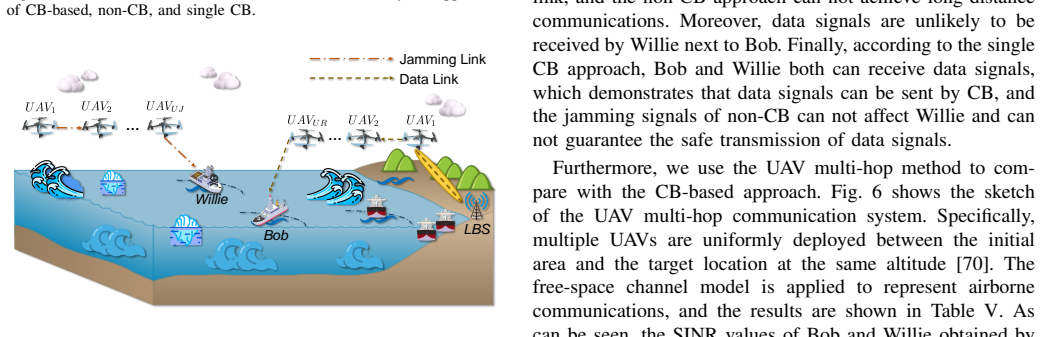
The central object is the maritime UAV-enabled virtual antenna array (MUVAA), a swarm of synchronized UAVs whose collective array factor $AF_r(\theta,\phi)$ (relay) or $AF_j(\theta',\phi')$ (jammer), together with the antenna gain normalization and path-loss models, determines the SINR at Bob and Willie. The array factor and gain equations convert UAV positions and excitation current weights into directional gain toward each vessel; the SINR expressions in Eqs. (7) and (8) then combine the relay gain, jammer gain, and path losses into the objectives $f_1$ and $f_2$, while the propulsion energy model in Eqs. (9)-(10) gives $f_3$. The proposed IMOMA carries the optimization: Tent-chaotic initialization spreads the initial solution population, and hybrid WOA/AOA update rules move the relay and jammer sets with different step sizes and boundary handling.
What would settle it
Re-run the simulations with the dB path losses in Eqs. (3) and (6) explicitly converted to linear factors, $PL_{\text{lin}}=10^{-PL_{\text{dB}}/10}$, before they enter Eqs. (7) and (8). If the reported SINR values, for example about 20.8 dB for Bob and -39.9 dB for Willie in the larger network, change materially, then the dimensional slip in the objective functions is what produced the headline separation, and the comparison to multi-hop, non-CB, and single-CB baselines needs to be recomputed.
Extended reading notes
Core claim
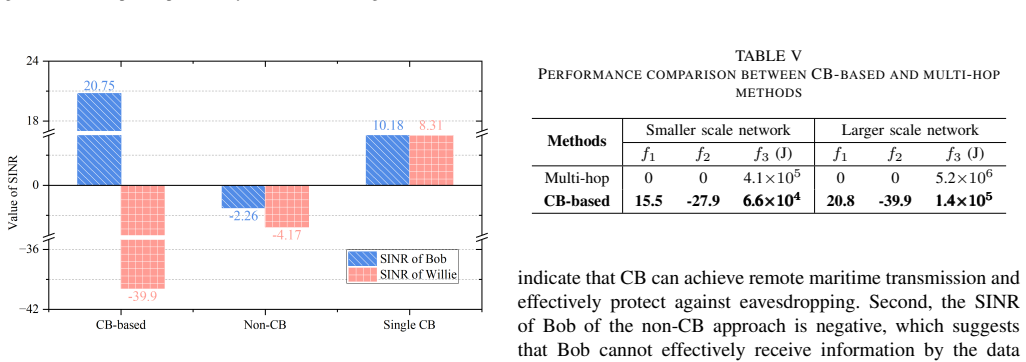
On its own terms, the paper's discovery is that two UAV clusters working as beamforming arrays can serve as a long-range relay and a long-range jammer at the same time, and that the joint placement and current-weight design of both arrays can be posed as a Pareto optimization that meaningfully separates the legitimate and eavesdropping vessels. The key outcome is a clean separation in SINR: in the larger-scale simulation the legitimate vessel's SINR is positive (about 20.8 dB) while the eavesdropper's is deeply negative (about -39.9 dB), and the relay-and-jammer arrangement achieves this with total flight energy about an order of magnitude below the multi-hop baseline. If the model holds, this means friendly jamming does not have to be close to the eavesdropper: collaborative beamforming lets a distant UAV swarm concentrate jamming power on the eavesdropper while a second swarm concentrates data power on the legitimate ship.
Load-bearing premise
The load-bearing premise is that the signal-loss numbers the paper computes in decibels are converted to ordinary multiplying factors before being fed into the signal-to-interference-plus-noise ratio formulas; if they are not, those formulas have no meaningful units.
Editorial extensions
If this is right
- If the central claim is correct, a shore station can talk to a distant vessel through one tightly packed UAV swarm, and another swarm can shield that link from a known eavesdropper location without either swarm flying close to the vessels.
- The reported SINR separation means physical-layer security can be achieved as a by-product of array geometry and current-weight design, rather than requiring cryptography or high-power jamming near the target.
- The large energy gap versus multi-hop relaying would make the CB-based system the preferred architecture when UAV endurance is the constraint, provided the synchronization overhead is as small as the paper states.
- The IMOMA's improvement on the eavesdropper-side objective (up to 43.20%) indicates that most of the algorithm's gain is in shaping the jamming array, which could be the deciding criterion in selecting an optimizer for this problem class.
Reading between the lines
- An untested but direct extension is to track vessels in motion rather than fixed positions; the paper itself lists this as future work, and a dynamic version would need the energy model to include trajectory, which the current start/end formula cannot capture.
- The same two-array geometry should transfer to non-maritime long-range settings, such as rural or disaster-area links, where one swarm relays data and a second swarm protects against eavesdroppers; nothing in the SINR math is specific to sea-surface propagation except the path-loss constants.
- A fair numerical test would recompute the SINR objectives after converting the dB path-loss values in Eqs. (3) and (6) into linear factors; if the reported results survive that conversion, the comparison claims are credible, and if not, the quantitative comparisons would need to be redone.
Signed reviews
Editorial analysis
A structured set of objections, weighed in public.
Referee Report
Summary. The paper proposes a dual-UAV-cluster maritime secure communication system in which one cluster forms a virtual antenna array relay and another forms a virtual antenna array jammer. It formulates a three-objective problem (maximize Bob SINR, minimize Willie SINR, minimize UAV flight energy), proposes an improved multi-objective mayfly algorithm with chaotic initialization and hybrid update strategies, and reports simulations claiming that the CB-based approach outperforms non-CB, single-CB, and multi-hop baselines and that IMOMA outperforms several metaheuristics. The system concept is relevant, but the stated SINR metric is dimensionally invalid and the energy objective is underspecified; the paper's central claims are therefore not supported.
Significance. If the system model were correct, the paper would address a timely problem: long-range maritime secure communications using UAV clusters with collaborative beamforming. The paper also has positive elements: it considers conflicting objectives, compares several baselines, and provides convergence diagnostics (IGD, ACR, solution distributions). However, the central quantitative claims rest on SINR expressions that mix dB and linear quantities and on an energy model that is not connected to any specified trajectory. The claimed CB advantage and the reported numerical comparisons are therefore not physically interpretable, and the significance of the findings cannot be evaluated.
major comments (4)
- [§III-B, Eqs. (7)–(8) and (3), (6)] The SINR expressions insert the dB path-loss values PL_B and PL'_B directly as multiplicative factors in linear power ratios. Since Eqs. (3) and (6) define path loss in dB (including 20log10 terms), the correct linear attenuation factor is 10^{-PL_dB/10} (or the equations must be rewritten in linear units before insertion). The same issue affects the noise term: Table IV lists σ² as -150 dBm, a logarithmic power, while Eq. (7) uses σ² as a linear noise power. Because f1 and f2 are defined directly as these SINRs in Eqs. (11)–(12), every objective value and every comparison in Section VI is computed from a dimensionally invalid metric. This is a central, load-bearing error.
- [§III-B, Eqs. (2) and (7)–(8)] The factor N_UR in Eq. (7) appears to double-count the array size: G_B in Eq. (2) already contains |AF_r|^2, which for in-phase excitations is proportional to N_UR^2 (and the unnormalized array factor in Eq. (1) already sums over all relay UAVs). Unless the authors define P_UR as total power and G_B as a per-element gain, the extra N_UR multiplies the array gain a second time; the identical issue holds for N_UJ in the denominator. No such clarification is given, so the SINR values (e.g., f1=15.5, f2=-27.9 in Table V) are not physically interpretable. This extra factor also inflates the apparent advantage of CB over the non-CB baseline, making the conclusion in Section VIII an artifact of the formula rather than a demonstrated system result.
- [§IV-C, Problem Analysis] The NP-hardness claim is not established. The argument discretizes the continuous f3 and then states that the transformed problem 'can be regarded as a combinatorial optimization problem which is NP-hard [54]', without giving a reduction from a known NP-hard problem or specifying how the constraints in Eqs. (14d)–(14g) encode such a problem. The same holds for f1/f2, which are asserted to be 'usually NP-hard' by citation. The algorithm itself is a heuristic and does not require a rigorous NP-hardness proof, but the paper's motivation for a metaheuristic is weakened by the unsupported claim.
- [§III-C and §IV-B, Eq. (10) and Eq. (13)] The energy objective f3 is underdetermined. Eq. (10) defines energy as an integral over a trajectory v(t), yet the optimization variables in SEMCMOP are only final UAV positions and excitation weights, and no trajectory is specified in the constraints or in the simulation setup. The values of f3 in Table V and the convergence experiments therefore cannot be reproduced or physically interpreted. If the authors intend straight-line constant-speed flight between initial and final positions, that assumption must be stated explicitly and included in Eq. (10) and in the constraint set.
minor comments (5)
- [§IV-C] In the large-scale dimension count, the jammer-set variables are written as (Xr, Yr, Zr, Ir) twice; the second should be (Xj, Yj, Zj, Ij).
- [Table V] The entries '6.6×1046.6×1046.6×104' and '1.4×1051.4×1051.4×105' appear corrupted by duplicated typesetting and should be corrected.
- [Algorithm 3] The comment '#Exploration phase' after Eq. (21) is inside the exploitation branch; it should read '#Exploitation phase'.
- [Section VII] The claims that data-sharing overhead is 10–20 seconds and that the method saves 50–90% of time are not derived in this paper; they need a supporting calculation or a clearer reference to [74].
- [§II-B, last paragraph] The paper acknowledges that CB has limitations such as communication overhead and limited multi-user support, but these costs are not reflected in f1–f3; the Discussion in Section VII only addresses data-sharing overhead qualitatively.
Circularity Check
No significant circularity: the CB-vs-non-CB result follows from the array-gain model, and the IMOMA comparisons are self-contained simulations, while the dB-unit SINR issue is a correctness defect rather than a circular reduction.
full rationale
The derivation chain is forward-defined: array factors in Eqs. (1) and (4), antenna gains in Eqs. (2) and (5), path losses in Eqs. (3) and (6), SINRs in Eqs. (7) and (8), and objectives in Eqs. (11)-(13) are all model statements, not quantities fitted from the results they are later used to support. The conclusion that the CB-based method outperforms non-CB is a direct consequence of the array-gain model, which is the intended simulation scenario rather than a fitted prediction; no parameter is inferred from the outputs and then renamed as a finding. The IMOMA-versus-MOMA/MODA/MOMVO/MALO comparisons are self-contained benchmark runs on the same objectives, so they do not reduce to their inputs by construction. The paper does cite prior work by overlapping authors, notably [7], [40], and [66], for standard claims such as the N_U^2 array gain and the energy benefit of clustered UAVs, but those claims are also embodied in Eqs. (1)-(2) and are externally checkable antenna-array results, so the self-citations are not load-bearing in the circularity sense. The more serious concerns in the paper are dimensional: Eqs. (7) and (8) appear to insert dB-valued path losses directly into a linear power ratio, and the N_UR/N_UJ factors may double-count the array gain already contained in G_v/G'_v. Those are modeling and correctness defects that invalidate the quantitative comparisons, but they do not make an output equivalent to an input by construction, and they are not circularity under the required standard. Similarly, the multi-hop row in Table V assigns f1=f2=0 rather than deriving those values from an explicit link calculation; that is an unsupported baseline choice, not a circular derivation. Overall, no significant circularity is present, so the score is 1.
Assumptions & free parameters
free parameters (5)
- Tent map parameter a
- AOA coefficients M and M'
- AOA control parameters mu, Min, Max
- WOA parameters l and H
- Population size and maximum iteration =
N=30, tmax=500
assumptions (5)
- domain assumption UAVs in the same virtual antenna array are synchronized in carrier frequency, initial phase, and time.
- domain assumption Data sharing among UAVs in a cluster is reliable and does not constrain relay rates.
- domain assumption The air-to-sea path loss takes the elevated-LoS form of Eqs. (3) and (6) with parameters from satellite and UAV-terrestrial studies [51], [66].
- domain assumption Propulsion energy of a rotary-wing UAV follows the model of Eqs. (9) and (10) from [53], and the energy of a 3D move can be closed-form approximated from initial and final positions without specifying the trajectory.
- domain assumption Vessel positions, Bob and Willie, are fixed and known in advance.
Cite this review
Pith. "Pith review of Dual UAV Cluster-Assisted Maritime Physical Layer Secure Communications via Collaborative Beamforming." pith.science (2026). https://pith.science/paper/QIJXQZIX
@misc{pith2026241205949,
  author       = {Pith},
  title        = {Pith review of: Dual UAV Cluster-Assisted Maritime Physical Layer Secure Communications via Collaborative Beamforming},
  year         = {2026},
  howpublished = {\url{https://pith.science/paper/QIJXQZIX}},
  note         = {Machine review of arXiv:2412.05949}
}
read the original abstract
Unmanned aerial vehicles (UAVs) can be utilized as relay platforms to assist maritime wireless communications. However, complex channels and multipath effects at sea can adversely affect the quality of UAV transmitted signals. Collaborative beamforming (CB) can enhance the signal strength and range to assist the UAV relay for remote maritime communications. However, due to the open nature of UAV channels, security issue requires special consideration. This paper proposes a dual UAV cluster-assisted system via CB to achieve physical layer security in maritime wireless communications. Specifically, one UAV cluster forms a maritime UAV-enabled virtual antenna array (MUVAA) relay to forward data signals to the remote legitimate vessel, and the other UAV cluster forms an MUVAA jammer to send jamming signals to the remote eavesdropper. In this system, we formulate a secure and energy-efficient maritime communication multi-objective optimization problem (SEMCMOP) to maximize the signal-to-interference-plus-noise ratio (SINR) of the legitimate vessel, minimize the SINR of the eavesdropping vessel and minimize the total flight energy consumption of UAVs. Since the SEMCMOP is an NP-hard and large-scale optimization problem, we propose an improved swarm intelligence optimization algorithm with chaotic solution initialization and hybrid solution update strategies to solve the problem. Simulation results indicate that the proposed algorithm outperforms other comparison algorithms, and it can achieve more efficient signal transmission by using the CB-based method.
Figures


Figures from the paper (7 more)



Forward citations
Cited by 1 Pith paper
-
Toward Realization of Low-Altitude Economy Networks: Core Architecture, Integrated Technologies, and Future Directions
A survey that organizes low-altitude economy networks into a layered architecture and argues that multi-technology integration is the key enabler.
Reference graph
Works this paper leans on
-
[54]
Hybrid metaheuristics in combinatorial optimization: A survey,
C. Blum, J. Puchinger, G. R. Raidl, and A. Roli, “Hybrid metaheuristics in combinatorial optimization: A survey,” Appl Soft Comput , vol. 11, no. 6, pp. 4135–4151, 2011
work page 2011
-
[1]
J. Huang, A. Wang, G. Sun, and J. Li, “Jamming-aided maritime physical layer encrypted dual-UA Vs communications exploiting collaborative beamforming,” in IEEE CSCWD , 2023, pp. 1142–1147
work page 2023
-
[2]
H. Zhang, T. Zhou, T. Xu, M. Cheng, and H. Hu, “Field measurement and channel modeling around wailingding island for maritime wireless communication,” IEEE Antennas Wireless Propagat. Lett. , 2024
work page 2024
-
[3]
NOMA-based hybrid satellite-UA V-terrestrial networks for 6G mar- itime coverage,
X. Fang, W. Feng, Y . Wang, Y . Chen, N. Ge, Z. Ding, and H. Zhu, “NOMA-based hybrid satellite-UA V-terrestrial networks for 6G mar- itime coverage,” IEEE Trans. Wirel. Commun. , vol. 22, no. 1, pp. 138– 152, 2023
work page 2023
-
[5]
Improving connectivity in 6G maritime communication networks with UA V swarms,
N. Nomikos, A. Giannopoulos, A. Kalafatelis, V . ¨Ozduran, P. Trakadas, and G. K. Karagiannidis, “Improving connectivity in 6G maritime communication networks with UA V swarms,” IEEE Access , 2024
work page 2024
-
[6]
L. P. Qian, H. Zhang, Q. Wang, Y . Wu, and B. Lin, “Joint multi-domain resource allocation and trajectory optimization in UA V-assisted maritime IoT networks,” IEEE Internet Things J. , vol. 10, no. 1, pp. 539–552, 2023
work page 2023
-
[7]
Secure and energy-efficient UA V relay communications exploiting collaborative beamforming,
G. Sun, J. Li, A. Wang, Q. Wu, Z. Sun, and Y . Liu, “Secure and energy-efficient UA V relay communications exploiting collaborative beamforming,” IEEE Trans. Commun. , vol. 70, no. 8, pp. 5401–5416, 2022
2022
-
[8]
S. Jayaprakasam, S. K. A. Rahim, and C. Y . Leow, “Distributed and collaborative beamforming in wireless sensor networks: Classifications, trends, and research directions,” IEEE Commun. Surv. Tutorials, vol. 19, no. 4, pp. 2092–2116, 2017
work page 2017
Show all 74 references
-
[9]
Millimeter- wave full-duplex UA V relay: Joint positioning, beamforming, and power control,
L. Zhu, J. Zhang, Z. Xiao, X. Cao, X. Xia, and R. Schober, “Millimeter- wave full-duplex UA V relay: Joint positioning, beamforming, and power control,” IEEE J. Sel. Areas Commun. , vol. 38, no. 9, pp. 2057–2073, 2020
2020
-
[10]
On the physical layer security of the cooperative rate- splitting-aided downlink in UA V networks,
H. Bastami, M. Letafati, M. Moradikia, A. Abdelhadi, H. Behroozi, and L. Hanzo, “On the physical layer security of the cooperative rate- splitting-aided downlink in UA V networks,” IEEE Trans. Inf. F orensics Security., vol. 16, pp. 5018–5033, 2021
2021
-
[11]
Design of provably secure authentication protocol for edge-centric maritime transportation system,
K. Mahmood, S. Shamshad, M. F. Ayub, Z. Ghaffar, M. K. Khan, and A. K. Das, “Design of provably secure authentication protocol for edge-centric maritime transportation system,” IEEE Trans. Intell. Transp. Syst., vol. 24, no. 12, pp. 14 536–14 545, 2023
2023
-
[12]
A survey of physical layer security techniques for 5G wireless networks and challenges ahead,
Y . Wu, A. Khisti, C. Xiao, G. Caire, K. Wong, and X. Gao, “A survey of physical layer security techniques for 5G wireless networks and challenges ahead,” IEEE J. Sel. Areas Commun. , vol. 36, no. 4, pp. 679–695, 2018
2018
-
[13]
A survey of optimization approaches for wireless physical layer security,
D. Wang, B. Bai, W. Zhao, and Z. Han, “A survey of optimization approaches for wireless physical layer security,” IEEE Commun. Surv. Tutorials, vol. 21, no. 2, pp. 1878–1911, 2019
1911
-
[14]
Improving physical layer security via a UA V friendly jammer for unknown eavesdropper location,
Y . Zhou, P. L. Yeoh, H. Chen, Y . Li, R. Schober, L. Zhuo, and B. Vucetic, “Improving physical layer security via a UA V friendly jammer for unknown eavesdropper location,” IEEE Trans. V eh. Technol. , vol. 67, no. 11, pp. 11 280–11 284, 2018
2018
-
[15]
Secure swarm UA V-assisted commu- nications with cooperative friendly jamming,
H. Dang-Ngoc, D. N. Nguyen, K. Ho-Van, D. T. Hoang, E. Dutkiewicz, Q.-V . Pham, and W.-J. Hwang, “Secure swarm UA V-assisted commu- nications with cooperative friendly jamming,” IEEE Internet Things J. , 2022
2022
-
[16]
UA V-aided anti-jamming maritime communications: A deep reinforcement learning approach,
K. Liu, P. Li, C. Liu, L. Xiao, and L. Jia, “UA V-aided anti-jamming maritime communications: A deep reinforcement learning approach,” in IEEE WCSP 2021 , 2022, pp. 1–6
2021
-
[17]
UA V-enabled relay commu- nication under malicious jamming: Joint trajectory and transmit power optimization,
Y . Wu, W. Yang, X. Guan, and Q. Wu, “UA V-enabled relay commu- nication under malicious jamming: Joint trajectory and transmit power optimization,” IEEE Trans. V eh. Technol., vol. 70, no. 8, pp. 8275–8279, 2021
2021
-
[18]
An optimized approach of dynamic target nodes in wireless sensor network using bio inspired algorithms for maritime rescue,
S. Rani, H. Babbar, P. Kaur, M. D. Alshehri, and S. H. Ahmed, “An optimized approach of dynamic target nodes in wireless sensor network using bio inspired algorithms for maritime rescue,” IEEE Trans. Intell. Transp. Syst., vol. 24, no. 2, pp. 2548–2555, 2023
2023
-
[19]
Swarm intelligence algorithms for mul- tiple unmanned aerial vehicles collaboration: a comprehensive review,
J. Tang, H. Duan, and S. Lao, “Swarm intelligence algorithms for mul- tiple unmanned aerial vehicles collaboration: a comprehensive review,” Artif. Intell. Rev. , vol. 56, no. 5, pp. 4295–4327, 2023
2023
-
[20]
Application of improved multi-objective particle swarm optimization algorithm to solve disruption for the two-stage vehicle routing problem with time windows,
R. J. Kuo, M. F. Luthfiansyah, N. A. Masruroh, and F. E. Zulvia, “Application of improved multi-objective particle swarm optimization algorithm to solve disruption for the two-stage vehicle routing problem with time windows,” Expert Syst. Appl. , vol. 225, p. 120009, 2023
2023
-
[21]
MIMO unmanned surface vessels enabled maritime wireless network coexisting with satellite network: Beamforming and trajectory design,
C. Zeng, J. Wang, C. Ding, M. Lin, and J. Wang, “MIMO unmanned surface vessels enabled maritime wireless network coexisting with satellite network: Beamforming and trajectory design,” IEEE Trans. Commun., vol. 71, no. 1, pp. 83–100, 2023
2023
-
[22]
Performance analysis of end-to-end LEO satellite-aided shore-to-ship communications: A stochastic geometry approach,
X. Hu, B. Lin, X. Lu, P. Wang, N. Cheng, Z. Yin, and W. Zhuang, “Performance analysis of end-to-end LEO satellite-aided shore-to-ship communications: A stochastic geometry approach,” IEEE Trans. Wire- less Commun. , vol. 23, no. 9, pp. 11 753–11 769, 2024
2024
-
[23]
Intelligent spectrum sharing strategy for integrated satellite-maritime heterogeneous mobile networks,
R. Wu, Z. Li, Z. Xie, and X. Liang, “Intelligent spectrum sharing strategy for integrated satellite-maritime heterogeneous mobile networks,” IEEE Trans. V eh. Technol., vol. 73, no. 5, pp. 6780–6794, 2024
2024
-
[24]
Unmanned surface vessel assisted maritime wireless communication toward 6G: Opportunities and challenges,
J.-B. Wang, C. Zeng, C. Ding, H. Zhang, M. Lin, and J. Wang, “Unmanned surface vessel assisted maritime wireless communication toward 6G: Opportunities and challenges,” IEEE Wireless Commun. , 2022
2022
-
[25]
Joint optimization of trajectory and communication resource allocation for unmanned surface vehicle enabled maritime wireless networks,
C. Zeng, J.-B. Wang, C. Ding, H. Zhang, M. Lin, and J. Cheng, “Joint optimization of trajectory and communication resource allocation for unmanned surface vehicle enabled maritime wireless networks,” IEEE Trans. Commun., vol. 69, no. 12, pp. 8100–8115, 2021
2021
-
[26]
Towards reinforcement learning in UA V relay for anti-jamming maritime com- munications,
C. Liu, Y . Zhang, G. Niu, L. Jia, L. Xiao, and J. Luan, “Towards reinforcement learning in UA V relay for anti-jamming maritime com- munications,” Digit. Commun. Netw. , 2022
2022
-
[27]
Security of underwater and air–water wireless communication: State-of-the-art, challenges and outlook,
W. Aman, S. Al-Kuwari, M. Muzzammil, M. M. U. Rahman, and A. Ku- mar, “Security of underwater and air–water wireless communication: State-of-the-art, challenges and outlook,” Ad Hoc Netw , vol. 142, p. 103114, 2023
2023
-
[28]
Big data-enabled authentication framework for offshore maritime communication using drones,
A. Vangala, S. Agrawal, A. K. Das, S. Pal, N. Kumar, P. Lorenz, and Y . Park, “Big data-enabled authentication framework for offshore maritime communication using drones,” IEEE Trans. V eh. Technol. , vol. 73, no. 7, pp. 10 196–10 210, 2024
2024
-
[29]
A novel access and handover authentication scheme in UA V-aided satellite- terrestrial integration networks enabling 5G,
X. Ren, J. Cao, R. Ma, Y . Luo, J. Guan, Y . Zhang, and H. Li, “A novel access and handover authentication scheme in UA V-aided satellite- terrestrial integration networks enabling 5G,” IEEE Trans. Netw. Serv. Manage., 2023
2023
-
[30]
Caching UA V assisted secure transmission in hyper-dense networks based on interference alignment,
N. Zhao, F. Cheng, F. R. Yu, J. Tang, Y . Chen, G. Gui, and H. Sari, “Caching UA V assisted secure transmission in hyper-dense networks based on interference alignment,” IEEE Trans. Commun. , vol. 66, no. 5, pp. 2281–2294, 2018
2018
-
[31]
Robust 3D-trajectory and time switching optimization for dual- JOURNAL OF LATEX CLASS FILES, VOL. 14, NO. 8, AUGUST 2021 18 UA V-enabled secure communications,
W. Wang, X. Li, R. Wang, K. Cumanan, W. Feng, Z. Ding, and O. A. Dobre, “Robust 3D-trajectory and time switching optimization for dual- JOURNAL OF LATEX CLASS FILES, VOL. 14, NO. 8, AUGUST 2021 18 UA V-enabled secure communications,”IEEE J. Select. Areas Commun. , vol. 39, no....
2021
-
[32]
Resource and trajectory optimization for UA V-relay-assisted secure maritime MEC,
F. Lu, G. Liu, W. Lu, Y . Gao, J. Cao, N. Zhao, and A. Nallanathan, “Resource and trajectory optimization for UA V-relay-assisted secure maritime MEC,” IEEE Trans. Commun. , vol. 72, no. 3, pp. 1641–1652, 2024
2024
-
[33]
Energy harvesting UA V-RIS-assisted maritime communications based on deep reinforcement learning against jamming,
H. Yang, K. Lin, L. Xiao, Y . Zhao, Z. Xiong, and Z. Han, “Energy harvesting UA V-RIS-assisted maritime communications based on deep reinforcement learning against jamming,” IEEE Trans. Wireless Com- mun., pp. 1–1, 2024
2024
-
[34]
DRL- Optimized optical communication for a reliable UA V-based maritime data transmission,
H. Luo, S. Ma, H. Tao, R. Ruby, J. Zhou, and K. Wu, “DRL- Optimized optical communication for a reliable UA V-based maritime data transmission,” IEEE Internet Things J. , vol. 11, no. 10, pp. 18 768– 18 781, 2024
2024
-
[35]
Location management in LTE networks using multi-objective particle swarm optimization,
H. A. Hashim and M. A. Abido, “Location management in LTE networks using multi-objective particle swarm optimization,” Comput. Networks , vol. 157, pp. 78–88, 2019
2019
-
[36]
A multi-objective pigeon-inspired optimization approach to UA V distributed flocking among obstacles,
H. Qiu and H. Duan, “A multi-objective pigeon-inspired optimization approach to UA V distributed flocking among obstacles,” Inf. Sci. , vol. 509, pp. 515–529, 2020
2020
-
[37]
A novel non- stationary 6G UA V channel model for maritime communications,
Y . Liu, C.-X. Wang, H. Chang, Y . He, and J. Bian, “A novel non- stationary 6G UA V channel model for maritime communications,”IEEE J. Select. Areas Commun. , vol. 39, no. 10, pp. 2992–3005, 2021
2021
-
[38]
Passive maritime surveillance using satellite communication signals,
A. G. Stove, M. Gashinova, S. Hristov, and M. Cherniakov, “Passive maritime surveillance using satellite communication signals,” IEEE Trans. Aerosp. Electron. Syst. , vol. 53, no. 6, pp. 2987–2997, 2017
2017
-
[39]
Deep reinforcement learning based latency minimization for mobile edge computing with virtualization in maritime UA V communication network,
Y . Liu, J. Yan, and X. Zhao, “Deep reinforcement learning based latency minimization for mobile edge computing with virtualization in maritime UA V communication network,”IEEE Trans. V eh. Technol., vol. 71, no. 4, pp. 4225–4236, 2022
2022
-
[40]
Multi-objective optimization for UA V swarm-assisted IoT with virtual antenna arrays,
J. Li, G. Sun, L. Duan, and Q. Wu, “Multi-objective optimization for UA V swarm-assisted IoT with virtual antenna arrays,”IEEE Trans. Mob. Comput., vol. 23, no. 5, pp. 4890–4907, 2024
2024
-
[41]
UA V swarm-enabled aerial CoMP: A physical layer security perspective,
X. Wang, W. Feng, Y . Chen, and N. Ge, “UA V swarm-enabled aerial CoMP: A physical layer security perspective,” IEEE Access , vol. 7, pp. 120 901–120 916, 2019
2019
-
[42]
Joint spec- trum and energy optimization of NOMA-enabled small-cell networks with QoS guarantee,
W. U. Khan, F. Jameel, X. Li, M. Bilal, and T. A. Tsiftsis, “Joint spec- trum and energy optimization of NOMA-enabled small-cell networks with QoS guarantee,” IEEE Trans. V eh. Technol. , vol. 70, no. 8, pp. 8337–8342, 2021
2021
-
[43]
Smooth tchebycheff scalarization for multi-objective optimization,
X. Lin, X. Zhang, Z. Yang, F. Liu, Z. Wang, and Q. Zhang, “Smooth tchebycheff scalarization for multi-objective optimization,” CoRR, vol. abs/2402.19078, 2024
2024 arXiv
-
[44]
SABRE: Swarm-based aerial beamforming radios: Exper- imentation and emulation,
S. Mohanti, C. Bocanegra, S. G. Sanchez, K. Alemdar, and K. R. Chowdhury, “SABRE: Swarm-based aerial beamforming radios: Exper- imentation and emulation,” IEEE Trans. Wirel. Commun., vol. 21, no. 9, pp. 7460–7475, 2022
2022
-
[45]
Energy-efficient data dissemination using beamforming in wireless sensor networks,
J. Feng, Y . Lu, B. Jung, D. Peroulis, and Y . C. Hu, “Energy-efficient data dissemination using beamforming in wireless sensor networks,” ACM Trans. Sens. Networks , vol. 9, no. 3, pp. 31:1–31:30, 2013
2013
-
[46]
CSI feedback with model-driven deep learning of massive MIMO systems,
J. Guo, L. Wang, F. Li, and J. Xue, “CSI feedback with model-driven deep learning of massive MIMO systems,” IEEE Commun. Lett., vol. 26, no. 3, pp. 547–551, 2022
2022
-
[47]
Outage probability and ergodic capacity of distributed transmit beam- forming with imperfect CSI,
I. Ahmad, C. Sung, D. Kramarev, G. Lechner, H. Suzuki, and I. Grivell, “Outage probability and ergodic capacity of distributed transmit beam- forming with imperfect CSI,” IEEE Trans. V eh. Technol., vol. 71, no. 3, pp. 3008–3019, 2022
2022
-
[48]
A tutorial on extremely large-scale MIMO for 6G: Fundamentals, signal processing, and applications,
Z. Wang, J. Zhang, H. Du, D. Niyato, S. Cui, B. Ai, M. Debbah, K. B. Letaief, and H. V . Poor, “A tutorial on extremely large-scale MIMO for 6G: Fundamentals, signal processing, and applications,” IEEE Commun. Surveys Tuts., vol. 26, no. 3, pp. 1560–1605, 3rd quarter, 2024
2024
-
[49]
Base station sleeping and resource allocation in renewable energy powered cellular networks,
J. Gong, J. S. Thompson, S. Zhou, and Z. Niu, “Base station sleeping and resource allocation in renewable energy powered cellular networks,” IEEE Trans. Commun. , vol. 62, no. 11, pp. 3801–3813, 2014
2014
-
[50]
Communications and control for wireless drone-based antenna array,
M. Mozaffari, W. Saad, M. Bennis, and M. Debbah, “Communications and control for wireless drone-based antenna array,” IEEE Trans. Com- mun., vol. 67, no. 1, pp. 820–834, 2019
2019
-
[51]
Hybrid satellite-UA V- terrestrial networks for 6G ubiquitous coverage: A maritime communi- cations perspective,
Y . Wang, W. Feng, J. Wang, and T. Q. S. Quek, “Hybrid satellite-UA V- terrestrial networks for 6G ubiquitous coverage: A maritime communi- cations perspective,” IEEE J. Sel. Areas Commun. , vol. 39, no. 11, pp. 3475–3490, 2021
2021
-
[52]
Physical layer secure communications based on collaborative beamforming for UA V networks: A multi-objective optimization approach,
J. Li, H. Kang, G. Sun, S. Liang, Y . Liu, and Y . Zhang, “Physical layer secure communications based on collaborative beamforming for UA V networks: A multi-objective optimization approach,” in IEEE INFOCOM, 2021, pp. 1–10
2021
-
[53]
Accessing from the sky: A tutorial on UA V communications for 5G and beyond,
Y . Zeng, Q. Wu, and R. Zhang, “Accessing from the sky: A tutorial on UA V communications for 5G and beyond,”Proc. IEEE, vol. 107, no. 12, pp. 2327–2375, 2019
2019
-
[55]
Maximizing capacity in arbitrary wireless networks in the SINR model: Complexity and game theory,
M. Andrews and M. Dinitz, “Maximizing capacity in arbitrary wireless networks in the SINR model: Complexity and game theory,” in IEEE INFOCOM, 2009, pp. 1332–1340
2009
-
[56]
UA V-enabled secure communications via collaborative beamforming with imperfect eavesdropper information,
G. Sun, X. Zheng, Z. Sun, Q. Wu, J. Li, Y . Liu, and V . C. Leung, “UA V-enabled secure communications via collaborative beamforming with imperfect eavesdropper information,” IEEE Trans. Mobile Comput., vol. 23, no. 4, pp. 3291–3308, 2023
2023
-
[57]
Review of the multi-objective swarm intelligence optimization algorithms,
S. A. Yasear and K. R. Ku-Mahamud, “Review of the multi-objective swarm intelligence optimization algorithms,” J. Inf. Commun. Technol. , vol. 20, no. 2, pp. 171–211, 2021
2021
-
[58]
An improved mayfly optimization algorithm based on median position and its application in the optimization of pid parameters of hydro-turbine governor,
G. Lei, X. Chang, Y . Tianhang, and W. Tuerxun, “An improved mayfly optimization algorithm based on median position and its application in the optimization of pid parameters of hydro-turbine governor,” IEEE Access, vol. 10, pp. 36 335–36 349, 2022
2022
-
[59]
An enhanced mayfly optimiza- tion algorithm based on orthogonal learning and chaotic exploitation strategy,
D. Zhou, Z. Kang, X. Su, and C. Yang, “An enhanced mayfly optimiza- tion algorithm based on orthogonal learning and chaotic exploitation strategy,” Int. J. Mach. Learn. Cybern. , vol. 13, no. 11, pp. 3625–3643, 2022
2022
-
[60]
A mayfly optimization algorithm,
K. Zervoudakis and S. Tsafarakis, “A mayfly optimization algorithm,” Comput. Ind. Eng. , vol. 145, p. 106559, 2020
2020
-
[61]
A review of population initializa- tion techniques for evolutionary algorithms,
B. Kazimipour, X. Li, and A. K. Qin, “A review of population initializa- tion techniques for evolutionary algorithms,” in Proceedings of the IEEE Congress on Evolutionary Computation, CEC, Beijing, China, July 6-11,
-
[62]
Time and energy minimization communications based on collaborative beamforming for UA V networks: A multi-objective optimization method,
G. Sun, J. Li, Y . Liu, S. Liang, and H. Kang, “Time and energy minimization communications based on collaborative beamforming for UA V networks: A multi-objective optimization method,” IEEE J. Sel. Areas Commun., vol. 39, no. 11, pp. 3555–3572, 2021
2021
-
[63]
Modified whale optimization algorithm based on Tent chaotic mapping and its application in structural opti- mization,
Y . Li, M. Han, and Q. Guo, “Modified whale optimization algorithm based on Tent chaotic mapping and its application in structural opti- mization,” KSCE J. Civ. Eng. , vol. 24, no. 12, pp. 3703 – 3713, 2020
2020
-
[64]
The whale optimization algorithm,
S. Mirjalili and A. Lewis, “The whale optimization algorithm,” Adv. Eng. Softw., vol. 95, pp. 51–67, 2016
2016
-
[65]
The arithmetic optimization algorithm,
L. Abualigah, A. Diabat, S. Mirjalili, M. Abd Elaziz, and A. H. Gandomi, “The arithmetic optimization algorithm,” Comput. Methods Appl. Mech. Eng. , vol. 376, p. 113609, 2021
2021
-
[66]
Physical layer en- crypted maritime communications utilizing UA V-enabled virtual antenna array,
J. Huang, A. Wang, G. Sun, J. Li, and X. Zheng, “Physical layer en- crypted maritime communications utilizing UA V-enabled virtual antenna array,” in IEEE ICC , 2024, pp. 67–72
2024
-
[67]
Dragonfly algorithm: A new meta-heuristic optimization technique for solving single-objective, discrete, and multi-objective problems,
S. Mirjalili, “Dragonfly algorithm: A new meta-heuristic optimization technique for solving single-objective, discrete, and multi-objective problems,” Neural computing and applications , vol. 27, no. 4, pp. 1053– 1073, 2016
2016
-
[68]
Optimization of problems with multiple objectives using the multi- verse optimization algorithm,
S. Mirjalili, P. Jangir, S. Z. Mirjalili, S. Saremi, and I. N. Trivedi, “Optimization of problems with multiple objectives using the multi- verse optimization algorithm,” Knowl. Based Syst. , vol. 134, pp. 50–71, 2017
2017
-
[69]
Multi-objective ant lion opti- mizer: A multi-objective optimization algorithm for solving engineering problems,
S. Mirjalili, P. Jangir, and S. Saremi, “Multi-objective ant lion opti- mizer: A multi-objective optimization algorithm for solving engineering problems,” Appl. Intell. , vol. 46, no. 1, pp. 79–95, 2017
2017
-
[70]
Multiple UA Vs as relays: Multi-hop single link versus multiple dual-hop links,
Y . Chen, N. Zhao, Z. Ding, and M. Alouini, “Multiple UA Vs as relays: Multi-hop single link versus multiple dual-hop links,”IEEE Trans. Wirel. Commun., vol. 17, no. 9, pp. 6348–6359, 2018
2018
-
[71]
An evolutionary many-objective optimization algorithm using reference-point-based nondominated sorting approach, part I: Solving problems with box constraints,
K. Deb and H. Jain, “An evolutionary many-objective optimization algorithm using reference-point-based nondominated sorting approach, part I: Solving problems with box constraints,” IEEE Trans. Evol. Comput., vol. 18, no. 4, pp. 577–601, 2014
2014
-
[72]
Average convergence rate of evolutionary algorithms in continuous optimization,
Y . Chen and J. He, “Average convergence rate of evolutionary algorithms in continuous optimization,” Inf. Sci. , vol. 562, pp. 200–219, 2021
2021
-
[73]
Average convergence rate of evolutionary algorithms,
J. He and G. Lin, “Average convergence rate of evolutionary algorithms,” IEEE Trans. Evol. Comput. , vol. 20, no. 2, pp. 316–321, 2015
2015
-
[74]
Analysis of energy consumption on data sharing in beamforming for wireless sensor networks,
J. Feng, Y . Nimmagadda, Y . Lu, B. Jung, D. Peroulis, and Y . C. Hu, “Analysis of energy consumption on data sharing in beamforming for wireless sensor networks,” in IEEE ICCCN , 2010, pp. 1–6. JOURNAL OF LATEX CLASS FILES, VOL. 14, NO. 8, AUGUST 2021 19 Jiawei Huang received...
2010
-
[2014]
2585–2592
IEEE, 2014, pp. 2585–2592
2014
Reviewed August 11, 2026 · model on record in the stance chip above.
Discussion (0). Continue with ORCID to comment.