REVIEW 3 major objections 5 minor 1 cited by
Latent-Reframe: Enabling Camera Control for Video Diffusion Model without Training
T0 review · 3 major / 5 minor · reviewed 2026-08-11 · deepseek-v4-flash
Pith's one-line read Latent-Reframe claims that a pre-trained video diffusion model can follow a user-specified camera trajectory with no fine-tuning, by reframing halfway-denoised latent codes through time-aware 3D point clouds and then inpainting and…
desk verdict A genuinely training-free camera-control pipeline built on time-aware point clouds, with a plausible mechanism but an evaluation that overreaches on pose accuracy. read the letter →
The pith
A machine-rendered reading of the paper's core claim, the machinery that carries it, and where it could break.
The reading
What carries the argument
The load-bearing object is the time-aware 3D point cloud: each of the 16 video frames is lifted into its own point cloud via MonST3R, and all are aligned into one coordinate system by minimizing a global alignment objective over a sliding-window connectivity graph. Latent reframing re-renders every frame from the shifted camera pose, and latent rehabilitation—masked inpainting inspired by RePaint plus a three-step noise reduction on known regions inspired by FIFO-Diffusion—fills occluded holes and harmonizes the latent before the remaining denoising steps run. The default intervention point is denoising step 8 out of 25, chosen to balance pose accuracy against enough remaining denoising capacity to repair the latent.
What would settle it
Render a synthetic scene with known camera motion, interrupt the pipeline at the chosen denoising step, and compare the poses recovered from the estimated clean frames against the known ground truth; if the recovered rotation or translation errors exceed the reported values, or if large target rotations produce visible ghosting in the reframed frames, the central claim would be contradicted.
Extended reading notes
Core claim
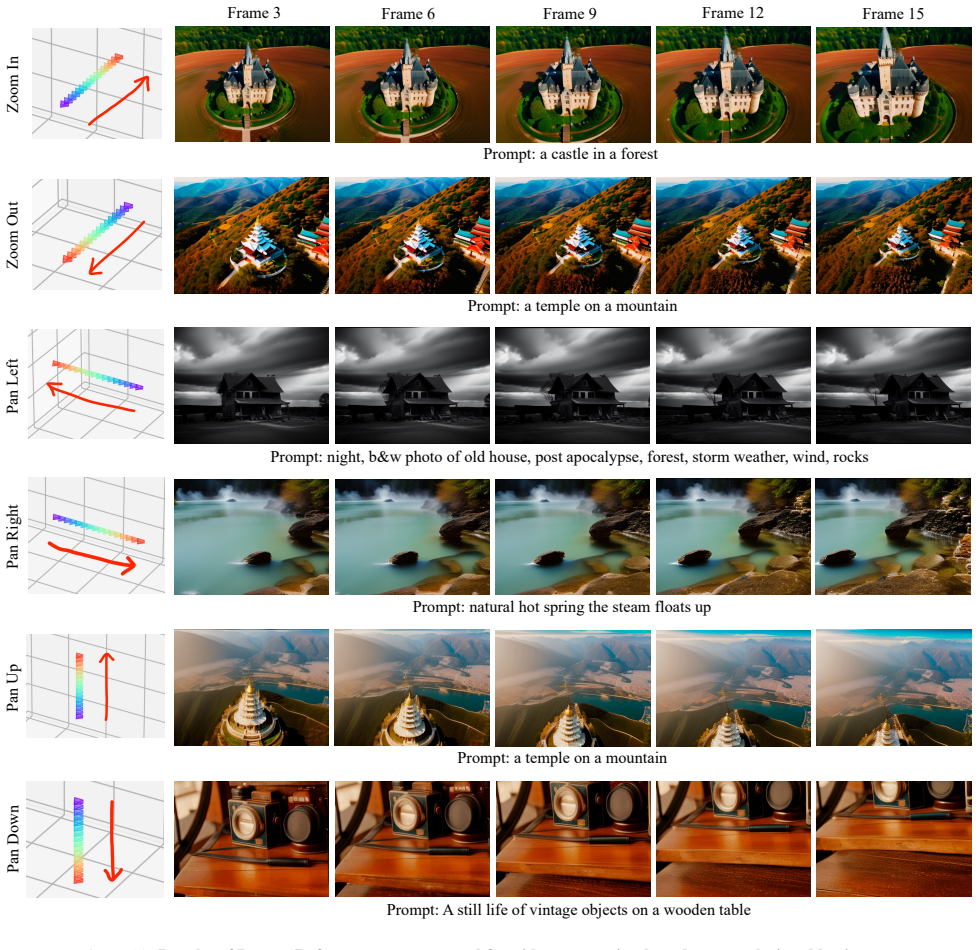
The central claim is that camera control can be imposed on a pre-trained video diffusion model without touching its weights. The paper shows that at a chosen point during denoising one can reconstruct an approximate clean video from the current latent, lift it with MonST3R into per-frame time-aware 3D point clouds in a globally aligned coordinate system, re-render the frames from the target camera poses supplied by a RealEstate10K trajectory, and then let the diffusion model itself repair the latent. The repaired latent is carried through the remaining denoising steps. On its 800-video comparison using 10 prompts and 80 poses, the paper reports FID 60.18, FVD 509.11, translation error 5.52, and rotation error 2.29 on the intersection of 463 samples whose poses could be estimated, against MotionCtrl's 63.96/468.29/7.44/1.23 and CameraCtrl's 92.40/531.69/8.39/2.57, and interprets these numbers as comparable or superior camera control precision and video quality without fine-tuning.
Load-bearing premise
The load-bearing premise is that the 3D geometry and camera poses estimated from a blurry, partially denoised video frame are accurate enough to be treated as ground truth when re-rendering the frames from a new camera path; if that geometry is wrong, the camera control fails.
Editorial extensions
If this is right
- Any video diffusion model whose latents can be cleanly decoded and re-encoded can gain camera control by inserting this sampling-stage pipeline, so new base models become controllable without collecting paired pose-annotated video datasets.
- Because the pre-trained weights are never updated, the generated video quality stays close to the original model: the paper reports FID 60.18 against MotionCtrl's 63.96 and CameraCtrl's 92.40 on its 800-video evaluation.
- The reframing step is a single intervention at denoising step 8 of 25, so the overhead is one extra encode-decode round trip plus point-cloud estimation and rendering, roughly three minutes per 16-frame clip on a single A5000 GPU.
- Large camera movements create large occluded regions, and the paper reports visual inconsistencies and artifacts in those cases; the method is therefore best suited to moderate trajectories rather than extreme ones.
- Since the target poses come from RealEstate10K trajectories, the method inherits that dataset's pose distribution; trajectories outside it would need to be converted into relative poses with matched scale before reframing.
Reading between the lines
- Because the pipeline leaves the diffusion backbone untouched, it should compose with other training-free latent manipulations—such as drag-style edits or motion brushes—that operate during sampling; the paper does not test such combinations.
- The method's accuracy ceiling is set by the monocular geometry estimator it borrows; improving that estimator should improve control precision directly, since the reframing step treats its point clouds as ground truth.
- A stress test the paper does not run: apply Latent-Reframe to prompts with heavy hallucination or non-rigid motion (fire, fur, water spray) under strong rotation and compare pose recovery against a known synthetic camera path; the limitation section already predicts artifacts here.
- The single reframing intervention could be generalized to multiple staggered reframing steps, which might allow longer or more complex trajectories than a one-shot warp at step 8; that extension is not explored in the paper.
Editorial analysis
A structured set of objections, weighed in public.
Referee Report
Summary. The paper proposes Latent-Reframe, a sampling-time method for imposing user-specified camera trajectories on a pre-trained text-to-video diffusion model (AnimateDiff) without any fine-tuning. Midway through DDIM denoising, the method decodes an estimated clean video, lifts it into per-frame time-aware 3D point clouds with MonST3R, reprojects those point clouds to the target camera poses, re-encodes the reframed video, and then inpaints occluded/unknown regions and harmonizes the latent code before resuming denoising. The authors evaluate on 10 prompts and 80 RealEstate10K trajectories against MotionCtrl and CameraCtrl, reporting FID, FVD, translation error, and rotation error. They conclude that Latent-Reframe achieves comparable or superior camera control precision and video quality without training.
Significance. If established, the result is significant: it would decouple camera control from training-based conditioning, preserve the base model distribution, and make camera control a plug-in inference-time operation. The time-aware point-cloud reframing plus latent rehabilitation is a plausible and original combination, and the paper usefully ablates the reframing step, noise-reduction strength, and geometry backbone. The pseudo-code and hyperparameter table also make the method easy to reproduce. However, the current quantitative evidence is not sufficient to support the headline claim: the pose-error comparison is subject to a favorable circularity for the proposed method, the evaluation uses only 463 of 800 samples without per-method failure counts, and the manual per-pose scale adjustment is not reproducible. The method deserves publication in principle, but the evaluation protocol must be substantially strengthened.
major comments (3)
- [Sec. 4.1, Table 1] The quantitative comparison is not a controlled test. The evaluation uses only the intersection of 463 successful samples out of 800, but the paper does not report how many failures each method contributed or how failures are defined. Since Sec. D acknowledges that large movements and rotations are a failure regime for the proposed method, dropping failed samples can systematically remove the cases where Latent-Reframe is weakest. In addition, the per-pose manual adjustment of camera motion scale before computing translation error is not reproducible and can directly bias TransErr. Please report per-method success rates, all-sample results, a fixed and disclosed scale-normalization procedure, and confidence intervals or repeated-sampling statistics.
- [Sec. 3.2 vs. Sec. 4.1] The pose-error evaluation has a circularity risk: Latent-Reframe uses MonST3R, a DUSt3R-family model, to construct the point clouds and camera poses that define its reframed frames, and the generated videos are then evaluated with DUSt3R-estimated poses. This creates a favorable bias because the output is constructed to be consistent with the same geometric prior used for measurement. A concrete fix is to evaluate pose error with an independent estimator, such as a structure-from-motion or SLAM pipeline that was not involved in generation, and to show that the ranking of methods is insensitive to the choice of estimator; alternatively, report a geometric consistency metric that does not rely on a learned pose estimator.
- [Sec. 4.1, Table 1] The abstract's claim of 'comparable or superior camera control precision and video quality' is not fully supported by Table 1 as reported. Latent-Reframe has worse FVD than MotionCtrl (509.11 vs. 468.29) and worse RotErr than MotionCtrl (2.29 vs. 1.23); it is better on FID and TransErr. The discussion attributes the higher rotational error to the reframe-by-inpaint process, but this is not tested. Please provide statistical significance measures and adjust the claim to reflect which metrics are favorable and which are not, or provide additional evidence that the relative performance is robust.
minor comments (5)
- [Sec. 4.1, Eq. (5)] The rotational-error formula is typeset ambiguously; the argument of arccos appears to be written as tr(R_est R_gt^T) - 1/2, but the standard form is arccos((tr(R_est R_gt^T) - 1)/2). Please correct the parentheses and define all symbols.
- [Throughout] The geometry model is referred to inconsistently as 'MonSt3R' in Secs. 1 and 3.2 and as 'MonST3R' elsewhere; please unify the spelling.
- [Fig. 3 caption] The caption contains a typo: 'EffielTower' should be 'Eiffel Tower'.
- [Alg. 1, lines 9-11] The loop variable t' in line 10 is not used consistently in the update rule, which switches between z'_t and z'_{t-1}; please clarify the indexing so the inpainting iteration is unambiguous.
- [Sec. 4.1] The description of the FID/FVD reference set should state whether the 800 AnimateDiff videos are generated with the same 80 trajectories or without camera control, since this affects the interpretation of quality scores.
Circularity Check
The pose-error metric is partially self-confirming because DUSt3R evaluates outputs constructed with the same geometry model family (MonST3R), but the training-free method itself is not circularly derived.
-
other
[Sec. 3.2 (Latent Reframing) + Sec. 3.3 (Eq. 4) + Sec. 4.1 (Evaluation Details) + Table 1]
"Next, we use MonST3R [48] to transform the 2D video into a sequence of time-aware 3D point clouds. ... Finally, these processed poses are multiplied by the original poses of 16 frames, resulting in the target new poses for video frames. ... only the masked regions are updated, while the unmasked regions are directly computed with Eq. 1 using z′0. ... Following ViewCrafter [46], we use DUSt3R [38] to estimate the pose. ... both MonST3R and DUSt3R demonstrated comparable performance."
The known-region pixels fed to the pose estimator are, by Eq. 4, re-noised versions of the reframed latent z′0, which is a render of the MonST3R point cloud from the target pose. The evaluator, DUSt3R, is not an independent geometric estimator: it belongs to the same DUSt3R-family and, per the paper's own ablation, is treated as comparable to MonST3R for this geometry task. Hence, whenever the rendering is internally consistent, DUSt3R will recover the target pose regardless of whether that pose is correct against RealEstate10K. Table 1's TransErr and RotErr therefore partly measure self-consistency between the reframing model and the measurement model, not absolute camera-control accuracy.
full rationale
The paper's central method is a sampling-stage algorithm, not a mathematical derivation from first principles, and there is no load-bearing self-citation or ansatz smuggling: MonST3R, DUSt3R, RePaint, and FIFO-Diffusion are external cited components. The FID/FVD reference to AnimateDiff and the visual and basic-pose ablations give the video-quality claim independent content. However, Table 1's pose-error comparison has a specific construction-level circularity: reframed frames are rendered from MonST3R point clouds at target poses, known pixels are preserved through rehabilitation, and poses are then estimated with DUSt3R, a sibling model of MonST3R. The low translation and rotation errors thus partly reflect the method's consistency with the same geometric prior used for evaluation, rather than independent agreement with ground-truth trajectories. Because this affects only the quantitative pose-precision claim and not the method's existence or its distribution-preserving property, the overall circularity score is moderate rather than severe. The manual per-pose translation-scale adjustment and the intersection of 463 out of 800 successful samples are secondary protocol concerns that further compromise the pose metric.
Assumptions & free parameters
free parameters (6)
- Latent reframing diffusion step tw =
8
- Noise reduction steps for latent harmonization =
3
- Sliding window size for MonST3R connectivity graph =
3
- Global alignment optimization iterations =
300
- Manual camera motion scale adjustment per test pose =
not reported, per-pose
- Classifier-free guidance scale =
7.5
assumptions (5)
- domain assumption MonST3R returns accurate, globally aligned point clouds and camera poses from partially denoised latent reconstructions of synthetic video frames.
- domain assumption The halfway-denoised latent at step 8 (Eq. 1) yields a reconstruction faithful enough for 3D lifting and reprojection.
- domain assumption The pre-trained video diffusion model can inpaint and harmonize occluded regions without fine-tuning when noise levels are offset by 3 steps.
- domain assumption Target poses can be extracted from RealEstate10K and applied to arbitrary generated scenes despite scale ambiguity.
- standard math Standard DDIM and RePaint update equations govern the denoising process.
Cite this review
Pith. "Pith review of Latent-Reframe: Enabling Camera Control for Video Diffusion Model without Training." pith.science (2026). https://pith.science/paper/KB3NVAWT
@misc{pith2026241206029,
  author       = {Pith},
  title        = {Pith review of: Latent-Reframe: Enabling Camera Control for Video Diffusion Model without Training},
  year         = {2026},
  howpublished = {\url{https://pith.science/paper/KB3NVAWT}},
  note         = {Machine review of arXiv:2412.06029}
}
read the original abstract
Precise camera pose control is crucial for video generation with diffusion models. Existing methods require fine-tuning with additional datasets containing paired videos and camera pose annotations, which are both data-intensive and computationally costly, and can disrupt the pre-trained model distribution. We introduce Latent-Reframe, which enables camera control in a pre-trained video diffusion model without fine-tuning. Unlike existing methods, Latent-Reframe operates during the sampling stage, maintaining efficiency while preserving the original model distribution. Our approach reframes the latent code of video frames to align with the input camera trajectory through time-aware point clouds. Latent code inpainting and harmonization then refine the model latent space, ensuring high-quality video generation. Experimental results demonstrate that Latent-Reframe achieves comparable or superior camera control precision and video quality to training-based methods, without the need for fine-tuning on additional datasets.
Figures


Figures from the paper (6 more)



Forward citations
Cited by 1 Pith paper
-
EPiC: Efficient Video Camera Control Learning with Precise Anchor-Video Guidance
EPiC trains a 30M-parameter visibility-aware ControlNet on mask-based anchor videos from 5,000 in-the-wild videos and 500 steps, reaching SOTA camera accuracy on RealEstate10K and MiraData.
Reference graph
Works this paper leans on
-
[1]
Latent-Shift: Latent Diffu- sion with Temporal Shift for Efficient Text-to-Video Gener- ation
Jie An, Songyang Zhang, Harry Yang, Sonal Gupta, Jia-Bin Huang, Jiebo Luo, and Xi Yin. Latent-Shift: Latent Diffu- sion with Temporal Shift for Efficient Text-to-Video Gener- ation. arXiv preprint arXiv:2304.08477, 2023. 2
arXiv 2023
-
[2]
On Inductive Biases That Enable Generalization of Diffusion Transformers
Jie An, De Wang, Pengsheng Guo, Jiebo Luo, and Alexan- der Schwing. On inductive biases that enable generalization of diffusion transformers. arXiv preprint arXiv:2410.21273,
-
[3]
Bring metric functions into diffusion models
Jie An, Zhengyuan Yang, Jianfeng Wang, Linjie Li, Zicheng Liu, Lijuan Wang, and Jiebo Luo. Bring metric functions into diffusion models. arXiv preprint arXiv:2401.02414, 2024. 2
arXiv 2024
-
[4]
Align your latents: High-Resolution Video Synthesis with Latent Diffusion Models
Andreas Blattmann, Robin Rombach, Huan Ling, Tim Dock- horn, Seung Wook Kim, Sanja Fidler, and Karsten Kreis. Align your latents: High-Resolution Video Synthesis with Latent Diffusion Models. In CVPR, 2023. 2
work page 2023
-
[5]
VideoCrafter1: Open Dif- fusion Models for High-Quality Video Generation
Haoxin Chen, Menghan Xia, Yingqing He, Yong Zhang, Xiaodong Cun, Shaoshu Yang, Jinbo Xing, Yaofang Liu, Qifeng Chen, Xintao Wang, et al. VideoCrafter1: Open Dif- fusion Models for High-Quality Video Generation. arXiv preprint arXiv:2310.19512, 2023
-
[6]
VideoCrafter2: Overcoming Data Limitations for High-Quality Video Diffu- sion Models
Haoxin Chen, Yong Zhang, Xiaodong Cun, Menghan Xia, Xintao Wang, Chao Weng, and Ying Shan. VideoCrafter2: Overcoming Data Limitations for High-Quality Video Diffu- sion Models. arXiv:2401.09047, 2024. 2
arXiv 2024
-
[7]
Instantsplat: Unbounded sparse-view pose-free gaus- sian splatting in 40 seconds, 2024
Zhiwen Fan, Wenyan Cong, Kairun Wen, Kevin Wang, Jian Zhang, Xinghao Ding, Danfei Xu, Boris Ivanovic, Marco Pavone, Georgios Pavlakos, Zhangyang Wang, and Yue Wang. Instantsplat: Unbounded sparse-view pose-free gaus- sian splatting in 40 seconds, 2024. 2
2024
-
[8]
Preserve Your Own Correlation: A Noise Prior for Video Diffusion Models
Songwei Ge, Seungjun Nah, Guilin Liu, Tyler Poon, Andrew Tao, Bryan Catanzaro, David Jacobs, Jia-Bin Huang, Ming- Yu Liu, and Yogesh Balaji. Preserve Your Own Correlation: A Noise Prior for Video Diffusion Models. In ICCV, 2023. 2
2023
Show all 55 references
-
[9]
Animatediff: Animate your personalized text-to- image diffusion models without specific tuning
Yuwei Guo, Ceyuan Yang, Anyi Rao, Zhengyang Liang, Yaohui Wang, Yu Qiao, Maneesh Agrawala, Dahua Lin, and Bo Dai. Animatediff: Animate your personalized text-to- image diffusion models without specific tuning. ICLR, 2024. 2, 5, 11
2024
-
[10]
AnimateDiff: Animate Your Personalized Text-to- Image Diffusion Models without Specific Tuning
Yuwei Guo, Ceyuan Yang, Anyi Rao, Zhengyang Liang, Yaohui Wang, Yu Qiao, Maneesh Agrawala, Dahua Lin, and Bo Dai. AnimateDiff: Animate Your Personalized Text-to- Image Diffusion Models without Specific Tuning. In ICLR,
-
[11]
Cameractrl: Enabling camera control for text-to-video generation
Hao He, Yinghao Xu, Yuwei Guo, Gordon Wetzstein, Bo Dai, Hongsheng Li, and Ceyuan Yang. Cameractrl: Enabling camera control for text-to-video generation. arXiv preprint arXiv:2404.02101, 2024. 1, 2, 5, 6
2024 arXiv
-
[12]
Gans trained by a two time-scale update rule converge to a local nash equilib- rium
Martin Heusel, Hubert Ramsauer, Thomas Unterthiner, Bernhard Nessler, and Sepp Hochreiter. Gans trained by a two time-scale update rule converge to a local nash equilib- rium. NeurIPS, 30, 2017. 2, 5
2017
-
[13]
Denoising dif- fusion probabilistic models
Jonathan Ho, Ajay Jain, and Pieter Abbeel. Denoising dif- fusion probabilistic models. NeurIPS, 33:6840–6851, 2020. 2
2020
-
[14]
Imagen Video: High Definition Video Generation with Diffusion Models
Jonathan Ho, William Chan, Chitwan Saharia, Jay Whang, Ruiqi Gao, Alexey Gritsenko, Diederik P Kingma, Ben Poole, Mohammad Norouzi, David J Fleet, et al. Imagen Video: High Definition Video Generation with Diffusion Models. arXiv preprint arXiv:2210.02303, 2022. 2
-
[15]
Video Diffu- sion Models
Jonathan Ho, Tim Salimans, Alexey Gritsenko, William Chan, Mohammad Norouzi, and David J Fleet. Video Diffu- sion Models. In NeurIPS, 2022. 2
2022
-
[16]
Training-free camera control for video generation
Chen Hou, Guoqiang Wei, Yan Zeng, and Zhibo Chen. Training-free camera control for video generation. arXiv preprint arXiv:2406.10126, 2024. 2, 4, 5
2024 arXiv
-
[17]
Lora: Low-rank adaptation of large language models
Edward J Hu, Yelong Shen, Phillip Wallis, Zeyuan Allen- Zhu, Yuanzhi Li, Shean Wang, Lu Wang, and Weizhu Chen. Lora: Low-rank adaptation of large language models. arXiv preprint arXiv:2106.09685, 2021. 2
2021 arXiv
-
[18]
Solving linear inverse problems using the prior implicit in a denoiser.arXiv preprint arXiv:2007.13640, 2020
Zahra Kadkhodaie and Eero P Simoncelli. Solving linear inverse problems using the prior implicit in a denoiser.arXiv preprint arXiv:2007.13640, 2020. 2
2007 arXiv
-
[19]
3d gaussian splatting for real-time radiance field rendering
Bernhard Kerbl, Georgios Kopanas, Thomas Leimk ¨uhler, and George Drettakis. 3d gaussian splatting for real-time radiance field rendering. ACM Transactions on Graphics, 42 (4), 2023. 2
2023
-
[20]
Fifo-diffusion: Generating infinite videos from text without training
Jihwan Kim, Junoh Kang, Jinyoung Choi, and Bohyung Han. Fifo-diffusion: Generating infinite videos from text without training. In NeurIPS, 2024. 2, 4
2024
-
[21]
Ground- ing image matching in 3d with mast3r, 2024
Vincent Leroy, Yohann Cabon, and Jerome Revaud. Ground- ing image matching in 3d with mast3r, 2024. 8
2024
-
[22]
Re- conx: Reconstruct any scene from sparse views with video diffusion model, 2024
Fangfu Liu, Wenqiang Sun, Hanyang Wang, Yikai Wang, Haowen Sun, Junliang Ye, Jun Zhang, and Yueqi Duan. Re- conx: Reconstruct any scene from sparse views with video diffusion model, 2024. 2
2024
-
[23]
Repaint: Inpainting using denoising diffusion probabilistic models
Andreas Lugmayr, Martin Danelljan, Andres Romero, Fisher Yu, Radu Timofte, and Luc Van Gool. Repaint: Inpainting using denoising diffusion probabilistic models. In CVPR, pages 11461–11471, 2022. 4
2022
-
[24]
Srinivasan, Matthew Tancik, Jonathan T
Ben Mildenhall, Pratul P. Srinivasan, Matthew Tancik, Jonathan T. Barron, Ravi Ramamoorthi, and Ren Ng. Nerf: Representing scenes as neural radiance fields for view syn- thesis. In ECCV, 2020. 2
2020
-
[25]
Improved denoising diffusion probabilistic models
Alexander Quinn Nichol and Prafulla Dhariwal. Improved denoising diffusion probabilistic models. In ICML, 2021. 2
2021
-
[26]
Scalable diffusion models with transformers
William Peebles and Saining Xie. Scalable diffusion models with transformers. In ICCV, pages 4195–4205, 2023. 4
2023
-
[27]
Accelerating 3d deep learning with pytorch3d
Nikhila Ravi, Jeremy Reizenstein, David Novotny, Tay- lor Gordon, Wan-Yen Lo, Justin Johnson, and Georgia Gkioxari. Accelerating 3d deep learning with pytorch3d. arXiv preprint arXiv:2007.08501, 2020. 5
2007 arXiv
-
[28]
U-net: Convolutional networks for biomedical image segmentation
Olaf Ronneberger, Philipp Fischer, and Thomas Brox. U-net: Convolutional networks for biomedical image segmentation. In MICCAI, pages 234–241. Springer, 2015. 4
2015
-
[29]
Dragdiffusion: Harnessing diffusion models for interactive point-based image editing
Yujun Shi, Chuhui Xue, Jun Hao Liew, Jiachun Pan, Han- shu Yan, Wenqing Zhang, Vincent YF Tan, and Song Bai. Dragdiffusion: Harnessing diffusion models for interactive point-based image editing. In CVPR, 2024. 2
2024
-
[30]
Make-A-Video: Text-to-Video Generation without Text-Video Data
Uriel Singer, Adam Polyak, Thomas Hayes, Xi Yin, Jie An, Songyang Zhang, Qiyuan Hu, Harry Yang, Oron Ashual, Oran Gafni, et al. Make-A-Video: Text-to-Video Generation without Text-Video Data. In ICLR, 2023. 2 9
2023
-
[31]
Splatt3r: Zero-shot gaussian splatting from uncalibrated image pairs
Brandon Smart, Chuanxia Zheng, Iro Laina, and Vic- tor Adrian Prisacariu. Splatt3r: Zero-shot gaussian splatting from uncalibrated image pairs. arXiv preprint arXiv:2408.13912, 2024. 2
2024 arXiv
-
[32]
Deep unsupervised learning using nonequilibrium thermodynamics
Jascha Sohl-Dickstein, Eric Weiss, Niru Maheswaranathan, and Surya Ganguli. Deep unsupervised learning using nonequilibrium thermodynamics. In ICML, pages 2256–
-
[33]
Denoising diffusion implicit models
Jiaming Song, Chenlin Meng, and Stefano Ermon. Denoising diffusion implicit models. arXiv preprint arXiv:2010.02502, 2020. 3, 5
2010 arXiv
-
[34]
Score-based generative modeling through stochastic differential equa- tions
Yang Song, Jascha Sohl-Dickstein, Diederik P Kingma, Ab- hishek Kumar, Stefano Ermon, and Ben Poole. Score-based generative modeling through stochastic differential equa- tions. arXiv preprint arXiv:2011.13456, 2020. 2
2011 arXiv
-
[35]
To- wards accurate generative models of video: A new metric & challenges
Thomas Unterthiner, Sjoerd Van Steenkiste, Karol Kurach, Raphael Marinier, Marcin Michalski, and Sylvain Gelly. To- wards accurate generative models of video: A new metric & challenges. arXiv preprint arXiv:1812.01717, 2018. 2, 5
2018 arXiv
-
[36]
Phenaki: Variable Length Video Generation from Open Do- main Textual Description
Ruben Villegas, Mohammad Babaeizadeh, Pieter-Jan Kin- dermans, Hernan Moraldo, Han Zhang, Mohammad Taghi Saffar, Santiago Castro, Julius Kunze, and Dumitru Erhan. Phenaki: Variable Length Video Generation from Open Do- main Textual Description. In ICLR, 2023. 2
2023
-
[37]
MCVD-Masked Conditional Video Diffusion for Pre- diction, Generation, and Interpolation
Vikram V oleti, Alexia Jolicoeur-Martineau, and Christopher Pal. MCVD-Masked Conditional Video Diffusion for Pre- diction, Generation, and Interpolation. In NeurIPS, 2022. 2
2022
-
[38]
Dust3r: Geometric 3d vi- sion made easy
Shuzhe Wang, Vincent Leroy, Yohann Cabon, Boris Chidlovskii, and Jerome Revaud. Dust3r: Geometric 3d vi- sion made easy. In CVPR, 2024. 2, 4, 5, 8
2024
-
[39]
VideoComposer: Compositional Video Synthesis with Motion Controllability
Xiang Wang, Hangjie Yuan, Shiwei Zhang, Dayou Chen, Ji- uniu Wang, Yingya Zhang, Yujun Shen, Deli Zhao, and Jin- gren Zhou. VideoComposer: Compositional Video Synthesis with Motion Controllability. In NeurIPS, 2023. 2
2023
-
[40]
Motionctrl: A unified and flexible motion controller for video generation
Zhouxia Wang, Ziyang Yuan, Xintao Wang, Yaowei Li, Tianshui Chen, Menghan Xia, Ping Luo, and Ying Shan. Motionctrl: A unified and flexible motion controller for video generation. In ACM SIGGRAPH 2024 Conference Pa- pers, pages 1–11, 2024. 1, 2, 5, 6, 11
2024
-
[41]
Tune-A-Video: One-Shot Tuning of Image Diffusion Models for Text-to-Video Generation
Jay Zhangjie Wu, Yixiao Ge, Xintao Wang, Weixian Lei, Yuchao Gu, Yufei Shi, Wynne Hsu, Ying Shan, Xiaohu Qie, and Mike Zheng Shou. Tune-A-Video: One-Shot Tuning of Image Diffusion Models for Text-to-Video Generation. In ICCV, 2023. 2
2023
-
[42]
Camco: Camera- controllable 3d-consistent image-to-video generation
Dejia Xu, Weili Nie, Chao Liu, Sifei Liu, Jan Kautz, Zhangyang Wang, and Arash Vahdat. Camco: Camera- controllable 3d-consistent image-to-video generation. arXiv preprint arXiv:2406.02509, 2024. 2
2024 arXiv
-
[43]
Direct-a-video: Customized video generation with user- directed camera movement and object motion
Shiyuan Yang, Liang Hou, Haibin Huang, Chongyang Ma, Pengfei Wan, Di Zhang, Xiaodong Chen, and Jing Liao. Direct-a-video: Customized video generation with user- directed camera movement and object motion. In ACM SIG- GRAPH 2024 Conference Papers, pages 1–12, 2024. 2
2024
-
[44]
No pose, no problem: Surprisingly simple 3d gaussian splats from sparse unposed images
Botao Ye, Sifei Liu, Haofei Xu, Li Xueting, Marc Pollefeys, Ming-Hsuan Yang, and Peng Songyou. No pose, no problem: Surprisingly simple 3d gaussian splats from sparse unposed images. arXiv preprint arXiv:2410.24207, 2024. 2
2024 arXiv
-
[45]
Dragnuwa: Fine-grained Control in Video Generation by Integrating Text, Image, and Trajectory
Shengming Yin, Chenfei Wu, Jian Liang, Jie Shi, Houqiang Li, Gong Ming, and Nan Duan. Dragnuwa: Fine-grained Control in Video Generation by Integrating Text, Image, and Trajectory. arXiv preprint arXiv:2308.08089, 2023. 2
2023 arXiv
-
[46]
Viewcrafter: Taming video diffusion models for high-fidelity novel view synthesis.arXiv preprint arXiv:2409.02048, 2024
Wangbo Yu, Jinbo Xing, Li Yuan, Wenbo Hu, Xiaoyu Li, Zhipeng Huang, Xiangjun Gao, Tien-Tsin Wong, Ying Shan, and Yonghong Tian. Viewcrafter: Taming video diffusion models for high-fidelity novel view synthesis.arXiv preprint arXiv:2409.02048, 2024. 2, 5
2024 arXiv
-
[47]
Recapture: Gener- ative video camera controls for user-provided videos using masked video fine-tuning
David Junhao Zhang, Roni Paiss, Shiran Zada, Nikhil Kar- nad, David E Jacobs, Yael Pritch, Inbar Mosseri, Mike Zheng Shou, Neal Wadhwa, and Nataniel Ruiz. Recapture: Gener- ative video camera controls for user-provided videos using masked video fine-tuning. arXiv preprint arXi...
-
[48]
Monst3r: A simple approach for estimat- ing geometry in the presence of motion
Junyi Zhang, Charles Herrmann, Junhwa Hur, Varun Jam- pani, Trevor Darrell, Forrester Cole, Deqing Sun, and Ming- Hsuan Yang. Monst3r: A simple approach for estimat- ing geometry in the presence of motion. arXiv preprint arxiv:2410.03825, 2024. 2, 4, 5, 8, 11
-
[49]
Good- drag: Towards good practices for drag editing with diffusion models
Zewei Zhang, Huan Liu, Jun Chen, and Xiangyu Xu. Good- drag: Towards good practices for drag editing with diffusion models. arXiv preprint arXiv:2404.07206, 2024. 2
2024 arXiv
-
[50]
Stereo magnification: Learning view synthesis using multiplane images
Tinghui Zhou, Richard Tucker, John Flynn, Graham Fyffe, and Noah Snavely. Stereo magnification: Learning view synthesis using multiplane images. arXiv preprint arXiv:1805.09817, 2018. 4, 5 10 A. More Results In this section, we present additional results of Latent- Reframe in ...
2018 arXiv
-
[51]
Denoising is conducted using the video diffusion model until reaching the predetermined latent reframing step, which is step 8
The process begins with fully Gaussian noise at the 25th step. Denoising is conducted using the video diffusion model until reaching the predetermined latent reframing step, which is step 8
-
[52]
3.2, is then applied to generate the reframed video at the target camera pose
Latent reframing, as described in Sec. 3.2, is then applied to generate the reframed video at the target camera pose. At this point, holes caused by occlusions are present, and the regions are differentiated into known and unknown regions
-
[53]
As outlined in Sec
The noise addition process starts. As outlined in Sec. 3.3, the noise level in the known region is set to be 3 steps lower than that in the unknown region. For in- stance, when the unknown region is at the25th denoising step, the known region is at the 22th denoising step
-
[54]
At this stage, the input to the denoising network combines un- known and known regions, as described in Eq
Denoising of the unknown region proceeds. At this stage, the input to the denoising network combines un- known and known regions, as described in Eq. 4 of the main paper. The output of the denoising network up- dates the unknown region for the next step, while the known region...
-
[55]
After this, the known region is no longer merged
When the unknown region reaches the 11th denoising step, the known region has already reached the 8th step, which is the step for latent reframing. After this, the known region is no longer merged. The denoising pro- cess continues normally, updating the entire video until the...
Reviewed August 11, 2026 · model on record in the stance chip above.
Discussion (0). Continue with ORCID to comment.