REVIEW 3 major objections 5 minor 30 references
A Comparative Study of Learning Paradigms in Large Language Models via Intrinsic Dimension
T0 review · 3 major / 5 minor · reviewed 2026-08-11 · deepseek-v4-flash
Pith's one-line read Across four models and eight datasets, in-context learning with five or more demonstrations yields higher intrinsic dimension in hidden representations than supervised fine-tuning or zero-shot prompting.
desk verdict A useful empirical survey of ID in LLM representations, but the headline ICL-vs-SFT comparison is confounded by input length and needs a control before the central claim can be believed. read the letter →
The pith
A machine-rendered reading of the paper's core claim, the machinery that carries it, and where it could break.
The reading
What carries the argument
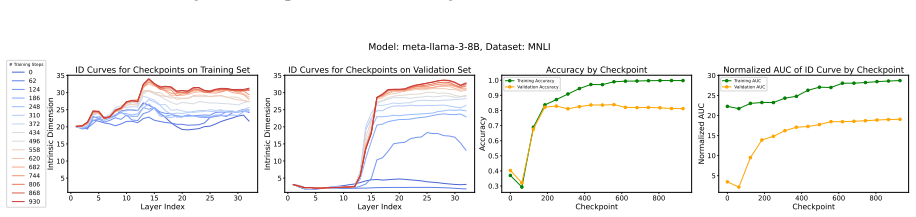
The load-bearing object is the Intrinsic Dimension Curve: collect the last-token hidden-state vectors from all validation prompts at each transformer layer, estimate the intrinsic dimension of each layer's point cloud, and plot ID against layer index. The estimate comes from the TwoNN estimator, which takes each point's ratio μ = r2/r1 of second-nearest to nearest-neighbor distance and reads the dimension off the slope relating log μ to the empirical survival probability, under the local Poisson assumption. The per-layer curve is then compressed into a Normalized AUC (trapezoidal average across layers), which lets models of different depths be compared on a single number. This curve and its AUC are the metric that carries the whole argument.
What would settle it
Run the same protocol many times with fresh random seeds and subsamples of the validation set, then form bootstrap confidence intervals on the Normalized AUC difference between ICL-5 and SFT; if the gap is within noise, the ordering claim fails. A second check is to pad fine-tuning prompts with neutral filler text to match ICL input lengths: if the higher ID follows longer prompts rather than the learning paradigm itself, the central comparison collapses.
Extended reading notes
Core claim
On its own terms, the central claim is that in-context learning induces a higher intrinsic dimension in LLM hidden representations than supervised fine-tuning does. In every (model, dataset) pair tested, ICL prompts with k ≥ 5 demonstrations yield ID curves above both the zero-shot baseline and the LoRA fine-tuned model at every layer, which the authors read as evidence that ICL representations live on higher-dimensional manifolds in embedding space. A second claim is that ID responds non-monotonically to demonstration count: it grows through small k, then plateaus or declines for larger k, and in most experiments the k with peak ID also reaches peak or near-peak accuracy. A third claim is that the ID of fine-tuned models tracks the zero-shot baseline closely even while accuracy rises, so ID is not a proxy for task performance. The paper contrasts its SFT-versus-ICL ordering with a concurrent study reporting the opposite ordering.
Load-bearing premise
The entire comparison rests on the assumption that the intrinsic-dimension estimator is unbiased for these hidden-state sets and that the ICL-versus-SFT gap is larger than the estimator's own variability, yet the paper reports no repeated runs, error bars, or confidence intervals to show that.
Editorial extensions
If this is right
- With five or more demonstrations, ICL can be expected to show higher intrinsic dimension than SFT across models of different families and sizes, not just the four models tested here.
- The k value at which ID peaks can serve as a practical stopping point for choosing the number of demonstrations, since accuracy has usually plateaued by that point.
- Intrinsic dimension is not a proxy for accuracy: fine-tuned models have the lowest ID and the highest accuracy, so a low ID should not be read as poor task performance.
- Fine-tuned representations remain geometrically close to the zero-shot baseline, suggesting that LoRA fine-tuning on 1,000 examples reshapes the representation space less than adding demonstrations does.
- The absence of a universal hunchback ID curve in LLMs, unlike CNNs and image transformers, points to a more diverse layer-wise organization of language representations.
Reading between the lines
- Editorial inference: the higher ID of ICL could partly be a prompt-length effect, since longer demonstration contexts change the distribution of last-token embeddings; a controlled comparison that pads fine-tuning prompts to the same length would show whether the paradigm or the sequence length drives the gap.
- Editorial inference: if the geometry reflects mechanism, then parameter-efficient methods that interpolate between ICL and SFT, such as prefix tuning or attention-only adaptation, should produce ID values between the two paradigms, which is testable.
- Editorial inference: the paper's own control experiments only rule out demonstration reuse as the cause of the ID plateau; an equally cheap check would be fixing k while shuffling or corrupting demonstrations, which should lower ID if the task signal, not the context length, is what expands the manifold.
- Editorial inference: because the TwoNN estimator is sensitive to sampling density, the 5,000-prompt validation set size may itself set a ceiling on detectable ID differences; re-running with larger pools could push the reported gap up or down.
Editorial analysis
A structured set of objections, weighed in public.
Referee Report
Summary. This paper presents an empirical study of the intrinsic dimension (ID) of LLM hidden representations under supervised fine-tuning (SFT) and in-context learning (ICL). Using the TwoNN estimator on last-token hidden states from four open-weight LLMs (7B–13B) across eight datasets, the authors report three main findings: (i) ID generally increases over the course of LoRA fine-tuning, with occasional initial decreases; (ii) ID initially rises with the number of ICL demonstrations k and then plateaus or decreases; and (iii) ICL with k≥5 consistently yields higher ID than SFT or zero-shot prompts, which they interpret as evidence that ICL representations inhabit higher-dimensional manifolds. They also propose the k value at peak ID as a practical heuristic for choosing demonstration count.
Significance. If the central comparison were robust, this would be a useful geometric characterization of two major adaptation paradigms, and the demonstration-count heuristic could save computational resources. The paper has genuine strengths: it is systematic, covering 8 datasets and 4 models; it uses an established estimator with a sanity check against MLE (Appendix F); it reports code availability; and it includes a check against demonstration-reuse artifacts (Appendix D). However, the claim that ICL induces higher ID than SFT is currently undermined by an uncontrolled input-length confound and by the absence of any uncertainty quantification, both of which are load-bearing. The significance is therefore conditional on these issues being resolved.
major comments (3)
- [Section 7.2 (and Section 4.1)] The central comparison confounds learning paradigm with input length. In Section 4.1, ID is measured on the last-token hidden state of each input sequence, so the estimate reflects the entire preceding context. ICL prompts with k≥5 are systematically longer than SFT prompts (which contain no demonstrations) and zero-shot prompts. The paper reports no control in which SFT or zero-shot models are evaluated on long prompts, e.g., padded with task-irrelevant text to match ICL-5 length. The k-vs-AUC results in Section 6.2, where ID rises from k=0 to k≈5 and then plateaus or decreases, are precisely the pattern one would expect from a saturating context-length effect. Without such a control, the abstract's conclusion that 'representations generated during ICL reside in higher dimensional manifolds' is not warranted by the data. This is the load-bearing point of the paper and needs an additional experiment.
- [All experimental figures (e.g., Figures 4 and 5)] No measure of estimator variability is reported. ID estimates are point values with no error bars, confidence intervals, or repeated runs. The consistency claim 'across all datasets and models' in Section 7.2 depends on differences between paradigms that may be within estimator noise. The only reliability check, the TwoNN-versus-MLE correlation in Appendix F (r=0.70), is moderate. The authors should provide bootstrap confidence intervals for the ID estimates or repeated independent runs, and verify that the ordering ICL-k≥5 > SFT and ICL-k≥5 > ICL-0 holds after accounting for this variability.
- [Section 6.2] The proposed heuristic that the peak of the k-vs-AUC curve indicates the optimal number of demonstrations is tested on the same six experiments from which it is derived, and the match is reported as 5 out of 6. This is an in-sample evaluation with a small sample; no held-out validation or out-of-sample test is provided. The heuristic therefore should be framed as a preliminary observation, not as a practical indicator, unless the authors add a validation experiment or cross-validation.
minor comments (5)
- [Section 2.2] The displayed formula for TwoNN suggests a closed-form per-point estimate, but the estimator actually computes the slope of a linear fit to the empirical CDF; please clarify the estimation procedure.
- [Section 7.2] The first sentence contains a subject-verb agreement error: 'ICL prompts with k ≥ 5 consistently induces higher intrinsic dimensions' should be 'ICL prompts with k ≥ 5 consistently induce higher intrinsic dimensions'.
- [Section 7.3.1 and Appendix C] Figure 36 is cited in Section 7.3.1 but is located in Appendix C; please add explicit cross-references to appendices for all cited figures.
- [Table 1] Table 1 reports accuracy without any variance; because demonstrations are sampled randomly and fine-tuning has stochasticity, standard errors or a note on single-run reporting should be included.
- [Appendix G] Appendix G appears to contain dataset prompts but the text refers to 'details of dataset creation' in Appendix G; add a section heading and describe the split generation procedure used for CommonsenseQA and MMLU (which are drawn from train/test splits rather than a validation split).
Circularity Check
No significant circularity: the paper reports direct measurements using an external ID estimator and does not fit parameters or rely on a self-citation chain for its central claim.
full rationale
The paper's central claim is an empirical measurement: intrinsic dimension is computed from hidden states with the TwoNN estimator of Facco et al. (2017), an external method with no parameters fitted to force the reported ICL-versus-SFT ordering. The ICL-k curves and the SFT checkpoints are generated by standard forward passes and LoRA fine-tuning, and the comparisons in Section 7.2 are descriptive statistics of those measurements. The claim that peak ID indicates a good number of demonstrations is presented as a post-hoc observation from the same data, not as a fitted parameter later relabeled as a prediction, so it does not meet the threshold for a circular step. The paper contains no load-bearing self-citations: the authors do not cite themselves, and the cited prior work (Facco, Levina and Bickel, Doimo et al.) is independent external evidence. Concerns about input-length confounding or estimator variability are threats to empirical validity, not circularity, and the Limitations section does not assert any circular dependency. Therefore the appropriate finding is no significant circularity.
Assumptions & free parameters
free parameters (7)
- LoRA rank r =
64
- LoRA alpha =
16
- LoRA learning rate =
1e-4
- Number of fine-tuning epochs =
15 (Section 5), 4 (Section 7)
- Training set size for SFT =
1000
- Validation set size for ID estimation =
5000
- ICL demonstration values in comparison =
k in {0,1,2,5,10}
assumptions (4)
- domain assumption Manifold hypothesis: real-world data and learned representations lie on low-dimensional manifolds.
- standard math The TwoNN estimator yields unbiased intrinsic dimension estimates for point sets sampled from a manifold.
- domain assumption The representation of the last input token captures task-relevant state.
- domain assumption The four open-source models and eight datasets are representative of LLM behavior.
Cite this review
Pith. "Pith review of A Comparative Study of Learning Paradigms in Large Language Models via Intrinsic Dimension." pith.science (2026). https://pith.science/paper/G6G37HBX
@misc{pith2026241206245,
  author       = {Pith},
  title        = {Pith review of: A Comparative Study of Learning Paradigms in Large Language Models via Intrinsic Dimension},
  year         = {2026},
  howpublished = {\url{https://pith.science/paper/G6G37HBX}},
  note         = {Machine review of arXiv:2412.06245}
}
read the original abstract
The performance of Large Language Models (LLMs) on natural language tasks can be improved through both supervised fine-tuning (SFT) and in-context learning (ICL), which operate via distinct mechanisms. Supervised fine-tuning updates the model's weights by minimizing loss on training data, whereas in-context learning leverages task demonstrations embedded in the prompt, without changing the model's parameters. This study investigates the effects of these learning paradigms on the hidden representations of LLMs using Intrinsic Dimension (ID). We use ID to estimate the number of degrees of freedom between representations extracted from LLMs as they perform specific natural language tasks. We first explore how the ID of LLM representations evolves during SFT and how it varies due to the number of demonstrations in ICL. We then compare the IDs induced by SFT and ICL and find that ICL consistently induces a higher ID compared to SFT, suggesting that representations generated during ICL reside in higher dimensional manifolds in the embedding space.
Figures


Figures from the paper (39 more)







Reference graph
Works this paper leans on
-
[1]
Rishabh Agarwal, Avi Singh, Lei M Zhang, Bernd Bohnet, Stephanie Chan, Ankesh Anand, Zaheer Abbas, Azade Nova, John D Co-Reyes, Eric Chu, et al. 2024. Many-shot in-context learning. arXiv preprint arXiv:2404.11018
arXiv 2024
-
[2]
Armen Aghajanyan, Luke Zettlemoyer, and Sonal Gupta. 2020. Intrinsic dimensionality explains the effectiveness of language model fine-tuning. arXiv preprint arXiv:2012.13255
arXiv 2020
-
[3]
Alessio Ansuini, Alessandro Laio, Jakob H Macke, and Davide Zoccolan. 2019. Intrinsic dimension of data representations in deep neural networks. Advances in Neural Information Processing Systems, 32
2019
-
[4]
Stephen Bach, Victor Sanh, Zheng Xin Yong, Albert Webson, Colin Raffel, Nihal V. Nayak, Abheesht Sharma, Taewoon Kim, M Saiful Bari, Thibault Fevry, Zaid Alyafeai, Manan Dey, Andrea Santilli, Zhiqing Sun, Srulik Ben-david, Canwen Xu, Gunjan Chhablani, Han Wang, Jason Fries, Maged Al-shaibani, Shanya Sharma, Urmish Thakker, Khalid Almubarak, Xiangru Tang, ...
-
[5]
Tom B Brown. 2020. Language models are few-shot learners. arXiv preprint arXiv:2005.14165
arXiv 2020
-
[6]
Emily Cheng, Corentin Kervadec, and Marco Baroni. 2023. Bridging information-theoretic and geometric compression in language models. arXiv preprint arXiv:2310.13620
arXiv 2023
-
[7]
Damai Dai, Yutao Sun, Li Dong, Yaru Hao, Shuming Ma, Zhifang Sui, and Furu Wei. 2022. Why can gpt learn in-context? language models implicitly perform gradient descent as meta-optimizers. arXiv preprint arXiv:2212.10559
arXiv 2022
-
[8]
Diego Doimo, Alessandro Serra, Alessio Ansuini, and Alberto Cazzaniga. 2024. The representation landscape of few-shot learning and fine-tuning in large language models. arXiv preprint arXiv:2409.03662
work page Pith review arXiv 2024
Show all 30 references
-
[9]
Abhimanyu Dubey, Abhinav Jauhri, Abhinav Pandey, Abhishek Kadian, Ahmad Al-Dahle, Aiesha Letman, Akhil Mathur, Alan Schelten, Amy Yang, Angela Fan, et al. 2024. The llama 3 herd of models. arXiv preprint arXiv:2407.21783
2024 arXiv
-
[10]
Elena Facco, Maria d’Errico, Alex Rodriguez, and Alessandro Laio. 2017. Estimating the intrinsic dimension of datasets by a minimal neighborhood information. Scientific reports, 7(1):12140
2017
-
[11]
Ian Goodfellow. 2016. Deep learning
2016
-
[12]
Dan Hendrycks, Collin Burns, Steven Basart, Andy Zou, Mantas Mazeika, Dawn Song, and Jacob Steinhardt. 2020. Measuring massive multitask language understanding. arXiv preprint arXiv:2009.03300
2020 arXiv
-
[13]
Edward J Hu, Yelong Shen, Phillip Wallis, Zeyuan Allen-Zhu, Yuanzhi Li, Shean Wang, Lu Wang, and Weizhu Chen. 2021. Lora: Low-rank adaptation of large language models. arXiv preprint arXiv:2106.09685
2021 arXiv
-
[14]
Albert Q Jiang, Alexandre Sablayrolles, Arthur Mensch, Chris Bamford, Devendra Singh Chaplot, Diego de las Casas, Florian Bressand, Gianna Lengyel, Guillaume Lample, Lucile Saulnier, et al. 2023. Mistral 7b. arXiv preprint arXiv:2310.06825
2023 arXiv
-
[15]
Jin Hwa Lee, Thomas Jiralerspong, Lei Yu, Yoshua Bengio, and Emily Cheng. 2024. Geometric signatures of compositionality across a language model's lifetime. arXiv preprint arXiv:2410.01444
2024 arXiv
-
[16]
Elizaveta Levina and Peter Bickel. 2004. Maximum likelihood estimation of intrinsic dimension. Advances in neural information processing systems, 17
2004
-
[17]
Utkarsh Sharma and Jared Kaplan. 2022. Scaling laws from the data manifold dimension. Journal of Machine Learning Research, 23(9):1--34
2022
-
[18]
Richard Socher, Alex Perelygin, Jean Wu, Jason Chuang, Christopher D Manning, Andrew Y Ng, and Christopher Potts. 2013. Recursive deep models for semantic compositionality over a sentiment treebank. In Proceedings of the 2013 conference on empirical methods in natural language...
2013
-
[19]
Alon Talmor, Jonathan Herzig, Nicholas Lourie, and Jonathan Berant. 2018. Commonsenseqa: A question answering challenge targeting commonsense knowledge. arXiv preprint arXiv:1811.00937
2018 arXiv
-
[20]
Hugo Touvron, Louis Martin, Kevin Stone, Peter Albert, Amjad Almahairi, Yasmine Babaei, Nikolay Bashlykov, Soumya Batra, Prajjwal Bhargava, Shruti Bhosale, et al. 2023. Llama 2: Open foundation and fine-tuned chat models. arXiv preprint arXiv:2307.09288
2023 arXiv
-
[21]
Lucrezia Valeriani, Diego Doimo, Francesca Cuturello, Alessandro Laio, Alessio Ansuini, and Alberto Cazzaniga. 2024. The geometry of hidden representations of large transformer models. Advances in Neural Information Processing Systems, 36
2024
-
[22]
Alex Wang. 2018. Glue: A multi-task benchmark and analysis platform for natural language understanding. arXiv preprint arXiv:1804.07461
2018 arXiv
-
[23]
Zhiguo Wang, Wael Hamza, and Radu Florian. 2017. Bilateral multi-perspective matching for natural language sentences. arXiv preprint arXiv:1702.03814
2017 arXiv
-
[24]
Alex Warstadt, Amanpreet Singh, and Samuel R Bowman. 2018. Neural network acceptability judgments. arXiv preprint arXiv:1805.12471
2018 arXiv
-
[25]
Adina Williams, Nikita Nangia, and Samuel R Bowman. 2017. A broad-coverage challenge corpus for sentence understanding through inference. arXiv preprint arXiv:1704.05426
2017 arXiv
-
[26]
Sang Michael Xie, Aditi Raghunathan, Percy Liang, and Tengyu Ma. 2021. An explanation of in-context learning as implicit bayesian inference. arXiv preprint arXiv:2111.02080
2021 arXiv
-
[27]
Fan Yin, Jayanth Srinivasa, and Kai-Wei Chang. 2024. Characterizing truthfulness in large language model generations with local intrinsic dimension. arXiv preprint arXiv:2402.18048
2024 arXiv
-
[28]
Xiang Zhang, Junbo Zhao, and Yann LeCun. 2015. Character-level convolutional networks for text classification. Advances in neural information processing systems, 28
2015
-
[29]
URL: " 'urlintro :=
ENTRY address author booktitle chapter edition editor howpublished institution journal key month note number organization pages publisher school series title type volume year eprint doi pubmed url lastchecked label extra.label sort.label short.list INTEGERS output.state before...
-
[30]
write newline
" write newline "" before.all 'output.state := FUNCTION n.dashify 't := "" t empty not t #1 #1 substring "-" = t #1 #2 substring "--" = not "--" * t #2 global.max substring 't := t #1 #1 substring "-" = "-" * t #2 global.max substring 't := while if t #1 #1 substring * t #2 gl...
Reviewed August 11, 2026 · model on record in the stance chip above.
Discussion (0). Continue with ORCID to comment.