REVIEW 4 major objections 6 minor 1 cited by
Rendering-Refined Stable Diffusion for Privacy Compliant Synthetic Data
T0 review · 4 major / 6 minor · reviewed 2026-08-11 · deepseek-v4-flash
Pith's one-line read RefSD claims that replacing people in photos with synthetic humans—guided by a rendered 3D pose—preserves posture and scene context while keeping the images as useful for training detectors and classifiers as the originals.
desk verdict RefSD is a sensible new assembly of SMPL rendering plus ControlNet for in-place pseudonymization, with a serious evaluation suite, but the posture-preservation and GDPR claims outrun the measurements. read the letter →
The pith
A machine-rendered reading of the paper's core claim, the machinery that carries it, and where it could break.
The reading
What carries the argument
The load-bearing object is the rendered SMPL avatar used as a structural bridge between the two blocks. 4DHuman extracts per-subject pose and shape parameters $\{\theta_i, \beta_i\}$ from the original image, and a synthetic human is rendered from them; the Canny edge map of that render is then fed, via ControlNet (a conditioning mechanism that lets an edge map steer the diffusion output), into SDXL alongside a text prompt that specifies the new person's attributes. This way the diffusion process is free to change identity, age, clothing, and other appearance, but is geometrically pinned to the original posture. The reintegration step composites each generated crop back into the untouched background using feathered person masks and $\alpha$ blending, and a Grounding DINO pass detects and inpaints any remaining personal information such as faces or license plates.
What would settle it
Run a keypoint estimator (or 4DHuman itself) on both the original and the pseudonymized versions of a large image set and measure the mean per-joint distance or percentage of correct keypoints between the two. If pseudonymized images are no closer to the original pose than images produced by SDXL without the rendered edge guidance, the central posture-preservation claim collapses; an ablation that switches off the ControlNet edge condition would isolate exactly how much of the pose fidelity comes from the rendering block.
Extended reading notes
Core claim
The paper's central claim is that rendering a 3D body model of a person and feeding its edge map into a text-guided diffusion model produces pseudonymized images that are both identity-replacing and posture-preserving, and that these images retain enough information to train downstream models. In the RefSD pipeline, 4DHuman extracts SMPL pose and shape parameters from each subject, a featureless avatar is rendered and blended over the original person, and the avatar's Canny edge map is passed through ControlNet to condition SDXL, so the generated person is geometrically locked to the original pose while a text prompt freely changes appearance. The quantitative anchor of the utility claim is Table 3: a DINOv2-Adapter with Faster R-CNN detector trained on 75,000 pseudonymized images reaches mAP@[.5:.95] of 26.4 against 25.3 for the same detector trained on real images, and 30.8 when synthetic pretraining is followed by real-data fine-tuning. Table 2 reports consistent classification gains on RAF-DB, up to 11.1 points for gender with ViT-Base, when synthetic data is combined with or used to pretrain on real data.
Load-bearing premise
The pipeline assumes that the Canny edge map of a rendered SMPL avatar gives SDXL enough structural guidance to reproduce the original posture exactly, and that 4DHuman's SMPL extraction captured that posture correctly in the first place; the paper verifies this only with qualitative side-by-side images, never with a numeric pose-fidelity measurement.
Editorial extensions
If this is right
- Photographic datasets containing people could be pseudonymized for sharing or commercial use under GDPR- and CCPA-style rules without the utility loss that blurring or masking imposes.
- A detector trained only on pseudonymized images can match or beat one trained on the originals: 26.4 versus 25.3 mAP@[.5:.95] on OpenImages.
- Using pseudonymized data for pretraining and real data for fine-tuning lifts detection mAP to 30.8, a 5.5-point gain over real-only training.
- Combining synthetic and real data consistently improves attribute classification on RAF-DB across emotion, age, gender, and ethnicity.
- Because the pipeline is modular, future rendering and diffusion models could be swapped in while carrying the same posture-preserving, attribute-controllable pseudonymization forward.
Reading between the lines
- The annotator data imply a ceiling on fine-grained prompt control: closely related ethnicities and subtle emotions were nearly indistinguishable (annotator consistency 0.340 for the translation test), so users should expect attribute control to follow SDXL's underlying biases rather than a neutral attribute axis.
- A quantitative pose-fidelity metric, such as keypoint distance between original and pseudonymized images, is the missing piece that would turn the qualitative posture-preservation claim into a testable specification other pipelines could adopt.
- The paper's own discussion concedes that pose and location survive pseudonymization and remain re-identification cues; going further, a stricter privacy regime would have to perturb them, which would directly trade away part of the measured detection utility.
Editorial analysis
A structured set of objections, weighed in public.
Referee Report
Summary. The paper proposes RefSD, a pseudonymization pipeline that combines SMPL-based 3D rendering with Canny-edge-conditioned SDXL to replace human subjects in images while preserving posture and scene context, and introduces HumanGenAI, a two-part evaluation framework covering human perception of attribute fidelity and downstream utility in classification and detection. The experiments generate 73,130 synthetic images and collect 147,942 annotator ratings; the utility section reports that detectors trained on RefSD data match or exceed those trained on real data (Table 3: mAP@[.5:.95] 26.4 vs 25.3, and 30.8 with synthetic pretraining), and that combining synthetic with real data improves classification accuracy for several attributes (Table 2). The central technical claim is that the rendered SMPL avatar provides sufficient structural guidance for SDXL to preserve the original pose, but this is supported only by qualitative comparisons in Figures 3, 9, and 10, and no quantitative pose metric is reported anywhere in the paper.
Significance. If the posture-preservation claim were quantitatively validated, RefSD would be a useful contribution to privacy-oriented dataset release, and the HumanGenAI framework is a valuable attempt to standardize attribute-level evaluation of synthetic human generation. The large-scale human perception study, with 73,130 generated images and 147,942 graded annotations across prompt complexity, fine-grained translation, and full-body attributes, is a concrete empirical resource. However, the paper's defining advantage over standard diffusion-based anonymization is exactly the pose-preservation claim, and that claim currently lacks direct evidence; the utility benchmarks, while competently designed, do not by themselves establish pose fidelity because detection and classification do not require per-instance keypoint alignment. The significance is therefore conditional: with added quantitative pose metrics and statistical rigor on the utility tables, the contribution would be solid, but as written the central claim remains unverified.
major comments (4)
- [Section 3.3, Eq. (3), Fig. 3] The paper's core claim of posture-preserving pseudonymization rests on the pipeline in Section 3.3: 4DHuman SMPL parameter extraction, rendering, Canny edge extraction, and ControlNet-conditioned SDXL generation (Eq. 3). However, no quantitative pose metric is reported anywhere in the paper or supplementary material. Figures 3, 9, and 10 provide only qualitative side-by-side comparisons with SD and DeepPrivacy2; the reader cannot determine whether joint locations, limb orientations, or body proportions are actually preserved, or how often the chain fails when SMPL estimation is inaccurate. The detection results in Table 3 do not rescue this claim, because person detection does not require matching original keypoints. Please add quantitative pose-preservation metrics on a held-out set (e.g., PCK, OKS, or mean keypoint distance between original and pseudonymized instances), ideally with per-stage errors along the chain (SMPL, render, final output), and report failure modes such as occlusion, loose clothing, and unusual viewpoints.
- [Table 2, Section 5.2 (ψA)] The text states that 'incorporating synthetic data consistently enhances performance across all attributes' and that pre-training on synthetic then fine-tuning on real 'offers the most substantial gains.' This is contradicted by the table itself: for Age, ViT-Tiny S→R (55.7) is below R (57.0) and ViT-Base S→R (58.1) is below R (58.4); for Emotion, ViT-Tiny S→R (42.2) is only 0.7 points above R while S alone (39.6) is far below R; for ViT-Base Age, S+R (59.9) is only 1.5 points above R. All numbers are from single runs with no error bars or significance tests. Please either soften the 'consistent' claim, or provide multiple seeds and a paired significance test, so that the reported 0.5% to 11.1% differences can be evaluated against run-to-run variance.
- [Table 3, Section 5.2 (ψB)] The claimed 1.1-point mAP advantage of synthetic data over real data is based on a single training run with no error bars, no multiple seeds, and no statistical test. Detector training on 75,000 images is stochastic, and a 1.1 mAP difference can easily fall within run-to-run noise, especially on a validation set with only 722 Person and 227 Human Face instances out of a 600-class evaluation. The S→R gain of 5.5 mAP points is more substantial, but it still needs variance estimates before the conclusion that RefSD data 'consistently improves results without any negative impact.' Please report at least 2-3 seeds with mean and standard deviation, or a significance test, for both mAP@[.5:.95] and mAP@0.5.
- [Title, Section 5.3] The title and abstract claim 'Privacy Compliant' synthetic data, and the introduction invokes GDPR and CCPA requirements, but the paper contains no privacy evaluation: there is no re-identification attack, no membership-inference test, no face-identification metric, and no measure of residual personally identifiable information beyond the qualitative statement that PII regions are inpainted. Section 5.3 does acknowledge that pose and location may carry re-identification risk, which is a useful caveat, but it does not substantiate the compliance claim. Please add a privacy-leakage evaluation (e.g., face re-identification or attribute inference on the pseudonymized outputs) or explicitly scope the claim to 'privacy-preserving intent' rather than legal compliance.
minor comments (6)
- [Section 3.3, Eq. (2)] The notation [·]bi is introduced as 'cropping with bounding box bi' but the exact tensor indexing and resizing operation are not specified; please define the crop operation unambiguously and state how the mask ai and rendered avatar mi are aligned with the cropped region in Eq. (2).
- [Table 3, Section 5.2 (ψB)] The text says the S→R setting 'further improved by 5.5%' and '6.6%' compared to real data alone; since the baseline mAP values are 25.3 and 32.2, the differences are 5.5 and 6.6 mAP points, not percentages. Please use 'mAP points' to avoid conflating absolute and relative improvements.
- [Section 5.1, Fig. 7 (ϕC)] The reported Cronbach's alpha of 0.340 for the fine-grained attribute translation evaluation indicates low inter-annotator reliability, yet the insights drawn from these scores are presented as model limitations. Please discuss how this reliability level affects the conclusions, or report additional agreement statistics.
- [Section 3.2, Eq. (1)] The rendering block says synthetic avatars are rendered using 'various appearance textures,' but no details are given on how many textures are used, how they are sampled, or how they affect downstream conditioning; this is material for reproducibility.
- [Algorithm 1, line 10] In the pseudocode, x'[cropi] is set using the full image x before cropping, while the rendered avatar mi and mask ai are also involved; please clarify that all three terms are cropped with the same bounding box and resized consistently before being passed to the generative model.
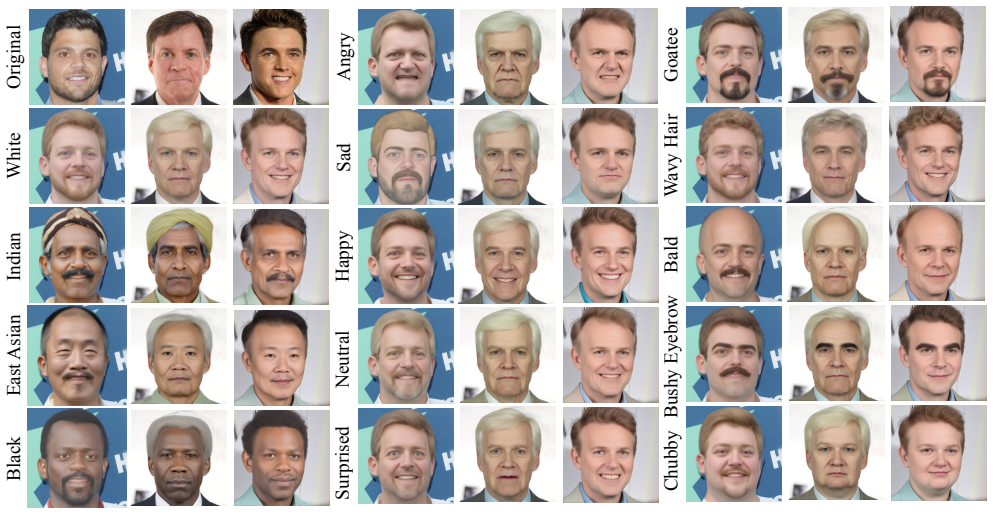
- [Fig. 1(b)] The 'footballer' example in Figure 1(b) is not described in the main text; either reference it explicitly in Section 3.3 or remove it to avoid confusion.
Circularity Check
No construction-level circularity: central utility claims rest on external benchmarks, while the pose-preservation claim is under-validated rather than circular.
full rationale
The paper's central quantitative claims are evaluated against independent external data. For classification, 'Classifier performance is then evaluated on a real-image test set' (Sec. 4.2, psi_A) using RAF-DB; for detection, 'The model was evaluated on 1,564 validation images' from OpenImages (Sec. 5). Human perception results come from 'three annotators on a 1-5 scale' (Sec. 4.3), an external judgment process. The pipeline equations (1)-(4) define a constructive inpainting procedure: SMPL extraction, rendering, Canny-edge extraction, and SDXL/ControlNet generation. These equations do not encode the outcome 'pose is preserved'; whether the final output preserves pose is an empirical property of the pipeline, and the paper supports it only with qualitative comparisons (Figs. 3, 9). That is a validation gap, not circularity. The self-citations [34, 52] are used to justify the choice of human-perception evaluation methodology and are not load-bearing for the main utility results. No fitted parameter is renamed as a prediction, and no uniqueness theorem or prior-work ansatz is invoked to force the RefSD design. Under the specific-reduction test, no equation or fitted value is, by construction, equivalent to a claimed output. Score is 2 only for the presence of minor non-load-bearing self-citations in the evaluation-methodology discussion.
Assumptions & free parameters
assumptions (3)
- domain assumption The SMPL body model provides a sufficiently accurate representation of the original person's pose for the purpose of pseudonymization.
- domain assumption The Canny edge map of the rendered avatar, when used as ControlNet conditioning for SDXL, preserves the original pose in the final generated image.
- domain assumption Human annotator ratings on a 1-5 scale are a valid and reliable measure of attribute fidelity in generated images.
Cite this review
Pith. "Pith review of Rendering-Refined Stable Diffusion for Privacy Compliant Synthetic Data." pith.science (2026). https://pith.science/paper/QCHBUW74
@misc{pith2026241206248,
  author       = {Pith},
  title        = {Pith review of: Rendering-Refined Stable Diffusion for Privacy Compliant Synthetic Data},
  year         = {2026},
  howpublished = {\url{https://pith.science/paper/QCHBUW74}},
  note         = {Machine review of arXiv:2412.06248}
}
read the original abstract
Growing privacy concerns and regulations like GDPR and CCPA necessitate pseudonymization techniques that protect identity in image datasets. However, retaining utility is also essential. Traditional methods like masking and blurring degrade quality and obscure critical context, especially in human-centric images. We introduce Rendering-Refined Stable Diffusion (RefSD), a pipeline that combines 3D-rendering with Stable Diffusion, enabling prompt-based control over human attributes while preserving posture. Unlike standard diffusion models that fail to retain posture or GANs that lack realism and flexible attribute control, RefSD balances posture preservation, realism, and customization. We also propose HumanGenAI, a framework for human perception and utility evaluation. Human perception assessments reveal attribute-specific strengths and weaknesses of RefSD. Our utility experiments show that models trained on RefSD pseudonymized data outperform those trained on real data in detection tasks, with further performance gains when combining RefSD with real data. For classification tasks, we consistently observe performance improvements when using RefSD data with real data, confirming the utility of our pseudonymized data.
Figures


Figures from the paper (23 more)




Forward citations
Cited by 1 Pith paper
-
Diffuse the object, keep its label: curating detector training data from a few unlabeled photographs via VLM-built 3D vegetation scenes
A detector trained on VLM-built 3D scenes re-textured by diffusion, with a graded mask-lock on the object, matched or exceeded a detector trained on a larger real labeled dataset on cross-site landmine detection.
Reference graph
Works this paper leans on
-
[1]
Leaving reality to imagi- nation: Robust classification via generated datasets
Hritik Bansal and Aditya Grover. Leaving reality to imagi- nation: Robust classification via generated datasets. ArXiv, abs/2302.02503:null, 2023. 2
arXiv 2023
-
[2]
A roadmap for greater public use of privacy-sensitive government data: Workshop report
Chris Clifton, Bradley Malin, Anna Oganian, Ramesh Raskar, and Vivek Sharma. A roadmap for greater public use of privacy-sensitive government data: Workshop report. arXiv preprint arXiv:2208.01636, 2022. 2
-
[3]
An efficient privacy protection scheme for data secu- rity in video surveillance
Ling Du, Wei Zhang, Huazhu Fu, Wenqi Ren, and Xinpeng Zhang. An efficient privacy protection scheme for data secu- rity in video surveillance. Journal of visual communication and image representation, 59:347–362, 2019. 1, 2
work page 2019
-
[4]
Guidelines on anonymisation: Minsunderstandings related to anonymisation
EDPS. Guidelines on anonymisation: Minsunderstandings related to anonymisation. https://edps.europa. eu/system/files/2021- 04/21- 04- 27_aepd- edps_anonymisation_en_5.pdf, 2021. 1
work page 2021
-
[5]
The pascal visual object classes (voc) challenge
Mark Everingham, Luc Van Gool, Christopher KI Williams, John Winn, and Andrew Zisserman. The pascal visual object classes (voc) challenge. International journal of computer vision, 88:303–338, 2010. 5
2010
-
[6]
Stylegan-human: A data-centric odyssey of human genera- tion
Jianglin Fu, Shikai Li, Yuming Jiang, Kwan-Yee Lin, Chen Qian, Chen Change Loy, Wayne Wu, and Ziwei Liu. Stylegan-human: A data-centric odyssey of human genera- tion. In European Conference on Computer Vision , pages 1–19. Springer, 2022. 2
2022
-
[7]
Humans in 4D: Reconstructing and tracking humans with transformers
Shubham Goel, Georgios Pavlakos, Jathushan Rajasegaran, Angjoo Kanazawa, and Jitendra Malik. Humans in 4D: Reconstructing and tracking humans with transformers. In ICCV, 2023. 3
work page 2023
-
[8]
Ruifei He, Shuyang Sun, Xin Yu, Chuhui Xue, Wenqing Zhang, Philip H. S. Torr, Song Bai, and Xiaojuan Qi. Is syn- thetic data from generative models ready for image recogni- tion? ArXiv, abs/2210.07574:null, 2022. 2
arXiv 2022
Show all 60 references
-
[9]
Ganonymization: A gan- based face anonymization framework for preserving emo- tional expressions
Fabio Hellmann, Silvan Mertes, Mohamed Benouis, Alexan- der Hustinx, Tzung-Chien Hsieh, Cristina Conati, Peter Krawitz, and Elisabeth Andr ´e. Ganonymization: A gan- based face anonymization framework for preserving emo- tional expressions. ACM Transactions on Multimedia Com- ...
2024
-
[10]
Mind the gap between synthetic and real: Utilizing transfer learning to probe the boundaries of stable diffusion generated data
Leonhard Hennicke, Christian Medeiros Adriano, Holger Giese, Jan Mathias Koehler, and Lukas Schott. Mind the gap between synthetic and real: Utilizing transfer learning to probe the boundaries of stable diffusion generated data. arXiv preprint arXiv:2405.03243, 2024. 2
2024 arXiv
-
[11]
Denoising dif- fusion probabilistic models
Jonathan Ho, Ajay Jain, and Pieter Abbeel. Denoising dif- fusion probabilistic models. Advances in neural information processing systems, 33:6840–6851, 2020. 2, 3
2020
-
[12]
Humannorm: Learning normal diffusion model for high-quality and realistic 3d hu- man generation
Xin Huang, Ruizhi Shao, Qi Zhang, Hongwen Zhang, Ying Feng, Yebin Liu, and Qing Wang. Humannorm: Learning normal diffusion model for high-quality and realistic 3d hu- man generation. In Proceedings of the IEEE/CVF Confer- ence on Computer Vision and Pattern Recognition , pages...
2024
-
[13]
Deepprivacy2: To- wards realistic full-body anonymization
H ˚akon Hukkel ˚as and Frank Lindseth. Deepprivacy2: To- wards realistic full-body anonymization. In Proceedings of the IEEE/CVF Winter Conference on Applications of Com- puter Vision, pages 1329–1338, 2023. 3
2023
-
[14]
Realistic full-body anonymization with surface- guided gans
H ˚akon Hukkel˚as, Morten Smebye, Rudolf Mester, and Frank Lindseth. Realistic full-body anonymization with surface- guided gans. In Proceedings of the IEEE/CVF Winter confer- ence on Applications of Computer Vision, pages 1430–1440,
-
[15]
Guide to the uk general data protection regulation (uk gdpr).https://ico.org
Information Commissioner’s Office. Guide to the uk general data protection regulation (uk gdpr).https://ico.org. uk / for - organisations / uk - gdpr - guidance - and- resources/lawful- basis/a- guide- to- lawful-basis/, 2019. 1
2019
-
[16]
Mimic-iii, a freely accessible critical care database
Alistair EW Johnson, Tom J Pollard, Lu Shen, H Lehman Li-Wei, Mengling Feng, Mohammad Ghassemi, Benjamin Moody, Peter Szolovits, Leo Anthony Celi, and Roger G Mark. Mimic-iii, a freely accessible critical care database. Scientific data, 3(1):1–9, 2016. 2
2016
-
[17]
A style-based generator architecture for generative adversarial networks
Tero Karras, Samuli Laine, and Timo Aila. A style-based generator architecture for generative adversarial networks. In Proceedings of the IEEE/CVF conference on computer vi- sion and pattern recognition, pages 4401–4410, 2019. 5
2019
-
[18]
Ldfa: Latent diffusion face anonymiza- tion for self-driving applications
Marvin Klemp, Kevin R ¨osch, Royden Wagner, Jannik Quehl, and Martin Lauer. Ldfa: Latent diffusion face anonymiza- tion for self-driving applications. In Proceedings of the IEEE/CVF Conference on Computer Vision and Pattern Recognition, pages 3199–3205, 2023. 2
2023
-
[19]
Abaw: Learning from synthetic data & 9 multi-task learning challenges
Dimitrios Kollias. Abaw: Learning from synthetic data & 9 multi-task learning challenges. In European Conference on Computer Vision, pages 157–172. Springer, 2022. 2
2022
-
[20]
The open images dataset v4: Unified image classification, object detection, and visual relationship detection at scale
Alina Kuznetsova, Hassan Rom, Neil Alldrin, Jasper Ui- jlings, Ivan Krasin, Jordi Pont-Tuset, Shahab Kamali, Stefan Popov, Matteo Malloci, Alexander Kolesnikov, et al. The open images dataset v4: Unified image classification, object detection, and visual relationship detection...
1956
-
[21]
California consumer privacy act (ccpa)
California State Legislature. California consumer privacy act (ccpa). https://oag.ca.gov/privacy/ccpa ,
-
[22]
Fidler, and A
Daiqing Li, Huan Ling, Seung Wook Kim, Karsten Kreis, Adela Barriuso, S. Fidler, and A. Torralba. Bigdataset- gan: Synthesizing imagenet with pixel-wise annotations. 2022 IEEE/CVF Conference on Computer Vision and Pat- tern Recognition (CVPR), null:21298–21308, 2022. 2
2022
-
[23]
Reliable crowd- sourcing and deep locality-preserving learning for expres- sion recognition in the wild
Shan Li, Weihong Deng, and JunPing Du. Reliable crowd- sourcing and deep locality-preserving learning for expres- sion recognition in the wild. In 2017 IEEE Conference on Computer Vision and Pattern Recognition (CVPR) , pages 2584–2593. IEEE, 2017. 5
2017
-
[24]
Microsoft coco: Common objects in context
Tsung-Yi Lin, Michael Maire, Serge Belongie, James Hays, Pietro Perona, Deva Ramanan, Piotr Doll´ar, and C Lawrence Zitnick. Microsoft coco: Common objects in context. In Computer Vision–ECCV 2014: 13th European Conference, Zurich, Switzerland, September 6-12, 2014, Proceeding...
2014
-
[25]
Grounding dino: Marrying dino with grounded pre-training for open-set object detection
Shilong Liu, Zhaoyang Zeng, Tianhe Ren, Feng Li, Hao Zhang, Jie Yang, Chunyuan Li, Jianwei Yang, Hang Su, Jun Zhu, et al. Grounding dino: Marrying dino with grounded pre-training for open-set object detection. arXiv preprint arXiv:2303.05499, 2023. 4
2023 arXiv
-
[26]
Large-scale celebfaces attributes (celeba) dataset
Ziwei Liu, Ping Luo, Xiaogang Wang, and Xiaoou Tang. Large-scale celebfaces attributes (celeba) dataset. Retrieved August, 15(2018):11, 2018. 5
2018
-
[27]
The chicago face database: A free stimulus set of faces and norm- ing data
Debbie S Ma, Joshua Correll, and Bernd Wittenbrink. The chicago face database: A free stimulus set of faces and norm- ing data. Behavior research methods, 47:1122–1135, 2015. 5
2015
-
[28]
Ad- vances in diffusion models for image data augmentation: A review of methods, models, evaluation metrics and future re- search directions
I Mademlis, P Alimisis, and P Radoglou-Grammatikis. Ad- vances in diffusion models for image data augmentation: A review of methods, models, evaluation metrics and future re- search directions. arXiv preprint arXiv:2407.04103 , 2024. 4
2024 arXiv
-
[29]
On the challenges and opportunities in generative ai
L Manduchi, K Pandey, R Bamler, and R Cotterell. On the challenges and opportunities in generative ai. arXiv preprint arXiv:2403.00025, 2024. 4
2024 arXiv
-
[30]
Diver- sity and diffusion: Observations on synthetic image distribu- tions with stable diffusion.arXiv preprint arXiv:2311.00056,
David Marwood, Shumeet Baluja, and Yair Alon. Diver- sity and diffusion: Observations on synthetic image distribu- tions with stable diffusion.arXiv preprint arXiv:2311.00056,
-
[31]
Pyrender
Matthew Matl. Pyrender. https://github.com/ mmatl/pyrender, 2019. 3
2019
-
[32]
Glide: Towards photorealistic image generation and editing with text-guided diffusion models.arXiv preprint arXiv:2112.10741, 2021
Alex Nichol, Prafulla Dhariwal, Aditya Ramesh, Pranav Shyam, Pamela Mishkin, Bob McGrew, Ilya Sutskever, and Mark Chen. Glide: Towards photorealistic image generation and editing with text-guided diffusion models.arXiv preprint arXiv:2112.10741, 2021. 2
2021 arXiv
-
[33]
Maxime Oquab, Timoth ´ee Darcet, Theo Moutakanni, Huy V . V o, Marc Szafraniec, Vasil Khalidov, Pierre Fernandez, Daniel Haziza, Francisco Massa, Alaaeldin El-Nouby, Rus- sell Howes, Po-Yao Huang, Hu Xu, Vasu Sharma, Shang- Wen Li, Wojciech Galuba, Mike Rabbat, Mido Assran, Ni...
2023
-
[34]
PerceptAnon: Exploring the human perception of image anonymization beyond pseudonymization for GDPR
Kartik Patwari, Chen-Nee Chuah, Lingjuan Lyu, and Vivek Sharma. PerceptAnon: Exploring the human perception of image anonymization beyond pseudonymization for GDPR. In Proceedings of the 41st International Conference on Ma- chine Learning, pages 39955–39971. PMLR, 2024. 2, 4, 5, 8
2024
-
[35]
Data and its (dis) contents: A survey of dataset development and use in ma- chine learning research
Amandalynne Paullada, Inioluwa Deborah Raji, Emily M Bender, Emily Denton, and Alex Hanna. Data and its (dis) contents: A survey of dataset development and use in ma- chine learning research. Patterns, 2(11), 2021. 1
2021
-
[36]
Scalable diffusion models with transformers
William Peebles and Saining Xie. Scalable diffusion models with transformers. In Proceedings of the IEEE/CVF Inter- national Conference on Computer Vision, pages 4195–4205,
-
[37]
Latent diffusion models for attribute-preserving im- age anonymization
Luca Piano, Pietro Basci, Fabrizio Lamberti, and Lia Morra. Latent diffusion models for attribute-preserving im- age anonymization. arXiv preprint arXiv:2403.14790, 2024. 2
2024 arXiv
-
[38]
State of the art on diffusion models for visual computing
R Po, W Yifan, V Golyanik, and K Aberman. State of the art on diffusion models for visual computing. Computer Graph- ics Forum, 2024. 4
2024
-
[39]
Sdxl: Improving latent diffusion mod- els for high-resolution image synthesis
Dustin Podell, Zion English, Kyle Lacey, Andreas Blattmann, Tim Dockhorn, Jonas M ¨uller, Joe Penna, and Robin Rombach. Sdxl: Improving latent diffusion mod- els for high-resolution image synthesis. arXiv preprint arXiv:2307.01952, 2023. 4
2023 arXiv
-
[40]
Zero-shot text-to-image generation
Aditya Ramesh, Mikhail Pavlov, Gabriel Goh, Scott Gray, Chelsea V oss, Alec Radford, Mark Chen, and Ilya Sutskever. Zero-shot text-to-image generation. In International confer- ence on machine learning, pages 8821–8831. Pmlr, 2021. 2
2021
-
[41]
Hierarchical text-conditional image gener- ation with clip latents
Aditya Ramesh, Prafulla Dhariwal, Alex Nichol, Casey Chu, and Mark Chen. Hierarchical text-conditional image gener- ation with clip latents. arXiv preprint arXiv:2204.06125, 1 (2):3, 2022. 2
2022 arXiv
-
[42]
Regulation (eu) 2016/679 of the eu- ropean parliament and of the council
Protection Regulation. Regulation (eu) 2016/679 of the eu- ropean parliament and of the council. Regulation (eu), 679: 2016, 2016. 1
2016
-
[43]
Faster r-cnn: Towards real-time object detection with region proposal networks
Shaoqing Ren, Kaiming He, Ross Girshick, and Jian Sun. Faster r-cnn: Towards real-time object detection with region proposal networks. IEEE transactions on pattern analysis and machine intelligence, 39(6):1137–1149, 2016. 6, 19
2016
-
[44]
Challenge design and lessons learned from the 2018 differential privacy challenges
Diane Ridgeway, Mary Theofanos, Terese Manley, and Christine Task. Challenge design and lessons learned from the 2018 differential privacy challenges. https://doi. org/10.6028/NIST.TN.2151, 2021. 2
2018 doi
-
[45]
Blattmann, Dominik Lorenz, Patrick Esser, and B
Robin Rombach, A. Blattmann, Dominik Lorenz, Patrick Esser, and B. Ommer. High-resolution image synthesis 10 with latent diffusion models. 2022 IEEE/CVF Conference on Computer Vision and Pattern Recognition (CVPR) , null: 10674–10685, 2021. 2, 3
2022
-
[46]
High-resolution image synthesis with latent diffusion models
Robin Rombach, Andreas Blattmann, Dominik Lorenz, Patrick Esser, and Bj ¨orn Ommer. High-resolution image synthesis with latent diffusion models. In Proceedings of the IEEE/CVF conference on computer vision and pattern recognition, pages 10684–10695, 2022. 3
2022
-
[47]
Denton, Seyed Kamyar Seyed Ghasemipour, Burcu Karagol Ayan, S
Chitwan Saharia, William Chan, Saurabh Saxena, Lala Li, Jay Whang, Emily L. Denton, Seyed Kamyar Seyed Ghasemipour, Burcu Karagol Ayan, S. S. Mahdavi, Raphael Gontijo Lopes, Tim Salimans, Jonathan Ho, David J. Fleet, and Mohammad Norouzi. Photorealistic text- to-image diffusio...
2022 arXiv
-
[48]
Fake it till you make it: Learning trans- ferable representations from synthetic imagenet clones
Mert Bulent Sariyildiz, Karteek Alahari, Diane Larlus, and Yannis Kalantidis. Fake it till you make it: Learning trans- ferable representations from synthetic imagenet clones. In Proceedings of the IEEE/CVF Conference on Computer Vi- sion and Pattern Recognition (CVPR), 2023. 2
2023
-
[49]
Stretching each dollar: Diffu- sion training from scratch on a micro-budget
Vikash Sehwag, Xianghao Kong, Jingtao Li, Michael Spranger, and Lingjuan Lyu. Stretching each dollar: Diffu- sion training from scratch on a micro-budget. arXiv preprint arXiv:2407.15811, 2024. 4
2024 arXiv
-
[50]
Objects365: A large-scale, high-quality dataset for object detection
Shuai Shao, Zeming Li, Tianyuan Zhang, Chao Peng, Gang Yu, Xiangyu Zhang, Jing Li, and Jian Sun. Objects365: A large-scale, high-quality dataset for object detection. In Pro- ceedings of the IEEE/CVF international conference on com- puter vision, pages 8430–8439, 2019. 1
2019
-
[51]
Decouple- and-sample: Protecting sensitive information in task agnos- tic data release
Abhishek Singh, Ethan Garza, Ayush Chopra, Praneeth Vepakomma, Vivek Sharma, and Ramesh Raskar. Decouple- and-sample: Protecting sensitive information in task agnos- tic data release. In European Conference on Computer Vi- sion, pages 499–517. Springer, 2022. 2
2022
-
[52]
Privacy as- sessment on reconstructed images: Are existing evaluation metrics faithful to human perception? Advances in Neural Information Processing Systems, 36, 2024
Xiaoxiao Sun, Nidham Gazagnadou, Vivek Sharma, Lingjuan Lyu, Hongdong Li, and Liang Zheng. Privacy as- sessment on reconstructed images: Are existing evaluation metrics faithful to human perception? Advances in Neural Information Processing Systems, 36, 2024. 4, 5
2024
-
[53]
Making sense of cron- bach’s alpha
Mohsen Tavakol and Reg Dennick. Making sense of cron- bach’s alpha. International journal of medical education, 2: 53, 2011. 6
2011
-
[54]
Fake it till you make it: face analysis in the wild using synthetic data alone
Erroll Wood, Tadas Baltru ˇsaitis, Charlie Hewitt, Sebastian Dziadzio, Thomas J Cashman, and Jamie Shotton. Fake it till you make it: face analysis in the wild using synthetic data alone. In Proceedings of the IEEE/CVF international conference on computer vision, pages 3681–36...
2021
-
[55]
A study of face obfuscation in ima- genet
Kaiyu Yang, Jacqueline H Yau, Li Fei-Fei, Jia Deng, and Olga Russakovsky. A study of face obfuscation in ima- genet. In International Conference on Machine Learning , pages 25313–25330. PMLR, 2022. 1, 2
2022
-
[56]
Adding conditional control to text-to-image diffusion models, 2023
Lvmin Zhang, Anyi Rao, and Maneesh Agrawala. Adding conditional control to text-to-image diffusion models, 2023. 4 11 Rendering-Refined Stable Diffusion for Privacy Compliant Synthetic Data Supplementary Material Rendering-Refined Stable Diffusion (RefSD) is an im- age pseudon...
2023
-
[57]
A person with no beard
Prompt Templates and Details To generate images using Stable Diffusion, we designed four prompt types, each varying in complexity and addi- tional details. Every prompt follows a consistent structure: Prefix + Attribute Prompt + Suffix All prompts included a common prefix: see...
-
[58]
9, 12 original SD RefSDDP2 Figure 9
Comparisons with Related Works Further comparisons between RefSD, regular Stable Diffu- sion (SD), and DeepPrivacy2 (DP2) are presented in Fig. 9, 12 original SD RefSDDP2 Figure 9. Comparison of regular Stable Diffusion (SD), DeepPrivacy2 (DP2), and our RefSD for posture-prese...
-
[59]
For each evaluation, we provide a detailed breakdown of the categories and at- tributes, present all results for each category, and include sample RefSD-generated images
Human Perception Evaluations (ϕ) This section presents the results of the human perception evaluations conducted on HumanGenAI, covering four key evaluations: Prompt Complexity ( ϕA), Individual Attribute — Face (ϕB), Fine-Grain Attribute Translation (ϕC), and In- dividual Att...
-
[60]
Utility Evaluations (ψ) This section details the training process for utility evalu- ations of HumanGenAI, for both classification ( ψA) and detection models ( ψB). We outline the training configura- tions, categories, including model architectures, optimiza- tion parameters, ...
Reviewed August 11, 2026 · model on record in the stance chip above.
Discussion (0). Continue with ORCID to comment.