REVIEW 3 major objections 3 minor 2 cited by
Discovery potential of charmonium $2P$ states through the $e^+e^- \to \gamma D\bar{D}$ processes
T0 review · 3 major / 3 minor · reviewed 2026-08-11 · deepseek-v4-flash
Pith's one-line read The paper predicts that $e^+e^-\to \gamma D\bar D$ at $\sqrt{s}=4.23$ GeV is a discovery channel for both $\chi_{c0}(2P)$ and $\chi_{c2}(2P)$, with a measurable $\chi_{c2}$ signal and a photon angular distribution that separates the two…
desk verdict A testable proposal with one clean observable (the chi_c0 vs chi_c2 angular distribution), but the preprint's central cross-section claim swings by an order of magnitude with the ad hoc coupling g_psiD1D. read the letter →
The pith
A machine-rendered reading of the paper's core claim, the machinery that carries it, and where it could break.
The reading
What carries the argument
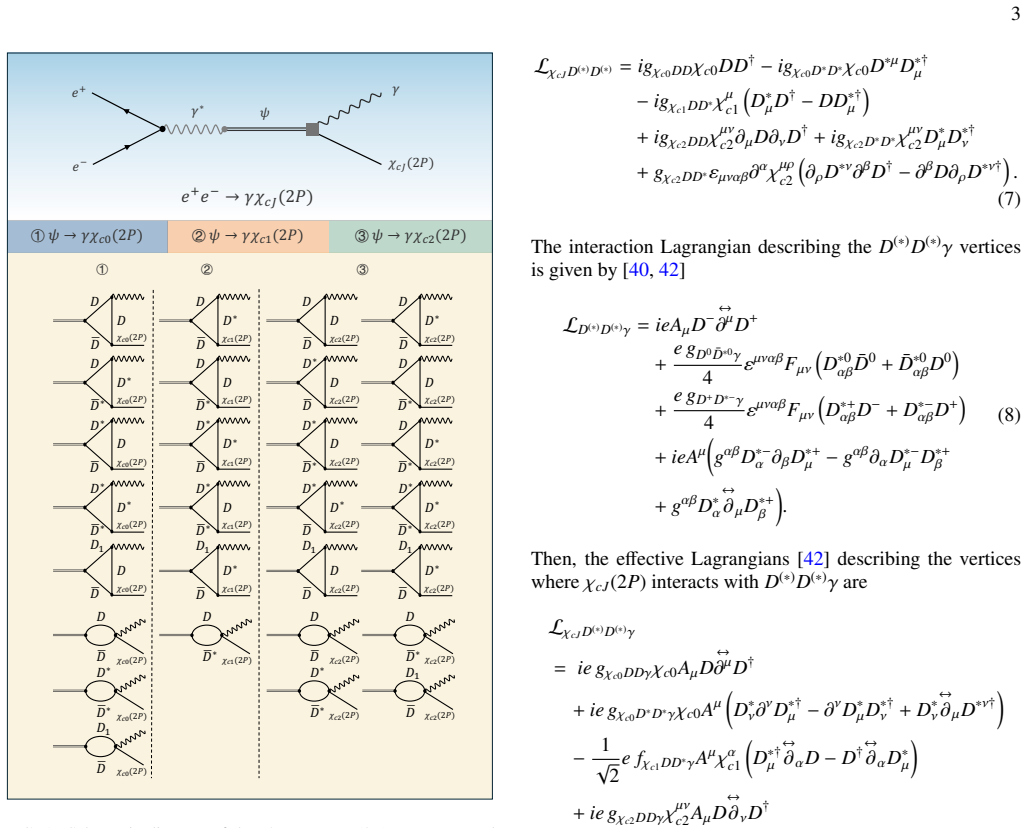
The central object is the hadronic-loop amplitude for $\psi(4230)\to \gamma \chi_{cJ}(2P)$: triangle diagrams with virtual $D$, $D^*$, and $D_1(2420)$ meson loops plus contact diagrams whose strength is fixed by the Ward-Takahashi identity. A dipole form factor $F(q^2)=\left((m_E^2-\Lambda^2)/(q^2-\Lambda^2)\right)^2$ with $\Lambda=m_E+\alpha\Lambda_{\rm QCD}$ regularises the loops, and the couplings of the $\chi_{cJ}(2P)$ multiplet to charmed mesons share a universal constant $g_p$ that cancels in the width ratios. The result is a prediction that depends only on the cutoff parameter $\alpha\in[3,5]$ and on the $\psi(4230)\to D_1\bar D$ coupling $g_{\psi D_1 D}$.
What would settle it
Measure the $e^+e^-\to\gamma D\bar D$ cross section near $\sqrt{s}=4.23$ GeV and look for a $D\bar D$ invariant-mass enhancement around 3.922 GeV whose photon polar-angle distribution in the $e^+e^-$ center-of-mass frame matches $1+\cos^2\theta$ (for $\chi_{c0}$) or the nearly flat shape with $\beta_2\approx 0.11$ (for $\chi_{c2}$); absence of such an enhancement would falsify the prediction. A separate decisive check is a precise measurement of $\psi(4230)\to\pi^+ D^{*-}D^0$, which fixes $g_{\psi D_1 D}$ and determines whether the claimed cross sections survive.
Extended reading notes
Core claim
Treating $X(3872)$ as $\chi_{c1}(2P)$, the BESIII data on $e^+e^-\to \gamma X(3872)$ fix the cross section for $e^+e^-\to \psi(4230)\to \gamma \chi_{c1}(2P)$, and the paper's hadronic-loop calculation yields the quoted width ratios $\Gamma_{\gamma\chi_{c0}}:\Gamma_{\gamma\chi_{c1}}:\Gamma_{\gamma\chi_{c2}} = (0.07\text{--}0.13):1:(0.47\text{--}0.64)$ for cutoff $\alpha=3\text{--}5$. From these ratios the paper predicts that $\sigma[e^+e^-\to \gamma \chi_{c2}(2P)]$ is slightly below but of the same order as $\sigma[\gamma \chi_{c1}(2P)]$, while $\sigma[\gamma \chi_{c0}(2P)]$ is smaller but still favourably detectable; both are large enough for the next round of BESIII and Belle II data. With $\chi_{c0}(2P)\to D\bar D$ treated as 100\% and $\chi_{c2}(2P)\to D\bar D$ as about 60\%, the process $e^+e^-\to \gamma D\bar D$ should show two overlapping 3.9 GeV structures in the $D\bar D$ mass distribution, and the angular distribution of the photon ($\beta_0=1$ for $\chi_{c0}$ versus $\beta_2\approx 0.11$ for $\chi_{c2}$) offers a kinematic handle to tell them apart.
Load-bearing premise
The size of the predicted cross sections rests on the assumed value $g_{\psi D_1 D}=g_{\rm max}/4\approx 2.55$ GeV$^{-1/2}$ for the $\psi(4230)$ coupling to the $D_1(2420)\bar D$ channel, chosen because $g_{\rm max}$ overestimates the coupling; if the true coupling were closer to $g_{\rm max}$, the ratio $\Gamma_{\gamma\chi_{c2}}:\Gamma_{\gamma\chi_{c1}}$ would shrink from about 0.5 to below 0.05 and the measurable signal would largely disappear.
Editorial extensions
If this is right
- The $e^+e^-\to \gamma D\bar D$ channel would let $\chi_{c0}(2P)$ and $\chi_{c2}(2P)$ be observed simultaneously in one production process at BESIII or Belle II.
- The $D\bar D$ invariant mass spectrum should contain a two-peak structure near 3.9 GeV whose relative size is set by the computed width ratios.
- The photon angular distribution distinguishes $\chi_{c0}(2P)$ and $\chi_{c2}(2P)$ even though their masses are almost equal.
- A $\chi_{c2}(2P)$ signal at the predicted level would corroborate the treatment of $\psi(4230)$ as an unquenched charmonium state and support the hadronic-loop description of its radiative decays.
Reading between the lines
- If the prediction holds, the same scaling method could be applied to other hidden-charm states whose $\gamma X$ production through $\psi(4230)$ is kinematically open and whose branching ratios are known.
- The near-flat photon distribution predicted for $\chi_{c2}$ means a modest number of events may distinguish the two states by fitting the photon polar angle alone, without resolving their sub-MeV mass gap.
- A precise measurement of $\psi(4230)\to \pi^+ D^{*-}D^0$ would pin down the one coupling that currently dominates the uncertainty and would turn the prediction from a range into a sharp number.
Editorial analysis
A structured set of objections, weighed in public.
Referee Report
Summary. The manuscript proposes e+e− → γ D Dbar at √s = 4.23 GeV as a discovery channel for the charmonium 2P states χc0(2P) and χc2(2P). The production is assumed to proceed through ψ(4230) → γχcJ(2P), with the radiative transition computed in a hadronic-loop model that includes D(∗)D(∗) and D1(2420)Dbar loops plus gauge-invariant contact terms. Using the measured BESIII cross section for e+e− → γX(3872) as a reference and identifying X(3872) with χc1(2P), the authors derive cross sections for e+e− → γχc0(2P) and e+e− → γχc2(2P), then predict the D Dbar invariant mass spectrum of e+e− → γD Dbar and the photon angular distribution for the two states. The central quantitative outputs are the partial-width ratios in Eq. (28), the scaled cross sections in Fig. 2(b), the invariant-mass spectra in Fig. 3, and the angular parameter β2 in Table III.
Significance. If the predictions are robust, the paper gives a concrete, testable production mechanism for two poorly established charmonium states and provides phenomenological guidance for BESIII and Belle II. The hadronic-loop amplitudes are presented in enough detail to be reproduced, and the contact terms are fixed by the Ward-Takahashi identity rather than fitted, which is a genuine strength. The predicted β0 = 1 for ψ → γχc0(2P) is essentially model-independent, and the differential spectra and angular distributions are falsifiable. However, the headline conclusion that e+e− → γD Dbar is an ideal discovery channel is not yet supported with quantified uncertainties, because the predicted χc2(2P) signal is controlled by an unconstrained coupling choice.
major comments (3)
- [§III, Eq. (28) and Table II] The stress-test concern is borne out. The central claim that σ[γχc2(2P)] is measurable rests on the ratio Γγχc2/Γγχc1, and the quoted range 0.47–0.64 in Eq. (28) is obtained only for gψD1D = gmax/4. Table II shows that at gψD1D = gmax/2 the ratio is 0.118–0.168 and at gψD1D = gmax it is 0.029–0.042, i.e. a drop by more than an order of magnitude at the upper end of the plausible interval. Since σ[γχc2(2P)] is obtained in Fig. 2(b) by multiplying the BESIII-extracted σ[γχc1(2P)] by exactly this ratio (Eq. (2)), the predicted χc2 signal—and therefore the "ideal process" conclusion in the abstract—is not robust to the choice of gψD1D. The authors acknowledge the dependence in the text, but no uncertainty band is propagated into Fig. 2(b), Fig. 3, or the conclusions. This is load-bearing and should be fixed by either constraining gψD1D with a data-driven error estimate or by presenting the cross-section predictions as functions of gψD1D and softening the abstract and conclusions accordingly.
- [§III, Eq. (24)] The derivation of gmax assumes that the measured quantity Rψ(4230) = 2.70 eV is saturated by a single D1(2420)Dbar loop, and the subsequent reduction gψD1D = gmax/4 is introduced as an order-of-magnitude guess to absorb other intermediate channels. The factor 1/4 is not obtained from any fit or independent constraint, and it is the single parameter that most strongly controls the final cross sections. The manuscript should either derive a range for this factor from the coupled-channel results it cites, or explicitly present the central predictions as conditional on gψD1D = gmax/4 rather than as unconditional discovery potentials.
- [§III, Eq. (29) and Fig. 2(b)] The absolute normalization of σ[γχc0(2P)] and σ[γχc2(2P)] is obtained by dividing the measured e+e− → γX(3872) → γπ+π−J/ψ cross section by BR(X(3872) → π+π−J/ψ) = 3.5% and identifying X(3872) with χc1(2P). This introduces an external systematic uncertainty that is not propagated into the figures, and the comparison with data is made "ignoring background contributions" without reporting a fit quality or an uncertainty on the extracted σ[γχc1(2P)]. The absolute scale of the predictions therefore carries an additional unquantified systematic error beyond the α and gψD1D variations. The authors should quote this uncertainty or explicitly state in the conclusions that the absolute cross sections are uncertain at this level.
minor comments (3)
- [§III, Eq. (30)] The notation "dN/Nd cosθ" should be written as dN/(N d cosθ) for clarity.
- [§III, Fig. 2(b)] The caption says "The data points are obtained by dividing the original BESIII experiment data [23] by the branching fraction of X(3872)→π+π−J/ψ," but the curve labeled σ[γX(3872)] appears to be the reference cross section before this division; the relation between the displayed curves and the data should be stated explicitly.
- [§IV] The abstract and concluding paragraph state that e+e− → γD Dbar is an ideal process without repeating the caveat, stated in §III, that a precise determination of gψD1D requires additional experimental measurements; a one-sentence qualification in the conclusions would make the paper internally consistent.
Circularity Check
No significant circularity: predicted σ[γχc0,2(2P)] are measured σ[γX(3872)] rescaled by model-computed partial-width ratios, and the ratios are not fitted to the target e+e−→γD Dbar data.
full rationale
The paper's central derivation is a reference-scaling estimate, not a first-principles prediction that folds its own target data back in. Equation (2) gives σ[γχc0,2]/σ[γχc1] = Γγχc0,2/Γγχc1, a consequence of the common Breit-Wigner production via ψ(4230). The normalization σ[γχc1(2P)] is extracted from the measured BESIII e+e−→γX(3872) cross section (after dividing by BR(X→π+π−J/ψ)), and the width ratios are computed from a hadronic-loop model whose parameters come from prior fits to other channels (e.g., Ref. [8]) and from the measured Rψ(4230) for e+e−→π+D*−D0. No equation in the paper forces the predicted σ[γχc2] to match the e+e−→γD Dbar data; no parameter is fitted to the target process. The paper itself flags the main weakness in Sec. III: 'a precise determination of gψD1D necessitates additional experimental measurements.' Table II confirms that the quoted Γγχc2/Γγχc1 range 0.47–0.64 is tied to the unshown gψD1D=gmax/4 choice, while gmax and gmax/2 give values an order of magnitude smaller; this is a robustness/correctness concern, not circularity, because the ratio remains an independently computed model input rather than a fit to the predicted channel. Self-citations (Refs. [8,14,15,34,42,46,52]) supply input couplings, hadronic-loop machinery, and the χcJ(2P) identifications, but these are anchored to external experimental data and are not used as an unverified uniqueness proof. The cross-section claim is therefore self-contained and falsifiable by future BESIII/Belle II measurements, so no circular step meets the evidentiary bar.
Assumptions & free parameters
free parameters (5)
- Cutoff parameter alpha in dipole form factor =
3 to 5 (chosen range)
- psi(4230)-D1-D coupling g_psiD1D =
gmax/4 = 2.55 GeV^-1/2
- Branching fraction BR(X(3872)->pi+pi-J/psi) =
3.5% (PDG input)
- Branching fraction BR(chi_c0(2P)->D Dbar) =
100% (assumed)
- Branching fraction BR(chi_c2(2P)->D Dbar) =
60% (from Refs. [10,14,15,19,20])
assumptions (6)
- domain assumption X(3872) is identified with the charmonium state chi_c1(2P)
- domain assumption e+e- -> gamma X(3872) is dominated by the psi(4230) intermediate state with negligible background
- domain assumption The hadronic loop mechanism with charmed-meson loops and contact diagrams gives realistic radiative widths psi(4230)->gamma chi_cJ(2P)
- ad hoc to paper The D1(2420) Dbar channel is important and can be included with coupling g_psiD1D estimated from e+e- -> pi+ D*0 D-
- domain assumption The PDG values for psi(4230) mass, width, and leptonic width, and the branching fractions used for X, chi_c0, and chi_c2 are correct
- domain assumption Gauge invariance is fully restored by the contact amplitudes determined through the Ward-Takahashi identity
Cite this review
Pith. "Pith review of Discovery potential of charmonium $2P$ states through the $e^+e^- \to \gamma D\bar{D}$ processes." pith.science (2026). https://pith.science/paper/VEO33GOV
@misc{pith2026241206400,
  author       = {Pith},
  title        = {Pith review of: Discovery potential of charmonium $2P$ states through the $e^+e^- \to \gamma D\barD$ processes},
  year         = {2026},
  howpublished = {\url{https://pith.science/paper/VEO33GOV}},
  note         = {Machine review of arXiv:2412.06400}
}
abstract
In this work, we investigate the production of charmonium $2P$ states via the $e^+e^-\to \gamma D\bar{D}$ process at $\sqrt{s} = 4.23$ GeV. Using the measured cross-section data for $e^+e^-\to \gamma X(3872)$ as a reference, we calculate the cross sections for $e^+e^-\to \gamma \chi_{c0}(2P)$ and $e^+e^-\to \gamma \chi_{c2}(2P)$. Since the $\chi_{c0}(2P)$ and $\chi_{c2}(2P)$ states predominantly decay into $D\bar{D}$ final states, we also predict the corresponding $D\bar{D}$ invariant mass spectrum for the $e^+e^-\to \gamma D\bar{D}$ process. Our results indicate that $e^+e^-\to \gamma D\bar{D}$ is an ideal process for identifying the $\chi_{c0}(2P)$ and $\chi_{c2}(2P)$ states, analogous to the $\gamma\gamma\to D\bar{D}$ and $B^+\to D^+D^-K^+$ processes. This study highlights the discovery potential of charmonium $2P$ states at BESIII and Belle II.
Figures


Forward citations
Cited by 2 Pith papers
-
Medium modifications of $1P$-wave charmonia $\chi_{cJ}(1P)$ in cold nuclear matter
χcJ(1P) masses drop by 34–97 MeV in nuclear matter in the QMC+unquenched-loop model, with the D*D̄* loop dominating χc2 and no D-D̄ threshold crossing below 3ρ0.
-
Unquenched Charmonium and Beyond
This Lanzhou-group review argues that coupled-channel (unquenched) effects, not exotic constituents, are the common thread explaining charmonium anomalies from the rho-pi puzzle to the Y-problem states.
Reference graph
Works this paper leans on
-
[1]
are introduced to account for the o ff-shell effects of the exchanged charmed mesons and to regulate the ultraviolet (UV) divergences in the loop integrals. For F (q2), we adopt the dipole form factor F (q2) = m2 E− Λ2 q2− Λ2 2 , (5) where mE and q represent the mass and four-momentum of the exchanged charmed mesons, respectively. The cut-of...
work page 2010
-
[2]
S. K. Choi et al. (Belle), Observation of a narrow charmonium- like state in exclusive B± → K±π+π− J/ψ decays, Phys. Rev. Lett. 91, 262001 (2003), arXiv:hep-ex/0309032
arXiv 2003
- [3]
- [4]
-
[5]
H. Hogaasen, J. M. Richard, and P. Sorba, A Chromomagnetic mechanism for the X(3872) resonance, Phys. Rev. D73, 054013 (2006), arXiv:hep-ph/0511039
arXiv 2006
- [6]
-
[7]
Wong, Molecular states of heavy quark mesons, Phys
C.-Y . Wong, Molecular states of heavy quark mesons, Phys. Rev. C 69, 055202 (2004), arXiv:hep-ph/0311088
arXiv 2004
-
[8]
M. T. AlFiky, F. Gabbiani, and A. A. Petrov,X(3872): Hadronic molecules in e ffective field theory, Phys. Lett. B 640, 238 (2006), arXiv:hep-ph/0506141
arXiv 2006
Show all 53 references
-
[9]
Wang, D.-Y
J.-Z. Wang, D.-Y . Chen, X. Liu, and T. Matsuki, Constructing J/ψ family with updated data of charmoniumlikeY states, Phys. Rev. D 99, 114003 (2019), arXiv:1903.07115 [hep-ph]
2019 arXiv
-
[10]
Uehara et al
S. Uehara et al. (Belle), Observation of aχ′ c2 candidate inγγ→ D ¯D production at BELLE, Phys. Rev. Lett. 96, 082003 (2006), arXiv:hep-ex/0512035
2006 arXiv
-
[11]
Liu, Z.-G
X. Liu, Z.-G. Luo, and Z.-F. Sun, X(3915) and X(4350) as new members in P-wave charmonium family, Phys. Rev. Lett. 104, 122001 (2010), arXiv:0911.3694 [hep-ph]
2010 arXiv
-
[12]
Beringer et al
J. Beringer et al. (Particle Data Group), Review of Particle Physics (RPP), Phys. Rev. D 86, 010001 (2012)
2012
-
[13]
Guo and U.-G
F.-K. Guo and U.-G. Meissner, Where is the χc0(2P)?, Phys. Rev. D 86, 091501 (2012), arXiv:1208.1134 [hep-ph]
2012 arXiv
-
[14]
S. L. Olsen, Is the X(3915) the χc0(2P)?, Phys. Rev. D 91, 057501 (2015), arXiv:1410.6534 [hep-ex]
2015 arXiv
-
[15]
D.-Y . Chen, J. He, X. Liu, and T. Matsuki, Does the enhance- ment observed in γγ→ D ¯D contain two P-wave higher char- monia?, Eur. Phys. J. C72, 2226 (2012), arXiv:1207.3561 [hep- ph]
2012 arXiv
-
[16]
Duan, S.-Q
M.-X. Duan, S.-Q. Luo, X. Liu, and T. Matsuki, Possibility of charmoniumlike state X(3915) as χc0(2P) state, Phys. Rev. D 101, 054029 (2020), arXiv:2002.03311 [hep-ph]
2020 arXiv
-
[17]
Aaij et al
R. Aaij et al. (LHCb), Amplitude analysis of the B+ → D+D−K+ decay, Phys. Rev. D 102, 112003 (2020), arXiv:2009.00026 [hep-ex]
2020
-
[18]
Aaij et al
R. Aaij et al. (LHCb), A model-independent study of reso- nant structure in B+→ D+D−K+ decays, Phys. Rev. Lett. 125, 242001 (2020), arXiv:2009.00025 [hep-ex]
2020
-
[19]
Uehara et al
S. Uehara et al. (Belle), Observation of a charmonium-like en- hancement in the γγ → ωJ/ψ process, Phys. Rev. Lett. 104, 092001 (2010), arXiv:0912.4451 [hep-ex]
2010 arXiv
-
[20]
D.-Y . Chen, X. Liu, and T. Matsuki, Hidden-charm decays of X(3915) and Z(3930) as the P-wave charmonia, PTEP 2015, 043B05 (2015), arXiv:1311.6274 [hep-ph]
2015 arXiv
-
[21]
Duan, J.-Z
M.-X. Duan, J.-Z. Wang, Y .-S. Li, and X. Liu, Role of the newly measured B→ KD ¯D process to establish χc0(2P) state, Phys. Rev. D 104, 034035 (2021), arXiv:2104.09132 [hep-ph]
2021 arXiv
-
[22]
Ji, X.-K
T. Ji, X.-K. Dong, M. Albaladejo, M.-L. Du, F.-K. Guo, J. Nieves, and B.-S. Zou, Understanding the 0 ++ and 2 ++ charmonium(-like) states near 3.9 GeV, Sci. Bull. 68, 688 (2023), arXiv:2212.00631 [hep-ph]
2023 arXiv
-
[23]
Ablikim et al
M. Ablikim et al. (BESIII), Observation ofe+e−→γX(3872) at BESIII, Phys. Rev. Lett. 112, 092001 (2014), arXiv:1310.4101 [hep-ex]
2014 arXiv
-
[24]
Ablikim et al
M. Ablikim et al. (BESIII), Study of e+e−→ γωJ/ψ and Ob- servation of X(3872)→ ωJ/ψ, Phys. Rev. Lett. 122, 232002 (2019), arXiv:1903.04695 [hep-ex]
2019 arXiv
-
[25]
He, D.-Y
L.-P. He, D.-Y . Chen, X. Liu, and T. Matsuki, Prediction of a missing higher charmonium around 4.26 GeV in J/ψ family, Eur. Phys. J. C 74, 3208 (2014), arXiv:1405.3831 [hep-ph]
2014 arXiv
-
[26]
Li and K.-T
B.-Q. Li and K.-T. Chao, Higher Charmonia and X, Y, Z states with Screened Potential, Phys. Rev. D79, 094004 (2009), arXiv:0903.5506 [hep-ph]
2009 arXiv
-
[27]
D.-Y . Chen, X. Liu, and T. Matsuki, Interference effect as reso- nance killer of newly observed charmoniumlike states Y(4320) and Y(4390), Eur. Phys. J. C 78, 136 (2018), arXiv:1708.01954 [hep-ph]
2018 arXiv
-
[28]
F.-K. Guo, C. Hanhart, U.-G. Meißner, Q. Wang, and Q. Zhao, Production of the X(3872) in charmonia radiative decays, Phys. Lett. B 725, 127 (2013), arXiv:1306.3096 [hep-ph]
2013 arXiv
-
[29]
Ding, Are Y(4260) and Z+ 2 (4250) are D1D or D0D∗ Hadronic Molecules?, Phys
G.-J. Ding, Are Y(4260) and Z+ 2 (4250) are D1D or D0D∗ Hadronic Molecules?, Phys. Rev. D 79, 014001 (2009), arXiv:0809.4818 [hep-ph]
2009 arXiv
-
[30]
Li, W.-L
M.-T. Li, W.-L. Wang, Y .-B. Dong, and Z.-Y . Zhang, A Study of P-wave Heavy Meson Interactions in A Chiral Quark Model, (2013), arXiv:1303.4140 [nucl-th]
2013 arXiv
-
[31]
Q. Wang, C. Hanhart, and Q. Zhao, Decoding the riddle of Y(4260) and Zc(3900), Phys. Rev. Lett. 111, 132003 (2013), arXiv:1303.6355 [hep-ph]
2013 arXiv
-
[32]
Ablikim et al
M. Ablikim et al. (BESIII), Precise measurement of the e+e− → π+π− J/ψ cross section at center-of-mass energies from 3.77 to 4.60 GeV, Phys. Rev. Lett. 118, 092001 (2017), arXiv:1611.01317 [hep-ex]
2017 arXiv
-
[33]
Wang, R.-Q
J.-Z. Wang, R.-Q. Qian, X. Liu, and T. Matsuki, Are the Y states around 4.6 GeV from e+e− annihilation higher charmo- nia?, Phys. Rev. D101, 034001 (2020), arXiv:2001.00175 [hep- ph]
2020 arXiv
-
[34]
Y . Lu, M. N. Anwar, and B.-S. Zou, X(4260) Revisited: A Coupled Channel Perspective, Phys. Rev. D96, 114022 (2017), arXiv:1705.00449 [hep-ph]
2017 arXiv
-
[35]
Man, S.-Q
Z.-L. Man, S.-Q. Luo, Z.-Y . Bai, and X. Liu, Unraveling char- monium mixing scheme for the ψ(4220) and ψ(4380) by a coupled-channel approach, (2025), arXiv:2502.08072 [hep- ph]
2025 arXiv
-
[36]
Ablikim et al
M. Ablikim et al. (BES), Precise measurement of spin-averaged χcJ(1P) mass using photon conversions inψ(2S )→γχcJ, Phys. Rev. D 71, 092002 (2005), arXiv:hep-ex/0502031
2005 arXiv
-
[37]
Artuso et al
M. Artuso et al. (CLEO), Photon transitions in Υ(2S ) and Υ(3S ) decays, Phys. Rev. Lett. 94, 032001 (2005), arXiv:hep- ex/0411068
2005
-
[38]
Liu, X.-Q
X. Liu, X.-Q. Zeng, and X.-Q. Li, Study on contribu- tions of hadronic loops to decays of J/ψ → vector + pseudoscalar mesons, Phys. Rev. D 74, 074003 (2006), arXiv:hep-ph/0606191
2006 arXiv
-
[39]
X. Liu, B. Zhang, and X.-Q. Li, The puzzle of exces- sive non- D ¯D component of the inclusive ψ(3770) decay and the long-distant contribution, Phys. Lett. B 675, 441 (2009), arXiv:0902.0480 [hep-ph]
2009 arXiv
-
[40]
Zhang, G
Y .-J. Zhang, G. Li, and Q. Zhao, Towards a dynamical under- standing of the non-D ¯D decay ofψ(3770), Phys. Rev. Lett.102, 172001 (2009), arXiv:0902.1300 [hep-ph]. 10
2009 arXiv
-
[41]
D.-Y . Chen, X. Liu, and T. Matsuki, Anomalous radiative tran- sitions between hb(nP) and ηb(mS ) and hadronic loop e ffect, Phys. Rev. D 87, 094010 (2013), arXiv:1304.0372 [hep-ph]
2013 arXiv
-
[42]
Cheng, C.-K
H.-Y . Cheng, C.-K. Chua, and A. Soni, Final state interac- tions in hadronic B decays, Phys. Rev. D 71, 014030 (2005), arXiv:hep-ph/0409317
2005 arXiv
-
[43]
Duan, Role of the short-distance interaction in e+e−→ γX(3872), Phys
M.-X. Duan, Role of the short-distance interaction in e+e−→ γX(3872), Phys. Rev. D110, 034027 (2024), arXiv:2403.06440 [hep-ph]
2024 arXiv
-
[44]
Casalbuoni, A
R. Casalbuoni, A. Deandrea, N. Di Bartolomeo, R. Gatto, F. Feruglio, and G. Nardulli, Phenomenology of heavy meson chiral Lagrangians, Phys. Rept. 281, 145 (1997), arXiv:hep- ph/9605342
1997
-
[45]
Colangelo, F
P. Colangelo, F. De Fazio, and T. N. Pham, Nonfactorizable contributions in B decays to charmonium: The Case of B−→ K−hc, Phys. Rev. D 69, 054023 (2004), arXiv:hep-ph/0310084
2004 arXiv
-
[46]
H. Xu, X. Liu, and T. Matsuki, Understanding B− → X(3823)K− via rescattering mechanism and predicting B− → ηc2(1D2)/ψ3(3D3)K−, Phys. Rev. D 94, 034005 (2016), arXiv:1605.04776 [hep-ph]
2016 arXiv
-
[47]
Wang and X
J.-Z. Wang and X. Liu, Identifying a characterized energy level structure of higher charmonium well matched to the peak struc- tures in e+e−→ π+D0D∗−, Phys. Lett. B 849, 138456 (2024), arXiv:2306.14695 [hep-ph]
2024 arXiv
-
[48]
Ablikim et al
M. Ablikim et al. (BESIII), Evidence of a resonant structure in the e+e− → π+D0D∗− cross section between 4.05 and 4.60 GeV, Phys. Rev. Lett. 122, 102002 (2019), arXiv:1808.02847 [hep-ex]
2019 arXiv
-
[49]
Liu, X.-Z
M.-Z. Liu, X.-Z. Ling, and L.-S. Geng, Productions of X(3872) /Zc(3900) and X2(4013) /Zc(4020) in Y(4220) and Y(4360) decays, Phys. Rev. D 110, 054035 (2024), arXiv:2404.07681 [hep-ph]
2024 arXiv
-
[50]
R. L. Workman et al. (Particle Data Group), Review of Particle Physics, PTEP 2022, 083C01 (2022)
2022
-
[51]
Chen, Y .-B
D.-Y . Chen, Y .-B. Dong, and X. Liu, Long-distant contribution andχc1 radiative decays to light vector meson, Eur. Phys. J. C 70, 177 (2010), arXiv:1005.0066 [hep-ph]
2010 arXiv
-
[52]
Godfrey and K
S. Godfrey and K. Moats, Properties of Excited Charm and Charm-Strange Mesons, Phys. Rev. D 93, 034035 (2016), arXiv:1510.08305 [hep-ph]
2016 arXiv
-
[53]
Li, Z.-Y
Y .-S. Li, Z.-Y . Bai, Q. Huang, and X. Liu, Hidden-bottom hadronic decays of Υ(10753) with a η(′) or ω emission, Phys. Rev. D 104, 034036 (2021), arXiv:2106.14123 [hep-ph]
2021 arXiv
Reviewed August 11, 2026 · model on record in the stance chip above.
Discussion (0). Continue with ORCID to comment.