REVIEW 1 major objections 4 minor 1 cited by
Investigating the underlying structure of vector hidden-charm tetraquark states via their electromagnetic characteristics
T0 review · 1 major / 4 minor · reviewed 2026-08-11 · deepseek-v4-flash
Pith's one-line read The paper claims that the magnetic moments of vector hidden-charm tetraquarks depend sharply on the assumed diquark-antidiquark current, and that this spread may reveal multiple states with identical quantum numbers and quark content but…
desk verdict A workmanlike extension of the author's LCSR program with new numerical tables, but the advertised reading of the current spread as evidence for multiple tetraquarks does not survive contact with the method's own single-pole approximation. read the letter →
The pith
A machine-rendered reading of the paper's core claim, the machinery that carries it, and where it could break.
The reading
What carries the argument
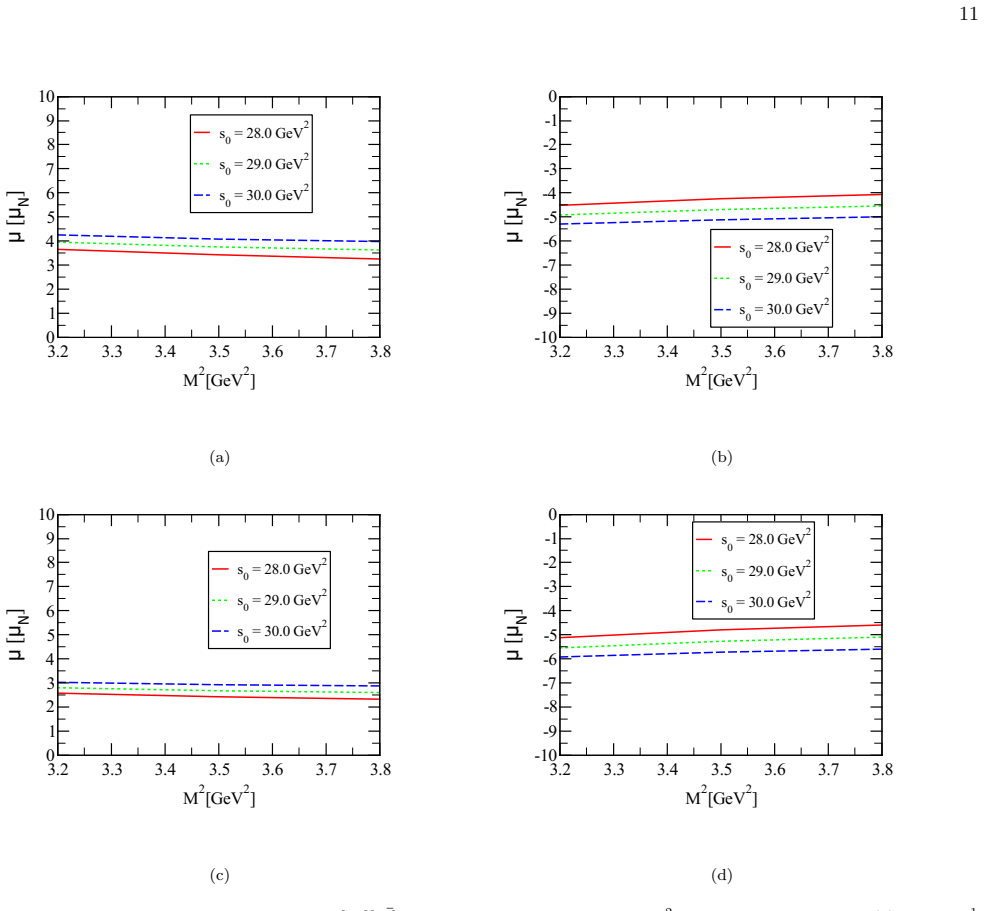
The engine is the two-point correlation function of a vector tetraquark current in an external electromagnetic field, Eq. (1), evaluated once in hadronic degrees of freedom and once in QCD. The four interpolating currents $J^1_\alpha$--$J^4_\alpha$, Eqs. (2)--(5), combine $C\gamma_5$- and $C\gamma_\alpha\gamma_5$-type diquark structures with $C$- and $C\gamma_\alpha$-type antidiquark structures. Matching the coefficient of the Lorentz structure $q_\alpha\varepsilon_\beta - \varepsilon_\alpha q_\beta$ from the hadronic and QCD descriptions gives the sum rule in Eq. (22), in which the magnetic moment enters through the form factor $G_2(0)$ via $\mu = e\,G_2(0)/(2m_{Y_{c\bar c}})$. The Borel parameter $M^2$ and continuum threshold $s_0$ are fixed by pole-dominance and operator-product-expansion convergence criteria, and the masses and residues feeding the hadronic side come from the spectrum calculation cited as Ref. [55].
What would settle it
A lattice QCD calculation of the magnetic form factor at zero momentum transfer for the lowest vector hidden-charm tetraquark states, or a measurement of the radiative transition moments of the $Y(4220/4260)$, $Y(4360/4390)$, and $Y(4630/4660)$ resonances in electron-positron collisions, would check whether any observed moment matches one of the four current predictions; a sum-rule variant keeping two poles instead of one would test whether the spread disappears once near-degenerate states are separated.
Extended reading notes
Core claim
The paper claims that the magnetic moment of a vector hidden-charm tetraquark is a sharp probe of its internal diquark-antidiquark organization. Using QCD light-cone sum rules, it evaluates four interpolating currents, $J^1_\alpha$ through $J^4_\alpha$, that have identical quantum numbers and the same quark content for each of the $[uc][\bar c\bar d]$, $[uc][\bar c\bar s]$, $[dc][\bar c\bar s]$, and $[sc][\bar c\bar s]$ systems. For the same quark content the extracted moments differ dramatically across currents: for $[uc][\bar c\bar d]$ they run from $3.75\pm 0.50\,\mu_N$ (current $J^1_\alpha$) to $-5.26\pm 0.67\,\mu_N$ (current $J^4_\alpha$), and the paper reads this spread as evidence that more than one physical vector hidden-charm tetraquark can share quark content and quantum numbers while differing in electromagnetic character. Light quarks dominate the moments, contributing roughly 53--77\% of the total, while the charm quark contributes about 23--47\%. As a byproduct, the extracted quadrupole moments are nonzero, indicating non-spherical charge distributions, with most states found to be oblate; the deviations from U-spin symmetry reach about 20\%.
Load-bearing premise
The calculation assumes that for each interpolating current a single tetraquark state dominates the sum rule, with its mass and residue taken from a separate spectrum calculation; if several nearly degenerate states overlap the same current, the extracted magnetic moment is a mixture of their moments rather than a property of one state.
Editorial extensions
If this is right
- A measured magnetic moment for a candidate vector hidden-charm tetraquark would select among the four predicted current structures, because for a given quark content the predictions differ in both sign and magnitude.
- Future electron-positron searches for the $Y(4220/4260)$, $Y(4360/4390)$, and $Y(4630/4660)$ states can use the predicted radiative-transition moments as a checklist for identifying which diquark-antidiquark arrangement is realized.
- Nonzero quadrupole moments for every state imply the charge distribution is not spherical; the negative signs found for most currents indicate oblate shapes, a geometric prediction that could be compared with lattice calculations.
- The dominance of light-quark contributions and the roughly 20\% U-spin violation mean the moments are sensitive to strangeness content and to the choice of quark condensates, providing cross-checks on QCD input parameters.
Reading between the lines
- The paper leaves implicit that these predictions turn the magnetic moment into a search tool: experiments should look for several narrow resonances with nearly equal masses but different radiative widths in the same invariant-mass region.
- If a lattice calculation instead finds one magnetic moment that matches none of the four current predictions, the single-pole assumption would be the first suspect, and the spread would be an artifact of overlapping states rather than evidence for multiple tetraquarks.
- The same four-current test could be carried out for axial-vector and scalar hidden-charm tetraquarks, and for bottom analogues, to see whether current sensitivity is a general feature of tetraquark sum rules.
- Including the near-degenerate states from Ref. [55] explicitly in a two-pole sum rule would show whether the four moments converge to one value, directly testing the paper's physical interpretation.
Editorial analysis
A structured set of objections, weighed in public.
Referee Report
Summary. The paper uses QCD light-cone sum rules to compute magnetic moments of vector hidden-charm tetraquark states in a diquark-antidiquark picture, considering four interpolating currents (J1–J4) for each of four quark-content configurations. The central numerical result is a large spread in the magnetic moments across the four currents for the same quark content, for example from +3.75 to -5.26 mu_N for [uc][cbar dbar]. The author interprets this spread as a possible indication of more than one tetraquark state with identical quantum numbers and similar quark content but different electromagnetic characteristics. The paper also reports quadrupole moments and individual quark contributions.
Significance. If the current-dependence of the computed moments truly reflected distinct physical states, the magnetic moment would become a powerful structural discriminator for exotic hadrons. The manuscript provides a complete LCSR calculation with standard inputs, explicit sum rules, pole dominance and OPE convergence checks, and a reasonably careful error treatment; the numerical tables (Tables II–IV) are a potentially useful reference set for future comparisons. However, the advertised interpretation of the spread as evidence for multiple tetraquark states is not established by the analysis as presented, and the paper's own caveat at the end of Section III acknowledges the core ambiguity. The value of the paper therefore lies mainly in the raw moment predictions, not in the multistate conclusion.
major comments (1)
- [Section III, Eqs. (22)–(23); parameter inputs] The use of mass and residue from Ref. [55] for all four currents is not justified. The left-hand sides of Eqs. (22)–(23) contain m_Y^{J_i} and lambda_Y^{J_i}, indicating that the mass and residue should correspond to the current used in the correlation function. Ref. [55] extracts these quantities with a specific interpolating current (or set of currents), and the present paper does not state which current(s) of Ref. [55] were used for each of J1–J4. If the same m_Y and lambda_Y are inserted for all currents, the resulting mu values are inconsistent because the overlap factor lambda_Y is current-dependent. The author should either specify current-specific mass and residue values, or verify that the final magnetic moments are insensitive to this choice, and propagate any associated uncertainty into the errors in Table III.
minor comments (4)
- [Table II, Eq. (29)] The CVG column reports '≪ 1' rather than a numerical value. Since the criterion in Eq. (29) is a 5% threshold, the actual ratio (or a statement that it is below, say, 1%) should be provided for each row.
- [Section III, Table III] The quadrupole moments (D) are presented as a numerical result, but the manuscript does not provide the formula or derivation by which D is extracted from the correlation function. A brief derivation or a reference to the explicit expression is needed for reproducibility.
- [References] The reference list is heavily dominated by the author's own publications (roughly one-third of the entries). While self-citation is common in this subfield, it would be helpful to cite independent calculations of tetraquark electromagnetic properties to place the results in a broader context.
- [Throughout] The manuscript contains numerous run-on and verbose sentences, particularly in the bullet list in Section III (e.g., 'the selection of distinct interpolating currents... may consequently lead to disparate magnetic moments'). A careful language edit is recommended.
Circularity Check
No significant circularity: the magnetic moments are computed from external QCD parameters and prior mass/residue inputs, not fitted to the target moments.
full rationale
The derivation chain is self-contained in the relevant sense. The sum rules in Eqs. (22)-(23) express each magnetic moment through the OPE function rho_i(M^2,s0) and the external mass and residue of the state; the paper states 'The mass and residue values for these states are essential for further analysis and have been taken from the Ref. [55]', and the QCD and photon parameters are taken from Refs. [49,51-54]. No moment from Table III is used as an input, and no parameter is fitted to reproduce the quoted moments, so there is no fitted-input-called-prediction step. The four interpolating currents (2)-(5) are an explicit ansatz ('we posit'), not an output of the calculation, so using them to compute current-dependent moments is not circular. The final interpretation that the current-to-current spread 'could be interpreted as an indication of the existence of more than one vector hidden-charm tetraquark states' is a hedged conjecture ('may be interpreted', 'plausible', 'it cannot be ruled out'), and the single-pole truncation in Eq. (6) is a limitation that weakens that inference, but an under-supported or speculative interpretation is a correctness risk, not a circular reduction. Self-citations (Refs. [18,22,30,56-58]) are parallel applications of the same method and are not load-bearing premises for the numerical result. Accordingly, no circular step can be exhibited and the circularity score is 0.
Assumptions & free parameters
free parameters (9)
- Borel mass M^2 =
3.2-4.1 GeV^2 (per channel)
- Continuum threshold s0 =
28.0-32.0 GeV^2
- Tetraquark mass m_Y =
taken from Ref [55] (values not quoted in text)
- Pole residue lambda_Y =
taken from Ref [55]
- Magnetic susceptibility chi =
-2.85 +/- 0.5 GeV^-2
- f3gamma =
-0.0039 GeV^2
- Gluon condensate =
0.48 +/- 0.14 GeV^4
- Light quark condensates and m0^2 =
(-0.24 GeV)^3, 0.8 <ss>, m0^2 = 0.8 GeV^2
- Photon distribution amplitude parameters =
from Ref [49] (e.g., phi_gamma, psi_v, psi_a, h_gamma)
assumptions (6)
- domain assumption Quark-hadron duality: the hadronic spectral density above s0 cancels against the QCD side.
- domain assumption The four interpolating currents J1-J4, having identical quantum numbers, couple to the same tetraquark states.
- ad hoc to paper The physical states are compact diquark-antidiquark configurations with only the C gamma5-gamma5 gamma-alpha C and C-gamma-alpha C diquark types.
- domain assumption Photon distribution amplitudes from Ref [49] describe the long-distance photon-quark interaction.
- domain assumption Masses and residues from Ref [55] correspond to the states whose moments are extracted.
- domain assumption Light quark masses m_u and m_d are set to zero and m_s^2 is dropped, keeping only linear m_s terms.
Cite this review
Pith. "Pith review of Investigating the underlying structure of vector hidden-charm tetraquark states via their electromagnetic characteristics." pith.science (2026). https://pith.science/paper/7ILVITWR
@misc{pith2026241206447,
  author       = {Pith},
  title        = {Pith review of: Investigating the underlying structure of vector hidden-charm tetraquark states via their electromagnetic characteristics},
  year         = {2026},
  howpublished = {\url{https://pith.science/paper/7ILVITWR}},
  note         = {Machine review of arXiv:2412.06447}
}
read the original abstract
Accessing a full picture of the internal structure of hadrons would be a key topic of hadron physics, with the main motivation to study the strong interaction binding the visible matter. Furthermore, the underlying structure of known exotic states remains an unresolved fundamental issue in hadron physics, which is currently being addressed by hadron physics community. It is well known that electromagnetic characteristics can serve as a distinguishing feature for states whose internal structures are complex and not yet fully understood. The aim of this study is to determine the magnetic moments of vector hidden-charm tetraquark states by making use of QCD light-cone sum rules. In order to achieve this objective, the states mentioned above are considered in terms of the diquark-antidiquark structure. Subsequently, a comprehensive examination is conducted, with four distinct interpolating currents being given particular consideration, as these have the potential to couple with the aforementioned states. It has been observed that there are considerable discrepancies between the magnetic moment results extracted employing different diquark-antidiquark structures. Such a prediction may be interpreted as the possibility of more than one tetraquark with the identical quantum numbers and similar quark constituents, but with different magnetic moments. The numerical predictions yielded have led to the conclusion that the magnetic moments of the vector hidden-charm tetraquark states are capable of projecting the inner structure of these states, which may then be used to determine their quark-gluon structure and quantum numbers. In order to provide a comprehensive analysis, the individual quark contributions to the magnetic moments are also examined.
Figures


Figures from the paper (3 more)


Forward citations
Cited by 1 Pith paper
-
Charting doubly strange hidden-charm pentaquarks: An electromagnetic mapping of spin-$\frac{1}{2}$ and $\frac{3}{2}$ states
LCSR calculations of magnetic, quadrupole and octupole moments for S=-2 hidden-charm pentaquarks yield large current-dependent ranges (-4.25 to 5.74 μ_N) dominated by the charm quark in most diquark configurations.
Reference graph
Works this paper leans on
-
[55]
R. L. Workman, et al., Review of Particle Physics, PTEP 2022 (2022) 083C01. doi:10.1093/ptep/ptac097
-
[1]
Hadronic Description To derive the hadronic description of the correlation function, we insert a complete set of intermediate vector hidden-charm tetraquark states with the same quantum numbers as the interpolating currents into the correlation function and then perform the integral over x. The resulting expression is as follows: ΠHad αβ (p,q ) =⟨0|Jα(x)|...
-
[2]
QCD Description In the context of the QCD description of the correlation function, the relevant interpolating currents for the identified vector hidden-charm tetraquark states are embedded within the correlation function expressed in Eq. (1). Subsequently, Wick’s theorem is employed to execute all pertinent contractions and derive the relevant expressions...
-
[3]
QCD light-cone sum rules for magnetic moments In conclusion, by matching the corresponding coefficients of the distinctive Lorentz structure (qαεβ−εαqβ) from the QCD and hadronic descriptions, we obtain the QCD light-cone sum rules, which allow us to determine the responsible 5 magnetic moments in terms of QCD and hadronic parameters, as well as auxiliary...
-
[4]
S. K. Choi, et al., Observation of a narrow charmonium- like state in exclusiveB±→K ±π+π−J/ψ decays, Phys. Rev. Lett. 91 (2003) 262001. arXiv:hep-ex/0309032, doi:10.1103/PhysRevLett.91.262001
arXiv 2003
-
[5]
A. Esposito, A. L. Guerrieri, F. Piccinini, A. Pilloni, A. D. Polosa, Four-Quark Hadrons: an Updated Re- view, Int. J. Mod. Phys. A 30 (2015) 1530002.arXiv: 1411.5997, doi:10.1142/S0217751X15300021
arXiv 2015
-
[6]
A. Esposito, A. Pilloni, A. D. Polosa, Multiquark Reso- nances, Phys. Rept. 668 (2017) 1–97.arXiv:1611.07920, doi:10.1016/j.physrep.2016.11.002
arXiv 2017
-
[7]
S. L. Olsen, T. Skwarnicki, D. Zieminska, Nonstandard heavy mesons and baryons: Experimental evidence, Rev. Mod. Phys. 90 (1) (2018) 015003. arXiv:1708.04012, doi:10.1103/RevModPhys.90.015003
arXiv 2018
Show all 62 references
-
[8]
R. F. Lebed, R. E. Mitchell, E. S. Swanson, Heavy-Quark QCD Exotica, Prog. Part. Nucl. Phys. 93 (2017)143–194. arXiv:1610.04528, doi:10.1016/j.ppnp.2016.11.003
2017 arXiv
-
[9]
Nielsen, F
M. Nielsen, F. S. Navarra, S. H. Lee, New Charmo- nium States in QCD Sum Rules: A Concise Review, 10 TABLE IV. The individual quark contributions to the magnetic moments of vector hidden-charm tetraquark states. Currents Tetraquarks µq1 [µN] µc [µN] µq2 [µN] µtot [µN] [uc] [¯c...
2010 arXiv
-
[10]
Brambilla, S
N. Brambilla, S. Eidelman, C. Hanhart, A. Nefediev, C.- P. Shen, C. E. Thomas, A. Vairo, C.-Z. Yuan, TheXYZ states: experimental and theoretical status and perspec- tives, Phys. Rept. 873 (2020) 1–154.arXiv:1907.07583, doi:10.1016/j.physrep.2020.05.001
2020 arXiv
-
[11]
Agaev, K
S. Agaev, K. Azizi, H. Sundu, Four-quark exotic mesons, Turk. J. Phys. 44 (2) (2020) 95–173.arXiv:2004.12079, doi:10.3906/fiz-2003-15
2020 arXiv
-
[12]
H.-X. Chen, W. Chen, X. Liu, S.-L. Zhu, The hidden- charm pentaquark and tetraquark states, Phys. Rept. 639 (2016) 1–121. arXiv:1601.02092, doi:10.1016/j. physrep.2016.05.004
2016 arXiv
-
[13]
A.Ali, J.S.Lange, S.Stone, Exotics: HeavyPentaquarks and Tetraquarks, Prog. Part. Nucl. Phys. 97 (2017) 123–
2017
-
[14]
Dong, F.-K
X.-K. Dong, F.-K. Guo, B.-S. Zou, A survey of heavy- antiheavy hadronic molecules, Progr. Phys. 41 (2021) 65–93. arXiv:2101.01021, doi:10.13725/j.cnki.pip. 2021.02.001
2021 arXiv
-
[15]
F.-K. Guo, C. Hanhart, U.-G. Meißner, Q. Wang, Q. Zhao, B.-S. Zou, Hadronic molecules, Rev. Mod. Phys. 90 (1) (2018) 015004, [Erratum: Rev.Mod.Phys. 94, 029901 (2022)]. arXiv:1705.00141, doi:10.1103/ RevModPhys.90.015004
2018 arXiv
-
[16]
Liu, H.-X
Y.-R. Liu, H.-X. Chen, W. Chen, X. Liu, S.-L. Zhu, Pen- taquark and Tetraquark states, Prog. Part. Nucl. Phys. 107 (2019) 237–320. arXiv:1903.11976, doi:10.1016/ j.ppnp.2019.04.003
2019 arXiv
-
[17]
G. Yang, J. Ping, J. Segovia, Tetra- and penta-quark structures in the constituent quark model, Symmetry 12 (11) (2020) 1869. arXiv:2009.00238, doi:10.3390/ sym12111869
2020 arXiv
-
[18]
Özdem, Magnetic moments of the vector hidden- charm tetraquark states, Phys
U. Özdem, Magnetic moments of the vector hidden- charm tetraquark states, Phys. Rev. D 105 (11) (2022) 114030. arXiv:2206.05196, doi:10.1103/PhysRevD. 105.114030
2022 arXiv
-
[19]
Dong, F.-K
X.-K. Dong, F.-K. Guo, B.-S. Zou, A survey of heavy–heavy hadronic molecules, Commun. Theor. Phys. 73(12)(2021)125201. arXiv:2108.02673, doi:10.1088/ 1572-9494/ac27a2
2021 arXiv
-
[20]
L. Meng, B. Wang, G.-J. Wang, S.-L. Zhu, Chiral per- turbation theory for heavy hadrons and chiral effective field theory for heavy hadronic molecules, Phys. Rept. 1019 (2023) 1–149. arXiv:2204.08716, doi:10.1016/j. physrep.2023.04.003
2023 arXiv
-
[21]
H.-X. Chen, W. Chen, X. Liu, Y.-R. Liu, S.-L. Zhu, An updated review of the new hadron states, Rept. Prog. Phys. 86 (2) (2023) 026201. arXiv:2204.02649, doi: 10.1088/1361-6633/aca3b6
2023 arXiv
-
[22]
Özdem, Unveiling the underlying structure of axial- vector bottom-charm tetraquarks in the light of their magnetic moments, JHEP 05 (2024) 301
U. Özdem, Unveiling the underlying structure of axial- vector bottom-charm tetraquarks in the light of their magnetic moments, JHEP 05 (2024) 301. arXiv:2403. 16191, doi:10.1007/JHEP05(2024)301
2024 doi
-
[23]
V. L. Chernyak, I. R. Zhitnitsky, B meson exclusive de- cays into baryons, Nucl. Phys. B 345 (1990) 137–172. doi:10.1016/0550-3213(90)90612-H
1990 doi
-
[24]
V. M. Braun, I. E. Filyanov, QCD Sum Rules in Exclu- sive Kinematics and Pion Wave Function, Z. Phys. C 44 (1989) 157. doi:10.1007/BF01548594
1989 doi
-
[25]
I. I. Balitsky, V. M. Braun, A. V. Kolesnichenko, Ra- diative Decay Sigma+ —> p gamma in Quantum Chro- modynamics, Nucl. Phys. B 312 (1989) 509–550. doi: 10.1016/0550-3213(89)90570-1
1989 doi
-
[26]
Özdem, Analysis of the Zb(10650) state based on electromagnetic properties, Eur
U. Özdem, Analysis of the Zb(10650) state based on electromagnetic properties, Eur. Phys. J. C 84 (1) (2024) 45. arXiv:2311.11327, doi:10.1140/epjc/ s10052-024-12408-2
2024 arXiv
-
[27]
Özdem, K
U. Özdem, K. Azizi, Electromagnetic properties of vec- tor doubly charmed tetraquark states, Phys. Rev. D 109 (11) (2024) 114019. arXiv:2401.04798, doi:10. 1103/PhysRevD.109.114019
2024 arXiv
-
[28]
Mutuk, Masses and magnetic moments of doubly heavy tetraquarks via diffusion Monte Carlo method, Eur
H. Mutuk, Masses and magnetic moments of doubly heavy tetraquarks via diffusion Monte Carlo method, Eur. Phys. J. C 84 (4) (2024) 395.arXiv:2312.13383, doi:10.1140/epjc/s10052-024-12736-3
2024 arXiv
-
[29]
Wang, S.-Q
F.-L. Wang, S.-Q. Luo, X. Liu, Radiative decays and magnetic moments of the predicted Bc-like molecules, 11 3.2 3.3 3.4 3.5 3.6 3.7 3.8 M 2 [GeV 2 ] 0 1 2 3 4 5 6 7 8 9 10 μ [μΝ] s0 = 28.0 GeV 2 s0 = 29.0 GeV 2 s0 = 30.0 GeV 2 (a) 3.2 3.3 3.4 3.5 3.6 3.7 3.8 M 2 [GeV 2 ] -10 -...
2023 arXiv
-
[30]
Azizi, U
K. Azizi, U. Özdem, Exploring the magnetic dipole mo- ments of TQQqs and TQQss states in the framework of QCD light-cone sum rules, JHEP 03 (2023) 166.arXiv: 2301.07713, doi:10.1007/JHEP03(2023)166
2023 arXiv
-
[31]
Özdem, Magnetic and quadrupole moments of the , , and states in the diquark-antidiquark picture, Chin
U. Özdem, Magnetic and quadrupole moments of the , , and states in the diquark-antidiquark picture, Chin. Phys. C 48 (1) (2024) 013101.arXiv:2307.05028, doi: 10.1088/1674-1137/ad0110
2024 arXiv
-
[32]
Lei, H.-S
Y.-D. Lei, H.-S. Li, Electromagnetic properties of the Tcc+ molecular states, Phys. Rev. D 109 (7) (2024) 076014. arXiv:2312.01332, doi:10.1103/PhysRevD. 109.076014
2024 arXiv
-
[33]
Zhang, H
W.-X. Zhang, H. Xu, D. Jia, Masses and magnetic moments of hadrons with one and two open heavy quarks: Heavy baryons and tetraquarks, Phys. Rev. D 104 (11) (2021) 114011. arXiv:2109.07040, doi: 10.1103/PhysRevD.104.114011
2021 arXiv
-
[34]
Özdem, Magnetic dipole moments of states, Chin
U. Özdem, Magnetic dipole moments of states, Chin. 12 3.3 3.4 3.5 3.6 3.7 3.8 3.9 4 4.1 M 2 [GeV 2 ] 0 1 2 3 4 5 6 7 8 9 10 μ [μΝ] s0 = 29.0 GeV 2 s0 = 30.0 GeV 2 s0 = 31.0 GeV 2 (a) 3.3 3.4 3.5 3.6 3.7 3.8 3.9 4 4.1 M 2 [GeV 2 ] -10 -9 -8 -7 -6 -5 -4 -3 -2 -1 0 μ [μΝ] s0 = 29...
2022 arXiv
-
[35]
Özdem, Electromagnetic form factors of the Bc- like tetraquarks: Molecular and diquark-antidiquark pic- tures, Phys
U. Özdem, Electromagnetic form factors of the Bc- like tetraquarks: Molecular and diquark-antidiquark pic- tures, Phys. Lett. B 838 (2023) 137750. arXiv:2211. 10169, doi:10.1016/j.physletb.2023.137750
2023
-
[36]
Xu, Y.-L
Y.-J. Xu, Y.-L. Liu, M.-Q. Huang, The magnetic moment ofZc(3900)as an axial-vector molecular state, Eur. Phys. J. C 80 (10) (2020) 953. arXiv:2007.15214, doi:10. 1140/epjc/s10052-020-08515-5
2020 arXiv
-
[37]
Wang, The magnetic moment of theZc(3900) as an axialvector tetraquark state with QCD sum rules, Eur
Z.-G. Wang, The magnetic moment of theZc(3900) as an axialvector tetraquark state with QCD sum rules, Eur. Phys. J. C 78 (4) (2018) 297.arXiv:1712.05664, doi: 10.1140/epjc/s10052-018-5794-0
2018 arXiv
-
[38]
Özdem, A
U. Özdem, A. K. Yıldırım, Magnetic dipole moments of the Zc(4020)+, Zc(4200)+, Zcs(4000)+ and Zcs(4220)+ states in light-cone QCD, Phys. Rev. D 104 (5) (2021) 054017. arXiv:2104.13074, doi:10.1103/PhysRevD. 104.054017
2021 arXiv
-
[39]
Y.-H. Wang, J. Wei, C.-S. An, C.-R. Deng,Zcs(4000)+ andZcs(4220)+ in a Multiquark Color Flux-Tube Model, Chin. Phys. Lett. 40 (2) (2023) 021201. doi:10.1088/ 0256-307X/40/2/021201
2023
-
[40]
Özdem, Magnetic moments of the doubly charged axial-vector Tcc++ states, Phys
U. Özdem, Magnetic moments of the doubly charged axial-vector Tcc++ states, Phys. Rev. D 105 (5) (2022) 054019. arXiv:2112.10402, doi:10.1103/PhysRevD. 105.054019
2022 arXiv
-
[41]
Azizi, U
K. Azizi, U. Özdem, Magnetic dipole moments of the Tcc+ and ZV++ tetraquark states, Phys. Rev. D 104 (11) (2021) 114002. arXiv:2109.02390, doi:10. 1103/PhysRevD.104.114002
2021 arXiv
-
[42]
Ozdem, K
U. Ozdem, K. Azizi, Magnetic and quadrupole moments of the Zc(3900), Phys. Rev. D 96 (7) (2017) 074030. arXiv:1707.09612, doi:10.1103/PhysRevD.96.074030
2017 arXiv
-
[43]
Xu, Y.-L
Y.-J. Xu, Y.-L. Liu, C.-Y. Cui, M.-Q. Huang,¯D(∗) s D(∗) molecular state with JP= 1+, Phys. Rev. D 104 (9) (2021) 094028. arXiv:2011.14313, doi:10.1103/ PhysRevD.104.094028
2021 arXiv
-
[44]
Özdem, K
U. Özdem, K. Azizi, Magnetic dipole moment of the Zcs(3985) state: diquark–antidiquark and molecular pic- tures, Eur. Phys. J. Plus 136 (9) (2021) 968. arXiv: 2102.09231, doi:10.1140/epjp/s13360-021-01977-w
2021 arXiv
-
[45]
Ozdem, K
U. Ozdem, K. Azizi, Magnetic dipole moment of Zb(10610) in light-cone QCD, Phys. Rev. D 97 (1) (2018) 014010. arXiv:1709.09714, doi:10.1103/PhysRevD.97. 014010
2018 arXiv
-
[46]
K.-C. Yang, W. Y. P. Hwang, E. M. Henley, L. S. Kisslinger, QCD sum rules and neutron proton mass difference, Phys. Rev. D 47 (1993) 3001–3012. doi: 10.1103/PhysRevD.47.3001
1993 doi
-
[47]
Özdem, Study on the electromagnetic properties of the [sc][¯q¯b] and [sc][¯s¯b] states with JP = 1 + (5 2024)
U. Özdem, Study on the electromagnetic properties of the [sc][¯q¯b] and [sc][¯s¯b] states with JP = 1 + (5 2024). 13 3.3 3.4 3.5 3.6 3.7 3.8 3.9 4 4.1 M 2 [GeV 2 ] 0 1 2 3 4 5 6 7 8 9 10 μ [μΝ] s0 = 29.0 GeV 2 s0 = 30.0 GeV 2 s0 = 31.0 GeV 2 (a) 3.3 3.4 3.5 3.6 3.7 3.8 3.9 4 4...
2024 arXiv
-
[48]
Mutuk, Doubly-charged Tcc++ states in the dy- namical diquark model, Phys
H. Mutuk, Doubly-charged Tcc++ states in the dy- namical diquark model, Phys. Rev. D 110 (3) (2024) 034025. arXiv:2401.02788, doi:10.1103/PhysRevD. 110.034025
2024 arXiv
-
[49]
Özdem, Elucidating the nature of axial-vector charm- antibottom tetraquark states (11 2024)
U. Özdem, Elucidating the nature of axial-vector charm- antibottom tetraquark states (11 2024). arXiv:2411. 15508
2024
-
[50]
Özdem, Electromagnetic properties of doubly heavy pentaquark states, Eur
U. Özdem, Electromagnetic properties of doubly heavy pentaquark states, Eur. Phys. J. Plus 137 (2022) 936. arXiv:2201.00979, doi:10.1140/epjp/ s13360-022-03125-4
2022 arXiv
-
[51]
V. M. Belyaev, B. Y. Blok, CHARMED BARYONS IN QUANTUM CHROMODYNAMICS, Z. Phys. C 30 (1986) 151. doi:10.1007/BF01560689
1986 doi
-
[52]
Li, C.-D
H.-D. Li, C.-D. Lü, C. Wang, Y.-M. Wang, Y.-B. Wei, QCD calculations of radiative heavy meson decays with subleading power corrections, JHEP 04 (2020) 023. arXiv:2002.03825, doi:10.1007/JHEP04(2020)023
2020 arXiv
-
[53]
P. Ball, V. M. Braun, N. Kivel, Photon distribution am- plitudes in QCD, Nucl. Phys. B 649 (2003) 263–296. arXiv:hep-ph/0207307, doi:10.1016/S0550-3213(02) 01017-9
2003 arXiv
-
[54]
Narison,mc,b, <α sG2 > and αs from Heavy Quarko- nia, Nucl
S. Narison,mc,b, <α sG2 > and αs from Heavy Quarko- nia, Nucl. Part. Phys. Proc. 300-302 (2018) 153–164. doi:10.1016/j.nuclphysbps.2018.12.026
2018 doi
-
[56]
B. L. Ioffe, QCD at low energies, Prog. Part. Nucl. Phys. 56 (2006) 232–277. arXiv:hep-ph/0502148, doi: 10.1016/j.ppnp.2005.05.001
2006 arXiv
-
[57]
Rohrwild, Determination of the magnetic susceptibil- ity of the quark condensate using radiative heavy me- son decays, JHEP 09 (2007) 073
J. Rohrwild, Determination of the magnetic susceptibil- ity of the quark condensate using radiative heavy me- son decays, JHEP 09 (2007) 073. arXiv:0708.1405, doi:10.1088/1126-6708/2007/09/073. 14 3.3 3.4 3.5 3.6 3.7 3.8 3.9 4 4.1 M 2 [GeV 2 ] 0 1 2 3 4 5 6 7 8 9 10 μ [μΝ] s0 ...
2007 arXiv
-
[58]
Özdem, Shedding light on the nature of thePcs(4459) pentaquark state (11 2024).arXiv:2411.11442
U. Özdem, Shedding light on the nature of thePcs(4459) pentaquark state (11 2024).arXiv:2411.11442. 15 3.75 -4.68 2.67 -5.26 Jα 1 Jα 2 Jα 3 Jα 4 -6 -4 -2 0 2 4 μ[μ N] (a) 4.52 -5.83 2.68 -5.15 Jα 1 Jα 2 Jα 3 Jα 4 -6 -4 -2 0 2 4 μ[μ N] (b) 4.51 0.42 2.68 0.59 Jα 1 Jα 2 Jα 3 Jα ...
2024 arXiv
-
[59]
Wang, Mass spectrum of the vector hidden charmed and bottomed tetraquark states, J
Z.-G. Wang, Mass spectrum of the vector hidden charmed and bottomed tetraquark states, J. Phys. G 36 (2009) 085002. arXiv:0903.0754, doi:10.1088/ 0954-3899/36/8/085002
2009 arXiv
-
[60]
Özdem, Elucidating the nature of hidden-charm pentaquark states with spin-32 through their elec- tromagnetic form factors, Phys
U. Özdem, Elucidating the nature of hidden-charm pentaquark states with spin-32 through their elec- tromagnetic form factors, Phys. Lett. B 851 (2024) 138551. arXiv:2402.03802, doi:10.1016/j.physletb. 2024.138551
2024 arXiv
-
[61]
Özdem, Magnetic moments of pentaquark states in light-cone sum rules, Eur
U. Özdem, Magnetic moments of pentaquark states in light-cone sum rules, Eur. Phys. J. A 58 (3) (2022) 46. doi:10.1140/epja/s10050-022-00700-2
2022 doi
-
[198]
arXiv:1706.00610, doi:10.1016/j.ppnp.2017.08. 003
2017 arXiv
Reviewed August 11, 2026 · model on record in the stance chip above.
Discussion (0). Continue with ORCID to comment.