REVIEW 3 major objections 4 minor 3 cited by
Tidal effects in gravitational waves from neutron stars in scalar-tensor theories of gravity
T0 review · 3 major / 4 minor · reviewed 2026-08-11 · deepseek-v4-flash
Pith's one-line read This paper claims that in scalar-tensor theories the net tidal contribution to the gravitational-wave phase of a neutron-star inspiral is generally smaller than in general relativity, even though it involves three distinct Love numbers.
desk verdict The derivation is sound but the headline formula (Eq. 83) has a sign error in the GR limit: the Lambda-tilde term should be negative, which makes the paper's central ready-to-use phase unusable until corrected. read the letter →
The pith
A machine-rendered reading of the paper's core claim, the machinery that carries it, and where it could break.
The reading
What carries the argument
The load-bearing structure is a skeletonized two-body action in which each neutron star carries three families of adiabatic, even-parity tidal Love numbers $\lambda_S^\ell$, $\lambda_T^\ell$, and $\lambda_{ST}^\ell$, responding respectively to scalar tides, tensor tides, and the cross-response between the two. These enter through tidal fields built from derivatives of the near-zone scalar and gravitational potentials, produce effective tidal coefficients $\zeta_\ell$, $\bar{\zeta}_\ell$, and $\tilde{\zeta}_\ell$ in the Lagrangian and in the radiative multipoles, and are converted into phasing by adiabatic energy balance between the binding energy and the combined scalar-plus-tensor flux. The final object is the stationary-phase Fourier phase of Eq. (83), with the inspiral split into dipole-driven and quadrupole-driven frequency domains; the quadrupole-driven version is the one relevant for current ground-based gravitational-wave detectors.
What would settle it
A concrete check is to run a numerical-relativity simulation of an equal-mass, equal-charge scalarized neutron-star binary, where $S_-=0$ so Eq. (83) reduces to the $c_3 x^3$ and $c_5 x^5$ terms: if the extracted tidal phase has the opposite sign or the wrong frequency scaling, the sign structure collapses. A second check is to recompute the phase after adding the Sec. 2.2 dynamical-friction force; if the 0.1-rad tidal difference shifts by a comparable amount, the phase model is incomplete.
Extended reading notes
Core claim
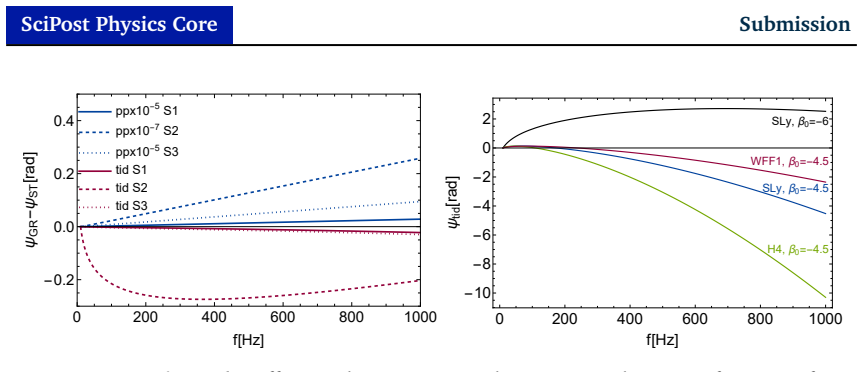
The paper's central claim is that the tidal part of the Fourier-domain gravitational-wave phase in the quadrupolar-driven inspiral regime is $$\psi_{\rm tid} = \frac{3}{128\eta $x^{{5/2}}$}\left[c_2 S_- $x^{2}$ + c_3 $x^{3}$ + c_4 S_-^2\left(\log x - \frac{2}{3}\right)$x^{4}$ + \left(\frac{39}{2\$alpha^{5}$\$xi^{2}$}\tilde{\Lambda} + c_5\right)$x^{5}$\right],$$ where $x=(G\alpha M\omega)^{2/3}$, $S_-=(q_A-q_B)/(2\sqrt{\alpha})$, $\alpha=1+q_A q_B$, $\xi=1+S_+^2\alpha/6$, and $\tilde{\Lambda}$ is the mass-weighted combination of quadrupolar tensor deformabilities with the same functional form as in GR. The coefficients $c_2$ and $c_4$ vanish for equal-mass, equal-charge binaries; $c_3$ involves scalar dipolar Love numbers; $c_5$ and $\tilde{\Lambda}$ involve quadrupolar tensor, scalar, and mixed Love numbers; and in the general-relativistic limit only the $\tilde{\Lambda}$ term survives. Because the scalar and scalar-tensor contributions enter with opposite sign from the tensor ones, the authors conclude that the net tidal phase in scalar-tensor gravity is generally smaller in magnitude than in GR, while still depending on all three types of Love numbers.
Load-bearing premise
The model assumes that the inspiral's orbital decay is driven only by scalar and tensor radiation reaction, with no comparable environmental force; the paper's own estimate in Sec. 2.2 finds that dynamical friction from the scalar cloud around each star is about one tenth of the gravitational-wave flux near 200 Hz, which is the same order of magnitude as the tidal phase differences it predicts.
Editorial extensions
If this is right
- Inspiral templates in scalar-tensor gravity must include all three Love numbers, because the scalar and mixed tidal terms scale as $x^2$, $x^3$, $x^4$, and $x^5$ and cannot be absorbed into a single GR-like deformability.
- Equal-mass, equal-charge binaries have $S_-=0$, which switches off the dipolar tidal terms $c_2S_-x^2$ and $c_4S_-^2x^4$, so systems with maximum scalar-charge asymmetry are the ones that maximize those terms.
- For the surveyed equations of state and couplings, the dipole-driven regime ends below about 3 Hz, so ground-based detectors should be modelled with the quadrupole-driven phase formula (83).
- The scalar-tensor Love number $\lambda_{ST}$ contributes at quadrupolar order at a level comparable to or larger than the pure scalar Love number, so it cannot be neglected once scalar tides are included.
- The smaller net tidal phase in scalar-tensor gravity creates a potential degeneracy with a softer equation of state in GR, but the much larger point-particle phase difference between the theories should resolve it in most cases.
Reading between the lines
- If the sign structure of Eq. (83) holds in more complete calculations, then parameter estimation with GR templates containing a single tidal deformability would map a scalar-tensor signal onto a biased equation-of-state measurement, and the size of that bias is a direct injection-study prediction.
- Beyond the paper, the same sign logic suggests a null test for modified gravity: a measured tidal phase whose frequency dependence cannot be fit by any single $\tilde{\Lambda}$ value would indicate the presence of the $x^2$, $x^3$, or $x^4$ terms.
- At deci-Hertz frequencies, where the dipole-driven regime becomes accessible, the tidal terms grow with different frequency powers, so future space-based detectors could separate the scalar and mixed Love numbers cleanly.
- The paper's own dynamical-friction estimate implies that scalar-cloud back-reaction may shift the phase by an amount comparable to the tidal signal, so the next step is to model that environment and test whether the predicted ST-minus-GR tidal difference survives.
Editorial analysis
A structured set of objections, weighed in public.
Referee Report
Summary. The paper computes tidal contributions to the gravitational-wave phase of inspiraling neutron-star binaries in massless scalar-tensor theories, working to first order in a combined post-Newtonian and small-finite-size expansion. The authors derive a skeletonized action with three types of tidal Love numbers, compute scalar and tensor energy fluxes and the associated Fourier-domain phase in both dipole-driven and quadrupole-driven regimes, and provide ready-to-use expressions for the tidal phase coefficients. They then apply these results to Gaussian scalar-tensor couplings with the WFF1, SLy, and H4 equations of state, surveying parameter space and presenting case studies that lead to the claim that the net tidal GW phase signature in scalar-tensor theories is smaller than in GR because contributions from different Love numbers enter with opposite signs and different frequency scalings.
Significance. If correct, this work provides the first systematic analytic treatment of quadrupolar tidal effects in scalar-tensor inspirals, showing that all three Love numbers enter the GW phase with distinct frequency scalings and cannot be absorbed into a single GR-like deformability. The derivation is careful and largely self-contained: the double expansion in PN and tidal parameters is performed explicitly, the SPA phase is built from the energy balance, and the authors verify the GR limit and cross-check their numerical evaluation of beta(phi) against a finite-difference derivative at the 0.37% level. The physical insight that sign cancellations can reduce the net tidal phase, together with the clear parameter-space study, makes the paper a useful methodological contribution for template-building and theory-specific tests beyond GR.
major comments (3)
- [Sec. 4.5.3, Eq. (83)] The coefficient of x^5 in the ready-to-use phase formula is printed with a positive sign: (39/(2 α^5 ξ^2)) Λ̃ + c5. This is inconsistent with the derivation in Sec. 4.5.2. In the GR limit (q=0, S_−=0, α=ξ=1, c3=c5=0), using ζ2=2 λ_T, ζ̃2=2 m λ_T, M=2m, η=1/4 in Eq. (82d) gives ρ^{nd,2}_tid = - (39/2) Λ̃, so the x^5 term in Eq. (83) should be negative to reproduce the standard GR tidal phase ψ_tid = -(3/(128 η))(39/2) Λ̃ x^5. The printed plus sign yields a positive GR tidal phase, contradicting the standard result cited in Refs. [42,86] and the negative λ_T contribution shown in the authors' own Fig. 9. Because the sign of this dominant term drives the cancellation argument that leads to the abstract's central claim of smaller net ST tidal effects, Eq. (83) and its restatement in Sec. 6 must be corrected, and the consequences for the discussion of sign structure should be re-examined.
- [Sec. 2.2, Eq. (10)] The authors estimate F_DF/F_GW ~ O(10^-1) at 200 Hz for a representative equal-mass SLy system, yet the phase evolution in Sec. 4.5 accounts only for scalar and tensor radiation reaction. The ST-vs-GR tidal phase differences presented in Fig. 8 are at the 0.1 rad level, so an environmental force of the estimated relative size is expected to produce a phase contribution of comparable order. The manuscript appropriately defers environmental effects to future work, but the abstract's claim that net tidal GW imprints in ST gravity are smaller than in GR applies to the modeled two-body system, not to the complete physical system. The authors should add a quantitative estimate of the environmental phase or otherwise explicitly qualify the scope of the central claim.
- [Sec. 2.2, Eq. (8)] The scalar tidal expansion is performed under the assumption (L_ϕ/r) ≪ 1 with L_ϕ ~ 6 R_body, but this condition is not well satisfied in the frequency band where the numerical results are presented. For a 1.4+1.4 M_sun SLy system at 200 Hz, the orbital separation is only a few times L_ϕ, and the QD-phase results in Figs. 8 and 9 are shown up to 500 Hz or 1 kHz. The paper should either quantify the error incurred by truncating the scalar-cloud multipole expansion at these separations or restrict the claimed quantitative accuracy to frequencies where the expansion parameter remains small.
minor comments (4)
- [Sec. 5.5.3] There are several typographical errors: "dubble" should be "double", "Tabel 1" should be "Table 1", and "induvidual" should be "individual". In Sec. 3 the term "Newtionian" should be "Newtonian".
- [Sec. 2.2, Eq. (9)] The phrase "lnΛ denotes the Coulomb algorithm" appears to be a typo; it should read "Coulomb logarithm".
- [Table 1] The header of Table 1 is garbled in the current text ("contribution to largest zero sign magnitude for phase coefficients for for NS-NS") and should be reformatted for clarity.
- [Appendix C.2, Eq. (D.1)] The dipolar-driven phase formula in Appendix C.2 is labeled Eq. (D.1), which conflicts with the appendix labeling (the formula appears in Appendix C.2). Please renumber or relabel for consistency.
Circularity Check
No significant circularity: Eq. (83) is derived from an action whose Love numbers are computed independently (with published code) in the authors' prior work, not fitted to the GW phase here.
full rationale
The central phase formula (83) is obtained from the adiabatic energy-balance integral (71) using tidal contributions to the binding energy (38) and to the scalar and tensor fluxes (63), (67), all derived from the tidal action (17) and the multipole decompositions (51), (57). The Love numbers λ_S, λ_T, λ_ST enter as inputs taken from the authors' earlier paper [45], where they are obtained by solving the linearized scalar-tensor field equations for static, tidally perturbed neutron stars; the present paper states that it extends the publicly available Mathematica code of [45] to compute β, so the prior result is code-reproduced and not a fit to the GW phase being predicted. The only other same-author citation [49] is used for the validity of the dipole-driven regime boundary and is likewise an independent derivation. No quantity in the claimed prediction is defined in terms of the predicted phase, and the GR limit of Eq. (83) is checked against the standard result. The paper itself flags the dynamical-friction environmental effect (Eq. (10)) as a caveat; that is a completeness limitation rather than a circular reduction. A separate apparent sign inconsistency between the printed plus sign in Eq. (83) and the negative ρ^{nd,2}_tid from Eq. (82d) is a correctness concern, not a circularity, because it does not make the derivation tautological.
Assumptions & free parameters
free parameters (2)
- beta_0 (Gaussian coupling parameter) =
-4.5 and -6 (case-study choices)
- phi_infinity (cosmological scalar field value) =
10^-3
assumptions (8)
- domain assumption The Damour-Esposito-Farese coupling A(phi)=exp(beta_0 phi^2/2) with massless scalar field describes the relevant ST theories.
- domain assumption The two-body motion is quasi-circular and adiabatic, with energy balance E-dot = -F and the stationary-phase approximation for the Fourier phase.
- domain assumption Finite-size effects are captured by the skeletonized action (17) with static, even-parity tidal multipoles to linear order; only l = 1 and l = 2 are retained in the fluxes.
- domain assumption Love numbers lambda_S, lambda_T, lambda_ST and scalar charges q, beta from the companion paper [45] are correct and applicable.
- domain assumption The scalar cloud energy is concentrated within L_phi ~ 6 R_body, so R/r and L_phi/r are small expansion parameters.
- ad hoc to paper Dynamical friction from the scalar environment is omitted from the phase evolution, despite an estimate F_DF/F_GW ~ O(10^-1) at 200 Hz.
- ad hoc to paper The PN/tidal approximation is valid only before merger; waveforms are cut at benchmark frequencies of 500 Hz or 1 kHz.
- standard math Standard identities for symmetric trace-free tensors and Faà di Bruno's formula are used without proof.
Cite this review
Pith. "Pith review of Tidal effects in gravitational waves from neutron stars in scalar-tensor theories of gravity." pith.science (2026). https://pith.science/paper/OP6U5BSY
@misc{pith2026241206620,
  author       = {Pith},
  title        = {Pith review of: Tidal effects in gravitational waves from neutron stars in scalar-tensor theories of gravity},
  year         = {2026},
  howpublished = {\url{https://pith.science/paper/OP6U5BSY}},
  note         = {Machine review of arXiv:2412.06620}
}
read the original abstract
We compute tidal signatures in the gravitational waves (GWs) from neutron star binary inspirals in scalar-tensor gravity, where the dominant adiabatic even-parity tidal interactions involve three types of Love numbers that depend on the matter equation of state and parameters of the gravitational theory. We calculate the modes of the GW amplitudes and the phase evolution in the time and frequency domain, working up to first order in the post-Newtonian and small finite-size approximations. We also perform several case studies to quantify the dipolar and quadrupolar tidal effects and their parameter dependencies specialized to Gaussian couplings. We show that various tidal contributions enter with different signs and scalings with frequency, which generally leads to smaller net tidal GW imprints than for the same binary system in General Relativity.
Figures


Figures from the paper (8 more)




Forward citations
Cited by 3 Pith papers
-
Dynamical Love Numbers for Black Holes and Beyond from Shell Effective Field Theory
A shell-based EFT computes scalar Love numbers for Schwarzschild black holes through O(G^9) and conjectures an all-orders Riemann-zeta structure.
-
Tidal Love Numbers of Neutron Stars in Horndeski Theories
In scalar-tensor theories, the 1/r^3 term used to extract neutron star tidal Love numbers contains a Love-number-independent contamination, computed here for minimally coupled and DEF scalar fields.
-
Tidal deformation and strain accumulation of solid compact stars
Solid strangeon stars of 1.4 Msun differ by ~40% in tidal deformability from fluid counterparts and release up to 10^46 erg via central-peaking strain fracture at hundreds of Hz.
Reference graph
Works this paper leans on
-
[1]
B. P . Abbottet al., GWTC-1: A Gravitational-Wave Transient Catalog of Compact Binary Mergers Observed by LIGO and Virgo during the First and Second Observing Runs , Phys. Rev. X9(3), 031040 (2019), doi:10.1103 /PhysRevX.9.031040, 1811.12907
arXiv 2019
-
[2]
R. Abbott et al., GWTC-2: Compact Binary Coalescences Observed by LIGO and Virgo During the First Half of the Third Observing Run , Phys. Rev. X 11, 021053 (2021), doi:10.1103/PhysRevX.11.021053, 2010.14527
arXiv 2021
-
[3]
R. Abbott et al., GWTC-3: Compact Binary Coalescences Observed by LIGO and Virgo during the Second Part of the Third Observing Run, Phys. Rev. X 13(4), 041039 (2023), doi:10.1103/PhysRevX.13.041039, 2111.03606
arXiv 2023
-
[4]
B. P . Abbott et al. , GW170817: Observation of Gravitational Waves from a Binary Neutron Star Inspiral , Phys. Rev. Lett. 119(16), 161101 (2017), doi:10.1103/PhysRevLett.119.161101, 1710.05832
arXiv 2017
-
[5]
B. P . Abbottet al., GW170817: Measurements of neutron star radii and equation of state, Phys. Rev. Lett.121(16), 161101 (2018), doi:10.1103/PhysRevLett.121.161101, 1805.11581
arXiv 2018
-
[6]
R. Abbott et al., Observation of Gravitational Waves from Two Neutron Star–Black Hole Coalescences, Astrophys. J. Lett. 915(1), L5 (2021), doi:10.3847 /2041-8213/ac082e, 2106.15163
arXiv 2021
-
[7]
Abbott et al., Tests of General Relativity with GWTC-3 (2021), 2112.06861
R. Abbott et al., Tests of General Relativity with GWTC-3 (2021), 2112.06861
arXiv 2021
-
[8]
R. Alves Batistaet al., EuCAPT White Paper: Opportunities and Challenges for Theoretical Astroparticle Physics in the Next Decade (2021), 2110.10074
arXiv 2021
Show all 100 references
-
[9]
Aprahamian et al., Reaching for the horizon: The 2015 long range plan for nuclear science (2015)
A. Aprahamian et al., Reaching for the horizon: The 2015 long range plan for nuclear science (2015)
2015
-
[10]
Bracco, The NuPECC long range plan 2017: perspectives in nuclear physics , Euro- physics News 48(4), 21 (2017), doi:10.1051 /epn/2017403
A. Bracco, The NuPECC long range plan 2017: perspectives in nuclear physics , Euro- physics News 48(4), 21 (2017), doi:10.1051 /epn/2017403
2017
-
[11]
B. P . Abbottet al., Tests of general relativity with GW150914, Phys. Rev. Lett. 116(22), 221101 (2016), doi:10.1103 /PhysRevLett.116.221101, [Erratum: Phys.Rev.Lett. 121, 129902 (2018)], 1602.03841
2016 arXiv
-
[12]
B. P . Abbott et al. , Tests of General Relativity with the Binary Black Hole Sig- nals from the LIGO-Virgo Catalog GWTC-1 , Phys. Rev. D 100(10), 104036 (2019), doi:10.1103/PhysRevD.100.104036, 1903.04467
2019 arXiv
-
[13]
Abbott et al
R. Abbott et al. , Tests of general relativity with binary black holes from the second LIGO-Virgo gravitational-wave transient catalog, Phys. Rev. D 103(12), 122002 (2021), doi:10.1103/PhysRevD.103.122002, 2010.14529
2021 arXiv
-
[14]
Fujii and K
Y. Fujii and K. Maeda, The scalar-tensor theory of gravitation, Cambridge Monographs on Mathematical Physics. Cambridge University Press, ISBN 978-0-521-03752-5, 978- 0-521-81159-0, 978-0-511-02988-2, doi:10.1017 /CBO9780511535093 (2007)
2007
-
[15]
Damour and G
T . Damour and G. Esposito-Farèse,Tensor-scalar gravity and binary-pulsar experiments, Physical Review D 54(2), 1474–1491 (1996), doi:10.1103 /physrevd.54.1474. 50 SciPost Physics Core Submission
1996
-
[16]
Pani and E
P . Pani and E. Berti,Slowly rotating neutron stars in scalar-tensor theories, Phys. Rev. D 90(2), 024025 (2014), doi:10.1103 /PhysRevD.90.024025, 1405.4547
2014 arXiv
-
[17]
S. M. Brown, Tidal Deformability of Neutron Stars in Scalar-tensor Theories of Gravity , Astrophys. J. 958(2), 125 (2023), doi:10.3847 /1538-4357/acfbe5, 2210.14025
2023 arXiv
-
[18]
Damour and G
T . Damour and G. Esposito-Farese, Tensor multiscalar theories of gravitation , Class. Quant. Grav. 9, 2093 (1992), doi:10.1088 /0264-9381/9/9/015
1992
-
[19]
Damour and G
T . Damour and G. Esposito-Farese, Gravitational wave versus binary - pulsar tests of strong field gravity , Phys. Rev. D 58, 042001 (1998), doi:10.1103/PhysRevD.58.042001, gr-qc /9803031
1998 doi
-
[20]
Damour and G
T . Damour and G. Esposito-Farèse, Nonperturbative strong-field effects in tensor-scalar theories of gravitation , Phys. Rev. Lett. 70, 2220 (1993), doi:10.1103/PhysRevLett.70.2220
1993 doi
-
[21]
D. D. Doneva, F . M. Ramazano ˘glu, H. O. Silva, T . P . Sotiriou and S. S. Yazad- jiev, Spontaneous scalarization , Rev. Mod. Phys. 96(1), 015004 (2024), doi:10.1103/RevModPhys.96.015004, 2211.01766
2024 arXiv
-
[22]
Andreou, N
N. Andreou, N. Franchini, G. Ventagli and T . P . Sotiriou, Spontaneous scalar- ization in generalised scalar-tensor theory , Phys. Rev. D 99(12), 124022 (2019), doi:10.1103/PhysRevD.99.124022, [Erratum: Phys.Rev.D 101, 109903 (2020)], 1904. 06365
2019 doi
-
[23]
Ventagli, New Perspectives on Spontaneous Scalarization in Black Holes and Neutron Stars, Ph.D
G. Ventagli, New Perspectives on Spontaneous Scalarization in Black Holes and Neutron Stars, Ph.D. thesis, Nottingham U. (2022), 2209.15330
2022 arXiv
-
[24]
Palenzuela, E
C. Palenzuela, E. Barausse, M. Ponce and L. Lehner, Dynamical scalarization of neutron stars in scalar-tensor gravity theories , Phys. Rev. D 89(4), 044024 (2014), doi:10.1103/PhysRevD.89.044024, 1310.4481
2014 arXiv
-
[25]
C. M. Will, The Confrontation between General Relativity and Experiment , Living Rev. Rel. 17, 4 (2014), doi:10.12942 /lrr-2014-4, 1403.7377
2014 arXiv
-
[26]
P . C. C. Freire, N. Wex, G. Esposito-Farese, J. P . W . Verbiest, M. Bailes, B. A. Jacoby , M. Kramer, I. H. Stairs, J. Antoniadis and G. H. Janssen, The relativistic pulsar-white dwarf binary PSR J1738+0333 II. The most stringent test of scalar-tensor gravity , Mon. Not. Roy...
2012
-
[27]
Anderson, P
D. Anderson, P . Freire and N. Yunes,Binary pulsar constraints on massless scalar–tensor theories using Bayesian statistics , Class. Quant. Grav. 36(22), 225009 (2019), doi:10.1088/1361-6382/ab3a1c, 1901.00938
2019 arXiv
-
[28]
L. Shao, N. Sennett, A. Buonanno, M. Kramer and N. Wex, Constraining nonper- turbative strong-field effects in scalar-tensor gravity by combining pulsar timing and laser-interferometer gravitational-wave detectors , Phys. Rev. X 7(4), 041025 (2017), doi:10.1103/PhysRevX.7.0410...
2017 arXiv
-
[29]
Kramer et al., Strong-Field Gravity Tests with the Double Pulsar, Phys
M. Kramer et al., Strong-Field Gravity Tests with the Double Pulsar, Phys. Rev. X 11(4), 041050 (2021), doi:10.1103 /PhysRevX.11.041050, 2112.06795. 51 SciPost Physics Core Submission
2021
-
[30]
J. Zhao, P . C. C. Freire, M. Kramer, L. Shao and N. Wex, Closing a spontaneous- scalarization window with binary pulsars, Class. Quant. Grav. 39(11), 11LT01 (2022), doi:10.1088/1361-6382/ac69a3, 2201.03771
2022 arXiv
-
[31]
Barausse, C
E. Barausse, C. Palenzuela, M. Ponce and L. Lehner,Neutron-star mergers in scalar-tensor theories of gravity, Phys. Rev. D87, 081506 (2013), doi:10.1103/PhysRevD.87.081506, 1212.5053
2013 arXiv
-
[32]
C. M. Will, Testing scalar - tensor gravity with gravitational wave observations of inspiral- ing compact binaries, Phys. Rev. D 50, 6058 (1994), doi:10.1103 /PhysRevD.50.6058, gr-qc/9406022
1994 arXiv
-
[33]
P . D. Scharre and C. M. Will,Testing scalar tensor gravity using space gravitational wave interferometers, Phys. Rev. D 65, 042002 (2002), doi:10.1103 /PhysRevD.65.042002, gr-qc/0109044
2002 arXiv
-
[34]
Berti, L
E. Berti, L. Gualtieri, M. Horbatsch and J. Alsing, Light scalar field constraints from gravitational-wave observations of compact binaries , Phys. Rev. D 85, 122005 (2012), doi:10.1103/PhysRevD.85.122005, 1204.4340
2012 arXiv
-
[35]
R. Niu, X. Zhang, B. Wang and W . Zhao, Constraining Scalar-tensor Theories Using Neutron Star–Black Hole Gravitational Wave Events, Astrophys. J. 921(2), 149 (2021), doi:10.3847/1538-4357/ac1d4f, 2105.13644
2021 arXiv
-
[36]
Takeda, S
H. Takeda, S. Tsujikawa and A. Nishizawa, Gravitational-wave constraints on scalar- tensor gravity from a neutron star and black-hole binary GW200115 , Phys. Rev. D 109(10), 104072 (2024), doi:10.1103 /PhysRevD.109.104072, 2311.09281
2024 arXiv
-
[37]
Quartin, S
M. Quartin, S. Tsujikawa, L. Amendola and R. Sturani, Constraining Horndeski theory with gravitational waves from coalescing binaries , JCAP 08, 049 (2023), doi:10.1088/1475-7516/2023/08/049, 2304.02535
2023 arXiv
-
[38]
Shibata, K.-i
M. Shibata, K.-i. Nakao and T . Nakamura,Scalar type gravitational wave emission from gravitational collapse in Brans-Dicke theory: Detectability by a laser interferometer, Phys. Rev. D50, 7304 (1994), doi:10.1103 /PhysRevD.50.7304
1994
-
[39]
Harada, T
T . Harada, T . Chiba, K.-i. Nakao and T . Nakamura, Scalar gravitational wave from Oppenheimer-Snyder collapse in scalar - tensor theories of gravity, Phys. Rev. D 55, 2024 (1997), doi:10.1103 /PhysRevD.55.2024, gr-qc /9611031
1997
-
[40]
A. E. H. Love, The yielding of the earth to disturbing forces, Proceedings of the Royal So- ciety of London. Series A, Containing Papers of a Mathematical and Physical Character 82(551), 73 (1909)
1909
-
[41]
Hinderer, Tidal Love numbers of neutron stars , Astrophys
T . Hinderer, Tidal Love numbers of neutron stars , Astrophys. J. 677, 1216 (2008), doi:10.1086/533487, [Erratum: Astrophys.J. 697, 964 (2009)], 0711.2420
2008 arXiv
-
[42]
E. E. Flanagan and T . Hinderer, Constraining neutron star tidal Love num- bers with gravitational wave detectors , Phys. Rev. D 77, 021502 (2008), doi:10.1103/PhysRevD.77.021502, 0709.1915
2008 arXiv
-
[43]
Damour and A
T . Damour and A. Nagar,Relativistic tidal properties of neutron stars , Phys. Rev. D 80, 084035 (2009), doi:10.1103 /PhysRevD.80.084035, 0906.0096
2009 arXiv
-
[44]
Binnington and E
T . Binnington and E. Poisson,Relativistic theory of tidal Love numbers, Phys. Rev. D 80, 084018 (2009), doi:10.1103 /PhysRevD.80.084018, 0906.1366. 52 SciPost Physics Core Submission
2009 arXiv
-
[45]
Creci, T
G. Creci, T . Hinderer and J. Steinhoff, Tidal properties of neutron stars in scalar-tensor theories of gravity (2023), 2308.11323
2023 arXiv
-
[46]
Hinderer, B
T . Hinderer, B. D. Lackey , R. N. Lang and J. S. Read,Tidal deformability of neutron stars with realistic equations of state and their gravitational wave signatures in binary inspiral, Phys. Rev. D81, 123016 (2010), doi:10.1103 /PhysRevD.81.123016, 0911.3535
2010 arXiv
-
[47]
Han and A
S. Han and A. W . Steiner, Tidal deformability with sharp phase transitions in (binary) neutron stars, Phys. Rev. D 99(8), 083014 (2019), doi:10.1103/PhysRevD.99.083014, 1810.10967
2019 arXiv
-
[48]
Bernard, Dipolar tidal effects in scalar-tensor theories , Phys
L. Bernard, Dipolar tidal effects in scalar-tensor theories , Phys. Rev. D 101(2), 021501 (2020), doi:10.1103 /PhysRevD.101.021501, 1906.10735
2020 arXiv
-
[49]
van Gemeren, B
I. van Gemeren, B. Shiralilou and T . Hinderer,Dipolar tidal effects in gravitational waves from scalarized black hole binary inspirals in quadratic gravity (2023), 2302.08480
2023 arXiv
-
[50]
S. M. Brown, B. Krishnan, R. Somasundaram and I. Tews,Can Neutron Star Tidal Effects Obscure Deviations from General Relativity? (2024), 2411.19129
2024 arXiv
-
[51]
S. Ma, V . Varma, L. C. Stein, F . Foucart, M. D. Duez, L. E. Kidder, H. P . Pfeiffer and M. A. Scheel, Numerical simulations of black hole-neutron star mergers in scalar-tensor gravity, Phys. Rev. D 107(12), 124051 (2023), doi:10.1103 /PhysRevD.107.124051, 2304.11836
2023 arXiv
-
[52]
Taniguchi, M
K. Taniguchi, M. Shibata and A. Buonanno, Quasiequilibrium sequences of binary neu- tron stars undergoing dynamical scalarization , Phys. Rev. D 91(2), 024033 (2015), doi:10.1103/PhysRevD.91.024033, 1410.0738
2015 arXiv
-
[53]
Shibata, K
M. Shibata, K. Taniguchi, H. Okawa and A. Buonanno, Coalescence of binary neu- tron stars in a scalar-tensor theory of gravity , Phys. Rev. D 89(8), 084005 (2014), doi:10.1103/PhysRevD.89.084005, 1310.0627
2014 arXiv
-
[54]
C. M. Will, Gravitational radiation from binary systems in alternative metric theories of gravity: dipole radiation and the binary pulsar. , Astrophys. J. 214, 826 (1977), doi:10.1086/155313
1977 doi
-
[55]
C. M. Will and H. W . Zaglauer, Gravitational Radiation, Close Binary Systems, and the Brans-Dicke Theory of Gravity, Astrophys. J. 346, 366 (1989), doi:10.1086 /168016
1989
-
[56]
D. M. Eardley ,Observable effects of a scalar gravitational field in a binary pulsar., Astro- phys. J. 196, L59 (1975), doi:10.1086 /181744
1975
-
[57]
Damour and G
T . Damour and G. Esposito-Farese, Testing gravity to second postNewtonian order: A Field theory approach, Phys. Rev. D 53, 5541 (1996), doi:10.1103/PhysRevD.53.5541, gr-qc/9506063
1996 arXiv
-
[58]
Saijo, H.-a
M. Saijo, H.-a. Shinkai and K.-i. Maeda, Gravitational waves in Brans-Dicke theory : Analysis by test particles around a Kerr black hole , Phys. Rev. D 56, 785 (1997), doi:10.1103/PhysRevD.56.785, gr-qc /9701001
1997 doi
-
[59]
Brunetti, E
M. Brunetti, E. Coccia, V . Fafone and F . Fucito,Gravitational wave radiation from com- pact binary systems in the Jordan-Brans-Dicke theory, Phys. Rev. D 59, 044027 (1999), doi:10.1103/PhysRevD.59.044027, gr-qc /9805056. 53 SciPost Physics Core Submission
1999 doi
-
[60]
Mirshekari and C
S. Mirshekari and C. M. Will, Compact binary systems in scalar-tensor gravity: Equa- tions of motion to 2.5 post-Newtonian order , Phys. Rev. D 87(8), 084070 (2013), doi:10.1103/PhysRevD.87.084070, 1301.4680
2013 arXiv
-
[61]
Bernard, Dynamics of compact binary systems in scalar-tensor theories: Equations of motion to the third post-Newtonian order , Phys
L. Bernard, Dynamics of compact binary systems in scalar-tensor theories: Equations of motion to the third post-Newtonian order , Phys. Rev. D 98(4), 044004 (2018), doi:10.1103/PhysRevD.98.044004, 1802.10201
2018 arXiv
-
[62]
Bernard, Dynamics of compact binary systems in scalar-tensor theories: II
L. Bernard, Dynamics of compact binary systems in scalar-tensor theories: II. Center- of-mass and conserved quantities to 3PN order , Phys. Rev. D 99(4), 044047 (2019), doi:10.1103/PhysRevD.99.044047, 1812.04169
2019 arXiv
-
[63]
R. N. Lang, Compact binary systems in scalar-tensor gravity. II. Tensor gravita- tional waves to second post-Newtonian order , Phys. Rev. D 89(8), 084014 (2014), doi:10.1103/PhysRevD.89.084014, 1310.3320
2014 arXiv
-
[64]
R. N. Lang, Compact binary systems in scalar-tensor gravity. III. Scalar waves and energy flux, Phys. Rev. D 91(8), 084027 (2015), doi:10.1103 /PhysRevD.91.084027, 1411. 3073
2015
-
[65]
Sennett, S
N. Sennett, S. Marsat and A. Buonanno, Gravitational waveforms in scalar- tensor gravity at 2PN relative order , Phys. Rev. D 94(8), 084003 (2016), doi:10.1103/PhysRevD.94.084003, 1607.01420
2016 arXiv
-
[66]
Ma and N
S. Ma and N. Yunes, Improved Constraints on Modified Gravity with Ec- centric Gravitational Waves , Phys. Rev. D 100(12), 124032 (2019), doi:10.1103/PhysRevD.100.124032, 1908.07089
2019 arXiv
-
[67]
Bernard, L
L. Bernard, L. Blanchet and D. Trestini, Gravitational waves in scalar-tensor theory to one-and-a-half post-Newtonian order , JCAP 08(08), 008 (2022), doi:10.1088 /1475- 7516/2022/08/008, 2201.10924
2022 arXiv
-
[68]
Bernard, E
L. Bernard, E. Dones and S. Mougiakakos,Tidal effects up to next-to-next-to-leading post- Newtonian order in massless scalar-tensor theories, Phys. Rev. D109(4), 044006 (2024), doi:10.1103/PhysRevD.109.044006, 2310.19679
2024 arXiv
-
[69]
K. S. Thorne, Multipole Expansions of Gravitational Radiation, Rev. Mod. Phys. 52, 299 (1980), doi:10.1103 /RevModPhys.52.299
1980
-
[70]
Blanchet, Post-Newtonian Theory for Gravitational Waves , Living Rev
L. Blanchet, Post-Newtonian Theory for Gravitational Waves , Living Rev. Rel. 27, 4 (2024), doi:10.1007 /s41114-024-00050-z, 1310.1528
2024 arXiv
-
[71]
Barausse, V
E. Barausse, V . Cardoso and P . Pani, Can environmental effects spoil preci- sion gravitational-wave astrophysics? , Phys. Rev. D 89(10), 104059 (2014), doi:10.1103/PhysRevD.89.104059, 1404.7149
2014 arXiv
-
[72]
B. J. Kavanagh, D. A. Nichols, G. Bertone and D. Gaggero,Detecting dark matter around black holes with gravitational waves: Effects of dark-matter dynamics on the gravitational waveform, Phys. Rev. D 102(8), 083006 (2020), doi:10.1103 /PhysRevD.102.083006, 2002.12811
2020 arXiv
-
[73]
M. E. Pati and C. M. Will,PostNewtonian gravitational radiation and equations of motion via direct integration of the relaxed Einstein equations. 1. Foundations, Phys. Rev. D 62, 124015 (2000), doi:10.1103 /PhysRevD.62.124015, gr-qc /0007087. 54 SciPost Physics Core Submission
2000
-
[74]
Julié and E
F .-L. Julié and E. Berti, Post-Newtonian dynamics and black hole thermodynam- ics in Einstein-scalar-Gauss-Bonnet gravity , Phys. Rev. D 100(10), 104061 (2019), doi:10.1103/PhysRevD.100.104061, 1909.05258
2019 arXiv
-
[75]
Shiralilou, T
B. Shiralilou, T . Hinderer, S. M. Nissanke, N. Ortiz and H. Witek,Post-Newtonian grav- itational and scalar waves in scalar-Gauss–Bonnet gravity , Class. Quant. Grav. 39(3), 035002 (2022), doi:10.1088 /1361-6382/ac4196, 2105.13972
2022 arXiv
-
[76]
Creci, T
G. Creci, T . Hinderer and J. Steinhoff, Tidal response from scattering and the role of analytic continuation , Phys. Rev. D 104(12), 124061 (2021), doi:10.1103/PhysRevD.104.124061, [Erratum: Phys.Rev.D 105, 109902 (2022) ], 2108.03385
2021 arXiv
-
[77]
L. D. Landau and E. M. Lifschits, The Classical Theory of Fields, vol. Volume 2 of Course of Theoretical Physics, Pergamon Press, Oxford, ISBN 978-0-08-018176-9 (1975)
1975
-
[78]
C. M. Will and A. G. Wiseman, Gravitational radiation from compact binary systems: Gravitational wave forms and energy loss to second postNewtonian order , Phys. Rev. D 54, 4813 (1996), doi:10.1103 /PhysRevD.54.4813, gr-qc /9608012
1996
-
[79]
Blanchet, B
L. Blanchet, B. R. Iyer, C. M. Will and A. G. Wiseman, Gravitational wave forms from inspiralling compact binaries to second postNewtonian order, Class. Quant. Grav.13, 575 (1996), doi:10.1088 /0264-9381/13/4/002, gr-qc /9602024
1996
-
[80]
W . P . Johnson,The curious history of faà di bruno’s formula, The American mathematical monthly 109(3), 217 (2002)
2002
-
[81]
Epstein and R
R. Epstein and R. V . Wagoner,Post-Newtonian generation of gravitational waves., Astro- phys. J. 197, 717 (1975), doi:10.1086 /153561
1975
-
[82]
Maggiore and A
M. Maggiore and A. Nicolis, Detection strategies for scalar gravitational waves with interferometers and resonant spheres , Phys. Rev. D 62, 024004 (2000), doi:10.1103/PhysRevD.62.024004, gr-qc /9907055
2000 doi
-
[83]
Dalang, P
C. Dalang, P . Fleury and L. Lombriser,Scalar and tensor gravitational waves, Phys. Rev. D 103(6), 064075 (2021), doi:10.1103 /PhysRevD.103.064075, 2009.11827
2021 arXiv
-
[84]
Buonanno, B
A. Buonanno, B. Iyer, E. Ochsner, Y. Pan and B. S. Sathyaprakash, Comparison of post- Newtonian templates for compact binary inspiral signals in gravitational-wave detectors , Phys. Rev. D80, 084043 (2009), doi:10.1103 /PhysRevD.80.084043, 0907.0700
2009 arXiv
-
[85]
S. Droz, D. J. Knapp, E. Poisson and B. J. Owen, Gravitational waves from inspiraling compact binaries: Validity of the stationary phase approximation to the Fourier transform, Phys. Rev. D59, 124016 (1999), doi:10.1103 /PhysRevD.59.124016, gr-qc /9901076
1999
-
[86]
L. Wade, J. D. E. Creighton, E. Ochsner, B. D. Lackey , B. F . Farr, T . B. Littenberg and V . Raymond,Systematic and statistical errors in a bayesian approach to the estimation of the neutron-star equation of state using advanced gravitational wave detectors, Phys. Rev. D 89(...
2014 arXiv
-
[87]
T . Damour, Binary Systems as Test-beds of Gravity Theories , In 6th SIGRAV Graduate School in Contemporary Relativity and Gravitational Physics: A Century from Einstein Relativity: Probing Gravity Theories in Binary Systems (2007), 0704.0749
2007 arXiv
-
[88]
Bertotti, L
B. Bertotti, L. Iess and P . Tortora, A test of general relativity using radio links with the Cassini spacecraft, Nature 425, 374 (2003), doi:10.1038 /nature01997. 55 SciPost Physics Core Submission
2003
-
[89]
J. S. Read, B. D. Lackey , B. J. Owen and J. L. Friedman, Constraints on a phenomeno- logically parameterized neutron-star equation of state, Phys. Rev. D 79, 124032 (2009), doi:10.1103/PhysRevD.79.124032, 0812.2163
2009 arXiv
-
[90]
Creci, Tidal properties of neutron stars in scalar-tensor theories of gravity: Mathematica code (2024)
G. Creci, Tidal properties of neutron stars in scalar-tensor theories of gravity: Mathematica code (2024)
2024
-
[91]
Tran Thanh Van, T
J. Tran Thanh Van, T . Damour, E. Hinds and J. F . Wilkerson, eds.,Perspectives in neu- trinos, atomic physics and gravitation. Proceedings, 28th Rencontres de Moriond, 13th Moriond Workshop, Villars sur Ollon, Switzerland, January 30 - February 6, 1993 . Ed. Frontieres, Gif-S...
1993
-
[92]
Özel and P
F . Özel and P . Freire,Masses, Radii, and the Equation of State of Neutron Stars , Ann. Rev. Astron. Astrophys. 54, 401 (2016), doi:10.1146 /annurev-astro-081915-023322, 1603.02698
2016 arXiv
-
[93]
B. P . Abbottet al., Prospects for observing and localizing gravitational-wave transients with Advanced LIGO, Advanced Virgo and KAGRA , Living Rev. Rel. 19, 1 (2016), doi:10.1007/s41114-020-00026-9, 1304.0670
2016 arXiv
-
[94]
Reitze et al., Cosmic Explorer: The U.S
D. Reitze et al., Cosmic Explorer: The U.S. Contribution to Gravitational-Wave Astronomy beyond LIGO, Bull. Am. Astron. Soc. 51(7), 035 (2019), 1907.04833
2019 arXiv
-
[95]
Einstein telescope design report update 2020, https: //gwic.ligo.org/3Gsubcomm/docs/ ET-0007B-20_ETDesignReportUpdate2020.pdf
2020
-
[96]
Kawamura et al., Current status of space gravitational wave antenna DECIGO and B-DECIGO, PTEP 2021(5), 05A105 (2021), doi:10.1093 /ptep/ptab019, 2006.13545
S. Kawamura et al., Current status of space gravitational wave antenna DECIGO and B-DECIGO, PTEP 2021(5), 05A105 (2021), doi:10.1093 /ptep/ptab019, 2006.13545
2021 arXiv
-
[97]
E. E. Flanagan and S. A. Hughes, The Basics of gravitational wave theory, New J. Phys. 7, 204 (2005), doi:10.1088 /1367-2630/7/1/204, gr-qc /0501041
2005
-
[98]
Sotani and K
H. Sotani and K. D. Kokkotas, Stellar oscillations in scalar-tensor theory of gravity, Phys. Rev. D71, 124038 (2005), doi:10.1103 /PhysRevD.71.124038, gr-qc /0506060
2005
-
[99]
C. M. Will, Theory and Experiment in Gravitational Physics, Cambridge University Press, 2 edn. (2018)
2018
-
[100]
Maggiore, Gravitational Waves
M. Maggiore, Gravitational Waves. Vol. 1: Theory and Experiments , Ox- ford University Press, ISBN 978-0-19-171766-6, 978-0-19-852074-0, doi:10.1093/acprof:oso/9780198570745.001.0001 (2007). 56
2007
Reviewed August 11, 2026 · model on record in the stance chip above.
Discussion (0). Continue with ORCID to comment.