REVIEW 4 major objections 8 minor 54 references
Optimising entanglement distribution policies under classical communication constraints assisted by reinforcement learning
T0 review · 4 major / 8 minor · reviewed 2026-08-11 · deepseek-v4-flash
Pith's one-line read Acting on partial information—guessing results from success probabilities or learning from history—delivers end-to-end entanglement faster than waiting for full classical information, in the high-success-probability regime.
desk verdict A genuinely new MDP formulation for repeater policies under communication delays, but the wait-for-broadcast baseline is modeled by a suspicious multiplicative factor that may inflate the reported speed-up. read the letter →
The pith
A machine-rendered reading of the paper's core claim, the machinery that carries it, and where it could break.
The reading
What carries the argument
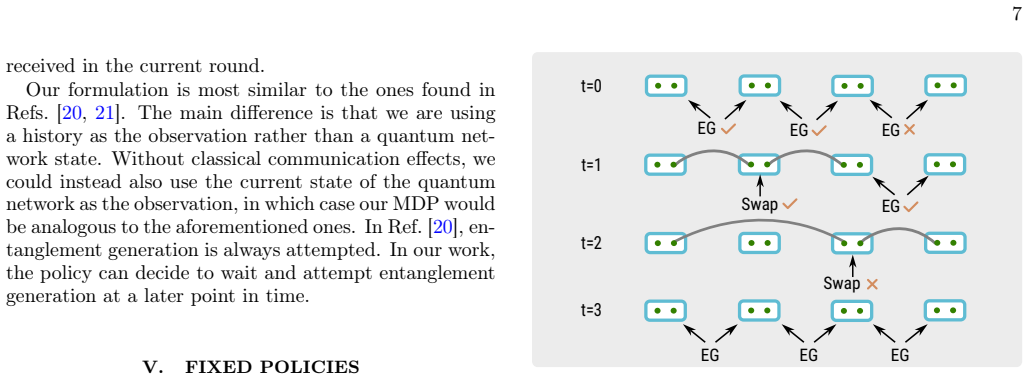
The central machinery is a Markov decision process with a history-based observation: the state is the last $t_{\mathrm{cut}}$ rounds of issued instructions and received results, so the agent never needs to reconstruct the true network state. Actions are grouped into two rounds per time step—one round for link-generation instructions on segments and one for swap instructions on nodes—and the reward is -1 for every nonterminal round, so minimizing cumulative reward equals minimizing delivery time. Against this MDP the paper benchmarks two hand-built policies: wait-for-broadcast swap-asap (do swap-asap but pause until all classical results return) and predictive swap-asap (each node predicts every action's success randomly according to $p_e$ and $p_s$, then acts immediately on the prediction, with all nodes coordinated through a shared random seed). The predictive policy is the carrier of the 'partial information helps' claim: it removes the waiting delay at the cost of acting on possibly wrong predictions.
What would settle it
Run a Monte Carlo simulation of the predictive swap-asap policy on the same four-node chain but give each node an independent random seed so predictions are not globally synchronized; under that condition the policy either fails to execute because segment endpoints disagree, or, if endpoints are forced to act anyway, its expected delivery time should be no better than wait-for-broadcast swap-asap. If it still beats wait-for-broadcast, the shared-seed coordination is not the source of the speedup.
Extended reading notes
Core claim
The paper establishes that when classical communication delays are present, it is often better to act on a guess than to wait for certainty. It formulates the entanglement-delivery problem as a Markov decision process whose observation is the history of instructions sent and results received over the last $t_{\mathrm{cut}}$ time steps, and it trains a centralized reinforcement-learning agent on that history. It then compares the agent with two fixed policies: wait-for-broadcast swap-asap, which performs the standard swap-asap actions but pauses until all classical results return, and predictive swap-asap, in which each node acts locally on predictions drawn from the known success probabilities. In Monte Carlo simulations of a four-node chain with cutoff time $t_{\mathrm{cut}} = 12$, both the predictive policy and the reinforcement-learning agent beat wait-for-broadcast when $p_e$ and $p_s$ are high, and at $p_e = p_s = 1$ the predictive policy delivers end-to-end entanglement in four time steps while the reinforcement-learning agent finds an optimal global strategy.
Load-bearing premise
The predictive swap-asap policy's advantage rests on every node starting with the same random seed and making identical predictions for every action and result, because an entanglement-generation attempt needs both endpoints to agree that they are attempting it.
Editorial extensions
If this is right
- At high link-generation and swap success probabilities on four-node chains, a policy that guesses results locally can deliver end-to-end entanglement in fewer expected time steps than one that waits for full information.
- With unit success probabilities, predictive swap-asap reaches the minimum possible delivery time under communication constraints (four time steps), and the reinforcement-learning agent converges to an equivalent optimal global strategy.
- The reinforcement-learning policies show interpretable structure—the same actions recur across episodes—so trained policies can be read as protocols rather than treated as black boxes.
- The authors argue the four-node advantage carries to longer chains through nested policies, in which the network is partitioned and each partition is served by a faster four-node protocol.
- The advantage of predictive swap-asap over wait-for-broadcast shrinks as success probabilities decrease, and the reinforcement-learning agent's weaker performance at low probabilities is attributed mainly to trainability.
Reading between the lines
- A direct test is to run predictive swap-asap on a longer chain with independent random seeds at each node; if the advantage disappears, the shared-seed coordination, rather than local guessing itself, is the load-bearing ingredient.
- The history-based MDP observation could be carried over to non-linear repeater topologies, with instruction and result delays set by graph distance between the controlling agent and each node or segment.
- Because the trained policies are interpretable, one could extract human-readable decision rules from them and check analytically whether those rules are near-optimal in the same parameter regime.
- A testable prediction suggested by the paper's local-versus-global comparison is that multi-agent reinforcement learning over local policies will beat the centralized agent whenever the central agent's distance to distant nodes dominates the delay.
Editorial analysis
A structured set of objections, weighed in public.
Referee Report
Summary. The manuscript studies the minimization of expected end-to-end entanglement delivery time in homogeneous linear quantum repeater chains when classical communication delays are present. The authors formulate the decision problem with a history-based observation and solve it with the PPO reinforcement learning algorithm; they also introduce a 'predictive swap-asap' policy in which nodes act on predicted outcomes rather than waiting for delayed results. They compare these policies against an 'instantaneous swap-asap' lower bound and a 'wait-for-broadcast swap-asap' baseline for a 4-node chain with cutoff time tcut=12. The central claim is that the RL policy and the predictive swap-asap policy achieve lower expected delivery times than wait-for-broadcast swap-asap at high success probabilities, with predictive swap-asap reaching the optimal delivery time at ps=pe=1. Code is provided in a public repository.
Significance. The topic is timely, because classical communication latency is a real constraint for quantum repeater networks and most prior RL work assumes instantaneous communication. The core idea—acting on partial information instead of waiting for global information—is intuitive and potentially practically valuable. Strengths of the paper include the provision of code, the interpretability analysis of the RL policies in Fig. 6, and the explicit modelling of action and result delays. If the reported speedups survive a direct simulation of the wait-for-broadcast baseline and a correct treatment of the partially observable nature of the problem, the work would be a useful contribution to the quantum-network literature. However, the quantitative central claim currently rests on an inconsistently derived baseline and on a formulation that is not strictly an MDP; the qualitative conclusion may survive, but the reported numbers and the 'optimal' statements require re-examination.
major comments (4)
- [§V.b and §VII, Fig. 7] The wait-for-broadcast (WB) swap-asap baseline is not simulated directly; instead, the authors simulate instantaneous swap-asap and multiply its delivery time by a constant factor. This is inconsistent with the policy description in §V.b, where after an EG round the policy waits 2∆EG and after a swap round it waits 2∆swap-result; since 2∆EG and 2∆swap-result are not equal, no single multiplicative factor can represent the WB process. Moreover, the stated factor is arithmetically inconsistent with Eqs. (2)–(4): for n=4 and k=2, Eqs. (2)–(4) give ∆EG(2)=3, ∆swap(2)=1, and ∆swap-result(2)=1, which sum to 5, not 6. The cutoff rescaling in §VII, where tcut is set to 2 before multiplication, is also only an approximation because link ages and the timing of action rounds are not uniformly rescaled. The authors should simulate the WB policy directly with the same environment used for the other policies and report the resulting curves; this is load-bearing because the claimed speed advantage of predictive swap-asap and the RL policy in Fig. 7 depends on the WB baseline.
- [§IV and App. C.b] The problem is not a Markov decision process as claimed. The observation is the history of actions and received results, but the true network state—which links exist and their ages—is partially hidden because results are delayed. The transition probabilities from one history to the next depend on outcomes of actions whose results have not yet arrived, so the history does not make the process Markovian. The statement in App. C.b that 'the performed actions and the results uniquely determine the state' is only true if all results are instantaneous. This is a POMDP, not an MDP. The paper should either reframe the contribution as a POMDP solved with a history-based policy and discuss the resulting lack of optimality guarantees, or define a belief-state MDP. This is not a purely terminological issue: PPO trained on a non-Markovian observation can converge to policies that are suboptimal in ways not captured by the reported training curves.
- [App. D.3] The predictive swap-asap policy is described as a local policy, but it requires all nodes to start with the same random seed and to make identical predictions for all actions and results in the entire network. This means each node must know the global action schedule and the common randomness, which is effectively centralized coordination, not 'nodes only coordinate with nearest neighbours' as stated in the abstract. The authors should either clarify the communication and synchronization assumptions or present the policy as a centralized predictive policy. The speed comparison with WB is not invalidated by this issue, but the local-policy framing is not accurate as written.
- [§VII, Fig. 7] The numerical results in Fig. 7 have no error bars, confidence intervals, or stated number of episodes. In addition, points are omitted when the average simulation time exceeds thresholds (2 seconds or 5·10^4 steps per episode), which can bias the reported expected delivery times in the low-probability regime if slow episodes are systematically different from fast ones. The authors should report statistical uncertainty and discuss or correct the selection bias, at least for the high-probability regime where the main claim lies.
minor comments (8)
- [Eq. (2)] There is an apparent indexing inconsistency: the text defines segment i as between nodes i and i+1, but Eq. (2) uses max(|k−i|, |k−i+1|), which corresponds to distances to nodes i and i−1. This should be corrected, as it propagates to the multiplier in §VII.
- [§VII] The text says the predictive swap-asap policy 'delivers end-to-end entanglement in 4 time steps' and then mentions 3 additional time steps for end-to-end communication to verify the link, while Fig. 6 reports the optimal RL strategy as 11 rounds = 5 time steps. Please clarify whether the 4 time steps include final verification and reconcile the two statements.
- [Fig. 6 caption] The caption states that 11 rounds is '5 time steps', but the paper defines each time step as two rounds; 11 rounds is 5.5 time steps. Please state the conversion explicitly.
- [§VII] The cutoff rescaling (setting tcut=2 in the instantaneous simulation before multiplication) should be justified or removed; a direct simulation of the WB policy would eliminate this approximation.
- [§VII] The paper does not state the number of Monte Carlo episodes or random seeds used for the delivery-time estimates in Fig. 7; please add these details for reproducibility.
- [§VII] The omission criterion 'took more than 2 seconds or 5·10^4 steps per episode to simulate on average' should specify the averaging window and the number of episodes over which the average is taken.
- [Fig. 7 caption] The caption should note explicitly that the WB swap-asap curve is an estimate obtained by time-dilating the instantaneous simulation rather than a direct simulation.
- [Code availability] The code repository is given as a URL; consider citing a specific commit or release to improve reproducibility.
Circularity Check
No significant circularity: both claimed improvements are evaluated by independent simulation and are not fitted to the reported comparison.
full rationale
The central comparison—predictive swap-asap and the RL policy versus WB swap-asap—does not reduce to a fitted parameter or to the authors' prior results. The predictive policy uses pe and ps as a probabilistic guess model and is then Monte-Carlo simulated; the RL policy is trained in the same stochastic simulator, which limits external grounding but is not a circular derivation because the reported delivery times are not used as training targets and the comparison is against an independently described baseline. The claimed 4- and 5-step delivery times follow from the delay definitions in Eqs. (2)-(4), not from assuming the outcome. Self-citations (Refs. [14,15,25,26,35]) are background results on swap-asap optimality and noise models and are not load-bearing for the new advantage claim; they are parameter-free statements with stated assumptions. The main validity concerns raised by reviewers—the WB baseline obtained by multiplying instantaneous swap-asap by a constant factor (Sec. VII, App. D2) rather than by direct simulation, and the shared-random-seed requirement that makes the 'local' predictive policy less local than advertised (App. D3)—are correctness or assumption-strength issues, not instances of a derivation being equivalent to its own inputs by construction. No circular step can be exhibited, so the circularity score is 0.
Assumptions & free parameters
free parameters (3)
- cutoff time tcut =
12
- RL entropy coefficient =
0.001
- Number of RL training agents (best-of-20 selection) =
20
assumptions (5)
- domain assumption Bell-pair fidelity after depolarising noise and swaps is characterized by a single multiplicative parameter a, with effective age additivity for swapped links.
- domain assumption Classical communication delays are integer multiples of the elementary-link time d/v, and swap operations are instantaneous relative to communication.
- domain assumption A link generation attempt on a segment discards existing links on that segment; a swap at a node with fewer than two links destroys all links at that node.
- ad hoc to paper The history of actions and received results up to tcut is a sufficient observation for optimal policy selection, i.e., the delayed-control problem is a Markov decision process.
- ad hoc to paper All nodes in the predictive swap-asap policy start with the same random seed and generate identical predictions for all actions.
Cite this review
Pith. "Pith review of Optimising entanglement distribution policies under classical communication constraints assisted by reinforcement learning." pith.science (2026). https://pith.science/paper/EGXCH2JL
@misc{pith2026241206938,
  author       = {Pith},
  title        = {Pith review of: Optimising entanglement distribution policies under classical communication constraints assisted by reinforcement learning},
  year         = {2026},
  howpublished = {\url{https://pith.science/paper/EGXCH2JL}},
  note         = {Machine review of arXiv:2412.06938}
}
read the original abstract
Quantum repeaters play a crucial role in the effective distribution of entanglement over long distances. The nearest-future type of quantum repeater requires two operations: entanglement generation across neighbouring repeaters and entanglement swapping to promote short-range entanglement to long-range. For many hardware setups, these actions are probabilistic, leading to longer distribution times and incurred errors. Significant efforts have been vested in finding the optimal entanglement-distribution policy, i.e. the protocol specifying when a network node needs to generate or swap entanglement, such that the expected time to distribute long-distance entanglement is minimal. This problem is even more intricate in more realistic scenarios, especially when classical communication delays are taken into account. In this work, we formulate our problem as a Markov decision problem and use reinforcement learning (RL) to optimise over centralised strategies, where one designated node instructs other nodes which actions to perform. Contrary to most RL models, ours can be readily interpreted. Additionally, we introduce and evaluate a fixed local policy, the `predictive swap-asap' policy, where nodes only coordinate with nearest neighbours. Compared to the straightforward generalization of the common swap-asap policy to the scenario with classical communication effects, the `wait-for-broadcast swap-asap' policy, both of the aforementioned entanglement-delivery policies are faster at high success probabilities. Our work showcases the merit of considering policies acting with incomplete information in the realistic case when classical communication effects are significant.
Figures


Figures from the paper (5 more)



Reference graph
Works this paper leans on
-
[1]
S. Wehner, D. Elkouss, and R. Hanson, Quantum in- ternet: A vision for the road ahead, Science 362, 10.1126/science.aam9288 (2018)
-
[2]
It shows that at high probabilities, the RL and the predictive swap-asap policy are able to outperform the WB swap-asap. Points where the RL and predictive swap-asap policy took more than2 seconds per episode to simulate or where the expected delivery time was larger or equal to5 · 104 time steps were omitted. further increase in delivery time mainly to i...
-
[3]
C. H. Bennett and G. Brassard, Quantum cryptogra- phy: Public key distribution and coin tossing, Theoret- ical Computer Science Theoretical Aspects of Quantum Cryptography – Celebrating 30 Years of BB84,560, 7 (2014)
work page 2014
-
[4]
A. K. Ekert, Quantum cryptography based on Bell’s the- orem, Physical Review Letters67, 661 (1991)
1991
-
[5]
A. Broadbent, J. Fitzsimons, and E. Kashefi, Universal blind quantum computation, in2009 50th Annual IEEE Symposium on Foundations of Computer Science (2009) pp. 517–526, arXiv:0807.4154 [quant-ph]
arXiv 2009
-
[6]
D. Gottesman, T. Jennewein, and S. Croke, Longer- Baseline Telescopes Using Quantum Repeaters, Physical Review Letters 109, 070503 (2012)
work page 2012
-
[7]
Kómár, E
P. Kómár, E. M. Kessler, M. Bishof, L. Jiang, A. S. Sørensen, J. Ye, and M. D. Lukin, A quantum network of clocks, Nature Physics10, 582 (2014)
2014
-
[8]
W. J. Munro, K. Azuma, K. Tamaki, and K. Nemoto, In- side quantum repeaters, IEEE Journal of Selected Topics in Quantum Electronics21, 78 (2015)
2015
Show all 54 references
-
[9]
W. K. Wootters and W. H. Zurek, A single quantum cannot be cloned, Nature299, 802 (1982)
1982
-
[10]
H.-J.Briegel, W.Dür, J.I.Cirac,andP.Zoller,Quantum Repeaters: The Role of Imperfect Local Operations in Quantum Communication, Physical Review Letters81, 5932 (1998)
1998
-
[11]
N.Sangouard, C.Simon, H.deRiedmatten,andN.Gisin, Quantum repeaters based on atomic ensembles and linear optics, Reviews of Modern Physics83, 33 (2011)
2011
-
[12]
Azuma, S
K. Azuma, S. E. Economou, D. Elkouss, P. Hilaire, L. Jiang, H.-K. Lo, and I. Tzitrin, Quantum repeaters: From quantum networks to the quantum internet, Re- views of Modern Physics95, 045006 (2023)
2023
-
[13]
C. H. Bennett, G. Brassard, C. Crépeau, R. Jozsa, A. Peres, and W. K. Wootters, Teleporting an unknown quantum state via dual classical and Einstein-Podolsky- Rosenchannels,PhysicalReviewLetters 70,1895(1993)
1993
-
[14]
Event-ready-detectors
M. Żukowski, A. Zeilinger, M. A. Horne, and A. K. Ekert, “Event-ready-detectors” Bell experiment via en- tanglement swapping, Physical Review Letters71, 4287 (1993)
1993
-
[15]
Goodenough, T
K. Goodenough, T. Coopmans, and D. Towsley, On noise in swap ASAP repeater chains: Exact analytics, distribu- tions and tight approximations (2024), arXiv:2404.07146 [quant-ph]
2024 arXiv
-
[16]
Coopmans, S
T. Coopmans, S. Brand, and D. Elkouss, Improved ana- lytical bounds on delivery times of long-distance entan- glement, Physical Review A105, 012608 (2022)
2022
-
[17]
Kamin, E
L. Kamin, E. Shchukin, F. Schmidt, and P. van Loock, Exact rate analysis for quantum repeaters with imperfect memories and entanglement swapping as soon as possi- ble, Physical Review Research5, 023086 (2023)
2023
-
[18]
Dai and D
W. Dai and D. Towsley, Entanglement Swapping for Repeater Chains with Finite Memory Sizes (2021), arXiv:2111.10994 [quant-ph]
2021 arXiv
-
[19]
M. G. de Andrade, E. A. V. Milligen, L. Bacciottini, A. Chandra, S. Pouryousef, N. K. Panigrahy, G. Var- doyan, and D. Towsley, On the analysis of quantum re- peater chains with sequential swaps, arXiv:2405.18252 (2024)
2024 arXiv
-
[20]
Shchukin and P
E. Shchukin and P. van Loock, Optimal Entanglement Swapping in Quantum Repeaters, Physical Review Let- ters 128, 150502 (2022)
2022
-
[21]
Á. G. Iñesta, G. Vardoyan, L. Scavuzzo, and S. Wehner, Optimal entanglement distribution policies in homoge- neous repeater chains with cutoffs, npj Quantum Infor- mation 9, 1 (2023)
2023
-
[22]
Haldar, P
S. Haldar, P. J. Barge, S. Khatri, and H. Lee, Fast and re- liable entanglement distribution with quantum repeaters: Principles for improving protocols using reinforcement learning, Physical Review Applied21, 024041 (2024)
2024
-
[23]
F. F. da Silva, A. Torres-Knoop, T. Coopmans, D. Maier, and S. Wehner, Optimizing entanglement generation and distribution using genetic algorithms, Quantum Science and Technology6, 035007 (2021)
2021
-
[24]
C. D. Donne, M. Iuliano, B. van der Vecht, G. M. Fer- reira, H. Jirovská, T. van der Steenhoven, A. Dahlberg, M.Skrzypczyk, D.Fioretto, M.Teller, P.Filippov, A.R.- P.Montblanch, J.Fischer, B.vanOmmen, N.Demetriou, D. Leichtle, L. Music, H. Ollivier, I. te Raa, W. Ko- zlowski, ...
2024 arXiv
-
[25]
S. D. Reiß and P. van Loock, Deep reinforcement learning for key distribution based on quantum repeaters, Physi- cal Review A108, 012406 (2023)
2023
-
[26]
Rozpędek, K
F. Rozpędek, K. Goodenough, J. Ribeiro, N. Kalb, V. C. Vivoli, A. Reiserer, R. Hanson, S. Wehner, and D. Elk- 12 ouss, Parameter regimes for a single sequential quantum repeater, Quantum Science and Technology 3, 034002 (2018)
2018
-
[27]
B. Li, T. Coopmans, and D. Elkouss, Efficient Opti- mization of Cutoffs in Quantum Repeater Chains, IEEE Transactions on Quantum Engineering2, 1 (2021)
2021
-
[28]
Haldar, P
S. Haldar, P. J. Barge, X. Cheng, K.-C. Chang, B. T. Kirby, S. Khatri, C. W. Wong, and H. Lee, Reducing classicalcommunicationcostsinmultiplexedquantumre- peaters using hardware-aware quasi-local policies (2024), arXiv:2401.13168 [quant-ph]
2024 arXiv
-
[29]
L.-M. Duan, M. D. Lukin, J. I. Cirac, and P. Zoller, Long- distance quantum communication with atomic ensembles and linear optics, Nature414, 413 (2001)
2001
-
[30]
P. C. Humphreys, N. Kalb, J. P. J. Morits, R. N. Schouten, R. F. L. Vermeulen, D. J. Twitchen, M. Markham, and R. Hanson, Deterministic delivery of remote entanglement on a quantum network, Nature 558, 268 (2018), arXiv:1712.07567 [quant-ph]
2018 arXiv
-
[31]
M. A. Nielsen and I. L. Chuang,Quantum Computation and Quantum Information: 10th Anniversary Edition , 10th ed. (Cambridge University Press, Cambridge ; New York, 2010)
2010
-
[32]
Khatri, On the design and analysis of near-term quan- tum network protocols using Markov decision processes, AVS Quantum Science4, 030501 (2022)
S. Khatri, On the design and analysis of near-term quan- tum network protocols using Markov decision processes, AVS Quantum Science4, 030501 (2022)
2022
-
[33]
Shchukin, F
E. Shchukin, F. Schmidt, and P. van Loock, Waiting time in quantum repeaters with probabilistic entangle- ment swapping, Physical Review A100, 032322 (2019)
2019
-
[34]
R. S. Sutton and A. Barto,Reinforcement Learning: An Introduction, second edition ed., Adaptive Computation andMachineLearning(TheMITPress,Cambridge, Mas- sachusetts London, England, 2020)
2020
-
[35]
Haldar, P
S. Haldar, P. J. Barge, S. Khatri, and H. Lee, Fast and re- liable entanglement distribution with quantum repeaters: Principles for improving protocols using reinforcement learning (2023), arXiv:2303.00777 [quant-ph]
2023 arXiv
-
[36]
Coopmans,Tools for the Design of Quantum Repeater Networks, Ph.D
T. Coopmans,Tools for the Design of Quantum Repeater Networks, Ph.D. thesis, Delft University of Technology (2021)
2021
-
[37]
Raffin, A
A. Raffin, A. Hill, A. Gleave, A. Kanervisto, M. Ernes- tus, and N. Dormann, Stable-baselines3: Reliable rein- forcement learning implementations, Journal of Machine Learning Research 22, 1 (2021)
2021
-
[38]
V. V. Sivak, A. Eickbusch, H. Liu, B. Royer, I. Tsioutsios, and M. H. Devoret, Model-Free Quantum Control with Reinforcement Learning, Physical Review X12, 011059 (2022)
2022
-
[39]
C. Yu, A. Velu, E. Vinitsky, J. Gao, Y. Wang, A. Bayen, and Y. Wu, The Surprising Effectiveness of PPO in Co- operative, Multi-Agent Games (2022), arXiv:2103.01955 [cs]
2022 arXiv
-
[40]
Zhu and X
X. Zhu and X. Hou, Quantum architecture search via truly proximal policy optimization, Scientific Reports13, 5157 (2023)
2023
-
[41]
R. Zen, J. Olle, L. Colmenarez, M. Puviani, M. Müller, and F. Marquardt, Quantum Circuit Discovery for Fault- Tolerant Logical State Preparation with Reinforcement Learning, https://arxiv.org/abs/2402.17761v2 (2024)
2024
-
[42]
Nägele, J
M. Nägele, J. Olle, T. Fösel, R. Zen, and F. Mar- quardt, Tackling Decision Processes with Non- Cumulative Objectives using Reinforcement Learning, https://arxiv.org/abs/2405.13609v1 (2024)
2024 arXiv
-
[43]
Nägele and F
M. Nägele and F. Marquardt, Optimizing ZX-diagrams withdeepreinforcementlearning,MachineLearning: Sci- ence and Technology5, 035077 (2024)
2024
-
[44]
W. P. Grice, Arbitrarily complete bell-state measure- ment using only linear optical elements, Physical Review A—Atomic, Molecular, and Optical Physics84, 042331 (2011)
2011
-
[45]
Buşoniu, R
L. Buşoniu, R. Babuška, and B. De Schutter, Multi-agent Reinforcement Learning: An Overview, in Innovations in Multi-Agent Systems and Applications - 1 , edited by D. Srinivasan and L. C. Jain (Springer, Berlin, Heidel- berg, 2010) pp. 183–221
2010
-
[46]
Zhang, Z
K. Zhang, Z. Yang, and T. Başar, Multi-agent reinforce- ment learning: A selective overview of theories and algo- rithms, Handbook of reinforcement learning and control , 321 (2021)
2021
-
[47]
M. M. Wilde, From Classical to Quantum Shannon The- ory (2019), arXiv:1106.1445
2019
-
[48]
Shahbeigi, D
F. Shahbeigi, D. Amaro-Alcalá, Z. Puchała, and K. Ży- czkowski, Log-Convex set of Lindblad semigroups acting on N-level system, Journal of Mathematical Physics62 (2021)
2021
-
[49]
Gymnasium Documentation, https://gymnasium.farama.org/index.html. Appendix A: Quantum network states and actions What follows in this section serves as a complementary description of the quantum network state and the entan- glement generation and swap actions. It gives a more ...
-
[50]
Here n ∈ N is the number of nodes in the linear network, where each node is labelled by an integer i ∈ [n]
The state of a quantum network The stateσ ∈ Σ of a quantum network is characterised by a triple(n, Λ, τ). Here n ∈ N is the number of nodes in the linear network, where each node is labelled by an integer i ∈ [n]. The set Λ is the set that contains all current links λ(i,j) = {...
-
[51]
When the link gen- eration attempt is applied, it first removes all links con- nected to qubits at segmenti, i.e
Actions Link generation: a link generation attempt between nodes i and i + 1 is denoted as ei. When the link gen- eration attempt is applied, it first removes all links con- nected to qubits at segmenti, i.e. it removes all the links λi,j with j > iand λi+1,k with k < i+ 1. Th...
-
[52]
In each even round, it will perform a swap on all of the nodes where two links are present
Instantaneous swap-asap For the instantaneous swap-asap, after each round, we already assume that the policy can see the entire state of the quantum network. In each even round, it will perform a swap on all of the nodes where two links are present. In all of the odd rounds, i...
-
[53]
This is to ensure that each time after sending out actions, enough time has passed such that all results have been collected back
W ait-for-broadcast (WB) swap-asap The WB swap-asap with an agent located at nodek waits for∆EG time steps after sending out entanglement generation actions and it waits for∆swap + ∆swap-result time steps after sending out swap actions. This is to ensure that each time after s...
-
[54]
Predictive swap-asap We also introduce a version of the swap-asap policy which does not wait for global information but also does not have instantaneous access to the quantum network state. It still experiences classical communication effects, but instead of waiting, it choose...
Reviewed August 11, 2026 · model on record in the stance chip above.
Discussion (0). Continue with ORCID to comment.