REVIEW 2 major objections 5 minor 64 references
Single production of singlet vector-like leptons at the ILC
T0 review · 2 major / 5 minor · reviewed 2026-08-11 · deepseek-v4-flash
Pith's one-line read At a 1 TeV electron-positron collider, single production of singlet vector-like leptons could be detected at 5σ for masses up to about 700 GeV, with the fully hadronic W-decay channel giving the larger reach.
desk verdict The 5σ reach rectangles claimed in the abstract do not follow from the paper's own cut tables; the significance is off by orders of magnitude at high mass. read the letter →
The pith
A machine-rendered reading of the paper's core claim, the machinery that carries it, and where it could break.
The reading
What carries the argument
The argument is carried by the singlet VLS model and the single-production process it generates. The model adds to the Standard Model a generation of SU(2)-singlet vector-like leptons $\psi$ and a new scalar $S$, with Yukawa couplings $\kappa$ and $\kappa'$ to the Higgs $h$ and $S$, respectively. After electroweak symmetry breaking, these couplings induce effective $\psi$–$Z$ and $\psi$–$W$ interactions whose strength scales as $\kappa v / M_F$; these drive the s-channel production $e^+e^- \to \psi\ell$ via $Z$ exchange (Eq. (5)) and the decay $\psi \to W\nu,\, Z\ell,\, h\ell$. The analysis machinery is a cut-based collider study: Monte Carlo event generation at leading order, parton showering and hadronization, fast detector simulation with the ILD detector card, and a statistical significance evaluated as $S/\sqrt{S+B}$ after kinematic cuts on missing energy, transverse energy, and pseudorapidity of the leptons (or on $M_{\rm eff}$ and $E_T$ for the hadronic channel). The model assumption that $\kappa/\kappa' = 10^{-2}$ with $\kappa'$ fixed by the muon anomalous magnetic moment (Eq. (6)) at $M_S = 500$ GeV anchors the coupling to the experiment that motivates the model.
What would settle it
Recompute the $5\sigma$ contours with $\kappa$ fixed by Eq. (6) and the relation $\kappa/\kappa' = 10^{-2}$ at $M_S = 500$ GeV for each $M_F$; if the resulting curve never reaches $5\sigma$ inside the quoted mass range, the paper's central quantitative claim fails.
Extended reading notes
Core claim
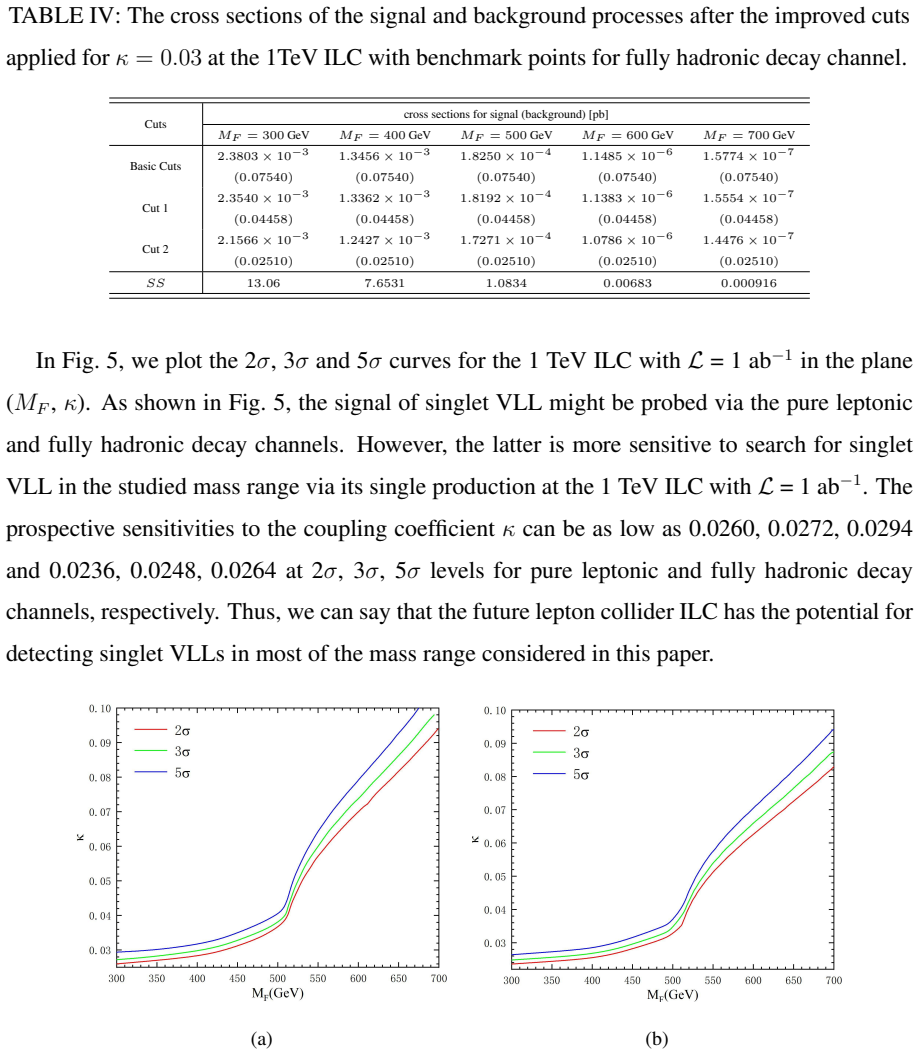
The central discovery claim is that, within the singlet VLS model, the process $e^+e^- \to \psi\ell$ followed by $\psi \to W\nu$ and $W \to \ell\nu$ or $jj$ yields a statistically significant signal at the ILC. With $\sqrt{s} = 1$ TeV, $L = 1$ ab$^{-1}$, and beam polarization $P(e^+, e^-) = (-30\%, 80\%)$, the $5\sigma$ contours in the ($M_F$, $\kappa$) plane enclose $M_F$ from 300 to 675 GeV and $\kappa$ from 0.0294 to 0.1 for the pure leptonic channel, and $M_F$ from 300 to 700 GeV with $\kappa$ from 0.0264 to 0.0941 for the fully hadronic channel. The fully hadronic channel reaches significance 13.06 at $M_F = 300$ GeV and 7.65 at $M_F = 400$ GeV for $\kappa = 0.03$, compared with 6.28 and 3.54 in the leptonic channel. The paper's bottom line is that the ILC could either discover or exclude singlet vector-like leptons in most of the mass range below 700 GeV, provided the coupling $\kappa$ lies above about 0.026.
Load-bearing premise
The analysis scans the coupling $\kappa$ freely at each mass, assuming $\kappa$ and $M_F$ are independent, even though the model's muon-g-2 constraint may tie $\kappa$ to $M_F$ and collapse the quoted two-dimensional discovery regions to a curve.
Editorial extensions
If this is right
- A null result at the 1 TeV ILC with 1 ab^-1 would exclude singlet vector-like leptons with masses below about 700 GeV and couplings κ down to roughly 0.026 in the VLS model, given the assumed polarization.
- The fully hadronic W-decay channel should be the primary search mode at lepton colliders, since it yields a larger reach in both MF and κ than the pure leptonic channel.
- The chosen beam polarization P(e+, e-) = (−30%, 80%) enhances the single-production cross section and suppresses the dominant electroweak backgrounds, making it a key ingredient of the projected sensitivity.
- Because the single-production cross sections are nearly identical for the first, second, and third generations of VLLs, the same search applies to all three generations without modification.
- If no signal appears, the ILC measurement would directly probe the coupling region that the VLS model invokes to explain the muon g-2 anomaly, providing a cross-check of that explanation.
Reading between the lines
- The two-dimensional reach regions treat κ and MF as independent parameters, but the model's own muon-g-2 constraint (Eq. (6) with κ/κ′ = 10^-2 at MS = 500 GeV) may fix κ for each MF; if so, the accessible parameter space collapses to a one-dimensional curve and the quoted rectangles likely overstate the discovery region.
- The quoted boundaries are derived from leading-order event generation; higher-order QCD and electroweak corrections could shift the signal and background shapes and move the 5σ contours by of order ten to twenty percent.
- The same single-production search strategy transfers directly to other proposed lepton colliders with adapted luminosity and energy, so the method generalizes beyond the specific ILC parameters assumed here.
- If the muon g-2 anomaly is later resolved by different new physics, the preferred values of κ and κ′ would change, and the reach regions would need to be recomputed; the discovery claim is contingent on the g-2 interpretation.
Editorial analysis
A structured set of objections, weighed in public.
Referee Report
Summary. The paper studies the single production of singlet vector-like leptons (VLLs) in the scalar-extended VLS model at a 1 TeV ILC with 1 ab^-1 and polarization P(e+, e-) = (-30%, 80%). It considers W-boson decays in the pure leptonic channel (two charged leptons plus missing energy) and the fully hadronic channel (two jets, one charged lepton, missing energy), using a MadGraph5/Pythia8/Delphes3/MadAnalysis5 pipeline. The authors present a cut-based analysis with cross sections after each cut and statistical significances, and they claim 5 sigma discovery reach for MF in [300, 675] GeV with kappa in [0.0294, 0.1] (leptonic) and MF in [300, 700] GeV with kappa in [0.0264, 0.0941] (hadronic).
Significance. If the quoted reach were correct, the paper would provide a useful projection for singlet VLL searches at the ILC and a concrete benchmark for the VLS model. The paper has clear strengths: the simulation chain is standard and reproducible, the cut flow is transparent with cross sections per cut in Tables II and IV, the polarization choice is motivated by a cross-section scan, and the significance formula is stated explicitly. The main weakness is that the headline reach regions are not supported by the paper's own Monte Carlo tables; the 5 sigma contours in Fig. 5 and the Abstract/Conclusions are internally inconsistent with the numerical significances in Tables II and IV. This makes the central quantitative claim unreliable in its present form.
major comments (2)
- [Abstract and Conclusions vs. Tables II and IV] The claimed 5 sigma reach rectangles cannot be reproduced from the paper's own cut tables. For the pure leptonic channel, Table II for MF = 600 GeV and kappa = 0.03 gives S = 2.2701 x 10^-7 pb and B = 6.1029 x 10^-3 pb, i.e. 0.227 signal events and 6103 background events at 1 ab^-1, corresponding to SS = 0.00291 as listed. Since the signal rate scales as kappa^2 while the background is kappa-independent, kappa = 0.1 gives only SS ~ 0.032; reaching SS = 5 at MF = 600 would require kappa ~ 1.24, far outside the quoted interval [0.0294, 0.1]. The same check on the fully hadronic channel using Table IV gives S = 1.0786 events and B = 25100 events at MF = 600 and kappa = 0.03 (SS = 0.00683); SS = 5 would require kappa ~ 0.81, and at MF = 700, kappa ~ 2.2. Thus the Abstract's MF in [300, 675] GeV (leptonic) and MF in [300, 700] GeV (hadronic) ranges, and the corresponding 5 sigma curves in Fig. 5, are incompatible with the stated cut-based analysis. This is not a minor scaling issue but a contradiction in the main quantitative result, and it must be resolved by recomputing the reach or by explaining an unstated alternative procedure.
- [Section II, Eqs. (1)-(6)] The role of the muon anomalous magnetic moment constraint in the parameter scan is ambiguous and load-bearing for the two-dimensional reach plots. The text says that kappa-prime can be expressed in terms of MF and MS via Eq. (6), and then fixes kappa/kappa-prime = 10^-2 with kappa-prime computed from Eq. (6) for MS = 500 GeV while scanning kappa in (0.01, 0.1). If kappa-prime is indeed fixed by the g-2 constraint for each MF, then kappa = 10^-2 kappa-prime is also determined as a function of MF, and the (MF, kappa) plane collapses to a one-dimensional curve; the filled rectangles in the Abstract and Fig. 5 would then overstate the independent parameter space. If instead kappa is meant to be an independent input in (0.01, 0.1), then Eq. (6) cannot be enforced simultaneously for all scanned points unless kappa-prime is also scanned and the AMM anomaly is not necessarily explained. The authors should state unambiguously which procedure generated Fig. 5; without this, the physical interpretation of the quoted kappa ranges is unclear.
minor comments (5)
- [Abstract] The Abstract calls the results 'analytic results' although they are obtained from a Monte Carlo detector-level simulation; 'simulation results' or 'numerical results' would be more accurate.
- [Section II] There are typos: 'electroweak symmertry breaking' and 'asymptotically safety' should read 'electroweak symmetry breaking' and 'asymptotic safety'.
- [Table II and Table IV] The SS row of both tables has broken spacing (e.g., '3 .541', '0 .479', '7 .6531'); the typesetting should be corrected.
- [Section III A] In the discussion of Fig. 3(c) and (d), the sentence 'the SM background has a peak at low values for eta_l-' is followed by 'while the SM background has a peak at high values for eta_l+'; the second clause should refer to the signal distribution.
- [Section III B] The variable written as 'Mef f' should be typeset as M_eff or similar, and its definition should appear consistently in the text and figure captions.
Circularity Check
No significant circularity: the ILC reach is computed from the model Lagrangian and Monte Carlo simulation, with only a contextual self-citation, although the claimed reach is inconsistent with the paper's own significance tables.
full rationale
The paper's derivation chain is self-contained: Eqs. (1)-(4) define the singlet VLS Lagrangian, couplings, and decay widths, Eq. (5) gives the analytic s-channel cross section, and the significance SS = S/sqrt(S+B) is applied to simulated signal and background events, so the kappa bounds quoted in the Abstract and Fig. 5 are scan outputs for a free coupling rather than fitted inputs, and the central reach claim does not reduce to its inputs by construction. The branching-ratio guidance is taken from Ref. [49] by different authors, and the only same-group citation, Ref. [50], is used merely to cite existing parameter constraints and prior collider studies, not to justify the 5-sigma reach, so it is a minor, non-load-bearing self-citation. A separate, non-circularity concern should be flagged: at kappa = 0.03 and MF = 600 GeV, Table II gives SS = 0.00291 for the pure leptonic channel and Table IV gives SS = 0.00683 for the fully hadronic channel; because the signal rate scales as kappa^2 with fixed backgrounds, reaching SS = 5 would require kappa roughly 1.26 (leptonic) and 0.82 (hadronic), so the quoted rectangles MF in [300,675] GeV with kappa in [0.0294,0.1] and MF in [300,700] GeV with kappa in [0.0264,0.0941] cannot be reproduced from the paper's own tables. This internal inconsistency is a correctness or reporting risk, not a circular reduction.
Assumptions & free parameters
free parameters (4)
- kappa =
scanned 0.01-0.1, benchmark 0.03
- MF (VLL mass) =
scanned 300-700 GeV
- MS (new scalar mass) =
500 GeV
- kappa-prime =
set by Delta a_mu via Eq. (6) with kappa/kappa-prime = 10^-2
assumptions (5)
- domain assumption VLS model Lagrangian and couplings (Eqs. (1)-(3))
- ad hoc to paper New scalar S is heavier than the VLL, so psi to S l decays are neglected
- ad hoc to paper kappa/kappa-prime = 10^-2
- domain assumption Muon AMM anomaly is explained by the VLS model
- domain assumption SM backgrounds computed at LO with fast detector simulation approximate the real ILC environment
Cite this review
Pith. "Pith review of Single production of singlet vector-like leptons at the ILC." pith.science (2026). https://pith.science/paper/GN6JHEEK
@misc{pith2026241207125,
  author       = {Pith},
  title        = {Pith review of: Single production of singlet vector-like leptons at the ILC},
  year         = {2026},
  howpublished = {\url{https://pith.science/paper/GN6JHEEK}},
  note         = {Machine review of arXiv:2412.07125}
}
abstract
Vector-like leptons (VLLs) as one kind of interesting new particles can produce rich phenomenology at low- and high-energy experiments. In the framework of the singlet vector-like leptons with scalar (VLS) model, we investigate the discovery potential of VLL via its single production at the International Linear Collider (ILC) with the center of mass energy $\sqrt{s} =$ 1 TeV and the integrated luminosity $\mathcal{L}$ = 1 ab$^{-1}$, taking into account the appropriate polarization. For the signal and standard model (SM) background analysis, we have considered two kinds of decay channels for the W boson, i.e. pure leptonic and fully hadronic decay channels. Our analytic results show that the parameter space $M_{F}\in$ [300, 675] GeV and $\kappa \in$ [0.0294, 0.1] might be detected by the proposed ILC for pure leptonic decay channel. For fully hadronic decay channel, larger detection region of the parameter space are derived as $M_{F}\in$ [300, 700] GeV and $\kappa \in$ [0.0264, 0.0941].
Figures


Figures from the paper (2 more)

Reference graph
Works this paper leans on
- [1]
- [2]
-
[3]
G. Bertone, D. Hooper, and J. Silk, Phys. Rept. 405, 279 (2005), hep-ph/0404175
arXiv 2005
-
[4]
J. L. Feng, Ann. Rev. Astron. Astrophys. 48, 495 (2010), 1003.0904
arXiv 2010
-
[5]
P. A. R. Ade et al. (Planck), Astron. Astrophys. 571, A16 (2014), 1303.5076. 14
arXiv 2014
-
[6]
J. L. Feng, Ann. Rev. Nucl. Part. Sci. 63, 351 (2013), 1302.6587
arXiv 2013
-
[7]
M. C. Gonzalez-Garcia and M. Maltoni, Phys. Rept. 460, 1 (2008), 0704.1800
arXiv 2008
-
[8]
A. P. Morais, A. Onofre, F. F. Freitas, J. a. Gonc ¸alves, R. Pasechnik, and R. Santos, Eur. Phys. J. C 83, 232 (2023), 2108.03926
arXiv 2023
Show all 64 references
-
[9]
Abi et al
B. Abi et al. (Muon g-2), Phys. Rev. Lett. 126, 141801 (2021), 2104.03281
2021
-
[10]
Kuflik, Y
E. Kuflik, Y . Nir, and T. V olansky, Phys. Rev. Lett.110, 091801 (2013), 1204.1975
2013 arXiv
-
[11]
Eberhardt, G
O. Eberhardt, G. Herbert, H. Lacker, A. Lenz, A. Menzel, U. Nierste, and M. Wiebusch, Phys. Rev. Lett. 109, 241802 (2012), 1209.1101
2012 arXiv
-
[12]
Arkani-Hamed, A
N. Arkani-Hamed, A. G. Cohen, E. Katz, and A. E. Nelson, JHEP 07, 034 (2002), hep-ph/0206021
2002 arXiv
-
[13]
Perelstein, M
M. Perelstein, M. E. Peskin, and A. Pierce, Phys. Rev. D 69, 075002 (2004), hep-ph/0310039
2004 arXiv
-
[14]
Carena, J
M. Carena, J. Hubisz, M. Perelstein, and P. Verdier, Phys. Rev. D 75, 091701 (2007), hep- ph/0610156
2007
-
[15]
T. Han, H. E. Logan, B. McElrath, and L.-T. Wang, Phys. Rev. D 67, 095004 (2003), hep- ph/0301040
2003
-
[16]
Anastasiou, E
C. Anastasiou, E. Furlan, and J. Santiago, Phys. Rev. D 79, 075003 (2009), 0901.2117
2009 arXiv
-
[17]
K. Kong, M. McCaskey, and G. W. Wilson, JHEP 04, 079 (2012), 1112.3041
2012 arXiv
-
[18]
Gillioz, R
M. Gillioz, R. Grober, C. Grojean, M. Muhlleitner, and E. Salvioni, JHEP 10, 004 (2012), 1206.7120
2012 arXiv
-
[19]
Keren-Zur, P
B. Keren-Zur, P. Lodone, M. Nardecchia, D. Pappadopulo, R. Rattazzi, and L. Vecchi, Nucl. Phys. B 867, 394 (2013), 1205.5803
2013 arXiv
- [20]
-
[21]
Agashe, G
K. Agashe, G. Perez, and A. Soni, Phys. Rev. D 75, 015002 (2007), hep-ph/0606293
2007 arXiv
-
[22]
Contino, T
R. Contino, T. Kramer, M. Son, and R. Sundrum, JHEP 05, 074 (2007), hep-ph/0612180
2007 arXiv
-
[23]
T. Li, Z. Murdock, S. Nandi, and S. K. Rai, Phys. Rev. D 85, 076010 (2012), 1201.5616
2012 arXiv
- [24]
- [25]
-
[26]
J. Kang, P. Langacker, and B. D. Nelson, Phys. Rev. D 77, 035003 (2008), 0708.2701
2008 arXiv
-
[27]
K. S. Babu, I. Gogoladze, M. U. Rehman, and Q. Shafi, Phys. Rev. D78, 055017 (2008), 0807.3055
2008 arXiv
-
[28]
S. P. Martin, Phys. Rev. D 81, 035004 (2010), 0910.2732
2010 arXiv
-
[29]
P. W. Graham, A. Ismail, S. Rajendran, and P. Saraswat, Phys. Rev. D 81, 055016 (2010), 15 0910.3020
2010 arXiv
- [30]
-
[31]
Crivellin, F
A. Crivellin, F. Kirk, C. A. Manzari, and M. Montull, JHEP 12, 166 (2020), 2008.01113
2020 arXiv
- [32]
- [33]
- [34]
- [35]
- [36]
-
[37]
Baspehlivan, B
F. Baspehlivan, B. Dagli, O. E. Delialioglu, and S. Sultansoy (2022), 2201.08251
2022 arXiv
- [38]
- [39]
- [40]
-
[41]
Hiller, C
G. Hiller, C. Hormigos-Feliu, D. F. Litim, and T. Steudtner, Phys. Rev. D 102, 095023 (2020), 2008.08606
2020 arXiv
-
[42]
Hiller, C
G. Hiller, C. Hormigos-Feliu, D. F. Litim, and T. Steudtner, Phys. Rev. D 102, 071901 (2020), 1910.14062
2020 arXiv
-
[43]
Hiller, C
G. Hiller, C. Hormigos-Feliu, D. F. Litim, and T. Steudtner, in 54th Rencontres de Moriond on Electroweak Interactions and Unified Theories (2019), pp. 415–418, 1905.11020
2019 arXiv
-
[44]
D. F. Litim and F. Sannino, JHEP 12, 178 (2014), 1406.2337
2014 arXiv
-
[45]
A. D. Bond and D. F. Litim, Phys. Rev. Lett. 122, 211601 (2019), 1801.08527
2019 arXiv
-
[46]
A. D. Bond and D. F. Litim, Phys. Rev. D 97, 085008 (2018), 1707.04217
2018 arXiv
- [47]
-
[48]
D. F. Litim, N. Riyaz, E. Stamou, and T. Steudtner, Phys. Rev. D 108, 076006 (2023), 2307.08747
2023 arXiv
-
[49]
Bißmann, G
S. Bißmann, G. Hiller, C. Hormigos-Feliu, and D. F. Litim, Eur. Phys. J. C 81, 101 (2021), 2011.12964
2021 arXiv
-
[50]
Yue, Y .-Q
C.-X. Yue, Y .-Q. Wang, H. Wang, Y .-H. Wang, and S. Li, Nucl. Phys. B 1000, 116482 (2024), 2402.02072
2024 arXiv
-
[51]
A. Das, S. Mandal, and T. Modak, Phys. Rev. D 102, 033001 (2020), 2005.02267
2020 arXiv
- [52]
-
[53]
Bhattacharya, S
S. Bhattacharya, S. Jahedi, and J. Wudka, JHEP 05, 009 (2022), 2106.02846. 16
2022 arXiv
- [54]
- [55]
-
[56]
Alloul, N
A. Alloul, N. D. Christensen, C. Degrande, C. Duhr, and B. Fuks, Comput. Phys. Commun. 185, 2250 (2014), 1310.1921
2014 arXiv
-
[57]
Degrande, C
C. Degrande, C. Duhr, B. Fuks, D. Grellscheid, O. Mattelaer, and T. Reiter, Comput. Phys. Com- mun. 183, 1201 (2012), 1108.2040
2012 arXiv
-
[58]
Alwall, R
J. Alwall, R. Frederix, S. Frixione, V . Hirschi, F. Maltoni, O. Mattelaer, H. S. Shao, T. Stelzer, P. Torrielli, and M. Zaro, JHEP07, 079 (2014), 1405.0301
2014 arXiv
-
[59]
Frederix, S
R. Frederix, S. Frixione, V . Hirschi, D. Pagani, H. S. Shao, and M. Zaro, JHEP 07, 185 (2018), [Erratum: JHEP 11, 085 (2021)], 1804.10017
2018 arXiv
-
[60]
Sj ¨ostrand, S
T. Sj ¨ostrand, S. Ask, J. R. Christiansen, R. Corke, N. Desai, P. Ilten, S. Mrenna, S. Prestel, C. O. Rasmussen, and P. Z. Skands, Comput. Phys. Commun. 191, 159 (2015), 1410.3012
2015 arXiv
-
[61]
de Favereau, C
J. de Favereau, C. Delaere, P. Demin, A. Giammanco, V . Lema ˆıtre, A. Mertens, and M. Selvaggi (DELPHES 3), JHEP 02, 057 (2014), 1307.6346
2014 arXiv
-
[62]
Conte, B
E. Conte, B. Fuks, and G. Serret, Comput. Phys. Commun. 184, 222 (2013), 1206.1599
2013 arXiv
-
[63]
Conte, B
E. Conte, B. Dumont, B. Fuks, and C. Wymant, Eur. Phys. J. C 74, 3103 (2014), 1405.3982
2014 arXiv
-
[64]
Conte and B
E. Conte and B. Fuks, Int. J. Mod. Phys. A 33, 1830027 (2018), 1808.00480. 17
2018 arXiv
Reviewed August 11, 2026 · model on record in the stance chip above.
Discussion (0). Continue with ORCID to comment.