REVIEW 3 major objections 4 minor 31 references
Fine-grained Text to Image Synthesis
T0 review · 3 major / 4 minor · reviewed 2026-08-11 · deepseek-v4-flash
Pith's one-line read This paper proposes FG-RAT GAN, which adds an auxiliary classifier and contrastive learning with cross-batch memory to RAT GAN, and reports the lowest FID scores on CUB-200-2011 and Oxford-102.
desk verdict A modest GAN-era fine-grained text-to-image extension whose FID gains are plausible but unverified, with a likely sign error in the contrastive loss equations. read the letter →
The pith
A machine-rendered reading of the paper's core claim, the machinery that carries it, and where it could break.
The reading
What carries the argument
The mechanism is an auxiliary classifier plus contrastive embedding added to the RAT GAN discriminator. The auxiliary classifier computes a categorical cross-entropy loss that grades both real and fake images against subclass labels, feeding a gradient to the generator; the contrastive branch L2-normalizes 256-D embeddings and applies a margin-based cosine similarity loss against a cross-batch memory queue of real-image embeddings, so that same-class pairs are pulled together and different-class pairs are pushed apart past margin α. The two losses are summed with the adversarial loss after an initial phase that stabilizes the embeddings through classification alone.
What would settle it
Train a version of RAT GAN that receives the same subclass labels as an additional input to the generator or discriminator but omits the auxiliary classifier and contrastive loss; if its FID matches the reported 8.66 on CUB-200-2011, the paper's attribution of the gain to the new losses is falsified. Repeating each configuration across multiple random seeds to obtain FID error bars would also test whether the reported gaps exceed run-to-run noise.
Extended reading notes
Core claim
FG-RAT GAN extends RAT GAN's discriminator with a fully connected classification head trained with categorical cross-entropy on both real and fake images, and an embedding branch trained with a contrastive loss that compares current-batch features against a queue of past real-image features. The two losses join the original adversarial loss in both generator and discriminator updates. On CUB-200-2011 the model reports FID 8.66 versus 12.12 for RAT GAN, 10.32 for VQ-Diffusion, and 10.48 for LAFITE; on Oxford-102 it reports FID 9.14 versus 12.90 for RAT GAN. The paper's claim is that these gains come from the auxiliary classifier and contrastive learning making the generator produce images that are more internally consistent within a subclass and better separated across subclasses.
Load-bearing premise
The comparison assumes that feeding subclass labels during training is not itself the cause of the FID improvement, so the gains can be attributed to the auxiliary classifier and contrastive learning rather than to the extra label signal.
Editorial extensions
If this is right
- On both CUB-200-2011 and Oxford-102, FG-RAT GAN reports lower FID than RAT GAN, LAFITE, and VQ-Diffusion, so the added components transfer across two datasets with different class counts.
- The full model beats both single-component ablations on FID, supporting the paper's claim that the classifier and contrastive learning are complementary rather than redundant.
- Because only two fully connected layers (roughly 17M parameters) are added at training time, the method offers a parameter-efficient path to fine-grained text-to-image synthesis without scaling to billion-parameter autoregressive or diffusion models.
- The generator's within-class similarity increases while cross-class similarity decreases, which is the geometric condition the contrastive loss directly enforces.
Reading between the lines
- A natural stress test would run the same ablation with class labels removed from the auxiliary head entirely to see how much of the FID drop is attributable to label availability rather than to the contrastive geometry.
- The cross-batch memory could be repurposed as a hard-negative mining mechanism for other conditional generators, not just GANs, by swapping the memory queue into diffusion or autoregressive training loops.
- If label noise is introduced during training, the margin-based contrastive loss may degrade more gracefully than the hard classifier, a hypothesis the current single-run FID table does not test.
Editorial analysis
A structured set of objections, weighed in public.
Referee Report
Summary. The paper proposes FG-RAT GAN, an extension of RAT GAN for fine-grained text-to-image synthesis. It adds an auxiliary classifier to the discriminator and a contrastive learning loss with a cross-batch memory (XBM) mechanism, and evaluates the resulting model on CUB-200-2011 and Oxford-102. The central claim, stated in the abstract and in Section 4.5, is that FG-RAT GAN achieves the lowest FID among the compared methods (LAFITE, VQ-Diffusion, RAT GAN) on both datasets while adding only a modest number of parameters.
Significance. If the reported results are valid, the paper would offer a lightweight and conceptually simple improvement over RAT GAN, with a parameter overhead of about 17M and a claimed FID reduction from 12.12 to 8.66 on CUB-200-2011 and from 12.90 to 9.14 on Oxford-102. The use of FID as the primary metric, with an explicit discussion of the limitations of Inception Score, is a reasonable methodological choice. However, the manuscript provides no code, no statistical uncertainty quantification, and the main comparison is not controlled for the extra class-label supervision used by the proposed method; these issues prevent the central claim from being verified as written. The auxiliary-classifier idea is well motivated, and the overall approach is easy to follow, but the load-bearing evaluation and the sign of the contrastive-loss term need correction before the contribution can be assessed.
major comments (3)
- [Section 3.2, Eqs. (3)-(4)] The negative-pair term in the contrastive loss has the wrong sign relative to the stated objective. For a negative pair with cos_sim > alpha, the term is written as -max((cos_sim - alpha), 0), which is negative and decreases as cos_sim increases. Minimizing this term therefore encourages embeddings from different subclasses to become more similar, contradicting the text's claim that the loss 'minimizes the similarity between feature embeddings of ... different subclasses.' The correct hinge form should be +max((cos_sim - alpha), 0). Since the contrastive loss is one of the two named contributions and Table 2 attributes part of the FID improvement to it, this is not a cosmetic typo; as printed, the equations do not implement the described mechanism. The absence of released code makes it impossible to determine whether the implementation used the printed sign or a corrected one.
- [Section 4.5, Table 1] The comparison against LAFITE and VQ-Diffusion is not controlled for the additional supervision used by FG-RAT GAN. The proposed method trains an auxiliary classifier with ground-truth class labels, while the two baselines are label-free text-conditioned models. The sentence 'Even though we use labels during the training, label information is not an unfair advantage but a distinct characteristic of our model' is an assertion, not a controlled experiment. The ablation in Table 2 shows that RAT GAN + classifier, which also uses labels, already reduces FID from 12.12 to 9.90 on CUB, so the label signal alone explains a substantial part of the gain. A comparison with a label-conditioned baseline (e.g., ACGAN or TAC-GAN) or a version of the proposed model trained without the classifier is necessary to attribute the reported improvement to the proposed mechanisms.
- [Section 4.5, Tables 1 and 2] All reported IS and FID values appear to come from a single training run, with no error bars, confidence intervals, or significance tests. The claimed gains are sometimes small (e.g., IS 5.08 vs 4.99 in Table 2 on CUB, and IS 3.66 vs 3.62 on Oxford), and FID is known to vary across seeds and evaluation batches. Without multiple runs and standard deviations, the reader cannot assess whether the reported FID differences, such as 8.66 vs 9.10 in Table 2, are statistically meaningful. The paper should report mean and standard deviation over at least three seeds for each configuration.
minor comments (4)
- [Throughout] There are numerous typos and formatting errors, including 'Frenchet Inception Distance' (Section 4.2), 'horizontaly' (Section 4.1), 'orginal' (Section 4.4), 'auxliary' and 'discrminator' (Figure 1 caption), 'contrastive' misspelled as 'contrtastive' (Table 2), and a stray '0' at the end of Section 4.4. The manuscript should be carefully proofread.
- [References, [17]-[18]] Reference [17] is the cross-batch memory (XBM) source, but reference [18] is a fine-grained image recognition paper by the current authors. Citing [18] together with [17] for the XBM mechanism is misleading unless the connection is explicitly explained; the citation should be corrected or removed.
- [Section 5, Conclusion] The conclusion states that 'further evaluations on broader text-to-image synthesis benchmarks and more varied datasets are necessary to confirm the generalizability of our approach.' This is a self-acknowledged limitation, but the paper currently presents the method as achieving state-of-the-art performance; the scope of the claim should be aligned with this admitted limitation in the abstract and Section 4.5.
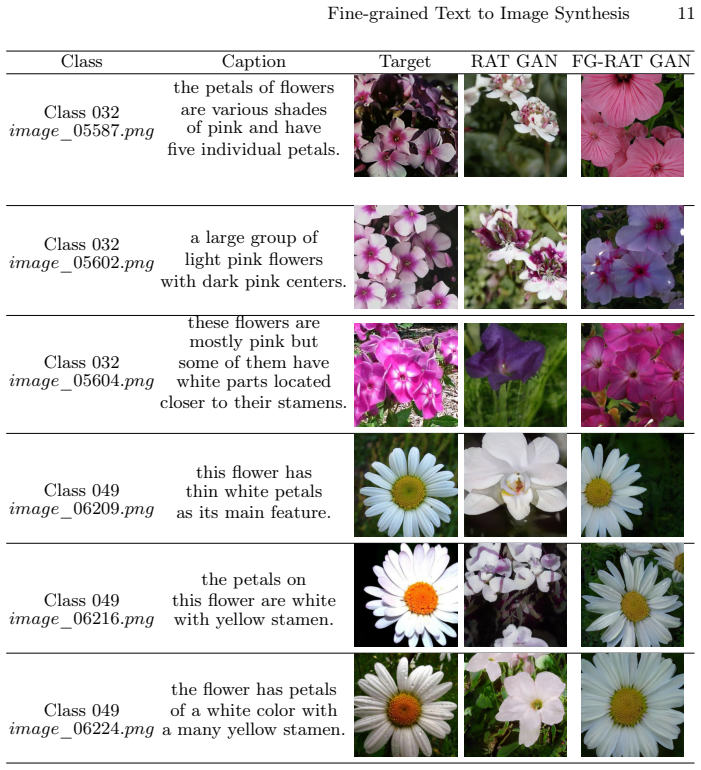
- [Section 4.4 and Appendix 6.1] The qualitative comparisons against DALL-E 2 and Stable Diffusion in the appendix are based only on a few cherry-picked examples and are not accompanied by any quantitative evaluation or human-study protocol. The text 'we demonstrate that our FG-RAT GAN can reach better visualized results compared with DALLE-2 and Stable Diffusion' overstates what such figures can support.
Circularity Check
No significant circularity: the central FID claim is benchmarked externally and the proposed losses are not fitted to the metric.
full rationale
The paper's central claim is empirical: FG-RAT GAN obtains lower FID than LAFITE, VQ-Diffusion, and RAT GAN on CUB-200-2011 and Oxford-102 (Section 4.5, Table 1). These numbers are evaluated against external models with separately reported results, and FID/IS compare generated images to real-image feature statistics; neither metric is a re-packaged training loss or a fitted value from the model's own objective. The proposed components (auxiliary classifier and contrastive loss) are defined as training losses (Eqs. 1-4, 7-8), and the ablation in Table 2 attributes the FID change to those components. The loss definitions do not reduce by construction to the reported FID scores. Self-citations in Section 2 ([3], [18], [25], [26]) are related-work attributions and are not load-bearing for the main result; the backbone RAT GAN [7] and the XBM mechanism [17] are external works. The paper itself flags its dependence on fine-grained labels in the conclusion and asserts in Section 4.5 that label use is 'not an unfair advantage but a distinct characteristic of our model'; this is a potential experimental-design confound, but it is a soundness concern, not circularity. Likewise, the apparent sign inconsistency in the negative-pair term of Eqs. (3)-(4) is a correctness issue, not a derivation that assumes its own conclusion. No circular step is exhibited.
Assumptions & free parameters
free parameters (5)
- Contrastive loss margin alpha =
Not reported
- XBM memory size M =
Not reported
- Batch size N =
Not reported
- Epoch at which contrastive loss is enabled =
After several training epochs
- Loss weights for L_ce and L_cl =
Implicitly 1.0
assumptions (3)
- domain assumption Class labels are available for all training images and are used in both discriminator and generator losses.
- domain assumption FID computed on a single run is a reliable and stable measure of fine-grained synthesis quality.
- domain assumption Cosine similarity in the learned 256-dimensional embedding reflects fine-grained subclass similarity.
Cite this review
Pith. "Pith review of Fine-grained Text to Image Synthesis." pith.science (2026). https://pith.science/paper/US5Q5QOD
@misc{pith2026241207196,
  author       = {Pith},
  title        = {Pith review of: Fine-grained Text to Image Synthesis},
  year         = {2026},
  howpublished = {\url{https://pith.science/paper/US5Q5QOD}},
  note         = {Machine review of arXiv:2412.07196}
}
read the original abstract
Fine-grained text to image synthesis involves generating images from texts that belong to different categories. In contrast to general text to image synthesis, in fine-grained synthesis there is high similarity between images of different subclasses, and there may be linguistic discrepancy among texts describing the same image. Recent Generative Adversarial Networks (GAN), such as the Recurrent Affine Transformation (RAT) GAN model, are able to synthesize clear and realistic images from texts. However, GAN models ignore fine-grained level information. In this paper we propose an approach that incorporates an auxiliary classifier in the discriminator and a contrastive learning method to improve the accuracy of fine-grained details in images synthesized by RAT GAN. The auxiliary classifier helps the discriminator classify the class of images, and helps the generator synthesize more accurate fine-grained images. The contrastive learning method minimizes the similarity between images from different subclasses and maximizes the similarity between images from the same subclass. We evaluate on several state-of-the-art methods on the commonly used CUB-200-2011 bird dataset and Oxford-102 flower dataset, and demonstrated superior performance.
Figures


Figures from the paper (3 more)


Reference graph
Works this paper leans on
- [18]
-
[1]
Goodfellow, I.J., Pouget-Abadie, J., Mirza, M., Xu, B., Warde-Farley, D., Ozair, S., Courville, A., Bengio, Y.: Generative adversarial nets. In: Proceedings of the 27th International Conference on Neural Information Processing Systems (NIPS’14), pp. 2672–2680. MIT Press, Cambridge, MA, USA (2014)
work page 2014
-
[2]
In: Balcan, M.F., Weinberger, K.Q
Reed, S., Akata, Z., Yan, X., Logeswaran, L., Schiele, B., Lee, H.: Generative Ad- versarial Text to Image Synthesis. In: Balcan, M.F., Weinberger, K.Q. (eds.) Pro- ceedings of The 33rd International Conference on Machine Learning, vol. 48, pp. 1060–1069. PMLR, New York, New York, USA (2016)
work page 2016
-
[3]
In: 2018 24th International Conference on Pattern Recognition (ICPR), pp
Ouyang, X., Zhang, X., Ma, D., Agam, G.: Generating Image Sequence from De- scription with LSTM Conditional GAN. In: 2018 24th International Conference on Pattern Recognition (ICPR), pp. 2456–2461. IEEE, Beijing, China (2018)
work page 2018
-
[4]
In: 2018 IEEE/CVF Conference on Computer Vision and Pattern Recog- nition (CVPR), pp
Xu, T., Zhang, P., Huang, Q., Zhang, H., Gan, Z., Huang, X., He, X.: AttnGAN: Fine-Grained Text to Image Generation with Attentional Generative Adversarial Networks. In: 2018 IEEE/CVF Conference on Computer Vision and Pattern Recog- nition (CVPR), pp. 1316–1324. IEEE, Salt Lake City, UT, USA (2018)
work page 2018
-
[5]
In: 2022 IEEE/CVF Conference on Com- puter Vision and Pattern Recognition (CVPR), pp
Zhou, Y., Chen, H., Zhang, W., Sun, Z., He, X., Fan, Y.: Towards Language-Free Training for Text-to-Image Generation. In: 2022 IEEE/CVF Conference on Com- puter Vision and Pattern Recognition (CVPR), pp. 17886–17896. IEEE, New Or- leans, LA, USA (2022)
work page 2022
-
[6]
In: 2020 IEEE/CVF Conference on Computer Vision and Pattern Recognition (CVPR), pp
Karras, T., Laine, S., Aittala, M., Hellsten, J., Lehtinen, J., Aila, T.: Analyzing and Improving the Image Quality of StyleGAN. In: 2020 IEEE/CVF Conference on Computer Vision and Pattern Recognition (CVPR), pp. 8107–8116. IEEE (2020)
work page 2020
-
[7]
In: IEEE Transactions on Multimedia, vol
Ye, S., Wang, H., Tan, M., Liu, F.: Recurrent Affine Transformation for Text-to- Image Synthesis. In: IEEE Transactions on Multimedia, vol. 26, pp. 462–473. IEEE (2024)
work page 2024
Show all 31 references
-
[8]
In: Proceedings of the 38th International Conference on Machine Learning, Proceedings of Machine Learning Research, vol
Ramesh, A., Pavlov, M., Goh, G., Gray, S., Voss, C., Radford, A., Chen, M., Sutskever, I.: Zero-Shot Text-to-Image Generation. In: Proceedings of the 38th International Conference on Machine Learning, Proceedings of Machine Learning Research, vol. 139, pp. 8821–8831. PMLR (2021)
2021
-
[9]
In: Advances in Neural Infor- mation Processing Systems, vol
Ding, M., Yang, Z., Hong, W., Zheng, W., Zhou, C., Yin, D., Lin, J., et al.: Cogview: Mastering text-to-image generation via transformers. In: Advances in Neural Infor- mation Processing Systems, vol. 34, pp. 19822–19835. (2021)
2021
-
[10]
In: Proceedings of the 31st International Conference on Neural Information Processing Systems (NIPS’17), pp
van den Oord, A., Vinyals, O., Kavukcuoglu, K.: Neural discrete representation learning. In: Proceedings of the 31st International Conference on Neural Information Processing Systems (NIPS’17), pp. 6309–6318. Curran Associates Inc., Red Hook, NY, USA (2017)
2017
-
[11]
arXiv preprint arXiv:2206.10789, vol
Yu,J.,Xu,Y.,Koh,J.Y.,Luong,T.,Baid,G.,Wang,Z.,Vasudevan,V.,etal.:Scal- ing autoregressive models for content-rich text-to-image generation. arXiv preprint arXiv:2206.10789, vol. 2, no. 3, p. 5 (2022)
2022 arXiv
-
[12]
arXiv preprint arXiv:2110.04627 (2021)
Yu, J., Li, X., Koh, J.Y., Zhang, H., Pang, R., Qin, J., Ku, A., Xu, Y., Baldridge, J., Wu, Y.: Vector-quantized image modeling with improved VQGAN. arXiv preprint arXiv:2110.04627 (2021)
2021 arXiv
-
[13]
arXiv preprint arXiv:2112.10741 (2021)
Nichol, A., Dhariwal, P., Ramesh, A., Shyam, P., Mishkin, P., McGrew, B., Sutskever, I., Chen, M.: Glide: Towards photorealistic image generation and editing with text-guided diffusion models. arXiv preprint arXiv:2112.10741 (2021)
2021 arXiv
-
[14]
In: 2022 IEEE/CVF Conference on Computer Vision and Pattern Recognition (CVPR), pp
Gu, S., Liu, Z., Ye, X., Lin, T., Wang, M., Cui, S., Liu, H., Liu, Y., Sun, C., Du, J., Hu, H.: Vector Quantized Diffusion Model for Text-to-Image Synthesis. In: 2022 IEEE/CVF Conference on Computer Vision and Pattern Recognition (CVPR), pp. 10686–10696. IEEE, New Orleans, LA,...
2022
-
[15]
arXiv preprint arXiv:2204.06125, vol
Ramesh, A., Dhariwal, P., Nichol, A., Chu, C., Chen, M.: Hierarchical text- conditional image generation with CLIP latents. arXiv preprint arXiv:2204.06125, vol. 1, no. 2, p. 3 (2022)
2022 arXiv
-
[16]
In: Proceedings of the 36th International Con- ference on Neural Information Processing Systems (NIPS ’22), Article 2643, pp
Saharia, C., Chan, W., Saxena, S., Lit, L., Whang, J., Denton, E., Seyed Ghasemipour, S.K., Karagol Ayan, B., Mahdavi, S.S., Gontijo-Lopes, R., Salimans, T., Ho, J., Fleet, D.J., Norouzi, M.: Photorealistic text-to-image diffusion models with deep language understanding. In: P...
2024
-
[17]
In: 2020 IEEE/CVF Conference on Computer Vision and Pattern Recognition (CVPR), pp
Wang, X., Zhang, H., Huang, W., Scott, M.R.: Cross-Batch Memory for Embed- ding Learning. In: 2020 IEEE/CVF Conference on Computer Vision and Pattern Recognition (CVPR), pp. 6387–6396. IEEE, Seattle, WA, USA (2020)
2020
-
[19]
In: Proceedings of the 30th International Conference on Neural Information Processing Systems (NIPS’16), pp
Salimans, T., Goodfellow, I., Zaremba, W., Cheung, V., Radford, A., Chen, X.: Improved techniques for training GANs. In: Proceedings of the 30th International Conference on Neural Information Processing Systems (NIPS’16), pp. 2234–2242. Curran Associates Inc., Red Hook, NY, USA (2016)
2016
-
[20]
In: Proceedings of the 30th International Conference on Neural Information Processing Systems (NIPS’16), pp
Chen, X., Duan, Y., Houthooft, R., Schulman, J., Sutskever, I., Abbeel, P.: Info- GAN: interpretable representation learning by information maximizing generative adversarial nets. In: Proceedings of the 30th International Conference on Neural Information Processing Systems (NI...
2016
-
[21]
In: Proceedings of the 30th International Conference on Neural Information Processing Systems (NIPS’16), pp
Nguyen, A., Dosovitskiy, A., Yosinski, J., Brox, T., Clune, J.: Synthesizing the preferred inputs for neurons in neural networks via deep generator networks. In: Proceedings of the 30th International Conference on Neural Information Processing Systems (NIPS’16), pp. 3395–3403....
2016
-
[22]
In: Proceedings of the 34th International Conference on Machine Learning (ICML’17), vol
Odena,A.,Olah,C.,Shlens,J.:Conditionalimagesynthesiswithauxiliaryclassifier GANs. In: Proceedings of the 34th International Conference on Machine Learning (ICML’17), vol. 70, pp. 2642–2651. JMLR.org (2017)
2017
-
[23]
arXiv preprint arXiv:2107.02423 (2021)
Ye, H., Yang, X., Takac, M., Sunderraman, R., Ji, S.: Improving text-to-image synthesis using contrastive learning. arXiv preprint arXiv:2107.02423 (2021)
2021 arXiv
-
[24]
arXiv preprint arXiv:1703.06412 (2017)
Dash, A., Gamboa, J.C.B., Ahmed, S., Liwicki, M., Afzal, M.Z.: Tac-gan-text conditioned auxiliary classifier generative adversarial network. arXiv preprint arXiv:1703.06412 (2017)
2017 arXiv
-
[25]
Ouyang, Y
X. Ouyang, Y. Chen and G. Agam: Accelerated WGAN update strategy with loss change rate balancing, 2021 IEEE Winter Conference on Applications of Computer Vision (WACV), pp. 2545-2554, Waikoloa, HI, USA. (2020)
2020
-
[26]
Ouyang, Y
X. Ouyang, Y. Chen, K. Zhu and G. Agam: Image restoration refinement with Uformer GAN, 2024 IEEE/CVF Conference on Computer Vision and Pattern Recognition Workshops (CVPRW), pp. 5919-5928, Seattle, WA, USA. (2024)
2024
-
[27]
In: 2021 IEEE/CVF Conference on Com- puter Vision and Pattern Recognition (CVPR), pp
Zhang, H., Koh, J.Y., Baldridge, J., Lee, H., Yang, Y.: Cross-Modal Contrastive Learning for Text-to-Image Generation. In: 2021 IEEE/CVF Conference on Com- puter Vision and Pattern Recognition (CVPR), pp. 833–842. IEEE, Nashville, TN, USA (2021)
2021
-
[28]
In: 2019 IEEE/CVF Conference on Computer Vision 16 X
Yin, G., Liu, B., Sheng, L., Yu, N., Wang, X., Shao, J.: Semantics Disentangling for Text-To-Image Generation. In: 2019 IEEE/CVF Conference on Computer Vision 16 X. Ouyang et al. and Pattern Recognition (CVPR), pp. 2322–2331. IEEE, Long Beach, CA, USA (2019)
2019
-
[29]
In: Advances in Neural Information Pro- cessing Systems 29: Annual Conference on Neural Information Processing Systems 2016, pp
Salimans, T., Goodfellow, I.J., Zaremba, W., Cheung, V., Radford, A., Chen, X.: Improved Techniques for Training GANs. In: Advances in Neural Information Pro- cessing Systems 29: Annual Conference on Neural Information Processing Systems 2016, pp. 2226–2234. (2016)
2016
-
[30]
Journal of Multivariate Analysis, vol
Dowson, D.C., Landau, B.V.: The Fréchet distance between multivariate normal distributions. Journal of Multivariate Analysis, vol. 12, no. 3, pp. 450–455. (1982)
1982
-
[31]
arXiv preprint arXiv:1801.01973
Barratt, S., Sharma, R.: A Note on the Inception Score. arXiv preprint arXiv:1801.01973. (2018). 6 Appendix 6.1 Comparision results We compare with the DALLE-2 and Stable Diffusion which are the most popu- lar models for text to image synthesis task. Since neither DALLE-2 nor ...
2018 arXiv
Reviewed August 11, 2026 · model on record in the stance chip above.
Discussion (0). Continue with ORCID to comment.