REVIEW 3 major objections 5 minor 29 references
"So what if I used GenAI?" -- Implications of Using Cloud-based GenAI in Software Engineering Research
T0 review · 3 major / 5 minor · reviewed 2026-08-11 · deepseek-v4-flash
Pith's one-line read Software engineering researchers who use free-tier cloud-based GenAI expose themselves to data-protection and copyright liability, and this paper's proposed checklist is designed to make those risks visible and avoidable.
desk verdict A sincere but unvalidated checklist paper: the GATE checklist is a plausible awareness instrument, but the central claim that it can guide legal self-assessment is not backed by evidence. read the letter →
The pith
A machine-rendered reading of the paper's core claim, the machinery that carries it, and where it could break.
The reading
What carries the argument
The central object is the GATE checklist (Generative AI Transparency & Accountability Evaluation), a two-part yes/no questionnaire. The transparency assessment covers data legality, output ownership, regulatory compliance, and licensing compatibility; the accountability assessment covers GenAI usage declaration, output attribution, compliance statement, GenAI contribution, authorship, and open-science acknowledgment. The checklist carries the argument by turning scattered legal and ethical warnings into concrete self-audit steps a researcher can answer before publishing, which is what gives the paper's risk list its practical force.
What would settle it
A validation study in which software engineering researchers apply the GATE checklist to realistic GenAI-use scenarios and their risk identifications are compared with an independent legal expert's assessment would settle the claim; if checklist users are no more accurate than non-users in spotting privacy, copyright, and licensing problems, the paper's central claim fails.
Extended reading notes
Core claim
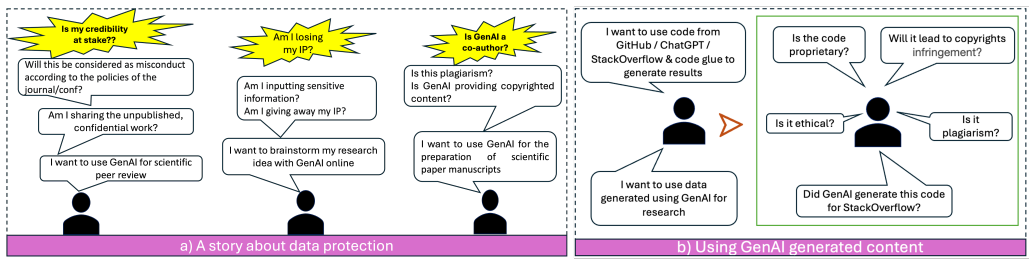
The paper's claim is that the main legal risks of using cloud-based GenAI in software engineering research are data protection and copyright, compounded by licensing incompatibilities, academic-integrity concerns, and an evolving regulatory landscape. To address these, it proposes the GATE checklist, which separates transparency items—whether the data source is legally compliant, whether output ownership is clear, whether the research complies with AI regulations, and whether licenses are compatible—from accountability items—whether GenAI usage is disclosed, whether outputs are attributed, whether a compliance statement is included, whether GenAI's contribution is documented, whether researchers are credited, and whether source code and reused repositories are acknowledged. The paper presents this as an awareness and guidance instrument rather than a validated procedure; its evidence base is the cited terms of service, conference policies, legal analyses, and prior checklist practice.
Load-bearing premise
The checklist's usefulness depends on researchers being able to answer its yes/no questions correctly—whether a dataset is legally compliant, whether output ownership is clear, whether open-source licenses are compatible—without specialized legal help, and on the paper's descriptions of terms of service and regulations being accurate and current.
Editorial extensions
If this is right
- Researchers who work through the checklist will document data legality and output ownership before relying on cloud GenAI, reducing their exposure to data-protection and copyright liability.
- The transparency half pushes researchers to check terms of service, regulations such as GDPR or the EU AI Act, and license compatibility before combining GenAI output with open-source code.
- The accountability half commits researchers to disclosing GenAI use, attributing outputs, and crediting human authors, aligning with emerging conference and publisher disclosure policies.
- Because the checklist is product-agnostic, it applies to any cloud-based free-tier or enterprise GenAI service, and the paper positions it as a foundation for future work on legal and ethical evaluation in SE research.
Reading between the lines
- The checklist's practical value could be tested empirically by measuring inter-rater agreement among researchers using it, or by comparing their risk judgments to a legal expert's assessment on realistic scenarios; the paper does not report such a validation.
- A natural extension is to link each checklist item to the relevant clause of a service agreement or to the text of a specific regulation, since the paper leaves evidence-gathering entirely to the researcher.
- Because terms of service and regulations change quickly, the checklist would need a versioning or review mechanism to remain accurate; the paper acknowledges regulatory evolution but does not build one in.
- If the checklist changes behavior, an indirect consequence would be more uniform disclosure statements in software engineering papers, making GenAI use in research more auditable over time.
Signed reviews
Editorial analysis
A structured set of objections, weighed in public.
Referee Report
Summary. The paper discusses legal and ethical risks of using cloud-based generative AI in software engineering research, focusing on data protection, copyright, licensing, academic integrity, and evolving AI regulations. It reports a high-level analysis of Stack Exchange questions, summarizes risks from the literature and current terms of service, and proposes the GATE checklist (Table II) containing transparency and accountability items. The paper concludes that this checklist can guide researchers in evaluating the legal and ethical implications of using GenAI products in research.
Significance. If validated, a lightweight checklist for researchers using cloud-based GenAI would be a useful contribution in a field where GenAI adoption is outpacing guidance. The paper names concrete risks such as training-data reuse, copyright lawsuits, and licensing incompatibility, and it usefully separates transparency concerns from accountability concerns. Its strengths are the breadth of issues it brings together and the clearly structured checklist. The paper does not claim empirical validation; it is essentially an awareness-raising position paper. However, the central claim that the checklist can guide researchers depends on assumptions that are not tested, so the contribution is currently a proposal rather than an established tool.
major comments (3)
- [Table II, Section V] Several checklist items require legal conclusions rather than factual observations. Items such as 'Is the data source legally compliant?', 'Does the research comply with AI regulations?', and 'Is the licensing of GenAI outputs compatible?' ask a researcher to determine compliance with GDPR, HIPAA, the EU AI Act, IRB rules, and open-source licenses for a specific jurisdiction. The checklist provides no definitions, no jurisdictional qualifiers, no decision procedure, and no 'do not know / seek advice' option. A novice or budding researcher, the paper's stated target audience, cannot reliably answer these items. If a user answers 'Yes' incorrectly, the checklist produces false reassurance; if 'No' incorrectly, it produces false alarms. The conclusion in Section V that the checklist 'can guide researchers in evaluating legal and ethical implications' is therefore not established by the manuscript. Adding explicit pointers to regulations, a 'seek expert advice' option, and a worked example would substantially strengthen the claim.
- [Section I, Motivation] The Stack Exchange analysis used to motivate the paper is informal and insufficiently documented. The manuscript reports counts such as 45,000 questions, over 2,000 ethics questions, 960 on plagiarism, 180 on research misconduct, 45 with the Generative-AI tag, and 81 law/AI questions, but it does not give search queries, date ranges, inclusion criteria, or a description of how the tags were selected. The interpretation that low tag counts indicate 'little interest' in copyright and licensing issues is not supported by tag counts alone, since users may discuss these topics without using a specific tag. This evidence is load-bearing for the motivation, so the lack of method weakens the paper's rationale.
- [Section III, Table II] The GATE checklist is not evaluated at all. There is no pilot study, no expert legal review, no application to a worked example, and no comparison with existing SE or legal checklists, even though the paper cites related checklists in Section III and related work. For a paper whose central contribution is a checklist, some form of validation or at least a detailed worked application is needed to support the claim that the checklist can guide researchers. Without this, the checklist remains an untested proposal.
minor comments (5)
- [Throughout] The manuscript contains many typos and grammatical errors, including 'gereral', 'Well aclaimed', 'thier', 'conversatioal', 'upraor', and 'highlightes'. A thorough language edit is needed before publication.
- [Section II, Copyright and Intellectual Property] The 'Copyright and Intellectual Property' paragraph largely repeats the earlier 'Licensing Issues' paragraph, including the same Stack Overflow moderator observation. The duplication should be removed and the distinct legal points clarified.
- [Section II, Evolving AI regulations] The sentence beginning 'OpenAI TOS policies on their website [13] says the content co-authored with the OpenAI API policy...' is grammatically unclear and confuses OpenAI's general terms of use with its API content policy. Since the legal content is central to the paper, these sources should be quoted and cited precisely.
- [Table I] The claim that enterprise models provide 'Guaranteed privacy' is stated without qualification or citation, and 'free-tier' data retention is described only as 'may be retained for model improvements.' These are important distinctions for researchers and should be supported with references to current terms of service.
- [Section III] The paper says 'Wieringa et al. [22] developed a checklist,' but reference [22] is a single-author paper. Please verify the attribution.
Circularity Check
No significant circularity: the paper proposes a checklist synthesized from external legal sources and prior work, and it makes no prediction that reduces to its own inputs.
full rationale
The paper's central artifact is the GATE checklist, a set of transparency and accountability questions in Table II. Its derivation chain consists of summarizing risks (data privacy, licensing, academic integrity, copyright, evolving regulations) from external references such as OpenAI's terms of service, Stack Overflow policies, the GitHub Copilot litigation, and prior checklist literature. There is no fitted parameter, no empirical model, and no prediction that is statistically forced by construction. The checklist's items are not defined in terms of the paper's own conclusion; rather, the conclusion that the checklist 'can guide researchers' is an assertion of utility, not a result derived from the checklist itself. The cited sources are mostly third-party policies and legal discussions, and none of the load-bearing references reduce to the present paper's own claims. The paper is self-citation-free in the relevant sense: the author does not invoke a prior uniqueness theorem or imported ansatz to make a forced choice. Weaknesses such as the checklist's unvalidated reliability, the lack of legal-expert review, and the difficulty of answering yes/no legal questions are validity and usefulness concerns, not circularity concerns. Under the stated rules, a non-circular but under-supported proposal receives score 0, so this is reported accordingly.
Assumptions & free parameters
assumptions (3)
- domain assumption Free-tier cloud GenAI services may use user inputs for model training unless users opt out.
- domain assumption Existing legal frameworks such as GDPR, copyright law, and the EU AI Act apply to GenAI outputs and research use in the way described.
- domain assumption Checklists are an effective intervention for guiding human behavior, by analogy to aviation and medicine.
Cite this review
Pith. "Pith review of "So what if I used GenAI?" -- Implications of Using Cloud-based GenAI in Software Engineering Research." pith.science (2026). https://pith.science/paper/ZF2JGDXO
@misc{pith2026241207221,
  author       = {Pith},
  title        = {Pith review of: "So what if I used GenAI?" -- Implications of Using Cloud-based GenAI in Software Engineering Research},
  year         = {2026},
  howpublished = {\url{https://pith.science/paper/ZF2JGDXO}},
  note         = {Machine review of arXiv:2412.07221}
}
read the original abstract
Generative Artificial Intelligence (GenAI) advances have led to new technologies capable of generating high-quality code, natural language, and images. The next step is to integrate GenAI technology into various aspects while conducting research or other related areas, a task typically conducted by researchers. Such research outcomes always come with a certain risk of liability. This paper sheds light on the various research aspects in which GenAI is used, thus raising awareness of its legal implications to novice and budding researchers. In particular, there are two risks: data protection and copyright. Both aspects are crucial for GenAI. We summarize key aspects regarding our current knowledge that every software researcher involved in using GenAI should be aware of to avoid critical mistakes that may expose them to liability claims and propose a checklist to guide such awareness.
Figures

Reference graph
Works this paper leans on
-
[1]
Hints for generative ai software development,
C. Ebert, J. P. Arockiasamy, L. Hettich, and M. Weyrich, “Hints for generative ai software development,” IEEE Software , vol. 41, no. 5, pp. 24–33, 2024
work page 2024
-
[2]
Generative ai for software practitioners,
C. Ebert and P. Louridas, “Generative ai for software practitioners,” IEEE Software, vol. 40, no. 4, pp. 30–38, 2023
work page 2023
-
[3]
Open-source llms vs closed: Unbiased guide for innovative companies [2025]
“Open-source llms vs closed: Unbiased guide for innovative companies [2025].” https://hatchworks.com/blog/gen-ai/ open-source-vs-closed-llms-guide/. (Accessed on 12/06/2024)
work page 2025
-
[4]
Open-source llm vs closed source llm for enterprises
“Open-source llm vs closed source llm for enterprises.” https:// datasciencedojo.com/blog/open-source-llm/. (Accessed on 12/06/2024)
work page 2024
-
[5]
Chatgpt alternative solutions: Large language models survey,
H. Alipour, N. Pendar, and K. Roy, “Chatgpt alternative solutions: Large language models survey,” arXiv preprint arXiv:2403.14469 , 2024
arXiv 2024
-
[6]
S. Wang, T.-H. Chen, and A. E. Hassan, “Understanding the factors for fast answers in technical q&a websites: An empirical study of four stack exchange websites,” Empirical Software Engineering, vol. 23, pp. 1552– 1593, 2018
work page 2018
-
[7]
Legal implications of using generative ai in the media,
J. Bayer, “Legal implications of using generative ai in the media,” Information & Communications Technology Law, vol. 33, no. 3, pp. 310– 329, 2024
work page 2024
-
[8]
M. M ¨”arz, M. Himmelbauer, K. Boldt, and A. Oksche, “Legal aspects of generative artificial intelligence and large language models in exami- nations and theses,” GMS Journal for Medical Education , vol. 41, no. 4, p. Doc47, 2024
work page 2024
Show all 29 references
-
[9]
The potential and concerns of using ai in scientific research: Chatgpt performance evaluation,
Z. N. Khlaif, A. Mousa, M. K. Hattab, J. Itmazi, A. A. Hassan, M. Sanmugam, and A. Ayyoub, “The potential and concerns of using ai in scientific research: Chatgpt performance evaluation,” JMIR Medical Education, vol. 9, p. e47049, 2023
2023
-
[10]
A survey of generative ai applications,
R. Gozalo-Brizuela, “A survey of generative ai applications,” Cornell University, 2023
2023
-
[11]
Galactica: A large language model for science,
R. Taylor, M. Kardas, G. Cucurull, T. Scialom, A. Hartshorn, E. Saravia, A. Poulton, V . Kerkez, and R. Stojnic, “Galactica: A large language model for science,” arXiv preprint arXiv:2211.09085 , 2022
2022 arXiv
-
[12]
Solv- ing quantitative reasoning problems with language models,
A. Lewkowycz, A. Andreassen, D. Dohan, E. Dyer, H. Michalewski, V . Ramasesh, A. Slone, C. Anil, I. Schlag, T. Gutman-Solo,et al., “Solv- ing quantitative reasoning problems with language models,” Advances in Neural Information Processing Systems , vol. 35, pp. 3843–3857, 2022
2022
-
[13]
Terms of use — openai
“Terms of use — openai.” https://openai.com/policies/ row-terms-of-use/. (Accessed on 12/05/2024)
2024
-
[14]
Usefulness of llms as an author checklist assistant for scientific papers: Neurips’24 experiment,
A. Goldberg, I. Ullah, T. G. H. Khuong, B. K. Rachmat, Z. Xu, I. Guyon, and N. B. Shah, “Usefulness of llms as an author checklist assistant for scientific papers: Neurips’24 experiment,” arXiv preprint arXiv:2411.03417, 2024
2024 arXiv
-
[15]
mathematics - is it plagiarism using an ai to do the bulk of my latex? - academia stack exchange
“mathematics - is it plagiarism using an ai to do the bulk of my latex? - academia stack exchange.” https://academia.stackexchange.com/questions/206563/ is-it-plagiarism-using-an-ai-to-do-the-bulk-of-my-latex. (Accessed on 12/06/2024)
2024
-
[16]
Policy: Generative ai (e.g., chatgpt) is banned - meta stack overflow
“Policy: Generative ai (e.g., chatgpt) is banned - meta stack overflow.” https://meta.stackoverflow.com/questions/421831/ policy-generative-ai-e-g-chatgpt-is-banned. (Accessed on 12/06/2024)
2024
-
[17]
Github copilot litigation · joseph saveri law firm & matthew butterick
“Github copilot litigation · joseph saveri law firm & matthew butterick.” https://githubcopilotlitigation.com/. (Accessed on 12/06/2024)
2024
-
[18]
Chatgpt and ai language tools banned by ai conference for writ- ing papers - the verge
“Chatgpt and ai language tools banned by ai conference for writ- ing papers - the verge.” https://www.theverge.com/2023/1/5/23540291/ chatgpt-ai-writing-tool-banned-writing-academic-icml-paper. (Ac- cessed on 12/06/2024)
2023
-
[19]
About cope — cope: Committee on publication ethics
“About cope — cope: Committee on publication ethics.” https:// publicationethics.org/about/our-organisation. (Accessed on 12/06/2024)
2024
-
[20]
Securing the future of genai: Policy and technology,
M. Christodorescu, R. Craven, S. Feizi, N. Gong, M. Hoffmann, S. Jha, Z. Jiang, M. S. Kamarposhti, J. Mitchell, J. Newman, et al. , “Securing the future of genai: Policy and technology,” Cryptology ePrint Archive , 2024
2024
-
[21]
Checklists to support decision-making in regression testing,
N. M. Minhas, J. B ¨orstler, and K. Petersen, “Checklists to support decision-making in regression testing,” Journal of Systems and Software , vol. 202, p. 111697, 2023
2023
-
[22]
Towards a unified checklist for empirical research in software engineering: first proposal,
R. Wieringa, “Towards a unified checklist for empirical research in software engineering: first proposal,” in 16th International Conference on Evaluation & Assessment in Software Engineering (EASE 2012) , pp. 161–165, IET, 2012
2012
-
[23]
Towards automation of checklist-based code- reviews,
F. Belli and R. Crisan, “Towards automation of checklist-based code- reviews,” in Proceedings of ISSRE’96: 7th International Symposium on Software Reliability Engineering , pp. 24–33, IEEE, 1996
1996
-
[24]
A state-of-the-practice release-readiness checklist for generative ai-based software products,
H. Patel, D. Boucher, E. Fallahzadeh, A. E. Hassan, and B. Adams, “A state-of-the-practice release-readiness checklist for generative ai-based software products,” arXiv preprint arXiv:2403.18958 , 2024
2024 arXiv
-
[25]
Future of software development with generative ai,
J. Sauvola, S. Tarkoma, M. Klemettinen, J. Riekki, and D. Doermann, “Future of software development with generative ai,” Automated Soft- ware Engineering, vol. 31, no. 1, p. 26, 2024
2024
-
[26]
Generative ai: Redefin- ing the future of software engineering,
A. Carleton, D. Falessi, H. Zhang, and X. Xia, “Generative ai: Redefin- ing the future of software engineering,” IEEE Software , vol. 41, no. 6, pp. 34–37, 2024
2024
-
[27]
Toward gen- eral design principles for generative ai applications,
J. D. Weisz, M. Muller, J. He, and S. Houde, “Toward gen- eral design principles for generative ai applications,” arXiv preprint arXiv:2301.05578, 2023
2023 arXiv
-
[28]
Copyright in generative deep learning,
G. Franceschelli and M. Musolesi, “Copyright in generative deep learning,” Data & Policy , vol. 4, p. e17, 2022
2022
-
[29]
Copyright protection in generative ai: A technical perspective,
J. Ren, H. Xu, P. He, Y . Cui, S. Zeng, J. Zhang, H. Wen, J. Ding, P. Huang, L. Lyu, et al. , “Copyright protection in generative ai: A technical perspective,” arXiv preprint arXiv:2402.02333 , 2024
2024 arXiv
Reviewed August 11, 2026 · model on record in the stance chip above.
Discussion (0). Continue with ORCID to comment.