REVIEW 2 major objections 6 minor 53 references
Filling Memory Gaps: Enhancing Continual Semantic Parsing via SQL Syntax Variance-Guided LLMs without Real Data Replay
T0 review · 2 major / 6 minor · reviewed 2026-08-11 · deepseek-v4-flash
Pith's one-line read Continual text-to-SQL can beat replay without any historical data by using SQL syntax gaps to guide an LLM's memory reconstruction.
desk verdict Smart, replay-free continual text-to-SQL with a skeleton-guided LLM memory, but the 'beyond upper bound' FWT claim is a resource-comparison artifact. read the letter →
The pith
A machine-rendered reading of the paper's core claim, the machinery that carries it, and where it could break.
The reading
What carries the argument
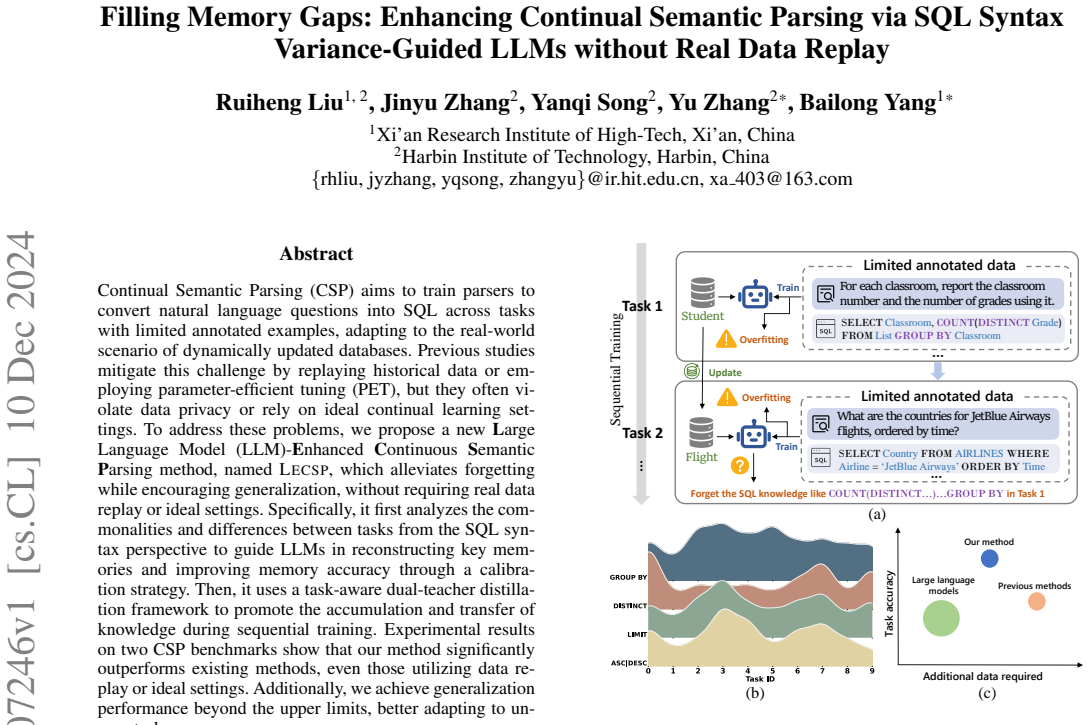
The load-bearing objects are the SQL skeleton and the component bias built from it. A SQL skeleton is a domain-erased query shape such as SELECT [COL] FROM [TAB] WHERE [COL] = [VAL] GROUP BY [COL], obtained by masking schema entities; the component bias $\Delta A^{(t)}$ selects skeletons present in the union of previous tasks' cluster-center sets but absent from the current task's set. The bias serves as the instruction to the LLM for what pseudo-sample memory to generate on the current schema, the calibration stage keeps only samples whose SQL executes and whose de-erased form is close to the target skeleton by edit distance, and the dual-teacher distillation propagates the resulting memory into the student while preserving agreement with the previous student's outputs.
What would settle it
Construct a task stream in which a past task's distinguishing SQL pattern (for example, COUNT(DISTINCT ...) with GROUP BY) appears in the training set but never lands close to any of the K cluster centers; if the student then forgets that pattern as badly as sequential fine-tuning, the claim that $\Delta A^{(t)}$ preserves the syntactically complete memory gap is falsified.
Extended reading notes
Core claim
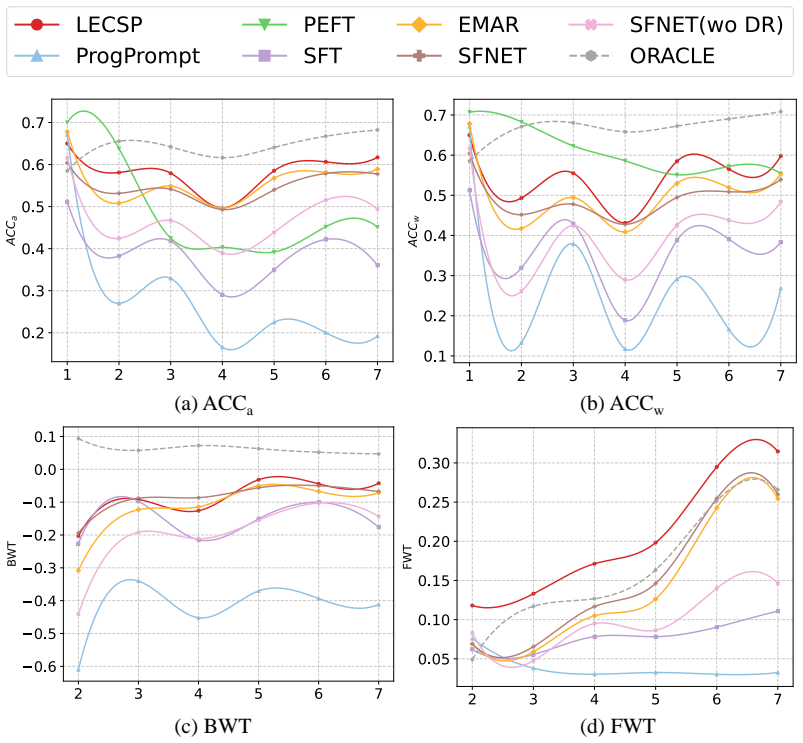
The paper's central discovery is that SQL syntax variance alone can serve as the memory signal in continual semantic parsing. For each task, LECSP erases database-specific entities from question-SQL pairs, clusters the resulting domain-agnostic skeletons with K-means on CodeT5 representations, and keeps K cluster-center skeletons as the task's component feature set $A^{(t)}$. The component bias $\Delta A^{(t)} = (A^{(1)} \cup A^{(2)} \cup \dots \cup A^{(t-1)}) - A^{(t)}$ consists of skeletons seen in earlier tasks but missing from the current task; prompting an LLM with $\Delta A^{(t)}$ and the current database schema produces pseudo question-SQL pairs that fill exactly those gaps. A calibration stage of iterative execution-checked self-correction and edit-distance sampling filters out hallucinated samples, and a task-aware dual-teacher distillation trains the student on original data, pseudo-memory, and KL agreement with the previous student. On Spider-stream-semi with T5-large, the method reaches 58.6 ACCa-EM without replay, versus 52.2 for SFNET with data replay, and its forward-transfer score 44.3 FWT-EX exceeds the ORACLE bound of 36.0.
Load-bearing premise
The method assumes that a limited set of typical SQL query shapes extracted from each task's training examples captures every piece of SQL knowledge the current task lacks, so prompting an LLM with those shapes can reconstruct the missing memory.
Editorial extensions
If this is right
- A continual semantic parser can retain historical task accuracy with zero stored real data, which matters when database contents are private or memory is constrained.
- Knowledge can transfer forward to unseen tasks without task identifiers at test time, because the memory is reconstructed from syntax rather than from per-task modules.
- The method is robust to cold-start task orders where the first task has few annotations, while prompt-based PET methods degrade sharply in that setting.
- Pseudo-memory quality, as measured by SQL execution success, is higher than self-training based pseudo-labels, so the calibration stage is essential to the gains.
- Only compact skeleton sets need to be saved across tasks, so the storage cost of remembering past tasks is small and does not grow with data size.
Reading between the lines
- If syntax-variance-driven memory reconstruction is the active ingredient, the same recipe should transfer to other structured generation streams, such as code generation, SPARQL, or JSON transformation, where task differences can be summarized by skeleton shapes.
- The forward-transfer scores above ORACLE suggest that the LLM teacher contributes knowledge beyond what the task annotations contain, so the true ceiling for a small parser is not the oracle trained only on task data; explicitly measuring teacher-only knowledge would make this explicit.
- A testable extension is to replace the cluster-center skeletons with an exhaustive syntax inventory derived from a grammar; if performance does not improve, the K-center approximation is already sufficient, and if it does, the paper's bias signal is currently under-sampling rare syntax.
Editorial analysis
A structured set of objections, weighed in public.
Referee Report
Summary. The paper proposes LECSP, a continual semantic parsing method that avoids replaying real historical data and does not rely on the ideal task-identity setting used by prompt-based continual learners. The method reconstructs pseudo-memories by (i) removing domain-specific information, (ii) clustering SQL skeletons per task via CodeT5, (iii) computing a syntax-level component bias between the current task and previous tasks, and (iv) prompting an open-source LLM (Mixtral-8x7B) to generate pseudo question-SQL pairs, which are then filtered by execution checks, LLM self-correction, and skeleton-based edit-distance sampling. A dual-teacher distillation framework trains a T5 student using the reconstructed memories, the previous student as a second teacher, and the current task's annotated data. Experiments on Spider-stream-semi and Combined-stream report that LECSP outperforms rehearsal and PET baselines in both warm-start and cold-start protocols, and the paper claims FWT performance beyond the ORACLE upper bound.
Significance. If the empirical results are robust, the paper makes a useful contribution: it demonstrates an effective no-replay, no-ideal-setting recipe for continual text-to-SQL by shifting the burden of memory reconstruction to an offline open-source LLM, and it provides a decomposition (inter-task skeleton completion, intra-task CFG augmentation, calibration, and distillation) with ablations showing that each component matters. The cold-start experiments and the memory-size comparison are valuable additions to the CSP evaluation landscape. However, the headline claim of surpassing an upper bound is overstated, and the absence of variance reporting makes the word 'significantly' unsupported as stated. The core comparison against replay-based baselines remains credible and is the main strength of the paper.
major comments (2)
- [Section 2] The claim that ORACLE represents 'the performance upper bound for CSP' is used in Section 2 and in the discussion. As noted above, this is not a theorem; it is an empirical baseline. This should be stated and the 'beyond upper bound' language removed or carefully qualified.
- [Experiments, 'Quality and Quantity of Pseudo Samples'; Figure 5(a)] The quality comparison in Figure 5(a) appears to compare LECSP pseudo-samples (evaluated by manual inspection) with SFNET and Mixtral samples (evaluated using their original labels). This is an asymmetric evaluation: manual judgment may use different criteria than the automatic SQL execution used for the baselines. Please state clearly whether the same execution-based metric was applied to all three methods, or provide a human-evaluation protocol applied identically to all methods.
minor comments (6)
- [Abstract and throughout] The name is introduced as 'Continual Semantic Parsing' but the abstract first uses 'Continuous Semantic Parsing'; please ensure consistent terminology.
- [Methodology, 'Task-Aware Dual-Teacher Distillation learning Framework'] The heading has inconsistent capitalization ('learning' is lowercase); please polish the formatting.
- [Experiments, 'Comparison with ORACLE and LLMs'] The phrase 'exceeds most performance upper bound on FWT' is grammatically awkward and should be reworded, especially after the upper-bound concern is addressed.
- [Appendix B.1] The cold-start task orders are given as lists of indices [3, 5, 7, 0, 2, 6, 8, 4, 9, 1] and [3, 2, 4, 0, 6, 5, 1], but the original task names are not listed in the appendix; please provide a mapping to the original task domains for reproducibility.
- [Table 7] The hyperparameter ablation lists K=60, 70, 90 but not K=80, the value used in the main experiments; including K=80 would make the sensitivity curve complete.
- [Figure 1(c)] The caption says 'additional data required refers to extra historical data or unsupervised data', but the figure is not explicitly described in the text; please add a sentence in the Introduction explaining what the axes and symbols represent.
Circularity Check
No significant circularity: the pipeline is empirically benchmarked rather than defined into its outputs; the ORACLE 'upper bound' claim is a labeling/interpretation issue, not a circular reduction.
full rationale
LECSP's derivation chain is empirical and self-contained in the relevant sense. The component sets A(t) are produced by clustering CodeT5 representations of current-task samples (Eqs. 6-7); the component bias ΔA(t) is a set difference over SQL skeletons (Eq. 1); pseudo-samples are generated by prompting an external LLM with ΔA(t) and the current schema (Eq. 2); calibration filters by execution checks and edit distance; and the student is trained with the losses in Eqs. 3-5. None of these equations sets a predicted quantity equal to its own input by construction. The FWT values (e.g., LECSP 41.4/44.3 vs ORACLE 34.3/36.0 in Table 1) are measured on held-out test sets against independently implemented baselines. The 'beyond the upper limit' claim is not a circular derivation: ORACLE is called an upper bound in the Baselines section, but ORACLE's FWT is not a formal upper bound for a method with an external LLM teacher, and training on more prior-task data can even reduce forward transfer. This is a correctness/interpretation concern rather than a definitional reduction. The only self-citation found is Li et al. (2024) in Related Work, used for the incidental claim that closed-source LLMs hinder continual learning due to their black-box nature; it is not load-bearing for any central premise. No step meets the standard of a quoted equation-to-equation self-reduction.
Assumptions & free parameters
free parameters (6)
- K (number of cluster centers) =
80
- Nske (pseudo-samples per skeleton) =
10
- Ncfg (CFG-synthesized instances per annotated sample) =
3
- lambda (distillation weight) =
0.1
- M (max self-correction iterations) =
3
- R (top samples retained per skeleton) =
3
assumptions (4)
- domain assumption Tasks have disjoint database schemas: for i != j, S(Di) ∩ S(Dj) = ∅.
- domain assumption CodeT5 embeddings of (Qde, Z) provide a meaningful similarity space for K-means clustering of SQL syntax.
- domain assumption The LLM (e.g., Mixtral-8x7B) can generate faithful question/SQL pairs from simplified skeletons and a database schema, and can verify and correct its own outputs reliably.
- ad hoc to paper Representing each cluster by the SQL skeleton of the sample closest to its center (Eq. 7) is sufficient to capture that cluster's syntactic information.
Cite this review
Pith. "Pith review of Filling Memory Gaps: Enhancing Continual Semantic Parsing via SQL Syntax Variance-Guided LLMs without Real Data Replay." pith.science (2026). https://pith.science/paper/2ISWMLC2
@misc{pith2026241207246,
  author       = {Pith},
  title        = {Pith review of: Filling Memory Gaps: Enhancing Continual Semantic Parsing via SQL Syntax Variance-Guided LLMs without Real Data Replay},
  year         = {2026},
  howpublished = {\url{https://pith.science/paper/2ISWMLC2}},
  note         = {Machine review of arXiv:2412.07246}
}
read the original abstract
Continual Semantic Parsing (CSP) aims to train parsers to convert natural language questions into SQL across tasks with limited annotated examples, adapting to the real-world scenario of dynamically updated databases. Previous studies mitigate this challenge by replaying historical data or employing parameter-efficient tuning (PET), but they often violate data privacy or rely on ideal continual learning settings. To address these problems, we propose a new Large Language Model (LLM)-Enhanced Continuous Semantic Parsing method, named LECSP, which alleviates forgetting while encouraging generalization, without requiring real data replay or ideal settings. Specifically, it first analyzes the commonalities and differences between tasks from the SQL syntax perspective to guide LLMs in reconstructing key memories and improving memory accuracy through a calibration strategy. Then, it uses a task-aware dual-teacher distillation framework to promote the accumulation and transfer of knowledge during sequential training. Experimental results on two CSP benchmarks show that our method significantly outperforms existing methods, even those utilizing data replay or ideal settings. Additionally, we achieve generalization performance beyond the upper limits, better adapting to unseen tasks.
Figures


Figures from the paper (10 more)



Reference graph
Works this paper leans on
-
[1]
, " * write output.state after.block = add.period write newline
ENTRY address archivePrefix author booktitle chapter edition editor eid eprint howpublished institution isbn journal key month note number organization pages publisher school series title type volume year label extra.label sort.label short.list INTEGERS output.state before.all mid.sentence after.sentence after.block FUNCTION init.state.consts #0 'before.a...
-
[2]
write newline
" write newline "" before.all 'output.state := FUNCTION n.dashify 't := "" t empty not t #1 #1 substring "-" = t #1 #2 substring "--" = not "--" * t #2 global.max substring 't := t #1 #1 substring "-" = "-" * t #2 global.max substring 't := while if t #1 #1 substring * t #2 global.max substring 't := if while FUNCTION word.in bbl.in capitalize " " * FUNCT...
-
[3]
Androutsopoulos, I.; Ritchie, G. D.; and Thanisch, P. 1995. Natural language interfaces to databases--an introduction. Natural language engineering, 1(1): 29--81
work page 1995
-
[4]
Anil, R.; Dai, A. M.; Firat, O.; Johnson, M.; Lepikhin, D.; Passos, A.; Shakeri, S.; Taropa, E.; Bailey, P.; Chen, Z.; and et al., E. C. 2023. PaLM 2 Technical Report. arXiv:2305.10403
arXiv 2023
-
[5]
Bang, Y.; Cahyawijaya, S.; Lee, N.; Dai, W.; Su, D.; Wilie, B.; Lovenia, H.; Ji, Z.; Yu, T.; Chung, W.; Do, Q. V.; Xu, Y.; and Fung, P. 2023. A Multitask, Multilingual, Multimodal Evaluation of ChatGPT on Reasoning, Hallucination, and Interactivity. arXiv:2302.04023
arXiv 2023
-
[6]
Cai, Z.; Li, X.; Hui, B.; Yang, M.; Li, B.; Li, B.; Cao, Z.; Li, W.; Huang, F.; Si, L.; and Li, Y. 2022. STAR : SQL Guided Pre-Training for Context-dependent Text-to- SQL Parsing. In Goldberg, Y.; Kozareva, Z.; and Zhang, Y., eds., Findings of the Association for Computational Linguistics: EMNLP 2022, 1235--1247. Abu Dhabi, United Arab Emirates: Associati...
work page 2022
-
[7]
Chang, S.; and Fosler-Lussier, E. 2023 a . How to Prompt LLM s for Text-to- SQL : A Study in Zero-shot, Single-domain, and Cross-domain Settings. In NeurIPS 2023 Second Table Representation Learning Workshop
work page 2023
-
[8]
Chang, S.; and Fosler-Lussier, E. 2023 b . Selective Demonstrations for Cross-domain Text-to- SQL . In Bouamor, H.; Pino, J.; and Bali, K., eds., Findings of the Association for Computational Linguistics: EMNLP 2023, 14174--14189. Singapore: Association for Computational Linguistics
work page 2023
Show all 53 references
-
[9]
Chen, X.; Lin, M.; Sch \"a rli, N.; and Zhou, D. 2024. Teaching Large Language Models to Self-Debug. In The Twelfth International Conference on Learning Representations
2024
-
[10]
Chen, Y.; Guo, X.; Wu, T.; Qi, G.; Li, Y.; and Dong, Y. 2023 a . Learn from Yesterday: a semi-supervised continual learning method for supervision-limited text-to-SQL task streams. In Proceedings of the Thirty-Seventh AAAI Conference on Artificial Intelligence and Thirty-Fifth...
2023
-
[11]
Chen, Y.; Zhang, S.; Qi, G.; and Guo, X. 2023 b . Parameterizing Context: Unleashing the Power of Parameter-Efficient Fine-Tuning and In-Context Tuning for Continual Table Semantic Parsing. In Oh, A.; Neumann, T.; Globerson, A.; Saenko, K.; Hardt, M.; and Levine, S., eds., Adv...
2023
-
[12]
d'Autume, C. d. M.; Ruder, S.; Kong, L.; and Yogatama, D. 2019. Episodic memory in lifelong language learning. In Proceedings of the 33rd International Conference on Neural Information Processing Systems. Red Hook, NY, USA: Curran Associates Inc
2019
-
[13]
Dou, L.; Gao, Y.; Pan, M.; Wang, D.; Che, W.; Lou, J.-G.; and Zhan, D. 2023. UniSAr: a unified structure-aware autoregressive language model for text-to-SQL semantic parsing. International Journal of Machine Learning and Cybernetics, 14(12): 4361--4376
2023
-
[14]
Guo, C.; Tian, Z.; Tang, J.; Li, S.; Wen, Z.; Wang, K.; and Wang, T. 2024. Retrieval-Augmented GPT-3.5-Based Text-to-SQL Framework with Sample-Aware Prompting and Dynamic Revision Chain. In Luo, B.; Cheng, L.; Wu, Z.-G.; Li, H.; and Li, C., eds., Neural Information Processing,...
2024
-
[15]
Guo, C.; Tian, Z.; Tang, J.; Wang, P.; Wen, Z.; Yang, K.; and Wang, T. 2023. Prompting GPT-3.5 for Text-to-SQL with De-semanticization and Skeleton Retrieval. In PRICAI 2023: Trends in Artificial Intelligence: 20th Pacific Rim International Conference on Artificial Intelligenc...
2023
-
[16]
Han, X.; Dai, Y.; Gao, T.; Lin, Y.; Liu, Z.; Li, P.; Sun, M.; and Zhou, J. 2020. Continual Relation Learning via Episodic Memory Activation and Reconsolidation. In Jurafsky, D.; Chai, J.; Schluter, N.; and Tetreault, J., eds., Proceedings of the 58th Annual Meeting of the Asso...
2020
-
[17]
He, J.; and Yao, X. 2002. From an individual to a population: An analysis of the first hitting time of population-based evolutionary algorithms. IEEE Transactions on Evolutionary Computation, 6(5): 495--511
2002
-
[18]
R.; Campello, R
Hruschka, E. R.; Campello, R. J.; Freitas, A. A.; et al. 2009. A survey of evolutionary algorithms for clustering. IEEE Transactions on systems, man, and cybernetics, Part C (applications and reviews), 39(2): 133--155
2009
-
[19]
Hsieh, C.-Y.; Li, C.-L.; Yeh, C.-k.; Nakhost, H.; Fujii, Y.; Ratner, A.; Krishna, R.; Lee, C.-Y.; and Pfister, T. 2023. Distilling Step-by-Step! Outperforming Larger Language Models with Less Training Data and Smaller Model Sizes. In Rogers, A.; Boyd-Graber, J.; and Okazaki, N...
2023
-
[20]
Hu, C.; Fu, J.; Du, C.; Luo, S.; Zhao, J.; and Zhao, H. 2023. ChatDB: Augmenting LLMs with Databases as Their Symbolic Memory. arXiv:2306.03901
2023 arXiv
-
[21]
J.; Madotto, A.; and Fung, P
Ji, Z.; Lee, N.; Frieske, R.; Yu, T.; Su, D.; Xu, Y.; Ishii, E.; Bang, Y. J.; Madotto, A.; and Fung, P. 2023. Survey of Hallucination in Natural Language Generation. ACM Comput. Surv., 55(12)
2023
-
[22]
Q.; Sablayrolles, A.; Roux, A.; Mensch, A.; Savary, B.; Bamford, C.; Chaplot, D
Jiang, A. Q.; Sablayrolles, A.; Roux, A.; Mensch, A.; Savary, B.; Bamford, C.; Chaplot, D. S.; de las Casas, D.; Hanna, E. B.; Bressand, F.; Lengyel, G.; Bour, G.; Lample, G.; Lavaud, L. R.; Saulnier, L.; Lachaux, M.-A.; Stock, P.; Subramanian, S.; Yang, S.; Antoniak, S.; Scao...
2024 arXiv
-
[23]
Jung, D.; Han, D.; Bang, J.; and Song, H. 2023. Generating Instance-level Prompts for Rehearsal-free Continual Learning. In 2023 IEEE/CVF International Conference on Computer Vision (ICCV), 11813--11823
2023
-
[24]
Lester, B.; Al-Rfou, R.; and Constant, N. 2021. The Power of Scale for Parameter-Efficient Prompt Tuning. In Moens, M.-F.; Huang, X.; Specia, L.; and Yih, S. W.-t., eds., Proceedings of the 2021 Conference on Empirical Methods in Natural Language Processing, 3045--3059. Online...
2021
-
[25]
Li, H.; Zhang, J.; Li, C.; and Chen, H. 2023 a . RESDSQL: decoupling schema linking and skeleton parsing for text-to-SQL. In Proceedings of the Thirty-Seventh AAAI Conference on Artificial Intelligence and Thirty-Fifth Conference on Innovative Applications of Artificial Intell...
2023
-
[26]
Li, H.; Zhang, J.; Liu, H.; Fan, J.; Zhang, X.; Zhu, J.; Wei, R.; Pan, H.; Li, C.; and Chen, H. 2024. CodeS: Towards Building Open-source Language Models for Text-to-SQL. Proc. ACM Manag. Data, 2(3)
2024
-
[27]
Li, J.; Hui, B.; Cheng, R.; Qin, B.; Ma, C.; Huo, N.; Huang, F.; Du, W.; Si, L.; and Li, Y. 2023 b . Graphix-T5: Mixing Pre-trained Transformers with Graph-Aware Layers for Text-to-SQL Parsing. Proceedings of the AAAI Conference on Artificial Intelligence, 37(11): 13076--13084
2023
-
[28]
Li, J.; Hui, B.; Qu, G.; Yang, J.; Li, B.; Li, B.; Wang, B.; Qin, B.; Geng, R.; Huo, N.; Zhou, X.; Chenhao, M.; Li, G.; Chang, K.; Huang, F.; Cheng, R.; and Li, Y. 2023 c . Can LLM Already Serve as A Database Interface? A BIg Bench for Large-Scale Database Grounded Text-to-SQL...
2023
-
[29]
Li, Z.; Qu, L.; and Haffari, G. 2021. Total Recall: a Customized Continual Learning Method for Neural Semantic Parsers. In Moens, M.-F.; Huang, X.; Specia, L.; and Yih, S. W.-t., eds., Proceedings of the 2021 Conference on Empirical Methods in Natural Language Processing, 3816...
2021
-
[30]
Lialin, V.; Goel, R.; Simanovsky, A.; Rumshisky, A.; and Shah, R. 2021. Update Frequently, Update Fast: Retraining Semantic Parsing Systems in a Fraction of Time. arXiv:2010.07865
2021 arXiv
-
[31]
Liang, Y.; Meng, F.; Wang, J.; Xu, J.; Chen, Y.; and Zhou, J. 2024. Continual Learning with Semi-supervised Contrastive Distillation for Incremental Neural Machine Translation. In Ku, L.-W.; Martins, A.; and Srikumar, V., eds., Proceedings of the 62nd Annual Meeting of the Ass...
2024
-
[32]
Mao, W.; Wang, R.; Guo, J.; Zeng, J.; Gao, C.; Han, P.; and Liu, C. 2024. Enhancing Text-to- SQL Parsing through Question Rewriting and Execution-Guided Refinement. In Ku, L.-W.; Martins, A.; and Srikumar, V., eds., Findings of the Association for Computational Linguistics ACL...
2024
-
[33]
L.; Almeida, D.; Altenschmidt, J.; Altman, S.; and Shyamal Anadkat, e
OpenAI; :; Achiam, J.; Adler, S.; Agarwal, S.; Ahmad, L.; Akkaya, I.; Aleman, F. L.; Almeida, D.; Altenschmidt, J.; Altman, S.; and Shyamal Anadkat, e. a. 2024. GPT-4 Technical Report. arXiv:2303.08774
2024 arXiv
-
[34]
Pourreza, M.; and Rafiei, D. 2023. DIN-SQL: Decomposed In-Context Learning of Text-to-SQL with Self-Correction. In Oh, A.; Neumann, T.; Globerson, A.; Saenko, K.; Hardt, M.; and Levine, S., eds., Advances in Neural Information Processing Systems, volume 36, 36339--36348. Curra...
2023
-
[35]
Qin, C.; and Joty, S. 2022. LFPT 5: A Unified Framework for Lifelong Few-shot Language Learning Based on Prompt Tuning of T5. In International Conference on Learning Representations
2022
-
[36]
Razdaibiedina, A.; Mao, Y.; Hou, R.; Khabsa, M.; Lewis, M.; and Almahairi, A. 2023. Progressive Prompts: Continual Learning for Language Models. In The Eleventh International Conference on Learning Representations
2023
-
[37]
Shazeer, N.; and Stern, M. 2018. Adafactor: Adaptive Learning Rates with Sublinear Memory Cost. In Dy, J.; and Krause, A., eds., Proceedings of the 35th International Conference on Machine Learning, volume 80 of Proceedings of Machine Learning Research, 4596--4604. PMLR
2018
-
[38]
Wang, D.; Dou, L.; Zhang, X.; Zhu, Q.; and Che, W. 2024 a . Improving Demonstration Diversity by Human-Free Fusing for Text-to-SQL. arXiv:2402.10663
2024 arXiv
-
[39]
Wang, L.; Zhang, X.; Li, Q.; Zhang, M.; Su, H.; Zhu, J.; and Zhong, Y. 2023 a . Incorporating neuro-inspired adaptability for continual learning in artificial intelligence. Nature Machine Intelligence, 5(12): 1356--1368
2023
-
[40]
Wang, L.; Zhang, X.; Su, H.; and Zhu, J. 2024 b . A Comprehensive Survey of Continual Learning: Theory, Method and Application. IEEE Transactions on Pattern Analysis and Machine Intelligence, 1--20
2024
-
[41]
Wang, L.; Zhang, X.; Yang, K.; Yu, L.; Li, C.; HONG, L.; Zhang, S.; Li, Z.; Zhong, Y.; and Zhu, J. 2022. Memory Replay with Data Compression for Continual Learning. In International Conference on Learning Representations
2022
-
[42]
Wang, X.; Zhang, S.; Qing, Z.; Shao, Y.; Gao, C.; and Sang, N. 2021 a . Self-Supervised Learning for Semi-Supervised Temporal Action Proposal. In 2021 IEEE/CVF Conference on Computer Vision and Pattern Recognition (CVPR), 1905--1914
2021
-
[43]
Wang, Y.; Wang, W.; Joty, S.; and Hoi, S. C. 2021 b . C ode T 5: Identifier-aware Unified Pre-trained Encoder-Decoder Models for Code Understanding and Generation. In Moens, M.-F.; Huang, X.; Specia, L.; and Yih, S. W.-t., eds., Proceedings of the 2021 Conference on Empirical ...
2021
-
[44]
Wang, Z.; Liu, Y.; Ji, T.; Wang, X.; Wu, Y.; Jiang, C.; Chao, Y.; Han, Z.; Wang, L.; Shao, X.; and Zeng, W. 2023 b . Rehearsal-free Continual Language Learning via Efficient Parameter Isolation. In Rogers, A.; Boyd-Graber, J.; and Okazaki, N., eds., Proceedings of the 61st Ann...
2023
-
[45]
Xiao, R.; Dong, Y.; Zhao, J.; Wu, R.; Lin, M.; Chen, G.; and Wang, H. 2023. F ree AL : Towards Human-Free Active Learning in the Era of Large Language Models. In Bouamor, H.; Pino, J.; and Bali, K., eds., Proceedings of the 2023 Conference on Empirical Methods in Natural Langu...
2023
-
[46]
Xue, S.; Jiang, C.; Shi, W.; Cheng, F.; Chen, K.; Yang, H.; Zhang, Z.; He, J.; Zhang, H.; Wei, G.; Zhao, W.; Zhou, F.; Qi, D.; Yi, H.; Liu, S.; and Chen, F. 2024. DB-GPT: Empowering Database Interactions with Private Large Language Models. arXiv:2312.17449
2024 arXiv
-
[47]
K.; Bansal, M.; and Xiang, B
Yadav, P.; Sun, Q.; Ding, H.; Li, X.; Zhang, D.; Tan, M.; Bhatia, P.; Ma, X.; Nallapati, R.; Ramanathan, M. K.; Bansal, M.; and Xiang, B. 2023. Exploring Continual Learning for Code Generation Models. In Rogers, A.; Boyd-Graber, J.; and Okazaki, N., eds., Proceedings of the 61...
2023
-
[48]
Yogatama, D.; de Masson d'Autume, C.; Connor, J.; Kocisky, T.; Chrzanowski, M.; Kong, L.; Lazaridou, A.; Ling, W.; Yu, L.; Dyer, C.; and Blunsom, P. 2019. Learning and Evaluating General Linguistic Intelligence. arXiv:1901.11373
2019 arXiv
-
[49]
V.; bailin wang; Tan, Y
Yu, T.; Wu, C.-S.; Lin, X. V.; bailin wang; Tan, Y. C.; Yang, X.; Radev, D.; richard socher; and Xiong, C. 2021. GraPPa: Grammar-Augmented Pre-Training for Table Semantic Parsing. In International Conference on Learning Representations
2021
-
[50]
Yu, T.; Zhang, R.; Yang, K.; Yasunaga, M.; Wang, D.; Li, Z.; Ma, J.; Li, I.; Yao, Q.; Roman, S.; Zhang, Z.; and Radev, D. 2018. S pider: A Large-Scale Human-Labeled Dataset for Complex and Cross-Domain Semantic Parsing and Text-to- SQL Task. In Riloff, E.; Chiang, D.; Hockenma...
2018
-
[51]
Zhao, W.; Wang, S.; Hu, Y.; Zhao, Y.; Qin, B.; Zhang, X.; Yang, Q.; Xu, D.; and Che, W. 2024. SAPT: A Shared Attention Framework for Parameter-Efficient Continual Learning of Large Language Models. arXiv:2401.08295
2024 arXiv
-
[52]
Zhong, R.; Yu, T.; and Klein, D. 2020. Semantic Evaluation for Text-to- SQL with Distilled Test Suites. In Webber, B.; Cohn, T.; He, Y.; and Liu, Y., eds., Proceedings of the 2020 Conference on Empirical Methods in Natural Language Processing (EMNLP), 396--411. Online: Associa...
2020
-
[53]
Zhong, V.; Xiong, C.; and Socher, R. 2018. Seq2 SQL : Generating Structured Queries From Natural Language Using Reinforcement Learning
2018
Reviewed August 11, 2026 · model on record in the stance chip above.
Discussion (0). Continue with ORCID to comment.