REVIEW 4 major objections 5 minor 63 references
PETALface: Parameter Efficient Transfer Learning for Low-resolution Face Recognition
T0 review · 4 major / 5 minor · reviewed 2026-08-11 · deepseek-v4-flash
Pith's one-line read Quality-weighted twin LoRA blocks adapt a frozen high-resolution face model to low-resolution surveillance data, beating full fine-tuning on TinyFace, BRIAR, and IJB-S while training only 0.48% of parameters.
desk verdict A useful PEFT-for-low-res-FR paper with a modest quality-weighted twin-LoRA idea, whose empirical claims need a validation split and cleaner reporting before the numbers can be trusted. read the letter →
The pith
A machine-rendered reading of the paper's core claim, the machinery that carries it, and where it could break.
The reading
What carries the argument
The load-bearing object is the adaptive twin-LoRA block: a pair of low-rank matrices $W_1$ and $W_2$ added in parallel to a frozen weight matrix $W_0$, with output $x_{\text{out}} = W_0 x + \alpha W_1 x + (1-\alpha) W_2 x$. LoRA, low-rank adaptation, confines updates to small trainable matrices (rank 8 on TinyFace, rank 32 on BRIAR), so the pre-trained weights stay untouched and the original knowledge is preserved. The weight $\alpha$ is derived from the off-the-shelf CNN-IQA score of the input through the piecewise-linear rule $\alpha = 0.5 \pm (\text{score} - t)$, with threshold $t$ set to the dataset mean plus one standard deviation; the paper intends this to create two constrained proxy encoders, one for high-resolution and one for low-resolution inputs, inside a single backbone. Placing the twin blocks at the attention qkv layers plus the final feature projection aligns the embedding space after adaptation, and the small parameter count (about 1.04M trainable parameters out of 213.67M, 0.48%) is what makes the transfer cheap.
What would settle it
Take a fixed PETALface model fine-tuned on BRIAR and re-run the same protocol with $\alpha$ clipped to [0,1]; if rank-1 on BRIAR or IJB-S does not drop on extreme-quality probes, the unbounded weighting is not carrying the claimed benefit. Separately, perturb CNN-IQA scores within their measurement noise, or replace CNN-IQA with BRISQUE or CR-FIQA as the ablation already does, and check whether TinyFace rank-1 moves monotonically with score fidelity; a non-monotone response would falsify the assumption that quality scores are a valid proxy for domain difference.
Extended reading notes
Core claim
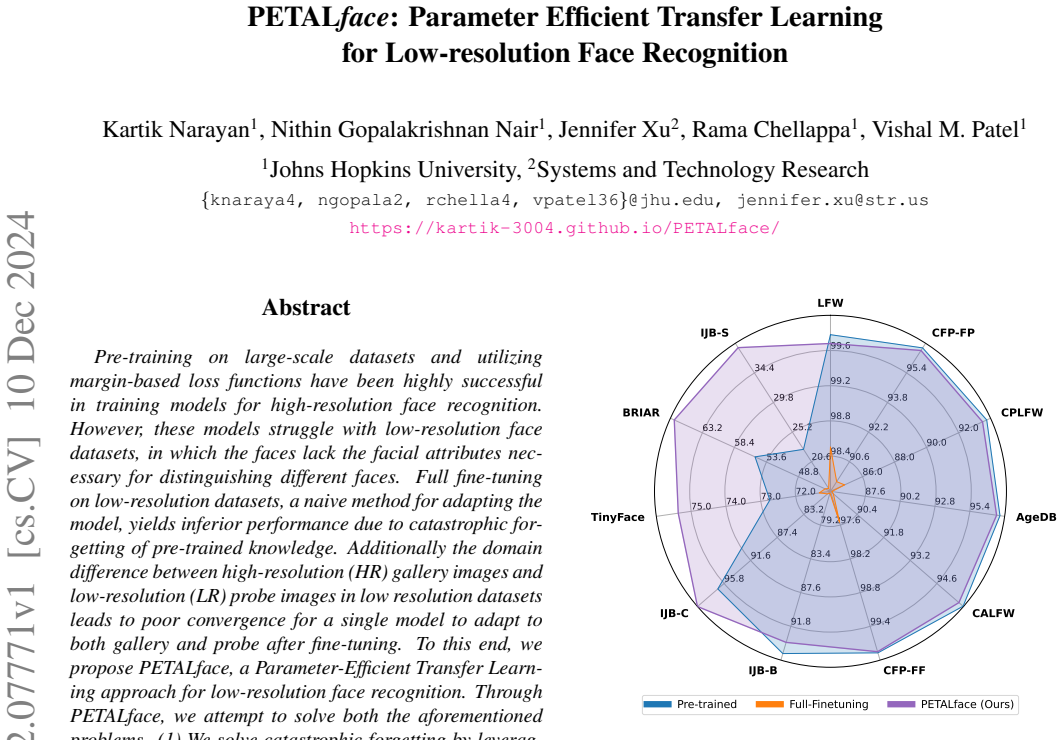
On the paper's own terms, the central discovery is that the resolution gap between gallery and probe is not a nuisance to be removed by super-resolution or shared fine-tuning but a domain difference that can be encoded by two low-rank interpolation paths inside one frozen network. PETALface places twin LoRA blocks beside the attention weights and the final feature projection; for each input, an off-the-shelf CNN-IQA score $q$ is converted into a weight $\alpha = 0.5 + (q - t)$, where $t$ is the mean-plus-one-standard-deviation quality threshold of the target dataset, and the layer output is $x_{\text{out}} = W_0 x + \alpha W_1 x + (1-\alpha) W_2 x$. This makes one LoRA block specialize toward high-quality gallery-like inputs and the other toward low-quality probe-like inputs, while the shared frozen backbone and shared final embedding layer keep both domains in one aligned space. The paper reports that this beats full fine-tuning on every low-resolution protocol tested, including a rank-1 rise from 73.31 to 75.72 on TinyFace and from 55.31 to 67.42 on BRIAR, and that the same model still scores near pre-trained levels on LFW, CFP-FP, AgeDB, IJB-B, and IJB-C.
Load-bearing premise
The central bet is that the off-the-shelf CNN-IQA score is a reliable, monotone measure of how far an input lies from the pre-trained high-resolution domain, so that $\alpha = 0.5 + (\text{score} - t)$ correctly separates gallery-like and probe-like inputs; the paper itself concedes in Section 7 that most IQA networks are not accurate and that $\alpha$ is a manually chosen heuristic, and it never clips $\alpha$ to (0,1) or validates extreme weights.
Editorial extensions
If this is right
- Pre-trained high-resolution face models can be repurposed for surveillance-quality recognition by training only about 0.48% of parameters, making adaptation feasible on small or private low-resolution datasets without paired high- and low-resolution images.
- Because the backbone stays frozen, the same model can serve high-resolution, mixed-quality, and low-resolution benchmarks at once, and the LoRA modules can be switched off to recover the original pre-trained model.
- Scaling pre-training data from WebFace4M to WebFace12M raises PETALface's TinyFace rank-1 from 75.72 to 76.66, so the method's ceiling tracks the quality of the base model rather than the small fine-tuning set.
- The twin-proxy design removes the need to train two separate encoders for gallery and probe, avoiding embedding-space misalignment while still giving each domain its own adaptation path.
- PETALface is presented as the first use of parameter-efficient transfer learning for low-resolution face recognition, and the reported gains over naive LoRA and full fine-tuning indicate that quality-adaptive weighting, not low-rank adaptation alone, is the source of the improvement.
Reading between the lines
- Editorial inference: the same quality-weighted twin-adapter mechanism should transfer to other recognition tasks with a systematic gallery/probe quality gap, such as person re-identification or vehicle/document recognition, wherever a cheap domain-appropriateness score exists.
- Editorial inference: because $\alpha$ is unclipped, extreme quality scores push the interpolation outside [0,1]; the paper does not test this regime, and a direct comparison against clipping $\alpha$ would show whether extrapolation is helping or hurting.
- Editorial inference: a stronger test of the proxy-encoder story would be to replace the generic CNN-IQA score with a utility-based score, such as predicted retrieval contribution or face-matching confidence, and check whether rank-1 accuracy tracks the score's fidelity rather than the score's raw value.
Editorial analysis
A structured set of objections, weighed in public.
Referee Report
Summary. The paper proposes PETALface, a parameter-efficient transfer learning approach for low-resolution face recognition. The method freezes a pre-trained transformer backbone and inserts two low-rank adaptation (LoRA) modules parallel to selected layers, with the contribution of each module weighted by an off-the-shelf no-reference image quality score of the input face. The authors claim that this twin-LoRA design creates separate proxy encoders for high- and low-resolution images while sharing a common embedding space, thereby avoiding catastrophic forgetting and handling the gallery/probe domain gap. Experiments cover fine-tuning on TinyFace and BRIAR, with evaluation on TinyFace, BRIAR, IJB-S, and standard high-resolution and mixed-quality benchmarks. The central claim is that PETALface outperforms full fine-tuning and static LoRA on low-resolution benchmarks while preserving performance on high-resolution datasets, using only 0.48% of the model parameters.
Significance. If the claims hold, the method offers a practical and parameter-efficient way to adapt large pre-trained face recognition models to low-resolution surveillance imagery, a setting where full fine-tuning is known to be unstable. The comparison against full fine-tuning is useful and the authors provide extensive experiments across multiple backbones, loss functions, and datasets. However, the significance is currently limited by two factors: the reported gains are small (e.g., 75.72 vs. 75.64 on TinyFace Rank-1) and may be inflated by test-set-based hyperparameter selection, and the paper compares only against pre-trained, full fine-tuning, and static LoRA baselines, not against existing low-resolution face recognition methods. The parameter-efficiency claim is also undermined by an apparent inconsistency in how the 0.48% figure is computed.
major comments (4)
- [§3.2 and §6 (Tables 3–5)] The LoRA placement, rank, and IQA network are selected using the TinyFace test set. The text states 'we tested different LoRA placements, as shown in Table 3, and chose the best performing configuration', and Table 4 ('Effect of LoRA rank') and Table 5 ('Effect of Image quality assessment') likewise report TinyFace test Rank-1 accuracy. No held-out validation split or cross-validation is described anywhere in the paper. Because the baselines (full fine-tuning and static LoRA) are evaluated with fixed/default settings, the reported improvements—especially the 75.72 vs. 75.64 margin over static LoRA—are not a fair comparison and may reflect test-set overfitting rather than the method's intrinsic merit. The paper needs a proper validation split for hyperparameter selection, with test performance reported only once.
- [Abstract and §6 (Table 3)] The claim of using 'only 0.48% of the parameters' is inconsistent with the twin-LoRA design. The 0.48% figure is taken from the single-LoRA 'Attention + Feature' row of Table 3 (1041k trainable parameters out of 213.67M). However, PETALface uses two LoRA modules per adapted layer, as shown in the AdaptiveLoRA code in Appendix A, so the actual number of trainable parameters for PETALface is roughly twice the single-LoRA value. The paper never reports the actual PETALface trainable-parameter count, and the efficiency comparison to full fine-tuning therefore rests on an undercount. Please report the true parameter count and update the abstract accordingly.
- [Related Work and §5] The paper claims state-of-the-art results (e.g., 'outperforming other state-of-the-art models on low-resolution benchmarks' and 'achieving SOTA results' in Table 1), but no comparison is made to any prior low-resolution face recognition method. The related work discusses super-resolution, distillation, and quality-adaptive approaches, yet the experiments only compare against pre-trained models, full fine-tuning, and static LoRA. Without empirical comparison to representative existing methods (e.g., super-resolution based, distillation based, or quality-adaptive recognition), the state-of-the-art claim is not established. Please either add such comparisons or temper the claim to be about the comparison to fine-tuning baselines.
- [§3.2, Eq. (1)] The weighting formula alpha = 0.5 + (q - t) for q > t and alpha = 0.5 - (t - q) for q < t is equivalent to alpha = 0.5 + q - t, which is unbounded. The text states the weight is 'a parameter in (0, 1)', but no clipping is applied. For quality scores far from the threshold t, alpha can be negative or greater than 1, which would invert or amplify the contribution of one LoRA branch. The paper should either clip alpha to (0,1) or provide evidence that extreme alpha values do not occur on the test datasets, with an analysis of the distribution of alpha.
minor comments (5)
- [§4.3] The text mentions 'Swin-N' but the intended architecture appears to be 'Swin-B'; please correct the typo.
- [Figure 1 caption] The caption uses 'PETAL face' while the method is called 'PETALface' throughout; please make the naming consistent.
- [§5.2] In the sentence 'with a FAR of 35.12, 55.35, and 75.43 at TAR of 0.01%, 0.1%, and 1%', the roles of FAR and TAR appear reversed; Table 2 reports TAR at given FAR values. Please correct the wording.
- [§6] The '0.48%' is described as 'only a 0.48% increase of total parameters', which is ambiguous; it should be stated as a fraction of total parameters, and the text should clarify that this is for the single-LoRA ablation, not the final PETALface model.
- [Algorithm 1 and Appendix A code] The set-builder notation in line 11 of Algorithm 1 has a formatting error ('p∋'), and the code condition 'if score[i] == threshold' is sensitive to floating-point equality; consider using a tolerance or comparing with <= and >=.
Circularity Check
No circularity: the quality-weighted LoRA design is empirically evaluated against external benchmarks, and no claimed result reduces by construction to its own inputs.
full rationale
PETALface is an empirical transfer-learning method: the paper freezes a pre-trained face-recognition backbone, adds two quality-weighted LoRA adapters, and measures recognition accuracy on TinyFace, BRIAR, IJB-S, and high/mixed-quality benchmarks. The weighting factor alpha is computed from an external off-the-shelf NR-IQA network (CNN-IQA) using a threshold t = mu + sigma estimated from training-set quality scores; it is not derived from recognition outputs, and it is not a fitted constant chosen to reproduce the reported metrics. The paper's claim that the twin LoRA blocks act as separate proxy encoders for high- and low-quality images is true by construction only in the weak sense that the alpha formula makes one branch dominate for extreme quality scores; whether this improves face recognition is an externally tested empirical question, not a tautology. The LoRA machinery and its low-rank motivation are cited from external prior work [16], and the only self-citations (e.g., CFP-FP [43] for a benchmark dataset) are not load-bearing for the method's central claim. The Limitation section explicitly concedes that the alpha heuristic is 'manually selected' and suggests a validation-set sweep as future work, which is an honest statement of an empirical design choice rather than a hidden circular step. The skeptic's concerns about choosing LoRA placement, rank, and the IQA network using TinyFace test-set accuracy, and about the '0.48% of parameters' figure apparently counting only a single static LoRA path, are experimental-validity and reporting issues; they do not make any prediction equivalent to its inputs by construction. No equation in the paper reduces the reported gain to the fitted threshold, and no load-bearing claim is justified only by a self-citation chain. Therefore the paper shows no significant circularity.
Assumptions & free parameters
free parameters (4)
- quality threshold t = mu + sigma =
approx. 75.7 for TinyFace (based on l=1000 random samples)
- LoRA rank r =
8 for TinyFace, 32 for BRIAR
- LoRA placement =
attention qkv layers plus final feature projection
- weighting formula constants =
0.5 baseline, unit slope
assumptions (4)
- domain assumption The pre-trained Swin-B model trained on WebFace4M/WebFace12M provides a strong feature representation for the target low-resolution datasets.
- domain assumption CNN-IQA scores are a reliable monotone indicator of the HR/LR domain difference and of recognition difficulty.
- domain assumption The TinyFace and BRIAR training sets contain enough signal to adapt the model to low-resolution faces.
- domain assumption LoRA low-rank updates preserve the frozen backbone's pre-trained knowledge while allowing task adaptation.
Cite this review
Pith. "Pith review of PETALface: Parameter Efficient Transfer Learning for Low-resolution Face Recognition." pith.science (2026). https://pith.science/paper/E7UDX4GG
@misc{pith2026241207771,
  author       = {Pith},
  title        = {Pith review of: PETALface: Parameter Efficient Transfer Learning for Low-resolution Face Recognition},
  year         = {2026},
  howpublished = {\url{https://pith.science/paper/E7UDX4GG}},
  note         = {Machine review of arXiv:2412.07771}
}
read the original abstract
Pre-training on large-scale datasets and utilizing margin-based loss functions have been highly successful in training models for high-resolution face recognition. However, these models struggle with low-resolution face datasets, in which the faces lack the facial attributes necessary for distinguishing different faces. Full fine-tuning on low-resolution datasets, a naive method for adapting the model, yields inferior performance due to catastrophic forgetting of pre-trained knowledge. Additionally the domain difference between high-resolution (HR) gallery images and low-resolution (LR) probe images in low resolution datasets leads to poor convergence for a single model to adapt to both gallery and probe after fine-tuning. To this end, we propose PETALface, a Parameter-Efficient Transfer Learning approach for low-resolution face recognition. Through PETALface, we attempt to solve both the aforementioned problems. (1) We solve catastrophic forgetting by leveraging the power of parameter efficient fine-tuning(PEFT). (2) We introduce two low-rank adaptation modules to the backbone, with weights adjusted based on the input image quality to account for the difference in quality for the gallery and probe images. To the best of our knowledge, PETALface is the first work leveraging the powers of PEFT for low resolution face recognition. Extensive experiments demonstrate that the proposed method outperforms full fine-tuning on low-resolution datasets while preserving performance on high-resolution and mixed-quality datasets, all while using only 0.48% of the parameters. Code: https://kartik-3004.github.io/PETALface/
Figures


Figures from the paper (2 more)


Reference graph
Works this paper leans on
-
[1]
Face description with local binary patterns: Application to face recognition
Timo Ahonen, Abdenour Hadid, and Matti Pietikainen. Face description with local binary patterns: Application to face recognition. IEEE transactions on pattern analysis and ma- chine intelligence, 28(12):2037–2041, 2006. 3
work page 2006
-
[2]
Belhumeur, Joao P Hespanha, and David J
Peter N. Belhumeur, Joao P Hespanha, and David J. Krieg- man. Eigenfaces vs. fisherfaces: Recognition using class specific linear projection. IEEE Transactions on pattern analysis and machine intelligence, 19(7):711–720, 1997. 3
1997
-
[3]
Cr-fiqa: face image quality assessment by learning sample relative classifiability
Fadi Boutros, Meiling Fang, Marcel Klemt, Biying Fu, and Naser Damer. Cr-fiqa: face image quality assessment by learning sample relative classifiability. In Proceedings of the IEEE/CVF Conference on Computer Vision and Pattern Recognition, pages 5836–5845, 2023. 8
work page 2023
-
[4]
One-for-all: Generalized lora for parameter- efficient fine-tuning
Arnav Chavan, Zhuang Liu, Deepak Gupta, Eric Xing, and Zhiqiang Shen. One-for-all: Generalized lora for parameter- efficient fine-tuning. arXiv preprint arXiv:2306.07967 ,
-
[5]
Adaptformer: Adapting vision transformers for scalable visual recogni- tion
Shoufa Chen, Chongjian Ge, Zhan Tong, Jiangliu Wang, Yibing Song, Jue Wang, and Ping Luo. Adaptformer: Adapting vision transformers for scalable visual recogni- tion. Advances in Neural Information Processing Systems , 35:16664–16678, 2022. 3
2022
-
[6]
Vision transformer adapter for dense predictions
Z Chen, Y Duan, W Wang, J He, T Lu, J Dai, and Y Qiao. Vision transformer adapter for dense predictions. arxiv 2022. arXiv preprint arXiv:2205.08534, 4, 2022. 3
arXiv 2022
-
[7]
Low- resolution face recognition
Zhiyi Cheng, Xiatian Zhu, and Shaogang Gong. Low- resolution face recognition. In Computer Vision–ACCV 2018: 14th Asian Conference on Computer Vision, Perth, Australia, December 2–6, 2018, Revised Selected Papers, Part III 14 , pages 605–621. Springer, 2019. 1, 2, 3, 5, 6, 8, 12
work page 2018
-
[8]
Expanding accurate person recognition to new altitudes and ranges: The briar dataset
David Cornett, Joel Brogan, Nell Barber, Deniz Aykac, Seth Baird, Nicholas Burchfield, Carl Dukes, Andrew Duncan, Regina Ferrell, Jim Goddard, et al. Expanding accurate person recognition to new altitudes and ranges: The briar dataset. In Proceedings of the IEEE/CVF Winter Conference on Applications of Computer Vision , pages 593–602, 2023. 2, 3, 5, 7, 12
work page 2023
Show all 63 references
-
[9]
Arcface: Additive angular margin loss for deep face recognition
Jiankang Deng, Jia Guo, Niannan Xue, and Stefanos Zafeiriou. Arcface: Additive angular margin loss for deep face recognition. In Proceedings of the IEEE/CVF con- ference on computer vision and pattern recognition , pages 4690–4699, 2019. 3, 6, 8
2019
-
[10]
Uniformface: Learn- ing deep equidistributed representation for face recognition
Yueqi Duan, Jiwen Lu, and Jie Zhou. Uniformface: Learn- ing deep equidistributed representation for face recognition. In Proceedings of the IEEE/CVF Conference on Computer Vision and Pattern Recognition, pages 3415–3424, 2019. 3
2019
-
[11]
Look one and more: Distilling hybrid order relational knowledge for cross-resolution image recognition
Shiming Ge, Kangkai Zhang, Haolin Liu, Yingying Hua, Shengwei Zhao, Xin Jin, and Hao Wen. Look one and more: Distilling hybrid order relational knowledge for cross-resolution image recognition. In Proceedings of the AAAI conference on artificial intelligence, volume 34, pages ...
2020
-
[12]
Low- resolution face recognition in the wild via selective knowl- edge distillation
Shiming Ge, Shengwei Zhao, Chenyu Li, and Jia Li. Low- resolution face recognition in the wild via selective knowl- edge distillation. IEEE Transactions on Image Processing , 28(4):2051–2062, 2018. 3
2018
-
[13]
Ms-celeb-1m: A dataset and benchmark for large-scale face recognition
Yandong Guo, Lei Zhang, Yuxiao Hu, Xiaodong He, and Jianfeng Gao. Ms-celeb-1m: A dataset and benchmark for large-scale face recognition. In Computer Vision–ECCV 2016: 14th European Conference, Amsterdam, The Nether- lands, October 11-14, 2016, Proceedings, Part III 14, pages 8...
2016
-
[14]
Parameter-efficient transfer learning for nlp
Neil Houlsby, Andrei Giurgiu, Stanislaw Jastrzebski, Bruna Morrone, Quentin De Laroussilhe, Andrea Gesmundo, Mona Attariyan, and Sylvain Gelly. Parameter-efficient transfer learning for nlp. In International conference on machine learning, pages 2790–2799. PMLR, 2019. 3
2019
-
[15]
Sigan: Siamese generative adversarial network for identity-preserving face hallucination
Chih-Chung Hsu, Chia-Wen Lin, Weng-Tai Su, and Gene Cheung. Sigan: Siamese generative adversarial network for identity-preserving face hallucination. IEEE Transactions on Image Processing, 28(12):6225–6236, 2019. 3
2019
-
[16]
Lora: Low-rank adaptation of large language models
Edward J Hu, Yelong Shen, Phillip Wallis, Zeyuan Allen- Zhu, Yuanzhi Li, Shean Wang, Lu Wang, and Weizhu Chen. Lora: Low-rank adaptation of large language models. arXiv preprint arXiv:2106.09685, 2021. 2, 3, 4, 5, 7, 8
2021 arXiv
-
[17]
Labeled faces in the wild: A database forstudying face recognition in unconstrained environments
Gary B Huang, Marwan Mattar, Tamara Berg, and Eric Learned-Miller. Labeled faces in the wild: A database forstudying face recognition in unconstrained environments. In Workshop on faces in’Real-Life’Images: detection, align- ment, and recognition, 2008. 1, 3, 5, 6
2008
-
[18]
Im- proving face recognition from hard samples via distribution distillation loss
Yuge Huang, Pengcheng Shen, Ying Tai, Shaoxin Li, Xi- aoming Liu, Jilin Li, Feiyue Huang, and Rongrong Ji. Im- proving face recognition from hard samples via distribution distillation loss. In Computer Vision–ECCV 2020: 16th Eu- ropean Conference, Glasgow, UK, August 23–28, 20...
2020
-
[19]
Curricularface: adaptive curriculum learning loss for deep face recognition
Yuge Huang, Yuhan Wang, Ying Tai, Xiaoming Liu, Pengcheng Shen, Shaoxin Li, Jilin Li, and Feiyue Huang. Curricularface: adaptive curriculum learning loss for deep face recognition. In proceedings of the IEEE/CVF con- ference on computer vision and pattern recognition , pages 5...
2020
-
[20]
Conan: Conditional neural aggregation network for unconstrained face feature fusion
Bhavin Jawade, Deen Dayal Mohan, Dennis Fedorishin, Sri- rangaraj Setlur, and Venu Govindaraju. Conan: Conditional neural aggregation network for unconstrained face feature fusion. In 2023 IEEE International Joint Conference on Bio- metrics (IJCB), pages 1–10. IEEE, 2023. 1
2023
-
[21]
Vi- 9 sual prompt tuning
Menglin Jia, Luming Tang, Bor-Chun Chen, Claire Cardie, Serge Belongie, Bharath Hariharan, and Ser-Nam Lim. Vi- 9 sual prompt tuning. In European Conference on Computer Vision, pages 709–727. Springer, 2022. 3
2022
-
[22]
Deep cnn denoiser and multi-layer neighbor com- ponent embedding for face hallucination
Junjun Jiang, Yi Yu, Jinhui Hu, Suhua Tang, and Jiayi Ma. Deep cnn denoiser and multi-layer neighbor com- ponent embedding for face hallucination. arXiv preprint arXiv:1806.10726, 2018. 3
2018 arXiv
-
[23]
Convolutional bypasses are better vision transformer adapters
Shibo Jie and Zhi-Hong Deng. Convolutional bypasses are better vision transformer adapters. arXiv preprint arXiv:2207.07039, 2022. 3
2022 arXiv
-
[24]
Fact: Factor-tuning for lightweight adaptation on vision transformer
Shibo Jie and Zhi-Hong Deng. Fact: Factor-tuning for lightweight adaptation on vision transformer. InProceedings of the AAAI conference on artificial intelligence, volume 37, pages 1060–1068, 2023. 3
2023
-
[25]
Ijb–s: Iarpa janus surveillance video bench- mark
Nathan D Kalka, Brianna Maze, James A Duncan, Kevin O’Connor, Stephen Elliott, Kaleb Hebert, Julia Bryan, and Anil K Jain. Ijb–s: Iarpa janus surveillance video bench- mark. In 2018 IEEE 9th international conference on bio- metrics theory, applications and systems (BTAS), page...
2018
-
[26]
Convolu- tional neural networks for no-reference image quality assess- ment
Le Kang, Peng Ye, Yi Li, and David Doermann. Convolu- tional neural networks for no-reference image quality assess- ment. In Proceedings of the IEEE conference on computer vision and pattern recognition , pages 1733–1740, 2014. 6, 7, 8, 12
2014
-
[27]
Compacter: Efficient low-rank hypercomplex adapter layers
Rabeeh Karimi Mahabadi, James Henderson, and Sebastian Ruder. Compacter: Efficient low-rank hypercomplex adapter layers. Advances in Neural Information Processing Systems, 34:1022–1035, 2021. 3
2021
-
[28]
A broad study of pre-training for domain generaliza- tion and adaptation
Donghyun Kim, Kaihong Wang, Stan Sclaroff, and Kate Saenko. A broad study of pre-training for domain generaliza- tion and adaptation. In European Conference on Computer Vision, pages 621–638. Springer, 2022. 6
2022
-
[29]
Adaface: Quality adaptive margin for face recognition
Minchul Kim, Anil K Jain, and Xiaoming Liu. Adaface: Quality adaptive margin for face recognition. InProceedings of the IEEE/CVF conference on computer vision and pattern recognition, pages 18750–18759, 2022. 2, 3, 6
2022
-
[30]
The power of scale for parameter-efficient prompt tuning.arXiv preprint arXiv:2104.08691, 2021
Brian Lester, Rami Al-Rfou, and Noah Constant. The power of scale for parameter-efficient prompt tuning.arXiv preprint arXiv:2104.08691, 2021. 3
2021 arXiv
-
[31]
On low-resolution face recognition in the wild: Compar- isons and new techniques
Pei Li, Loreto Prieto, Domingo Mery, and Patrick J Flynn. On low-resolution face recognition in the wild: Compar- isons and new techniques. IEEE Transactions on Informa- tion Forensics and Security, 14(8):2000–2012, 2019. 3
2000
-
[32]
Scaling & shifting your features: A new baseline for efficient model tuning
Dongze Lian, Daquan Zhou, Jiashi Feng, and Xinchao Wang. Scaling & shifting your features: A new baseline for efficient model tuning. Advances in Neural Information Processing Systems, 35:109–123, 2022. 3
2022
-
[33]
Dora: Weight-decomposed low-rank adaptation
Shih-Yang Liu, Chien-Yi Wang, Hongxu Yin, Pavlo Molchanov, Yu-Chiang Frank Wang, Kwang-Ting Cheng, and Min-Hung Chen. Dora: Weight-decomposed low-rank adaptation. arXiv preprint arXiv:2402.09353, 2024. 3
2024 arXiv
-
[34]
Sphereface: Deep hypersphere embedding for face recognition
Weiyang Liu, Yandong Wen, Zhiding Yu, Ming Li, Bhiksha Raj, and Le Song. Sphereface: Deep hypersphere embedding for face recognition. In Proceedings of the IEEE conference on computer vision and pattern recognition, pages 212–220,
-
[35]
Swin transformer: Hierarchical vision transformer using shifted windows
Ze Liu, Yutong Lin, Yue Cao, Han Hu, Yixuan Wei, Zheng Zhang, Stephen Lin, and Baining Guo. Swin transformer: Hierarchical vision transformer using shifted windows. In Proceedings of the IEEE/CVF international conference on computer vision, pages 10012–10022, 2021. 6
2021
-
[36]
An implicit identity-extended data augmentation for low-resolution face representation learning
Cheng-Yaw Low and Andrew Beng-Jin Teoh. An implicit identity-extended data augmentation for low-resolution face representation learning. IEEE Transactions on Information Forensics and Security, 17:3062–3076, 2022. 3
2022
-
[37]
Mind-net: A deep mutual information distillation network for realistic low-resolution face recognition
Cheng-Yaw Low, Andrew Beng-Jin Teoh, and Jaewoo Park. Mind-net: A deep mutual information distillation network for realistic low-resolution face recognition. IEEE Signal Processing Letters, 28:354–358, 2021. 3
2021
-
[38]
Cross-resolution learning for face recognition.Image and Vision Computing, 99:103927, 2020
Fabio Valerio Massoli, Giuseppe Amato, and Fabrizio Falchi. Cross-resolution learning for face recognition.Image and Vision Computing, 99:103927, 2020. 3
2020
-
[39]
Iarpa janus benchmark-c: Face dataset and protocol
Brianna Maze, Jocelyn Adams, James A Duncan, Nathan Kalka, Tim Miller, Charles Otto, Anil K Jain, W Tyler Niggel, Janet Anderson, Jordan Cheney, et al. Iarpa janus benchmark-c: Face dataset and protocol. In 2018 inter- national conference on biometrics (ICB) , pages 158–165. I...
2018
-
[40]
No-reference image quality assessment in the spatial domain
Anish Mittal, Anush Krishna Moorthy, and Alan Con- rad Bovik. No-reference image quality assessment in the spatial domain. IEEE Transactions on image processing , 21(12):4695–4708, 2012. 8
2012
-
[41]
Agedb: the first manually collected, in-the-wild age database
Stylianos Moschoglou, Athanasios Papaioannou, Chris- tos Sagonas, Jiankang Deng, Irene Kotsia, and Stefanos Zafeiriou. Agedb: the first manually collected, in-the-wild age database. In proceedings of the IEEE conference on computer vision and pattern recognition workshops , pa...
2017
-
[42]
Facenet: A unified embedding for face recognition and clus- tering
Florian Schroff, Dmitry Kalenichenko, and James Philbin. Facenet: A unified embedding for face recognition and clus- tering. In Proceedings of the IEEE Conference on Computer Vision and Pattern Recognition (CVPR), June 2015. 3
2015
-
[43]
Frontal to profile face verification in the wild
Soumyadip Sengupta, Jun-Cheng Chen, Carlos Castillo, Vishal M Patel, Rama Chellappa, and David W Jacobs. Frontal to profile face verification in the wild. In 2016 IEEE winter conference on applications of computer vision (WACV), pages 1–9. IEEE, 2016. 1, 5, 6
2016
-
[44]
Sengupta, J.C
S. Sengupta, J.C. Cheng, C.D. Castillo, V .M. Patel, R. Chel- lappa, and D.W. Jacobs. Frontal to profile face verification in the wild. In IEEE Conference on Applications of Computer Vision, February 2016. 3
2016
-
[45]
Reslora: Identity residual mapping in low-rank adaption
Shuhua Shi, Shaohan Huang, Minghui Song, Zhoujun Li, Zihan Zhang, Haizhen Huang, Furu Wei, Weiwei Deng, Feng Sun, and Qi Zhang. Reslora: Identity residual mapping in low-rank adaption. arXiv preprint arXiv:2402.18039, 2024. 3
2024 arXiv
-
[46]
Derivenet for (very) low resolution image classifi- cation
Maneet Singh, Shruti Nagpal, Richa Singh, and Mayank Vatsa. Derivenet for (very) low resolution image classifi- cation. IEEE Transactions on Pattern Analysis and Machine Intelligence, 44(10):6569–6577, 2021. 3
2021
-
[47]
Identity aware synthesis for cross resolution face recognition
Maneet Singh, Shruti Nagpal, Mayank Vatsa, Richa Singh, and Angshul Majumdar. Identity aware synthesis for cross resolution face recognition. In Proceedings of the IEEE con- ference on computer vision and pattern recognition work- shops, pages 479–488, 2018. 3 10
2018
-
[48]
Dylora: Parameter efficient tuning of pre- trained models using dynamic search-free low-rank adapta- tion
Mojtaba Valipour, Mehdi Rezagholizadeh, Ivan Kobyzev, and Ali Ghodsi. Dylora: Parameter efficient tuning of pre- trained models using dynamic search-free low-rank adapta- tion. arXiv preprint arXiv:2210.07558, 2022. 3
2022 arXiv
-
[49]
Normface: L2 hypersphere embedding for face veri- fication
Feng Wang, Xiang Xiang, Jian Cheng, and Alan Loddon Yuille. Normface: L2 hypersphere embedding for face veri- fication. In Proceedings of the 25th ACM international con- ference on Multimedia, pages 1041–1049, 2017. 3
2017
-
[50]
Cosface: Large margin cosine loss for deep face recognition
Hao Wang, Yitong Wang, Zheng Zhou, Xing Ji, Dihong Gong, Jingchao Zhou, Zhifeng Li, and Wei Liu. Cosface: Large margin cosine loss for deep face recognition. In Pro- ceedings of the IEEE conference on computer vision and pat- tern recognition, pages 5265–5274, 2018. 3, 6, 8
2018
-
[51]
A discriminative feature learning approach for deep face recog- nition
Yandong Wen, Kaipeng Zhang, Zhifeng Li, and Yu Qiao. A discriminative feature learning approach for deep face recog- nition. In Computer vision–ECCV 2016: 14th European con- ference, amsterdam, the netherlands, October 11–14, 2016, proceedings, part VII 14, pages 499–515. Spri...
2016
-
[52]
Iarpa janus benchmark-b face dataset
Cameron Whitelam, Emma Taborsky, Austin Blanton, Bri- anna Maze, Jocelyn Adams, Tim Miller, Nathan Kalka, Anil K Jain, James A Duncan, Kristen Allen, et al. Iarpa janus benchmark-b face dataset. In proceedings of the IEEE conference on computer vision and pattern recognition w...
2017
-
[53]
Fan: Fea- ture adaptation network for surveillance face recognition and normalization
Xi Yin, Ying Tai, Yuge Huang, and Xiaoming Liu. Fan: Fea- ture adaptation network for surveillance face recognition and normalization. In Proceedings of the Asian Conference on Computer Vision, 2020. 3
2020
-
[54]
Super-resolving very low-resolution face images with sup- plementary attributes
Xin Yu, Basura Fernando, Richard Hartley, and Fatih Porikli. Super-resolving very low-resolution face images with sup- plementary attributes. InProceedings of the IEEE conference on computer vision and pattern recognition, pages 908–917,
-
[55]
Image super- resolution: The techniques, applications, and future
Linwei Yue, Huanfeng Shen, Jie Li, Qiangqiang Yuan, Hongyan Zhang, and Liangpei Zhang. Image super- resolution: The techniques, applications, and future. Signal processing, 128:389–408, 2016. 3
2016
-
[56]
Bitfit: Simple parameter-efficient fine-tuning for transformer-based masked language-models
Elad Ben Zaken, Shauli Ravfogel, and Yoav Goldberg. Bitfit: Simple parameter-efficient fine-tuning for transformer-based masked language-models. arXiv preprint arXiv:2106.10199,
-
[57]
Super- identity convolutional neural network for face hallucination
Kaipeng Zhang, Zhanpeng Zhang, Chia-Wen Cheng, Win- ston H Hsu, Yu Qiao, Wei Liu, and Tong Zhang. Super- identity convolutional neural network for face hallucination. In Proceedings of the European conference on computer vi- sion (ECCV), pages 183–198, 2018. 3
2018
-
[58]
Adacos: Adaptively scaling cosine logits for effec- tively learning deep face representations
Xiao Zhang, Rui Zhao, Yu Qiao, Xiaogang Wang, and Hong- sheng Li. Adacos: Adaptively scaling cosine logits for effec- tively learning deep face representations. In Proceedings of the IEEE/CVF Conference on Computer Vision and Pattern Recognition, pages 10823–10832, 2019. 3
2019
-
[59]
Neural prompt search
Yuanhan Zhang, Kaiyang Zhou, and Ziwei Liu. Neural prompt search. arXiv preprint arXiv:2206.04673, 2022. 3
2022 arXiv
-
[60]
Cross-pose lfw: A database for studying cross-pose face recognition in un- constrained environments
Tianyue Zheng and Weihong Deng. Cross-pose lfw: A database for studying cross-pose face recognition in un- constrained environments. Beijing University of Posts and Telecommunications, Tech. Rep, 5(7):5, 2018. 5, 6
2018
-
[61]
Cross-age lfw: A database for studying cross-age face recognition in un- constrained environments
Tianyue Zheng, Weihong Deng, and Jiani Hu. Cross-age lfw: A database for studying cross-age face recognition in un- constrained environments. arXiv preprint arXiv:1708.08197,
-
[62]
Low-resolution visual recognition via deep feature distillation
Mingjian Zhu, Kai Han, Chao Zhang, Jinlong Lin, and Yunhe Wang. Low-resolution visual recognition via deep feature distillation. In ICASSP 2019-2019 IEEE Interna- tional Conference on Acoustics, Speech and Signal Process- ing (ICASSP), pages 3762–3766. IEEE, 2019. 3
2019
-
[63]
Webface260m: A benchmark unveiling the power of million-scale deep face recognition
Zheng Zhu, Guan Huang, Jiankang Deng, Yun Ye, Junjie Huang, Xinze Chen, Jiagang Zhu, Tian Yang, Jiwen Lu, Da- long Du, et al. Webface260m: A benchmark unveiling the power of million-scale deep face recognition. In Proceed- ings of the IEEE/CVF Conference on Computer Vision and...
2021
Reviewed August 11, 2026 · model on record in the stance chip above.
Discussion (0). Continue with ORCID to comment.