REVIEW 4 major objections 4 minor 52 references
Dynamic data summarization for hierarchical spatial clustering
T0 review · 4 major / 4 minor · reviewed 2026-08-12 · deepseek-v4-flash
Pith's one-line read This paper claims that a balanced tree of clustering features called Bubble-tree can summarize fully dynamic spatial data well enough that re-running static HDBSCAN on the summaries gives near-static clustering quality at a fraction of…
desk verdict A plausible new tree-based summarization for fully dynamic HDBSCAN, but the maintenance algorithm is underspecified and the experiments have confounds; deserves review, not acceptance yet. read the letter →
The pith
A machine-rendered reading of the paper's core claim, the machinery that carries it, and where it could break.
The reading
What carries the argument
The load-bearing mechanism is Bubble-tree, a balanced tree whose node entries are clustering features (linear sum, squared sum, and weight) and whose leaf count is pinned to a target L. Insertions and deletions update clustering features along the path to a leaf; the MaintainCompression procedure then splits overfilled leaves, removes underfilled leaves and reinserts their children, or extracts the m farthest children of the most overfilled leaf, keeping the number of leaves near L. The offline phase converts each leaf clustering feature into a data bubble by computing its representative, extent, and k-nearest-neighbor distance estimates, and runs static HDBSCAN on those bubbles. What makes the approach work is the combination of cheap tree updates with the data-bubble distance corrections that let summaries stand in for the original points.
What would settle it
Run an adversarial sliding-window workload that repeatedly deletes points from the same overfilled leaf and then check the occupancy of that leaf at the moment MaintainCompression is called: if it has fewer than m children, the 'extract the m farthest children' step cannot run without violating the minimum-occupancy invariant, and either the leaf count or the update cost will drift from the claimed behavior.
Extended reading notes
Core claim
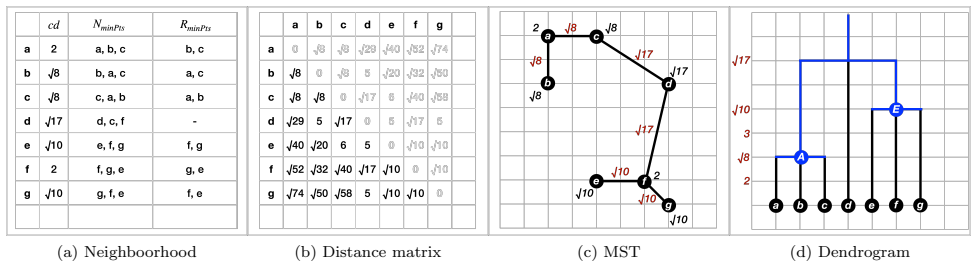
The central claim is that the leaf-level clustering features of a dynamically rebalanced Bubble-tree are a sufficient compressed representation for HDBSCAN: clustering the L data bubbles derived from those features produces nearly the same hierarchy as clustering the full N points. The paper also contributes an exact dynamic HDBSCAN algorithm based on RkNN queries, link-cut trees, and dual-tree Boruvka, but its feasibility experiments show this exact route is often slower than static recomputation after a few percent of updates. The Bubble-tree route avoids that cost because updates touch only the tree path and a fixed number of leaves, and the offline HDBSCAN run is on the summaries rather than the raw data.
Load-bearing premise
The load-bearing assumption is that Bubble-tree stays balanced, meaning every non-root node stays between the minimum and maximum occupancy, through arbitrary insertions, deletions, and the dynamic reorganization step; the paper states this as a property but does not prove it or give the insert/delete pseudocode.
Editorial extensions
If this is right
- Re-running HDBSCAN on L leaf summaries replaces the O(n log n) MST rebuild over N points, so dynamic workloads can be served by updating a tree and then applying the existing static algorithm.
- The compression factor L is a direct accuracy-versus-runtime dial: the paper reports that at 10% compression its pipeline yields good hierarchies in under a minute, including a twenty-second per-slide average on the Intrusion dataset where static HDBSCAN took thirty-five minutes.
- Because Bubble-tree supports arbitrary point deletions and reorganizes overfilled leaves, its summaries do not carry the insertion-order bias that ClusTree exhibits on the paper's toy example.
- The exact dynamic algorithm, though not competitive at scale, supplies a correctness baseline and identifies RkNN queries and MST updates as the operations that dominate the cost.
Reading between the lines
- If Bubble-tree's balance invariant holds under adversarial deletion patterns, the same leaf-summary structure could plausibly serve other hierarchical density-based algorithms, since data bubbles were introduced for OPTICS as well as HDBSCAN.
- The paper leaves insertion/deletion pseudocode and a balance proof implicit; a formal amortized analysis would determine whether the runtime claim survives worst-case updates.
- A testable extension would compare Bubble-tree with an incremental-MST HDBSCAN under random and adversarial update orders to map where summarization loses to incremental exactness.
- Datasets with highly skewed density may need a larger L than 1% to keep NMI high, because data-bubble distance estimates are the main channel through which compression error enters the hierarchy.
Editorial analysis
A structured set of objections, weighed in public.
Referee Report
Summary. The paper addresses dynamic hierarchical density-based clustering by proposing an online-offline framework. The online component maintains a dynamic tree of clustering features ('Bubble-tree') that keeps a fixed number L of leaf-level summaries; the offline component runs static HDBSCAN on data bubbles derived from those summaries. The paper also proposes an exact dynamic MST-maintenance algorithm for HDBSCAN and reports experiments showing that Bubble-tree achieves NMI quality comparable to static HDBSCAN while running faster than ClusTree and an incremental data-bubble baseline.
Significance. The problem is timely and the online-offline architecture is a sensible response to the hardness of exact dynamic HDBSCAN. The strength of the paper is its empirical setup: it evaluates clustering quality by comparing against static HDBSCAN on the full data, which is a fair external benchmark rather than a circular internal check, and it includes a feasibility study of the exact algorithm that motivates the summarization approach. However, the central algorithmic contribution is underspecified: the insert/delete/split operations for Bubble-tree are not given in pseudocode, the routing criterion for choosing a child during insertion is never defined, and there is no balance or complexity analysis. The runtime and quality claims therefore rest on an assumed but unproven invariant.
major comments (4)
- [§4.1, Algorithm 1] The paper never provides the point insertion and deletion procedures for Bubble-tree, nor a distance or cost function to direct a new point toward a leaf during insertion; it only says 'standard depth-first strategy from dynamic index structures.' Because the claimed runtime advantage depends on these operations being cheap, the central algorithm is not fully specified and cannot be reproduced or verified from the manuscript.
- [§4.1, Algorithm 1 (Lines 10–11)] In the dynamic reorganization branch, the algorithm extracts the m farthest children of the most overfilled leaf O and reinserts them. If O has fewer than 2m children, the remaining child set has fewer than m entries, contradicting the fanout invariant stated in Property 2; if O has exactly m children, the leaf becomes empty. The paper neither describes a subsequent rebalancing step nor bounds the cascade of underflows that the reinserted entries may cause.
- [§4.1, Properties 1–4] The Properties assert that Bubble-tree is balanced and that the number of leaves is maintained to be L, but no proof is given that insertions, deletions, and MaintainCompression preserve these invariants, and no amortized bound on the cost of MaintainCompression is provided. Since the speedup reported in Section 5 is relative to static algorithms and is measured only per window slide, the experimental numbers cannot substitute for an analysis of per-update cost or worst-case reorganization behavior.
- [§5.2, Figures 5–7] The experimental comparison reports a single average NMI value and per-slide runtime without error bars, number of repetitions, or the number of clusters found by each method; since NMI is affected by cluster-count imbalance, the paper should report adjusted mutual information and cluster counts. More fundamentally, the runtime comparison uses a sliding-window order that is not adversarial, and without a bound on per-update reorganization the claimed 'orders of magnitude' speedup cannot be expected to generalize to arbitrary fully dynamic workloads.
minor comments (4)
- [§3.3, Lemma 1] The statement 'requires Omega(n log n) time' is derived by counting the cost of checking each new edge with a link-cut tree; this is a statement about the proposed method, not a problem lower bound. Please rephrase to avoid the appearance of unconditional hardness.
- [§4.1] In the deletion paragraph, 'if the leaf node representing the deleted point has less than m children, the leaf is deleted and all of its remaining m children are reinserted back into the tree' is internally inconsistent because a leaf with fewer than m children has at most m-1 remaining children.
- [§5.1] The paper says ClusTree and Bubble-tree 'approximately have the same number of leaf nodes' but does not report the actual leaf counts or the compression factor used in the Seeds experiment; adding these numbers would make the visual comparison reproducible.
- [§5.2] The paper reports average NMI scores but does not state how many window slides were averaged or the standard deviation; please include this information.
Circularity Check
No significant circularity: Bubble-tree is evaluated against the external static HDBSCAN benchmark, and no fitted parameter or self-citation chain forces the claimed result.
full rationale
The paper's central claim is that running static HDBSCAN on the L leaf-level clustering features of Bubble-tree gives clustering quality comparable to static HDBSCAN on the full data while improving runtime in dynamic workloads. This is evaluated empirically against an external benchmark: NMI is computed between the flat clusters obtained from each summarization method and the clusters produced by the exact static HDBSCAN algorithm on the full data (Section 5.2), and runtime is measured as wall-clock time per sliding-window slide against ClusTree, Incremental, Dynamic, and Static baselines. No parameter is fitted to the target quality values: the compression factor L is a user-configured input and the fanout M is a standard index parameter. The data-bubble representation and quality measures are cited to independent prior work (Breunig et al. [5]; Nassar et al. [32]), and the static HDBSCAN implementation used for comparison is an external library. There are no load-bearing self-citations: none of the references are authored by the present authors, and the exact dynamic components (link-cut trees, dual-tree Boruvka, RkNN queries) are external standard machinery. The absence of insertion/deletion pseudocode and balance proofs for Bubble-tree is a completeness and correctness concern, not a circularity concern: an unproven invariant does not make the claimed result equivalent to its input by construction. The derivation chain is therefore self-contained with respect to the circularity failure modes considered.
Assumptions & free parameters
free parameters (5)
- L (compression factor) =
1%, 5%, 10% of N in experiments
- M (maximum fanout) =
10 in experiments
- m (minimum fanout) =
not specified in paper
- k (quality threshold multiplier in summarization index) =
not reported
- minPts (HDBSCAN density parameter) =
100 in main experiments, 10 in feasibility analysis
assumptions (5)
- standard math HDBSCAN's clustering hierarchy is correctly represented by the MST of the mutual reachability graph.
- domain assumption Data bubbles, with core distance modified as cd(B) = d(B,C) + C.nnDist(k), approximate the HDBSCAN hierarchy of the original points.
- domain assumption The data summarization index beta(B) = n/N, with Chebyshev-based classification into good, under-filled, and over-filled, is a valid criterion for maintaining high-quality summaries.
- ad hoc to paper A fixed number L of leaf-level clustering features is sufficient to represent the dynamic dataset with controllable compression quality.
- standard math The dynamic MST update rules, reduction and contraction, of Eppstein apply to the mutual reachability graph under core-distance changes.
invented entities (1)
-
Bubble-tree
Cite this review
Pith. "Pith review of Dynamic data summarization for hierarchical spatial clustering." pith.science (2026). https://pith.science/paper/MGGLHUBQ
@misc{pith2026241207789,
  author       = {Pith},
  title        = {Pith review of: Dynamic data summarization for hierarchical spatial clustering},
  year         = {2026},
  howpublished = {\url{https://pith.science/paper/MGGLHUBQ}},
  note         = {Machine review of arXiv:2412.07789}
}
read the original abstract
Hierarchical Density-Based Spatial Clustering of Applications with Noise (HDBSCAN) finds meaningful patterns in spatial data by considering density and spatial proximity. As the clustering algorithm is inherently designed for static applications, so have recent studies focused on accelerating the algorithm for static applications using approximate or parallel methods. However, much less attention has been given to dynamic environments, where even a single point insertion or deletion can require recomputing the clustering hierarchy from scratch due to the need of maintaining the minimum spanning tree (MST) over a complete graph. This paper addresses the challenge of enhancing the clustering algorithm for dynamic data. We present an exact algorithm that maintains density information and updates the clustering hierarchy of HDBSCAN during point insertions and deletions. Considering the hardness of adapting the exact algorithm to dynamic data involving modern workloads, we propose an online-offline framework. The online component efficiently summarizes dynamic data using a tree structure, called Bubble-tree, while the offline step performs the static clustering. Experimental results demonstrate that the data summarization adapts well to fully dynamic environments, providing compression quality on par with existing techniques while significantly improving runtime performance of the clustering algorithm in dynamic data workloads.
Figures


Figures from the paper (4 more)


Reference graph
Works this paper leans on
-
[1]
C. C. Aggarwal, S. Y. Philip, J. Han, and J. Wang. A framework for clustering evolving data streams. In Proceedings 2003 VLDB conference, pages 81–
work page 2003
-
[2]
M. Ankerst, M. M. Breunig, H.-P. Kriegel, and J. Sander. Optics: Ordering points to identify the clustering structure. ACM Sigmod record , 28(2):49–60, 1999
work page 1999
-
[3]
N. Beckmann, H.-P. Kriegel, R. Schneider, and B. Seeger. The r*-tree: An efficient and robust access method for points and rectangles. SIGMOD Rec., 19(2):322–331, may 1990
work page 1990
-
[4]
K. Beyer, J. Goldstein, R. Ramakrishnan, and U. Shaft. When is “nearest neighbor” meaningful? In C. Beeri and P. Buneman, editors, Database 11 Theory — ICDT’99 , pages 217–235, Berlin, Hei- delberg, 1999. Springer Berlin Heidelberg
work page 1999
-
[5]
M. M. Breunig, H.-P. Kriegel, P. Kr¨ oger, and J. Sander. Data bubbles: Quality preserving per- formance boosting for hierarchical clustering. In Proceedings of the 2001 ACM SIGMOD interna- tional conference on Management of data , pages 79–90, 2001
work page 2001
- [6]
-
[7]
R. J. G. B. Campello, D. Moulavi, and J. Sander. Density-based clustering based on hierarchical density estimates. In J. Pei, V. S. Tseng, L. Cao, H. Motoda, and G. Xu, editors, Advances in Knowledge Discovery and Data Mining , pages 160–172, Berlin, Heidelberg, 2013. Springer Berlin Heidelberg
work page 2013
-
[8]
F. Cao, M. Estert, W. Qian, and A. Zhou. Density-based clustering over an evolving data stream with noise. In Proceedings of the 2006 SIAM international conference on data mining , pages 328–339. SIAM, 2006
work page 2006
Show all 52 references
-
[9]
Cattaneo, P
G. Cattaneo, P. Faruolo, U. F. Petrillo, and G. F. Italiano. Maintaining dynamic minimum spanning trees: An experimental study. Discrete Applied Mathematics, 158(5):404–425, 2010
2010
-
[10]
R. R. Curtin. Faster dual-tree traversal for nearest neighbor search. In Similarity Search and Applica- tions: 8th International Conference, SISAP 2015, Glasgow, UK, October 12-14, 2015, Proceedings 8, pages 77–89. Springer, 2015
2015
-
[11]
Dean and S
J. Dean and S. Ghemawat. Mapreduce: Simplified data processing on large clusters. OSDI, 2004
2004
-
[12]
Dell’Amico
M. Dell’Amico. Fishdbc: Flexible, incremental, scalable, hierarchical density-based clustering for arbitrary data and distance, 2019
2019
-
[13]
J. A. dos Santos, T. I. Syed, M. C. Naldi, R. J. Campello, and J. Sander. Hierarchical density- based clustering using mapreduce. IEEE Trans- actions on Big Data , 7(1):102–114, 2019
2019
-
[14]
Eppstein
D. Eppstein. Offline algorithms for dynamic min- imum spanning tree problems. Journal of Algo- rithms, 17(2):237–250, 1994
1994
-
[15]
Ester, H.-P
M. Ester, H.-P. Kriegel, J. Sander, and X. Xu. A density-based algorithm for discovering clusters in large spatial databases with noise. In Proceedings of the Second International Conference on Knowl- edge Discovery and Data Mining , KDD’96, page 226–231. AAAI Press, 1996
1996
-
[16]
Fonollosa
J. Fonollosa. Gas sensor array under dynamic gas mixtures. UCI Machine Learning Repository,
-
[17]
Gan and Y
J. Gan and Y. Tao. Dynamic density based clus- tering. In Proceedings of the 2017 ACM Interna- tional Conference on Management of Data , pages 1493–1507, 2017
2017
-
[18]
A. Guttman. R-trees: A dynamic index structure for spatial searching. In Proceedings of the 1984 ACM SIGMOD international conference on Man- agement of data , pages 47–57, 1984
1984
-
[19]
Hahsler and J
M. Hahsler and J. Forrest. streamMOA: Interface for MOA Stream Clustering Algorithms , 2024. R package version 1.3-1
2024
-
[20]
Harary and G
F. Harary and G. Gupta. Dynamic graph models. Mathematical and Computer Modelling , 25(7):79– 87, 1997
1997
-
[21]
Hassani, P
M. Hassani, P. Spaus, A. Cuzzocrea, and T. Seidl. Adaptive stream clustering using incremental graph maintenance. In W. Fan, A. Bifet, Q. Yang, and P. S. Yu, editors, Proceedings of the 4th In- ternational Workshop on Big Data, Streams and Heterogeneous Source Mining: Algorith...
2015
-
[22]
Jackson, A
J. Jackson, A. Qiao, and E. P. Xing. Scaling hdb- scan clustering with knn graph approximation. In Proceedings of the SysML Conference , pages 14– 16, 2018
2018
-
[23]
J. W. Jaromczyk and G. T. Toussaint. Relative neighborhood graphs and their relatives. Proceed- ings of the IEEE , 80(9):1502–1517, 1992
1992
-
[24]
Korn and S
F. Korn and S. Muthukrishnan. Influence sets based on reverse nearest neighbor queries. SIG- MOD Rec., 29(2):201–212, may 2000
2000
-
[25]
Kranen, I
P. Kranen, I. Assent, C. Baldauf, and T. Seidl. Self-adaptive anytime stream clustering. In 2009 Ninth IEEE International Conference on Data Mining, pages 249–258. IEEE, 2009
2009
-
[26]
H. Lee, Y. Kang, S. Noh, J. Kim, and J. Lee. Exploring lifestyle patterns from gps trajectory data: embedding spatio-temporal context infor- mation via geohash and poi. Spatial Information Research, pages 1–13, 2024
2024
-
[27]
S. T. Leutenegger, J. Edgington, and M. A. Lopez. Str: a simple and efficient algorithm for r-tree packing. Proceedings 13th International Confer- ence on Data Engineering , pages 497–506, 1997
1997
-
[28]
B. Liu, Y. Shi, Z. Wang, W. Wang, and B. Shi. Dy- namic incremental data summarization for hierar- chical clustering. In Advances in Web-Age Infor- mation Management: 7th International Confer- 12 ence, WAIM 2006, Hong Kong, China, June 17- 19, 2006. Proceedings 7, pages 410–42...
2006
-
[29]
W. B. March, P. Ram, and A. G. Gray. Fast euclidean minimum spanning tree: Algorithm, analysis, and applications. In Proceedings of the 16th ACM SIGKDD International Conference on Knowledge Discovery and Data Mining , KDD ’10, page 603–612, New York, NY, USA, 2010. Associ- ati...
2010
-
[30]
McInnes and J
L. McInnes and J. Healy. Accelerated hierarchi- cal density based clustering. In 2017 IEEE Inter- national Conference on Data Mining Workshops (ICDMW), pages 33–42, 2017
2017
-
[31]
Melnykov, W.-C
V. Melnykov, W.-C. Chen, and R. Maitra. MixSim: An R package for simulating data to study performance of clustering algorithms. Jour- nal of Statistical Software , 51(12):1–25, 2012
2012
-
[32]
Nassar, J
S. Nassar, J. Sander, and C. Cheng. Incremental and effective data summarization for dynamic hi- erarchical clustering. In Proceedings of the 2004 ACM SIGMOD international conference on Man- agement of data , pages 467–478, 2004
2004
-
[33]
A. C. A. Neto, J. Sander, R. J. G. B. Campello, and M. A. Nascimento. Efficient computation and visualization of multiple density-based clustering hierarchies. IEEE Transactions on Knowledge and Data Engineering, 33(8):3075–3089, 2021
2021
-
[34]
T. D. Nguyen, P. Rieger, R. De Viti, H. Chen, B. B. Brandenburg, H. Yalame, H. M¨ ollering, H. Fereidooni, S. Marchal, M. Miettinen, et al. {FLAME}: Taming backdoors in federated learn- ing. In 31st USENIX Security Symposium (USENIX Security 22) , pages 1415–1432, 2022
2022
-
[35]
Pedregosa, G
F. Pedregosa, G. Varoquaux, A. Gramfort, V. Michel, B. Thirion, O. Grisel, M. Blondel, P. Prettenhofer, R. Weiss, V. Dubourg, et al. Scikit-learn: Machine learning in python. the Journal of machine Learning research , 12:2825– 2830, 2011
2011
-
[36]
Radovanovic, A
M. Radovanovic, A. Nanopoulos, and M. Ivanovic. Hubs in space: Popular nearest neighbors in high- dimensional data. Journal of Machine Learning Research, 11(sept):2487–2531, 2010
2010
-
[37]
K. S. S. Reddy and C. S. Bindu. Streamsw: A density-based approach for clustering data streams over sliding windows. Measurement, 144:14–19, 2019
2019
-
[38]
A. Reiss. PAMAP2 Physical Activity Monitoring. UCI Machine Learning Repository, 2012. DOI: https://doi.org/10.24432/C5NW2H
2012 doi
-
[39]
Roussopoulos, S
N. Roussopoulos, S. Kelley, and F. Vincent. Nearest neighbor queries. In Proceedings of the 1995 ACM SIGMOD International Conference on Management of Data , SIGMOD ’95, page 71–79, New York, NY, USA, 1995. Association for Com- puting Machinery
1995
-
[40]
Shekhar, A
S. Shekhar, A. G. Pai, and H. Srikanth Kamath. Geolocation clustering for radio resource manage- ment in 6g networks. In 2021 Fourth International Conference on Electrical, Computer and Commu- nication Technologies (ICECCT), pages 1–7, 2021
2021
-
[41]
Singh, H
A. Singh, H. Ferhatosmanoglu, and A. c. Tosun. High dimensional reverse nearest neighbor queries. In Proceedings of the Twelfth International Con- ference on Information and Knowledge Manage- ment, CIKM ’03, page 91–98, New York, NY, USA, 2003. Association for Computing Machin- ery
2003
-
[42]
D. D. Sleator and R. E. Tarjan. A data structure for dynamic trees. In Proceedings of the Thirteenth Annual ACM Symposium on Theory of Comput- ing, STOC ’81, page 114–122, New York, NY, USA, 1981. Association for Computing Machin- ery
1981
-
[43]
Stolfo, W
S. Stolfo, W. Fan, W. Lee, A. Prodromidis, and P. Chan. KDD Cup 1999 Data. UCI Machine Learning Repository, 1999. DOI: https://doi.org/10.24432/C51C7N
1999 doi
-
[44]
Y. Sui, Y. Zhang, J. Sun, T. Xu, S. Zhang, Z. Li, Y. Sun, F. Guo, J. Shen, Y. Zhang, et al. Logkg: Log failure diagnosis through knowledge graph. IEEE Transactions on Services Computing , 2023
2023
-
[45]
T. I. Syed. Parallelization of Hierarchical Density- Based Clustering using MapReduce . PhD thesis, University of Alberta, 2015
2015
-
[46]
E. Undraa. Hierarchical density-based clustering for data stream over sliding window. Master’s the- sis, Seoul National University, 2022
2022
-
[47]
Y. Wang, S. Yu, Y. Gu, and J. Shun. Fast parallel algorithms for euclidean minimum spanning tree and hierarchical spatial clustering. In Proceedings of the 2021 International Conference on Manage- ment of Data, SIGMOD ’21, page 1982–1995, New York, NY, USA, 2021. Association f...
2021
-
[48]
Wellhausen, R
L. Wellhausen, R. Dub´ e, A. Gawel, R. Siegwart, and C. Cadena. Reliable real-time change detec- tion and mapping for 3d lidars. In 2017 IEEE International Symposium on Safety, Security and Rescue Robotics (SSRR), pages 81–87, 2017
2017
-
[49]
D. A. White and R. C. Jain. Similarity indexing with the ss-tree. Proceedings of the Twelfth Inter- national Conference on Data Engineering , pages 516–523, 1996
1996
-
[50]
Yang and K.-I
C. Yang and K.-I. Lin. An index structure for effi- cient reverse nearest neighbor queries. In Proceed- ings 17th International Conference on Data Engi- neering, pages 485–492, 2001. 13
2001
-
[51]
Zhang, R
T. Zhang, R. Ramakrishnan, and M. Livny. Birch: an efficient data clustering method for very large databases. ACM sigmod record , 25(2):103–114, 1996. A Reverse Nearest Neighbors Search Reverse k Nearest Neighbors (RkNN) query searches for data points that will have the query ...
1996
-
[2015]
DOI: https://doi.org/10.24432/C5WP4C
Reviewed August 12, 2026 · model on record in the stance chip above.
Discussion (0). Continue with ORCID to comment.