REVIEW 3 major objections 4 minor 1 cited by
A large language model-based approach to quantifying the effects of social determinants in liver transplant decisions
T0 review · 3 major / 4 minor · reviewed 2026-08-11 · deepseek-v4-flash
Pith's one-line read This paper claims that LLM-extracted social factors from clinical notes substantially improve prediction of liver-transplant recommendations and listing, and explain most of the Asian versus non-Asian listing gap.
desk verdict Useful descriptive SDOH analysis held back by outcome labels co-extracted from the same notes as the features; the predictive claims need external validation before they can be taken at face value. read the letter →
The pith
A machine-rendered reading of the paper's core claim, the machinery that carries it, and where it could break.
The reading
What carries the argument
The 'SDOH snapshot' is the central object: a standardized vector of 23 binary social and behavioral factors produced by having a privacy-preserving LLM answer 28 expert-designed questions about each psychosocial evaluation note (23 SDOH factors plus outcome-related questions). It carries the argument by turning unstructured clinical prose into comparable, patient-level features. Those features are then fed to XGBoost (a gradient-boosted tree model) to test predictive value, interpreted with SHAP values, and used in Blinder-Oaxaca decompositions to separate explained from unexplained portions of racial listing gaps.
What would settle it
Take the listing outcome from an independent transplantation registry rather than from the psychosocial note, retrain the same models, and check whether adding the 23 SDOH features still raises AUROC from 0.616 to 0.717; if the gain disappears, the result is an artifact of reading the label and features from the same text.
Extended reading notes
Core claim
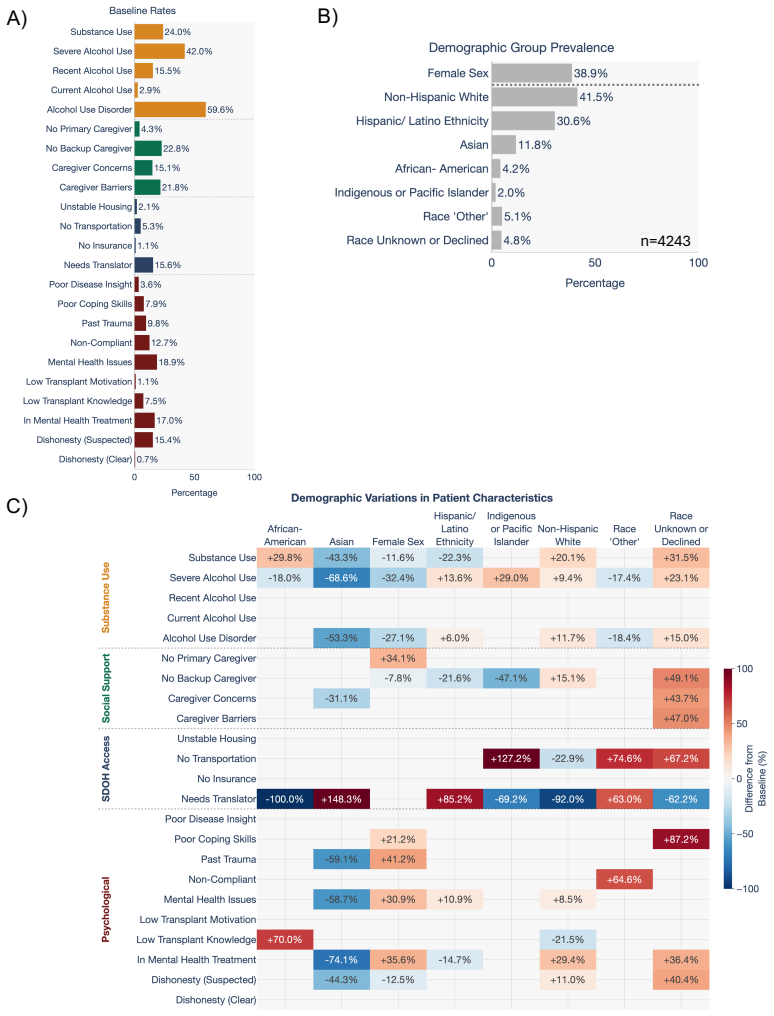
On the paper's own terms, the central discovery is that LLM-derived 'SDOH snapshots'—23 standardized factors such as alcohol use, housing stability, caregiver availability, mental health treatment, disease insight, and translator need—carry substantial predictive and explanatory power for liver transplant decisions. Compared with clinical features alone (MELD score, HCC status, age, BMI), adding the snapshots raises the AUROC for psychosocial recommendation from 0.494 to 0.876 and for eventual listing from 0.616 to 0.717; in patients already recommended, SDOH-only models reached AUROC 0.641, beating clinical-only models at 0.589. In a Blinder-Oaxaca decomposition, the combined feature set explains 94.6% of the Asian listing gap, with SDOH alone explaining 42.6% versus 36.8% for liver-health measures, while the gap for patients with unknown or undisclosed race remains 89.2% unexplained. Extraction accuracy against expert annotations averaged 0.859 across categories, ranging from 0.70 for disease insight to 0.98 for housing instability.
Load-bearing premise
Both the outcome labels (psychosocial recommendation and listing) and the 23 SDOH features are extracted by the LLM from the same psychosocial evaluation note; if the note does not independently record the decision, the reported AUROC gains could reflect within-note correlation rather than the predictive power of SDOH.
Editorial extensions
If this is right
- If the claim is right, transplant programs could rank modifiable social factors such as caregiver support, housing stability, current alcohol use, and disease insight by measured association with outcomes and target resources accordingly.
- Since SDOH-only models beat clinical-only models for listing prediction, psychosocial circumstances carry decision-relevant information beyond MELD score, HCC status, age, and BMI.
- The decomposition implies most of the Asian listing advantage in this cohort is attributable to measured characteristics, while the low listing rate for patients with unknown or undisclosed race is not explained by the measured features.
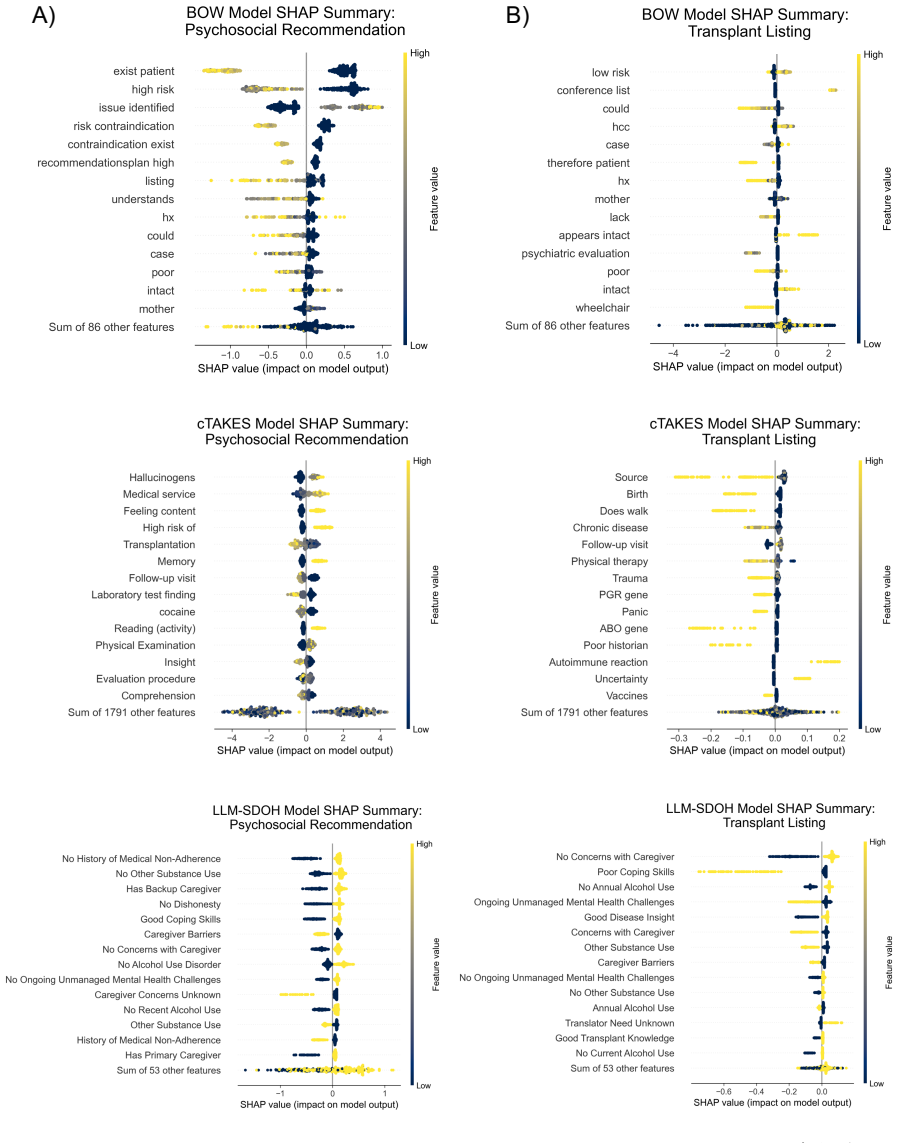
- Because bag-of-words models achieve higher raw AUROC but appear to leak outcome language, the interpretable LLM features are the safer basis for explaining decisions rather than reproducing them.
Reading between the lines
- The paper does not test listing outcomes against an independent registry; a reader should infer that part of the AUROC gain may reflect the LLM reading the decision out of the same note that supplies the features.
- A neighboring application would be to run the same note-survey procedure on kidney or heart transplant evaluations, but the extracted labels would first need validation against administrative records rather than the note itself.
- The paper's own missing-data analyses imply that excluding patients without complete clinical data may bias disparity estimates; modeling note availability as a predictor would test this directly.
- The co-occurrence matrix suggests compound vulnerabilities (e.g., mental-health challenges plus housing instability) could be treated as phenotypes and tested for predicting dropout between recommendation and listing.
Signed reviews
Editorial analysis
A structured set of objections, weighed in public.
Referee Report
Summary. The paper develops an LLM-based pipeline to extract 23 social determinants of health (SDOH) features from psychosocial evaluation notes of liver transplant candidates at a single academic center (n=3,704 with complete data). Using these features, the authors report substantial improvements in predicting two clinical decisions: the psychosocial recommendation (AUROC 0.494→0.876) and eventual listing (AUROC 0.616→0.717), as well as Blinder-Oaxaca decompositions claiming that SDOH explain 42.6% of the Asian listing gap and 94.6% jointly with clinical features. The paper also presents demographic prevalence analyses, temporal trends, co-occurrence patterns, and SHAP-based interpretability. The central claims rest on LLM-extracted outcome labels obtained from the same psychosocial notes that supply the SDOH features.
Significance. If the central claims hold, the paper offers a scalable method for converting unstructured psychosocial notes into standardized SDOH representations, with clear interpretability advantages over bag-of-words baselines and potential applicability to other clinical decision settings. The authors are appropriately careful in noting limitations such as documentation bias and the assumption that social worker labels are ground truth. However, the validity of the predictive and disparity-explanation claims depends critically on the independence of the outcome labels from the feature source. That independence is not established, and the paper's own supplement acknowledges label leakage in text-based baselines without resolving the same concern for LLM-derived features. The paper's strengths—clinician-informed category design, a 101-note validation set, and transparent SHAP analyses—are real, but they do not outweigh the unresolved circularity at the heart of the main results.
major comments (3)
- [§2.6, Supplementary Table 2] The outcome labels for psychosocial recommendation (Q25–Q26) and listing (Q27–Q28) are extracted by the same LLM from the same psychosocial evaluation note that supplies the 23 SDOH features (Q2–Q24). The paper does not validate these extracted outcomes against an independent source, such as UNOS listing data, structured EHR fields, or chart review. Since the LLM prompt contains the full note, the reported AUROC improvements (0.494→0.876 for recommendation; 0.616→0.717 for listing) may measure within-note correlation between feature labels and outcome labels rather than the predictive power of SDOH. This is load-bearing because the abstract and Section 2.6 base their central claim on these numbers.
- [§2.5, Figure 7, Table 2] The listing outcome is defined 'based on evidence from notes' (Figure 7) rather than from an independent registry. The Blinder-Oaxaca decomposition presented in Section 2.5 uses this note-derived outcome. The explained shares (e.g., 42.6% for SDOH alone and 94.6% combined for Asian patients) therefore cannot be attributed to SDOH until the listing label is verified against an independent source. If the note's stated listing decision is the same text that informs the SDOH features, the decomposition's 'explained' component is partly a measure of internal consistency of the note rather than a causal or explanatory quantity.
- [Supplementary §A.3.3, Table 3] The claim that LLM-derived features 'avoid the label leakage' attributed to BOW is not supported. The authors correctly note that BOW features such as 'recommendation' and 'listing' leak outcome information, but the LLM is given the entire note and is asked (Q25–Q28) to produce outcome labels. The same outcome-bearing text is present when the LLM answers Q2–Q24. The fact that BOW outperforms LLM features (AUROC 0.91 vs. 0.87 for recommendation; 0.71 vs. 0.66 for listing in Table 3) does not rule out leakage in LLM features; it merely indicates that BOW captures the outcome terms more directly. The authors should test this by masking or removing outcome-related sections from the notes before extraction and re-running the prediction, or by validating the extracted outcomes against independent chart review.
minor comments (4)
- [§2.2] The sentence 'achieving 0.70-0.98% accuracy' contains an erroneous percentage symbol; it should read '0.70–0.98' as a proportion.
- [§2.2, Figure 1c] The caption states '28 questions' while the text says 23 SDOH dimensions; Supplementary Table 2 lists 30 questions. The relationship among the number of questions, the 23 SDOH factors, and the additional questions for outcomes should be clarified.
- [§5.2] The validation of LLM extraction against 101 expert annotations would be strengthened by reporting inter-annotator agreement (e.g., Cohen's kappa or Fleiss' kappa) rather than only average accuracy, especially for categories with accuracy as low as 0.70.
- [§2.6, Table 3] Because the outcome base rates are highly imbalanced (93% for recommendation and 81% for listing), the paper should report precision-recall AUC or Brier scores alongside AUROC, as AUROC can be optimistic in this setting.
Circularity Check
Headline predictive and disparity claims rest on LLM-extracted outcome labels from the same psychosocial notes that supply the SDOH features; the AUROC gains and Blinder-Oaxaca shares may measure within-note coherence rather than predictive power of SDOH.
-
other
[Figure 1b; Supplementary Table 2 (Q2-Q28); Section 2.6]
"Clinical notes are processed using LLMs to extract both (i) 23 SDOH dimensions describing patient circumstances* and (ii) clinical decisions/outcomes not captured in structured data (e.g., psychosocial risk assessments, transplant recommendations). These extracted elements are combined with structured clinical and demographic data from the EHR to create comprehensive patient snapshots at evaluation."
The psychosocial recommendation target is one of the extracted elements (Table 2, Q26: 'is the patient recommended... for a liver transplant?'), while the 23 SDOH features are the other extracted elements (Q2-Q24), both obtained by prompting GPT-4-Turbo with the same note. The LLM therefore has access to the note's stated recommendation when it labels features such as caregiver concerns, coping skills, or motivation, so the feature set can encode the outcome text. The reported AUROC increase (0.494 to 0.876) is thus evidence of within-note coherence between two LLM extractions, not that independent SDOH information predicts an independently recorded psychosocial decision.
-
other
[Figure 7; Section 2.5 (Blinder-Oaxaca)]
"Initial Demographic Outcomes AnalysisProportion eventually listed for transplant based on evidence from notes: 0.75Proportion receiving transplant at UCSF: 0.34"
The listing outcome used for the AUROC and Blinder-Oaxaca analyses is derived 'from evidence from notes' rather than from an independent registry or structured EHR field, even though listing with UNOS is an external administrative decision. Since the SDOH features are extracted from those same notes, the listing prediction gain (0.616 to 0.717) and the 42.6%/94.6% 'explained' shares for Asian patients conflate the LLM's reading of a note's stated listing status with an association between SDOH and an independently recorded listing outcome.
full rationale
The SDOH feature extraction itself has independent support: it was validated against 101 expert annotations with average accuracy 0.859, so the feature extraction step is not circular. The circularity enters at the outcome-label step. The paper's own Figure 1b says the LLM extracts both the SDOH dimensions and the clinical decisions/outcomes from the same notes, and Table 2 shows Q25-Q28 recover risk, recommendation, and listing status from the same note queried for features. Listing is explicitly note-derived in Figure 7. The paper acknowledges in Supplement A.3.3 that BOW models suffer label leakage from terms 'directly mention recommendation and risk', but the same leakage pathway is available to the LLM because the full note is the input to every question; the BOW comparison (AUROC 0.91 vs 0.87 for recommendation) shows the leak can be strong. Consequently the AUROC improvements and the Blinder-Oaxaca decomposition support a weaker claim: LLM-extracted SDOH labels and LLM-extracted outcome labels are internally consistent, not that SDOH snapshots predict independently recorded transplant decisions. No load-bearing self-citation or imported uniqueness was found; citations to the authors' prior work are background only. This is partial circularity, not a fully tautological derivation.
Assumptions & free parameters
free parameters (4)
- XGBoost hyperparameters =
grid ranges: max_depth [3,6,9], learning_rate [0.01,0.1,0.2], n_estimators [100,300,500], subsample [0.7,0.8,0.9]…
- LLM prompt design =
final prompt in Supplement A.1.1
- BOW feature selection thresholds =
top 100 chi2 features; min document frequency >5 notes; max document frequency <80% notes; ngram range 1-2
- SDOH category and question definitions =
23 categories, 30 questions (Table 2)
assumptions (5)
- domain assumption Psychosocial evaluation notes are a faithful record of patient circumstances and decision-relevant factors
- domain assumption Outcome labels (psychosocial recommendation, listing) can be validly extracted from the same notes
- domain assumption The 101 expert annotations are a gold standard for SDOH factor extraction
- standard math Linear probability models in Blinder-Oaxaca are correctly specified
- standard math Standard i.i.d. and no-train-test-leakage assumptions for the XGBoost models
invented entities (1)
-
SDOH snapshot
Cite this review
Pith. "Pith review of A large language model-based approach to quantifying the effects of social determinants in liver transplant decisions." pith.science (2026). https://pith.science/paper/DCSRE2UP
@misc{pith2026241207924,
  author       = {Pith},
  title        = {Pith review of: A large language model-based approach to quantifying the effects of social determinants in liver transplant decisions},
  year         = {2026},
  howpublished = {\url{https://pith.science/paper/DCSRE2UP}},
  note         = {Machine review of arXiv:2412.07924}
}
read the original abstract
Patient life circumstances, including social determinants of health (SDOH), shape both health outcomes and care access, contributing to persistent disparities across gender, race, and socioeconomic status. Liver transplantation exemplifies these challenges, requiring complex eligibility and allocation decisions where SDOH directly influence patient evaluation. We developed an artificial intelligence (AI)-driven framework to analyze how broadly defined SDOH -- encompassing both traditional social determinants and transplantation-related psychosocial factors -- influence patient care trajectories. Using large language models, we extracted 23 SDOH factors related to patient eligibility for liver transplantation from psychosocial evaluation notes. These SDOH ``snapshots'' significantly improve prediction of patient progression through transplantation evaluation stages and help explain liver transplantation decisions including the recommendation based on psychosocial evaluation and the listing of a patient for a liver transplantation. Our analysis helps identify patterns of SDOH prevalence across demographics that help explain racial disparities in liver transplantation decisions. We highlight specific unmet patient needs, which, if addressed, could improve the equity and efficacy of transplant care. While developed for liver transplantation, this systematic approach to analyzing previously unstructured information about patient circumstances and clinical decision-making could inform understanding of care decisions and disparities across various medical domains.
Figures


Figures from the paper (16 more)




Forward citations
Cited by 1 Pith paper
-
Mediation Analysis in the Presence of Sample Selection Bias with an Application to Disparities in Liver Transplantation Listing
New sufficient conditions and a reweighted formula identify mediation and path-specific effects under sample selection, applied to liver transplant listing disparities.
Reference graph
Works this paper leans on
-
[1]
Michael Marmot and Richard Wilkinson. Social determinants of health . Oup Oxford, 2005
work page 2005
-
[2]
Who european review of social determinants of health and the health divide
Michael Marmot, Jessica Allen, Ruth Bell, Ellen Bloomer, and Peter Goldblatt. Who european review of social determinants of health and the health divide. The Lancet, 380(9846):1011–1029, 2012
work page 2012
-
[3]
Hannah P Truong, Alina A Luke, Gmerice Hammond, Rishi K Wadhera, Mat Reidhead, and Karen E Joynt Maddox. Utilization of social determinants of health icd-10 z-codes among hospitalized patients in the united states, 2016–2017. Medical care, 58(12):1037–1043, 2020
work page 2016
-
[4]
Elham Heidari, Rana Zalmai, Kristin Richards, Lakshya Sakthisivabalan, and Carolyn Brown. Z- code documentation to identify social determinants of health among medicaid beneficiaries.Research in Social and Administrative Pharmacy , 19(1):180–183, 2023
work page 2023
-
[5]
Michael Wang, Matthew S Pantell, Laura M Gottlieb, and Julia Adler-Milstein. Documentation and review of social determinants of health data in the ehr: measures and associated insights. Journal of the American Medical Informatics Association , 28(12):2608–2616, 2021
work page 2021
-
[6]
Clustering interval-censored time-series for disease phenotyping
Irene Y Chen, Rahul G Krishnan, and David Sontag. Clustering interval-censored time-series for disease phenotyping. In Proceedings of the AAAI Conference on Artificial Intelligence , 2022
work page 2022
-
[7]
Scott Mayer McKinney, Marcin Sieniek, Varun Godbole, Jonathan Godwin, Natasha Antropova, Hutan Ashrafian, Trevor Back, Mary Chesus, Greg S. Corrado, Ara Darzi, and et al. International evaluation of an ai system for breast cancer screening. Nature, 577(7788):89–94, Jan 2020
work page 2020
-
[8]
Dissecting racial bias in an algorithm used to manage the health of populations
Ziad Obermeyer, Brian Powers, Christine Vogeli, and Sendhil Mullainathan. Dissecting racial bias in an algorithm used to manage the health of populations. Science, 366(6464):447–453, Oct 2019
work page 2019
Show all 53 references
-
[9]
Large language models to identify social determinants of health in electronic health records
Marco Guevara, Shan Chen, Spencer Thomas, Tafadzwa L Chaunzwa, Idalid Franco, Benjamin H Kann, Shalini Moningi, Jack M Qian, Madeleine Goldstein, Susan Harper, et al. Large language models to identify social determinants of health in electronic health records. NPJ digital medi...
2024
-
[10]
Treating health disparities with artificial intelligence
Irene Y Chen, Shalmali Joshi, and Marzyeh Ghassemi. Treating health disparities with artificial intelligence. Nature medicine, 26(1):16–17, 2020
2020
-
[11]
Liver: What it does, disorders & symptoms, staying healthy, Feb 2021
Cleveland Clinic. Liver: What it does, disorders & symptoms, staying healthy, Feb 2021
2021
-
[12]
Lucey, Katryn N
Michael R. Lucey, Katryn N. Furuya, and David P. Foley. Liver transplantation. New England Journal of Medicine , 389(20):1888–1900, Nov 2023
1900
-
[13]
Title 42 - public health, part 121 - organ procurement and transplantation network
Department of Health Public Health Service and Human Services. Title 42 - public health, part 121 - organ procurement and transplantation network. Electronic Code of Federal Regulations, Aug
-
[14]
Centers for Medicare & Medicaid Services. Medicare and medicaid programs; organ procurement organizations conditions for coverage: Revisions to the outcome measure requirements for organ procurement organizations; public comment period; delay of effective date. Federal Register, Feb
-
[15]
National organ allocation policy: The final rule
Lara Duda. National organ allocation policy: The final rule. AMA Journal of Ethics , 7(9), Sep 2005
2005
-
[16]
Liver policy: Medical urgency, Aug 2023
UNOS. Liver policy: Medical urgency, Aug 2023
2023
-
[17]
Ani Kardashian, Marina Serper, Norah Terrault, and Lauren D. Nephew. Health disparities in chronic liver disease. Hepatology, 77(4):1382–1403, Sep 2022
2022
-
[18]
The easl–lancet liver commission: protecting the next generation of europeans against liver disease complications and premature mortality
Tom H Karlsen, Nick Sheron, Shira Zelber-Sagi, Patrizia Carrieri, Geoffrey Dusheiko, Elisabetta Bugianesi, Rachel Pryke, Sharon J Hutchinson, Bruno Sangro, Natasha K Martin, Michele Cecchini, Mae Ashworth Dirac, Annalisa Belloni, Miquel Serra-Burriel, Cyriel Y Ponsioen, Brittn...
2022
-
[19]
Novel approaches are needed to study social determinants of health in liver transplantation
Jin Ge, Jennifer C Lai, and Sharad I Wadhwani. Novel approaches are needed to study social determinants of health in liver transplantation. Liver Transplantation, 29(3):241–243, 2023
2023
-
[20]
Association between social determinants of health and rates of liver transplantation in individuals with cirrhosis
Jennifer A Flemming, Hala Muaddi, Maja Djerboua, Paula Neves, Gonzalo Sapisochin, and Nazia Selzner. Association between social determinants of health and rates of liver transplantation in individuals with cirrhosis. Hepatology, 76(4):1079–1089, 2022
2022
-
[21]
Policies - optn, Aug 2024
Organ Procurement and Transplantation Network. Policies - optn, Aug 2024
2024
-
[22]
Measuring equity: Access to transplant dash- board, Aug 2024
Organ Procurement and Transplantation Network. Measuring equity: Access to transplant dash- board, Aug 2024
2024
-
[23]
Racial, gender, and socioeconomic disparities in liver trans- plantation
Lauren D Nephew and Marina Serper. Racial, gender, and socioeconomic disparities in liver trans- plantation. Liver Transplantation, 27(6):900–912, 2021
2021
-
[24]
A review of the current state of liver transplantation disparities
Nabeel A Wahid, Russell Rosenblatt, and Robert S Brown Jr. A review of the current state of liver transplantation disparities. Liver Transplantation, 27(3):434–443, 2021
2021
-
[25]
Racial disparity in liver transplantation listing
Curtis Warren, Anne-Marie Carpenter, Daniel Neal, Kenneth Andreoni, George Sarosi, and Ali Zarrinpar. Racial disparity in liver transplantation listing. Journal of the American College of Surgeons, 232(4):526–534, 2021
2021
-
[26]
Disparities in liver transplantation before and after introduction of the meld score
Cynthia A Moylan, Carla W Brady, Jeffrey L Johnson, Alastair D Smith, Janet E Tuttle-Newhall, and Andrew J Muir. Disparities in liver transplantation before and after introduction of the meld score. Jama, 300(20):2371–2378, 2008
2008
-
[27]
Sex- based disparities in liver transplant rates in the united states
Amit K Mathur, Douglas E Schaubel, Qi Gong, Mary K Guidinger, and Robert M Merion. Sex- based disparities in liver transplant rates in the united states. American Journal of Transplantation, 11(7):1435–1443, 2011
2011
-
[28]
Black patients have unequal access to listing for liver transplantation in the united states
Russell Rosenblatt, Nabeel Wahid, Karim J Halazun, Alyson Kaplan, Arun Jesudian, Catherine Lucero, Jihui Lee, Lorna Dove, Alyson Fox, Elizabeth Verna, et al. Black patients have unequal access to listing for liver transplantation in the united states. Hepatology, 74(3):1523–1532, 2021
2021
-
[29]
Gender disparity in liver transplant waiting-list mortality: the importance of kidney function
Ayse L Mindikoglu, Arie Regev, Stephen L Seliger, and Laurence S Magder. Gender disparity in liver transplant waiting-list mortality: the importance of kidney function. Liver Transplantation, 16(10):1147–1157, 2010
2010
-
[30]
too sick
Giuseppe Cullaro, Monika Sarkar, and Jennifer C Lai. Sex-based disparities in delisting for being “too sick” for liver transplantation. American Journal of Transplantation , 18(5):1214–1219, 2018
2018
-
[31]
Quantifying sex-based disparities in liver allocation
Jayme E Locke, Brittany A Shelton, Kim M Olthoff, Elizabeth A Pomfret, Kimberly A Forde, Deirdre Sawinski, Meagan Gray, and Nancy L Ascher. Quantifying sex-based disparities in liver allocation. JAMA surgery, 155(7):e201129–e201129, 2020
2020
-
[32]
Chaunzwa, Idalid Franco, Benjamin H
Marco Guevara, Shan Chen, Spencer Thomas, Tafadzwa L. Chaunzwa, Idalid Franco, Benjamin H. Kann, Shalini Moningi, Jack M. Qian, Madeleine Goldstein, Susan Harper, and et al. Large language models to identify social determinants of health in electronic health records. npj Digit...
2024
-
[33]
Extract- ing social determinants of health from electronic health records using natural language processing: a systematic review
Braja G Patra, Mohit M Sharma, Veer Vekaria, Prakash Adekkanattu, Olga V Patterson, Benjamin Glicksberg, Lauren A Lepow, Euijung Ryu, Joanna M Biernacka, Al’ona Furmanchuk, et al. Extract- ing social determinants of health from electronic health records using natural language ...
2021
-
[34]
Leveraging natural language processing to augment structured so- cial determinants of health data in the electronic health record
Kevin Lybarger, Nicholas J Dobbins, Ritche Long, Angad Singh, Patrick Wedgeworth, ¨Ozlem Uzuner, and Meliha Yetisgen. Leveraging natural language processing to augment structured so- cial determinants of health data in the electronic health record. Journal of the American Medi...
2023
-
[35]
Nlp for maternal healthcare: Perspectives and guiding principles in the age of llms
Maria Antoniak, Aakanksha Naik, Carla S Alvarado, Lucy Lu Wang, and Irene Y Chen. Nlp for maternal healthcare: Perspectives and guiding principles in the age of llms. In The 2024 ACM Conference on Fairness, Accountability, and Transparency, pages 1446–1463, 2024
2024
-
[36]
County health rankings: relationships between determinant factors and health outcomes
Carlyn M Hood, Keith P Gennuso, Geoffrey R Swain, and Bridget B Catlin. County health rankings: relationships between determinant factors and health outcomes. American journal of preventive medicine, 50(2):129–135, 2016
2016
-
[37]
Lundberg and Su-In Lee
Scott M. Lundberg and Su-In Lee. A unified approach to interpreting model predictions. In Pro- ceedings of the 31st International Conference on Neural Information Processing Systems , NIPS’17, page 4768–4777, Red Hook, NY, USA, 2017. Curran Associates Inc
2017
-
[38]
Mayo clinical text analysis and knowledge extraction system (ctakes): architecture, component evaluation and applications
Guergana K Savova, James J Masanz, Philip V Ogren, Jiaping Zheng, Sunghwan Sohn, Karin C Kipper-Schuler, and Christopher G Chute. Mayo clinical text analysis and knowledge extraction system (ctakes): architecture, component evaluation and applications. Journal of the American ...
2010
-
[39]
The data addition dilemma
Judy Hanwen Shen, Inioluwa Deborah Raji, and Irene Y Chen. The data addition dilemma. arXiv preprint arXiv:2408.04154, 2024
2024 arXiv
-
[40]
The future landscape of large language models in medicine
Jan Clusmann, Fiona R Kolbinger, Hannah Sophie Muti, Zunamys I Carrero, Jan-Niklas Eckardt, Narmin Ghaffari Laleh, Chiara Maria Lavinia L¨ offler, Sophie-Caroline Schwarzkopf, Michaela Unger, Gregory P Veldhuizen, et al. The future landscape of large language models in medicin...
2023
-
[41]
Chen, Emma Pierson, Sherri Rose, Shalmali Joshi, Kadija Ferryman, and Marzyeh Ghas- semi
Irene Y. Chen, Emma Pierson, Sherri Rose, Shalmali Joshi, Kadija Ferryman, and Marzyeh Ghas- semi. Ethical machine learning in healthcare. Annual Review of Biomedical Data Science , 4(1):123– 144, Jul 2021
2021
-
[42]
The streetlight effect in data-driven exploration
Johannes Hoelzemann, Gustavo Manso, Abhishek Nagaraj, and Matteo Tranchero. The streetlight effect in data-driven exploration. Working Paper 32401, National Bureau of Economic Research, May 2024
2024
-
[43]
Pedregosa, G
F. Pedregosa, G. Varoquaux, A. Gramfort, V. Michel, B. Thirion, O. Grisel, M. Blondel, P. Pretten- hofer, R. Weiss, V. Dubourg, J. Vanderplas, A. Passos, D. Cournapeau, M. Brucher, M. Perrot, and E. Duchesnay. Scikit-learn: Machine learning in Python. Journal of Machine Learni...
2011
-
[44]
Natural language processing with Python: analyzing text with the natural language toolkit
Steven Bird, Ewan Klein, and Edward Loper. Natural language processing with Python: analyzing text with the natural language toolkit . ” O’Reilly Media, Inc.”, 2009
2009
-
[45]
Tianqi Chen and Carlos Guestrin. Xgboost. Proceedings of the 22nd ACM SIGKDD International Conference on Knowledge Discovery and Data Mining , Aug 2016
2016
-
[46]
Guillaume Lema ˆ ıtre, Fernando Nogueira, and Christos K. Aridas. Imbalanced-learn: A python toolbox to tackle the curse of imbalanced datasets in machine learning. Journal of Machine Learning Research, 18(17):1–5, 2017
2017
-
[47]
statsmodels: Econometric and statistical modeling with python
Skipper Seabold and Josef Perktold. statsmodels: Econometric and statistical modeling with python. In 9th Python in Science Conference , 2010
2010
-
[48]
Male-female wage differentials in urban labor markets
Ronald Oaxaca. Male-female wage differentials in urban labor markets. International Economic Review, 14(3):693, Oct 1973
1973
-
[49]
A detailed explanation and graphical repre- sentation of the blinder-oaxaca decomposition method with its application in health inequalities
Ebrahim Rahimi and Seyed Saeed Hashemi Nazari. A detailed explanation and graphical repre- sentation of the blinder-oaxaca decomposition method with its application in health inequalities. Emerging Themes in Epidemiology , 18(1), Aug 2021. 17
2021
-
[50]
Decomposition methods in economics
Nicole Fortin, Thomas Lemieux, and Sergio Firpo. Decomposition methods in economics. Handbook of Labor Economics, page 1–102, 2011
2011
-
[51]
Question Number
Pauli Virtanen, Ralf Gommers, Travis E. Oliphant, Matt Haberland, Tyler Reddy, David Cour- napeau, Evgeni Burovski, Pearu Peterson, Warren Weckesser, Jonathan Bright, St´ efan J. van der Walt, Matthew Brett, Joshua Wilson, K. Jarrod Millman, Nikolay Mayorov, Andrew R. J. Nelso...
2020
-
[2021]
A Rule by the Centers for Medicare & Medicaid Services on 02/02/2021
2021
-
[2024]
Title 42 was last amended 8/01/2024
Displaying title 42, up to date as of 8/02/2024. Title 42 was last amended 8/01/2024
2024
Reviewed August 11, 2026 · model on record in the stance chip above.
Discussion (0). Continue with ORCID to comment.