REVIEW 3 major objections 5 minor 62 references
THUD++: Large-Scale Dynamic Indoor Scene Dataset and Benchmark for Mobile Robots
T0 review · 3 major / 5 minor · reviewed 2026-08-11 · deepseek-v4-flash
Pith's one-line read THUD++ is a 90,175-frame indoor RGB-D dataset with over 20 million labels for benchmarking how robot perception and navigation degrade as scenes get more dynamic.
desk verdict A useful but inconsistently-numbered dataset extension; the new trajectory and navigation components are unvalidated synthetic simulations. read the letter →
The pith
A machine-rendered reading of the paper's core claim, the machinery that carries it, and where it could break.
The reading
What carries the argument
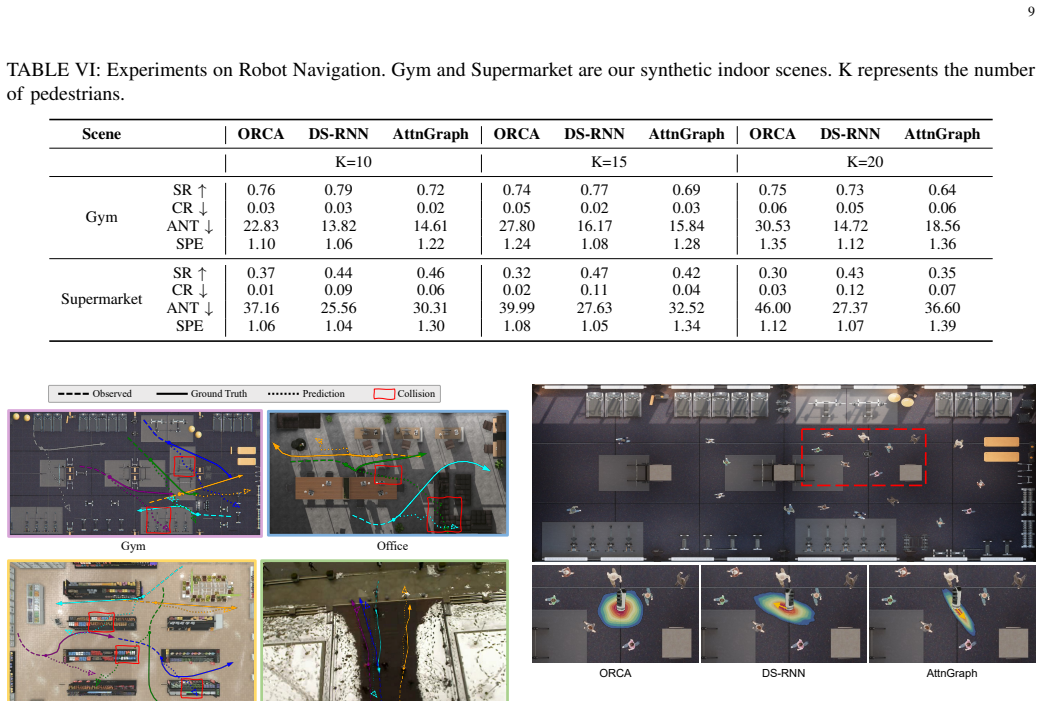
The load-bearing object is the dataset itself, organized in three synchronized parts: RGB-D frames with 2D/3D bounding boxes, semantic and instance segmentation, camera poses and IMU; pedestrian trajectories recorded in confined indoor layouts; and a physics-based simulation platform with a navigation emulator for closed-loop experiments. The argument-carrying device is the dynamic-complexity metric, defined as the average number of pedestrians or dynamic objects per frame. Every benchmark in the paper is arranged around that quantity: static versus dynamic object categories, scenes with low and high pedestrian density, and navigation trials with K=10, 15, or 20 pedestrians.
What would settle it
Run one of the benchmarked navigation policies in a real crowded indoor space, measure the same success, collision, and navigation-time metrics with the same per-frame pedestrian counts, and compare them with the synthetic results; systematic divergence would show that the simulated dynamics do not transfer.
Extended reading notes
Core claim
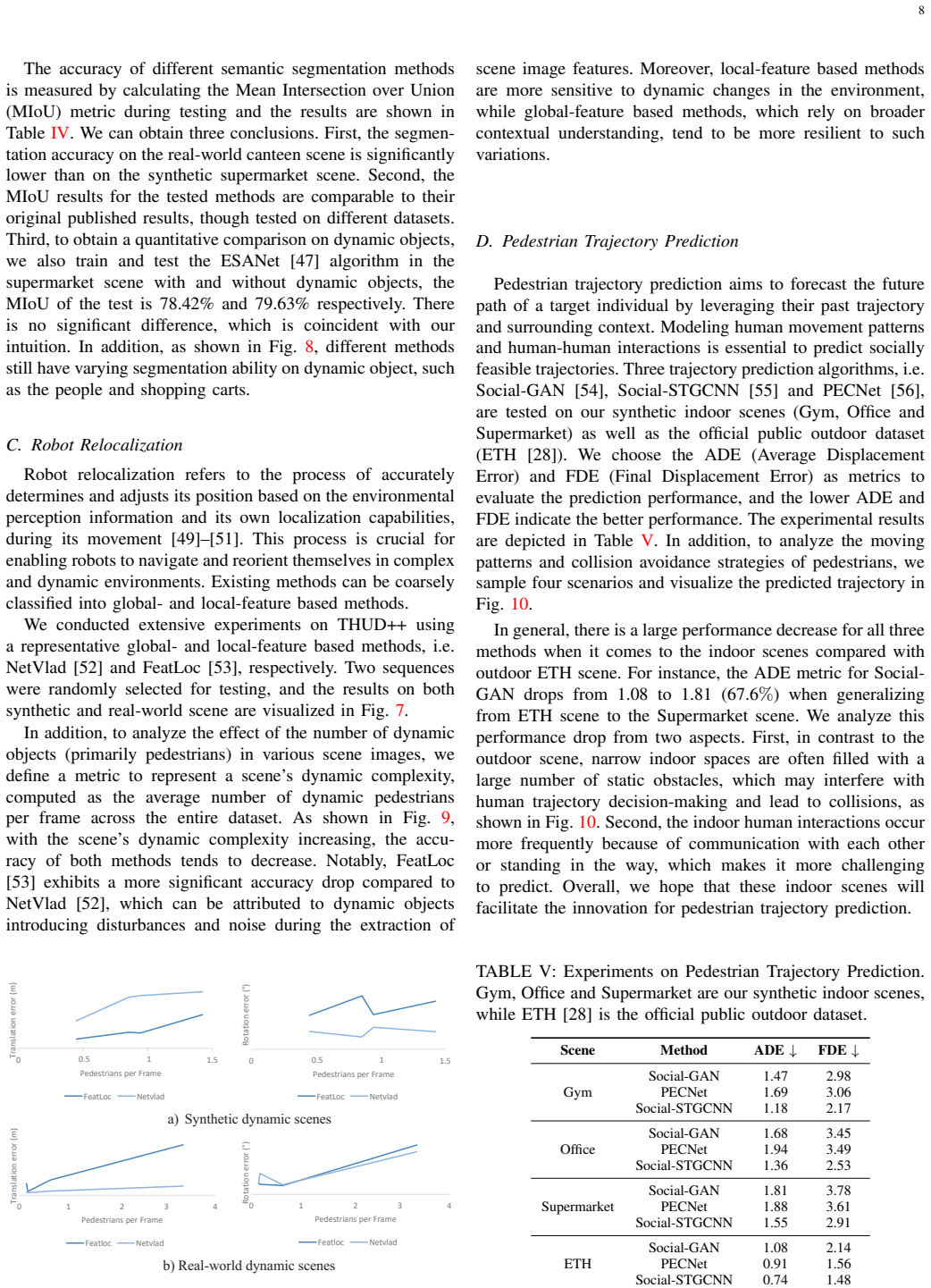
The central claim, stated on the paper's own terms, is that THUD++ is the large-scale dynamic indoor testbed that existing RGB-D and trajectory datasets lack. The paper demonstrates the claim by benchmarking five tasks at different levels of dynamic complexity, quantified as average pedestrians per frame. On THUD++, detectors lose mAP on dynamic objects, RGB-D segmentation mIoU drops on the real crowded canteen scene, relocalization translation and rotation errors increase with pedestrian count, trajectory-prediction ADE and FDE rise substantially compared with an outdoor public set, and navigation policies show lower success and higher collision rates as K grows from 10 to 20 pedestrians. Density of annotation, about 176 labels per frame, is what lets the benchmarks separate the effect of motion from the effect of clutter.
Load-bearing premise
The load-bearing assumption is that the simulated pedestrians and indoor layouts in THUD++ are representative enough of real crowded canteens and supermarkets that benchmark rankings obtained in simulation will also hold on physical robots.
Editorial extensions
If this is right
- THUD++ can serve as a stress test: methods that keep their accuracy as pedestrians per frame rises are the ones likely to survive real service-robot deployments.
- Evaluating detectors separately on static and dynamic objects makes it possible to quantify how much performance loss is caused by motion rather than by object category.
- Trajectory prediction gets an indoor benchmark with static obstacles and confined spaces, where current methods show markedly larger errors than on open outdoor scenes.
- The emulator allows closed-loop navigation experiments under controlled crowd density, with success rate, collision rate, navigation time, and social path efficiency as comparable metrics.
- The synthetic pipeline can generate additional labeled scenes on demand, so researchers can expand the benchmark without new physical sensors.
Reading between the lines
- Not tested in the paper: whether the 84,984 synthetic frames transfer to real robot operation; a real-crowd validation run would settle that.
- The dynamic-complexity metric could be applied to existing indoor datasets, letting the community rank benchmarks by motion content and compare methods at matched difficulty.
- A natural extension is to use the trajectory and navigation components together to train socially aware planners that both predict pedestrians and avoid static obstacles.
- The gap between global- and local-feature relocalization suggests fusing both feature types could be a cheap robustness gain that THUD++'s scene coverage could test.
Editorial analysis
A structured set of objections, weighed in public.
Referee Report
Summary. The paper introduces THUD++, a mobile-robot-oriented dataset that combines real and synthetic RGB-D data from 13 indoor scenes, with 90,175 frames annotated with 2D/3D bounding boxes, semantic and instance labels, camera poses, and IMU data; a synthetic pedestrian trajectory dataset for three indoor scenes; and a Unity3D-based navigation emulator. The authors benchmark several published methods on 3D object detection, semantic segmentation, robot relocalization, pedestrian trajectory prediction, and navigation, reporting performance degradation with increasing scene dynamics. The stated goal is to provide a reusable testbed for dynamic indoor scene understanding for mobile robots.
Significance. If the dataset is released as described and the benchmark results are reproducible, THUD++ would be a useful community resource: it is one of the few RGB-D datasets with explicit dynamic-object annotations spanning multiple real and synthetic scenes, and it offers a closed-loop navigation emulator plus trajectory data for indoor settings, where existing trajectory datasets are scarce. The paper is transparent about building on the authors' previous ICRA dataset [26], and the release of the dataset and platform is an asset. The main caveats are that the headline numbers in the abstract are not consistent with the body, and that the synthetic trajectory and navigation components carry an unvalidated realism assumption on which the causal claims in Section VI depend.
major comments (3)
- [Abstract; Section V.B; Table II] The abstract states that the trajectory dataset 'covers over 6,000 pedestrian trajectories', but Section V.B reports 1,257 automatically annotated pedestrian tracks across 6,363 frames, and Table II lists 1,257 pedestrians. This is a factor-of-five overstatement of the number of trajectories and must be corrected; the 'over 6,000' number appears to refer to frames, not pedestrians.
- [Abstract; Section IV.B] The abstract advertises 'more than 20 million 2D/3D bounding boxes', while Section IV.B says the dataset has 'over 20M labels' across four annotation types (2D boxes, 3D boxes, semantic segmentation, instance segmentation) and gives an average of 176 data labels per frame. With 90,175 frames, 176 labels per frame gives about 15.9M labels, not 20M. Please report per-annotation-type counts and reconcile these numbers; the current phrasing makes the dataset scale ambiguous.
- [Section V.A; Sections VI.D and VI.E] The trajectory prediction and navigation benchmarks are built entirely on synthetic pedestrians whose motion model is described only by start/end points, direction, speed, angular velocity, and acceleration, with no collision-avoidance or social-interaction model, and with pedestrians disappearing at their target. Section VI.D nevertheless attributes the indoor performance gap to static obstacles and to human interactions occurring more frequently, and Section VI.E treats the synthetic scenes as representative of real crowded indoor environments. This is a load-bearing inference that needs support: either document and validate the pedestrian model (for example, by comparison with real indoor trajectory statistics), or explicitly restrict the claims to synthetic-domain benchmarking.
minor comments (5)
- [Section VI.D] The sentence 'the ADE metric for Social-GAN drops from 1.08 to 1.81 (67.6%)' uses 'drops' for an increase in error; it should read 'increases by 67.6%'.
- [Table II; Section V.B] The stated duration of 60 minutes is inconsistent with 6,363 frames recorded at 0.4-second intervals (about 42 minutes); please clarify the sampling rate and duration.
- [Table III] ImVoteNet's dynamic-object mAP (17.49) exceeds its static-object mAP (17.29) in the Supermarket row, which is at odds with the unqualified statement that there are 'varying degrees of decrease' for dynamic objects; the subsequent caveat about object categories should be integrated into the conclusion.
- [Table IV; Figure 9] There is a typo 'ACNett' in the Canteen block of Table IV, and Figure 9 has garbled axis labels that should be regenerated.
- [Abstract; Section IV.B] The abstract and Section IV.B should use the same terminology for the annotation counts ('bounding boxes' versus 'labels') to avoid confusion.
Circularity Check
No circular derivation: THUD++ is a self-contained dataset/benchmark contribution; the only self-citation is a transparent prior-version reference.
full rationale
This is a dataset-and-benchmark paper with no fitted-parameter-to-prediction loop. The dataset components (RGB-D frames, trajectory records, navigation emulator) are constructed and released as artifacts, and the benchmark tables report measured performance of existing algorithms on those artifacts; none of the claimed results, e.g., performance degradation with pedestrian count, is derived from the construction parameters by an equation, so there is no self-definitional step. The only self-citation is [26], the earlier ICRA version of the same THUD dataset, explicitly identified in the 'Novelty with respect to our previous work' paragraph; it is transparent and not load-bearing for the new claims. The unvalidated representativeness of the synthetic pedestrian generator (Section V.A) and the absence of real-robot navigation validation (Section VI.E) are external-validity risks, not circularity, because the paper does not assert realism as a consequence of its benchmark results. Accordingly, no circular step is exhibited and the circularity score is low.
Assumptions & free parameters
assumptions (3)
- domain assumption Semi-automated detection outputs manually reviewed provide reliable ground-truth 2D/3D annotations and semantic labels.
- domain assumption PUDUbot V-SLAM poses, after cubic spline interpolation and 0-3 frame alignment, are accurate enough as camera ground truth.
- domain assumption Unity3D synthetic scenes and scripted pedestrians represent real indoor dynamics.
Cite this review
Pith. "Pith review of THUD++: Large-Scale Dynamic Indoor Scene Dataset and Benchmark for Mobile Robots." pith.science (2026). https://pith.science/paper/BPERBYIM
@misc{pith2026241208096,
  author       = {Pith},
  title        = {Pith review of: THUD++: Large-Scale Dynamic Indoor Scene Dataset and Benchmark for Mobile Robots},
  year         = {2026},
  howpublished = {\url{https://pith.science/paper/BPERBYIM}},
  note         = {Machine review of arXiv:2412.08096}
}
read the original abstract
Most existing mobile robotic datasets primarily capture static scenes, limiting their utility for evaluating robotic performance in dynamic environments. To address this, we present a mobile robot oriented large-scale indoor dataset, denoted as THUD++ (TsingHua University Dynamic) robotic dataset, for dynamic scene understanding. Our current dataset includes 13 large-scale dynamic scenarios, combining both real-world and synthetic data collected with a real robot platform and a physical simulation platform, respectively. The RGB-D dataset comprises over 90K image frames, 20M 2D/3D bounding boxes of static and dynamic objects, camera poses, and IMU. The trajectory dataset covers over 6,000 pedestrian trajectories in indoor scenes. Additionally, the dataset is augmented with a Unity3D-based simulation platform, allowing researchers to create custom scenes and test algorithms in a controlled environment. We evaluate state-of-the-art methods on THUD++ across mainstream indoor scene understanding tasks, e.g., 3D object detection, semantic segmentation, relocalization, pedestrian trajectory prediction, and navigation. Our experiments highlight the challenges mobile robots encounter in indoor environments, especially when navigating in complex, crowded, and dynamic scenes. By sharing this dataset, we aim to accelerate the development and testing of mobile robot algorithms, contributing to real-world robotic applications.
Figures


Figures from the paper (6 more)


Reference graph
Works this paper leans on
-
[26]
Mobile robot oriented large-scale indoor dataset for dynamic scene understanding,
Y .-F. Tang, C. Tai, F.-X. Chen, W.-T. Zhang, T. Zhang, X.-P. Liu, Y .-J. Liu, and L. Zeng, “Mobile robot oriented large-scale indoor dataset for dynamic scene understanding,” in 2024 IEEE International Conference on Robotics and Automation (ICRA) . IEEE, 2024, pp. 613–620
work page 2024
-
[1]
Planning-oriented autonomous driving,
Y . Hu, J. Yang, L. Chen, K. Li, C. Sima, X. Zhu, S. Chai, S. Du, T. Lin, W. Wang et al. , “Planning-oriented autonomous driving,” in Proceedings of the IEEE/CVF Conference on Computer Vision and Pattern Recognition, 2023, pp. 17 853–17 862
2023
-
[2]
Human-aware robot navigation: A survey,
T. Kruse, A. K. Pandey, R. Alami, and A. Kirsch, “Human-aware robot navigation: A survey,” Robotics and Autonomous Systems , vol. 61, no. 12, pp. 1726–1743, 2013
work page 2013
-
[3]
Online monitoring for safe pedestrian-vehicle interactions,
P. Du, Z. Huang, T. Liu, T. Ji, K. Xu, Q. Gao, H. Sibai, K. Driggs- Campbell, and S. Mitra, “Online monitoring for safe pedestrian-vehicle interactions,” in 2020 IEEE 23rd International Conference on Intelligent Transportation Systems (ITSC) . IEEE, 2020, pp. 1–8
work page 2020
-
[4]
A category-level 3-d object dataset: Putting the kinect to work,
A. Janoch, S. Karayev, Y . Jia, J. T. Barron, M. Fritz, K. Saenko, and T. Darrell, “A category-level 3-d object dataset: Putting the kinect to work,” in 2011 IEEE International Conference on Computer Vision Workshops (ICCV Workshops), 2011, pp. 1168–1174
work page 2011
-
[5]
Indoor segmen- tation and support inference from rgbd images,
P. K. Nathan Silberman, Derek Hoiem and R. Fergus, “Indoor segmen- tation and support inference from rgbd images,” in ECCV, 2012
work page 2012
-
[6]
Sun3d: A database of big spaces reconstructed using sfm and object labels,
J. Xiao, A. Owens, and A. Torralba, “Sun3d: A database of big spaces reconstructed using sfm and object labels,” in 2013 IEEE International Conference on Computer Vision , 2013, pp. 1625–1632
work page 2013
-
[7]
Joint 2d-3d-semantic data for indoor scene understanding,
I. Armeni, S. Sax, A. R. Zamir, and S. Savarese, “Joint 2d-3d-semantic data for indoor scene understanding,” ArXiv, vol. abs/1702.01105, 2017
arXiv 2017
Show all 62 references
-
[8]
Scenenet rgb-d: 5m photorealistic images of synthetic indoor trajectories with ground truth,
J. McCormac, A. Handa, S. Leutenegger, and A. J. Davison, “Scenenet rgb-d: 5m photorealistic images of synthetic indoor trajectories with ground truth,” ArXiv, vol. abs/1612.05079, 2016
2016 arXiv
-
[9]
Sun rgb-d: A rgb-d scene understanding benchmark suite,
S. Song, S. P. Lichtenberg, and J. Xiao, “Sun rgb-d: A rgb-d scene understanding benchmark suite,” in 2015 IEEE Conference on Computer Vision and Pattern Recognition (CVPR) , 2015, pp. 567–576
2015
-
[10]
Scannet: Richly-annotated 3d reconstructions of indoor scenes,
A. Dai, A. X. Chang, M. Savva, M. Halber, T. Funkhouser, and M. Nießner, “Scannet: Richly-annotated 3d reconstructions of indoor scenes,” in 2017 IEEE Conference on Computer Vision and Pattern Recognition (CVPR) , 2017, pp. 2432–2443
2017
-
[11]
Semantic scene completion from a single depth image,
S. Song, F. Yu, A. Zeng, A. X. Chang, M. Savva, and T. Funkhouser, “Semantic scene completion from a single depth image,” in 2017 IEEE Conference on Computer Vision and Pattern Recognition (CVPR) , 2017, pp. 190–198
2017
-
[12]
Matterport3d: Learning from rgb-d data in indoor environments,
A. X. Chang, A. Dai, T. A. Funkhouser, M. Halber, M. Nießner, M. Savva, S. Song, A. Zeng, and Y . Zhang, “Matterport3d: Learning from rgb-d data in indoor environments,” 2017 International Conference on 3D Vision (3DV) , pp. 667–676, 2017
2017
-
[13]
Interiornet: Mega- scale multi-sensor photo-realistic indoor scenes dataset,
W. Li, S. Saeedi, J. McCormac, R. Clark, D. Tzoumanikas, Q. Ye, Y . Huang, R. Tang, and S. Leutenegger, “Interiornet: Mega- scale multi-sensor photo-realistic indoor scenes dataset,” ArXiv, vol. abs/1809.00716, 2018
2018 arXiv
-
[14]
Arkitscenes: A diverse real-world dataset for 3d indoor scene understanding using mobile rgb-d data,
A. Dehghan, G. Baruch, Z. Chen, Y . Feigin, P. Fu, T. Gebauer, D. Kurz, T. Dimry, B. Joffe, A. Schwartz, and E. Shulman, “Arkitscenes: A diverse real-world dataset for 3d indoor scene understanding using mobile rgb-d data,” in NeurIPS Datasets and Benchmarks , 2021
2021
-
[15]
Scannet++: A high- fidelity dataset of 3d indoor scenes,
C. Yeshwanth, Y .-C. Liu, M. Nießner, and A. Dai, “Scannet++: A high- fidelity dataset of 3d indoor scenes,” ArXiv, vol. abs/2308.11417, 2023
2023 arXiv
-
[16]
3d object detection from images for autonomous driving: A survey,
X. Ma, W. Ouyang, A. Simonelli, and E. Ricci, “3d object detection from images for autonomous driving: A survey,” IEEE Transactions on Pattern Analysis and Machine Intelligence , vol. 46, no. 5, pp. 3537– 3556, 2024
2024
-
[17]
Multi-modal 3d object detection in autonomous driving: a survey,
Y . Wang, Q. Mao, H. Zhu, J. Deng, Y . Zhang, J. Ji, H. Li, and Y . Zhang, “Multi-modal 3d object detection in autonomous driving: a survey,” International Journal of Computer Vision , vol. 131, no. 8, pp. 2122– 2152, 2023
2023
-
[18]
3d object detection for autonomous driving: A comprehensive survey,
J. Mao, S. Shi, X. Wang, and H. Li, “3d object detection for autonomous driving: A comprehensive survey,” International Journal of Computer Vision, vol. 131, no. 8, pp. 1909–1963, 2023
1909
-
[19]
Vision-based semantic segmentation in scene understanding for autonomous driving: Recent achievements, challenges, and outlooks,
K. Muhammad, T. Hussain, H. Ullah, J. Del Ser, M. Rezaei, N. Kumar, M. Hijji, P. Bellavista, and V . H. C. de Albuquerque, “Vision-based semantic segmentation in scene understanding for autonomous driving: Recent achievements, challenges, and outlooks,” IEEE Transactions on In...
2022
-
[20]
A survey on continual semantic segmentation: Theory, challenge, method and application,
B. Yuan and D. Zhao, “A survey on continual semantic segmentation: Theory, challenge, method and application,” IEEE Transactions on Pattern Analysis and Machine Intelligence , 2024
2024
-
[21]
Transformer-based visual segmentation: A survey,
X. Li, H. Ding, H. Yuan, W. Zhang, J. Pang, G. Cheng, K. Chen, Z. Liu, and C. C. Loy, “Transformer-based visual segmentation: A survey,”IEEE Transactions on Pattern Analysis and Machine Intelligence , 2024
2024
-
[22]
A survey on monocular re- localization: From the perspective of scene map representation,
J. Miao, K. Jiang, T. Wen, Y . Wang, P. Jia, B. Wijaya, X. Zhao, Q. Cheng, Z. Xiao, J. Huang et al. , “A survey on monocular re- localization: From the perspective of scene map representation,” IEEE Transactions on Intelligent V ehicles, 2024
2024
-
[23]
Behavioral intention prediction in driving scenes: A survey,
J. Fang, F. Wang, J. Xue, and T.-S. Chua, “Behavioral intention prediction in driving scenes: A survey,”IEEE Transactions on Intelligent Transportation Systems, 2024
2024
-
[24]
A survey on socially aware robot navigation: Taxonomy and future challenges,
P. T. Singamaneni, P. Bachiller-Burgos, L. J. Manso, A. Garrell, A. San- feliu, A. Spalanzani, and R. Alami, “A survey on socially aware robot navigation: Taxonomy and future challenges,” The International Journal of Robotics Research , p. 02783649241230562, 2024
2024
-
[25]
Conflict avoidance in social navigation—a survey,
R. Mirsky, X. Xiao, J. Hart, and P. Stone, “Conflict avoidance in social navigation—a survey,” ACM Transactions on Human-Robot Interaction , vol. 13, no. 1, pp. 1–36, 2024
2024
-
[27]
Crowds by example,
A. Lerner, Y . Chrysanthou, and D. Lischinski, “Crowds by example,” Comput. Graph. F orum, vol. 26, pp. 655–664, 09 2007
2007
-
[28]
You’ll never walk alone: Modeling social behavior for multi-target tracking,
S. Pellegrini, A. Ess, K. Schindler, and L. Van Gool, “You’ll never walk alone: Modeling social behavior for multi-target tracking,” in 2009 IEEE 12th international conference on computer vision . IEEE, 2009, pp. 261–268
2009
-
[29]
Learning social etiquette: Human trajectory understanding in crowded scenes,
A. Robicquet, A. Sadeghian, A. Alahi, and S. Savarese, “Learning social etiquette: Human trajectory understanding in crowded scenes,” in Computer Vision – ECCV 2016 , B. Leibe, J. Matas, N. Sebe, and M. Welling, Eds. Cham: Springer International Publishing, 2016, pp. 549–565
2016
-
[30]
Person tracking in large public spaces using 3-d range sensors,
D. Br ˇsˇci´c, T. Kanda, T. Ikeda, and T. Miyashita, “Person tracking in large public spaces using 3-d range sensors,” IEEE Transactions on Human- Machine Systems , vol. 43, no. 6, pp. 522–534, 2013
2013
-
[31]
Online learning for human classification in 3d lidar-based tracking,
Z. Yan, T. Duckett, and N. Bellotto, “Online learning for human classification in 3d lidar-based tracking,” 2017 IEEE/RSJ International Conference on Intelligent Robots and Systems (IROS) , pp. 864–871, 11
2017
-
[32]
Th ¨or: Human-robot navigation data collection and accurate motion trajectories dataset,
A. Rudenko, T. P. Kucner, C. S. S. Swaminathan, R. T. Chadalavada, K. O. Arras, and A. J. Lilienthal, “Th ¨or: Human-robot navigation data collection and accurate motion trajectories dataset,” IEEE Robotics and Automation Letters , vol. 5, pp. 676–682, 2019. [Online]. Availabl...
2019
-
[33]
Self-supervised deep depth denoising,
V . Sterzentsenko, L. Saroglou, A. Chatzitofis, S. Thermos, N. Zioulis, A. Doumanoglou, D. Zarpalas, and P. Daras, “Self-supervised deep depth denoising,” in Proceedings of the IEEE/CVF International Conference on Computer Vision (ICCV) , October 2019
2019
-
[34]
A formal basis for the heuristic determination of minimum cost paths,
P. E. Hart, N. J. Nilsson, and B. Raphael, “A formal basis for the heuristic determination of minimum cost paths,” IEEE transactions on Systems Science and Cybernetics , vol. 4, no. 2, pp. 100–107, 1968
1968
-
[35]
Faster r-cnn: Towards real-time object detection with region proposal networks,
S. Ren, K. He, R. Girshick, and J. Sun, “Faster r-cnn: Towards real-time object detection with region proposal networks,” IEEE Transactions on Pattern Analysis and Machine Intelligence , vol. 39, no. 6, pp. 1137– 1149, 2017
2017
-
[36]
Imvotenet: Boosting 3d object detection in point clouds with image votes,
C. R. Qi, X. Chen, O. Litany, and L. J. Guibas, “Imvotenet: Boosting 3d object detection in point clouds with image votes,” in 2020 IEEE/CVF Conference on Computer Vision and Pattern Recognition (CVPR) , 2020, pp. 4403–4412
2020
-
[37]
Deformable detr: Deformable transformers for end-to-end object detection,
X. Zhu, W. Su, L. Lu, B. Li, X. Wang, and J. Dai, “Deformable detr: Deformable transformers for end-to-end object detection,” ArXiv, vol. abs/2010.04159, 2020
2010 arXiv
-
[38]
TokenFusion:multimodal token fusion for vision transformers
Y . Wang, X. Chen, L. Cao, W. Huang, F. Sun, and Y . Wang, “TokenFusion:multimodal token fusion for vision transformers.” [Online]. Available: http://arxiv.org/abs/2204.08721
-
[39]
Frustum ConvNet: Sliding frustums to aggregate local point-wise features for amodal 3d object detection
Z. Wang and K. Jia, “Frustum ConvNet: Sliding frustums to aggregate local point-wise features for amodal 3d object detection.” [Online]. Available: http://arxiv.org/abs/1903.01864
1903 arXiv
-
[40]
Frustum pointnets for 3d object detection from rgb-d data,
C. R. Qi, W. Liu, C. Wu, H. Su, and L. J. Guibas, “Frustum pointnets for 3d object detection from rgb-d data,” in 2018 IEEE/CVF Conference on Computer Vision and Pattern Recognition , 2018, pp. 918–927
2018
-
[41]
Boosting 3d object detection via object-focused image fusion,
H. Yang, C. Shi, Y . Chen, and L. Wang, “Boosting 3d object detection via object-focused image fusion,” ArXiv, vol. abs/2207.10589, 2022
2022 arXiv
-
[42]
A survey on image semantic segmentation methods with convolutional neural network,
F. Cao and Q. Bao, “A survey on image semantic segmentation methods with convolutional neural network,” in 2020 International Conference on Communications, Information System and Computer Engineering (CISCE), 2020, pp. 458–462
2020
-
[43]
Rgb-d semantic segmentation: A review,
Y . Hu, Z. Chen, and W. Lin, “Rgb-d semantic segmentation: A review,” in 2018 IEEE International Conference on Multimedia & Expo Work- shops (ICMEW) , 2018, pp. 1–6
2018
-
[44]
A brief survey on rgb- d semantic segmentation using deep learning,
C. Wang, C. Wang, W. Li, and H. Wang, “A brief survey on rgb- d semantic segmentation using deep learning,” Displays, vol. 70, p. 102080, 2021
2021
-
[45]
Acnet: Attention based network to exploit complementary features for rgbd semantic segmentation,
X. Hu, K. Yang, L. Fei, and K. Wang, “Acnet: Attention based network to exploit complementary features for rgbd semantic segmentation,” in 2019 IEEE International Conference on Image Processing (ICIP) , 2019, pp. 1440–1444
2019
-
[46]
Rednet: Residual encoder- decoder network for indoor rgb-d semantic segmentation,
J. Jiang, L. Zheng, F. Luo, and Z. Zhang, “Rednet: Residual encoder- decoder network for indoor rgb-d semantic segmentation,” ArXiv, vol. abs/1806.01054, 2018
2018 arXiv
-
[47]
Efficient rgb-d semantic segmentation for indoor scene analysis,
D. Seichter, M. K ¨ohler, B. Lewandowski, T. Wengefeld, and H.-M. Groß, “Efficient rgb-d semantic segmentation for indoor scene analysis,” 2021 IEEE International Conference on Robotics and Automation (ICRA) , pp. 13 525–13 531, 2020
2021
-
[48]
Bi-directional cross-modality feature propagation with separation-and- aggregation gate for rgb-d semantic segmentation,
X. Chen, K.-Y . Lin, J. Wang, W. Wu, C. Qian, H. Li, and G. Zeng, “Bi-directional cross-modality feature propagation with separation-and- aggregation gate for rgb-d semantic segmentation,” in European Con- ference on Computer Vision , 2020
2020
-
[49]
Posenet: A convolutional network for real-time 6-dof camera relocalization,
A. Kendall, M. Grimes, and R. Cipolla, “Posenet: A convolutional network for real-time 6-dof camera relocalization,” in Proceedings of the IEEE international conference on computer vision , 2015, pp. 2938– 2946
2015
-
[50]
Visual place recognition with repetitive structures,
A. Torii, J. Sivic, T. Pajdla, and M. Okutomi, “Visual place recognition with repetitive structures,” in Proceedings of the IEEE conference on computer vision and pattern recognition , 2013, pp. 883–890
2013
-
[51]
Dfnet: Enhance absolute pose regression with direct feature matching,
S. Chen, X. Li, Z. Wang, and V . A. Prisacariu, “Dfnet: Enhance absolute pose regression with direct feature matching,” in European Conference on Computer Vision . Springer, 2022, pp. 1–17
2022
-
[52]
Netvlad: Cnn architecture for weakly supervised place recognition,
R. Arandjelovi ´c, P. Gronat, A. Torii, T. Pajdla, and J. Sivic, “Netvlad: Cnn architecture for weakly supervised place recognition,” IEEE Trans- actions on Pattern Analysis and Machine Intelligence , vol. 40, no. 6, pp. 1437–1451, 2018
2018
-
[53]
Featloc: Absolute pose regressor for indoor 2d sparse features with simplistic view synthesizing,
T. B. Bach, T. T. Dinh, and J. H. Lee, “Featloc: Absolute pose regressor for indoor 2d sparse features with simplistic view synthesizing,” ISPRS Journal of Photogrammetry and Remote Sensing , 2022
2022
-
[54]
Social gan: Socially acceptable trajectories with generative adversarial networks,
A. Gupta, J. Johnson, L. Fei-Fei, S. Savarese, and A. Alahi, “Social gan: Socially acceptable trajectories with generative adversarial networks,” in Proceedings of the IEEE conference on computer vision and pattern recognition, 2018, pp. 2255–2264
2018
-
[55]
Social-stgcnn: A social spatio-temporal graph convolutional neural network for human trajectory prediction,
A. Mohamed, K. Qian, M. Elhoseiny, and C. Claudel, “Social-stgcnn: A social spatio-temporal graph convolutional neural network for human trajectory prediction,” in Proceedings of the IEEE/CVF Conference on Computer Vision and Pattern Recognition , 2020, pp. 14 424–14 432
2020
-
[56]
It is not the journey but the destination: Endpoint conditioned trajectory prediction,
K. Mangalam, H. Girase, S. Agarwal, K.-H. Lee, E. Adeli, J. Malik, and A. Gaidon, “It is not the journey but the destination: Endpoint conditioned trajectory prediction,” in European conference on computer vision. Springer, 2020, pp. 759–776
2020
-
[57]
Reciprocal n- body collision avoidance,
J. Van Den Berg, S. J. Guy, M. Lin, and D. Manocha, “Reciprocal n- body collision avoidance,” in Robotics Research: The 14th International Symposium ISRR . Springer, 2011, pp. 3–19
2011
-
[58]
Decentralized structural-rnn for robot crowd navigation with deep reinforcement learning,
S. Liu, P. Chang, W. Liang, N. Chakraborty, and K. Driggs-Campbell, “Decentralized structural-rnn for robot crowd navigation with deep reinforcement learning,” in 2021 IEEE international conference on robotics and automation (ICRA) . IEEE, 2021, pp. 3517–3524
2021
-
[59]
Intention aware robot crowd navigation with attention-based interaction graph,
S. Liu, P. Chang, Z. Huang, N. Chakraborty, K. Hong, W. Liang, D. L. McPherson, J. Geng, and K. Driggs-Campbell, “Intention aware robot crowd navigation with attention-based interaction graph,” in IEEE International Conference on Robotics and Automation (ICRA) , 2023, pp. 12 0...
2023
-
[60]
Robust, informative human-in-the-loop predictions via empirical reachable sets,
K. Driggs-Campbell, R. Dong, and R. Bajcsy, “Robust, informative human-in-the-loop predictions via empirical reachable sets,” IEEE Transactions on Intelligent V ehicles, vol. 3, no. 3, pp. 300–309, 2018
2018
-
[61]
Unfreezing the robot: Navigation in dense, interacting crowds,
P. Trautman and A. Krause, “Unfreezing the robot: Navigation in dense, interacting crowds,” in 2010 IEEE/RSJ International Conference on Intelligent Robots and Systems . IEEE, 2010, pp. 797–803
2010
-
[2017]
Available: https://api.semanticscholar.org/CorpusID: 4455393
[Online]. Available: https://api.semanticscholar.org/CorpusID: 4455393
Reviewed August 11, 2026 · model on record in the stance chip above.
Discussion (0). Continue with ORCID to comment.