REVIEW 4 major objections 6 minor 22 references
SecureNT: Smart Topology Obfuscation for Privacy-Aware Network Monitoring
T0 review · 4 major / 6 minor · reviewed 2026-08-11 · deepseek-v4-flash
Pith's one-line read SecureNT claims that fake-topology noise can hide real network structure from inference while keeping measurements usable for monitoring.
desk verdict A novel obfuscation combination with no mechanism for trusted-user recovery—the paper's main claim doesn't hold up, but the problem is worth a referee's attention. read the letter →
The pith
A machine-rendered reading of the paper's core claim, the machinery that carries it, and where it could break.
The reading
What carries the argument
The load-bearing mechanism is the path relation-based noise injection, centered on the paper's protection computing module $M$. The routing matrix $R$ records which links each end-to-end path traverses, and the real topology is encoded entirely in it. The module takes two inputs: fake path measurements $R'X'$ computed from a fake routing matrix and fake link delays, and a reference set of path delays $R\mathbf{1}$ built from the real routing matrix applied to an all-ones vector. It scales one distribution to match the other's sum, then alternates gradient descent on the L2 loss with a projection that preserves the sum, iterating until the loss falls below a threshold. The adjusted noise $\delta_y^{adj}$ is scaled by $\alpha$ and added to the true measurements, which is what the paper identifies as the source of both real-time protection and the privacy-utility trade-off.
What would settle it
Give a trusted user only the modified measurements $\tilde{Y}$ and the true routing matrix $R$, then run the paper's CLINK and RangeTomo evaluations. If the congestion-detection F1 or the inference similarity falls substantially below the reported 7-10 percent degradation, or matches the attacker's error, the utility claim fails; the paper's Eqs. (5)-(6) contain no denoising step to be tested.
Extended reading notes
Core claim
The central discovery is that a topology-hiding perturbation can be constructed from a fake routing matrix rather than from expensive topology-search optimization: choose a plausible fake topology, derive fake path delays from it, and run a fast distribution-matching step that reshapes this fake noise to the scale and shape of the real measurements. The paper argues that the resulting modified measurements $\tilde{Y}=Y+\alpha M(R' X', R\mathbf{1})$ mislead topology inference attacks while leaving trusted tomography algorithms accurate. In the evaluation, the protection is stable as probe counts grow to 1800, and trusted-user congestion detection (CLINK) and continuous inference (RangeTomo) degrade only mildly relative to the unprotected baseline.
Load-bearing premise
The trusted user can recover accurate link performance from deliberately perturbed measurements knowing only the real routing matrix $R$, even though the paper describes no step that removes or inverts the injected noise.
Editorial extensions
If this is right
- Operators can apply protection online as measurements arrive, because the modification is a scaling plus a short gradient-projection loop rather than a full optimization over topologies.
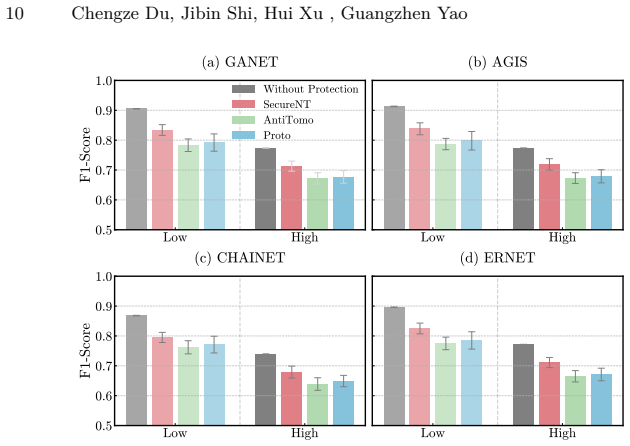
- Trusted users can keep their existing monitoring stack: CLINK-style congestion detection and RangeTomo-style performance inference run on the protected measurements with only a 7-10 percent F1 reduction.
- The protection does not wear out with attacker effort: topology similarity stays near 78-79 percent as probe count rises from 200 to 1800.
- Choosing a different fake routing matrix $R'$ gives the operator a tunable knob to trade privacy strength against measurement fidelity without changing the monitoring workflow.
- The result extends to at least four real networks of different sizes and path counts, so it is not confined to one small testbed.
Reading between the lines
- Implicit in Eqs. (5)-(6) is an access assumption the paper never states: a trusted user must know either the original measurements $Y$ or the noise parameters ($\alpha$, $R'$, and the output of $M$) to undo the perturbation; otherwise the utility results need a separate denoising argument.
- Because the attacker and the trusted user share the same $\tilde{Y}$, the framework's privacy-utility split ultimately rests on the attacker's ignorance of $R$; an adversary who learns a few real path-link relations may be able to subtract the reference term and expose the real topology.
- A natural stress test beyond the paper's evaluation is to attack with deep-learning tomographers rather than MPL, since the paper claims resilience to future inference approaches without evaluating any neural method.
- The L2 projection in $M$ could be replaced by other distribution distances, for example Wasserstein or KL, to see whether the same protection is achievable with less noise, a comparison the paper does not run.
Signed reviews
Editorial analysis
A structured set of objections, weighed in public.
Referee Report
Summary. The paper presents SecureNT, a framework that modifies end-to-end network measurements with the goal of preventing topology inference attacks while preserving the usefulness of the measurements for trusted network monitoring. The proposed mechanism constructs a fake topology (R′, X′), computes fake measurements R′X′, and injects noise into the true measurements as Ytilde = Y + α M(R′X′, R I), where M is the Protection Computing Module implemented by Algorithm 1 via iterative gradient descent with projection toward a reference distribution. The evaluation uses four Topology Zoo networks, compares against AntiTomo and Proto, and measures topology similarity under MPL inference, congestion-detection F1 with CLINK, and link-performance similarity with RangeTomo. The paper claims "superior privacy protection" and only a 7–10% F1 drop for trusted users.
Significance. The privacy–utility trade-off in network tomography is a real and timely problem, and the paper addresses it with a plausible threat model and standard benchmarks. Strengths include public source code, evaluation on multiple real-world topologies, and comparison against two protection baselines and three inference/monitoring algorithms. If the mechanism worked as claimed, the framework would be a practical contribution. However, the current manuscript does not establish the two central claims: the privacy gain over AntiTomo is marginal or slightly negative in the reported numbers, and the utility preservation for trusted users has no described mechanism because the injected noise is not invertible and no removal procedure is provided. The contribution is therefore currently at best incremental, and the load-bearing gaps need to be addressed before the paper can be accepted.
major comments (4)
- [§4.1, Eq. (5); §4.2, Algorithm 1] The trusted-user utility claim is unsupported: Eq. (5) defines Ytilde = Y + α M(R′X′, R I) and the text states that trusted and untrusted users work with the same measurement data, but the paper never specifies how a trusted user recovers or compensates for the injected noise. There is no decryption key, denoising step, or derivation showing that tomography performed on Ytilde with known R yields Xhat_t close to X. Consequently, the F1 and NRMSE results in Section 5.3 are unexplained empirical outcomes rather than evidence of a designed privacy–utility separation.
- [Abstract; §5.2, Figure 3] The claim of "superior privacy protection" is contradicted by the paper's own results. SecureNT's average similarity is 78.2% versus AntiTomo's 77.8% on smaller networks and 77.7% versus 77.4% on larger ones; since a lower similarity score means better protection, AntiTomo is slightly better in both settings. The body text correctly describes SecureNT as "comparable" to AntiTomo, but the abstract and conclusion claim superiority. The authors should either provide statistically significant evidence of improvement or revise the claim to comparability.
- [§4.2, Eq. (7)] The objective in Eq. (7) is not connected to Algorithm 1. The equation involves minimizing ||Y′−Y|| − λ1 d(G,G′) + λ2 ||Xhat_t − X||, but Algorithm 1 only performs projected gradient descent on ||Y − R I||. No derivation maps λ1, λ2, d(·,·), or Xhat_t to the update rule, and d(G,G′) depends on the attacker's inferred topology, which the algorithm never models. Thus the three claimed objectives are not actually optimized by the proposed mechanism.
- [§4.1, Eqs. (4)–(6)] The fake-topology and smoothing construction is underspecified. Eq. (6) calls M(R′X′, R I), but R is |P|×|L| and I ∈ R^{|L′|}, so the reference R I is only defined if |L| = |L′|, which is nowhere stated or justified. Algorithm 1 also takes an "initial distribution Y" and "target distribution RI" but never defines the loss L(·,·), the projection step beyond renormalization, or how the two input distributions A and B mentioned in the text map to the algorithm's inputs. A precise formulation is needed before the mechanism can be reproduced or analyzed.
minor comments (6)
- [Throughout] The manuscript contains many typos and formatting artifacts (e.g., "proctection computng moduel", "malicuous", "futher", "Giventhesechallenges", garbled font codes in Figures 2 and 3, and the stray "Mec." in Table 1), which suggests the paper has not been carefully proofread.
- [§3.1, Eq. (1)] The operator ⨀ is used for both additive and non-additive metrics, and the same symbol appears in Eq. (4) without stating which operation is used in the experiments; please specify that all experiments use delay (summation) and define the operation in each context.
- [§3.2, Eq. (3)] The quantities G0, G1, and G2 in the similarity metric are described only verbally as graph edit costs; please provide formal definitions so that the similarity measure is reproducible.
- [§5.1, Table 1 and Figure 3] The network name is spelled "CHINANET" in Table 1 but "CHAINET" in the Figure 3 caption; please make the naming consistent.
- [§4.2, Algorithm 1] The hyperparameters η, Tmax, and γ are not specified and no sensitivity analysis is reported; please add the values used in the experiments or point to the relevant code parameters.
- [§5.3, NRMSE] In the NRMSE formula, y[m] is used for both the true and the inferred link performance; please rename one of the signals to avoid confusion.
Circularity Check
No load-bearing circularity: SecureNT's construction is not self-referential, though the trusted-user utility claim lacks a stated mechanism and one background self-citation is present.
full rationale
The derivation chain in SecureNT does not reduce any prediction to a fitted input or definition. Equations (5) and (6) define the modified measurements as Ytilde = Y + alpha * M(R'X', R I), where M is a projection-based distribution-matching procedure; this is a construction, not an inference from the target quantities. The privacy results (similarity scores) are empirical outcomes of running MPL on the modified measurements, compared against AntiTomo and Proto, so they are externally evaluated rather than forced by construction. The utility results similarly come from running CLINK and RangeTomo on corrupted measurements; whether that should work is left unexplained (no key or denoising step is provided for the trusted user), but that is an unsupported assumption or missing mechanism, not equation-level circularity: the paper never defines the trusted user's estimate Xhat_t as equal to X or derives it from Eq. (7). The only self-citation, Ref. [4] (Du et al.), is used for the general background sentence that network tomography is important; it is not load-bearing for SecureNT's contributions. No uniqueness theorem, ansatz-by-citation, or renamed known result is invoked. The paper's claims of 'superior' privacy are empirically questionable (SecureNT similarity 78.2/77.7 is comparable to AntiTomo's 77.8/77.4), but that is a correctness or calibration concern, not circularity. Accordingly, the circularity score is low, reflecting only the minor non-load-bearing self-citation.
Assumptions & free parameters
free parameters (6)
- alpha (noise magnitude) =
not reported
- lambda1 (weight on topology distance) =
not reported
- lambda2 (weight on inference accuracy) =
not reported
- c (fake delay scaling) =
not reported
- convergence threshold gamma =
not reported
- learning rate eta and max iterations Tmax =
not reported
assumptions (3)
- domain assumption The attacker only observes the modified measurements Ytilde and cannot separate the injected noise from true delay variation.
- ad hoc to paper Iterative gradient descent with projection in Algorithm 1 produces a noise distribution that simultaneously defeats topology inference and preserves utility metrics.
- domain assumption The graph-edit-distance-inspired similarity measure in Eq. (3) accurately reflects attacker success.
invented entities (2)
-
Fake topology (R', L', X')
-
Protection Computing Module M
Cite this review
Pith. "Pith review of SecureNT: Smart Topology Obfuscation for Privacy-Aware Network Monitoring." pith.science (2026). https://pith.science/paper/XGLR4YIW
@misc{pith2026241208177,
  author       = {Pith},
  title        = {Pith review of: SecureNT: Smart Topology Obfuscation for Privacy-Aware Network Monitoring},
  year         = {2026},
  howpublished = {\url{https://pith.science/paper/XGLR4YIW}},
  note         = {Machine review of arXiv:2412.08177}
}
read the original abstract
Network tomography plays a crucial role in network monitoring and management, where network topology serves as the fundamental basis for various tomography tasks including traffic matrix estimation and link performance inference. The topology information, however, can be inferred through end-to-end measurements using various inference algorithms, posing significant security risks to network infrastructure. While existing protection methods attempt to secure topology information by modifying end-to-end measurements, they often require complex computation and sophisticated modification strategies, making real-time protection challenging. Moreover, these modifications typically render the measurements unusable for network monitoring, even by trusted users. This paper presents a novel privacy-preserving framework that addresses these limitations. Our approach provides efficient topology protection while maintaining the utility of measurements for authorized network monitoring. Through extensive evaluation on both simulated and real-world networks, we demonstrate that our framework achieves superior privacy protection compared to existing methods while enabling trusted users to effectively monitor network performance. Our solution offers a practical approach for organizations to protect sensitive topology information without sacrificing their network monitoring capabilities.
Figures


Figures from the paper (2 more)

Reference graph
Works this paper leans on
-
[1]
DeepNT: Path-centric graph neural networks for network tomogra- phy
Anonymous. DeepNT: Path-centric graph neural networks for network tomogra- phy. InSubmitted to The Thirteenth International Conference on Learning Repre- sentations, 2024. under review
work page 2024
-
[2]
Maximum likelihood network topology identification from edge-based unicast measurements
MarkCoates,RuiCastro,RobertNowak,ManikGadhiok,RyanKing,andYolanda Tsang. Maximum likelihood network topology identification from edge-based unicast measurements. ACM SIGMETRICS Performance Evaluation Review, 30(1):11–20, 2002
work page 2002
-
[3]
Shuhua Deng, Wenjie Dai, Xian Qing, and Xieping Gao. Vulnerabilities in sdn topology discovery mechanism: Novel attacks and countermeasures.IEEE Trans- actions on Dependable and Secure Computing, 2023
work page 2023
-
[4]
Chengze Du, Zhiwei Yu, and Xiangyu Wang. Identification of path congestion status for network performance tomography using deep spatial-temporal learning, 2024
work page 2024
-
[5]
Cambridge Uni- versity Press, 2021
Ting He, Liang Ma, Ananthram Swami, and Don Towsley.Network tomography: identifiability, measurement design, and network state inference. Cambridge Uni- versity Press, 2021
work page 2021
-
[6]
Proto: Proactive topology obfuscation against adversarial network topology inference
Tao Hou, Zhe Qu, Tao Wang, Zhuo Lu, and Yao Liu. Proto: Proactive topology obfuscation against adversarial network topology inference. InIEEE INFOCOM 2020-IEEE Conference on Computer Communications, pages 1598–1607. IEEE, 2020. 12 Chengze Du, Jibin Shi, Hui Xu , Guangzhen Yao
work page 2020
-
[7]
Sushil Jajodia and Steven Noel. Topological vulnerability analysis: A powerful new approach for network attack prevention, detection, and response. InAlgorithms, architectures and information systems security, pages 285–305. World Scientific, 2009
work page 2009
-
[8]
Sushil Jajodia, Steven Noel, and Brian O’berry. Topological analysis of network attack vulnerability.Managing Cyber Threats: Issues, Approaches, and Challenges, pages 247–266, 2005
work page 2005
Show all 22 references
-
[9]
Nguyen, Nickolas Falkner, Rhys Bowden, and Matthew Roughan
Simon Knight, Hung X. Nguyen, Nickolas Falkner, Rhys Bowden, and Matthew Roughan. The internet topology zoo.IEEE Journal on Selected Areas in Commu- nications, page 1765–1775, Oct 2011
2011
-
[10]
Combating temporal net- work inference by high-order camouflaged network topology obfuscation.Available at SSRN 4758548, 2022
Xiaohui Li, Xiang Yang, Yizhao Huang, and Yue Chen. Combating temporal net- work inference by high-order camouflaged network topology obfuscation.Available at SSRN 4758548, 2022
2022
-
[11]
Antit- omo: Network topology obfuscation against adversarial tomography-based topol- ogy inference
Yaqun Liu, Changyou Xing, Guomin Zhang, Lihua Song, and Hongxiu Lin. Antit- omo: Network topology obfuscation against adversarial tomography-based topol- ogy inference. Computers & Security, 113:102570, 2022
2022
-
[12]
Neural network tomography
Liang Ma, Ziyao Zhang, and Mudhakar Srivatsa. Neural network tomography. arXiv preprint arXiv:2001.02942, 2020
2001 arXiv
-
[13]
{NetHide}: Secure and practical network topology obfuscation
Roland Meier, Petar Tsankov, Vincent Lenders, Laurent Vanbever, and Martin Vechev. {NetHide}: Secure and practical network topology obfuscation. In27th USENIX Security Symposium (USENIX Security 18), pages 693–709, 2018
2018
-
[14]
H. X. Nguyen and P. Thiran. The boolean solution to the congested ip link location problem:Theoryandpractice. In IEEE INFOCOM 2007 - 26th IEEE International Conference on Computer Communications, Jan 2007
2007
-
[15]
Efficient and dynamic routing topology inference from end-to-end measurements.IEEE/ACM transactions on networking, 18(1):123–135, 2009
Jian Ni, Haiyong Xie, Sekhar Tatikonda, and Yang Richard Yang. Efficient and dynamic routing topology inference from end-to-end measurements.IEEE/ACM transactions on networking, 18(1):123–135, 2009
2009
-
[16]
Quantifying topological robustness of networks under sus- tained targeted attacks.Social Network Analysis and Mining, 3:939–952, 2013
Mahendra Piraveenan, Gnana Thedchanamoorthy, Shahadat Uddin, and Kon Shing Kenneth Chung. Quantifying topological robustness of networks under sus- tained targeted attacks.Social Network Analysis and Mining, 3:939–952, 2013
2013
-
[17]
Attack graph obfuscation.arXiv preprint arXiv:1903.02601, 2019
Rami Puzis, Hadar Polad, and Bracha Shapira. Attack graph obfuscation.arXiv preprint arXiv:1903.02601, 2019
1903 arXiv
-
[18]
Design and analysis of ddos mitigating network architecture
Swati, Sangita Roy, Jawar Singh, and Jimson Mathew. Design and analysis of ddos mitigating network architecture. International Journal of Information Security, 22(2):333–345, 2023
2023
-
[19]
Passive network tomography using em algorithms
Yolanda Tsang, Mark Coates, and Robert Nowak. Passive network tomography using em algorithms. In2001 IEEE International Conference on Acoustics, Speech, and Signal Processing. Proceedings (Cat. No. 01CH37221), volume 3, pages 1469–
-
[20]
Programmable in-network obfuscation of traffic.arXiv preprint arXiv:2006.00097, 2020
Liang Wang, Hyojoon Kim, Prateek Mittal, and Jennifer Rexford. Programmable in-network obfuscation of traffic.arXiv preprint arXiv:2006.00097, 2020
2006 arXiv
-
[21]
Range to- mography: combining the practicality of boolean tomography with the resolution of analog tomography
Sajjad Zarifzadeh, Madhwaraj Gowdagere, and Constantine Dovrolis. Range to- mography: combining the practicality of boolean tomography with the resolution of analog tomography. InProceedings of the 2012 Internet Measurement Conference, pages 385–398, 2012
2012
-
[22]
Eigenobfu: A novel network topology obfuscation defense method.IEEE Transactions on Network Science and Engineering, 2024
Ziliang Zhu, Guopu Zhu, Yu Zhang, Jiantao Shi, Xiaoxia Huang, and Yuguang Fang. Eigenobfu: A novel network topology obfuscation defense method.IEEE Transactions on Network Science and Engineering, 2024
2024
Reviewed August 11, 2026 · model on record in the stance chip above.
Discussion (0). Continue with ORCID to comment.