REVIEW 4 major objections 6 minor 39 references
Improving Multiresource Job Scheduling with Markovian Service Rate Policies
T0 review · 4 major / 6 minor · reviewed 2026-08-11 · deepseek-v4-flash
Pith's one-line read A queue-length-free Markov-chain policy class can stabilize any multiresource job system that any policy can stabilize.
desk verdict New policy class with real throughput-optimality results, but the non-preemptive response-time bounds rest on an independence assumption nMSR violates. read the letter →
The pith
A machine-rendered reading of the paper's core claim, the machinery that carries it, and where it could break.
The reading
What carries the argument
The load-bearing object is a finite-state CTMC whose states are candidate schedules $\mathbf{u}\in\mathbb{Z}_+^K$ satisfying $\mathbf{u}\mathbf{D}\le \mathbf{P}$, with transition rates fixed offline and updates conditionally independent of queue lengths. Because the modulating process is state-independent, the $K$-type system decouples into $K$ independent $M/M/1$ queues with Markov-modulated service rates (the MSR-1 systems); the argument compares the original system to these via a coupling (Theorem 6) and uses the relative-completions function $\Delta(s)$, computed by inverting the generator matrix, to bound mean queue length (Theorem 8). Carathéodory's theorem supplies the existence of at most $K$ schedules on the boundary of the convex hull of the schedulable set, and a MIQCP with load-balancing objective picks the candidate schedules.
What would settle it
Run an nMSR policy from Section 7.2 on a two-type, two-resource system with deterministic or Pareto service times, using arrival rates strictly inside the capacity region; if the mean queue length exceeds the Theorem 8 upper bound or fails to stabilize while the exponential model predicts stability, the exponential assumption is doing the work.
Extended reading notes
Core claim
The central claim is that the class of MSR policies is throughput-optimal and analytically tractable: if a multiresource job system with $K$ job types and arrival vector $\boldsymbol{\lambda}$ can be stabilized by any policy, then an MSR policy with $N_p \le K$ candidate schedules stabilizes it. For any MSR policy, the mean queue length of each job type is bounded by the mean queue length of a corresponding single-server Markov-modulated system plus at most the maximum number of jobs of that type served in parallel, which makes the bounds tight up to an additive constant. The paper further claims that the pMSR policy selected by minimizing the maximum per-type load is constant-competitive with MaxWeight in the heavy-traffic limit, and that the same construction works for non-preemptive jobs and for preemptions with setup times.
Load-bearing premise
The whole analysis assumes job service times are exponentially distributed, so the non-preemptive policy can time its switches by completions and the decoupled single-server comparison goes through; for general service-time distributions the response-time bounds are not proven and the nMSR state space can blow up.
Editorial extensions
If this is right
- The entire stability region of multiresource job systems is reachable by policies that do not look at queue lengths, so the expensive online bin-packing of MaxWeight is not needed for stabilization.
- Mean response time of a well-tuned MSR policy is within a constant of MaxWeight in heavy traffic, with an offline MIQCP and constant-time online operation; this transfers to non-preemptive and setup-time settings.
- The additive tightness of the bounds means the approximation formula from Section 6.4 can be used to select operating parameters such as the switching rate $\alpha$.
- Throughput optimality of nMSR and sMSR policies means preemption constraints alone do not shrink the capacity region below what is fundamentally stabilizable.
Reading between the lines
- If the exponential service-time assumption is dropped, the paper's response-time bounds and the nMSR switching construction do not automatically survive; extending the relative-completions analysis to phase-type or general distributions is the natural next test, as the paper itself notes the phase-type extension blows up for nMSR policies.
- Because the modulating process cannot react to queue lengths, MSR policies give up state-dependent gains; combining MSR with BackFilling—which the paper simulates but does not analyze—suggests a tractable hybrid that could improve response times at moderate loads.
- The load-balancing objective in equation (7) is one of many possible objectives; re-solving the same MIQCP with fairness or tail-latency constraints is a direct extension of the paper's offline optimization approach.
Editorial analysis
A structured set of objections, weighed in public.
Referee Report
Summary. The paper introduces Markovian Service Rate (MSR) policies for scheduling multiresource jobs: a finite-state CTMC selects among a small set of candidate schedules, with the CTMC designed offline from arrival rates, service rates, and resource demands. The main claims are that the MSR class is throughput-optimal under preemptive, non-preemptive, and setup-time preemption models (Theorems 2, 4, and 5); that the mean queue length of an MSR policy is within an additive constant of a corresponding Markov-modulated M/M/1 system (Theorems 6 and 8); that an MIQCP formulation (equation (7)) can select policies that are constant-competitive with MaxWeight in heavy traffic (Theorem 10); and that the resulting policies perform well on a Google Borg trace. The paper provides appendices for most proofs, a public code repository, and a detailed example system.
Significance. If the claims hold, this is a substantial step: it offers a class of low-complexity, offline-designed scheduling policies with throughput optimality and explicit response-time bounds for multiresource jobs, which prior work largely lacked. The pMSR and sMSR results, the use of relative completions from prior work, the closed-form bounds, and the reproducible Borg-trace evaluation are genuine strengths. The main concern is that the non-preemptive (nMSR) analysis relies on an independence assumption contradicted by the definition of nMSR, and the MIQCP in equation (7) has a units inconsistency; these issues are load-bearing for the paper's broadest claims and require repair.
major comments (4)
- [Section 6.1, Theorem 6, Appendix B] The decoupling argument assumes that the modulating process {u_i(t)} is independent of the queue-length state; Section 6.1 states this explicitly ("assumed to be independent of the overall state of the system"), and it is true for pMSR and sMSR policies, whose transition rates are exogenous or setup-rate driven. It is false for nMSR: Section 5.1 restricts nMSR so that decreasing the number of scheduled jobs of a type occurs only at job completions, with transition rates at most mu_i * u_i(t), and Appendix F, Figure 6b labels the transition from state t_{1,4,0} to t_{0,4,0} with rate mu_1, meaning the transition occurs only when a type-1 job completes. In the coupling proof, if the MSR-1 system is empty while the MSR system has a type-1 job in service, a completion in the MSR system triggers an nMSR state transition that has no counterpart in the MSR-1 system; conversely, if the MSR system is empty, the completion that would drive the nMSR transition cannot occur, so the two modulating processes diverge. The induction in Appendix B does not address this case. Consequently, Theorems 6 and 8 do not support the abstract's claim of additive-tight response-time bounds for non-preemptive systems, and Section 7.2's use of these bounds to select the nMSR switching rate alpha* is unsupported. The authors should either restrict Theorems 6 and 8 to pMSR and sMSR policies, or develop a genuinely different comparison for nMSR.
- [Appendix A, Lemma 1] The Foster-Lyapunov proof of Lemma 1 uses step (10), E[C(t) | Q(0)=q] = E[C(t)], which requires the potential-completion process C(t) to be independent of the queue state. For nMSR policies this independence fails: the switching-state transitions are driven by actual completions, and a modulating process can stall in a switching state when no job of the type needed for the next transition is present. Thus the 'if' direction of Lemma 1 is unproved for nMSR, and Theorem 4's construction, which invokes Lemma 1 to conclude stability from E[u^q] approximately equal to E[u^p], is incomplete. This is load-bearing for the claimed throughput-optimality of the nMSR class.
- [Section 7.1, equation (7)] The MIQCP objective defines rho_i = lambda_i / (pi W_p)_i, omitting the service-rate vector mu_i. Elsewhere in the paper (Section 6.3 and Definition 2), rho_i = lambda_i / E[u_i^{p-1}] = lambda_i / (mu_i E[u_i^p]). Unless all mu_i are equal to 1, which is the case only in the Appendix J example, equation (7) minimizes a different quantity from the per-type load that appears in the response-time bounds. The formulation should use lambda_i / (mu_i (pi W_p)_i) componentwise, otherwise the selected pMSR policy is not the one claimed to balance the loads that determine the Theta(1/(1-rho_i)) terms.
- [Section 5.1, Theorem 5] The proof of Theorem 5 is only a two-sentence sketch ("This proof is nearly identical to the proof of Theorem 4") and does not define the sMSR switching states, their schedules, or the transition rates involving setup times, nor does it verify that the renewal-reward argument of Appendix E applies to the setup-time routes. Since throughput-optimality under setup costs is one of the paper's stated contributions, a complete proof or a detailed appendix is needed to support the theorem as stated.
minor comments (6)
- [Section 3.3, Definition 1] The phrase "conditionally independent of the underlying queueing system given the system events (e.g. completions and setups)" is ambiguous and does not by itself imply the independence used in Section 6.1; the two statements should be reconciled, especially in light of the nMSR transition rules.
- [Appendix B] The coupling construction says to "set u_i(t) exponential timers at any time t corresponding to an event ... in either system," but it does not specify what happens to timers when the MSR system has no job associated with a given timer, nor how timer expirations that are not completions affect the nMSR modulating process; the event construction should be made fully precise.
- [Lemma 9, equation (6)] Equation (6) appears to have an extra factor mu_i on the second term: the preceding display (5) and the lemma statement use E[u_i^{p-1}] 1 - u^{p-1}_{*,i}, whereas (6) writes E[u_i^{p-1}] 1 - mu_i (u^{p-1}_{1,i}, ..., u^{p-1}_{N_p,i}). Please correct this typo or clarify the notation.
- [Section 6.4] The quantity P^{M/M/k*_i}_Q is used without a definition; please define the M/M/k queueing probability and state the parameter k*_i = E[u_i^p] explicitly before presenting the approximation.
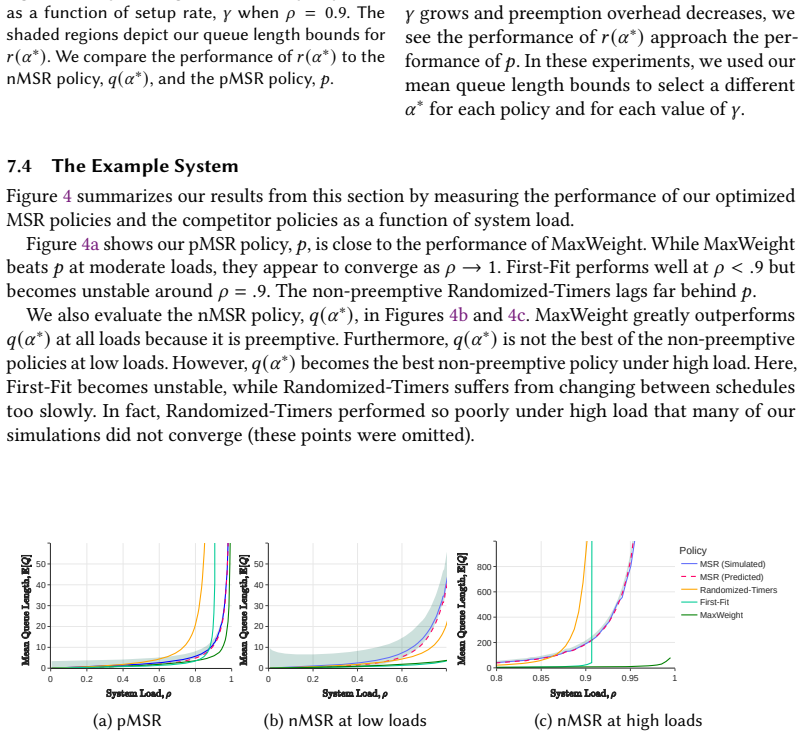
- [Section 8.1] The evaluation sets alpha = 0.1 for the pMSR policy, although Section 7.1 recommends a large switching rate alpha; please explain whether this choice is specific to the Borg trace or represents a different normalization of alpha.
- [Theorem 10 proof] The proof cites reference [7] for the claim that E[Q^{MaxWeight}] scales as Theta(1/epsilon); the heavy-traffic result for MaxWeight in generalized switches is more commonly attributed to [34], so the citation should be checked.
Circularity Check
No significant circularity: the stability and response-time claims are derived from external capacity-region and relative-completions theorems, with simulation used for validation rather than to fit the predicted quantities.
full rationale
The paper's central derivation chain is self-contained and does not reduce to its own inputs. Throughput-optimality (Theorem 2) starts from the externally established capacity region in equation (2), proves the MSR stability condition in Lemma 1 via a Foster-Lyapunov drift argument, and then invokes Caratheodory's theorem to obtain at most K candidate schedules; Theorems 4 and 5 construct nMSR and sMSR policies by scaling switching rates, with the renewal-reward argument in Appendix E. No step fits a parameter to the target stability claim. The response-time analysis decouples the multiresource system into per-type MSR-1 queues (Theorem 6) and then applies the relative-completions formula of references [15, 16] as a stated published theorem (Remark 7); the resulting bound in Theorem 8 is a direct composition of these two results. The quantities Delta are computed from the generator matrix by solving the linear system in Lemma 9, not calibrated to simulated queue lengths. The queue-length approximation in Section 6.4 replaces an expected unused-service term by E[Delta], which is an explicitly stated modeling approximation rather than a fitted constant. Simulation is used only to validate the predictions and to choose an optimization parameter alpha*, and the paper reports that the predicted optimal alpha* is within 2.1% of the simulated optimum, which is evidence of independence rather than circularity. Although references [15, 16] share authors with this paper, the cited relative-completions result is an external, parameter-free theorem with stated assumptions and is not derived from the present paper's fitted values, so it does not raise the circularity score. The skeptic concern that nMSR modulating processes depend on queue lengths and may break the coupling in Theorem 6 is a correctness or assumption-violation issue, not a circularity issue; the paper itself acknowledges that the nMSR modulating process relies on completions and notes in Appendix G that phase-type extensions are more complicated for nMSR. No quoted step exhibits a prediction that is equivalent to an input by construction, a fitted parameter renamed as a prediction, or a load-bearing argument whose only support is an unverified self-citation.
Assumptions & free parameters
free parameters (1)
- switching rate alpha =
0.1 (pMSR), 3.6e-6 (nMSR), 2 (example)
assumptions (7)
- standard math Foster-Lyapunov theorem implies positive recurrence when drift is negative outside a finite set.
- standard math Caratheodory's theorem bounds the number of extreme points needed in a convex combination.
- standard math Renewal-reward theorem relates long-run fractions of time in working states to scaled transition rates.
- domain assumption The capacity region of a multiresource job system is C = {lambda : (1+epsilon) lambda/mu in Conv(S), epsilon > 0}.
- domain assumption The relative-completions formula for the mean queue length of an MSR-1 system (Remark 7).
- domain assumption MaxWeight mean queue length scales as Theta(1/epsilon) in heavy traffic.
- domain assumption Poisson arrivals, exponential service times, finite job types, and constant resource demands.
Cite this review
Pith. "Pith review of Improving Multiresource Job Scheduling with Markovian Service Rate Policies." pith.science (2026). https://pith.science/paper/E7R56ZBQ
@misc{pith2026241208915,
  author       = {Pith},
  title        = {Pith review of: Improving Multiresource Job Scheduling with Markovian Service Rate Policies},
  year         = {2026},
  howpublished = {\url{https://pith.science/paper/E7R56ZBQ}},
  note         = {Machine review of arXiv:2412.08915}
}
read the original abstract
Modern cloud computing workloads are composed of multiresource jobs that require a variety of computational resources in order to run, such as CPU cores, memory, disk space, or hardware accelerators. A single cloud server can typically run many multiresource jobs in parallel, but only if the server has sufficient resources to satisfy the demands of every job. A scheduling policy must therefore select sets of multiresource jobs to run in parallel in order to minimize the mean response time across jobs -- the average time from when a job arrives to the system until it is completed. Unfortunately, achieving low response times by selecting sets of jobs that fully utilize the available server resources has proven to be a difficult problem. In this paper, we develop and analyze a new class of policies for scheduling multiresource jobs, called Markovian Service Rate (MSR) policies. While prior scheduling policies for multiresource jobs are either highly complex to analyze or hard to implement, our MSR policies are simple to implement and are amenable to response time analysis. We show that the class of MSR policies is throughput-optimal in that we can use an MSR policy to stabilize the system whenever it is possible to do so. We also derive bounds on the mean response time under an MSR algorithm that are tight up to an additive constant. These bounds can be applied to systems with different preemption behaviors, such as fully preemptive systems, non-preemptive systems, and systems that allow preemption with setup times. We show how our theoretical results can be used to select a good MSR policy as a function of the system arrival rates, job service requirements, the server's resource capacities, and the resource demands of the jobs.
Figures


Figures from the paper (3 more)


Reference graph
Works this paper leans on
- [1]
-
[2]
David Y Burman and Donald R Smith. 1986. An asymptotic analysis of a queueing system with Markov-modulated arrivals. Operations Research 34, 1 (1986), 105–119
work page 1986
-
[3]
Zhongrui Chen, Isaac Grosof, and Benjamin Berg. 2024. Simple Policies for Multiresource Job Scheduling. ACM SIGMETRICS Performance Evaluation Review 52, 2 (2024), 27–29
work page 2024
-
[4]
Florin Ciucu and Felix Poloczek. 2018. Two extensions of Kingman’s GI/G/1 bound. Proceedings of the ACM on Measurement and Analysis of Computing Systems 2, 3 (2018), 1–33
work page 2018
-
[5]
Christina Delimitrou and Christos Kozyrakis. 2014. Quasar: Resource-efficient and qos-aware cluster management. ACM SIGPLAN Notices 49, 4 (2014), 127–144
work page 2014
-
[6]
Mitko Dimitrov. 2011. Single-server queueing system with Markov-modulated arrivals and service times. Pliska Stud. Math. Bulg 20 (2011), 53–62
work page 2011
-
[7]
Atilla Eryilmaz and Rayadurgam Srikant. 2012. Asymptotically tight steady-state queue length bounds implied by drift conditions. Queueing Systems 72 (2012), 311–359
work page 2012
-
[8]
Ruy Fabila-Monroy and Clemens Huemer. 2017. Caratheodory’s theorem in depth. Discrete & Computational Geometry 58 (2017), 51–66
work page 2017
Show all 39 references
-
[9]
Gennadi Falin and Anatoli Falin. 1999. Heavy traffic analysis of M/G/1 type queueing systems with Markov-modulated arrivals. Top 7, 2 (1999), 279–291
1999
-
[10]
Anshul Gandhi, Sherwin Doroudi, Mor Harchol-Balter, and Alan Scheller-Wolf. 2013. Exact analysis of the M/M/k/setup class of Markov chains via recursive renewal reward. In Proceedings of the ACM SIGMETRICS/international conference on Measurement and modeling of computer system...
2013
-
[11]
Javad Ghaderi. 2016. Randomized algorithms for scheduling VMs in the cloud. Proceedings - IEEE INFOCOM 2016-July (7 2016). https://doi.org/10.1109/INFOCOM.2016.7524536
2016
-
[12]
Javad Ghaderi. 2016. Simple high-performance algorithms for scheduling jobs in the cloud. 2015 53rd Annual Allerton Conference on Communication, Control, and Computing, Allerton 2015 (4 2016), 345–352. https://doi.org/10.1109/ ALLERTON.2015.7447025
2016
-
[13]
Isaac Grosof, Mor Harchol-Balter, and Alan Scheller-Wolf. 2020. Stability for Two-class Multiserver-job Systems. (10 2020). https://arxiv.org/abs/2010.00631v1
2020 arXiv
-
[14]
Isaac Grosof, Mor Harchol-Balter, and Alan Scheller-Wolf. 2022. WCFS: a new framework for analyzing multiserver systems. Queueing Systems 102, 1-2 (10 2022), 143–174. https://doi.org/10.1007/S11134-022-09848-6/METRICS
2022 doi
-
[15]
Isaac Grosof, Yige Hong, and Mor Harchol-Balter. 2024. Analysis of Markovian Arrivals and Service with Applications to Intermittent Overload. arXiv preprint arXiv:2405.04102 (2024)
2024 arXiv
-
[16]
Isaac Grosof, Yige Hong, Mor Harchol-Balter, and Alan Scheller-Wolf. 2023. The RESET and MARC techniques, with application to multiserver-job analysis. Performance Evaluation 162 (2023), 102378
2023
-
[17]
Harchol-Balter
M. Harchol-Balter. 2013. Performance Modeling and Design of Computer Systems: Queueing Theory in Action . Cambridge University Press
2013
-
[18]
Mor Harchol-Balter. 2022. The multiserver job queueing model. Queueing Systems 100, 3 (2022), 201–203
2022
-
[19]
Benjamin Hindman, Andy Konwinski, Matei Zaharia, Ali Ghodsi, Anthony D Joseph, Randy H Katz, Scott Shenker, and Ion Stoica. 2011. Mesos: A platform for fine-grained resource sharing in the data center.. In NSDI, Vol. 11. 22–22
2011
-
[20]
Sungjin Im, Nathaniel Kell, Janardhan Kulkarni, and Debmalya Panigrahi. 2015. Tight Bounds for Online Vector Scheduling. Proceedings - Annual IEEE Symposium on Foundations of Computer Science, FOCS 2015-December (12 2015), 525–544. https://doi.org/10.1109/FOCS.2015.39
2015 doi
-
[21]
Sungjin Im, Benjamin Moseley, Kamesh Munagala, and Kirk Pruhs. 2020. Dynamic weighted fairness with minimal disruptions. Proceedings of the ACM on Measurement and Analysis of Computing Systems 4, 1 (2020), 1–18
2020
-
[22]
Stefano Leonardi and Danny Raz. 2007. Approximating total flow time on parallel machines. J. Comput. System Sci. 73, 6 (2007), 875–891
2007
-
[23]
Qiao Li and Rohit Negi. 2011. Distributed throughput-optimal scheduling in ad hoc wireless networks. In 2011 IEEE International Conference on Communications (ICC) . IEEE, 1–5
2011
-
[24]
Don Lipari. 2012. The SLURM Scheduler Design. SLURM User Group. http://slurm. schedmd. com/slurm_ug_2012/SUG- 2012-Scheduling. pdf (2012)
2012
-
[25]
Siva Theja Maguluri and Rayadurgam Srikant. 2013. Scheduling jobs with unknown duration in clouds. IEEE/ACM Transactions On Networking 22, 6 (2013), 1938–1951
2013
-
[26]
Srikant, and Lei Ying
Siva Theja Maguluri, R. Srikant, and Lei Ying. 2014. Heavy traffic optimal resource allocation algorithms for cloud computing clusters. Performance Evaluation 81 (2014), 20–39. https://doi.org/10.1016/j.peva.2014.08.002
2014 doi
-
[27]
Mihalis G Markakis, Eytan Modiano, and John N Tsitsiklis. 2013. Max-weight scheduling in queueing networks with heavy-tailed traffic. IEEE/ACM Transactions on networking 22, 1 (2013), 257–270. Proc. ACM Meas. Anal. Comput. Syst., Vol. 9, No. 2, Article 25. Publication date: Ju...
2013
-
[28]
Marcel F Neuts. 1978. The M/M/1 queue with randomly varying arrival and service rates. Opsearch 15 (1978), 139–157
1978
-
[29]
Jian Ni, Bo Tan, and R. Srikant. 2012. Q-CSMA: Queue-length-based CSMA/CA algorithms for achieving maximum throughput and low delay in wireless networks. IEEE/ACM Transactions on Networking 20, 3 (6 2012), 825–836. https://doi.org/10.1109/TNET.2011.2177101
2012
-
[30]
Konstantinos Psounis, Pablo Molinero-Fernández, Balaji Prabhakar, and Fragkiskos Papadopoulos. 2005. Systems with multiple servers under heavy-tailed workloads. Performance Evaluation 62, 1-4 (2005), 456–474
2005
-
[31]
Konstantinos Psychas and Javad Ghaderi. 2018. Randomized algorithms for scheduling multi-resource jobs in the cloud. IEEE/ACM Transactions on Networking 26, 5 (10 2018), 2202–2215. https://doi.org/10.1109/TNET.2018.2863647
2018
-
[32]
GJK Regterschot and JHA De Smit. 1986. The queue M//G/1 with Markov modulated arrivals and services.Mathematics of operations research 11, 3 (1986), 465–483
1986
-
[33]
SchedMD. 2021. SLURM Workload Manager. (2021). https://slurm.schedmd.com/heterogeneous_jobs.html
2021
-
[34]
Alexander L. Stolyar. 2004. MaxWeight scheduling in a generalized switch: State space collapse and workload minimization in heavy traffic. https://doi.org/10.1214/aoap/1075828046 14, 1 (2 2004), 1–53. https://doi.org/10.1214/ AOAP/1075828046
2004
-
[35]
Leandros Tassiulas and Anthony Ephremides. 1990. Stability properties of constrained queueing systems and scheduling policies for maximum throughput in multihop radio networks. In 29th IEEE Conference on Decision and Control . IEEE, 2130–2132
1990
-
[36]
Muhammad Tirmazi, Adam Barker, Nan Deng, Md E Haque, Zhijing Gene Qin, Steven Hand, Mor Harchol-Balter, and John Wilkes. 2020. Borg: the next generation. In Proceedings of the Fifteenth European Conference on Computer Systems . 1–14
2020
-
[37]
Abhishek Verma, Luis Pedrosa, Madhukar Korupolu, David Oppenheimer, Eric Tune, and John Wilkes. 2015. Large- scale cluster management at Google with Borg. In Proceedings of the Tenth European Conference on Computer Systems (Bordeaux, France) (EuroSys ’15). Association for Comp...
2015
-
[38]
Qiaomin Xie Weina Wang and Mor Harchol-Balter. 2021. Zero Queueing for Multi-Server Jobs. Proceedings of the ACM on Measurement and Analysis of Computing Systems 5, 1 (2 2021), 1–25. https://doi.org/10.1145/3447385
2021 doi
-
[39]
Adam Wierman and Mor Harchol-Balter. 2003. Classifying scheduling policies with respect to unfairness in an M/GI/1. In Proceedings of the 2003 ACM SIGMETRICS international conference on Measurement and modeling of computer systems . 238–249. Appendix A Proof of Lemma 1 Lemma 1...
2003
Reviewed August 11, 2026 · model on record in the stance chip above.
Discussion (0). Continue with ORCID to comment.