REVIEW 2 major objections 5 minor 76 references
BaB-ND: Long-Horizon Motion Planning with Branch-and-Bound and Neural Dynamics
T0 review · 2 major / 5 minor · reviewed 2026-08-11 · deepseek-v4-flash
Pith's one-line read Long-horizon manipulation planning can be solved by branch-and-bound over neural dynamics, outperforming sampling-based planners and scaling beyond mixed-integer programming.
desk verdict A practical, well-tested heuristic for planning over neural dynamics, with an honest but under-explored caveat: the pruning step is not sound, so the 'systematic exploration' framing overstates the guarantee. read the letter →
The pith
A machine-rendered reading of the paper's core claim, the machinery that carries it, and where it could break.
The reading
What carries the argument
The central object is the branch-and-bound tree over the action-sequence box $\mathcal{C} = [\underline{u}, \overline{u}]^d$. Branching selects $n$ subdomains per iteration, ranking them by their stored lower and upper bounds and splitting each along the dimension that maximizes $(\overline{u}_j - \underline{u}_j) \, |n^{\mathrm{lo}}_j - n^{\mathrm{up}}_j|$, i.e., dimensions with large remaining range and imbalanced top samples. Bounding adapts CROWN linear bound propagation: propagation stops early at chosen intermediate layers, and the pre-activation bounds needed to relax ReLUs are taken as min/max over $M$ samples from the search rather than computed recursively; this makes the bound cheap enough to scale, though the paper states that a strictly sound lower bound is not required. Searching runs CEM inside each subdomain and returns feasible upper bounds, and any subdomain whose lower bound exceeds the global best upper bound is pruned.
What would settle it
On a small problem with a known optimum, such as the paper's synthetic $f(u)=\sum_i (5u_i^2 + \cos(50u_i))$ with $d=2$, run BaB-ND with a small sample count $M$ for the search-integrated bounds and record every pruned subdomain; if the known global optimum lies inside any pruned subdomain, or if the reported lower bound on a subdomain containing the optimum exceeds the true minimum, the empirical bounds are not sound enough to guarantee the claimed systematic search.
Extended reading notes
Core claim
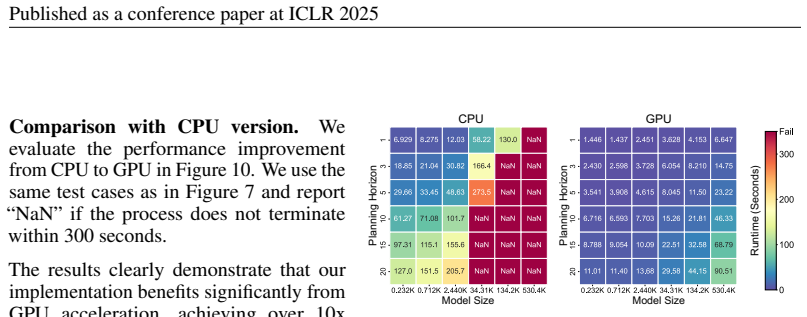
The paper's central claim is that the planning problem $\min_{u \in \mathcal{C}} f(u)$ over a neural dynamics model can be solved much better by branch-and-bound than by sampling alone, and much more scalably than by MIP. The authors argue that because planning wants a concrete near-optimal action sequence rather than a verified lower bound, the branch-and-bound machinery from neural network verification can be redirected: branching heuristics that split on dimensions where good sampled actions are concentrated, bound estimates that stop propagation early and reuse sample statistics as intermediate bounds, and a CEM search inside each surviving subdomain. With this combination, they report consistently lower open-loop objectives than GD, MPPI, and CEM on four contact-rich tasks, and closed-loop real-robot performance that tracks the planned advantages. On scalability, BaB-ND solves problems with a 530K-parameter dynamics model and horizon 20, where MIP fails to return a solution within 300 seconds on most of the 36 tested settings.
Load-bearing premise
Everything rests on the estimated lower bound being at or below the true best objective in each subdomain when the bound is used to prune; the paper lets the bound be computed from a finite sample of trajectories, so a subdomain containing the best action sequence could in principle be discarded if the sample-based bound overshoots the true minimum.
Editorial extensions
If this is right
- On the four benchmark tasks, BaB-ND reports better open-loop planning objectives than gradient descent, MPPI, and CEM, and the better plans transfer to better real-robot closed-loop final costs or success rates.
- On the synthetic high-dimensional objective, BaB-ND reaches the optimum on 98 to 100 of 100 dimensions at $d=100$, while the sampling baselines saturate at suboptimal values.
- MIP-based planning solves only 6 of 36 tested settings within 300 seconds, while BaB-ND handles a 530K-parameter dynamics model with horizon 20, with branching and bounding runtime growing only slowly with model size.
- The framework is architecture-agnostic: it works with MLP dynamics and with graph-neural-network dynamics for multi-object and deformable-object tasks.
- The pruning is aggressive: reported pruned-space size reaches roughly 0.995 of the domain, and the surviving selected subdomain shrinks to order $10^{-4}$ of the original volume.
Reading between the lines
- A consequence the authors leave implicit is that replacing the empirical bounds with sound interval bounds would turn the same algorithm into a certifying planner that could return a global optimality gap, at the cost of the quadratic propagation they avoid.
- The pruning behavior suggests the method is closer to adaptive mesh refinement than to exact branch-and-bound; a testable extension is to measure the gap between the estimated lower bound and the true minimum as the sample count $M$ grows, and to choose $M$ per subdomain.
- The splitting heuristic, which uses the distribution of top samples to pick a bisection dimension, could transfer to other nonconvex neural-network optimization problems where feasible solutions matter more than certificates, such as robust control synthesis.
Editorial analysis
A structured set of objections, weighed in public.
Referee Report
Summary. The paper presents BaB-ND, a GPU-accelerated branch-and-bound framework for motion planning over neural dynamics models. The planner partitions the action space into subdomains, uses a modified CROWN bound-propagation procedure with early stopping and search-integrated empirical intermediate-layer bounds to estimate subdomain lower bounds, and employs a CEM-based searching component to find high-quality action sequences. The method is evaluated on a synthetic high-dimensional nonconvex problem, four simulated manipulation tasks (pushing with obstacles, object merging, rope routing, object sorting), and real-world execution of these tasks, with comparisons against GD, MPPI, CEM, and a MIP baseline, plus scalability and ablation analyses.
Significance. If the empirical claims hold, the paper delivers a practical planner that scales to neural dynamics models with over 500K parameters and planning horizons up to 20 while outperforming sampling-based baselines on long-horizon, contact-rich manipulation tasks. The framework's support for both MLP and GNN dynamics, its real-world closed-loop validation, and its explicit runtime comparison against MIP are notable strengths. The main weakness is that the lower bounds used for pruning are explicitly unsound, which undermines the 'systematic exploration' and 'cannot yield better solutions' claims as stated. With the soundness issue addressed or the claims appropriately hedged, the work would be a solid empirical contribution to model-based planning.
major comments (2)
- [Section 3 and Section 3.2] The methodology states that 'We can always prune subdomain Cj if its f*_Cj > f* ... since, in Cj, there is no solution better than the current best objective f*' (Section 3, near Eq. 1). This statement is only valid if f*_Cj is a genuine lower bound on min_{u in Cj} f(u). However, Section 3.2 explicitly says 'a strictly sound lower bound is not required,' and Approach 2 computes pre-activation bounds as min/max over M samples from searching, which 'may underestimate the actual bounds.' When these empirical ranges are tighter than the true ranges over the subdomain, the CROWN linear relaxation in Lemma B.1 is not a valid lower bounding function, so f*_Cj can exceed the true minimum. The pruner in Algorithm 1 (line 13) and Algorithm 2 (line 12) can then discard subdomains containing the optimal or a better trajectory. The paper provides no measurement of how often such incorrect pruning occurs or how much of the reported gain depends on invalid prunes. Because the central claim is that BaB-ND 'systematically and strategically explores the action space,' this inconsistency is load-bearing. Please either make the bounds sound (e.g., compute true interval bounds on each subdomain, or replace sample-based pre-activation bounds with verified ones) and retain the pruning guarantee, or explicitly reframe the pruner as a heuristic and remove the 'always' and 'cannot yield better solutions' language. In either case, add an experiment on small problems where the true optimum is computable that reports the precision of pruning (fraction of pruned subdomains whose true minimum was actually above the pruning threshold).
- [Section 4 and Appendix C.1] The empirical comparison in Figure 6 and Tables 1 and 7 reports point values without error bars, standard deviations, or statistical tests over test cases or seeds. The main claim is that BaB-ND 'consistently outperforms' all baselines, but in several settings the reported differences are small (e.g., Table 7a: MPPI 26.9970 vs. Ours 26.4841 for (134.2K,20); Table 2: all methods nearly identical on MIP-solvable cases). Please report variance (medians with interquartile ranges as in Figure 4, or mean ± std over seeds) and, where possible, paired tests across the test cases. Additionally, the main experiments do not report wall-clock time or the total number of forward dynamics evaluations used by each method; the only compute-matched comparison appears in the scalability section (Appendix C.1). Without this information the reader cannot determine whether the open-loop improvements stem from systematically better search or from a larger computational budget.
minor comments (5)
- [Section 3.2] The number of samples M used in the search-integrated bounding is not specified. Please state how M is chosen and whether it is included in the hyperparameter sensitivity analysis.
- [Algorithm 1 and Algorithm 2] The line 'P ← P S Pruner(...)' in Algorithm 1 (and similarly in Algorithm 2) appears to be a typesetting error; it should read 'P ← P ∪ Pruner(...)'.
- [Section 4, Figure 6 caption] The caption states 'GD is excluded from testing due to its poor open-loop performance,' but Table 3 in the appendix includes GD in the comparison. This is acceptable, but the main text should clarify that GD was excluded only from real-world deployment, not from all analyses.
- [Appendix D.6] Please clarify the relationship between the sample budget inside BaB-ND's search component (CEM) and the sample counts of the standalone baseline methods, so the reader can assess whether the comparisons are compute-fair.
- [Section C.3] The hyperparameter analysis in Table 5 varies one hyperparameter at a time but does not report variance across runs or seeds. Adding such variation would strengthen the claim that performance is insensitive to these choices.
Circularity Check
No significant circularity: the central claim is an empirical comparison of a planner, with no fitted constant or self-referential derivation chain.
full rationale
The paper's central claim is that BaB-ND outperforms sampling-based baselines and scales better than MIP on planning objectives over neural dynamics models. This is an empirical claim evaluated on simulation and real-world benchmarks; nothing in the claimed derivation reduces to re-importing the benchmark outcomes. The objective f(u) is defined from the cost and the pre-trained dynamics model, and the lower bounds are produced by CROWN-style bound propagation. The search-integrated bounding heuristic uses samples from the planner's own searching process, but this is an internal computational shortcut, not a parameter fitted to the prediction targets or to the benchmark results. The paper explicitly relaxes soundness ('a strictly sound lower bound is not required'; empirical bounds 'may underestimate the actual bounds'), which is a correctness/validity limitation of the pruning guarantee, not a circularity: the analysis honestly flags that the lower bound is not a true relaxation. The self-citations to alpha-beta-CROWN and DPI-Net are not load-bearing: CROWN is external verification literature that motivates, but does not by itself validate, the proposed planning algorithm, and DPI-Net is used only as a dynamics-model architecture choice. No uniqueness theorem or ansatz is imported from the authors' prior work to force the present choice. The stated limitations in Section A.4 (dependence on dynamics-model errors and on the underlying searching algorithm) further acknowledge the heuristic nature of the result rather than concealing a circular reduction. Accordingly, no specific circular step can be exhibited, and the appropriate finding is no significant circularity.
Assumptions & free parameters
free parameters (5)
- Select-subdomain softmax temperature T =
0.05 (base)
- Exploitation ratio eta =
0.75 (base)
- Split percentile w =
1 (base)
- BaB batch size n =
Not fixed in paper
- Task cost weights w_t and collision penalty lambda =
Not reported
assumptions (5)
- standard math CROWN bound propagation produces valid linear lower bounds for ReLU networks.
- ad hoc to paper Empirical pre-activation bounds from M search samples substitute for true intermediate layer bounds well enough to guide pruning.
- domain assumption The learned neural dynamics models are accurate enough over the planning horizon that optimizing the learned objective transfers to the real system.
- domain assumption Hand-designed cost functions with obstacle penalties correctly encode task success.
- domain assumption Sampling-based search inside progressively smaller boxes finds good upper bounds in each subdomain.
Cite this review
Pith. "Pith review of BaB-ND: Long-Horizon Motion Planning with Branch-and-Bound and Neural Dynamics." pith.science (2026). https://pith.science/paper/K5LHCMTP
@misc{pith2026241209584,
  author       = {Pith},
  title        = {Pith review of: BaB-ND: Long-Horizon Motion Planning with Branch-and-Bound and Neural Dynamics},
  year         = {2026},
  howpublished = {\url{https://pith.science/paper/K5LHCMTP}},
  note         = {Machine review of arXiv:2412.09584}
}
read the original abstract
Neural-network-based dynamics models learned from observational data have shown strong predictive capabilities for scene dynamics in robotic manipulation tasks. However, their inherent non-linearity presents significant challenges for effective planning. Current planning methods, often dependent on extensive sampling or local gradient descent, struggle with long-horizon motion planning tasks involving complex contact events. In this paper, we present a GPU-accelerated branch-and-bound (BaB) framework for motion planning in manipulation tasks that require trajectory optimization over neural dynamics models. Our approach employs a specialized branching heuristics to divide the search space into subdomains, and applies a modified bound propagation method, inspired by the state-of-the-art neural network verifier alpha-beta-CROWN, to efficiently estimate objective bounds within these subdomains. The branching process guides planning effectively, while the bounding process strategically reduces the search space. Our framework achieves superior planning performance, generating high-quality state-action trajectories and surpassing existing methods in challenging, contact-rich manipulation tasks such as non-prehensile planar pushing with obstacles, object sorting, and rope routing in both simulated and real-world settings. Furthermore, our framework supports various neural network architectures, ranging from simple multilayer perceptrons to advanced graph neural dynamics models, and scales efficiently with different model sizes.
Figures


Figures from the paper (10 more)




Reference graph
Works this paper leans on
-
[1]
write newline
" write newline "" before.all 'output.state := FUNCTION n.dashify 't := "" t empty not t #1 #1 substring "-" = t #1 #2 substring "--" = not "--" * t #2 global.max substring 't := t #1 #1 substring "-" = "-" * t #2 global.max substring 't := while if t #1 #1 substring * t #2 global.max substring 't := if while FUNCTION format.date year duplicate empty "emp...
-
[2]
Learning to Poke by Poking: Experiential Learning of Intuitive Physics
Pulkit Agrawal, Ashvin Nair, Pieter Abbeel, Jitendra Malik, and Sergey Levine. Learning to poke by poking: Experiential learning of intuitive physics. arXiv preprint arXiv:1606.07419, 2016
work page Pith review arXiv 2016
-
[3]
Strong mixed-integer programming formulations for trained neural networks
Ross Anderson, Joey Huchette, Will Ma, Christian Tjandraatmadja, and Juan Pablo Vielma. Strong mixed-integer programming formulations for trained neural networks. Mathematical Programming, 183 0 (1): 0 3--39, 2020
work page 2020
-
[4]
Stanley Bak, Changliu Liu, and Taylor Johnson. The second international verification of neural networks competition (vnn-comp 2021): Summary and results. arXiv preprint arXiv:2109.00498, 2021
arXiv 2021
-
[5]
Interaction networks for learning about objects, relations and physics
Peter Battaglia, Razvan Pascanu, Matthew Lai, Danilo Jimenez Rezende, et al. Interaction networks for learning about objects, relations and physics. Advances in neural information processing systems, 29, 2016
work page 2016
-
[6]
Victor Blomqvist. Pymunk. https://pymunk.org, November 2022
work page 2022
-
[7]
Rudy Bunel, Ilker Turkaslan, Philip H. S. Torr, Pushmeet Kohli, and M. Pawan Kumar. A unified view of piecewise linear neural network verification. In Advances in Neural Information Processing Systems (NeurIPS), 2018
work page 2018
-
[8]
Rudy Bunel, Alessandro De Palma, Alban Desmaison, Krishnamurthy Dvijotham, Pushmeet Kohli, Philip H. S. Torr, and M. Pawan Kumar. Lagrangian decomposition for neural network verification. Conference on Uncertainty in Artificial Intelligence (UAI), 2020 a
work page 2020
Show all 76 references
-
[9]
Rudy Bunel, Jingyue Lu, Ilker Turkaslan, Philip H. S. Torr, Pushmeet Kohli, and M. Pawan Kumar. Branch and bound for piecewise linear neural network verification, 2020 b
2020
-
[10]
Model Predictive Control
Eduardo F Camacho and Carlos Bordons Alba. Model Predictive Control. Springer Science & Business Media, 2013
2013
-
[11]
Alessandro De Palma, Harkirat Singh Behl, Rudy Bunel, Philip H. S. Torr, and M. Pawan Kumar. Scaling the convex barrier with active sets. International Conference on Learning Representations (ICLR), 2021
2021
-
[12]
Learning multi-object dynamics with compositional neural radiance fields
Danny Driess, Zhiao Huang, Yunzhu Li, Russ Tedrake, and Marc Toussaint. Learning multi-object dynamics with compositional neural radiance fields. In Conference on robot learning, pp.\ 1755--1768. PMLR, 2023
2023
-
[13]
Self-supervised visual planning with temporal skip connections
Frederik Ebert, Chelsea Finn, Alex X Lee, and Sergey Levine. Self-supervised visual planning with temporal skip connections. In CoRL, pp.\ 344--356, 2017
2017
-
[14]
Visual foresight: Model-based deep reinforcement learning for vision-based robotic control
Frederik Ebert, Chelsea Finn, Sudeep Dasari, Annie Xie, Alex Lee, and Sergey Levine. Visual foresight: Model-based deep reinforcement learning for vision-based robotic control. arXiv preprint arXiv:1812.00568, 2018
2018 arXiv
-
[15]
Zico Kolter Eric Wong
J. Zico Kolter Eric Wong. Provable defenses against adversarial examples via the convex outer adversarial polytope. In International Conference on Machine Learning (ICML), 2018
2018
-
[16]
Complete verification via multi-neuron relaxation guided branch-and-bound
Claudio Ferrari, Mark Niklas Muller, Nikola Jovanovic, and Martin Vechev. Complete verification via multi-neuron relaxation guided branch-and-bound. arXiv preprint arXiv:2205.00263, 2022
2022 arXiv
-
[17]
Deep visual foresight for planning robot motion
Chelsea Finn and Sergey Levine. Deep visual foresight for planning robot motion. In 2017 IEEE International Conference on Robotics and Automation (ICRA), pp.\ 2786--2793. IEEE, 2017
2017
-
[18]
Unsupervised learning for physical interaction through video prediction
Chelsea Finn, Ian Goodfellow, and Sergey Levine. Unsupervised learning for physical interaction through video prediction. arXiv preprint arXiv:1605.07157, 2016
2016 arXiv
-
[19]
On the effectiveness of interval bound propagation for training verifiably robust models
Sven Gowal, Krishnamurthy Dvijotham, Robert Stanforth, Rudy Bunel, Chongli Qin, Jonathan Uesato, Timothy Mann, and Pushmeet Kohli. On the effectiveness of interval bound propagation for training verifiably robust models. Proceedings of the IEEE International Conference on Comp...
2019
-
[20]
Parrilo, and Russ Tedrake
Bernhard Paus Graesdal, Shao Yuan Chew Chia, Tobia Marcucci, Savva Morozov, Alexandre Amice, Pablo A. Parrilo, and Russ Tedrake. Towards tight convex relaxations for contact-rich manipulation, 2024. URL https://arxiv.org/abs/2402.10312
2024 arXiv
-
[21]
Dream to control: Learning behaviors by latent imagination
Danijar Hafner, Timothy Lillicrap, Jimmy Ba, and Mohammad Norouzi. Dream to control: Learning behaviors by latent imagination. arXiv preprint arXiv:1912.01603, 2019 a
1912 arXiv
-
[22]
Learning latent dynamics for planning from pixels
Danijar Hafner, Timothy Lillicrap, Ian Fischer, Ruben Villegas, David Ha, Honglak Lee, and James Davidson. Learning latent dynamics for planning from pixels. In International Conference on Machine Learning, pp.\ 2555--2565. PMLR, 2019 b
2019
-
[23]
Learning latent dynamics for planning from pixels
Danijar Hafner, Timothy Lillicrap, Ian Fischer, Ruben Villegas, David Ha, Honglak Lee, and James Davidson. Learning latent dynamics for planning from pixels. In International Conference on Machine Learning, pp.\ 2555--2565, 2019 c
2019
-
[24]
Model predictive control for aggressive driving over uneven terrain, 2024
Tyler Han, Alex Liu, Anqi Li, Alex Spitzer, Guanya Shi, and Byron Boots. Model predictive control for aggressive driving over uneven terrain, 2024
2024
-
[25]
Real-time safe control of neural network dynamic models with sound approximation, 2024 a
Hanjiang Hu, Jianglin Lan, and Changliu Liu. Real-time safe control of neural network dynamic models with sound approximation, 2024 a
2024
-
[26]
Verification of neural control barrier functions with symbolic derivative bounds propagation
Hanjiang Hu, Yujie Yang, Tianhao Wei, and Changliu Liu. Verification of neural control barrier functions with symbolic derivative bounds propagation. In 8th Annual Conference on Robot Learning, 2024 b . URL https://openreview.net/forum?id=jnubz7wB2w
2024
-
[27]
Mesh-based dynamics model with occlusion reasoning for cloth manipulation
Zixuan Huang, Xingyu Lin, and David Held. Mesh-based dynamics model with occlusion reasoning for cloth manipulation. In Robotics: Science and Systems (RSS), 2022
2022
-
[28]
Towards scalable complete verification of relu neural networks via dependency-based branching
Panagiotis Kouvaros and Alessio Lomuscio. Towards scalable complete verification of relu neural networks via dependency-based branching. In IJCAI, pp.\ 2643--2650, 2021
2021
-
[29]
Unsupervised learning of object keypoints for perception and control
Tejas D Kulkarni, Ankush Gupta, Catalin Ionescu, Sebastian Borgeaud, Malcolm Reynolds, Andrew Zisserman, and Volodymyr Mnih. Unsupervised learning of object keypoints for perception and control. Advances in neural information processing systems, 32: 0 10724--10734, 2019
2019
-
[30]
Learning quadrupedal locomotion over challenging terrain
Joonho Lee, Jemin Hwangbo, Lorenz Wellhausen, Vladlen Koltun, and Marco Hutter. Learning quadrupedal locomotion over challenging terrain. Science robotics, 5 0 (47), 2020
2020
-
[31]
Deepmpc: Learning deep latent features for model predictive control
Ian Lenz, Ross A Knepper, and Ashutosh Saxena. Deepmpc: Learning deep latent features for model predictive control. In Robotics: Science and Systems, volume 10, pp.\ 25. Rome, Italy, 2015
2015
-
[32]
Learning particle dynamics for manipulating rigid bodies, deformable objects, and fluids
Yunzhu Li, Jiajun Wu, Russ Tedrake, Joshua B Tenenbaum, and Antonio Torralba. Learning particle dynamics for manipulating rigid bodies, deformable objects, and fluids. arXiv preprint arXiv:1810.01566, 2018
2018 arXiv
-
[33]
Propagation networks for model-based control under partial observation
Yunzhu Li, Jiajun Wu, Jun-Yan Zhu, Joshua B Tenenbaum, Antonio Torralba, and Russ Tedrake. Propagation networks for model-based control under partial observation. In 2019 International Conference on Robotics and Automation (ICRA), pp.\ 1205--1211. IEEE, 2019
2019
-
[34]
Causal discovery in physical systems from videos
Yunzhu Li, Antonio Torralba, Anima Anandkumar, Dieter Fox, and Animesh Garg. Causal discovery in physical systems from videos. Advances in Neural Information Processing Systems, 33, 2020
2020
-
[35]
Learning visible connectivity dynamics for cloth smoothing
Xingyu Lin, Yufei Wang, Zixuan Huang, and David Held. Learning visible connectivity dynamics for cloth smoothing. In Conference on Robot Learning, 2021
2021
-
[36]
Kochenderfer
Changliu Liu, Tomer Arnon, Christopher Lazarus, Christopher Strong, Clark Barrett, and Mykel J. Kochenderfer. Algorithms for verifying deep neural networks. Foundations and Trends in Optimization , 4 0 (3-4): 0 244--404, 2021
2021
-
[37]
Model-based control with sparse neural dynamics
Ziang Liu, Genggeng Zhou, Jeff He, Tobia Marcucci, Li Fei-Fei, Jiajun Wu, and Yunzhu Li. Model-based control with sparse neural dynamics. In Thirty-seventh Conference on Neural Information Processing Systems, 2023. URL https://openreview.net/forum?id=ymBG2xs9Zf
2023
-
[38]
Plan online, learn offline: Efficient learning and exploration via model-based control
Kendall Lowrey, Aravind Rajeswaran, Sham Kakade, Emanuel Todorov, and Igor Mordatch. Plan online, learn offline: Efficient learning and exploration via model-based control. arXiv preprint arXiv:1811.01848, 2018
2018 arXiv
-
[39]
Pawan Kumar
Jingyue Lu and M. Pawan Kumar. Neural network branching for neural network verification. In International Conference on Learning Representations (ICLR), 2020
2020
-
[40]
Unified particle physics for real-time applications
Miles Macklin, Matthias M \"u ller, Nuttapong Chentanez, and Tae-Yong Kim. Unified particle physics for real-time applications. ACM Transactions on Graphics (TOG), 33 0 (4): 0 1--12, 2014
2014
-
[41]
Keypoints into the future: Self-supervised correspondence in model-based reinforcement learning
Lucas Manuelli, Yunzhu Li, Pete Florence, and Russ Tedrake. Keypoints into the future: Self-supervised correspondence in model-based reinforcement learning. arXiv preprint arXiv:2009.05085, 2020
2009 arXiv
-
[42]
Graphs of Convex Sets with Applications to Optimal Control and Motion Planning
Tobia Marcucci. Graphs of Convex Sets with Applications to Optimal Control and Motion Planning. PhD thesis, MASSACHUSETTS INSTITUTE OF TECHNOLOGY, 2024
2024
-
[43]
The third international verification of neural networks competition (vnn-comp 2022): Summary and results
Mark Niklas M \"u ller, Christopher Brix, Stanley Bak, Changliu Liu, and Taylor T Johnson. The third international verification of neural networks competition (vnn-comp 2022): Summary and results. arXiv preprint arXiv:2212.10376, 2022
2022 arXiv
-
[44]
Deep dynamics models for learning dexterous manipulation
Anusha Nagabandi, Kurt Konolige, Sergey Levine, and Vikash Kumar. Deep dynamics models for learning dexterous manipulation. In Conference on Robot Learning, pp.\ 1101--1112. PMLR, 2020
2020
-
[45]
Alessandro De Palma, Rudy Bunel, Aymeric Desmaison, Krishnamurthy Dvijotham, Pushmeet Kohli, Philip H. S. Torr, and M. Pawan Kumar. Improved branch and bound for neural network verification via lagrangian decomposition. arXiv preprint arXiv:2104.06718, 2021
2021 arXiv
-
[46]
The cross-entropy method: a unified approach to combinatorial optimization, Monte-Carlo simulation and machine learning
Reuven Y Rubinstein and Dirk P Kroese. The cross-entropy method: a unified approach to combinatorial optimization, Monte-Carlo simulation and machine learning. Springer Science & Business Media, 2013
2013
-
[47]
Deep model predictive optimization, 2023
Jacob Sacks, Rwik Rana, Kevin Huang, Alex Spitzer, Guanya Shi, and Byron Boots. Deep model predictive optimization, 2023
2023
-
[48]
A convex relaxation barrier to tight robustness verification of neural networks
Hadi Salman, Greg Yang, Huan Zhang, Cho-Jui Hsieh, and Pengchuan Zhang. A convex relaxation barrier to tight robustness verification of neural networks. In Advances in Neural Information Processing Systems (NeurIPS), 2019
2019
-
[49]
Mastering atari, go, chess and shogi by planning with a learned model
Julian Schrittwieser, Ioannis Antonoglou, Thomas Hubert, Karen Simonyan, Laurent Sifre, Simon Schmitt, Arthur Guez, Edward Lockhart, Demis Hassabis, Thore Graepel, et al. Mastering atari, go, chess and shogi by planning with a learned model. Nature, 588 0 (7839): 0 604--609, 2020
2020
-
[50]
Masked world models for visual control
Younggyo Seo, Danijar Hafner, Hao Liu, Fangchen Liu, Stephen James, Kimin Lee, and Pieter Abbeel. Masked world models for visual control. In Conference on Robot Learning, pp.\ 1332--1344. PMLR, 2023
2023
-
[51]
Robocraft: Learning to see, simulate, and shape elasto-plastic objects with graph networks
Haochen Shi, Huazhe Xu, Zhiao Huang, Yunzhu Li, and Jiajun Wu. Robocraft: Learning to see, simulate, and shape elasto-plastic objects with graph networks. arXiv preprint arXiv:2205.02909, 2022
2022 arXiv
-
[52]
Robocook: Long-horizon elasto-plastic object manipulation with diverse tools, 2023
Haochen Shi, Huazhe Xu, Samuel Clarke, Yunzhu Li, and Jiajun Wu. Robocook: Long-horizon elasto-plastic object manipulation with diverse tools, 2023
2023
-
[53]
An abstract domain for certifying neural networks
Gagandeep Singh, Timon Gehr, Markus P \"u schel, and Martin Vechev. An abstract domain for certifying neural networks. Proceedings of the ACM on Programming Languages (POPL), 2019
2019
-
[54]
The surprising effectiveness of linear models for visual foresight in object pile manipulation
HJ Suh and Russ Tedrake. The surprising effectiveness of linear models for visual foresight in object pile manipulation. arXiv preprint arXiv:2002.09093, 2020
2002 arXiv
-
[55]
Manipulation by feel: Touch-based control with deep predictive models
Stephen Tian, Frederik Ebert, Dinesh Jayaraman, Mayur Mudigonda, Chelsea Finn, Roberto Calandra, and Sergey Levine. Manipulation by feel: Touch-based control with deep predictive models. In 2019 International Conference on Robotics and Automation (ICRA), pp.\ 818--824. IEEE, 2019
2019
-
[56]
Evaluating robustness of neural networks with mixed integer programming, 2019
Vincent Tjeng, Kai Xiao, and Russ Tedrake. Evaluating robustness of neural networks with mixed integer programming, 2019
2019
-
[57]
Efficient formal safety analysis of neural networks
Shiqi Wang, Kexin Pei, Justin Whitehouse, Junfeng Yang, and Suman Jana. Efficient formal safety analysis of neural networks. In Advances in Neural Information Processing Systems (NeurIPS), 2018
2018
-
[58]
Beta-crown: Efficient bound propagation with per-neuron split constraints for complete and incomplete neural network robustness verification
Shiqi Wang, Huan Zhang, Kaidi Xu, Suman Jana, Xue Lin, Cho-Jui Hsieh, and Zico Kolter. Beta-crown: Efficient bound propagation with per-neuron split constraints for complete and incomplete neural network robustness verification. In Advances in Neural Information Processing Sys...
2021
-
[59]
Dynamic-Resolution Model Learning for Object Pile Manipulation
Yixuan Wang, Yunzhu Li, Katherine Driggs-Campbell, Li Fei-Fei, and Jiajun Wu. Dynamic-Resolution Model Learning for Object Pile Manipulation . In Proceedings of Robotics: Science and Systems, Daegu, Republic of Korea, July 2023. doi:10.15607/RSS.2023.XIX.047
2023 doi
-
[60]
Embed to control: A locally linear latent dynamics model for control from raw images
Manuel Watter, Jost Tobias Springenberg, Joschka Boedecker, and Martin Riedmiller. Embed to control: A locally linear latent dynamics model for control from raw images. arXiv preprint arXiv:1506.07365, 2015
2015 arXiv
-
[61]
Safe control with neural network dynamic models, 2022
Tianhao Wei and Changliu Liu. Safe control with neural network dynamic models, 2022
2022
-
[62]
Model predictive path integral control: From theory to parallel computation
Grady Williams, Andrew Aldrich, and Evangelos A Theodorou. Model predictive path integral control: From theory to parallel computation. Journal of Guidance, Control, and Dynamics, 40 0 (2): 0 344--357, 2017
2017
-
[63]
Verified safe reinforcement learning for neural network dynamic models, 2024
Junlin Wu, Huan Zhang, and Yevgeniy Vorobeychik. Verified safe reinforcement learning for neural network dynamic models, 2024. URL https://arxiv.org/abs/2405.15994
2024 arXiv
-
[64]
Daydreamer: World models for physical robot learning
Philipp Wu, Alejandro Escontrela, Danijar Hafner, Pieter Abbeel, and Ken Goldberg. Daydreamer: World models for physical robot learning. In Conference on Robot Learning, pp.\ 2226--2240. PMLR, 2023
2023
-
[65]
Fast and complete: Enabling complete neural network verification with rapid and massively parallel incomplete verifiers
Kaidi Xu, Huan Zhang, Shiqi Wang, Yihan Wang, Suman Jana, Xue Lin, and Cho-Jui Hsieh. Fast and complete: Enabling complete neural network verification with rapid and massively parallel incomplete verifiers. International Conference on Learning Representations (ICLR), 2021
2021
-
[66]
Experience-embedded visual foresight
Lin Yen-Chen, Maria Bauza, and Phillip Isola. Experience-embedded visual foresight. In Conference on Robot Learning, pp.\ 1015--1024. PMLR, 2020
2020
-
[67]
Covo-mpc: Theoretical analysis of sampling-based mpc and optimal covariance design, 2024
Zeji Yi, Chaoyi Pan, Guanqi He, Guannan Qu, and Guanya Shi. Covo-mpc: Theoretical analysis of sampling-based mpc and optimal covariance design, 2024
2024
-
[68]
Trajectory distribution control for model predictive path integral control using covariance steering
Ji Yin, Zhiyuan Zhang, Evangelos Theodorou, and Panagiotis Tsiotras. Trajectory distribution control for model predictive path integral control using covariance steering. In 2022 International Conference on Robotics and Automation (ICRA), pp.\ 1478--1484, 2022. doi:10.1109/ICR...
2022
-
[69]
Efficient neural network robustness certification with general activation functions
Huan Zhang, Tsui-Wei Weng, Pin-Yu Chen, Cho-Jui Hsieh, and Luca Daniel. Efficient neural network robustness certification with general activation functions. In Advances in Neural Information Processing Systems (NeurIPS), 2018
2018
-
[70]
General cutting planes for bound-propagation-based neural network verification
Huan Zhang, Shiqi Wang, Kaidi Xu, Linyi Li, Bo Li, Suman Jana, Cho-Jui Hsieh, and J Zico Kolter. General cutting planes for bound-propagation-based neural network verification. Advances in Neural Information Processing Systems, 2022 a
2022
-
[71]
A branch and bound framework for stronger adversarial attacks of R e LU networks
Huan Zhang, Shiqi Wang, Kaidi Xu, Yihan Wang, Suman Jana, Cho-Jui Hsieh, and Zico Kolter. A branch and bound framework for stronger adversarial attacks of R e LU networks. In International Conference on Machine Learning (ICML), pp.\ 26591--26604. PMLR, 2022 b
2022
-
[72]
Adaptigraph: Material-adaptive graph-based neural dynamics for robotic manipulation
Kaifeng Zhang, Baoyu Li, Kris Hauser, and Yunzhu Li. Adaptigraph: Material-adaptive graph-based neural dynamics for robotic manipulation. In Proceedings of Robotics: Science and Systems (RSS), 2024
2024
-
[73]
A simple decentralized cross-entropy method, 2022 c
Zichen Zhang, Jun Jin, Martin Jagersand, Jun Luo, and Dale Schuurmans. A simple decentralized cross-entropy method, 2022 c . URL https://arxiv.org/abs/2212.08235
2022 arXiv
-
[74]
@esa (Ref
\@ifxundefined[1] #1\@undefined \@firstoftwo \@secondoftwo \@ifnum[1] #1 \@firstoftwo \@secondoftwo \@ifx[1] #1 \@firstoftwo \@secondoftwo [2] @ #1 \@temptokena #2 #1 @ \@temptokena \@ifclassloaded agu2001 natbib The agu2001 class already includes natbib coding, so you should ...
-
[75]
\@lbibitem[] @bibitem@first@sw\@secondoftwo \@lbibitem[#1]#2 \@extra@b@citeb \@ifundefined br@#2\@extra@b@citeb \@namedef br@#2 \@nameuse br@#2\@extra@b@citeb \@ifundefined b@#2\@extra@b@citeb @num @parse #2 @tmp #1 NAT@b@open@#2 NAT@b@shut@#2 \@ifnum @merge>\@ne @bibitem@firs...
-
[76]
0 ” stands for taking positive elements from the matrix while setting other elements to zero, and vice versa for subscript “ <0
@open @close @open @close and [1] URL: #1 \@ifundefined chapter * \@mkboth \@ifxundefined @sectionbib * \@mkboth * \@mkboth\@gobbletwo \@ifclassloaded amsart * \@ifclassloaded amsbook * \@ifxundefined @heading @heading NAT@ctr thebibliography [1] @ \@biblabel @NAT@ctr \@bibset...
1938
Reviewed August 11, 2026 · model on record in the stance chip above.
Discussion (0). Continue with ORCID to comment.