REVIEW 4 major objections 7 minor 38 references
Toy-GS: Assembling Local Gaussians for Precisely Rendering Large-Scale Free Camera Trajectories
T0 review · 4 major / 7 minor · reviewed 2026-08-11 · deepseek-v4-flash
Pith's one-line read Toy-GS claims that splitting large free-trajectory scenes into pose-aligned regions and training a local 3D Gaussian Splatting model per region—then fusing local and global models at render time—raises rendering quality while cutting GPU…
desk verdict Toy-GS is a believable incremental step for 3DGS on free trajectories, but the unvalidated 1/N camera-selection threshold and the missing code/error bars keep me from fully trusting the numbers. read the letter →
The pith
A machine-rendered reading of the paper's core claim, the machinery that carries it, and where it could break.
The reading
What carries the argument
The load-bearing structure is the adaptive spatial partitioning plus local-global rendering. K-means on camera poses yields regions $\{A_n\}_{n=1}^N$; a camera is kept for region $A_i$ iff the fraction of points it sees that lie in $A_i$ exceeds $1/N$ (Eq. 2), which is meant to be robust to varying point-cloud density because both numerator and denominator move together. Within each region, a separate 3D Gaussian Splatting model is trained with two additions: PatchMatch homography warping (Eqs. 5–6) between reference and source views to refine depth and normals and relocate Gaussians onto correct geometry, and PPAC, which scales Gaussian size by $\gamma(\mu)=\|\mu\|_2/r-1$ for $\|\mu\|_2 \geq 2r$ so distant regions are covered by larger splats. At render time, a new viewpoint first locates its region by k-means, then passes the distance test $\|C_{\text{new}}-O\|<\gamma$ and the visibility test $M'_{A_i}/M'_{c_{\text{new}}}>1/N$; if both hold, the local Gaussian renders it, otherwise the global Gaussian does. This fusion is what prevents the holes that arise when each region's Gaussian is simply merged and pruned as in VastGaussian.
What would settle it
On a free-trajectory scene, re-run training with the selection threshold in Eq. (2) varied (e.g., $1/(2N)$ and $2/N$) while keeping everything else fixed; if a non-$1/N$ threshold raises PSNR or removes holes in regions with sparse background coverage, the ratio test's critical assumption fails.
Extended reading notes
Core claim
On free camera trajectories, the spatial coverage of views is strongly inhomogeneous: foreground objects are captured densely and up close, while backgrounds are seen sparsely from far away, and parts of the scene may be invisible from every camera. Toy-GS's central claim is that this regime requires splitting the scene, not to save memory alone, but to let each local Gaussian model concentrate on the texture detail it can actually see, and that the split must follow the camera poses rather than axis-aligned boxes. It therefore clusters cameras with k-means on their poses, assigns each point in the sparse SfM cloud to a region, prunes and expands cameras per region using a visibility ratio test, trains a 3DGS per region in parallel, and then decides per new viewpoint, by distance and visibility constraints, whether to render with that region's local Gaussian or with a global Gaussian. The multi-view constraint (PatchMatch on rendered depth and normal maps) and PPAC (scale factor $\gamma(\mu)=\|\mu\|_2/r-1$ for points beyond radius $r$) are added to improve geometry and distant rendering. The reported result is consistent gains in PSNR/SSIM/LPIPS over 3DGS and over VastGaussian on two public datasets and the authors' SCUTic dataset, with memory usage that falls as region count rises.
Load-bearing premise
The camera-selection test assumes that the share of points a camera sees inside a region reliably tells whether that camera should train that region; on free trajectories where foreground is dense and background sparse, this threshold can drop informative cameras and leave holes.
Editorial extensions
If this is right
- On the Free dataset, Toy-GS with three regions improves PSNR by 1.35 dB over 3DGS and by 1.37 dB over VastGaussian, with better SSIM and LPIPS.
- On the Tanks and Temples advanced split, the method gains 0.4 dB over 3DGS (21.27 vs 20.87) and 1.16 dB over VastGaussian, while using about 1 G less memory than 3DGS.
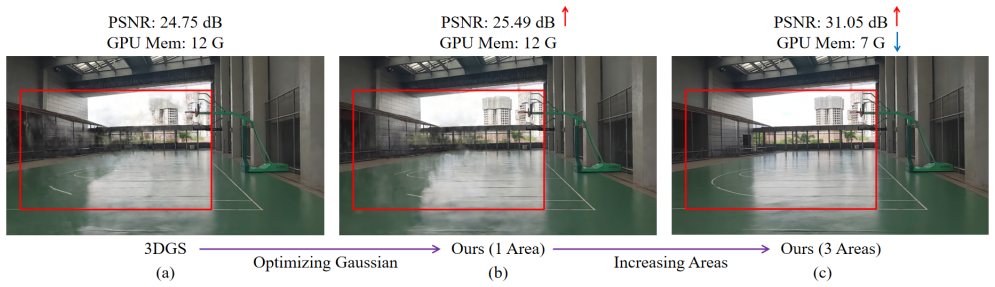
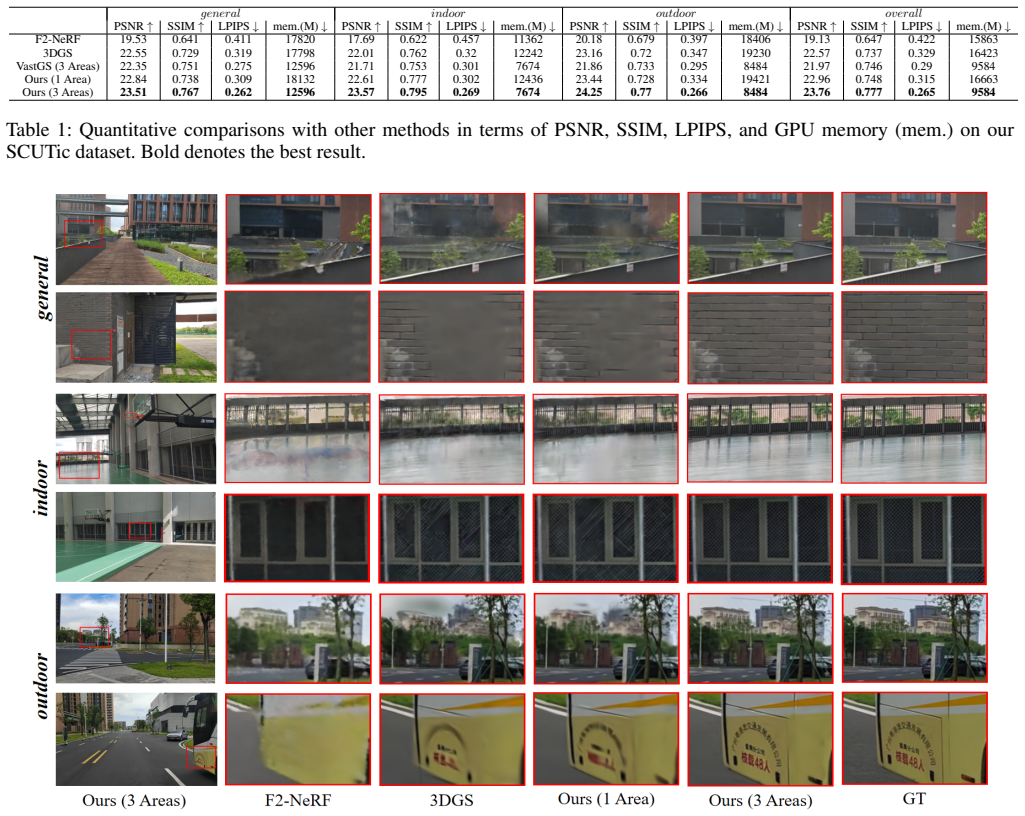
- On the SCUTic dataset, Toy-GS with three areas beats 3DGS by 1.19 dB overall (23.76 vs 22.57), beats VastGaussian by 1.79 dB, and cuts total GPU memory from about 16.4 G to 9.6 G.
- Ablations show that PatchMatch+PPAC alone add 0.6 dB, the local-global renderer adds about 1.8 dB over global-only rendering, and increasing region count from 1 to 7 raises PSNR by 1.14 dB while reducing memory by about 6 G.
- Rendering quality improves monotonically as the number of regions grows from 1 to 7, without the degradation seen in VastGaussian's global merging.
Reading between the lines
- Because the camera-selection threshold $1/N$ is fixed by region count, scenes with extreme foreground/background imbalance may silently exclude cameras whose small in-region share is still geometrically essential; an adaptive threshold or a view-coverage prior is a natural next step, though untested in the paper.
- The local-global fusion rule is only demonstrated for up to seven regions; at finer granularity the distance test $\|C_{\text{new}}-O\|<\gamma$ likely needs re-tuning, since the max-distance threshold grows with region spread and may admit the wrong local model.
- Since the base is 3DGS, the same divide-train-fuse recipe could be dropped into other point-based or splatting renderers, and the SCUTic dataset (2–3 times larger than Free) could serve as a stress test for trajectory-level generalization.
- The reported memory figures are peak GPU usage on one RTX 3090; the claimed 7 G saving is an average over benchmarks, so actual savings vary by scene and region count.
Signed reviews
Editorial analysis
A structured set of objections, weighed in public.
Referee Report
Summary. The paper presents Toy-GS, a 3D Gaussian Splatting system for large-scale free camera trajectories. It partitions cameras and the point cloud with k-means on camera poses, expands or prunes cameras by a visibility ratio (Eq. 2), trains per-region 3DGS models, and enhances them with a PatchMatch-based multi-view constraint and position-aware point adaptive control (PPAC). A local-global rendering rule selects local Gaussians for new viewpoints that pass distance and visibility tests and falls back to a global Gaussian otherwise. The authors report state-of-the-art PSNR, SSIM, and LPIPS on the Free dataset, the Tanks and Temples advanced set, and a new SCUTic dataset, with GPU memory savings of several GB relative to 3DGS.
Significance. If the results hold, Toy-GS is a practical step toward applying 3DGS to trajectories that are neither object-centric nor aerial: it reduces memory through parallel region training and shows quality gains from region-local optimization plus a fusion strategy. The empirical evidence is broad, covering three datasets, and Figure 7 supports the quality-versus-region-count trend. The paper's value is as a system paper, not as a theoretical contribution, and it would be publishable once the central mechanisms are specified and the statistical uncertainty is addressed. The claimed gains are not yet fully supported because the PatchMatch-to-Gaussian update is unspecified, the camera-selection threshold is unablated, and the memory accounting is ambiguous.
major comments (4)
- [Section 3.1, Eq. (2)] The 1/N camera-selection threshold is load-bearing but unvalidated. The paper's introduction states that free trajectories have dense foreground views and sparse background views. Under Eq. (2), a camera that sees many foreground points (large Mc) and only a few points in a background region Ai (small MAi) is discarded from exactly the region whose training data are already sparse. No ablation varies this threshold; Table 4 varies the number of areas, PatchMatch/PPAC, and global versus local-global rendering, but never the selection rule. Since the headline gains (e.g., 1.19 dB on SCUTic) depend on the quality of each local model, the authors should report sensitivity to the threshold or replace the rule with one that cannot reject informative sparse-background cameras.
- [Section 3.2] The paper claims PatchMatch moves the Gaussian ellipsoids to their correct positions, but it does not specify the matching cost, the number or choice of source views, or how the optimized depth maps are converted into Gaussian mean updates. The only implementation details given are an iteration interval and a patch size in the Appendix. Because the components labeled 2P are ablated jointly in Table 4, the individual contribution of the PatchMatch constraint cannot be isolated, and the method cannot be reproduced or independently verified as written.
- [Tables 1, 2, and 4; Section 3.3] The GPU-memory accounting is unclear. In Tables 1 and 2 the 'Ours (3 Areas)' memory values equal the VastGaussian values to the megabyte, and in Table 4 the RG and RLG rows have identical memory for the same number of areas. Section 3.3 states that viewpoints failing the local criteria are rendered by the global Gaussian used with VastGaussian, so the authors need to state whether that global model is trained and retained, and if so why its memory is not reflected. A per-component memory breakdown is needed to support the memory-saving claim in the abstract and Figure 7.
- [Experimental protocol] All tables report a single run with no error bars, seeds, or statistical tests, and the train/test split is not defined for the SCUTic and Tanks and Temples evaluations. With headline differences as small as 0.4 dB (Table 2) and ablation differences of 0.02 in SSIM (Table 4), readers cannot assess whether the differences are within run-to-run variation. Please provide multi-seed results or confidence intervals for the main comparisons.
minor comments (7)
- [Section 3.2, Eqs. (7)-(8)] The symbol gamma is used both for the PPAC scale factor and for the local-rendering distance threshold; please rename one to avoid confusion.
- [Section 3.1, Eq. (1)] Equation (1) writes zp = KTP without defining the homogeneous coordinate convention; please state explicitly that z is the depth scale and that P and p are homogeneous vectors.
- [Section 3.3] 'VastGaussain' is a typo for VastGaussian.
- [Ablation Studies, Table 4 discussion] The text 'improves by 1.8 dB, 0.42 dB, and 0.032 dB in PSNR, SSIM, and LPIPS' should read 0.042 for SSIM, and the values are not all in dB.
- [Table 4] The checkmarks for the RG and RLG columns are not visually distinguishable in the rendered text; please use explicit column entries so the comparisons described in the prose can be verified.
- [Abstract] The '1.19 dB' gain should be identified as the SCUTic overall result rather than appearing to be an average over all benchmarks.
- [SCUTic dataset] Please provide a public link, release plan, or access mechanism for the SCUTic dataset, since the paper bills the dataset as a contribution.
Circularity Check
No significant circularity: Toy-GS's rendering-quality claims are empirical measurements against external benchmarks, not consequences of a self-referential derivation.
full rationale
I walked the claimed derivation chain - adaptive spatial partitioning (Sec. 3.1), PatchMatch multi-view constraints and PPAC (Sec. 3.2), and local-global rendering (Sec. 3.3) - and found no step in which a prediction is equivalent to an input by construction. The camera-selection rule of Eq. (2) and the render-time assignment criteria of Eqs. (8)-(9) do reuse the same k-means pose model and the same 1/N visibility threshold, but this is a consistent partitioning scheme rather than a case of fitting a parameter and then reporting the fit as a prediction; the paper never claims that the PSNR gains are derived from these equations. PatchMatch is cited to Barnes et al. and PPAC to Chen et al., neither a self-citation, and the main quantitative claims are PSNR/SSIM/LPIPS measured on the public Free and Tanks and Temples datasets as well as the authors' SCUTic dataset. Using a self-collected dataset is not circular unless the model is tuned to that test set, which is not evidenced and is offset by the public-benchmark results. The ablation in Table 4 varies areas, PatchMatch/PPAC, and rendering mode, providing independent component-level evidence. A possible robustness concern about the 1/N camera-selection threshold excluding sparse-background cameras is a correctness risk, not a circularity, and no quoted equation reduces a claimed result to its own inputs.
Assumptions & free parameters
free parameters (4)
- number of regions k in k-means partition =
3 for main results; 5 and 7 in ablations
- PPAC scene-radius threshold r =
0.005
- camera visibility threshold 1/N =
1/N, e.g., 1/3
- PatchMatch patch size and optimization schedule =
patch size 20, propagation every 50 iterations, active from 1k to 6k of 30k iterations
assumptions (3)
- domain assumption COLMAP sparse point cloud provides a reliable geometric prior for both partitioning and Gaussian initialization
- domain assumption Gaussian-rendered depth and normal maps are accurate enough for PatchMatch to produce useful multi-view depth constraints
- ad hoc to paper A global Gaussian assembled from local models can render viewpoints that cross multiple regions without holes
Cite this review
Pith. "Pith review of Toy-GS: Assembling Local Gaussians for Precisely Rendering Large-Scale Free Camera Trajectories." pith.science (2026). https://pith.science/paper/OKGUCLO2
@misc{pith2026241210078,
  author       = {Pith},
  title        = {Pith review of: Toy-GS: Assembling Local Gaussians for Precisely Rendering Large-Scale Free Camera Trajectories},
  year         = {2026},
  howpublished = {\url{https://pith.science/paper/OKGUCLO2}},
  note         = {Machine review of arXiv:2412.10078}
}
read the original abstract
Currently, 3D rendering for large-scale free camera trajectories, namely, arbitrary input camera trajectories, poses significant challenges: 1) The distribution and observation angles of the cameras are irregular, and various types of scenes are included in the free trajectories; 2) Processing the entire point cloud and all images at once for large-scale scenes requires a substantial amount of GPU memory. This paper presents a Toy-GS method for accurately rendering large-scale free camera trajectories. Specifically, we propose an adaptive spatial division approach for free trajectories to divide cameras and the sparse point cloud of the entire scene into various regions according to camera poses. Training each local Gaussian in parallel for each area enables us to concentrate on texture details and minimize GPU memory usage. Next, we use the multi-view constraint and position-aware point adaptive control (PPAC) to improve the rendering quality of texture details. In addition, our regional fusion approach combines local and global Gaussians to enhance rendering quality with an increasing number of divided areas. Extensive experiments have been carried out to confirm the effectiveness and efficiency of Toy-GS, leading to state-of-the-art results on two public large-scale datasets as well as our SCUTic dataset. Our proposal demonstrates an enhancement of 1.19 dB in PSNR and conserves 7 G of GPU memory when compared to various benchmarks.
Figures


Figures from the paper (5 more)



Reference graph
Works this paper leans on
-
[1]
Aliev, K.-A.; Sevastopolsky, A.; Kolos, M.; Ulyanov, D.; and Lempitsky, V. 2020. Neural point-based graphics. In Computer Vision--ECCV 2020: 16th European Conference, Glasgow, UK, August 23--28, 2020, Proceedings, Part XXII 16, 696--712. Springer
work page 2020
-
[2]
Barnes, C.; Shechtman, E.; Finkelstein, A.; and Goldman, D. B. 2009. PatchMatch: A randomized correspondence algorithm for structural image editing. ACM Trans. Graph., 28(3): 24
2009
-
[3]
T.; Mildenhall, B.; Verbin, D.; Srinivasan, P
Barron, J. T.; Mildenhall, B.; Verbin, D.; Srinivasan, P. P.; and Hedman, P. 2022. Mip-nerf 360: Unbounded anti-aliased neural radiance fields. In Proceedings of the IEEE/CVF conference on computer vision and pattern recognition, 5470--5479
2022
-
[4]
Buehler, C.; Bosse, M.; McMillan, L.; Gortler, S.; and Cohen, M. 2001. Unstructured lumigraph rendering. In Proceedings of the 28th annual conference on Computer graphics and interactive techniques, 425--432
work page 2001
-
[5]
Chen, Y.; Gu, C.; Jiang, J.; Zhu, X.; and Zhang, L. 2023. Periodic vibration gaussian: Dynamic urban scene reconstruction and real-time rendering. arXiv preprint arXiv:2311.18561
arXiv 2023
-
[6]
Davis, A.; Levoy, M.; and Durand, F. 2012. Unstructured light fields. In Computer Graphics Forum, volume 31, 305--314. Wiley Online Library
work page 2012
-
[7]
Debevec, P. E.; Taylor, C. J.; and Malik, J. 2023. Modeling and rendering architecture from photographs: A hybrid geometry-and image-based approach. In Seminal Graphics Papers: Pushing the Boundaries, Volume 2, 465--474
work page 2023
-
[8]
Dhamo, H.; Tateno, K.; Laina, I.; Navab, N.; and Tombari, F. 2019. Peeking behind objects: Layered depth prediction from a single image. Pattern Recognition Letters, 125: 333--340
work page 2019
Show all 38 references
-
[9]
Flynn, J.; Broxton, M.; Debevec, P.; DuVall, M.; Fyffe, G.; Overbeck, R.; Snavely, N.; and Tucker, R. 2019. Deepview: View synthesis with learned gradient descent. In Proceedings of the IEEE/CVF Conference on Computer Vision and Pattern Recognition, 2367--2376
2019
-
[10]
J.; Grzeszczuk, R.; Szeliski, R.; and Cohen, M
Gortler, S. J.; Grzeszczuk, R.; Szeliski, R.; and Cohen, M. F. 2023. The lumigraph. In Seminal Graphics Papers: Pushing the Boundaries, Volume 2, 453--464
2023
-
[11]
He, T.; Collomosse, J.; Jin, H.; and Soatto, S. 2020. Deepvoxels++: Enhancing the fidelity of novel view synthesis from 3d voxel embeddings. In Proceedings of the Asian conference on computer vision
2020
-
[12]
Kerbl, B.; Kopanas, G.; Leimk \"u hler, T.; and Drettakis, G. 2023. 3D Gaussian Splatting for Real-Time Radiance Field Rendering. ACM Trans. Graph., 42(4): 139--1
2023
-
[13]
Knapitsch, A.; Park, J.; Zhou, Q.-Y.; and Koltun, V. 2017. Tanks and temples: Benchmarking large-scale scene reconstruction. ACM Transactions on Graphics (ToG), 36(4): 1--13
2017
-
[14]
Levin, A.; and Durand, F. 2010. Linear view synthesis using a dimensionality gap light field prior. In 2010 IEEE Computer Society Conference on Computer Vision and Pattern Recognition, 1831--1838. IEEE
2010
-
[15]
Li, Z.; Xian, W.; Davis, A.; and Snavely, N. 2020. Crowdsampling the plenoptic function. In Computer Vision--ECCV 2020: 16th European Conference, Glasgow, UK, August 23--28, 2020, Proceedings, Part I 16, 178--196. Springer
2020
-
[16]
Lin, J.; Li, Z.; Tang, X.; Liu, J.; Liu, S.; Liu, J.; Lu, Y.; Wu, X.; Xu, S.; Yan, Y.; et al. 2024. Vastgaussian: Vast 3d gaussians for large scene reconstruction. In Proceedings of the IEEE/CVF Conference on Computer Vision and Pattern Recognition, 5166--5175
2024
-
[17]
Liu, Y.; Guan, H.; Luo, C.; Fan, L.; Peng, J.; and Zhang, Z. 2024. Citygaussian: Real-time high-quality large-scale scene rendering with gaussians. arXiv preprint arXiv:2404.01133
2024 arXiv
-
[18]
Lombardi, S.; Simon, T.; Saragih, J.; Schwartz, G.; Lehrmann, A.; and Sheikh, Y. 2019. Neural volumes: Learning dynamic renderable volumes from images. arXiv preprint arXiv:1906.07751
2019 arXiv
-
[19]
Lombardi, S.; Simon, T.; Schwartz, G.; Zollhoefer, M.; Sheikh, Y.; and Saragih, J. 2021. Mixture of volumetric primitives for efficient neural rendering. ACM Transactions on Graphics (ToG), 40(4): 1--13
2021
-
[20]
P.; Ortiz-Cayon, R.; Kalantari, N
Mildenhall, B.; Srinivasan, P. P.; Ortiz-Cayon, R.; Kalantari, N. K.; Ramamoorthi, R.; Ng, R.; and Kar, A. 2019. Local light field fusion: Practical view synthesis with prescriptive sampling guidelines. ACM Transactions on Graphics (ToG), 38(4): 1--14
2019
-
[21]
P.; Tancik, M.; Barron, J
Mildenhall, B.; Srinivasan, P. P.; Tancik, M.; Barron, J. T.; Ramamoorthi, R.; and Ng, R. 2021. Nerf: Representing scenes as neural radiance fields for view synthesis. Communications of the ACM, 65(1): 99--106
2021
-
[22]
M \"u ller, T.; Evans, A.; Schied, C.; and Keller, A. 2022. Instant neural graphics primitives with a multiresolution hash encoding. ACM transactions on graphics (TOG), 41(4): 1--15
2022
-
[23]
Shade, J.; Gortler, S.; He, L.-w.; and Szeliski, R. 1998. Layered depth images. In Proceedings of the 25th annual conference on Computer graphics and interactive techniques, 231--242
1998
-
[24]
Shih, M.-L.; Su, S.-Y.; Kopf, J.; and Huang, J.-B. 2020. 3d photography using context-aware layered depth inpainting. In Proceedings of the IEEE/CVF Conference on Computer Vision and Pattern Recognition, 8028--8038
2020
-
[25]
P.; Tucker, R.; Barron, J
Srinivasan, P. P.; Tucker, R.; Barron, J. T.; Ramamoorthi, R.; Ng, R.; and Snavely, N. 2019. Pushing the boundaries of view extrapolation with multiplane images. In Proceedings of the IEEE/CVF Conference on Computer Vision and Pattern Recognition, 175--184
2019
-
[26]
Thies, J.; Zollh \"o fer, M.; and Nie ner, M. 2019. Deferred neural rendering: Image synthesis using neural textures. Acm Transactions on Graphics (TOG), 38(4): 1--12
2019
-
[27]
Tucker, R.; and Snavely, N. 2020. Single-view view synthesis with multiplane images. In Proceedings of the IEEE/CVF Conference on Computer Vision and Pattern Recognition, 551--560
2020
-
[28]
Tulsiani, S.; Tucker, R.; and Snavely, N. 2018. Layer-structured 3d scene inference via view synthesis. In Proceedings of the European Conference on Computer Vision (ECCV), 302--317
2018
-
[29]
Turki, H.; Ramanan, D.; and Satyanarayanan, M. 2022. Mega-nerf: Scalable construction of large-scale nerfs for virtual fly-throughs. In Proceedings of the IEEE/CVF Conference on Computer Vision and Pattern Recognition, 12922--12931
2022
-
[30]
Waechter, M.; Moehrle, N.; and Goesele, M. 2014. Let there be color! Large-scale texturing of 3D reconstructions. In Computer Vision--ECCV 2014: 13th European Conference, Zurich, Switzerland, September 6-12, 2014, Proceedings, Part V 13, 836--850. Springer
2014
-
[31]
Wang, P.; Liu, Y.; Chen, Z.; Liu, L.; Liu, Z.; Komura, T.; Theobalt, C.; and Wang, W. 2023. F2-nerf: Fast neural radiance field training with free camera trajectories. In Proceedings of the IEEE/CVF Conference on Computer Vision and Pattern Recognition, 4150--4159
2023
-
[32]
N.; Azuma, D
Wood, D. N.; Azuma, D. I.; Aldinger, K.; Curless, B.; Duchamp, T.; Salesin, D. H.; and Stuetzle, W. 2023. Surface light fields for 3D photography. In Seminal Graphics Papers: Pushing the Boundaries, Volume 2, 487--496
2023
-
[33]
Xu, Q.; Xu, Z.; Philip, J.; Bi, S.; Shu, Z.; Sunkavalli, K.; and Neumann, U. 2022. Point-nerf: Point-based neural radiance fields. In Proceedings of the IEEE/CVF conference on computer vision and pattern recognition, 5438--5448
2022
-
[34]
Zhang, K.; Riegler, G.; Snavely, N.; and Koltun, V. 2020. Nerf++: Analyzing and improving neural radiance fields. arXiv preprint arXiv:2010.07492
2020 arXiv
-
[35]
A.; Shechtman, E.; and Wang, O
Zhang, R.; Isola, P.; Efros, A. A.; Shechtman, E.; and Wang, O. 2018. The unreasonable effectiveness of deep features as a perceptual metric. In Proceedings of the IEEE conference on computer vision and pattern recognition, 586--595
2018
-
[36]
Zhou, T.; Tucker, R.; Flynn, J.; Fyffe, G.; and Snavely, N. 2018. Stereo magnification: Learning view synthesis using multiplane images. arXiv preprint arXiv:1805.09817
2018 arXiv
-
[37]
, " * write output.state after.block = add.period write newline
ENTRY address archivePrefix author booktitle chapter edition editor eid eprint howpublished institution isbn journal key month note number organization pages publisher school series title type volume year label extra.label sort.label short.list INTEGERS output.state before.all...
-
[38]
write newline
" write newline "" before.all 'output.state := FUNCTION n.dashify 't := "" t empty not t #1 #1 substring "-" = t #1 #2 substring "--" = not "--" * t #2 global.max substring 't := t #1 #1 substring "-" = "-" * t #2 global.max substring 't := while if t #1 #1 substring * t #2 gl...
Reviewed August 11, 2026 · model on record in the stance chip above.
Discussion (0). Continue with ORCID to comment.